|
One Love Organics |
One Love Organics Is Award-Winning Skin Care Made With Organic Ingredients
During the weekends in 1998, Suzanne LeRoux frequented a yoga studio near her law school5!M. One Saturday, the studio was holding an essential oils class, and so on a whim, she went. What she thought was just going to be a class she’d enjoy and soon forget turned out to be a pivotal lesson for her mental and physical well-being.
Inspired by what she learned about the health benefits of aromatherapy, LeRoux started using essential oils to relieve stress while studying. When that helped, she began blending essential oils into her skin care routine and stopped using conventional beauty products. For years, LeRoux had struggled with acne, but her skin changed dramatically when she switched from a standard facial routine to a more natural regimen.
LeRoux finished law school and became a practicing lawyer, but she soon realized that she had found her passion in skin care. After work and on the weekends, she learned more about and practiced making holistic, plant-based cosmetics. Then, when LeRoux took a break from her law practice to spend time with her children in 2005, she further refined techniques and finalized formulas she had been developing. Two years later, when LeRoux and her family were ready for her to go back to full-time work, she found it was her hobby that was calling her, not her law office.
Through 2008 and 2009, LeRoux continued to experiment in her home kitchen in Georgia, giving her products away to friends and family, and using their feedback to make changes.
She also spoke with industry experts about whether pursuing holistic skin care full-time was a realistic idea, and was told that her vision for an independent, organic, plant-based cosmetics company was not feasible. At the time, small-scale skin care companies were uncommon, and plant-based skin care was a new concept.
“Everyone was saying natural organics was a trend; it was a fad; it would be in and out in two years. They told us not to invest anything,” LeRoux recalls.
LeRoux did not shy away from her bold idea, though. She knew organic, plant-based skin care worked better than petroleum- and paraben-based products. She had seen the results herself, so she decided to pursue her business concept. By September of 2010, she’d found a licensed facility in Georgia and officially launched One Love Organics.
As demand for her products rose, LeRoux’s business took off. Since its beginnings, the company has moved four times to increasingly larger facilities, ultimately purchasing a manufacturing space of its own. It has won several green beauty awards, including two from Glamour Magazine in 2016—one for best cleanser for the company’s Vitamin B Cleansing Oil, and one for best body product for its Vitamin C Body Polish.
“We just thought this was something that I would do: I’d hand-make cosmetics and send them out, and maybe one day I could replace my law income and do what I like to do,” LeRoux says. “The growth of the company and where it is now was a huge surprise to both me and my husband.”
Today, One Love Organics features dozens of original, plant-based, organic products at competitive prices. The company’s team has grown from one to nine people, including her husband, who joined as the chief financial officer in 2014. Since the start, the products have been free of parabens, silicon, and synthetic perfumes and dyes. Most are vegan, all are plant-based, and all are GMO-free. The company and its facilities are certified cruelty-free and ECOCERT organic, a European organic certification.
LeRoux is still involved in every step of the process—from customer service to production to final products and packaging. She even still formulates every new product that One Love Organics releases. And she still enjoys what she does.
“I used to love shopping for beauty products, but as you get older, you hear about parabens and animal testing and unfair trade practices and all kinds of stuff that made shopping not as fun anymore,” LeRoux explains. “I just wanted to take those worries away and make shopping for beauty products fun again.”
|
|
Planning Within Reach, LLC |
See attached
|
|
Natural Investments, LLC |
Coming soon.
|
|
Arcadia Power |
Arcadia Power Is Connecting People In All 50 States to Green Energy
When Kiran Bhatraju was in third grade, long before Arcadia Power formed, he took a field trip to a coal mine in Eastern Kentucky. There, for the first time, he started to understand where energy came from and the dangers miners faced working underground. Growing up in the heart of coal country, Bhatraju viewed coal as more than just an industry; it was a way of life. It influenced politics and culture in the area, and it drove the economy. As he got older and continued to see the environmental harm and job hazards of the coal industry, he thought, “There’s got to be better ways to produce energy.”
After graduating college in 2009, Bhatraju worked on Capitol Hill for his congressman from Louisville, KY. There, he learned about the “complex, convoluted way” energy is generated and delivered in the US. The US has a 50-state fragmented energy market, so every state has a different system for distributing energy to consumers. He also observed industry trends: solar and wind energy were getting cheaper, and they reduced pollution and global-warming emissions associated with fossil fuels. Yet at the federal level, Bhatraju felt that nothing was changing to bring about a green-energy future. These observations spurred his first big idea: he’d create a software platform to make clean-energy choices convenient. Arcadia Power would make it easy for the average person to access green energy, so they could save money and help the environment.
“It just felt like giving users a way to connect to clean energy was going to be a more effective use of my time [than working in Washington]. ... Starting a company felt like a way that I could drive change and make a difference faster,” Bhatraju says.
While he had a strong idea, he had no background in entrepreneurship or software development. To bring his vision to life, he educated himself in accounting, financial models, and customer relations, and became an expert in energy markets and clean-energy purchasing. With a small team, he launched Arcadia Power in 2014.
Arcadia Power makes clean energy simple: customers across the US can use the company’s website to connect their utility accounts with Arcadia and enroll in its clean-energy programs, which Bhatraju says takes about a minute and is free. From there, Arcadia Power ensures your electricity usage supports solar and wind energy, or even community solar projects, for no added cost.
In addition, if Arcadia Power’s Price Alerts program is available in your area, you can have the company constantly search for the lowest green energy options, sending you price alerts when it finds a way for you to save money.
“The demand for clean energy is there. The customers may not fully understand the grid or how it operates, but they know that they would like to support pollution-free power,” Bhatraju says. “It’s our job to take out all the complexity and make it simple for the user.”
Arcadia Power already has over 150,000 customers in all 50 states. It’s the collective buying power of this large group that allows Arcadia Power to secure exclusively low prices from clean-energy suppliers, which pay the company a fee for connecting them with more customers.
The company has supported the generation of over 465 GWh of clean energy, preventing over 260,000 tons of CO2 emissions. This year, the company closed a $25 million round of investments, and it has committed to bring120 Megawatts of new solar projects to its members. Bhatraju says that amounts to more than 40 solar farms, or 600 acres, that will be exclusive to Arcadia Power members.
Bhatraju calls Arcadia Power a “platform for change.” After all, it’s working to make green energy usage more efficient, re-envisioning how customers use energy at home, and advocating for environmental action all at once.
“If we’re going to be successful as a movement, we have to make energy access a priority. That means every one of the 130 million people that pay a power bill each month needs to have easy access to clean energy,” he says. “It’s good business for us, and it’s the right thing to do to expand clean-energy options to anyone—rich or poor, homeowner or renter.”
|
|
Green America Chocolate Scorecard 2019 |
|
|
Elect Your Representative to the Green America Board of Directors |
As a Green Business Network Member, you can vote for your representatives to the Green America Board. This year, there is one seat up for election, and we want to hear from you.
Green America's democratically elected Board of Directors represents all of our various stakeholders—our individual members, our business members, and Green America's worker members. Your participation is vital to our ongoing work to grow the green economy.
Browse your candidates' personal statements below and cast your vote by February 11. The winner will be announced in an upcoming issue of Connections.
Cast Your Vote

Kimberly Griego-Kiel
Horizons Sustainable Financial Services
I am President and majority shareholder of Horizons Sustainable Financial Services, Inc. in Santa Fe, NM, in operation since January 2007 and have been a Financial Advisor since 1999.
I currently serve as a member of the Mayoral appointed board of the Santa Fe Sustainability Commission which has just had approved our 2040 Sustainability Plan for the City of Santa Fe. I have also been a founding member of the Santa Fe Green Chamber and served for 6 years with 2 years as board chair. Other previous volunteer commitments include 6 years as a member of the governing board for a local bilingual charter school with 2 years as board chair, a member of PFLAG, and a member of Equality NM’s statewide board. Additionally I have had other local volunteer stints over the course of my 20 years in NM.
With a growing business in the Sustainability sector and an Advisor who only focus’ on Sustainable Investments in my 20 years in this industry, I feel I can bring a distinctive perspective to the ever-changing landscape of sustainability. I have a unique idea of what consumers are looking for in the current marketplace, it is not just about investments, but about how our purchasing power can shift the economy and make a statement in these uncertain political times. Our money tells our story, now more than ever and consumers want that story to be heard, and they want their voices carried into the next generation.
Vote for Kimberly

Deborah Momsen-Hudson
Self-Help Credit Union
I am honored to currently serve as a board member of Green America and would be honored to continue to serve. I have been involved with formerly Co-op America and now Green America for over 20 years. Currently I serve as Vice Chair of the Board, on the Board’s Finance committee as chair of the Endowment Committee, and as chair of the Personnel Committee.
I come to this work from a social justice perspective, believing that equal access and opportunity for all is critical for the new economy to thrive and grow. Green America is a critical piece of building the new economy. Committed to environmental responsibility and social justice, Green America is an important piece of the puzzle in furthering a new structure for economic change.
The programmatic successes of the last few years at Green American have been tremendous. From Verizon's recent announcement to commit to 50% renewable energy, to 'skip the slip' campaign against CVS on Time Square on Giving Tuesday, to systems changing work on regenerative agriculture, the organization has been incredibly successful in changing corporate behavior and making a difference in the Green Economy.
In my opinion, Green America and Green Business Network does the best job of consumer and business education & engagement of any organization. It is critical that Green America grows and strengthens so alternative voices can be heard, especially against the vitriolic rhetoric of today.
I believe my experience as a leader, manager, board member and strategic thinker allow me to work well with current board members and staff to continue and increase Green America’s significant impact and sustainability.
Vote for Deborah

Veejay Patell
Beyond GREEN, LLC
I wish to serve on the Green America Board, representing green business in order to actively design and promote eco-efficient products and practices that can be used in harmony with the natural world as an alternative to the eco-destructive single-use plastic products existing in the market.
Today, when I look back on my career of 20+ years of management in the field of plastic processing and manufacturing, I recall the entire life cycle of plastics, from the birth of commercial plastic products to the declining demand for plastic products due to climate change, global warming, plastic pollution and consumption of natural resources.
I was torn and deeply saddened. Plastics had long been my passion, but I could not look away from the difficult truth: they are dangerous for our environment and planet. My increased awareness of plastic pollution motivated me to continue my learning in Sustainable Management and Environmental Science.
Currently I am working on various projects of renewable material technology as an alternative to environmentally harmful single-use plastic products, as an effort to cut-down landfill waste, reduce greenhouse gas emissions and carbon footprint.
Through my passion for sustainability and an efforts to change, I launched bioDOGradable™ Bags in November 2015. As the industry’s truly alternative to plastic bags, our mission at bioDOGradable Bags is to actively design and build eco-efficient products that can be used in harmony with the natural world. Our passion for sustainability comes from our innermost care for the health of humans, pets, and the environment overall.
Vote for Veejay
|
|
Soil SuperHeroes |
Consumers, policy makers and food companies often think of soil simply as dirt to hold up crops. Learning about the role that healthy soil can play to support human health can change that.
Poor soil stewardship is creating a crisis in top soil available for food production – at the rate we’re going, according to the international Food & Agriculture Organization (FAO) we only have 50 years of topsoil left. Because conventional farming practices have released so much carbon from the soil, farming is also fueling climate change. Soil SuperHeroes are working to reverse that damage and turn soil into a carbon sink to store the excess carbon contributing to climate change. We need to regenerate the soil to save farming and to save the planet – SoilSuperHeroes are showing us how.
|
|
The Washington Post |
|
|
The New York Times |
|
|
CNBC |
|
|
Editor-at-large |
|
|
Interim Director, Center for Sustainability Solutions |
|
|
Historic Skip the Slip Bill Tackles Major Impacts of Paper Receipts |
Thanks to our Skip the Slip campaign to address the toxicity, resource use, and waste of paper receipts, the first-ever bill to tackle paper receipts was introduced in California on January 8, 2019.
This new bill in the California Assembly would make the state the first in the U.S. to mandate that retailers must offer digital receipts as the default to customers starting January 1, 2022. Customers will still be able to request a paper receipt in lieu of a digital receipt. Reflecting the focus of Green America’s “Skip the Slip” campaign, the bill, introduced by Assemblymember Phil Ting (D-San Francisco), will help protect consumers and workers from the toxins that often coat paper-based receipts, while also creating substantial environmental benefits.
|
|
Historic "Skip the Slip" Bill Introduced in California Assembly to Tackle Major Impacts of Paper Receipts |
Green America Lauds Landmark State Bill Introduced to Mandate Digital Receipts as Default Alternative to Wasteful, BPA- and BPS-Coated Paper Receipts.
SACRAMENTO, CA – January 8, 2019 – A new bill in the California Assembly would make the state the first in the U.S. to mandate that retailers must offer digital receipts as the default to customers starting January 1, 2022. Customers will still be able to request a paper receipt in lieu of a digital receipt. Reflecting the focus of Green America’s “Skip the Slip” campaign, the bill, introduced by Assemblymember Phil Ting (D-San Francisco), will help protect consumers and workers from the toxins that often coat paper-based receipts, while also creating substantial environmental benefits.
“We applaud Assemblymember Ting for introducing legislation that will protect the health of California workers and consumers, while protecting the environment,” said Green America’s climate and recycling director Beth Porter. “Over time, this legislation would prevent millions of trees from being logged for paper receipts, which fewer and fewer consumers want, and which often go straight to landfills. This bill will make California a leader in addressing the impacts of paper-based receipts.”
“Retailers who have adopted digital receipts are already seeing benefits in terms of reduced costs and greater connection to their customers,” said Green America’s executive co-director Todd Larsen. “Assemblymember Ting’s bill will benefit retailers, workers, and consumers in California, and it will be an important step forward in addressing the increasing impacts of paper-based receipts.”
*Green America’s “Skip the Slip” report documented the following national impacts annually of paper-based receipts,
- Use 10 million trees
- Consume 21 billion gallons of water
- Generate 686 million pounds of waste and 12 billion pounds of CO2
In addition, research from Ecology Center estimates 93 percent of paper receipts are coated with Bisphenol-A (BPA) or Bisphenol-S (BPS), known endocrine-disruptors. These toxins are absorbed when people touch receipts and are linked to serious health problems, including numerous types of cancer, diabetes, and reproductive issues. The environmental and health impacts of paper-based receipts highlight the need for retailers to adopt digital receipts.
Skip the Slip highlights cost-effective digital and non-toxic solutions for retailers to protect their employees and customers, and reduce their impacts on the environment, while reducing fraud and increasing sales. There are major companies that have successfully adopted many of these solutions, including Best Buy, Apple, Lidl Grocery, and Trader Joe's.
ABOUT GREEN AMERICA
Green America is the nation’s leading green economy organization. Founded in 1982, Green America provides the economic strategies, organizing power and practical tools for businesses and individuals to solve today’s social and environmental problems. http://www.GreenAmerica.org
MEDIA CONTACT: Max Karlin for Green America, (703) 276-3255, or mkarlin@hastingsgroup.com.
ASSEMBLYMEMBER CONTACT: Nannette Miranda, Office of Assemblymember Phil Ting: 916-319-2019.
*For updated impacts and explained methodology, please see our Jan 2019 revised report here.
|
|
California Bill Would Require Businesses to Offer e-Receipts |
SACRAMENTO, Calif. — California would become the first state to require businesses to offer electronic receipts unless customers ask for paper copies under legislation proposed on Tuesday.
Many businesses and consumers already are moving toward e-receipts, said Democratic Assemblyman Phil Ting of San Francisco.
But he said a law is needed because many consumers don't realize most paper receipts are coated with chemicals prohibited in baby bottles, can't be recycled and can contaminate other recycled paper because of the chemicals known as Bisphenol-A (BPA) and Bisphenol-S (BPS).
His bill would require all businesses to provide proof of purchase receipts electronically starting in 2022 unless a customer asks for a printed copy.
It comes days after another first-in-the-nation California law took effect requiring dine-in restaurants to provide straws only at customers' request.
The penalties in Ting's bill are modeled on the straw bill, said Nick Lapis of Californians Against Waste. It calls for written warnings for the first two violations and a fine of $25 a day for subsequent infractions, with an annual $300 cap.
"It's intended to be a pretty light touch in terms of enforcement," Lapis said.
Advocates claim the use of straws is declining since the law was passed.
Republican Assemblyman Brian Dahle of Bieber said he's concerned the receipt proposal could be burdensome for small businesses, won't save that much paper and may not be practical in rural areas without internet connections.
In addition, "then they have your email, then they'll be marketing to you or selling your information or it can get into privacy issues," he said.
Many larger stores already offer the choice of paper or electronic receipts but it is unclear if a mandate would cause a hardship for small and medium-size stores, said California Retailers Association spokeswoman Pamela Williams. Her association and other business groups have not taken positions on the bill.
Ting said businesses can save money by moving away from printed receipts.
The advocacy group Green America, which is pushing a "skip the slip" campaign, estimated that millions of trees and billions of gallons of water are used annually to produce paper receipts in the United States.
Ting cited studies by the Environmental Working Group and the Centers for Disease Control and Prevention that retail workers have higher concentrations of BPA or BPS than those who do not have regular contact with receipts.
___
Eds: Bill is AB161.
|
|
California bill would curb use of paper receipts to reduce waste, push digital alternative |
A California lawmaker introduced legislation this week that would make the state the first to bar retailers from giving out printed receipts unless a customer requests them.
The proposed measure — Assembly Bill 161 — would require stores to use electronic receipts as the default option. Stores that give out printed receipts without first being asked by the customer could be subject to fines. If passed, the bill could have implications far beyond California, according to experts.
"There's a negative impact on the environment with these receipts and the inability to recycle them," said Assemblyman Phil Ting, D-San Francisco, who introduced the legislation.
Speaking at a press conference on Tuesday in Sacramento, the lawmaker said there are health concerns for consumers and store employees with some of the chemicals used in paper receipts. He acknowledged that some retailers — both large and small — have already started offering consumers the option to receive a digital receipt as an alternative.
California has been seen as an environmental trendsetter, and given its large market size a switch to e-receipts could encourage more retailers to curb the use of printed receipts. Last year, the state legislature passed a bill curbing the use of single-use plastic straws in California, and it's already led to efforts in Oregon and elsewhere to adopt similar laws.
Up to 10 million trees and 21 billion gallons of water are used annually in the U.S. to create receipts, according to Green America, a green ecology organization. It said receipts annually generate 686 million pounds of waste and 12 billion pounds of carbon dioxide, or the equivalent of 1 million cars on the road.
"To the degree certain retailers implement it in California, then they have the system set up to kind of operate that way with consumers and there's an easier transition to moving it to other markets," said Heather Honea, chair of the marketing department at San Diego State University.
Then again, the use of electronic receipts raises some privacy concerns since retailers usually require an email address for an electronic receipt and companies will then be able to potentially track and collect more data about customers.
"There are huge privacy concerns," said Honea. "Privacy legislation in this country, and even in California, is pretty minimal relative to the amount of data that is consistently collected on consumers."
Honea said any moment that retailers or businesses transact with consumers "they can identify who you are and they are sending information. Certainly, this is just one more opportunity for more of that information. But that doesn't always create bad outcomes for consumers because sometimes the more information a retailer has about you, the more they can optimize the experience or the way they target you [with discounts]."
That said, some retailers already collect information about consumers through "club" or membership programs that target them with promotions, including store coupons.
Pamela Williams, a spokesperson for the California Retailers Association, said in a statement that it was "too soon for us to comment, since the bill was just introduced [Monday]. Many of the larger stores are already offering the option of e-receipts or hard copy to their customers, but we will need to determine the workability of a mandate for e-receipts for small and medium-size stores."
If AB 161 passes, it would make e-receipts the default for retailers statewide as of Jan. 1, 2022. Language in the new "Skip the Slip" bill includes fines of up to $300 per year for stores violating the mandate for digital receipts.
Proponents of the bill say the legislation would help reduce waste as well as contaminants in the recycling stream from toxins often used to coat the paper-based receipts.
According to Ting, many of the paper receipts used by retailers today contain BPA, or bisphenol A — a chemical he called "harmful" both to the environment and human health. Thermal receipt paper frequently contains BPA or a chemical cousin that has raised similar concerns, bisphenol S, or BPS.
"There's been a lot of research in the last 20 years about the harmful effects of bisphenol A," said Caroline Cox of the Center for Environmental Health, an organization that seeks to reduce exposure to toxic chemicals. "It causes a whole variety of health problems, many of them related to a woman's ability to have a successful pregnancy."
Cox has been involved in research over the years that includes testing of receipts for toxic chemicals. One study released in 2016involved the testing of hundreds of receipts nationwide and found toxic chemicals in receipts of many large chain stores.
Cox said most thermal receipt paper has switched from BPA to BPS in recent years. Still, she said with more research being done on BPS, "we find that it has many of the same effects as BPA."
Jeff Daniels
Reporter
|
|
Reusable Products to Help You Break Up with Single-Use Plastics |
Our worldwide addiction to plastic is clogging up the oceans, harming wildlife, and resulting in overburdened landfills and lots of litter. That's why we scoured GreenPages.org for the most useful products to help you get single-use plastic out of your life.
Rina recommends:
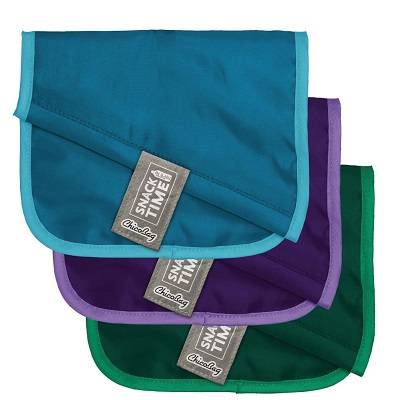
Pack tomorrow’s snacks in ChicoBag’s Snack Time rePete bag rather than a disposable plastic baggie. Composed primarily of recycled plastic bottles, this snack-time super hero offers a stain- and water-resistant liner and can be tossed in the washing machine after use.

Give your gift a festive finish with VZWraps reusable fabric gift bags. Sewn in Philadelphia, PA, these vibrant vessels eliminate the use of plastic ribbons, as well as throwaway paper. VZWraps come in a variety of patterns, from turquoise elephants to multi-colored aliens.
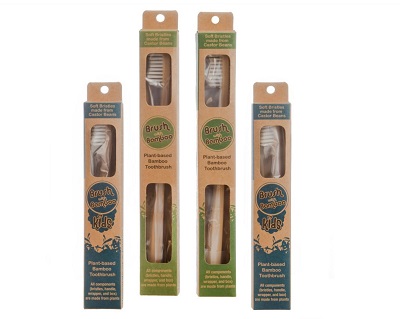
Plant-based from box to bristles, Brush with Bamboo offers its Adult and Kid’s Toothbrushes made from 100 percent organic bamboo. These eco-friendly brushes feature soft bristles and a pesticide-free bamboo handle.

Filled in a plastic-free “Eco Tube” and sealed with a matching “Eco Cap,” Organic Essence lip balm is all-natural and features compostable paper packaging. The shea butter-based moisturizer is available in six different flavors, including grapefruit and almond.
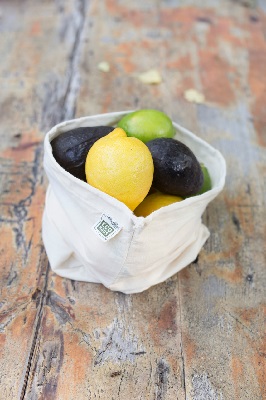
When stocking up on fresh fruits and vegetables during your next grocery run, bring along an ECOBAGS Organic Cloth Bulk and Produce Bag, so you are not left using the store-provided, flimsy plastic produce bags. This ECOBAG is made of 100 percent certified organic cotton and features a secure drawstring closure.
Jenna recommends:
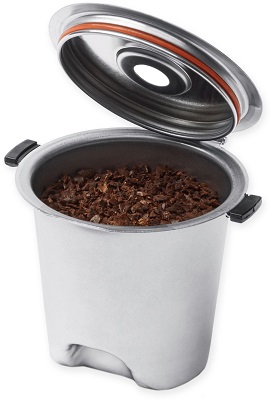
Keep your favorite single-serve morning coffee plastic-free and guilt-free by investing in a Stainless Steel Reusable Coffee Pod Fill Life Without Plastic’s pod with your favorite coffee, tea, or cocoa and pop it in your Keurig or other single-serving coffee maker.

Whether you’re going camping or just having lunch at the office, To-Go Ware’s Carry Around Bamboo Utensil Set is the perfect plastic-free utensil option. The set includes a pouch made of recycled bottles, which easily holds a fork, knife, spoon, and chopsticks and can conveniently be clipped to a lunch bag or purse.

Skip the single-use plastic bag at checkout when grocery or retail shopping. With Marketplace: Handwork of India’s fair trade and 100 percent cotton Umang Bag, you’re not only supporting the environment, but you’re also helping to provide dignified job training for women in India.

Klean Kanteen can help you combat your habit of picking up plastic straws with its 5-Piece Straw Set. Made with stainless steel and food-grade silicone, these straws are a perfect accessory to any reusable water bottle or coffee thermos we know you already have. Split this set with a friend, and pledge to go plastic-straw-free together!

Typical period care and packaging amounts to excessive single-use plastic waste. Stay comfortable but cut back on plastic by investing in one (or several) MAIA Bikini by LUNAPADS: leak-proof cotton underwear with additional organic cotton inserts to create customizable absorbency to fit your flow.
|
|
How to Recycle Your Christmas Tree |
Twinkling pine, spruce and fir trees bring holiday cheer to homes around the world. But with the end of festivities comes the not-so-jolly chore of disrobing and discarding these unwieldy house guests.
You don’t want your Christmas tree to end up in a landfill, where it will take forever to decompose. So what’s the most responsible way to get rid of a Christmas tree?
Usually, the best and easiest way is to follow your town’s instructions
Take a minute to search the internet for what your town recommends, or call your local trash haulers. Many communities will collect Christmas trees curbside for two or three weeks after the holidays.
Not only is this method most efficient (better to have a few garbage trucks driving around than a bunch of individual cars), but municipalities often use the trees for parks or habitat restoration, piling them into barriers against soil erosion or sinking them into ponds to provide habitat for fish. Some beachside towns use Christmas trees to rebuild sand dunes, a tactic that came in handy after Hurricane Sandy.
In New York City, the Department of Sanitation will collect your tree for mulching and “treecycling” from Jan. 2 through 12. Another option is to haul your tree to a MulchFest event, where you can watch it get chipped and bring home a bag of mulch.
Before you drag your shrub to the curb, make sure to strip the lights, ornaments and tinsel. If you wrap the tree in a plastic bag to get it out of the house, take the wrap off once it’s outside.
“If you leave anything on, the whole thing is garbage,” said Friday Apaliski, a sustainability coach based in San Francisco. Metal or plastic on trees can also damage choppers, and potentially harm people running that machinery, she added.
[Like the Science Times page on Facebook. | Sign up for the Science Times newsletter.]
If you have to dispose of your tree yourself
Try to find a friend with a wood chipper who can shred your tree for you. “It makes wonderful compost,” said Todd Larsen, executive co-director of Green America, an environmental nonprofit based in Washington D.C.
Alternatively, visit Earth911 and search your ZIP code for places that recycle Christmas trees. Many Home Depots, Boy Scout troops or local nonprofits will take Christmas trees at no cost.
Another good place to check is your local zoo or animal sanctuary, which might want trees for animal enrichment or food. One Michigan petting zoo, for instance, wants to turn your Christmas tree into a nutritious snack for its twin goats, Bubba and Gump.
If you’re feeling crafty, you can recycle parts of your tree to make wreaths, candles, coasters and fragrant sachets.
Finally, if you live in a rural area, you can simply put your tree out on your land and “return it to nature,” said Eric A. Goldstein, a lawyer for the Natural Resources Defense Council. Trees fall on their own all the time and become good habitat for birds, rodents and other wildlife.
What not to do
The big no-no is to chuck your tree in a bag and have it go to the landfill.
Landfills are packed so tightly that there’s no oxygen, which organic materials need to decompose, said Jessica Davis, the director of the IUPUI Office of Sustainability in Indianapolis. Also, the lack of oxygen means that when your Christmas tree finally does decompose, it will release methane, a far more potent greenhouse gas than carbon dioxide.
It’s not great to burn your tree either, Mr. Larsen said. Sap and dried needles tend to crackle, pop and explode when they burn. Moreover, fir, pine and spruce trees contain a highly flammable tar called creosote, which produces soot and can lead to chimney fires.
For next year
Many experts agree that buying a cut tree (particularly from a local, organic farm) and recycling it is better than using an artificial tree, which can’t be recycled at the end of its life. But even better than a cut tree is a live tree that can be replanted in your yard or donated to a nearby park. Some places even rent living trees that can be returned after Christmas.
|
|
Issue #113, Green American Magazine - Healthy Soil, Cool Climate (Winter 2018) |
|
|
National Green Pages - 2019 |
|
|
Looking for a socially conscious holiday gift? You may have to decide between principles and price. |
This Christmas, Mariah Byrne was set on buying a hammock for a college friend. Preferably, she’d find just the right one from an environmentally conscious outdoor retailer.
She checked REI. Too expensive. She looked at Patagonia. Also beyond her budget as a graduate student.
So resist as she might, Byrne, 26, settled for a much cheaper option on Amazon that also came with free shipping.
“That for me is the toughest part: balancing wanting to be socially-conscious with being realistic about my budget," Byrne said.
Byrne’s conundrum is one shared by shoppers wanting to support eco-friendly, social-justice oriented or politically-savvy brands without breaking the bank. Especially around the holidays, retailers make a point of promoting themselves as companies you can feel good about supporting. Maybe they’re sourcing products from recycled materials; maybe they’re donating a share of Black Friday sales to charity. Maybe they’re teaming up with nonprofits and taking a stance on a charged social issue.
It’s an appealing pitch, especially to shoppers who increasingly wish to support companies that share their ideals or values.
But practically speaking, higher-income shoppers are often the ones who can afford to weigh those options in the first place.
“The climate has caused people to want to care, and I think that has caused people to be more aware,” said Alexis Desalva, a retail expert at Mintel. But still, “the price is always going to be the motivating factor. I don’t think that’s going away.”
Among older shoppers, it may be an added perk if, for example, a holiday gift was cruelty-free or fair trade, said Steven Barr, consumer markets expert at PwC.
“For prior generations, it was more 'oh, well, it’s kind of a bonus to make me feel good about a purchase I was already going to make," Barr said. “Now it’s the primary driver.”
[How to get holiday shoppers into the mall — and keep them there]
That means retailers cannot win customers over with their products alone. They also must convince shoppers that by making a purchase, they’re supporting some greater good. Madewell, for example, encourages customers to “shop for a cause” through its “Do Well”campaign. Fifty percent of the retail price from “Do Well” products go to charities including Girls Inc. and the Human Rights Campaign.
To cut down on plastic waste, Everlane announced its ReNew collection just before the holidays. The outwear line is made of recycled plastic bottles and kicked off a company pledge for no new plastic in its supply chain by 2021.
And through its holiday Believe campaign, Macy’s aims to raise one million dollars for Make-A-Wish. For every shopper who writes a letter to Santa through the Macy’s website, the retailer will donate $1.
Then there are the companies whose entire platforms revolve around promoting a greener and socially just economy. The national nonprofit organization Green America, for example, curates lists of “Grinch Gifts to Avoid This Holiday," “11 Great Green Gifts Under $100,″ and children’s gifts from green, family-owned and fair-trade businesses.
“Every dollar you spend is a dollar voting for the kind of world you want to see,” said Eleanor Greene, editor for Green America.
[How Hanukkah gets lost in the holiday retail rush]
In St. Louis, Byrne scoured local bookstores in search of a copy of “It’s Kind of a Funny Story” for her brother. Out of luck, Byrne decided to buy him a print from one of her favorite artists, rather than order the book online. (Byrne’s dad, on the other hand, was more insistent about the exact gift he wanted: a sports water bottle from Target. He was unmoved by Byrne’s request to buy a different water bottle from a company with an ethically sourced supply chain.)
Celia Strainge is making a point of supporting local small businesses this Christmas. Strainge said she used to do most of her holiday shopping on Amazon but grew worried about reports surrounding company pay and worker treatment. (Amazon chief executive Jeffrey P. Bezos owns The Washington Post.)
For ideas, Strainge has been following the Instagram account of comedian Aisling Bea, who’s been posting her recommendations for socially conscious brands and holiday gifts. So far, the haul has included companies that sell second-hand clothes, a beer company that partners with charities to end food waste, and earrings made by women who survived sex trafficking.
|
|
Green America's Beth Porter on Getting Curious with Jonathan Van Ness: What’s Really Going on with Recycling, Hunny? |
Beth Porter is Green America’s Climate & Recycling Director, as well as the author of Reduce, Reuse, Reimagine: Sorting Out the Recycling System who joins Jonathan to talk all things recycling; what is is, how it works, if plastic straws are as dangerous we’ve been told, how oil prices effect recycled plastic demands, and more.
Listen to the Podcast here:https://player.fm/series/series-2323839/whats-really-going-on-with-recy…
Find Beth’s work at https://www.bethrecycles.com/
She’s on Twitter https://twitter.com/bethrecycles and Instagram at https://www.instagram.com/bethrecycles/
Buy her book Reduce, Reuse, Reimagine: Sorting Out the Recycling System here:
https://rowman.com/ISBN/9781538105399/Reduce-Reuse-Reimagine-Sorting-Ou…
Beth also heads up Green America's Climate and Recycling Program: https://www.greenamerica.org/climate
|
|
Getting Curious |
https://player.fm/series/series-2323839
A weekly exploration of all the things Jonathan Van Ness (Queer Eye, Gay of Thrones) is curious about. Come on a journey with Jonathan and experts in their respective fields as they get curious about anything and everything under the sun.
|
|
Tiny Garden Grows 300 Lbs of Produce Annually |
By Nicky Schauder of Permaculture Gardens, a member of our Green Business Network
My family and I have a Climate Victory Garden in the suburbs of Washington DC. I wanted to give you a tour of our tiny garden with the hopes it will inspire you. Permaculture designer Geoff Lawton is known for saying, “All problems can be solved in a garden.” The real problem of climate change is no exception.
Remember, you don't have to fulfill all the commitments to have a Climate Victory Garden but getting to all 10 is not as hard as you may think. Start with one and grow slowly but surely from there. We're a family of 8 living in what some consider a tiny townhome, and we grow over 300 pounds of produce each year. Here's how we try to live the Climate Victory Garden commitments:
1. Grow Edible Plants
We can all grow something, even during the cooler months. If you're going to grow a garden, you might as well get the most bang for your buck. Choose your plants wisely. Many people grow ornamental plants for their beauty. But selecting plants that are also edible allows us to capture carbon from the atmosphere and feed ourselves all in one go (not to mention, they're still beautiful). If your plant is also medicinal (i.e. herbs), then you have a 4th function to boot!
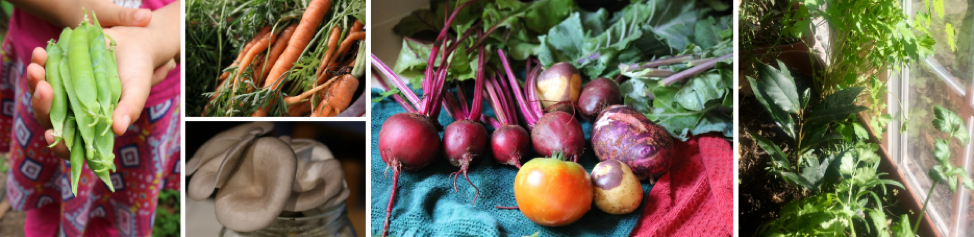
We grow food in our garden and home year-round. We grow over 300 pounds of produce per year in our townhome’s back and front yards (around 500 sq ft). In the spring and fall, we have cool weather crops like peas and carrots. We grow seasonal mushrooms both outdoors or indoors in logs, bags or mason jars. Summer harvests include beets and tomatoes, and in the winter we start seedlings and grow herbs and lettuce by the south-facing windows.
2. Keep Soils Covered
There are so many reasons to keep the soil covered. Here are some of them:
- We are trying to maximize our space and therefore maximize our yield, especially when growing in small spaces. No “plantable” space should be left uncovered.
- Nature will help you out. Go with her flow. When weeds come to cover those empty spaces you've left bare, don't take the weeds out unless you have a better idea of what should live there and are ready to plant it in the weed’s place.
- Covering the ground reverses soil erosion and depending on what you plant, may even build-up your soil fertility.
- Covering soil keeps moisture in. Even if some ground cover doesn't provide apparent edible benefits, it may be harboring beneficial animals as well as shading other plants from too much sun.
3. Encourage Biodiversity
Just as in a community of people, in our garden, even a tiny garden, diversity is the key to abundance. And by diversity, we mean we encourage the growth of all the 6 Kingdoms on the planet! We want a diversity of plants, animals, fungi, algae, archaea, and bacteria even if we are planting in a small space.

A monoculture (planting the same thing in rows) may give an appearance of neat and tidy-ness. But it is not a healthy one. If you must have rows of the same kinds of plants, consider planting what's known as a "polyculture" of alternating plants and planting diverse habitats around these production patches. From our experience, it is possible to design your gardens to be both beautiful and biodiverse at the same time.
4. Plant Perennials
Perennials provide stability to your garden. Less fussing with the soil, allowing plants to "take root" and establish themselves over time will lead to less work for you and the garden ecosystem. Perennials include powerhouse plants like trees, vines, and bushes. There is nothing like a tree to stabilize a garden. When you cut down a tree, you alter the weather. Trees are havens for biodiversity and great helpers in rain/water management. So, choose your trees wisely and remember that trees can outlive us!
In our backyard, we plant apples, pears, cherries, native trees called pawpaws, and figs. We even grow bananas indoors!
5. Ditch the Chemicals
When talking about balance and ecosystem health, permaculture designer Geoff Lawton says, "You don't have a mosquito problem. You have a lack of dragonfly (or bat or mosquito fish) problem." Your species and crops have to be in a balance that favors bountiful yields and keeps “pests” in check. That balance is not achieved when we use pesticides and unwittingly kill the good bugs (and plants, and ourselves) too!
We understand that everything affects everything else. So, we cannot in good conscience justify the use of chemical pesticides to wipe out a pesky population of mosquitoes (or rats or weeds) in our backyard. Instead, we have sought out natural alternatives that work in a holistic way. The balance in our yard is an ongoing process. But we have learned more and more every year how to slowly keep the "pest" population down and the favorable species population up! This takes more time than spraying chemicals, but it’s worth it!
As Ron Finley said, "If it's in the soil, it's in our food." We already know about all the evils of glyphosate. No thank you!
6. Compost
Our garden is a cyclical one. We try our best to have a zero-waste gardening process and teach others to do the same. Our main household aim is to eventually become a zero-waste household. I was shocked to learn that if global food waste were a country, “it would be the third largest carbon emitter in the world.” What an inspiration for composting. We use several methods:
- chop & drop - just prune or chop leaves and let them fall close to the plants.
- mulch with leaves - we use what we have or ask the neighbors if they want someone to rake their leaves for free!
- hot composting - we use an 18-day process called the Berkeley method.
- compost pile - when we are lazy we just let our compost heap rot and harvest the rich remains to feed our garden after 3 months.
- vermicomposting - we have worm pets that eat our kitchen scraps and turn them into "black gold" quality soil.
- Bokashi - we put all non-compostables such as meats, bones, and fish into an anaerobic air-tight bin filled with EM (effective micro-organisms) that ferment these foodstuffs so they can be safely added to the outdoor compost heap or directly into the soil.
7. Integrate Crops with Animals
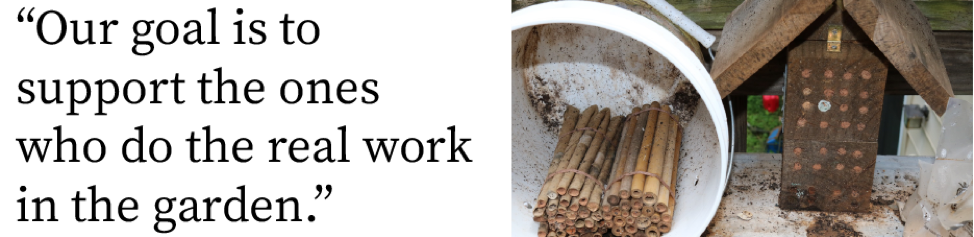
The backbone of every Climate Victory Garden should be a pollinator-friendly patch. Or better yet, several pollinator corridors sprinkled throughout your garden beds. Our goal is to support the ones who do the real work in the garden. Bees rely on plants and flowers for their homes and food and our crops rely on bees.
Integrating crops with animals has a lot to do with diversity and function. We want the garden to be an ecosystem, a web of functions and relationships. The more crops and animals, the more stable your garden will be. That means fewer diseases, fewer crop decimations, and more wildlife. A total win-win-win all around.
In our garden, we keep mason bees and have made a cute little bee lodge for these early spring pollinators. We plant native varieties of flowers and plants to support the native species of wildlife in our region. As we learn more and more about plants and animals, we begin to see that plants that we once thought of as "weeds" and animals that we once thought of as "pests" shoulder the burden of stabilizing our local ecosystems, our home gardens, and our nutrition.
We don't have chickens or other large animals (our HOA won't even allow us to grow crops in our front yard!), but we've asked neighboring friends with farms and stables for manure to add to our compost for a natural nutrient boost that makes this “waste” useful.
8. Use People Power, not Mechanization
There are so many benefits to getting "grounded." To us, low-tech people power means:
- less dependency on fossil fuels and therefore less carbon released into the air.
- a healthier, truly mobile, human body. Our bodies were made to move!
- a connection to the process of food production.
- no mechanized tilling to keep the soil biome alive.
When we teach students how to best water plants, we tell them what Brad Lancaster writes in his book Rainwater Harvesting for Drylands Vol 2: households that use automatic timers and other high tech approaches tend to use more water than those who water by hand. For example, households that water with a hand-held hose use 33% less water than those that do not. That's why we try to capture the water into our landscape passively instead of sourcing it from the grid and spraying it into the air.
9. Rotate Plants and Crops
We have written a whole boat-load about how we do crop-rotation in our garden. Basically, we try to keep renewing our soil's fertility with every action we take. How? By feeding it the way John Jeavon's teaches in his Grow Biointensive method: follow a “heavy-feeder” plant, with a “heavy-giver” plant.
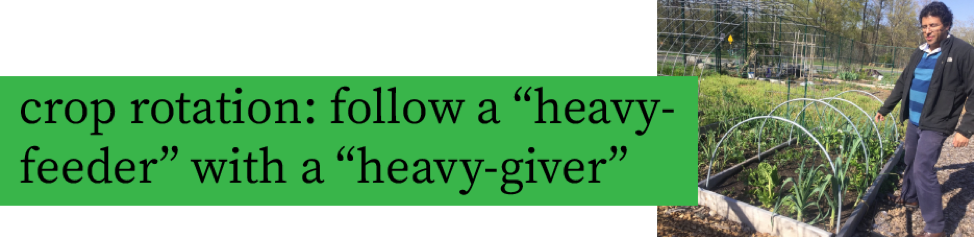
Tomatoes and most summer crops are heavy feeders. After the harvest, they can leave your soil depleted of trace nutrients and minerals. To help that cause, we plant nitrogen-fixing legumes in between large harvests. In fact, no garden bed is ever without a legume plant in our yard. It’s that important!
Rotating annual crops also helps confuse pests like squash beetles. We usually give the squashes a rest for two years before we try again for this reason. And, we try different bug-resistant squash and cucumber varieties to keep from crying after a bad year when all baby cucumbers have been lost to beetles!
10. Get To Know Your Tiny Garden
Finally, observe your yard. I cannot say enough about this. Don't just rely on garden manuals and Youtube videos. Find out what the weather is like by going outside and feeling it (in many areas of your garden). There is no replacement for your own personal observation. There are myriad ways to do this.
 Photo: Courtesy of botanical artist Lara Gastinger with permission Photo: Courtesy of botanical artist Lara Gastinger with permission
By getting to know your tiny garden, you will find out what gardening techniques work or not. Getting to know your garden is directly proportional to your gardening success. And by doing so, you will be able to better plan and prepare for an epic next year. In essence, observation and reflection is where the cycle of growing begins again.
Together all our gardens make a difference.
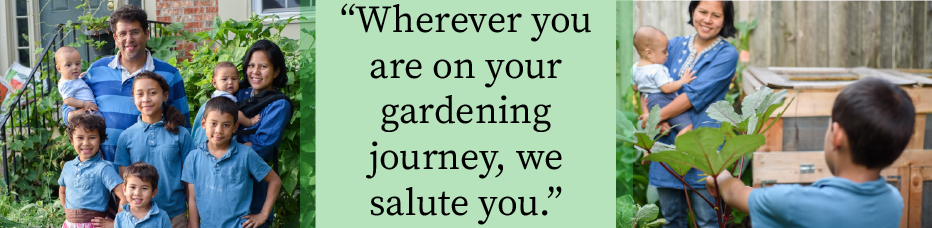
Our family of eight eating from our tiny townhouse garden is but one version of what a Climate Victory Garden could look like. Your garden may be on an apartment balcony or in a community garden plot. You may have been practicing these Climate Victory Garden commitments all your life. Or you may only be "Ditching the Chemicals."
Wherever you are on your gardening journey, we salute you. We celebrate you. And we encourage you on your way, at your own gardening pace.
Through our gardens, we are all connected in this environmental campaign. Each of our gardens, small or large, make more of a difference than we think. Together, they capture carbon in our soils and bring all of us closer to real global climate victory. With these Climate Victory Gardens, we all move the needle towards a greener, healthier, and happier life.
|
|
dollar for dollar popup |
|
|
Alchemy Distillery |
We start with 100% American made equipment.
Our goal has always been to purchase materials as locally as possible. If what we need isn’t available in Humboldt, we widen our search to all of California. If California cannot fulfill our needs we look throughout the West Coast, and then the Country as a whole.
This cuts down on fuel and transportation costs but also keeps our investment in our community, contributing to a stronger local economy.
100% of our grains are organically grown and sourced as locally as possible.
More details under the ingredients section below.
We have extremely high quality control due to my husband and i being the only employees. The two of us oversee every stage of production including; grain procurement, milling, fermenting, distilling, bottling and labeling.
|
|
Verizon Sets Major New Clean Energy Goal in Response to Pressure From More Than 30,000 Consumers |
WASHINGTON, D.C. – December 11, 2018 – After hearing from more than 30,000 consumers mobilized by Green America, telecommunications giant Verizon has quietly set a new goal to achieve 50 percent clean energy use by 2025. Now at 2 percent renewables, Verizon had previously indicated that it would only go to 4 percent in the foreseeable future.
Approximately 33,000 people mobilized by Green America have sent petitions urging Verizon to begin powering its networks and data centers with renewables. As participants in Green America’s Hang Up On Fossil Fuels Campaign, thousands of consumers also took direct action by contacting Verizon through social media and phone calls. Earlier this year, Verizon had the worst showing among major telecom companies in Green America’s industry report.
Green America estimates that, based on Verizon’s reported carbon emissions, this will result in a reduction of approximately 2.8 million tons of carbon dioxide, or the equivalent of taking nearly 600,000 cars off the road each year. That also equals the amount of carbon that 2.9 million acres of forest could sequester in a year.
Even though Verizon is moving in the right direction, there is still much more that can be done.
The Verizon announcement comes after T-Mobile's January 2018 commitment to reach 100 percent clean energy by 2021 (which will reduce over 1.2 million tons of CO2). Also earlier this year, AT&T announced its plan to purchase 830 MW of wind power, taking that telecommunications company up to 30 percent clean energy and cutting more than 2.6 million tons of CO2 emissions.
So far, Verizon has not announced any purchase agreements with wind or solar farms that will help the company meet its 2025 goal. Green America is asking all telecom companies to commit to 100 percent clean energy by 2025.
Green America Executive Co-Director for Consumer and Corporate Engagement Todd Larsen said: “Verizon management, shareholders and customers deserve credit for moving in the right direction on renewable energy. The company has gone from a meager commitment of 24 MW of new clean energy for its facilities to a commitment of hundreds of MW meeting 50 percent of its total energy usage. Consumers are still calling on Verizon to match T-Mobile and commit to 100 percent renewable energy in the near term and put purchasing agreements for wind and solar into place soon. Not only is this achievable, but it is essential for every corporation to take action to address climate change quickly to protect the planet.”
The telecom sector uses enormous amounts of energy. The four largest companies – AT&T, Verizon, Sprint and T-Mobile – collectively use more than 30 million MWh of electric power each year.
“Recent climate reports show that climate change is already impacting communities worldwide. We need bold action from all sectors to cut emissions,” said Beth Porter, climate & recycling director at Green America. “On top of reducing carbon emissions, T-Mobile said it will save $100 million from the shift to renewables. Moving to clean energy is the responsible choice and a sound business decision.”
ABOUT GREEN AMERICA
Green America is the nation’s leading green economy organization. Founded in 1982, Green America provides the economic strategies, organizing power and practical tools for businesses and individuals to solve today’s social and environmental problems. http://www.GreenAmerica.org
MEDIA CONTACT: Max Karlin for Green America, (703) 276-3255, or mkarlin@hastingsgroup.com.
|
|
Germinate |
We work on websites that sell sustainable products, so far this has been in the arena of Fair Trade. I have been involved with Fair Trade for almost 20 years , being the Chair of the Fair Trade Federation for 4 years around 2010. I have a deep interest in advancing the business objectives and success of companies who are doing good in a sustainable way. As a digital online company that does not sell any physical product our environmental footprint is small. We are a paperless business.
|
|
Financial Statements and Auditor Report, Year-ending March 31, 2018 |
|
|
Verizon Commits to 50% Clean Energy by 2025 |
Verizon’s commitment to 50% clean energy by 2025 means a reduction of 2.8 million tons of carbon dioxide, or the equivalent of taking nearly 600,000 cars off the road each year. This is also the equivalent of what 2.9 million acres of forest could sequester in a year.
This comes after T-Mobile's January commitment to reach 100% clean energy by 2021 (which will reduce over 1.2 tons of CO2). Also earlier this year, AT&T’s announced its acquisition of 830 MW of wind power, taking AT&T up to 30% clean energy and cutting more than 2.6 million tons of CO2 emissions.
This progress is thanks to Green Americans taking action with our campaign to Hang Up on Fossil Fuels, signing petitions urging Verizon to begin powering its networks and data centers with renewables and directly contacting the company through social media and phone calls.
|
|
Rbc Wealth Management |
Jeff's mission is to help clients feel competent and effective about the way they are managing their household finances. We live in distressing times, and he helps fellow human beings reduce financial anxiety, feel empowered, and remain connected to abundance and gratitude. Through clearly articulated strategies and analysis of global events, along with the development of a personal financial profile, Jeff works to make every conversation educational.
His vision is that the growing power of activist investors will bring a degree of economic democracy to the capital markets.
|
|
WCP Popup 2 |
|
|
WCP Mobile Pop |
|
|
Eating in a Warming World |
For years, scientists have tested how carbon dioxide (CO2) levels affect crops, including whether CO2 affects how fast and tall plants grow, and what the nutritional value is of the harvested crops under study.
It’s not hard to imagine that a warming climate will affect the food supply. Hotter weather and more humidity means more insects. Changing rain patterns mean more droughts, fires, and floods. More frequent and more intense storms will undoubtedly have effects on growing crops and raising livestock. But rising temperatures will also affect the food itself, causing staple crops like rice, wheat, corn, and soy to lose nutritional value because of increased levels of carbon dioxide in the atmosphere.
While a drop in food nutrition may be scary, it’s not a change that is set in stone. Regenerative agriculture provides interconnected solutions: restored soils grow healthier plants while also drawing down carbon in the atmosphere. Drawing down carbon prevents dangerous warming and reduces risks to crops—both from extreme weather and reduced nutrition.
The Science Behind It
One of the first things we learn in biology class is that people breathe in oxygen and breathe out CO2, but plants “inhale” CO2 and “exhale” oxygen during photosynthesis. While an increasing amount of CO2 is bad for many natural processes and for people, it’s actually good for crops—to a limit, of course.
This year, scientists conducting a multi-year study of the impact of a warming climate on 18 rice varieties in Japan and China published their findings in Science Advances. They observed averages of a ten percent drop in protein, eight percent in iron, and five percent in zinc, which they also discovered correlates with an accompanying rise in CO2 levels. Several B vitamins also fell between 13 and 30 percent.
“Overall, these results indicate that the role of rising CO2 on reducing rice quality may represent a fundamental, but underappreciated, human health effect associated with anthropogenic climate change,” the scientists write.
On another note, a 2016 study from NASA’s Goddard Institute for Space Studies showed that staple crops soy, wheat, corn, and rice, grew better at higher temperatures when the CO2 levels in the air were also higher. When the temperatures increased and CO2 stayed the same, crops grew less well.
Delphine Deryng, the lead author on the NASA study, also confirmed that nitrogen, a main ingredient in synthetic fertilizer used widely on conventionally grown fields worldwide, is itself a major source of greenhouse gas emissions. But, she says, there is no simple solution regarding nitrogen, because it is an essential element for plant growth.
That leaves scientists and farmers stuck between a rock and a hard place, wondering: Can plants be grown on a large scale without vast use of synthetic fertilizer, and can we afford to risk the Earth as we continue to use it?
“The biggest question is how can we sustain and ensure the soil is still nutrient-rich to produce the crops that we need while reducing emissions,” Deryng says. She explains that regenerative agriculture practices like cover cropping and crop rotation can mitigate farmers’ reliance on high-emissions fertilizers.
“There are soil-management practices that can compensate for the use of fertilizer, by sequestering carbon from the atmosphere to the soil, using management practices like mixed cropping systems where you mix crops with legumes that can use nitrous oxide to fertilize the soil. [Regenerative agriculture] is a practice that offers win-win solutions,” she says.
Who Will Be Affected
For those who eat a diverse diet, whether omnivorous or vegetarian, food losing its nutritional value isn’t that concerning. Less protein in rice means you can just eat more protein from other sources. But this becomes an environmental justice issue when you consider the two billion people on Earth who rely on rice as their primary food source, and one billion people who are considered food insecure. Not all people who rely on rice are also food insecure, but staple goods like rice make up a large part of the diet of folks who are regularly hungry.
Deryng explains that those who are already likely to go hungry will be the most affected, while folks who currently have money and access to healthy foods may just rely on vitamin supplements.
“In developing countries, there’s clearly a need to get enough food on the plate,” she says. “The question is how to ensure people have enough food that is nutritious.”
Eating in a Warming World
To feed the 9.8 billion people on Earth in 2050, the world must increase food production by 70 percent from 2005 levels, according to the United Nations Food and Agriculture Organization. But as food production is rising, so are global temperatures, by 0.13 °C per decade since 1950, now at 0.2°C per decade.
A 2016 study from the European Geosciences Union shows that if average temperatures rise by 1.5˚C over pre-
industrial levels, corn, wheat, and other crops will be much less affected than if the Earth gets 2˚C warmer. The Paris Agreement of 2016 states that countries should aim for emissions low enough so global temperatures only rise to 1.5 C.
“The main difference between a 1.5 and 2 degree rise is extreme rainfalls, which will particularly affect regions that are already at the limit of extreme,” Deryng says. “For regions in the tropics that already have a high-temperature climate, they would step into higher levels, which would be fatal to crops, and we see more extreme precipitation patterns and heavy rain that can affect agriculture.”
Some scientists are looking to genetic engineering of crops to solve this problem. Make plants hardier in the face of drought, heat, and CO2, and there will be enough for folks to simply eat ten percent more rice. But we know that’s not the solution, because genetic engineering generally requires increased applications of pesticides and herbicides, eventually resulting in dead soils that won’t be able to grow much of anything.
By looking to regenerative methods to restore soil health and make farming as chemical-free and low-emission as possible, we will be saving lives in the process.
|
|
Farms That Harvest the Sun—Twice |
In a greenhouse in Santa Cruz, CA, tomatoes are bright red, lemons look a little orange, and green basil has a definite pink glow. This isn’t a genetic modification project, but it is a science experiment. These plants are growing in the tinted light of a greenhouse made of magenta solar panels. The techniques the gardeners use to grow their produce also help regenerate the soil beneath.
This structure is just one example of dual-use farming, a growing practice of incorporating solar-energy collection and regenerative farming or gardening in the same places. This practice will combat climate change on multiple fronts: water, soil, and energy, allowing the same patch of land to provide clean energy and more food to feed a growing population, while the healthier soil is able to hold more water and sequester more carbon than chemically farmed soil.
Solar Above, Soil Below
In Bluffton, GA, Will Harris has been regeneratively farming his White Oak Pastures ranch since 1995 (see p. 16). He’s one of the farmers who has been teaching others how to achieve his success with regenerative agriculture through our Carbon Farming Network, part of Green America’s Center for Sustainability Solutions. And, he’s currently in talks to be a land manager for Silicon Ranch, a solar company that just bought up 2,000 acres of land abutting his 3,200-acre farm.
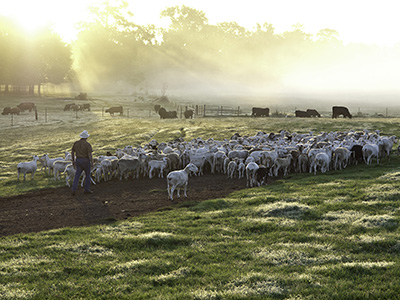
Will Harris with some of his animals in a pasture at White Oak Pastures in Bluffton, GA. Photo by Angie Mosier.
Through the arrangement, Silicon Ranch will pay Harris to manage the land under and around their solar panels (about 800 acres under, and 1,200 around) using his regenerative practices, which include laying down compost; planting diverse species like legumes and grasses; and grazing his animals: cows, goats, sheep, chickens, turkeys, pigs, ducks, guinea fowls, and rabbits.
Solar companies typically tear up and level the ground underneath arrays in the process of installing solar panels, and once they’ve finished construction, they limit vegetation because they don’t want their panels to be shaded by overgrown grass or trees. Normally, solar farms use chemical pesticides to keep the weeds underneath their panels in check, and they hire landscapers to keep vegetation short.
“The engineering feat of building mechanical panels that will harvest the energy of the sun and send it down a wire to your home is just an act of brilliance by engineers,” Harris says. “But those people cannot be expected to know about the balance and biological science that occur in a well-managed ecosystem. For a [solar engineer], it’s all about building from the ground up with no consideration from the ground down.”
But with Harris’s help, Silicon Ranch’s array in Bluffton will be pesticide-free, and the land underneath the company’s equipment will be put to good use growing food, rather than just sitting fallow. Harris sees collaboration between farmers and solar utilities as a natural partnership that will benefit people, the land, and ecosystems.
When asked what benefit he’ll see with this collaboration, Harris responds that he simply wants to grow the regenerative ecosystem in his region. He explains that his is one of 20 holistically-managed farms certified by The Savory Institute, an organization that works with farms to make the change to regenerative agriculture and then uses those farms as working classrooms for teaching others. He prides himself on making healthier land, raising animals in a way that mimics how they would be in nature, and teaching people about regenerative agriculture.
Harris’s plan is to regenerate the soil under and around Silicon Ranch’s solar panels enough to one day use the space to grow certified organic crops. Since the land where the array will be hasn’t been managed regeneratively before, the White Oaks Pasture team’s first step will be laying down compost and planting a mix of grasses, legumes, and pollinators, which will begin to draw down carbon and attract microorganisms. Once those plants get going, the land can be used for grazing animals. The animals’ droppings will also help the land be restored. Eventually, it will be suitable for growing certified organic vegetables.
“In a healthy ecosystem, you have many cycles going on at one time: carbon cycle, water cycle, energy cycle, mineral cycle, microbial cycles,” Harris explains. “Under a normal solar-voltaic array, those cycles would be broken—the effort is to limit the vegetation; no care has been given to keep the cycles cycling. When the cycles are operating properly, they pull carbon and other greenhouse gases into the soil through photosynthesis, and it’s sequestered there.”
Silicon Ranch and White Oak Pasture’s dual-use space is projected to be online in the next several years.
Growing in Magenta Light
In the magenta greenhouse on campus at University of California–Santa Cruz (UCSC), professor and plant physiologist Michael Loik and his lab is running tests to see just how well hothouse plants can grow under solar panels. The lab workers use regenerative growing techniques.
Loik got started on his project after his colleagues Sue Carter and Glenn Alers developed the magenta solar panels. Unlike conventional panels, these Wavelength-Selective Photovoltaic (WSPV) systems let sunlight on certain parts of the visible light spectrum pass through, while collecting green- and blue-colored wavelengths to generate energy. The pair asked Loik to test the impact of growing plants under the WSPV systems.
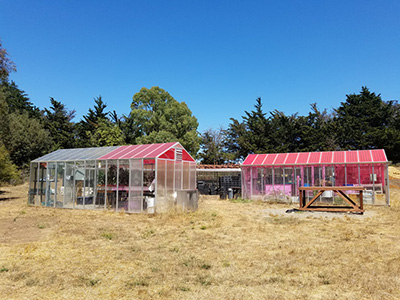
The pink glass of the greenhouses at the University of California–Santa Cruz allow sunlight in and perform double duty as energy-generating solar panels. Photo courtesy of Michael Loik.
Greenhouses currently cover 9 million acres on Earth, which means the WSPV technology could mitigate reliance on dirty energy to power the agriculture industry. If the world doesn’t work quickly to restore soils, desertification and degradation may make less land available in the future for agricultural purposes, which may mean an increased reliance on greenhouse-grown foods.
What the lab found was that its 20 varieties of tomatoes, along with cucumbers, lemons, limes, peppers, strawberries, and basil, thrived (and without pesticides) under the pink roof panels. The plants all grew just as quickly and well in this less bright, cooler setting, and tomatoes ended up using five percent less water than they would in a typical clear greenhouse. Because of the relative shade of the greenhouse, water stays in the soil longer before evaporating, which accounts for that change.
But dual-use farming doesn’t always look like growing plants in a magenta greenhouse. In fact, it rarely looks like that. More often, it looks like the setup that Greg Barron-Gafford works on at University of Arizona in Tuscon, and at Biosphere 2 in Oracle, AZ.
Farming Under Solar Panels
A 2016 study from University of Maryland and University of Arizona shows that large solar farms tend to store heat, both in the panels themselves and by trapping hot air under them. Arizonans, Barron-Gafford found, were particularly concerned about how solar farms might heat up their already sweltering communities. He explained that land being sited for new solar arrays was often in historically agricultural communities, and families were hesitant to let the industry in if it meant abandoning their farming heritage and heating up their region.
Those ideas inspired a project at the University of Arizona called “agri-voltaics,” a term that combines the words agriculture and photovoltaics.
“We wondered if you could co-locate agricultural production and solar installations. Could you allow for this green energy source, but allow for the agricultural lifestyle to stay within the community?” Barron-Gafford says.
To find answers to these questions, Ph.D. students, undergrads, and professors got to work planting on 60-foot by 30-foot plots (about the size of a community garden), which they’d located both under solar arrays and in regular sunny conditions. It was important that they set up the voltaics to a height where tractors could drive underneath, making the plots below usable on a large scale, so the panels are set up 15 feet off the ground.
He goes on to explain that on the plots they test, they use several regenerative farming techniques: people power, compost, no chemical inputs, and a diversity of plants species to grow an understory that attracts pollinators and deters herbivores.
“Beyond making more use of our lands, reducing irrigation use due to lower evaporation rates [thanks to the shade the panels provide], and boosting renewable energy production, our dual-use or ‘solar sharing’ approach speaks to multiple core principles of regenerative farming.”
The Results
The garden plots in Arizona grow ingredients for salsa—tomatoes, peppers, cilantro, and onions. Like Loik’s lab, Barron-Gafford kept looking for the downsides to the project but found none.
He found that when vegetation was present under solar panels, the warming effect Arizonans were so worried about disappeared. With a garden below, conditions under the panels are much cooler, partially because of the shade, and partially because of the way plants “sweat” and create moisture in the process of transpiration. The cooler temperature under the panels causes evaporation to slow by about 50 percent, which means the team can water the plants every other day instead of once a day, as they’d have to do in the sun.
Barron-Gafford’s lab’s preliminary research shows the significant cooling benefits workers (or livestock, should they be present) as well, as tests have recorded skin temperatures up to 20°F cooler under the array. In addition, though the panels cut back the gardens’ sunlight exposure by half, doing so has only cut the plants’ maximum potential by ten percent.
And like the work on Harris’s farm, planting crops underneath these solar panels gives life in a place that would typically have none, especially in the region Barron-Gafford is working in, where people are having to choose between holding onto less productive agricultural land and a steady income from a solar utility that might be interested. Like Harris, they can have both.
Solar Symbiosis
These instances of dual-use, regenerative spaces do not stand alone. At research universities from Minnesota to Massachusetts, California to Germany, studies are showing that not only does solar energy not hinder plants, but the two can often have a symbiotic relationship. Studies are also being done with livestock, testing how sheep and chickens can coexist with renewable-energy generation, and holistic farmers like Will Harris are putting those ideas into practice.
“Every little wedge we can put into societies’ use of energy that reduces how much we rely on burning coal or oil to generate electricity, then all the better,” Loik says. “Some of the work that we’re doing is developing these wedges—little technological things to reduce our greenhouses gases.”
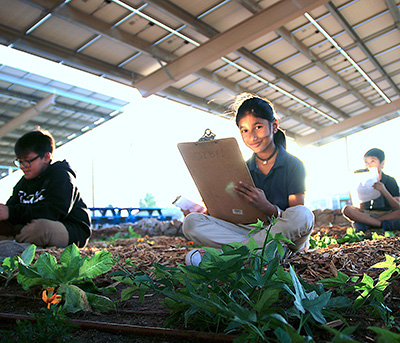
Students from Manzo Elementary School in Tucson, AZ, study regenerative gardens planted underneath solar panels—a University of Arizona experiment in dual-use farming. Photo by Moses Thompson.
The University of Arizona has replicated the agri-voltatics project at two local elementary schools, where kids are involved in planting, collecting data about the growing plants, harvesting, and selling their goods at a bi-weekly farmer’s market to benefit the gardening program. Barron-Gafford said last season, the kids harvested so much basil that they worked with the school’s kitchen to make and sell seven gallons of pesto that was “solar-shaded and kid-powered.”
“Part of what makes it fun for me is not only making new discoveries but working with kids who are so excitable and interested,” he says. “They understand what kind of future they’re going into. They hear about climate change and drought enough living around here. They see this as playing their part to fix it.”
|
|
Real Gardeners, Real Climate Action |
Even if you’re not a farmer or a corporate CEO, you can take part in the effort to regenerate our soil and reverse climate change. All you have to do is garden.
Americans planted Victory Gardens during WWI and WWII to feed their communities and families at home, as part of supporting the war effort. (That way, more food from farms went overseas to feed soldiers.) By 1944, nearly 20 million Victory Gardens produced nearly 8 million tons of food.
Green America is asking Americans to garden for the common good once more. By planting what we call a Climate Victory Garden, all of us have the opportunity to use our gardens to fight global warming.
To grow a Climate Victory Garden, all you have to do is shift to regenerative gardening practices. You’ll regenerate the soil in your corner of the country, allowing it to sequester more carbon.
Use the techniques listed below to grow a Climate Victory Garden during your next growing season. (Note: You don’t have to use all of the techniques. Even using some of them will help regenerate your soil and fight the climate crisis.)
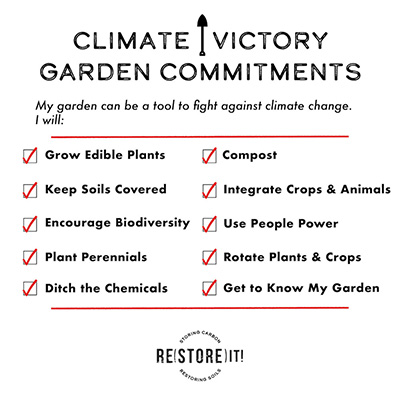
Jes Walton, Green America’s food campaigns manager, is an avid gardener-turned-Climate Victory Gardener. “Climate Victory Gardens gives individuals a chance to engage with regenerative agriculture in their own backyards,” she says. “They represent a very real, tangible action that anyone can do to support and take part in the fight against climate change. And that’s just the beginning. Gardening gets people outdoors, engaging with their natural surroundings, creating community, and eating fresh foods. It’s a win all around.”
Learn more about the Climate Victory Gardens program, learn regenerative gardening tips, and have the opportunity to add your garden to our Climate Victory Garden Map.
If you're a climate victory gardener looking for a community, you can request to join our Facebook group of Climate Victory Gardeners, and join the folks you see below!
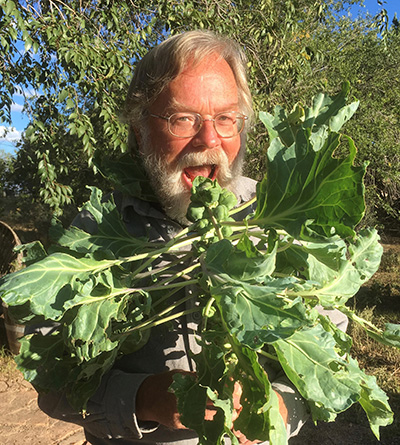
Tom Brodersen, a Climate Victory Gardener from Prescott, AZ, encourages other gardeners to grow edible plants. “Eat your vegetables! Save the world!” he says.
Integrate Crops and Animals: Jes Walton, Green America’s food campaigns manager, allows her chickens to roam about her yard and garden. Their manure naturally fertilizes the soil and feeds the microorganisms that sequester climate-warming carbon.
Jes wants people to know that even if you don’t have chickens, you can still climate garden.“This year, we had 1,000 Climate Victory Garden join our movement,” she says. “Of those gardens, 215 of them were brand new gardens, which gives us so much hope for the future of climate change mitigation through regenerative gardening. Currently, these gardens cover over five million square feet or around 90 football fields.”
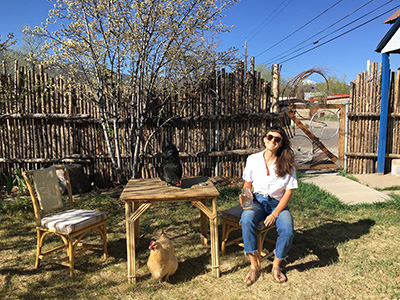
Jes and her backyard chickens.
Encourage Biodiversity: This summer, Cynthia Schaefer completed a 30-day Eat Your Yard Challenge, where she only ate what she grew in her Davie, FL, garden. Cynthia is committed to organic gardening with a wide range of edible plant types. She says, “I’ve found that if you feed the soil and cultivate biodiversity, the system will find solutions. It’s my lazy way of gardening....”
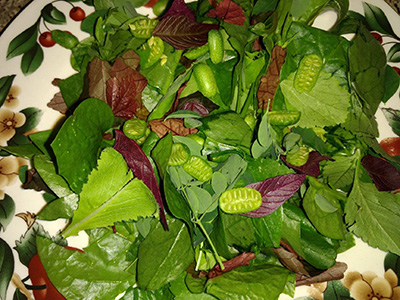
Photo by Cynthia Shaefer of her garden salad
Grow Edible Plants: John and Holly Trimble ripped out their front lawn in northern Utah and replaced it with raised garden beds, on which they grow organic produce.
“We have transformed our own landscape into climate victory gardens we also call ‘foodscapes,’” says John. “ We also started a small volunteer group, Foodscaping Utah, that helps people near us foodscape their front yards. ... We believe people would love to grow some of their own food if they had some help getting started. Homegrown fruits and vegetables taste amazing, are incredibly nutritious, and bring beauty to our surroundings.”

Holly and John of Foodscaping Utah.
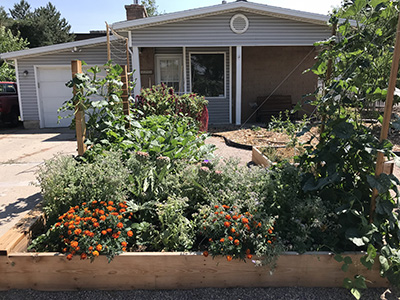
John and Holly's front yard climate victory garden.
|
|
WCP 2018 Popup |
|
|
Turning “Food Prisons” into Gardens |
Ron Finley is an urban gardener and fashion designer using regenerative agriculture to increase access to healthy food and bring neighbors together in his South-Central Los Angeles community. He has traveled to Denmark, England, Greece, New Zealand, and Brazil; spoken at conferences including the American Public Gardens Association; and delivered a 2013 TED Talk that garnered 3 million views on the platform website to date—all to share the story of how starting his own urban garden planted a transformative seed in his South-Central Los Angeles neighborhood.
Recently, he starred with actress Rosario Dawson in a short video for Green America’s Climate Victory Garden effort. Produces with our ally Kiss the Ground, the video touts the benefits of starting a regenerative garden.
Regenerative community gardens, he says, can provide fresh food for communities where there’s a dearth of healthy food stores. They can bring community members together to work toward a common purpose. And they can also help cool the climate and ensure your local soil is fertile enough to feed future generations.
Community gardens, he says, are “about sharing and realizing that there’s enough for everybody. This is about feeding communities, cities, and each other and realizing there’s so much we can do collectively.”
"Gangsta Gardening”
In 2010, long before he was the quintessential “Gangsta Gardener,” as he calls himself, Finley was just trying to maintain his yard while regrouping from the Great Recession of ’08 and ’09.
Tired of traveling 40 minutes outside his South-Central neighborhood to get fresh produce, Finley decided to plant on his own land. After taking a University of California Cooperative Extension gardening class at L.A.’s Natural History Museum, Finley began gardening on his parkway—a 10-foot by 150-foot-long strip of land between the sidewalk in front of his home and the street that most passersby didn’t pay much attention to.
When his swaths of celery, tomatoes, broccoli, peppers, melons, and eggplants sprouted, Finley’s neighbors took delight—and the Los Angeles Bureau of Street Services took action.
While Los Angeles residents have the responsibility of maintaining their parkways along with their yards, the City of Los Angeles owns them, and Finley’s food forest was a bit taller than the city’s 36-inch height limit for parkway plantings. So, an enforcement officer told him he would have to cut the excess vegetation or get a $400 food-planting permit.
Back in 2003, before Finley had ever envisioned an urban gardening movement, he’d planted banana trees on that same strip. A neighbor had reported him to the city, and he’d been forced to remove the banana trees. When asked why he decided to plant on the parkway again in 2010, given the ordeal he went through in 2003, Finley said, “because it was still right.”
This ordinance is why Finley calls L.A. and other cities “food prisons,” as he does in the 2015 documentary Can You Dig This: “You can grow things in a desert. In a prison, you need permission to do everything. That’s why growing food in the city is so defiant, because you’re disrupting a system in place.”
In round two of his battle against the City of Los Angeles, Finley decided not to cut down the food forest, and he solicited the support of 900 petition signatories to fight L.A.’s parkway ordinance. Finley found allies in Steve Lopez, a Los Angeles Times writer who documented these events in his regular column, and Councilman Herb Wesson, who argued alongside Finley that South-Central L.A. is vegetable-poor and that Finley’s garden brought much-needed access.
Though it took Finley an arrest warrant, two court dates, and a public hearing, all over the span of two-and-a-half years, the city overturned the ordinance in 2015, officially allowing L.A. residents to garden on their parkways.
Since then, Los Angeles has developed plans to grow more urban farms and marketplaces to increase food access, which is exciting, but the question remains: Why is it still so difficult to get fresh, organic produce in South-Central Los Angeles anyway?
A Paradise within a Desert
South-Central Los Angeles is a food desert: a geographic location where access to healthy food options are extremely limited or nonexistent. There are currently 23.5 million people living in food deserts in the US. And cities with high African American and Latin American populations, including Atlanta, Chicago, Detroit, New Orleans, and New York City, regularly top the list of those hit hardest by food scarcity.
South-Central L.A. has higher obesity rates than more affluent neighboring communities like Beverly Hills, Glendale, and Pasadena, which are only a few miles to its north, according to a 2011 study conducted by the Los Angeles County Department of Public Health.
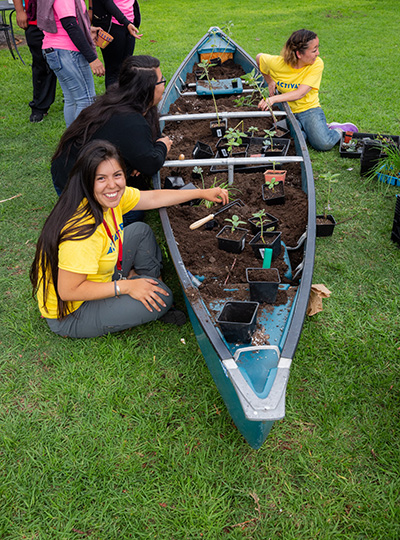
L.A. residents get their hands dirty at DaFunction, a community event held by the Ron Finley Project to celebrate urban gardening. Photo by Jim Newberry.
There may not be a definitive answer for the stark difference in food access between South-Central L.A. and its neighbors, but studies like one conducted by the Associated Press found that out of 2,434 US grocery stores that opened between 2011 and 2015, only 250 of those stores opened in food deserts. So South-Central L.A., like other cities across the country, has likely been overlooked by supermarket developers that anticipate lackluster profits from low-income communities.
What isn’t hard to find in South L.A. is a surplus of fast food restaurants, liquor stores, and vacant lots, which Finley says are part of a larger design he talks about often. His work, he says, aims to give people the tools to turn food deserts into good food oases.
“This work isn’t just about the garden or food; it’s about freedom, and beyond that, it’s about people,” he says. “I want to show people how to be free from the designed paradigm in which they think this is the only way they can live.”
Following his success overturning the gardening ordinance, Finley turned to his life’s work: teaching people organic urban-gardening basics to create a source of fresh food for their community. In 2012, he launched the Ron Finley Project—a nonprofit combining education, business, and community bonding to nurture the people of South L.A. through regenerative, organic urban gardens.
Regenerating South-Central L.A.
“HQ,” short for the headquarters of the operation, is also the Ron Finley Project’s flagship garden, which is located on Exposition Boulevard and is adjacent to Finley’s own home. Taking up about 150 feet, HQ is lush with numerous fruits, veggies, and herbs including, lettuce, broccoli, eggplants, potatoes, collard greens, tomatoes, pears, bananas, basil, sage, and mustard, to name a few. Ten-foot tall sunflowers and graffiti murals collaborate in creating a soulful neighborhood paradise.
At HQ, Finley and the Ron Finley Project staff lead gardening classes for the adults and kids he’s recruited from the neighborhood.
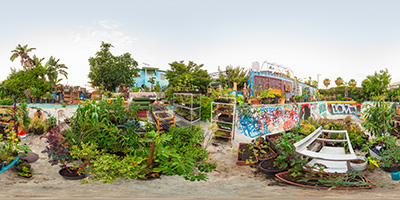
A panoramic view of the Ron Finley Project headquarters. Photo by Jim Newberry.
In addition to regenerating the area, Finley and HQ’s gardeners are also regenerating the soil. In his gardening practice, Finley abstains from pesticides and fungicides, and keeps soil covered with plants, which helps improve water infiltration. He also embraces hügelkultur-styled raised soil beds, in which mounds of logs, branches, and compost are topped with soil. As the wooden materials decay, they provide nutrients to that soil and greater aeration over time.
Finley says he’s grateful to participate in a larger ecosystem as a gardener and has witnessed bees, butterflies, and hummingbirds return to his neighborhood. Though regenerative agriculture may be a fairly new term, Finley says he’s been doing it all along but calling it “biomimicry.”
“The forest does regenerative agriculture by itself. So what I’ve done is replicate the forest by doing biomimicry,” says Finley, meaning that he tries to mimic natural growing cycles in his gardens. For Finley, regenerative gardening starts and ends at the soil. For example, he’s devoted to composting—the process of taking plant material like trimmings, grass, old plants, twigs, leaves, and food scraps and allowing them to decompose.
“One of the things I learned gardening and working with compost is that we’re carbon, and we’re part of the soil,” he continues. “If you look at compost, a collection of things that were supposedly dead, and then see the heat produced from it, it makes you question where the heat comes from. It shows that we’re energy, and energy never dies; it just transforms, and gardening makes you understand that.”
Paying It Forward
Finley says he has no idea how many gardens he’s helped plant, and though it would be nice to know, he isn’t concerned with numbers. What he says is most rewarding is seeing how far his message has traveled and inspired people around the world.
“It’s crazy how many people have gotten into [urban gardening] after saying they’ve heard me speak,” says Finley. “I was in New Zealand recently, and Maori elders told me they’ve been following my work for years, and I was like damn. I get to see the fruit of the seed I planted in real time, and I’m honored by that. I don’t have the words to express how that makes me feel.”
Currently, Finley has plans to bring the ultimate garden experience to life by finding a larger location where he can include not just the garden but a café, a greenhouse, and a food stand where people will be able to trade their extra produce. The Huffington Post originally reported on Finley’s plan to build a garden behind one of L.A.’s Carnegie Libraries in 2014, but he says government bureaucracy is halting the process, so he’s exploring private funding options.
And he continues to encourage people across the US to embrace regenerative “biomimicry” techniques in their gardens.
“We have communities nationwide that are food prisons that could be producing their own organic food while addressing climate change,” said Finley in the video. “By educating the public about regeneratively homegrown food, Climate Victory Gardens are raising awareness about one of the biggest global challenges of our time and showing Americans how they can make a difference for themselves, their households, and their communities. Soil equals life.”
|
|
From Slash and Burn to Regeneration in Ghana |
Dr. Kofi Boa, 63, lives in the town of Toase in Ghana, a country on West Africa’s Gulf of Guinea. When he was a kid, his mother’s cocoa farm burned to the ground because of a poorly managed slash-and-burn on neighboring land. From then on, Boa was interested in fighting the slash-and-burn tactics that many farmers in the region used, and in finding practices that worked better for the long-term health of farms in the community. When he grew up, he studied agronomy at the University of Nebraska, then took his education home, where he started the Centre for No-Till Agriculture (CNTA). Dr. Boa is also a member of the Soil Committee, overseeing the design of our Soil Carbon Initiative standard, a joint project of Green America and The Carbon Underground.
The CNTA was created with support from the Howard G. Buffett Foundation and is supported in its work in the Foase area of Ghana’s Atwima Kwanwoma district by Grow Ahead, a nonprofit and Green America ally that helps bridge the financing gap for small-scale family farmers worldwide as they address the challenge of climate change in their communities. Grow Ahead’s fundraising and revolving loan programs are especially critical for farmer organizations in the developing world, which historically have had limited access to capital for growing their organizations beyond their day-to-day needs.
Here’s Dr. Boa’s story, in his own words, with thanks to Alex Groome at Grow Ahead.
Green American: How did you become interested in farming?
Dr. Kofi Boa: My parents were farmers, and when I was a young child at age six, they had to take me to the farm on weekends and school holidays. Just like all the children in the village, I only knew the school and the farm. I liked the farm because there was always so much to eat and a lot of space to play. This got me interested in farming, and I wished every day was a weekend or holiday.
Today, I am a farmer and educator. I grow a wide variety of food and cash crops, including trees, vegetables, grains, and cover crops. I grow more than ten different crops on six different farms (a total of 25 acres) scattered around my village.
Green American: When did you learn about the importance of soil health and begin farming regeneratively?
Dr. Kofi Boa: My father died when I was ten years old. When I was 12, my mother’s cocoa farm—our family’s main source of income—was burned by a neighboring farmer who had set fire to his field to prepare for planting corn. From that day on, I pledged to fight slash and burn, a method used by farmers to prepare their fields for planting, which gives crops an initial nutrient boost but kills the soil life necessary for sustained, healthy farmlands.
I spoke to elders in the village when I was 12 and learned that, rather than use fire, they used to cut vegetation, leave it on the ground for a year, and then come back to plant crops—especially cocoa—when it had decomposed. This technique was called proka in the local Akan language. I started practicing proka at that age and have adapted it by planting in the mulch immediately after slashing, without the one-year waiting period (which was to allow enough time for the cut vegetation to settle and decompose, so farmers could easily move around to work on the field.)

Dr. Kofi Boa stresses the value of cover crops for building soil health to a group of visitors to the Centre for No-Till Agriculture. Photo courtesy of the Centre for No-Till Agriculture
Green American: What inspired you to continue no-till farming for so many years?
Dr. Kofi Boa: Human population has dramatically increased in Sub-Saharan Africa over the past two decades, resulting in increasing demand for food. While the number of people that need to be fed is rising, the arable land area suitable for producing food is declining. This is due to enhanced desertification, flooding, accelerated urbanization, and unfavorable farming practices—especially land preparation methods.
I am inspired by the regenerative power of agriculture to build healthy soils, increase organic matter and nutrient levels, enhance soil life, and improve soil structure to meet rising demands for food.
The practices I use and advocate for allow for continuous and intensive farming in an environmentally friendly and profitable manner, whilst satisfying human needs for food and/or income. This is all possible because of soil health. I believe these practices help balance production, costs, environmental considerations, and economic sustainability.
Green American: What regenerative growing practices do you follow?
Dr. Kofi Boa: Everything I do on my farm is guided by a goal to regenerate the soil:
- Minimal soil disturbance through no-till and/or reduced tillage practices such as planting directly on the mulch-covered field.
- Permanent soil cover by retaining crop residue on fields after slashing, or using cover crops if there is no residue.
- Crop diversification through crop rotations.
Green American: Tell us about the Centre for No-Till Agriculture (CNTA) and the outcomes you witness when regenerative agriculture is adopted by the communities you work with.
Dr. Kofi Boa: I founded the CNTA to show the benefits that come from conserving and regenerating the soil. I had been using these farming practices on my farms as an example, where farmers could see results. I began to teach others, and farmers were getting interested, so I started the Centre.
At CNTA, I teach farmers about forest productivity, fallow land (Fallow means land that has been left uncropped for one or more growing seasons.), and how to replicate healthy soil conditions on arable lands using the principles I mentioned earlier. I build farmers’ confidence with interactive and visual evidence on demonstration plots and other farmers’ fields. Once farmers become confident that the approach works, they complete hands-on practical training so they feel comfortable implementing on their own lands.
With healthy, productive soils, farming can be a real business and an assured means of livelihood. Outcomes are visible in the community, with farmers no longer starting bushfires, year-round food security, and the creation of wealth among vibrant youth in rural areas.
Green American: What are the biggest challenges in getting farmers on board?
Dr. Kofi Boa: The benefits of building soil health are slow to come into effect, and no-till practices are not widespread. There is a lack of support and promotion around regenerative agriculture.
Financing is needed for creating additional learning and demonstration plots for farmer training. Farmer-to-farmer extension services (education and mentorship) are very important, but the lack of incentives for getting outstanding smallholder farmers involved continues to hinder the spread of regenerative agriculture. Inadequate inputs and market access is also limiting and slows more widespread adoption of these practices.
Green American: When people are resistant to adopting regenerative practices, what changes their minds?
Dr. Kofi Boa: I work with smallholder farmers who mostly would not have much formal education to be able make meaningful conclusions and inferences from written research results and scientific presentations. The numerous talks and the volumes of published materials available on regenerative agriculture continue to have no impact on this group of people who continue to produce the bulk of food in Africa.
For them, seeing is the truth, and so what really turns them around into trying on their own fields is on-farm visual evidence. This requires creating opportunity for them to be part of the establishment of a field demonstration (learning plot) or to create the chance for them to see a field demonstration repeatedly.
Green American: Do you have a good story about how someone saw benefits and got excited after being skeptical?
Dr. Kofi Boa: I know a man named Kwame Anane in Amanchia, Ghana. When I met Kwame over ten years ago, I realized that he was a hardworking farmer, but he was not getting much yield from his efforts. I talked to him about regenerative agriculture, but he was not in any way prepared to accept me.
He finally agreed to try it on a field that he had been monocropping maize on continuously and was experiencing declining yields. Two years later, Kwame now has several regenerative farms scattered in the village, and he uses his farms to teach other farmers. Kwame practices no-tillage, crop residue retention, and rotations involving food crops and cover crops. He has experienced a complete change in life and is well-respected in the village. Now he works with me to continue to show regenerative ag to farmers.
One more benefit Kwame saw that motivated him was that he didn’t have to spend so much time and effort to plow and make ridges to plant vegetables such as tomatoes and peppers. He invested the free time to work on his cocoa farm, which had not been receiving that much care for lack of time.
Green American: How can people who aren’t farmers support regenerative agriculture and your work?
Dr. Kofi Boa: Rising consumer demand could trigger more interest in products grown regeneratively, which in turn would drive the recognition and adoption of soil-conserving practices at the farm level. This would greatly support our initiatives at CNTA. Rising consumer demand for these products will have positive impacts on the changing climate, as more environmentally friendly production practices are employed.
Learn more about Dr. Boa and the Centre for No-Till Agriculture. Learn more about Grow Ahead’s work with farmers like Dr. Boa.
|
|
Heal the Soil, Cool the Climate |
above: Will Harris, owner of White Oak Pastures ranch in Bluffton, GA, has been farming regeneratively since 1995. See the inspiring video about his ranch, 100,000 Beating Hearts. Photo by Angie Mosier.
Back when I first started at Green America, in 2000, I remember our president/CEO Alisa Gravitz often cautioning those of us on the editorial team against using the term “end” when it came to climate change. There simply wasn’t a solution available that would “end” or “stop” the climate crisis, she would say. The best the world could hope for was collective action that would curb the worst of its effects. We’d get excited about a set of climate solutions and write that they could help “end global warming,” and Alisa would shake her head sadly and ask us to strike the word “end” for accuracy.
That’s not to say that she wasn’t optimistic about the potential of renewable energy—particularly solar—to make a dent in climate change. Or that she wasn’t hopeful that businesses could come up with some powerful innovations. Or that homeowners could cut their energy use in half through efficiency measures. But “ending” climate change simply wasn’t in her vocabulary.
So imagine my surprise when she started talking about something that would “reverse the climate crisis”: regenerative agriculture.
Regenerative agriculture is a set of farming techniques that help regenerate the soil. It’s not the same as organic. It includes organic steps, but its focus is on improving soil health. Even farms that aren’t yet organic can add in more practices that heal the soil. In fact, if you have a yard, you can regenerate your soil, too.
When you over-farm soil and douse it in chemical fertilizers and pesticides, you kill soil microbes and fungi. On the other hand, rich, healthy soil has microorganisms in it that consume carbon and sequester it. If society can convert a good portion of the world’s agricultural land to regenerative practices, we could heal the soil enough that it could start sequestering a whole lot more carbon—enough to actually reverse climate change.
Today, Green America’s Center for Sustainability Solutions is helping US farmers and major food companies make the switch to regenerative agriculture through our Carbon Farming Network, a working group of scientists, experts, farmers, food-industry titans, and others.
Alisa’s right in the thick of the Center’s efforts to catalyze a widespread shift in the US to regenerative agriculture. And whenever she talks about their work, her hands start flying around, and she talks a mile a minute, eager to pass on her excitement over the potential for us to heal the soil, heal the Earth, and, yes, end climate change. Really.
As Dr. Vandana Shiva, a physicist and world-renowned food activist, writes in her book Soil Not Oil (North Atlantic Books, 2015), “Rebuilding soil fertility is the very basis of sustainable food production and food security. There is no alternative to fertile soil to sustain life, including human life, on Earth. It is our work with living soil that provides sustainable alternatives to the triple crisis of climate, energy, and food.”

Green America's CEO/President, Alisa Gravitz. Photo courtesy of Bioneers.
Green American/Tracy: What was your “a-ha!” moment about regenerative agriculture? What made you realize it was such a powerful solution?
Alisa Gravitz: Soil scientists have always known that healthy, regenerated soil is key to solving the climate and water crises. We’ve been so badly degrading the soil we rely on for food, particularly over the last 50 years, with chemical agriculture. UN FAO [the United Nations’ Food and Agriculture Organization] released a report in 2017 that said depending on where you live and the conditions of soil there, the world has about 30 to 60 years left in our soil unless we take action. This soil and food crisis is exacerbated by the interrelated climate and water crises.
But until the past four of five years ago, not many people were listening. They call it “the soil scientists’ lament.” If scientists as a group get 15 minutes of fame, 14 minutes go to climate scientists, and one minute goes to hydrologists. None goes to soil scientists.
In recent years, there have been more and more soil scientists looking at the question of, “How do you more quickly regenerate soil?” And they began to really talk about soil’s ability to help with the climate and water crises.
As soil scientists began to tell their story through those lenses, many people—including me—began to go, “Whoa! This is our superpower to not only mitigate the climate crisis but actually to reverse it—while feeding the world.”
Green American/Tracy: How does regenerating soil help the climate and water crises?
Alisa Gravitz: No matter which lens you look through—a climate lens or a water lens—you need to regenerate the soil. You’ll capture more carbon, because the microbes in healthy soil eat and sequester carbon. And healthy soil can hold more water, which is good in drought—more plants survive. It’s equally good in case of a flood, because rather than having everything erode, the soil is able to absorb more water, and the roots in healthy soil’s organic matter can hold it in place. Regenerating soil better equips it for the ability to grow food, as well. The soil has more nutrients, so it naturally fertilizes crops.
Green American/Tracy: What would it take to reverse climate change? How big of a switch are we talking?
Alisa Gravitz: Scientists agree that our goal is to draw greenhouse gases in the atmosphere down to pre-industrial levels of 280 parts per million [ppm] of CO2-equivalent. That assumes a fossil-free energy system and no new CO2 emissions by 2050, so then we can begin drawing down legacy carbon that’s currently in the atmosphere. In 2017, the world passed 410 ppm. If we shift land use to more regenerative practices, we could sequester enough carbon to get back to 280 ppm.
Green America is working with a team of scientists and other experts who have done the math, using data from the UN FAO, and we’ve found that we’d need to convert 58 percent of the world’s current farmland and 42 percent of our current forests to regenerative practices.
How long our goal will take to achieve will depend on the speed and scale of the strategies/actions deployed. Dr. Rattan Lal, the world’s preeminent soil scientist on soil-carbon sequestration, says we need to start by increasing the carbon in the world’s soils to at least two percent, which would offset 100 percent of all greenhouse gases going into the atmosphere. In the US, the average is less than one percent.
This kind of scale is totally doable. But we need to move quickly.
Green American/Tracy: The UN also just released a report saying that we have about 12 years to keep world temperatures from rising further and catalyzing the worst effects of climate change. Can we regenerate the soil quickly enough?
Alisa Gravitz: We can. For the last five years or so, soil scientists have been looking into how we encourage soil’s natural abilities to go further faster. How do we regenerate soil faster so it can sequester carbon faster?
The great news is that the potential to increase carbon in soil is much higher than two percent. Leading US regenerative farmers and ranchers have increased the carbon in their soils to six to eight percent.
New research from soil scientist Dr. David Johnson shows that introducing super-compost, which he calls “inoculants,” along with the most regenerative practices, can shoot soil carbon to ten percent and cut the time for restoring degraded soil from 10 to 15+ years to four to five years.
These scientists are finding that under the right regenerative conditions, soil can sequester up to ten times more than anyone thought it could.
But back to the overall work of reversing climate change. When it comes to climate, we have two tasks: 1) Stop putting fossil fuels into the atmosphere, and 2) draw down the legacy carbon already there.
We can stop using fossil fuels. It’s not just Green America’s climate team saying that, but scientists at Google, at MIT, are saying, “We could get to where we’re not putting new carbon into the atmosphere by mid-century, maybe even 2030.”
Yet, even if we did that tomorrow, we’d still have the legacy carbon wreaking all this havoc, like with Hurricanes Michael and Florence, and other big storms.
It’s possible to get legacy carbon down to 280 parts per million if we stop putting carbon in the atmosphere and change land use to regenerative, higher carbon-sequestration practices. In fact, 280 is a conservative number. We can sequester even more carbon. That’s what got me really excited about regenerative ag.
Green American/Tracy: This is much more optimistic than I’ve ever seen you about climate change!
Alisa Gravitz: Yes! I believe that we really can solve it. Science keeps making new discoveries that give us even more hope. For example, because oceans are acidifying and temperatures are rising, we’ve had global collapse of seaweed forests. The seaweed industry farms it for food, fillers, and cosmetics. Most is raised by small farmers off the coasts of the Philippines or Malaysia. Seaweed has collapsed by about 50 percent because of warming oceans, so these farmers’ earnings have been cut in half, and their communities are in desperate need as a result.
If we can regenerate seaweed forests, we not only sequester huge amounts of carbon, but it also revives the economy in those farming communities, and that regeneration can help the land. New studies show supplementing cow feed with seaweed greatly reduces methane from cows. And seaweed fertilizer can speed up remediation of the soil.
I’m also excited because soil and climate work is coming together. Let me tell you about Will Harris, a fifth-generation rancher who participates in our Carbon Farming Network. Will converted his Bluffton, GA, ranch to regenerative agriculture starting in 1995. I’ve seen his ranch, and it’s so healthy. It’s for real. Not only that, but his daughters loved what he’s doing and came back to the ranch after leaving it. And business is booming, so he’s hiring more people.
Just north of his ranch, there’s another 2,000 acres where a solar company came to put in a solar farm. They asked Will if he would be willing to manage the land, so they could have a regenerative solar farm. On solar farms, weeds can grow between the solar panels, and the companies often put chemical weed killer, glyphosate, on them. But this company wants to work with Will to allow him to use the land to graze underneath the panels.
I’m seeing more and more of these types of solutions as people catch on to the benefits of regenerative agriculture, and our work at the Center brings these solutions to more farmers and companies. Green America members will hear more of these stories when we launch our Soil Heroes campaign next year.
Green American/Tracy: Are there any naysayers who don’t believe regenerative agriculture can cool the climate?
Alisa Gravitz: You will find some people saying, “Oh, no no no, carbon will not be sequestered in soil because there’s a carbon cycle, and it will respirate back out.” It’s true that some of it does. But what the new research has shown is that a lot of the models are based on degraded soil.
Again, the average amount of carbon in agricultural soils is less than one percent. In the current research, when carbon in soil approaches three percent, you have enough diversity in the microbial community where you go from sick soil conditions to a healthy enough soil to really start regenerating and rebuilding the soil. And that sequesters more carbon that stays sequestered.
The three percent tipping point is also when the soil microbial and fungal community just takes off. The things that they do! The networks that form with the root system can literally signal for miles what kind of nutrients a plant needs and can call those nutrients from great distances. When soils are healthy, single-cell microbes act as a unit that then can do a lot more. They can be a lot more regenerative. They can protect soil and plants a lot better from diseases and invaders, just like the human immune system. It’s just so cool.
Which is also why, if you can regain soil health, you can have amazing yields, too. We can save the world and feed the world.
Green American/Tracy: So regenerated soil sounds like it doesn’t need chemical fertilizers to feed the world?
Alisa Gravitz: That’s true. Soil itself fights diseases, and it can give plants the nutrients they need without synthetic fertilizer and other chemicals. People like Will Harris, who have spent 20 years making their fields really healthy, show that even if you know nothing about regenerative agriculture, you walk onto these fields, and you know there’s a difference. There are butterflies; there are bees. You can see the healthy, diverse plant life above ground, and it’s reflective of the diversity below it.
In fact, one of Will’s problems is that he’s made his land so healthy—without chemicals—that the eagles know it’s a great place to hang out, so they like to go after the chicks on the ranch. The adults only eat what they need, but the juveniles go in and destroy a whole pasture full of chickens. That’s why he thinks farming among solar panels would be great because chickens can hide under solar panels.
It’s kind of like the early days of solar, where even if you don’t believe in the climate crisis, it has other benefits. Regenerative agriculture will also increase biodiversity, create more jobs, and make soil more flood-resistant and more fertile, so we can grow more food.
Green American/Tracy: So much behind-the-scenes work is happening through our Center for Sustainability Solutions. Can you tell us more?
Alisa Gravitz: Basically, the Center established a goal to reverse the climate crisis through agricultural carbon sequestration while restoring soil health, water quality, and ecosystem biodiversity, and providing global food security. Our core metric is to reduce atmospheric CO2 from 410 ppm to below 280 ppm by 2050. So we don’t have a small goal! .
Our work includes:
- Identifying a suite of financial benefits for farmers, so doing regenerative agriculture is more cost-effective. There are number of federal grants and certain farm credit bureaus that will give you a reduced rate on loans for organic and regenerative practices, but not everyone knows those are available.
- Putting together farmer-buyer innovation forums. We’re getting the farmers who are doing regenerative ag together with the companies that want to purchase regeneratively farmed foods, so they can do business together.
- We’re also putting together a database of agencies that can provide technical assistance with regenerative agriculture. Our database will help farmers learn where they can go for regenerative information and technical assistance.
- The Soil Carbon Initiative: We’re developing this standard, along with our partners, The Carbon Underground, to provide assurance that farmers are actually doing regenerative agriculture. So if a company says, “Yeah, I’ll buy your food, but I need to know you’re doing it,” our standard will provide proof.
- Help Build It! This work will help investors learn what they need to know, so investors can invest more in regenerative agriculture. And we’ll help project developers know how to speak “investor,” so they can better encourage people to invest.
- Roots in the Ground: We have two initiatives to encourage farmers to put regenerative farming into place. Rotating crops is a big part of regenerating the soil. So our Midwest Grains Initiative aims to put 5 million more acres to work growing a rotation of barley, oats, and other small grains. We’re developing markets and putting together a list of buyers for those crops, to reward farmers that make the switch.
And our Drawdown Dairy initiative is creating a model dairy that can be regenerative, rather than a greenhouse-gas emitter. Cows alone represent huge methane emissions. But there are a range of solutions that can make a dairy a net carbon sequesterer—even accounting for the methane cows emit—by growing food in a regenerative way, giving cows better diets and more grazing opportunities, and finding better ways of holding manure.
- Soil Heroes: We’re generating movement momentum by telling stories of what’s happening and who is doing it. Consumers don’t really know about the soil connection to climate and water. It’s like fair trade 25 years ago, when Green America staff knew about it, but most of our members didn’t, so we went into high gear to educate people about fair trade.
Green American/Tracy: There are some big companies involved. Are any of them willing to be named?
Alisa Gravitz: Danone and Ben and Jerry’s are very involved in working with us to switch their supply chains to regenerative agriculture. General Mills is involved. Several companies in our network that are not household names are important to the supply chain.
Green American/Tracy: Why are you so hopeful that the world can act fast enough with regenerative agriculture to end (Yay!) the climate crisis?
Alisa Gravitz: There are three reasons:
- The focus on regenerating soil is spreading rapidly in farming communities. I have seen that shift since the Center first started this work in 2013. At first, farmers would say, “No way am I joining them.” Now they’re asking to take part.
For example, farmers call me because they hear what Danone is doing, and they want to be part of the Danone supply chain. If farmers call you early in the morning, that’s very specific and real proof that they know something good is happening.
- Companies are actually ahead of consumers on the soil health question, and how loss of healthy soils impacts their supply chain. Not all, but many companies recognize they have a food security problem due to widespread soil degradation, and they have to start addressing it.
- Also, companies have made big, public climate commitments they need to meet. For a food company, at least 50 to 70 percent of the climate problem—and therefore, the opportunity to meet those commitments—is in their agricultural supply chain. All of these things are pushing big food companies to look at what’s going on in soil.
- There’s really a fourth. Around the world, there’s now global attention on climate. We’re the last of the climate denier countries. The rest of the world is really looking at these climate questions, and, more and more, they’re having these soil conversations. France has a plan to increase its soil carbon content, for example.
I just got an e-mail today from Finland, where they’re doing a research project with 100 farms, providing full public funding for a transition to regenerative agriculture in a pilot program, and, after this program, they’ll spread regenerative ag country-wide. They’re looking into using our Soil Carbon Initiative as the standard.
The switch to regenerative agriculture is happening, and it’s happening fast. Our job is to get the US on board. We can reverse the climate crisis. The answer lies beneath our feet.
|
|
Plant-Based Investing, for the Good of Animals |
In October, the United Nations Intergovernmental Panel on Climate Change (IPCC) published a historic report estimating that governments only have 12 years to meet the Paris Agreement’s goal of holding the increase in the global average temperature to 1.5°C above pre-industrial levels. While government action is critical to meet this goal, citizens can also help. When many of us take action together, it’s powerful.
One way individuals can help cool the climate is by going vegan or vegetarian, or eating less meat. A 2016 Oxford University study found that vegetarian and vegan diets can reduce food-related emissions by 63 percent and 70 percent, respectively, as compared to what the researchers called a “business-as-usual diet” with high amounts of red meat.
You can support plant-based eating with more than just your fork, however. Socially responsible investors are getting in on the act, too, by supporting plant-based businesses with their portfolios.
Plant-based and alternative meat businesses are booming: From 2013 to 2017, plant-based product purchases increased by 62 percent, and in 2017, sales of vegan or vegetarian food totaled $2 billion US dollars, according to Innova Market Insights and Statista, respectively.
Enter plant-based investing—a new, promising strategy within the larger socially responsible investing (SRI) movement that supports a global transition from animal- to plant-based products.
Innovative plant-based “meat” start-ups like Beyond Meat and Impossible Foods have been the darlings of the venture-capital set for the past few years. (Note: Some of these companies, including Impossible Foods, use genetically modified ingredients.) But you don’t need millions to get involved in the plant-based investing movement, just the know-how.
Plant-Based Investing
Plant-based investing goes by many names; you might hear it called vegan investing, humane investing, or cruelty-free investing. What all of these approaches have in common is the intention to support plant-based industry as a means to transition away from practices that either harm animals or promote unsustainable animal agriculture. Green America uses “plant-based investing” as a blanket term to best explain this movement.
Plant-based investors may do one or more of the following:
- Seek out investments in businesses that offer plant-based products, as well as plant-based alternatives to common animal-based products.
- Exclude investments in companies involved in animal slaughter, abuse, testing, and exploitation from portfolios.
- Participate in shareholder activism to spur positive changes in companies regarding animal welfare.
Since plant-based investing is still new, what each term means varies among investment managers and advisors, says Brenda Morris, a vegan financial planner and founder of Humane Investing LLC.
“At Humane Investing, we may invest in a retail company that sells fur, but we’d advocate for changes in their practices so that they stop selling fur,” says Morris. “Excluding any company that sells products affiliated with animal exploitation—for example, airlines with leather seats on the planes—will have very little impact on the company’s behavior. I will not go that far because I believe engagement is a more effective strategy.”
How to Do It
If you’d like to try plant-based investing on your own, here are a few ways you can take to get started.
Screen for plant-based companies
You can positively screen for companies that are on the cutting edge of plant-based products. And, you can screen companies that are involved with animal exploitation and abuse out of your portfolio.
To do so, you can do your own research, or find a socially responsible investment advisor to help. Any SRI advisor is well-versed in screening for social and environmental issues, and some now specialize in plant-based investing.
To help his clients, Tom Nowak, founder of the investment advisory firm Quantum Financial Planning LLC, says he develops a portfolio of about 30 stocks that are screened based on the criteria laid out in his book, Low Fee Vegan Investing (CreateSpace, 2014). Like many advisors, Nowak’s screening criteria isn’t available to the public, but for those who like to do their own research, he recommends CrueltyFreeInvesting.org, a nonprofit website where over 4,000 companies have already been screened for animal abuse and exploitation.
He cautions that just because a company is listed on the site doesn’t mean it’s an ethical company across the board: “A socially responsible investor may avoid [some of the companies listed on the site] because of their governance or hiring practices,” he says. “Still, it’s a great start because it allows advisors like me to show clients a list of stocks that have already gone through the cruelty-free filter, and now we can apply other filters to it.”
Check out the US Vegan Climate Index
The US Vegan Climate Index debuted in June 2018 on Bloomberg under the ticker VEGAN. Created by Beyond Advisors, a vegan investment products company, the Index is a collection of US large-cap stocks that have been screened according to environmental and anti-animal-abuse principles. Since extracting and burning fossil fuels continues to spur global warming, the Index also excludes oil and gas companies.
“I’ve never met a vegan who’s a climate change-denier,” says Claire Smith, CEO of Beyond Advisors. “So we’ve combined those two elements and called it Vegan Climate because animal agriculture is an enormous contributor to climate change.”
While you can’t invest directly in an index, Beyond Advisers has created an exchange traded fund (ETF) that mirrors the US Vegan Climate Index. The ETF is currently pending SEC approval and is expected to launch in January 2019.
Use your shareholder power
Shareholder activism is already making a visible impact on the American food industry.
In September, the New York State Pension Fund, which owns at least $344 million worth of shares in McDonald’s, made headlines when comptroller Thomas DiNapoli wrote a letter to McDonald’s imploring the fast food giant to adopt a more humane chicken welfare policy. Groups like the Humane Society charge that chickens from McDonald’s and other fast food companies are bred to grow at an unnatural pace and live in overcrowded conditions. Since Aramark, Burger King, Kraft Heinz, and Subway have pledged to give chickens more floor space by 2024, McDonald’s is considered the laggard in the industry.
In response to the letter, McDonald’s announced commitments this fall to improve chicken welfare, including raising chickens in safe environments that promote natural behaviors, implementing monitoring systems, and embracing third-party audits, as reported by an October 2017 company press release.
Also, in 2016, Green Century Capital Management, a Boston-based SRI firm, filed a shareholder resolution at Tyson Foods, the country’s second largest processor of chicken, beef, and pork, calling on the company to produce plant-based eating options. Following that resolution, as well as a robust grassroots campaign by the nonprofit Mighty Earth, Tyson became an investor of Beyond Meat and started a $150 million venture capital fund supporting alternative protein development.
Though Jared Fernandez, shareholder advocate at Green Century, says he can’t say for sure that Tyson made the investments solely because of Green Century’s efforts, it does seem that the shareholder resolution, coupled with the consumer campaign, nudged the company in the right direction.
Fernandez notes that the dialogue with Tyson started around the notion that going plant-based is good for business. “Ultimately, if you’re not addressing a burgeoning market like this, you’re restricting your own access within the greater market,” he says. “That can impact a company’s bottom line and make a company seem like they’re not exploring all the opportunities for growth they could.”
To support change within companies, voting during the upcoming proxy season for resolutions demanding plant-based food products and an end to animal abuse and exploitation is a gradual but promising strategy. To see if there will be shareholder resolutions in 2019 asking companies to address animal cruelty or offer plant-based products, check out Green America’s shareholder focus list, which is updated annually shortly before the spring shareholder season.
Seeds of Change
The shift to plant-based eating is a global movement: 70 percent of the world’s population is currently opting for less meat or no meat at all, according to GlobalData.
The rise in plant-based eating is on track to influence more corporations to develop alternative meat products and more financial institutions to create plant-based investing products. For example, in September, a New Zealand-based investment management company, Pathfinder Asset Management, announced that it will remove companies involved in animal testing and animal products from its stock portfolios. And in 2017, Walmart asked its suppliers to identify products that could be marketed to vegan and vegetarian consumers.
Actions like these anticipate a change in consumer sensibility—even a small, personal choice like buying a soybean burger can be a form of investment in our planet’s future.
“Meat and dairy are huge parts of our everyday lives, and there’s a huge infrastructure in place to deliver them,” says Nowak. “But if consumer preference changes and consumers want plant-based products that factory farms aren’t designed for, [those farms] could turn into stranded assets,” i.e. assets that have lost their value.
INVESTOR RESOURCES
- Cruelty Free Investing (CFI): A nonprofit developing investment resources that protect animal rights. Publishes lists of dedicated plant-based investment advisors and programs on its website, CrueltyFreeInvesting.org.
- ShareholderAction.org: Green America’s Shareholder Focus List is our annual list of social and environmental shareholder resolutions to watch, including any on animal rights.
- GreenPages.org: Green America’s directory of green businesses includes SRI advisors who can help you get started with plant-based investing.
|
|
Breaking Down Barriers to Composting |
Composting is no longer just a way to reduce the amount of organic waste headed for the landfill—although that’s a great benefit. Farmers and gardeners who use regenerative agricultural practices know that composting is key to building healthy soil, as it provides food to soil microorganisms that improve plant health and sequester carbon. The world needs more composters to keep our soils healthy—which is critical if we want to feed the world and cool the planet.
In fact, a worldwide switch to regenerative agriculture, including robust composting, could actually reverse the climate crisis, according to the scientists and other experts participating in the Carbon Farming Network of Green America’s Center for Sustainability Solutions.
While the idea of composting for the climate might appeal, perhaps you’ve yet to give it a try. Or, if you do compost, maybe you have a friend or family member who isn’t following your stellar example.
To help you or your neighbors overcome your organic-waste fears, here are Green America’s best suggestions for overcoming common barriers to composting.
“I’m interested in a compost bin, but there are so many to choose from!”
It’s true: there’s a wide variety of compost bins out there. Green America has an article called “Pick a Composter, Any Composter” on our website that details some of the most popular options in detail, but here’s the quick version:
- Holding bins: You can build or buy a low-maintenance, open-top wooden or plastic bin, or build your own. It’ll keep your compost pile out of sight, and the open top allows you easy access to turn your compost.
- Tumbling barrel composters: Smaller than the open-air versions, these bins are basically barrels that rotate easily with the turn of a hand-crank, nicely aerating smaller batches of organic waste. You’ll need to pay extra attention to getting the mix of brown and green waste balanced to achieve fast results, or you may end up with a bit of a backup.
- Multi-tiered composters: These composters are basically a series of shallow bins stacked on top of each other. As your organic waste decomposes, it falls into successively lower bins until it comes out of the bottom as finished compost. The smaller bins help the compost cook faster than a big pile or bin, but their stacked nature means they can hold as much waste as a large bin.
“Can I compost without a bin?”
Yes! Many people just find an out-of-the-way area in their yard and start piling their organic waste there. In fact, my family has a small patch of woods in our back yard, so we just take our organic waste to a spot hidden in the trees, and we rotate it with a shovel occasionally.
Keep a roughly 50/50 mix of green waste (think fruit and veggie peels) to brown waste (think leaves, grass clippings, and coffee grounds), and turn it occasionally to aerate it, as organic waste needs oxygen to decompose aerobically and turn into compost. You’ll soon have a nice pile of nutrient-rich humus (i.e. soil filled with plenty of dark, naturally decaying organic matter) to use on your garden or your house plants.
Or, if you don’t have a garden and would rather keep things really simple, dump in a remote corner of your yard and let nature do its thing without you. Keep in mind that a compost pile with food scraps may attract rodents. We have woods behind our house, so we’re able to set our pile several feet away from our home. If you want to avoid rodents, an enclosed bin or a simple fence with chicken wire around your pile will help.
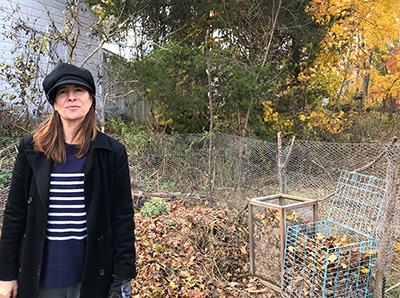
Priscilla Woolworth, a Climate Victory Gardener from upstate New York, put together a simple compost pile near her garden, which she enclosed inside a fence she made of chicken wire and branches. She says of her pile, “It’s working perfectly and slowly filling up with vegetable garden detritus and leaves. I hope that beneficial insects will enjoy it as well.”
“I have a bad back. Turning compost would be difficult for me.”
You have a few different options to make composting gentler on your spine and joints.
As noted above, a tumbling barrel composter lets you easily aerate small batches of compost with the turn of a hand-crank. Or, try a worm bin for the fastest results and smallest batches. (See below for more on the latter.)
Or, you can combine the simplicity of a pile with the ease of a tumbling barrel with a Compost Crank. Sold by Lotech Products, a family-owned green business in Tucson, AZ, the Compost Crank looks like a giant corkscrew. You just stick the Crank into your compost pile and turn it with the ergonomic handle, and your compost will be mixed and aerated without your ending up in bed for days. In fact, inventor Charlie Ambrose handcrafted his first Compost Crank when his own bad back made turning compost a challenge.
“I don’t have a yard.”
Sure, gardening stores often showcase spiffy composting bins or rotating barrels with plenty of bells and whistles, but you need a place to put a bin or barrel first. And that’s easier said than done if you live in an apartment or a place with a lack of outdoor green space.
Our solution: Try worm composting. Also known as vermicomposting, this type of composting is as simple as 1-2-3:
- Place a five- to ten-gallon wooden or plastic bin under your kitchen sink or in another place that’s warm and dark.
- Buy some red worms, also known as Eisenia foetida and Lumbricus rubellus. If you don’t have a local bait shop or worm farm, you can mail order them from businesses like Gardener’s Supply.
- Put the worms in the bin with some damp strips of newspaper to provide a nice, cushy (and edible) bed. Then, all you have to do is dump in your fruit and vegetable scraps, and the worms will turn them into rich compost.
- The 50/50 rule applies for worm bins, too, so make sure to resupply the newspaper (brown waste) as the worms eat through it and your produce peels (green waste). A proper balance will ensure that your bin doesn’t smell.
One big benefit: worms will process your organic waste quickly. Red wiggler worms will recycle half their weight in 24 hours.
For more information on worm composting, see our articleWorm Composting, All-Natural Recycling."
For an even easier option, a growing number of municipalities offer drop-off composting or may even pick it up curbside for processing at a municipal composter. Call your local waste authority to see if this service is available to you.
In addition, local businesses are popping up across the country that offer compost pick-up services, where they’ll collect your organic waste and turn it into compost products that they sell. Or local community gardeners or farmers may accept organic waste from you to turn into compost for their plants. Check your local business listings and ask around to see if you can find someone willing to take your organic waste.
“I live in a cold climate. Can I still compost in winter?”
Along with oxygen, your pile of brown and green organic waste will need heat to turn into compost fairly quickly. If you don’t have the heat, your compost won’t “cook.”
If you live in a snowy climate in winter, you can buy insulated composters that will keep your compost pile decomposing. It won’t cook as quickly in cold weather, but you’ll likely get some results.
If you have a compost pile out in the open, there’s no reason you can’t keep contributing organic waste to it in the winter. It may end up feeding animals versus turning into compost, but isn’t that better than sending that waste to a landfill? They’ll consume your scraps, eliminate some as waste, and that waste becomes natural fertilizer for the soil come spring. Mission accomplished.
“I’d like to compost fish, dairy, and meat. Is that possible?”
You can’t put fish, dairy, or meat into a traditional compost pile or bin without disrupting the composting process.
They’ll will attract flies and maggots, and cause your compost to smell.
Note that unlike home bins, municipal composters are designed to break down meat, fish, and dairy (in addition to things like compostable plastics that won’t decompose in your home bin), so don’t feel bad about sending those curbside if your city has compost pick-up and says they’re okay.
You can compost meat, fish, and dairy anaerobically; the Bokashi One-Bucket method of composting works in this manner. Bokashi (meaning “fermented organic matter” in Japanese) composting requires a plastic bucket with a spigot at the bottom. You put your organic waste, including meat and dairy, and a fermenting powder (usually a mix of bran and anaerobic bacteria) in, and the waste ferments. You’ll end up with liquid and a smaller amount of organic waste that you can then bury in the soil.
However, there’s a downside: Well- aerated organic waste decomposes aerobically, meaning that microorganisms that need oxygen to survive assist in the decomposition process. Without oxygen, your pile will decompose anaerobically, meaning bacteria that don’t need oxygen help it decompose. Unfortunately, anaerobic bacteria release methane, a potent greenhouse gas, as they work.
Your best bet for the climate? Compost aerobically with a pile, bin, or a worm bin, and take steps to reduce food waste overall, especially when it comes to foods like meat, fish, and dairy that can’t be composted at home.
|
|
Healthy Soil, Cool Climate |
A widespread switch to regenerative agriculture won’t just heal the soil. At scale, it can actually reverse the climate crisis.
|
|
National Green Pages 2019 |
|
|
About Green America |
What We Do
Economic Action for People and the Planet
Our Mission
Green America harnesses economic power—the strength of consumers, investors, businesses, and the marketplace—to create a socially just and environmentally sustainable society.
Together, we can protect our beautiful planet and all its people.
Our Vision
We work for a world where all people have enough, where all communities are healthy and safe, and where the abundance of the Earth is preserved for all the generations to come.
How We Work
Consumer Education and Mobilization
Green, Innovative Businesses
- Small businesses are the innovators and job creators. A green economy requires a vibrant, small green business sector that leads change and proves a better way is possible. Find and support real green businesses with Green America’s certification (ensuring both environmental and social responsibility) in our Green Business Network.
Greening Corporate Supply Chains
- Large businesses and their supply chains need to go green in order to bring social and environmental solutions to scale. Our Center for Sustainability Solutions works collaboratively with all players along entire supply chains to create system transformation.
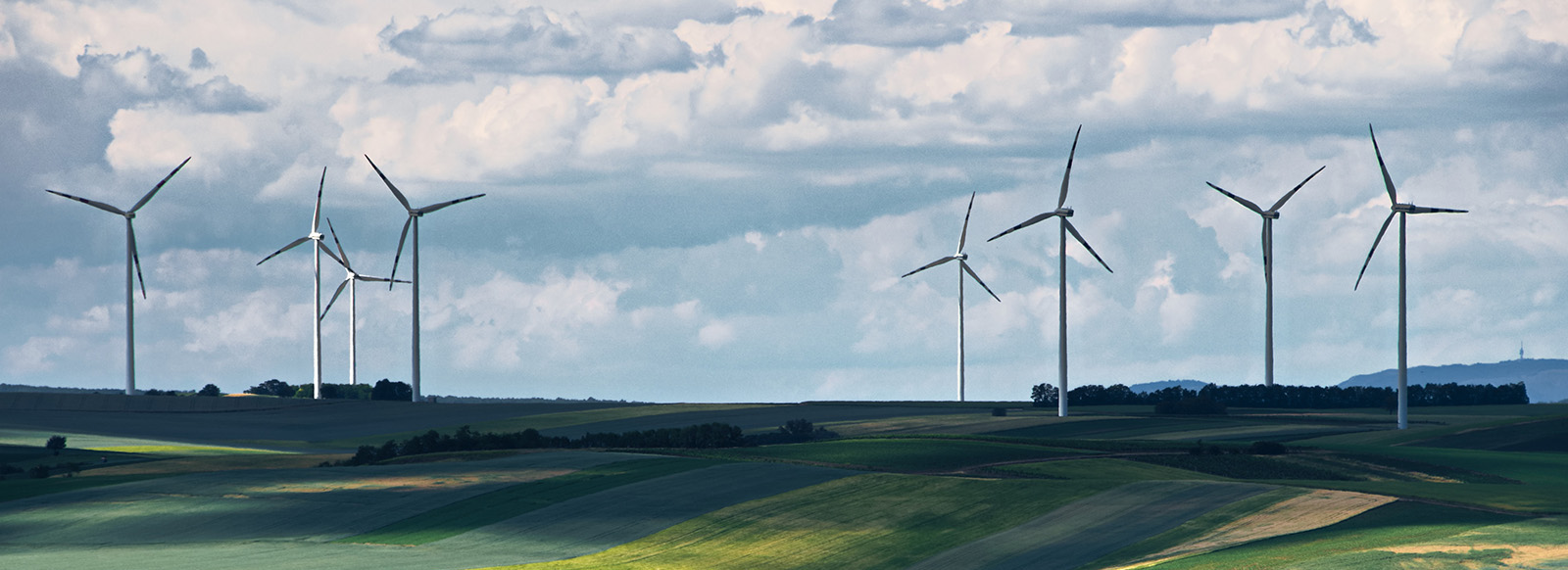
What Makes Green America Unique
- We mobilize people in their economic roles—as consumers, investors, workers —to address issues of social justice and environmental sustainability.
- We empower individuals to make purchasing and investing choices to build a just and sustainable world.
- We work on issues of social justice and environmental responsibility. We see these issues as completely linked in the quest for a sustainable world. It’s what we mean when we say “green.”
- We work to stop abusive practices and to create healthy, just, and sustainable practices.
- We demand an end to corporate irresponsibility through collective economic action.
- We promote green and fair trade business principles while building the market for businesses adhering to these principles.
Justice, Equity, Diversity, and Inclusion is Integral to our Work
Green America works to address multiple interrelated crises threatening our world. We believe we must work together to build a truly green economy that values all people and the planet. In doing so, we believe we must follow the lead of the people who are most disadvantaged by our current economic crises as we create a more just, equitable, and regenerative economy.
More About Us
|
|
RBC Wealth Management |
Jeff has been managing investment portfolios and doing finacial planning for thirty years. He was looking for socially responsible investments back in the days when Ben & Jerry's seemed to be the only company on that path. Now that there is a wide variety of SRI/ESG/Impact investments to choose from, it is his mission to help bring this approach to retail investors. Jeff manages discretionary portfolios of ESG mutual funds and ETF's and does retirement planning for families and business owners.
|
|
Helicon Works |
As buildings impact all aspects of society, we address them all........again, as a client chooses. We present issues to address, give pros and cons, and leave our clients in freedom to determine the positive change they want to be a part of.
|
|
Steve Brown |
Steve Brown is a Certified Industrial Hygienist with over 35 years EHS experience in a multiple industrial sectors including aerospace and semiconductor production. His most recent employment was with Intel Corporation where he was responsible for the safe introduction of new process chemistry's into Intel's global manufacturing facilities using Green Chemistry principles. In addition, Mr. Brown was the Head of the US Delegation to the International Standards Organization (ISO) on Nanotechnologies which is charged with developing EHS standards for the safe introduction of nanomaterials into worldwide commerce. He is currently employed by the Clean Electronics Production Network (CEPN) as a Senior Technical Fellow.
|
|
daiseye |
"The mission for daiseye is to offer unique earth-friendly and/or fair trade products to our customer while educating shoppers about the importance of global responsibility." daiseye is an eclectic marketplace offering fair trade & earth-friendly products, clothing, accessories and gifts to enhance you and your living space. Here you will find treasures of simple beauty created from materials such as reclaimed wood and tin, recycled glass, and organically-grown herbs and fibers. In everything daiseye does in our daily life and offers as products to our customers we adhere to our core principles. daiseye’s 7 core green principles that must be met by daiseye and our vendors: 1 - must be socially & economically responsible 2 - must NOT exploit children or any person 3 - must use energy efficient practices 4 - must use recycled content & reclaimed materials 5 - must support sustainable forestry 6 - must use organic and natural ingredients, including hemp 7 - must NOT test on animals
|
|
Socially Responsible Investing (SRI) Grows to $12 Trillion in US |
Green America’s work to promote socially responsible investing strategies, including portfolio screening on social, environmental, and corporate governance issues; community investing and banking; and shareholder action has helped drive the increase in SRI assets. The Forum for Sustainable and Responsible Investing (US SIF) reports that assets under professional management in the US have grown from $8.72 trillion in 2016 to $12 trillion in 2018.
Growth of socially responsible investing:
- Sustainable, responsible and impact investing (SRI) assets have expanded to $12.0 trillion in the United States, up 38 percent from $8.7 trillion in 2016.
- The top five issues for asset managers and their institutional investor clients are climate change/carbon, tobacco, conflict risk, human rights, and transparency and anti-corruption.
- Community investments that support low-to-moderate income communities grew from almost $122 billion in 2016 to $185 billion.
- Shareholder action continues to focus heavily on “proxy access” (the ability of shareowners to nominate corporate directors); corporate political spending; and climate issues.
|