Content by specific author

Body
UC, Berkeley
Apple*
HP, Inc.*
Green America
Soil Carbon Index (SCI)

Standards providing assurance of soil health outcomes to facilitate investment in and adoption of soil health improvements. Early adopter pilots are underway.

SCI is developing an outcomes & science-based performance standard and measurement framework-built by and for brands, investors and farmers. The Standard seeks to provide a standardized way to monitor progress on soil health and carbon sequestration improvements.  This Initiative was identified by this group of leaders as a necessary keystone missing from the current system that was needed for accelerating investment into measurable on farm progress in carbon sequestration and soil health across a broad spectrum of agricultural production systems. The Standard is agnostic to other certifications, and flexible enough to adapt to scientific and technological advances and enhance other standards already in use by farmers and food companies. For more information, visit the Soil Carbon Index webpage. 


Pamela Brody-Heine

Pamela has over twenty-five years of program management and multi-stakeholder facilitation experience, with the last 15 years focused on promoting environmental and corporate social responsibility in the electronics industry via standards development and stakeholder processes. She is currently the Director of Clean Electronic Production Network (CEPN) – a multi-stakeholder, cross-industry collaboration that launched in 2016. CEPN serves as a platform for collaborative innovation where diverse stakeholders – including technology suppliers, brands, labor and environmental advocates, governments and other leading experts – work together to understand, address, and eliminate worker exposures to toxic chemicals in electronics production.

Previously, Pamela was Green Electronics Council’s Director of Standards Management, designing and managing multi-stakeholder processes to maintain the sustainability standards on the EPEAT Registry for product categories including personal computers and displays, servers, imaging equipment and PV modules and inverters. Before joining GEC, Pamela was an independent consultant, with projects including management and facilitation of the development of the ground-breaking Outdoor Industry Association and European Outdoor Group Eco Index Green Standard.

Delta Institute
Farm OS, Wolfe's Neck Center for Agriculture & the Environment
Kiss the Ground
Regenerative Agriculture Foundation
Project Drawdown/LIFT Economy
The Climate Foundation
The Carbon Underground
Chico State’s Regenerative Agriculture Initiative
Colorado State University
HB Specialty Foods
Caney Fork Farms
White Buffalo Land Trust
Yield Organic
Agriforce Seeds
Fuller Farms
White Oak Pastures
Urth Agriculture
Native Energy
Pure Strategies
Healthy Food Ingredients
W.S. Badger Company
MegaFood
Ben & Jerry’s Homemade
Danone North America Soil Health Programs
Ask Acadia: Expert Answers Climate Victory Garden Questions

Green America teamed up with author and farmer Acadia Tucker to answer questions about Climate Victory Gardening. In this blog, you'll get to know Acadia, what motivates her, and why she's such a great candidate for answering your questions.

Acadia Tucker is a regenerative farmer, climate activist, and author of Growing Perennial Foods: A field guide to raising resilient herbs, fruits & vegetables, and Growing Good Food: A citizen's guide to backyard carbon farming. Her books are a call to action for citizen gardeners everywhere, and lay the groundwork for planting an organic, regenerative garden. For her, this is gardening as if our future depends on it.

Before becoming an author, Acadia started a four-season organic market garden in Washington state inspired by farming pioneers Eliot Coleman and Jean-Martin Fortier. While managing the farm, Acadia grew 200 different food crops before heading back to school at the University of British Columbia to complete a Masters in Land and Water Systems. Today, she lives in Maine and New Hampshire with her farm dog, Nimbus, and grows hops to support locally-sourced craft beer in New England, when she isn't raising perennials in her own backyard.

Take a peek into Acadia's life with this excerpt from her book Growing Perennial Foods: A field guide to raising resilient herbs, fruits & vegetables. Visit our Climate Victory Gardening FAQ to learn practical skills and become more familiar with carbon sequestration and growing healthy food (and soil!), with answers from Acadia and other experts. 


It’s 6:30 a.m. and the sun has been up for a little less than an hour. I roll out of bed and quickly guzzle a cup of coffee. Then I slip on my moss-green muck boots, tattered from many battles with blackberry brambles, and take the well-worn path through the woods to the farm. 

Every morning I open a greenhouse filled with beds of peppers, tomatoes, and eggplants. I want to do this before the temperature inside the greenhouse hits 85 degrees and the plants become stressed and thirsty. This morning, when I roll up the plastic sides of the greenhouse, I feel a wave of intense heat escape into the cool air. I check the thermometer inside—90 degrees—and remind myself to wake up earlier tomorrow.

Fortunately, the leaves haven’t started to wilt. I breathe a sigh of relief and move on to my morning routine. I start in the back field where a patch of garlic leaves rustle in the soft breeze. I pull weeds and check plants for the dreaded bean beetle. Then I scan the hedgerows of raspberries and currants for the succulent ripe fruits. After admiring the straight rows of potatoes, kale, and beets resting on a bed of straw, I turn on the irrigation system. Now it’s time to head to the apple orchard where I’ll watch the wildflowers vibrate as hungry bees hunt for nectar. Over at the compost pile, I plunge my hand into the heap to feel its heat.

I love to grow food, plain and simple, and can’t imagine doing anything else. When I started farming in Washington at age 21, I focused on practical concerns: finding some land to lease, figuring out which crops to grow, and finding enough customers to buy my food. What I didn’t give much thought to was climate change. However, after just a few years working this highly weather-dependent job, I noticed longer frost-free seasons, more intense storms, and more frequent droughts.

Alarmed, I went back to school to study soil management and how it can be a meaningful buffer against weather extremes. When I returned to farming, I started covering my fields every spring with a generous layer of compost. Then I’d lay down another protective layer, this time of straw or wood chips, to keep the compost from washing away and prevent new weeds from sprouting.

Feeding my farm this rich organic material quickly converted the light brown, sandy soil into a dark brown, fluffy bed for my plants. Water sank in instead of pooling on the surface. My plants weathered the heavy rains and occasional droughts of the Pacific Northwest. When I moved back east, I saw how these same methods helped my crops thrive despite New England’s harsh winter storms. Eventually, I started to think of myself as a “regenerative farmer.”


Regenerative Farming is Pretty Much What It Sounds Like

Regenerative farming is often described as an effort to mimic how nature grows food. Think of a forest that has sustained wild berries, watercress, cherry trees, and other long-lasting perennials for centuries. How does this happen? Leaves and other organic material fall to the ground, protecting the soil from erosion. Insects, fungi, bacteria, and other critters thrive in undisturbed soil and incorporate the fallen material into the ground through their daily activities. This cycle builds a fluffy layer of topsoil packed with nutrients, which supports more plant growth. It’s a process that replenishes ecosystems the world over, from forests to fields of wild grains and grasses.

Farmers who take their cue from this process minimize tilling, allowing the healthy microorganisms and bugs that enrich the soil to go about their lives undisturbed. These farmers cover their fields in truckloads of compost. And they plant nutrient-rich cover crops, like Red Clover and Buckwheat. They don’t violently break up the soil’s texture through plowing. They don’t use a lot of chemicals. Their reward? Nutrient-rich topsoil, better water retention, and heartier plants— plus savings on fertilizer, water, and pesticides.

These cost savings help explain why regenerative farming is springing up all over, even in soybean country where industrial farming has long been seen as the most efficient. Some farmers are also motivated by another by-product of organically enriched soil: it draws excess carbon out of the air and stores it underground. This ability to capture greenhouse gases is why many experts believe regenerative agriculture, also known as carbon farming, could play an important role in fighting climate change.
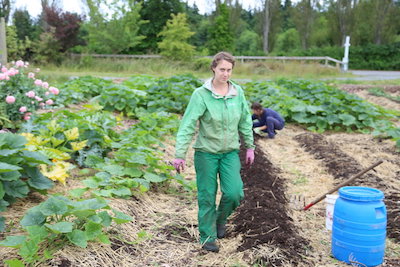
Author Acadia on her farm
The author adding compost and mulch to her soil. These are two important steps to growing a regenerative garden. Once added, microbes, fungi, and other soil organisms feast on the material and, over time, portions of this decomposed material become part of the carbon sink.

Plants are the ultimate and, dare I say, cheapest way to suck excess carbon dioxide out of the air. Almost all atmospheric carbon passes through plants during photosynthesis, the process that turns carbon, sunlight, and water into sugars and carbohydrates. Plant roots release carbon-rich sugars, which feed organisms in the soil. In exchange, these critters make nutrients in the soil available to the plant. As plants die back each winter, they drop leaves and branches and even the roots die off.

Over time this debris decomposes, adding even more nutrients and carbon to the soil. There’s evidence to suggest that when living soil organisms die they end up forming even more organic matter than plant residue.The alliance between plants and soil organisms helps lock carbon in topsoil, producing the dark organic matter every gardener lusts for and turning the very ground we stand on into a giant carbon sponge.
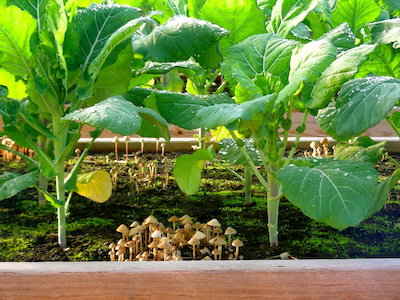
Broccoli growing in garden bed
Undisturbed soil rich in carbon feeds fungi that creates a soil structure that locks in moisture and holds on to nutrients making your garden more resilient while locking carbon underground.

Increasing the carbon stored in soil helps to maximize photosynthesis so plants can draw down even more carbon dioxide and trap it underground. Moreover, soil rich in carbon feeds mycorrhizae, a vast network of fungi that releases glomalin. Glomalin is a sticky, gum-like substance that binds together particles of sand, silt, and clay, creating a soil structure that locks in moisture and holds on to nutrients. Plants raised in favorable conditions like this, with easy access to water and nutrients, are sturdier and more resilient. This positive cycle is how nature works when we don’t interfere.

Heavy use of synthetic fertilizers, growing just one crop over large areas, exposing the soil to erosion from wind and water, and tilling are all mainstays of conventional farming, and reduce the amount of carbon in our soil. Instead, they release more greenhouse gases into the air. In 2011, farms emitted six billion tons of greenhouse gases. That’s about 13 percent of all greenhouse emissions worldwide, according to the World Resources Institute.

We can turn this around. By adopting regenerative practices, farms could remove carbon dioxide from the atmosphere at a rate of about one ton of carbon dioxide for every acre, according to data reviewed by soil expert Eric Toensmeier. The potential benefits are enormous, as spelled out in a 2014 study from The Rodale Institute. Citing data from farming systems and pasture trials, it concludes that we could sequester more than 100 percent of annual CO2 emissions worldwide if we start growing food this way. 

The authors write: “Soil carbon sequestration through regenerative agriculture is a known, proven, technical remedy to climate change: it gives humanity the necessary time to decarbonize.” Experts agree more study is needed but there’s no question that even a small increase in soil carbon can improve crop resilience, reduce chemical use, conserve water on a large scale, and draw down carbon.

The fact that carbon farming could make a difference is both exciting and frustrating. We are, after all, dealing with an agricultural system that does not prioritize health, environmental, or climate concerns. But farmers aren’t the only ones who can opt for a regenerative approach. Many of us have our own patches of soil we can tend to—in yards, community gardens, even pots. 


The Promise of Backyard Carbon Farming

I started my own garden after moving from Washington State to New Hampshire to grow hops for local breweries. When I moved, I left behind a farm where we’d grown 200 different food crops. In New England, I so badly missed having fresh fruits, vegetables, and herbs within easy reach that I started my garden almost immediately.

While fewer and fewer people are farmers by profession, many Americans are growing food. In fact, 35 percent of us, or 42 million households, report growing some of our own food, according to the National Gardening Association of America. Just imagine what could happen if more of us took up regenerative gardening. Not only would we have ready access to nutritious, local food. We could help heal the planet.

Perennials are a natural choice for regenerative gardeners. These sturdy, long-lived plants are anchored by extensive root systems that help them find water and nutrients deep in the soil. Deep roots also give these plants staying power when they’re buffeted by heavy winds, rains, and snow. In addition, having the same plants in the same place for years makes it easier for all the soil-enriching organisms—the bacteria, fungi, and bugs—to gather and multiply.

My favorite time of year is growing season and I end every day with a stroll through my garden. I watch the sunchokes lining the cedar fence track the last bit of sunshine. I look over my tomatoes once more before rolling down the greenhouse walls and tucking them in for the night. I grab a fistful of basil on my way back to the house. And I luxuriate in knowing I’ll see these plants again next year. 

Weather, soil type, and any number of other variables can make gardening complicated. I’ve done what I can to keep it simple. I want to make regenerative gardening easy because cultivating even a little bit of carbon-rich soil can make a big difference. Eric Toensmeier estimates that his own tiny carbon-rich backyard garden, about a tenth of an acre, can offset the carbon emissions of one American adult per year. For me, that says one thing: let’s grow some good food. It’s time.


book cover: growing perennial foods   book cover: growing good food

Have a gardening question? Send it to: ClimateVictoryGarden@GreenAmerica.org.

Or, post it on the Climate Victory Garden facebook group.

Don't forget to check out the Climate Victory Garden Q&A!

Green America Supports CA "Skip the Slip" Bill

Green Business Network director Fran Teplitz submitted the following letter to the Natural Resources Committee of the California Assembly in support of new “Skip the Slip” legislation. The bill was inspired by Green America’s Skip the Slip campaign urging businesses to use electronic receipts rather than toxic and wasteful paper receipts.

Progress! 

On March 25, 2019 the Skip the Slip bill in California, AB 161, passed through the Natural Resources Committee in the State Assembly and will next move on to the Privacy & Consumer Protection Committee.


March 21, 2019

Assemblymember Laura Friedman
Chair, Assembly Committee on Natural Resources
1020 N Street, Room 164
Sacramento, CA 95814

RE: AB 161 (Ting): Skip the Slip – Support

Dear Assemblymember Friedman,

On behalf of Green America’s Green Business Network, I am pleased to support AB 161, which would reduce waste, save water and trees, and reduce California’s carbon footprint by encouraging consumers to use electronic receipts instead of paper receipts.

The Green Business Network, with 2,000 business members nationwide and 262 business members in California, represents many smaller businesses, including retailers. These businesses are leaders in innovation and in greening their business practices including recycling, offering organic and non-toxic products, reducing their use of materials, and incorporating clean energy. These businesses also are experts in meeting the needs of their customers, including offering customers the choice of greener options that help build customer loyalty.

The Skip the Slip Bill is a commonsense measure to enhance sustainability and customer choice.  Currently, many retailers provide customers with a paper receipt, whether the customer wants it or not.  Skip the Slip puts the power in the hands of consumers to determine if they want a paper receipt or just an electronic receipt. Smart businesses are already moving in this direction and are finding that it meets customer needs and reduces business costs over time.  This bill will place California in a leadership issue on this important issue.

According to the California Department of Resources Recycling and Recovery (CalRecycle), California exports nearly one third of its recycled material to other countries every year. With recent developments in the international recycling market, exporting California’s recycled material has become unsustainable and the state must find ways to reduce waste.

The Ecology Center’s More than you Bargained For: BPS and BPA in Receipts found that 93 percent of paper receipts are coated with Bisphenol-A (BPA) or Bisphenol-S (BPS), chemicals which the United States Food and Drug Administration (FDA) has banned from baby bottles because they are known to disrupt hormones, causing cancerous tumors, birth defects, and other developmental issues.

Additionally, Green America’s own report, Skip the Slip: Environmental Costs & Human Health Risks of Paper Receipts with Proposed Solutions, found that over 3 million trees and 9 billion gallons of water in the United States are used to create proof of purchase receipts. These receipts generate 302 million pounds of waste and 4 billion pounds of carbon dioxide (CO2), the equivalent of more than 425,000 cars on the road.

Today there are many alternatives to paper receipts that retailers are already using. Data from a point-of-sale platform that offers digital receipts shows that their sellers send over 10 million digital receipts each month.

AB 161 would require all businesses to provide proof of purchase receipts electronically unless the customer asks for a physical copy, starting on January 1, 2022. This gives each customer the option of receiving a paper-based receipt, instead of receiving a paper receipt whether they want it or not.  Many customers will choose to “skip the slip” leading to less paper waste.

Reducing the number of paper receipts that are printed will not only vastly cut down the amount of waste that we produce, it will also save millions of trees and billions of gallons of water each year. For these reasons, we are supporting AB 161.

Sincerely,
Fran Teplitz
Executive Co-director, Green America
Director; Green America’s Green Business Network

Girl smiling
Why is soil health important? How can I improve my soil?

When I first started growing food, the farm I managed in the Pacific Northwest had patches of sandy, dry soil interspersed with waterlogged, hard packed clay. During the scorching hot summers, my thirsty plants shriveled. When the skies dumped rain the water pooled, flooding my crops. Those first couple of years on the farm were my first experience dealing with climate extremes, and my soil was not equipped for the job.

Worried about the outlook for my farm, I returned to school to study soil and water management, and did a deep dive into how global warming is changing the way we raise food. The experience helped turn me into a very different kind of grower.

When I returned I started covering my beds every spring with a generous layer of compost. On top of that, I laid down another protective layer of straw or grass clippings mixed with shredded leaves, to keep the compost from washing away and prevent new weeds from sprouting. Over the course of the growing season I dosed my soil with this potent combination as needed. It didn’t take time to notice a difference.

In just over a year, the rich organic material had converted the light brown, sandy soil into a dark brown, fluffy bed for my plants. The hard packed clay loosened and become more friable. Water sank instead of sitting on the surface. I swear my food is tastier and more resilient. But what really excites me about my job as a soil farmer is knowing the role it plays in cooling our environment.

The more organic matter in the soil, the more excess carbon dioxide it can absorb. Increasing the carbon stored in soil helps to maximize photosynthesis so plants can draw down even more carbon dioxide and trap it underground.

Moreover, soil rich in carbon feeds mycorrhizae, a vast network of fungi that releases glomalin. Glomalin is a sticky, gum-like substance that binds together particles of sand, silt, and clay, creating a soil structure that conserves moisture and holds onto nutrients. Plants raised in favorable conditions like this, with easy access to moisture and nutrients, grow sturdier and more resilient. This positive cycle is how nature works when we don’t interfere.

By adopting soil-building, regenerative practices, farms could remove carbon dioxide from the atmosphere at a rate of about one ton of carbon dioxide for every acre, according to data reviewed by soil expert Eric Toensmeier. The potential benefits are enormous, as spelled out in a 2014 study from Rodale Institute. Citing data from farming systems and pasture trials, it concludes that we could sequester more than 100 percent of annual CO2 emissions worldwide if we start growing food this way.

But even if you have nothing more than a sliver of land you can do something right now to battle the most significant ecological threat we’ve ever faced. Carbon farming expert Eric Toensmeier estimates that his own tiny carbon-rich backyard garden, about a tenth of an acre, can offset the carbon emissions of one American adult per year. So let’s all start nurturing the soil. It’s time.


Here’s how you can build (and maintain) healthy soil

Test your soil

The occasional soil test is a helpful gauge of what’s working and whether you need to pile on more compost or other amendments, so I’ve built soil testing into my annual routine and recommend you do, too. If you’re starting a garden from scratch, taking measure of your soil’s acidity and nutrient levels can get you off to the right start. Most state universities can test for acidity, organic matter, and nutrients. That said, testing the quality of your soil isn’t absolutely necessary for regenerative gardeners if you treat it with a healthy dose of compost and mulch every year. And if getting a test seems like a hassle, and stands in the way of you getting started on your own garden, don’t bother. Better to just get started.

You can easily keep tabs on the health of your soil each season by grabbing a handful of moist dirt from your garden and squeezing it. If it crumbles, your soil is too dry and sandy and you’ll have to add more organic matter. If it holds its shape even after some poking, the soil contains too much clay and you’ll have to mix in peat, compost, or lime to break it up and improve drainage. If your clod holds its shape and falls apart only after poking it,  then your probably have rich, well-drained loam soil, which most plants love.

Feed your soil

Adding organic matter is the most important step you can take to build healthy soil. Organic matter is anything living or dead, animals or plants, and the perfect food for soil organisms. So, I feed my soil with compost.

Throughout the season I build up my compost pile with straw, grass clippings, leaves, kitchen scraps, plants, pretty much any raw organic material, and let it sit. This creates a breeding ground for bacteria and microbes that make quick work of breaking down the materials into nutrients that plants need. The result is black gold packed with organic matter and plenty of the trace minerals - like iron, zinc, and manganese - that are left out of synthetic fertilizers.

Each spring I spread one to two inches of this amazing stuff over the entire garden, gently mixing it into the first few inches of the soil. But if you forget to feed your soil during the busy spring it’s fine to add it later on, and particularly poor patches of land benefit from getting it throughout the season.

Protect your soil

Mulch is a carbon farmer’s best friend. Spreading mulch over the soil each year accomplishes many goals at once. For starters, mulch helps trap water so you won’t need to water your plants as much. Mulch also fights against weeds so you spend less time hunched over pulling them out of the ground (you can tell how much I like weeding) and more time enjoying the fruits of your labor. But the most important aspect of mulch is the way protects the soil.

I add it in the spring, to prevent the healthy soil I’ve worked so hard to build from washing away. And in the fall, to keep nutrients in the ground and protect plant roots from becoming exposed and vulnerable to drying out and freezing in the winter.

Mulch works best when applied in an even layer, two to four inches deep. Make sure to keep it a few inches from the base of your plants so it doesn’t rot them. I spread wood chips along my pathways to prevent hard-packed soil, and a layer of shredded leaves and grass clipping or straw on my plant beds. But you can use pretty much anything from plain cardboard or newspaper to coco fiber or shredded tree waste from your local municipality. I much prefer organic materials, which can be broken down by soil microbes, rather than synthetic mulches like landscape fabric, which does nothing for soil health. The best organic mulches are readily available, cheap, and easy to spread.


Have a gardening question? Send it to: ClimateVictoryGarden@GreenAmerica.org.

Or, post it on the Climate Victory Garden facebook group.

Visit our FAQ page to learn practical skills and become more familiar with carbon sequestration and growing healthy food (and soil!). 


book cover: growing perennial foodsbook cover: growing good food

Written by Acadia Tucker, a regenerative farmer, climate activist, and author of Growing Perennial Foods: A field guide to raising resilient herbs, fruits & vegetables and Growing Good Food: A citizen's guide to backyard carbon farming.

Amalgamated Bank

For nearly a century, Amalgamated Bank has served as America’s socially responsible bank. Rooted firmly in the labor movement, we are a champion of working people and proudly support the forward-thinking organizations, companies and individuals across the country who are working to make the world more just, compassionate and sustainable. We are America’s largest certified B Corp bank and a member of the Global Alliance for Banking on Values. We don’t just have a mission. We are on a mission: to support those who support others, to invest in progressive and impactful causes and to advocate true financial opportunity for all.

Our majority area of impact is through our social and environmental products and services. As a green leader in the financial industry, we recognize that all people and businesses have a role to play in helping build a clean and just economy. We are proud of offer products and programs that align with our mission such as: 

  • We have pledged to double our portfolio to environmentally and socially responsible companies by the year 2020 from $350 million to $700 million.
  • We offer personal products such as the Give Back Checking/Savings accounts, Donate the Change ATM card; Solar HELOC Loan, for example. Through Amalgamated Investment Services, we offer investment opportunities designed to help the bottom line and create lasting change, including Aria: 100% Fossil Free Portfolio — Contains no investments in coal companies, oil and gas producers or fossil-fired utilities 
  • We have strict policies about not lending money to any company that pollutes the planet
  • Working with the GABV, we are the first US bank to commit to measure carbon outputs of our lending portfolio
  • Together with D.C.’s Property Assessed Clean Energy Program, we helped finance the preservation of 84 units of affordable housing in the Phyllis Wheatley YWCA. The outcome will generate 60 kilowatts of solar power and decrease annual utility bills by $6,000.
  • As shareholders, we successfully persuaded multiple companies to assess and report on becoming net-zero carbon in line with the Paris Climate Agreement, including CarMax, GameStop and Lowe’s.
  • We received South Pole’s Climate Neutral label based on our commitment to reduce our impact on the environment through the purchase of high quality renewable energy and carbon credits.


Amalgamated Bank

For nearly a century, Amalgamated Bank has served as America’s socially responsible bank. Rooted firmly in the labor movement, we are a champion of working people and proudly support the forward-thinking organizations, companies and individuals across the country who are working to make the world more just, compassionate and sustainable. We are America’s largest certified B Corp bank and a member of the Global Alliance for Banking on Values. We don’t just have a mission. We are on a mission: to support those who support others, to invest in progressive and impactful causes and to advocate true financial opportunity for all.

Our majority area of impact is through our social and environmental products and services. As a green leader in the financial industry, we recognize that all people and businesses have a role to play in helping build a clean and just economy. We are proud of offer products and programs that align with our mission such as: 

  • We have pledged to double our portfolio to environmentally and socially responsible companies by the year 2020 from $350 million to $700 million.
  • We offer personal products such as the Give Back Checking/Savings accounts, Donate the Change ATM card; Solar HELOC Loan, for example. Through Amalgamated Investment Services, we offer investment opportunities designed to help the bottom line and create lasting change, including Aria: 100% Fossil Free Portfolio — Contains no investments in coal companies, oil and gas producers or fossil-fired utilities 
  • We have strict policies about not lending money to any company that pollutes the planet
  • Working with the GABV, we are the first US bank to commit to measure carbon outputs of our lending portfolio
  • Together with D.C.’s Property Assessed Clean Energy Program, we helped finance the preservation of 84 units of affordable housing in the Phyllis Wheatley YWCA. The outcome will generate 60 kilowatts of solar power and decrease annual utility bills by $6,000.
  • As shareholders, we successfully persuaded multiple companies to assess and report on becoming net-zero carbon in line with the Paris Climate Agreement, including CarMax, GameStop and Lowe’s.
  • We received South Pole’s Climate Neutral label based on our commitment to reduce our impact on the environment through the purchase of high quality renewable energy and carbon credits.


The Green (Thumb) New Deal: “Climate Victory Gardens” Tops 1,000 Milestone, Green America Releases New How-To-Guide

WASHINGTON, DC – March 13, 2019 – Green America marked a major milestone this month: over 1,000 registered Climate Victory Gardens in the U.S., a major achievement on the road to the target for 2019 of 5,000 such carbon-capturing plots for fruit and vegetables. The existing 1,100 Climate Victory Gardens already equal 140 football fields of healthy plants that are healing the soil. Green America took note of the occasion to release Climate Victory Gardening 101: A toolkit for growing healthy food for a healthy planet.  

The Climate Victory Garden 101 Toolkit details step-by-step instructions for planting a Climate Victory Garden and 10 carbon capturing practices.

Climate Victory Gardens were inspired by the “Victory Gardens” planted during WWI and WWII. By 1944, nearly

20 million victory gardens produced eight million tons of food to feed Americans at home and for the troops abroad. The Climate Victory Garden campaign seeks to recreate this spirit to empower Americans to take immediate action on climate change, right in their own backyards. 

The announcement comes as U.S. gardening levels are hitting an all-time high. According to the National Gardening Survey, 77 percent of American households are gardening, and Millennials are increasingly taking part. Green America’s Climate Victory Gardens program and toolkit show them how to practice gardening in a way that creates healthy soils that can help to reverse climate change.

“The climate change data is clear, and we all need to take action to protect the planet,” said Jes Walton, food campaigns manager at Green America. “If you’re looking for a way to reduce your impact on the climate, then Climate Victory Gardens are one great way to do your part—the amazing fruit and vegetables you grow will be a bonus. We like to think of what we are doing as the Green (Thumb) New Deal!”

“Climate Victory Gardens are a great way to address two major problems at once: climate change and the lack of access to healthy foods faced by millions of Americans,” said Jillian Semaan, food campaigns director at Green America. “We’re exciting to see people planting Climate Victory Gardens in communities across the U.S. and around the world, helping people eat fresh food while sequestering carbon.”

“I believe that growing things, especially our own food, is an act of preservation and will ultimately save us,” said Catherine M.F., who has a Climate Victory Garden in Minneapolis.

“I feel connected to the earth and to myself when I am working in my garden, it’s my meditation,” said Yolanda W., who has a Climate Victory Garden in Colorado.

“I’m excited to supplement my family’s food with fresh herbs and produce that we grow. It makes a positive difference for us,” said Monica F., who has a Climate Victory Garden in Arlington, Virginia.

The Climate Victory Garden 101 Toolkit outlines the following carbon-capturing practices for Americans looking to transform their home garden into a Climate Victory Garden:

  1. Grow Edible Plants
  2. Keep Soils Covered
  3. Compost
  4. Encourage Biodiversity
  5. Plant Perennials
  6. Ditch the Chemicals
  7. Integrate Crops and Animals
  8. Use People Power, Not Mechanization
  9. Rotate Plants and Crops
  10. Get to Know Your Garden

More information on Climate Victory Gardens is available here: https://www.greenamerica.org/climate-victory-gardens. Climate Victory Gardens across the U.S. are being mapped here: https://www.greenamerica.org/climate-victory-gardens-map

On March 20, Green America will hold a webinar on Climate Victory Garden planning, design, and how to grow $700 worth of produce with limited space. The webinar is free and open to the public. Advance registration is required.

ABOUT GREEN AMERICA

Green America is the nation’s leading green economy organization. Founded in 1982, Green America provides the economic strategies, organizing power and practical tools for businesses and individuals to solve today’s social and environmental problems. http://www.GreenAmerica.org

Climate Victory Gardens guide
Issue #114, Green American Magazine - Your Home, Detoxed! (Spring 2019)
10 Carbon Capturing Practices
Need Help in your Climate Victory Garden? Find (or Become!) a Master Gardener

Climate Victory Gardeners are joining together to build a movement that brings healthy food into into our yards and communities, while drawing carbon from the atmosphere to fight climate change. This campaign is built upon the successes of the historic victory gardens of World War II, but today we’re in somewhat uncharted territory, relying upon the expertise of other gardeners to learn best practices for building soil health and strong communities. Master Gardeners are an invaluable resource to all gardeners, in all areas states. Catherine McDonnell-Forney tells us about her journey becoming a Master Gardener and highlights valuable resources for Climate Victory Gardens in all their many stages. 

I am a Climate Victory Gardener and a University of Minnesota Extension Master Gardener volunteer. I have tried, in my little corner of the world, to create a space for myself, my family, and my environment to live more equitably by restoring the prairie on part of my property (tiny though it may be), creating a habitat for local wildlife, and growing some of our own food. I have two children, and I want nothing more than for them to have a happy, healthy future and I believe that restoring and respecting our environment and understanding and taking part of our food production is key to that.

pots growing seedlings for garden

I started my own gardening adventure in earnest when my spouse and I purchased our home in 2009. I had never gardened before, so I relied on lots of great online and library resources. One resource that I kept coming back to was the University of Minnesota extension service. Not only was the Yard and Garden website an invaluable resource, so were the Master Gardeners I met at info booths at Farmers Markets and through the Ask an Expert online answering service.

My house is situated on the northside of a very small urban lot (about a tenth of an acre). The soil is “urban fill” (you can look up your soil type on the USDA soil survey), so not terribly healthy. I was unsure of any harmful chemicals (like lead or arsenic) in the soil so chose to grow food in raised beds. In the intervening years, I’ve had soil tests done, which you can have done at relatively low cost through most Extension services, and there is no lead or arsenic. I’ve grown tomatoes, peas, beans, lettuces, potatoes, garlic, lots of herbs, hot peppers, winter squash, zucchini, tomatillos, onions, and more than I can even recall. I also have a sour cherry tree, two nanking cherry trees, elderberry trees, hardy kiwi, hops, strawberries, blueberries and raspberries. My front yard has been converted to garden, it takes up about a quarter of my property. I grow mostly Minnesota natives, but also a few flashy non natives (Icelandic irises, for instance).   

In all of my gardens, I practice no dig gardening. This means I do not till the soil. This helps rebuild the health of my soil and makes my plants healthier. AND it’s less work for me! At the end of each growing season in my vegetable beds, I carefully remove any dead plants. Anything diseased goes to the municipal compost - we are very lucky in Minneapolis to have yard and kitchen waste pick up for compost - and everything else goes into my compost bins. I then top off all bins with fresh compost and that’s it! My fruit trees get a similar addition of compost and my natives are mostly left alone - I leave much of their dead growth in the garden to breakdown over the winter. Many native insects lay their eggs either in the garden debris or in the stems of hollow plants, so it’s a must to leave those items in your garden. All of this work has allowed me to reduce my carbon footprint several ways: growing food closer to home, restoring the soil on my own land and creating a carbon sink and teaching and inspiring others. 

I was inspired to become a Master Gardener through the extension program at the University of Minnesota. One of my coworkers at the time was a Master Gardener and encouraged me to consider becoming a Master Gardener myself.

Who are Master Gardeners?

Master Gardeners are your neighbors! Master Gardener programs are volunteer programs through Extension services at land grant universities throughout the country that train individuals in basic horticulture practices. These people then work with the public to pass on that knowledge. 

What can Master Gardeners do for you?

All 50 US States and eight Canadian provinces have Master Gardener services, with the sole purpose of serving the public. Master Gardener volunteers are trained and there to help YOU! Are you new to gardening and don’t know where to start? Check out your local services; many programs have classes or public speaking events you can attend for free or low cost. You can also find a question and answer booth, often at a farmer’s market. Did you find a really cool insect in your garden? Likely, your local Master Gardener can help you identify it, take a picture and Ask an Expert

Master Gardeners help new gardeners and homeowners learn how to create a more climate friendly space - either by growing their own food or creating gardens (carbon sinks) on their properties and teaching experienced gardeners and homeowners more environmentally friendly practices. 

How do you become a Master Gardener?

Ready to share the wealth of knowledge? Anyone can become a Master Gardener. In Minnesota, the process involves completing an application, answering questions that require some research, and then an interview process. Once you are accepted into the program, you complete 48+ hours of basic horticulture education, which includes topics like basic vegetable and flower growing, tree care, Integrated Pest Management, and much more. All the information and guidance that we, as Master Gardeners, pass on to the public is research backed. We learn to teach best practices that are sustainable and help guide our neighbors and community members toward a healthy environment, people, and community.

After  this course work, a Master Gardener completes 50 hours of volunteer service and 12 additional hours of continuing education, either at events like informational sessions at a University or college, conferences, workshops or webinars.  the first year. You are paired with a mentor who lives near you and has similar interests to help you though your first year. It’s a bit overwhelming at first! Following the first year, Master Gardeners only have to complete 25 hours of volunteer service and 12 hours of continuing education per year to stay active. 

Don't be overwhelmed by the commitment, anyone can do it!


girls in field of dandelions

That all sounds pretty grueling, especially if you’re a working parent of two kids. While it is a lot of work, it’s really fun and rewarding. I’ve answered questions at farmers markets, worked on educational projects with elementary school kids, worked on prairie restoration sites, and helped design rain gardens. I’ve helped people appreciate beneficial insects, attract more wildlife, grow their own food, keep trees healthy, and so much more. I’m an active member of the Climate Victory Garden facebook page where I get to share and learn from other gardeners and Master Gardeners. I get to share my passion with others, which I can’t really think of anything I’d rather be doing!

My training as a Master Gardener has helped guide my practices and enabled me to help others learn. Over the years, I have seen more and more people in my community embrace environmentally-friendly practices and develop more interest in food security, and I enjoy being a part of this process. I hope you’ll reach out to a local Master Gardener or consider becoming one yourself!

A Few Resources

  • Find a master gardener near you - Here you can find the contact information for Master Gardeners in every state, along with links to the extension programs that train Master Gardeners. 

  • Ask an Expert - This is an answering service. You can ask questions on all sorts of topics including food preserving, gardening, tree care, and insect identification! This resource matches you with someone in your area with the expertise to answer your questions.

  • Extension Articles - This site has an abundance of great articles, webinars, and videos about a wide range of topics, all things food, farm and garden related. 

About Catherine McDonnell-Forney
I was born and raised in the beautiful city of Minneapolis, Minnesota, where I still live with my spouse, two kids, two dogs and two cats. Long, cold winters leave me dreaming of flowers, veggies and bugs. I am going into my fifth year as a University of Minnesota Extension Master Gardener and loving every minute of it. I also work full time as a communications manager for a small nonprofit.

Midwest Grains Initiative

iStock_000049563350_XXXLarge.jpg

GOAL: Get 5 million more acres of small grains grown in rotation in the Upper Midwest by 2021.


We are a group of farmers, small businesses, and consumer brands working together to get 5 million more acres of small grains grown in rotation in the Upper Midwest by 2021.

JOIN US!


Small grains like barley, oats, wheat, and rye that were traditionally grown in the Upper Midwest are uniquely positioned to help consumer brands achieve the sustainability goals that consumers are demanding: reduction in GHGs, soil erosion, and pesticide use, and improved water quality, soil health, and ecosystem diversity. When added to a farmer's typical corn and soybean rotation, small grains not only reduce inputs like fertilizers and pesticides, but also improve overall farm profitability.

The millennial consumer, representing over $200 billion of spending power, is purchasing products made with responsibly sourced ingredients, and rewarding brands that share their values in environmental, social, and economic responsibility. 

Consumer brands that are tuned in to trends recognize the need to source high quality ingredients that reflect their customers' values: the health of regional watersheds and the oceans they impact, the long-term health and viability of soils, the reduction of greenhouse gases, and the health of rural communities.

Farmers in Minnesota, Wisconsin, Iowa, and Illinois are ready to make the change we all need. Now it's time for brands to show them they have partners in the marketplace. Join us on this journey to get small grains back into the rotation!


Our Approach

<p><img align="right" alt="chart" hspace="10" src="/sites/default/files/subsite/charts.jpg" /></p>

<h2>A SYSTEMATIC APPROACH TO COMPLEX CHALLENGES</h2>

<h3>The Center’s Innovation Network approach is part of a larger community of practice referred to variously as Collective Impact, Social Labs and other social change methodologies.</h3>

<p>Our Innovation Networks are distinguished by our highly-effective stakeholder selection methodology, our integration of human-centered design practices to produce solutions that work for real people in the real world, and our ability to swiftly move toward systemic solutions.</p>

<hr />
<h3>Collective Impact</h3>

<p>Collective Impact is the commitment of a group of actors from different sectors to a common agenda for solving a specific social problem, using a structured form of collaboration.&nbsp; Initiatives must meet five criteria in order to be considered collective impact:&nbsp;</p>

<h3>Common Agenda</h3>

<p>All participating organizations (government agencies, non-profits, community members, etc.) have a shared vision for social change that includes a common understanding of the problem and a joint approach to solving the problem through agreed upon actions.</p>

<h3>Shared Measurement System</h3>

<p>Agreement on the ways success will be measured and reported with a short list of key indicators across all participating organizations.</p>

<h3>Mutually Reinforcing Activities</h3>

<p>Engagement of a diverse set of stakeholders, typically across sectors, coordinating a set of differentiated activities through a mutually reinforcing plan of action.</p>

<h3>Continuous Communication</h3>

<p>Frequent communications over a long period of time among key players within and across organizations, to build trust and inform ongoing learning and adaptation of strategy.</p>

<h3>Backbone Organization</h3>

<p>Ongoing support provided by an independent staff dedicated to the initiative. The backbone staff tends to play six roles to move the initiative forward: Guide Vision and Strategy; Support Aligned Activity; Establish Shared Measurement Practices; Build Public Will; Advance Policy; and Mobilize Funding.</p>

Minority-Owned Green Businesses
Veteran-Owned Green Businesses

Having served in the military, and/or having incurred a service-related disability, veteran-owned businesses are eligible to receive 3% of federal contracting opportunities, due to The Veterans Entrepreneurship and Small Business Development Act of 1999.

Women-Owned Green Businesses
Michael Young
Dama Distributing

Massive petrol based plastic waste that has been created by the cannabis industry. Most recycling plants will not take the plastic containers since they have been contaminated with cannabis. Thus almost every plastic package sold in the industry has not been recycled. They end up in landfills or our oceans. We are working to eliminate all petrol based single use plastics from this industry.

The Uplifters' Prima PBC / dba: PRIMA

We know that our business activity — from powering our office and crafting product to working with people every day— has a real impact. We believe in hyper-transparency, and are committed to the truth and the openness that you deserve. As we build out our Betterment Report, which includes sustainability and impact reporting, we’ll keep you up-to-date on our efforts and progress.  

We are hyper-focused on maximizing sustainable and recycled content where we can, using readily recyclable materials like glass and polypropylene in our packaging, and drastically reducing single-use plastic containers.  

Paper/Cardboard: all of our unit cartons are made from SFI (Sustainable Forestry Initiative) Certified paper stock our shipper boxes are 100% recycled content and 100% recyclable  

Plastics: and plastic in our tube is 60% PCR (post-recycled content and 100% recyclable),

Packaging: all of our packaging is 100% recyclable with 65% PCR plastic

Swap Out Toxics to Green Your Home

Next time you’re doing a home improvement project, look to green products to reduce your exposure to toxic chemicals. Find more at GreenPages.org.

A big part of what makes a house a home are the efforts made to create a space that’s nurturing and safe to everyone there. The products we buy for our home are part of those efforts, but we can mistakenly purchase conventionally manufactured products that aren’t truly made with our home’s health in mind. Instead, many housewares are unsustainably made with precious natural resources, treated with toxic chemicals, and made by underpaid workers. But shifting our buying habits in support of businesses that meet high environmental and social sustainability standards can change that. Here are a few alternatives to common toxic products for your green abode. 

Floor finishes & Carpets

Like paints, conventional floor finishes and stains including lacquer, shellac, varnish, and sealers often contain VOCs and phthalates, the latter of which are commonly used in vinyl flooring.  

Carpets are often treated with chemical compounds like formaldehyde, phthalates, and benzyl benzoate for stain-, fire- and moth- resistance. VOCs are often emitted both from carpets and gluing installation.

Green Alternative: Healthy Finishes & Sustainable Carpet

polywhey

Vermont Natural Coatings makes PolyWhey Floor Finish, which replaces toxic ingredients with natural whey protein derived from cheese making and can give the finish you’re looking for without the toxic gases. Customers can opt for versions for heavy- or light-traffic floors, depending on where it’s being applied.

While some homeowners may opt for the sleek appeal of wood or tile flooring, carpeting does provide benefits such as insulation, noise reduction and can even be a safer choice for active little ones. Organic and Healthy Inc., offers an array of natural and eco-friendly carpets and rugs including organic wool with hemp or jute backing, and treated with no pesticides or stain-proofing chemicals.

Plastic wraps

Plastics contain BPA, DEHP, and other chemicals that are known endocrine disruptors. When heat is applied, these chemicals can leach into food and increase exposure to health risks.   

Green Alternative: Waxed Cloth

bees wax

Bees Wrap has brought another old-time tradition back to the modern day. The company produces organic cotton wraps coated with a mix of beeswax, jojoba oil, and tree resin. The mixture creates pliable sheets people can use to seal in the freshness of their food and its best qualities are being washable, reusable, and compostable!

Living Room Furniture

Beyond its practical use, furniture can bring personality, style, and warmth to a home. Unfortunately, many furniture companies manufacture with an unsustainable, built-to-break mentality, leading to waste, and discount furniture is often made by underpaid workers. Some companies also treat furniture with flame retardants, which have been associated with reproductive, developmental, and neurological health risks as well as cancer.

Green Alternative: Sustainable Furniture

Carolina morning furniture

For cozy and peace-inspiring home additions, check out Carolina Morning’s  selection of body-friendly furniture made with organic cotton, wool, kapok fiber, buckwheat hulls, beeswax, and flax seed. The company has also ditched plastic packaging for deliveries.

Nonstick Cookware  

Teflon has been both the signature brand and chemical ingredient of nonstick cookware products but, it’s also infamous for its adverse health effects from the noxious gases it can emit

Green Alternative: Ceramics 

tortellini pot

Xtrema, is a company specializing in ceramic cookware. All products are made from 100 percent ceramic without any lead, toxic glues, polymers, coatings, or dyes, plus products are tested for chemicals before leaving a manufacturing facility.

Paints

Many water and oil-based paints contain Volatile Organic Compounds (VOCs), which after off-gassing, can cause respiratory irritation, nausea, headaches, and dizziness according to the EPA.  Biocides and fungicides containing toxic chemicals are also used in paints to prevent mildew.  

Green Alternative: Milk Paint  

milk paint cants

Milk paint is a natural alternative to conventional paints dating back thousands of years. Real Milk Paint is a 2016 winner of Green America’s People and Planet Award and makes non-toxic, biodegradable milk paints in a variety of colors. It’s a durable alternative to conventional paints that can be safely applied to walls, furniture, and even children’s toys.