|
Review GBN directory listings |
|
|
Quick review current paid GBN members |
|
|
Recent renewals GBN members |
|
|
Newly-created GBN members |
|
|
View all GBN Member Users |
|
|
30 Days Recent Orders |
|
|
Member Report |
|
|
How To Be a Sustainable Food Business |
Green businesses adopt principles, policies, and practices that improve the quality of life for their customers, employees, communities, and planet. But just because a business claims they are “green” doesn’t mean they uphold the standards of social responsibility and sustainability. So how can you determine what is in fact a sustainable business, or how can your business achieve that high standard?
That’s where third-party certifications come in. A third-party certification serves to verify a business’s claims against their independently developed criterion. Such certifications reduce conflicts of interest and provide accountability to a business’s claims.
Green America's Green Business Certification is the leading trust mark for true green business practices. Our program recognizes businesses that excel in social and environmental responsibility, and the businesses found in our Green Pages directory have met or exceeded our certification standards to become leaders in the green economy.
The Green Business Network at Green America recommends businesses consider both environmental and social justice issues when making decisions. To earn our certification, businesses must meet both standards of social and environmental responsibility. If you are interested in becoming a green business, we’ve highlighted a few important steps—and if you’ve reached these steps, check out the full requirements of our Food certification. You may be ready to apply.
Environmental Responsibility
"Green" or sustainable business make planet health a core part of their mission. The following steps are ways your food business can account for environmental responsibility in its operations.
Go Organic, Non-GMO, and/or Fairtrade.
At least 50 percent of your ingredients are from one of these categories: USDA Organic; grown within 100 miles of production/processing/packaging site; fair trade certified, or Non-GMO Project Verified. Your ingredients cannot include GMOs, including animal feedstocks. You must be working towards the reduction of pesticides, herbicides, and fertilizers on farms where ingredients are produced. You can find the USDA Organic guidelines here and the Non-GMO Project verification here.
Partner with food co-ops, farms, and farm shares near you.
This often helps businesses achieve step 1, because smaller, local farms tend to focus on holistic agriculture. We prefer businesses that participate in a sustainable agriculture initiative, organization, network, or coalition—depending on your partners, you may meet this criterion. You can also find food hubs at the USDA Food Hub Directory. Food hubs are the connection between local producers and consumers, so plugging in with them can build the relationships between your business and the local food scene. Ask these farms if they are certified organic by the USDA and/or the Non-GMO Project or, if sourcing internationally, ensure your partner is Fairtrade or will be going through a Fairtrade certification and if they refrain from pesticides and GMOs.
Ensure the Safe and Humane Treatment of Animals.
If you have animals in your supply chain, they must be free of growth hormones and the use of combined Animal Feeding Lots. By choosing USDA Organic, cage-free, free-range, and antibiotic-free, you are ensuring the health and safety of the animals. Similarly, if you produce and/or sell honey, extraction must minimize bee mortality.
Reduce Packaging Waste.
Restoring and protecting the environment includes responsibly handling your packaging waste. We recommend either reusable or made from recycled materials, such as recyclable cardboard, recycled plastic, or aluminum. Businesses that recycle, compost, or reuse all residues and waste materials from harvest and processing are leaders in sustainability.
Social Responsibility
Triple bottom line businesses are not only planet-kind, but they are also kind to people—hence, social responsibility. The following points are a handful of ways your business can be an ethical one.
Uphold Transparency.
While we value integrity at all points in the supply chain, transparency in your ingredients promotes trust between you and your consumers. An accurate and complete list of ingredients, as well as information related to diet and personal health concerns on each product, uphold that transparency. This goes for products off and online.
Respect Workers.
If coffee, tea, chocolate, or olive oil are among your products or a primary ingredient, they must be either fair trade certified or include an explanation of how Fairtrade principles are upheld in production. The proves that overseas workers are respected and paid fairly. We condemn child labor in planting, harvest, and processing. For food that is not fair trade certified or produced locally, it must comply with the Fair Labor Association’s Code of Conduct.
Bonus: Serving the Community
Going the extra mile to invest back into the community is always applauded, such as providing a service for underserved communities and public health education. We are always interested to see the different ways businesses give back!
Why Certify?
In a sea of businesses claiming to be “conscious" or "natural," it’s hard for the average consumer to weed out the green from the greenwashed. Third-party certifications prove that your business has withstood the vetting of an outside body and come out as a truly socially and environmentally responsible business.
While these requirements are comprehensive, they are not definite. We love seeing businesses exceed these standards and take steps beyond certification to be even greener. In addition, our certification analyzes business practices and not individual products. We believe a sustainable future is also an ethical one and ensure the businesses that earn our certification reflect that.
If you have met these criteria, you can view the full requirements for Food businesses at our Food certification standard and begin the process of becoming a member and official sustainable business.
|
|
Who's Bankrolling the Climate Crisis |
On June 4, 2019, the National Oceanic and Atmospheric Administration (NOAA) and the Scripps Institute for Oceanography released their latest findings on atmospheric carbon dioxide. While past reports have been increasingly sobering and distressing, as a global community we can no longer ignore the alarm bell:
Average atmospheric carbon dioxide reached as high as 414 parts per million in May.
This constitutes the greatest level of atmospheric CO2 in the 61 years that it has been tracked at the Mauna Loa Observatory in Hawaii, and, it marks the seventh consecutive year of major increases in CO2 globally. The safe upper level of carbon dioxide is 350 parts per million. According to NOAA senior scientist Pieter Tans, there is conclusive evidence that human-generated emissions are responsible for the increase.
Given this ever-worsening trend, one would logically expect that are our major financial institutions would be pivoting rapidly from fossil fuel investments and toward investment in the development and installation of renewable energy. This is clearly the only response with the hope of safeguarding people and the planet.
To the peril of human and environmental health, however, banks globally are not only continuing to fund existing fossil fuel industries, but many are even financing the expansion of fossil fuel infrastructure into new areas. And the worst bank in the world for climate? JPMorgan Chase.
In the three years since the Paris Agreement on Climate, JPMorgan Chase has become the world’s largest bank funder of:
- fossil fuels to the tune of $196 billion; outpacing the next highest bank funder (Wells Fargo) by 29%;
- the expansion of fossil fuels with $67 billion for Arctic drilling, ultra-deep water oil and gas extraction, tar sands oil extraction, coal mining, and support for liquefied natural gas import and export facilities.
We are seeing massive and unconscionable increases in fossil fuel investment, driving the climate to ever greater chaos. US banks are at the forefront of this funding, especially JPMorgan Chase, Wells Fargo, Citi, and Bank of America.
While these US mega-banks are leading the way to climate catastrophe, banks globally have followed the same direction, bringing fossil fuel financing to $1.9 trillion since the adoption of the Paris Agreement in 2018.
What can we do to help stop Big Bank financing of fossil fuels? There are several actions to take:
1. Read Banking on Climate Change, endorsed by more than 150 organizations including Green America, so you have the latest facts from the Fossil Fuel Finance Report Card: educate yourself and your community!
2. Don’t bank with a mega-banks that funds fossil fuels. Get a better bank or credit union that supports communities and the environment. When you switch banks, be sure to tell the bank why you switched. Here is a sample letter.
3. Take our JPMorgan Chase action today! Tell CEO Jamie Dimon to halt investment in fossil fuel expansion, phase out funding for existing fossil fuels in accordance with the Paris Agreement, respect human rights that are regularly abused by fossil fuel extraction, and support renewable energy development and installation.
4. Organize educational events or local leafletting actions at JPMorgan Chase, Wells Fargo, Citi and Bank of America saying No Thanks, Fossil Banks, using our free downloadable flyers:
* JPMorgan Chase
* Wells Fargo
* Citi
* Bank of America
We haven’t a moment to lose – and together we can make a real difference for the climate for the sake of people and the planet and future generations.
|
|
Smaller Size Image for popup window (girl) |
|
|
Want to make your life more environmentally friendly? Here's 30 ways (USA Today) |
Being environmentally conscious is not all about plastic bags; it’s about making everyday choices that will — quite literally — determine our success or failure as a species. We can be more conscious about reducing pollution, protecting wildlife, conserving natural resources and take other actions that can help slow the rate of climate change.
Everyone can make a difference, particularly when smart environmental choices become a habit and perhaps even begins influencing others into taking similar actions. Doing the right thing for the future of life on Earth can even have immediate personal benefits. It can tap into your creativity, can get you more engaged with your community and the world, and may contribute to a healthier lifestyle.
We need to reduce the amount of trash we create, and to reuse or repurpose consumer goods rather than throwing them away. United States is among the countries in the world that produce the most waste.
Alternatives to plastic: 19 genius inventions
It is not possible to offer an exhaustive list of things you can do to help protect the environment or rank them based on impact, but here is a short list of relatively easy things you can do to shrink your carbon footprint, lead to more green actions, and initiate change on a larger scale, so there are no more climate change effects that can’t be stopped.
To compile a list of ways people can reduce their environmental impact, 24/7 Tempo reviewed numerous scientific studies on sources of greenhouse gases and consulted dozens of non-profit organizations working to raise awareness about ethical consumerism such as Green America and government agencies such as the Environmental Protection Agency (EPA).
1. Recycle
Recycling conserves natural resources, reduces pollution and saves energy. Recycling involves sorting and cleaning up trash to produce "secondary materials" — mainly glass, paper, metal and plastic — for reuse in products. Recycled aluminum, for example, is a particularly valuable resource; manufacturing using recycled aluminum is 92% more efficient than when unused raw materials are used, according to the Aluminum Association. About 40% of the country's aluminum supply comes from recycling, but we are still throwing away nearly $1 billion worth of aluminum cans that could have been recycled every year.
2. Turn down the bag
Plastic bags pose ecological problems. They take hundreds of years to decompose and pose a particular threat to wildlife. Hundreds of thousands of marine mammals die every year after mistaking plastic bags, which are laced with chemicals, for food. Many animals get entangled in plastic bags and suffocate.
A sound approach to retail bags is to decline them when your purchase is otherwise carriable or bring your own bags. Use and reuse all those bags — paper, plastic, cloth — that have been accumulating in the closet over the years — whether or not they are designed to be "reusable." If they become too grubby to carry your new purchases, use them to line waste cans or for picking up litter. And, ultimately, dispose of them properly — recycle them if you can.
3. Buy only what you will use
Americans are huge consumers of cars, food, furnishings, household products, recreational equipment, and electronics — and we buy much more than we need with many of our consumer purchases getting very little use. Excessive personal consumption of goods means higher direct and indirect costs to the environment, including the energy used and pollution emitted in the extraction of natural resources, and in the manufacturing, transportation, and disposal of goods.
These costs can be substantially reduced by avoiding impulse buying and making a realistic assessment of need before making a purchase. When you do have to buy goods, find durable alternatives with the smallest amount of packaging and the lowest possible carbon footprint and keep them in good repair.
4. Buy second hand
Use eBay, Craigslist or other means to buy used items, particularly durable goods that are needed for a limited time, like nursery furniture. Second-hand goods can be nearly as attractive and often just as functional as brand new purchases, and giving a household item a second life cuts its carbon footprint in half. A third or fourth life is even better.
5. Don't invest in idle equipment
You are wasting money and natural resources used to produce them when you buy items you won't regularly need. When the equipment, tools, or party supplies that you need once in a great while are not available through friends, rent them from a specialty rental business or a home improvement store. For those items you already have in the tool shed that you don't regularly depend on, let friends and family know you are happy to share. Use block parties and everyday interactions to initiate a sharing culture in your neighborhood.
6. Donate used goods
Donation is a particularly positive alternative to throwing away used consumer goods in the trash. Give your used clothing, appliances, and furniture to GoodWill, the Salvation Army, or a local church; computers to schools or needy families; and building materials and tools to Habitat for Humanity. Of course, these are just a few suggested organizations and any organization will do. In addition to the environmental benefits of giving these items a second life, you are helping others and may be eligible for a tax deduction.
7. Buy products with less packaging
The waste landfills are bulked up with consumer product packaging. Containers and packaging made up the largest portion of municipal waste at almost 78 million tons, or nearly 30%, according to the EPA. Slightly more than a third gets recycled, but huge amounts end up in landfills. Packaging also adds significantly to both the cost and carbon footprint of consumer products.
When it's not possible to avoid packaging, reuse containers, polystyrene (styrofoam) fillers, and bubble wrap, or see if your local shipping service can use them. The third best alternative, after reducing and reusing, is recycling.
8. Avoid disposable products
Paper and plastic plates and utensils, disposable diapers, paper towels and napkins, cheap plasticware, and other non-durable consumer goods (goods designed to last for a short period of time) make up about 20% of America's waste stream, which amounted to 50 million tons in 2015, according to the EPA.
A great concern are the greenhouse gas emissions that result from these items manufacture and disposal. Store away a quantity of durable, bargain-priced dishes, flatware, and glassware for parties and picnics. Use cloth napkins, cloth diapers, cloth rags, rechargeable batteries, durable razors, and refillable coffee thermoses for take-out coffee.
9. Kick the bottled water habit
Americans consumed 13.7 billion gallons of bottled water in 2017, beating carbonated drinks for a second year in a row. Though America's tap drinking water supplies are generally clean and have to meet EPA standards for potability, it's the convenience of bottled water that makes it so popular. And consumption continues to grow as consumers move away from sugary drinks in pursuit of better health and still use bottled water to the detriment of environmental health.
According to researchers from the Pacific Institute in Oakland, California, energy required to produce, transport, and chill bottled water requires up to 2,000 times the energy required to produce tap water. In addition, plastic bottles can take 450 years or more to decompose. So, yes, drink plenty of water for good health, but use a reusable water bottle or simply a glass as you pour water from your tap.
10. Upcycle
Repurpose items that still have life in them. The internet is full of crafty ideas for reusing waste materials, from high concept artistic statements — like a chandelier from bicycle parts, an aquarium from an upright piano, or a pool table from classic car — to simple DIY projects like turning plastic bottles into planters, wine bottle corks into bath mats, and various containers into toy organizers. These kinds of reuses do not remove a large percentage of material from the waste stream, but, to the extent the reimagined objects take the place of new purchases, they save the energy and reduce the greenhouse gas emissions required for their manufacture.
11. Give new life to old electronics
The world's output of discarded electronic devices — known as e-waste — reached nearly 45 million metric tons in 2016, according to a report by United Nations Environment Program. Electronics require a lot of water, energy, and valuable resources in their manufacture, so their reuse and recycling are particularly critical to environmentally-sound waste management.
If your TV, computer, cell phone or other consumer product containing electronics still works, give it to someone who can use it. There are nonprofits that specialize in the charitable redistribution of computers and companies that refurbish electronics for resale. If your electronic device is no longer serviceable, there are many recyclers who are interested in the valuable metals it contains.
12. Upgrade to a green computer
When you are ready to buy a new computer, buy one with an Energy Star label to save 35%-65% in energy use, and consider a laptop, which uses much less energy than a desktop computer. Donate your old computer rather than recycling it. In terms of greenhouse gas emissions, reusing just one computer with a CRT monitor, as opposed to buying a new one, keeps 1,333 pound of carbon dioxide out of the atmosphere.
13. Invest in a clothesline
Your clothes dryer is one of the largest energy users in the home, and, for the average family emits over a ton of carbon a year. Air-drying can reduce the average household's carbon footprint by 2,400 pounds a year, according to Green America, a non-profit organization. Many retail outlets sell racks and well-designed accessories for indoor drying. When you do use your dryer, use the setting that provides an automatic shut-off when your clothes are no longer damp. Use just enough energy to get the laundry dry. Be aware that you will lose energy if you add wet clothes to a load that is already partially dry.
14. Switch out your light bulbs
LED lights use 75% less energy to deliver the same amount of light as incandescents, and LED bulbs last 25 times longer. LED holiday string lights are not only more energy efficient and much cheaper over time, they also emit less heat (and therefore safer) and more durable. According to the U.S. Department of Energy, by 2027, the widespread use of LED lighting could save $30 billion in energy costs and reduce the use of electricity by the equivalent of 44 1,000-megawatt power plants.
15. Shut off lights
The cost of keeping a single light bulb on doesn't amount to much on an hourly basis: using a 60-watt bulb for one hour requires 0.06 kilowatt hours of electricity, costing about 1.2 cents if your electric rate is 20 cents per kilowatt hour. But the costs add up. Based on consumption data from 2015, lighting accounts for 12% of the average household electric bill. By shutting off unnecessary lights, such as in empty rooms, you will not only save money but also lower your carbon footprint.
16. Unplug electronics
Even when not in use, many electronic devices, including televisions, microwaves, scanners, and printers, use standby power to save warm-up time. In the United States, the total electricity consumed by idle electronics — sometimes referred to as vampire or phantom electricity — equals the annual output of 12 power plants, according to the Office of Sustainability at Harvard University. Use power strips for these devices to simplify plugging and unplugging.
17. Turn off your computer
It is true that your computer uses a surge of electricity when it starts up, but it's a small surge. The Department of Energy suggests that you turn off your monitor if you aren't going to use your PC for more than 20 minutes, and turn off your CPU and monitor if you're not going to use your PC for more than 2 hours.
18. Rein in heating and cooling
Combined, heating and cooling accounts for nearly half of household energy consumption. You can reduce energy consumption and save money by using a programmable thermostat. For every degree you reduce the temperature in the winter or raise it in the summer you are saving up to 1% in energy costs for each 8-hour period, according to the Department of Energy. Lowering your heating setting or raising your air conditioning settings by 10 degrees for eight hours a day could save you 10% on your energy bill — and reduce your carbon footprint.
There is added efficiency in doing this, in that lower interior temperatures in winter will slow the flow of heat to the outdoors, and higher interior temperatures in summer will slow the flow of heat into the house.
19. Eat healthier
You will reduce your carbon footprint if you limit the amount of meat and dairy you consume. Animal-derived food production has a much higher greenhouse gas output than grain and vegetable production because of the highly inefficient transfer of plant energy to animal energy. Depending on how it's measured, animal-based agriculture is responsible for about 15% of all worldwide GHG emissions, according to the Food and Agriculture Organization of the United Nations.
You don't need to become a vegetarian or a vegan to reduce your foodprint. By eating chicken instead of beef for one year, you will reduce carbon dioxide emissions by 882 pounds, and by having just one vegetarian meal a week you could save the GHG equivalent of driving 1,160 miles, according to the Center of Sustainable Systems at the University of Michigan.
20. Choose local and organic
Growing organic food is labor intensive but requires 30%-50% less energy to produce.
Eating locally-grown food also saves energy because of the lower transportation costs. Eating all locally-grown food for one year could save the GHG equivalent of driving 1,000 miles, according to the Center of Sustainable Systems at the University of Michigan.
21. Stop throwing out food
According to a 2012 study by The Natural Resource Defense Council, American families throw out approximately 25% of the food and beverages they buy, costing the average family of four between $1,365 and $2,275 every year — even more in today's dollars. There are also energy, production costs, and resources involved in the production and transport of this thrown food. You can save these by matching your food purchases to your actual consumption through menu planning and grocery lists.
22. Compost
Nearly 30% of the waste stream consists of food and yard waste, according to the EPA. Over 50 million tons go to a landfill or incinerator. Composting not only saves disposal costs — and reduces the methane emitted from landfills — but it also creates a valuable soil amendment, reducing the need for manufactured fertilizers. You don't need to have a lot of land or technology to compost your household food and yard waste, so long as you follow a simple formula and keep meat, bones and dairy products out of the mix.
23. Save water
Using less water saves energy and infrastructure costs. Saving water also means less water is lost to contamination, and it helps assure an adequate supply of clean water for the future. In your own household you can conserve outdoor water use by mulching your gardens, keeping your grass a little longer, and washing your car on the lawn. Indoors, simply keep the water off when you are not actively using it, like when washing dishes, brushing your teeth, or generally cleaning up. Try this in the shower by turning the water on to the lather up, off while scrubbing up, and on again for the rinse. Shorter showers are good too.
24. Buy a cleaner car
Vehicles produce about one-third of all U.S. air pollution, and the contaminants emitted are more of a health threat than those from smoke stacks because they are at ground level, where we live, work, and play. Cars and trucks also account for 23% of total U.S. GHG emissions, with the average passenger vehicle producing about 4.6 metric tons of carbon dioxide per year, according to the EPA.
Buying a fuel-efficient car reduces air pollution and your carbon footprint, and can also save you money. The difference between a car that gets 20 miles per gallon (mpg) and one that gets 30 mpg amounts to about $708 in fuel costs per year, or $3,538 over five years. The U.S. Department of Energy has an online calculator that allows you to assess the efficiency of your car and compare it to others, including hybrids and all electric cars.
25. Drive efficiently
Fast accelerations and high speeds use up fuel, and abrupt stops waste energy. By driving gently you can lower your gas mileage by up to 33% on the highway and 5% in the city, according to the Department of Energy. The optimal highway speed for gas mileage is 50 mph; after that, your gas mileage drops quickly. Don't idle your car, especially while running the air conditioner. In the winter, give your car only 30 seconds to warm up — it will warm up quickly when you start driving. Regular maintenance will help your car run at top efficiency — fixing serious maintenance problems can improve mileage by up to 40%.
26. Leave your car home
While great strides have been made to reduce tailpipe emissions — 99% since the 1960s — we are driving more than ever. There are more cars on the road than there are licensed drivers, and each vehicle emits about 4.6 metric tons of carbon dioxide per year.
Whenever you avoid getting into your car, you are doing the environment a favor. Walk or bike when you can, and use public transportation where you can't. Find companionable people who make the same routine trips you do and form a carpool. Rather than taking short trips to do your errands, combine your trips, thereby reducing mileage and avoiding a number of cold starts.
27. Consider alternatives to air travel
Air travel represents a growing percentage of the world's greenhouse gases. If you take a round-trip flight between New York and San Francisco, or to Europe, your travel represents the environmental release of up to 2 or 3 tons of carbon dioxide per person, compared to the 19 tons generated by the average American per year. (The average European generates 10.) In business, you can reduce your company's flights by sending fewer people to events, using video conferencing, and communicating using a variety of online tools.
For pleasure travel, consider alternating "staycations" with travel vacations. Generally speaking, the energy intensity per passenger mile of air travel is comparable to driving an SUV or to taking a train. Driving with passengers (a family road trip) or in a hybrid car will make your travel much more efficient than any other transportation option.
28. Green your school
Work with your local school administrators and PTAs to shrink the carbon footprint of your child's school through architectural design, waste management, cafeteria choices, and energy conservation. Involve students in green programs, such as student-maintained gardens, cafeteria composting, and initiatives to reduce energy use and waste. Environmental projects are fun, and will raise awareness in parents, school personnel and children alike.
29. Involve the workforce
Join or start a workplace environmental committee to work with your company in making environmental impacts a consideration in everyday operations, by, for example, facilitating telecommuting and carpooling, reducing paper use, and providing drinking glasses instead of bottled water at meetings and events. Make sure someone has the responsibility of turning off electronics, lights, and heat in the evening and encourage the proliferation of green plants to improve air quality.
30. Volunteer
Many environmental groups, land conservancies and other environmental stewardship organizations have volunteer programs. Whether it is picking up litter, fund-raising, clearing trails, stuffing envelopes, or educating others, by volunteering you will meet new people, stay on top of current environmental issues, and make a difference in protecting our one world.
24/7 Wall Street is a USA TODAY content partner offering financial news and commentary. Its content is produced independently of USA TODAY.
|
|
Chobani |
|
|
HFI |
|
|
Applegate |
|
|
Albert Lea Seeds |
|
|
GC RESOLVE |
|
|
The Organic & Non-GMO Report |
|
|
Naylor Farm |
|
|
Tillerman Seeds |
|
|
Scoular |
|
|
Envirologix |
|
|
Knuth Farms |
|
|
Health Research Institute |
|
|
The Non-GMO Project |
|
|
INFRA |
|
|
June 13, 2019 Monica |
|
|
June 13, 2019 Monica |
|
|
June 13, 2019 Monica |
|
|
These Banks Fund Communities, Not CEOs |
In Durham, North Carolina, chef Stephanie Terry is full of creative ideas. Without them, she never would have started Sweeties Southern & Vegan Catering, a business she owns with her husband Michael, who’s also a chef. Together, they cook up treats like vegan mac and cheese and “chicken” nuggets—comfort food that’s also healthier and better for the environment than their dairy- and meat-based inspirations.
After growing slowly and steadily for four years, Terry needed new equipment and a cargo van to bring her tasty treats to more people.
A big bank might not be willing to work with her on a loan that made sense to her business model and her background. But a Community Development Financial Institution (CDFI) would help her out—and so they do with thousands of businesses and nonprofits every year, resulting in an untold number of green jobs created in areas that need it most.
“Regular bank” vs. CDFI
Giving loans to small vegan catering companies isn’t necessarily in the business model of megabanks—companies like JP Morgan Chase that give huge loans to fossil fuel companies, aren’t using their trillions in wealth to help out small businesses, even though they could.
According to Rain Forest Action Network’s 2019 “Banking on Climate” report, the top three banks funding new fossil fuel projects are Chase, Wells Fargo, and Citi. These megabanks have been financing fossil fuel projects to the tune of about $477 billion in the past three years (yes, just from those three).
Luckily, there’s more than one type of financial institution that gives loans. CDFIs have a mission to bring financial services to low- and moderate- income communities that haven’t typically had access to fair economic opportunities. That mission is one shared by all CDFIs, as defined by the Department of Treasury.
While you might see commercial banks sponsoring green projects or touting their social investment programs, like Citi’s blue bikeshare “Citi bikes” across New York City, money talks—and despite the bikes, Citi’s investment dollars are saying “let’s keep drilling for oil.”
In contrast, CDFIs are always looking at the goal and the mission of their lendees.
“When CDFIs set their sights on making loans that also include environmental concerns, they’re already doing it with the lens that’s so crucial, of making sure that the investment benefits a community that typically hasn’t had access,” explains Melissa Malkin-Weber, director of sustainability at Self-Help Credit Union . “When CDFIs start making loans in the green economy, we’re bringing along the economic justice angle.”
That’s why Self-Help Credit Union worked with Terry from Sweeties Vegan and Southern Catering. Terry didn’t just create her business to support her family, she started it to support her community, too.
“Sweeties started because of catering for Racial Equity Institute workshops. That’s when I first encountered Self-Help, because they were intentional about sending their key employees to the workshops,” Terry says. “We developed a relationship through that, so when it was time for Sweeties to expand, we wanted to work with a bank that had a racial equity lens.”
Part of Sweeties’ goal to continue that justice and equity work is done by hiring people who may not be able to find jobs elsewhere because of disability or contact with the criminal justice system, and by paying everyone a living wage.
Green Jobs in Clean Energy
The clean energy sector grows when more investments are made in green energy projects. CDFIs help with that too.
Malkin-Weber remembers Self-Help making a loan to Blue Ridge Biofuels years ago. The company collects and recycles cooking oil from restaurants in North Carolina, then creates and sells the biodiesel, and also “bioheat,” an alternative to home heating oil. When the company was just starting out, Malkin-Weber remembers, they worked with Self-Help to get a loan that helped them buy a used truck.
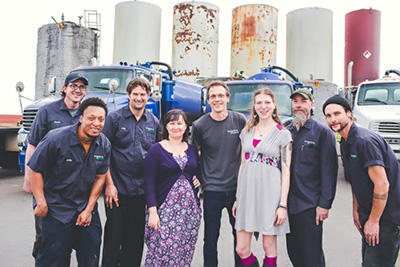 Courtesy of Blue Ridge Biofuels
Years after, loans long paid off, they came back to apply for a loan that would buy a whole building.
“We were their lender and we were able to grow their business from their first loan into a more mature state. That kind of relationship fuels economies,” Malkin-Weber says. “When things get shaky, our lending teams work really hard because we know what’s at stake in the communities where the borrowers work.”
Blue Ridge Biofuels now has 12 full-time staff working for their company—and working for the green economy, creating and selling a sustainable fuel source in a state that is still only fueled by seven percent clean energy, according to Energy Information Administration reports from 2016.
Contrast that with Wall Street Banks making billions in loans to fossil fuel projects—a practice that is dangerous for the climate and risky in a world where fossil fuels are in decline. CDFIs are investing in a better future in every way.
The Bigger Picture
These stories of green businesses thriving in North Carolina (the headquarters for Self-Help Credit Union) are just the tip of the iceberg. It’s not just a few CDFIs making small loans in a few states.
Jeannine Jacokes is the CEO of Partners for the Common Good (PCG), a loan fund that’s also a CDFI. While PCG mostly does real estate-related lending, she talks about how CDFIs use new market tax credits to fund community facilities, like charter schools, health centers, and nonprofits.
“The businesses we create [with CDFI loans] create construction jobs, but also permanent jobs,” Jacokes says. “Permanent jobs would be the people employed by all of those organizations.”
Like Self-Help, PCG has a wealth of stories to show how loans can support businesses and create jobs in a community. For example, Jobs Café at Findlay Market is a social enterprise restaurant linked to a workforce development program in an area of Cincinnati with a 56 percent poverty rate and a 23.6 percent unemployment rate. PCG has also been an investor in Equal Exchange a fair trade coffee collective that has paved the way for a mainstream fair trade movement in the US.
Jacokes has been in the CDFI world for many years, including serving over six years on the management team at the US Department of the Treasury’s CDFI Fund. She says not only are CDFIs growing small businesses, they’re growing their own industry. She says she sees more and more people coming from the traditional banking world because they are attracted to the work—they want to use their skills to make a positive impact.
Assets in management by community development banks, credit unions, loan funds, and venture capital funds (all the types of institutions that make up CDFIs), have grown significantly in the last decade. In 2010, 850 institutions managed $41.7 billion in assets. In 2018, 1,145 institutions managed $185 billion in assets, according to US SIF’s 2018 annual report.
It’s hard to decipher how many of those dollars are going into specifically green projects, but keeping money in communities and out of fossil fuel-funding banks is green in itself. If you want to contribute to the growing movement and to your community, Malkin-Weber suggests finding a CDFI in your area and opening an account to hold your rainy day fund.
“If you think about the amount of money you spend every month, you want to put your money where your values are, by buying fair trade or local,” Malkin-Weber says. “Where your money spends the night isn’t necessarily a tangible thing but it has a very big impact on the economy.”
Get a better bank
Find a community development bank, credit union, or loan fund from our national database.
Then, tell your megabank why you’re leaving. Read our 10 steps to break up with your bank.
Correction: This article originally said that the three megabanks were financing fossil fuels at $477 trillion a year. It has been corrected to billion.
|
|
Renewing Hope by Curbing Waste |
Humans have been making new things from old since the dawn of time, but it’s only been in the last 50 years that we’ve used recycling to make the most out of materials and to divert the mounting piles of material waste that come with our increasingly consumerist society.
The nonprofit recycling organization Eco-Cycle estimates that a US recycling rate of 75 percent would create 1.1 million new jobs. Right now, the recycling industry creates nine times as many jobs as conventional landfill and incinerator jobs, according to the US Recycling and Economic Information Study (EIS).
These stats echo what many business owners and consumers already know—recycling can not only create jobs, but life-sustaining careers. The recycling industry has already proven itself as a viable solution to the threats increasing material waste poses to our climate as well as the scarcity in quality job opportunities. And throughout the country, consumers, businesses, and nonprofit organizations are tapping into this promising sector within the green economy.
Curbing Waste for a Cleaner Climate
Today, the recycling industry involves the collection, sorting, and processing of recycled materials, re-manufacturing of new products made with recycled materials, the manufacturing of recycling equipment like vertical balers, the commercialization of recycled products for reuse, resale or shipment, and the age-old practice of composting.
All of these strategies work to prevent waste materials from entering landfills where if organic, they decompose and release methane gas. Materials containing chemicals can also mix with organic matter and form toxic substances that can leach into groundwater and compromise soil health. Beyond these environmental impacts, landfills can just be plain unpleasant to the senses as they fester with bacteria, oppressive odors, and prowling vermin that nobody wants in their backyard.
The US national recycling rate is 26 percent for solid waste and 34.7 percent when composting is factored in. The EPA estimates that increasing the national recycling rate for solid waste to 35 percent would cut greenhouse gas emissions by 11.4 million metric tons of carbon equivalent.
This is easier said than done as the recycling industry has dealt with changes to the market. In 2018, China enacted the “National Sword” anti-pollution policy that only accepts waste paper, plastics and metals that are no more than 0.5 percent contaminated. For US recyclers, this is daunting criteria, since US contamination rates can reach as high as 25 percent. The policy’s impact is felt across US facilities struggling to find new buyers for recycled materials. In response to China’s policy, CityLab has reported on how US facilities in Maryland and DC are improving recycling programs by making more concerted efforts to educate residents about what can and cannot be recycled. Some communities, like Montgomery County, Maryland are going back to dual-stream sorting models in which residents separate paper from other materials to prevent contamination before their bins are picked up.
The adjustments to the National Sword policy reflect the spirit of endurance in the US recycling industry. In addition to the efforts of municipalities, small businesses continue to recognize the treasure in thrown away materials by marketing to communities they know will have use for them.
In Gaithersburg, Maryland, the nonprofit Donation Nation has championed reuse as a green solution to local waste removal needs, and since it takes less energy to reuse an object than to recycle it, the company has already made a few wins for its local environment.
Founded in 2010, the organization collects items from residences and commercial buildings and has recycled and redistributed seven million pounds of unwanted items and given 840,000 pounds of reusable products to nonprofits including Interfaith Works Clothing Center, A Wider Circle, Goodwill, Salvation Army, and Habitat for Humanity.
Instead of taking products apart and recycling their materials, Donation Nation primarily collects unwanted reusable items. While most products for recycling aren’t reusable, Donation Nation has taken this approach so it can redistribute items to those in need.
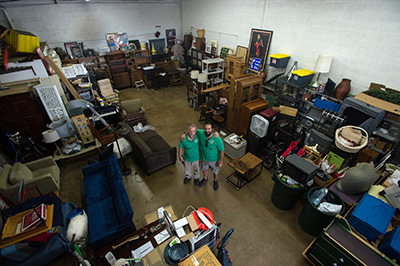 Chuck Bailey stands with his son Charles Bailey at Donation Nation, among goods that they picked up for donation and recycling to new homes. Photo by Jacqueline Malonson, Jax Photography.
Donation Nation saw a slight drop in demand recently due to 2018 tax law changes, but Bailey says the Donation Nation customer experience is more than enough to sustain the organization. Customers can choose services for junk removal, donation pick-ups, and complete clean outs. When a customer orders a pick-up of furniture, appliances or other household items, the team sorts and groups items containing similar chemicals. These grouped items are then transferred to a chemical recycling station and are used in other products like paints.
“I started the company with $300,” says Bailey. “We had humble beginnings, and it took a couple of years to get the ball rolling. But now we’ve built a reputation for having excellent service and it’s in demand for our customers. People know the other options out there and feel this is better.”
Donation Nation is also part of Montgomery county’s Ecowise program for chemicals. Through this program, some of the chemicals derived from donated items are recycled and used to make other products like oil and latex based paints, and paint thinners.
Bailey says electronics recycling has also been incentivized by the county, so he’s seeing more customers donate items like outdated computers and batteries so they can be sent to partners for electronic recycling, like the Montgomery Scrap Corporation.
Old Techniques, New Possibilities
After doing counter-explosives work as a Combat Engineer Officer during a 15-month deployment to Iraq, Justen Garrity returned to the US in 2009. Finding himself in a job market crippled by the Great Recession, he was unable to secure employment, a period he describes as one of the most difficult in his life.
“You can only be angry for so long...I started looking at different kinds of recycling and found out that two-thirds of the waste in every trash dump in America has compostable products,” says Garrity. “Whether it’s paper waste, yard waste, or food waste it just seemed like there was all this material and nobody collecting it, so I just thought it was a great opportunity.”
Garrity decided to start his own business in Veteran Compost, a composting operation based in Aberdeen, Maryland, that collects food, yard, and paper waste, and sells composts to nearby farmers and gardeners in the DC metro area. Veteran Compost provides collection services for restaurants, residences, and commercial buildings. As its name hints, it focuses on providing job opportunities for veterans.
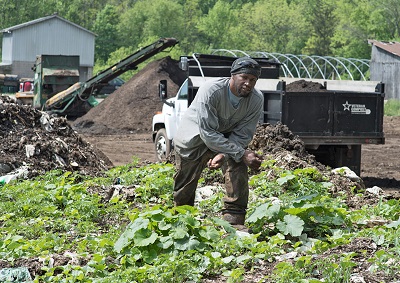 Monte Lawson stands on top of a mountain of finished compost that has vegetables naturally growing on it. In the background, is one of the fleet of trucks that picks up unwanted produce and delivers compost. Photo by Jacqueline Malonson, Jax Photography.
At the facilities in Aberdeen, Fairfax, Virginia and soon, Severna Park, Maryland, these food scraps are mixed with wood chips and left to sit in aerated piles where they remain for four to six weeks. After this “active composting” period, the compost is screened and cured for another two to six months.
Veteran Compost sells its soil to nearby urban and organic farmers, but Garrity says its most frequent customers are homeowners working on various gardening and landscaping projects.
The labor-intensity of the recycling industry that spurs demand for jobs is evident in Garrity’s business as staff have the daily tasks of transporting bins full of waste materials and composts, driving bins to and from pick-up sites, and eventually putting scraps through the composting process. Veteran Compost has hired 20 employees since 2010.
“We try to pay people a living wage and our Maryland operation is adding dental insurance and a retirement plan,” Garrity says. “A lot of our guys sometimes come to us and things in their life is a little turned around and they’re able to get the train back on track.”
Protecting Workers and Moving the Industry Forward
As the industry grows, consumers will continue to have the satisfaction of joining recycle collection programs or buying products made from recycled materials, but there remains opportunities to improve the work that makes this possible.
For workers who collect, transport, and sort materials, there are heightened risks for exposure to harmful substances and work-related injuries. The United States Bureau of Labor Statistics revealed that while the rate of injuries at solid waste collections dropped slightly from 5.2 to 5.1 per 100 workers in 2017, the rate within material recovery facilities (MRFs) rose significantly from 6.0 to 9.8 per hundred workers. What’s even more concerning is that the number of recycling and waste collection worker deaths reached 59 during 2018, according to the Solid Waste Association of North America.
There is still a ways to go to ensure recycling workers are properly protected, but the US is making steps in the right direction.
The National Waste and Recycling Association has worked with 22 states to pass “Slow Down to Get Around” laws that require drivers to slow down when around recycle vehicles for the benefit of collection workers.
Municipalities and the industry must work together for system change to curb the current trend of serious work-related injuries and deaths.The Occupational Safety and Health Association (OSHA) recommends that employers invest time in safety trainings, particularly for navigating loading trucks. OSHA also requires established protocol for handling powerful machinery like bales and forklifts, and that workers handling raw materials have access to proper ventilation and protective equipment like face masks and respirators.
Such regulations are proven to save lives, and by making safety an inherent part of recycling industry culture rather than just a requirement, businesses will make themselves more attractive to workers and investors in the long haul.
|
|
Could the World be Fully Powered by Renewable Energy? |
If the world transitioned out of fossil fuels, could we generate the energy needed to power the world on 100 percent renewable energy?
According to a new report by LUT University in Finland and Energy Watch Group, a German nonprofit, the answer is yes. The nearly five-year-long study simulated a global transition to 100 percent renewable energy by 2050 across all sectors—from power, heat, transport, and water sanitation/desalinization—and demonstrated that a sustainable energy system is more efficient and cost effective than our current energy system.
The world’s population is expected to grow from 7.7 billion in 2019 to 9.7 billion in 2050, and total energy demand is expected to grow by almost two percent annually to keep up with a higher standard of living. To match this growth, the study divided the world into nine major regions and 145 sub-regions. Energy use in these regions and sub-regions were measured hourly within five-year intervals from 2015 until 2050.
Almost all of the energy supply will be produced using a mix of existing and locally available renewable energy sources; the report emphasizes that decentralization of energy production will be vital to increased efficiency. Additionally, our we must transition from fossil fuels to electricity-based sources or biofuels, like biodiesel or algae fuels. Replacing carbon-intensive energy options in the power and heat sectors is possible by 2030, while the transport sector decarbonizes between 2030 and 2050.
The report claims that while energy supply in the fully renewable energy system will be covered by a mix of sources, solar and wind energy will lead the transition. Together, they will make up 88 percent of the total energy supply. The report predicts that a fully renewable global energy system will support an estimated 35 million local jobs, with solar leading job creation.
This report is the first of its kind to analyze a sustainable energy system on an hourly basis at a global level. It is a detailed and thorough study in support of 100 percent renewable energy and a vital testimony for climate change activists.
View the full report. |
|
The Sweet Taste of Sustainable Jobs |
If anyone wanted to find Evan Delahanty in 2011, they would have had to fly to the country of Suriname, drive through the Amazon rainforest for several hours, and kayak down a river. There, in a small village, Delahanty was serving as a community economic specialist with the Peace Corps. When his term of service ended, he didn’t want to leave the villages he served behind.
Inspired by the açaí berry that grew wild in Suriname, Delahanty began to brainstorm a social enterprise that could produce healthy fruit snacks to nurture the earth and the body. He wanted to ensure that each snack could be ethically sourced directly from farmers in the Amazon rainforest and made with whole, organic, non-GMO fruits. With this idea, Peaceful Fruits was born.
Today, Delahanty’s business supports economic stability for two communities: the sustainable farmers in South America who supply the fruits and the adults with developmental disabilities who make the snacks in the US. The product is a fruit leather that comes in eight different flavors.
“We’re both a food business and mission-based business,” Delahanty says.
When Delahanty made his first few batches of fruit snacks in 2014, he gave out samples at a local farmer’s market for feedback. At the market, he met a young man named AJ with Down syndrome who loved the Peaceful Fruits story and product. AJ was a “champion label sticker-er” and wanted to help.
“It was one of those things that grew organically,” Delahanty says. “I didn’t start working with adults with disabilities because I had a particular tie. I just needed help and they’re great help.”
After joining Green America’s Green Business Network in 2016, Delahanty pitched his company on an episode of Shark Tank in 2017. While the sharks didn’t bite, the exposure led to further growth, tripling Peaceful Fruit’s annual revenue. The company was able to move to a private kitchen soon after and has hired four full-time employees and 29 part-time employees.
Peaceful Fruits partners with the Blick Center, which provides comprehensive services to people with developmental disabilities. For those in Blick’s Community-Based Supported Employment program, the company offers an opportunity to earn a paycheck at a full wage.
“All of the folks in our program have either never had the opportunity to work competitively or have failed on multiple occasions when given the opportunity to work in the community,” says Bonny King, licensed occupational therapist and lead of the program. “We have been able to modify tasks and match the right people with the right task so that [they] can be successful.”
“For a lot of our folks, it’s more about the therapeutic and human benefits of being on a team and working in an organization than getting a paycheck,” adds Delahanty. Nevertheless, he believes a full wage is crucial. “As a CEO, it’s my responsibility to figure out how to make money while meeting those thresholds of being a good corporate citizen. It’s important for me to pay people first.”
Kim Smith is a participant in the Community-Based Supported Employment program and is one of Peaceful Fruits’ star employees.
“Peaceful Fruits has impacted me in such a great way,” she says. “I never thought I’d be able to have a full-time job working five days a week, and with Peaceful Fruits I’ve realized I can do that.”
Today, Delahanty manages company growth, production, and oversees recipes among a handful of other responsibilities. Increasingly, his job is to be the advocate and storyteller.
“[Social enterprises are] the future of doing business,” Delahanty says, “because it’s the only way that is truly sustainable as individuals, as communities, and ultimately as a planet that has finite resources.”
|
|
Bringing Renewables to Coal Country |
In the past two years President Trump has been in office, he’s been rolling back environmental regulations he says will revive the coal industry and has bragged about putting coal miners back to work.
But in reality, coal jobs are at a record low—just over 80,000 people are currently employed across the industry, and overall coal production has dropped to the lowest level in 40 years. The fact is that the shrinking fossil fuels industry from West Virginia to Wyoming has left thousands unemployed. Where the president says he’s putting people back to work, he could be working on creating a smooth fossil fuel to renewables transition.
As the clean energy industry has boomed to over 3.2 million jobs nationwide, advocates are just beginning to get a foothold in rural America. Nonprofits and people-minded businesses are fueling the clean energy transition and showing folks that clean energy can bring jobs and other economic gains.
The State of Mind
Brandon Dennison is a resident of Huntington, West Virginia, nestled between the borders of Ohio and Kentucky. In 2009, he was working on the construction of a house as a volunteer, when two men with tool belts approached, asking if there was work for them. They walked away when they found out it was a group of volunteers. The moment stuck with Dennison.
He saw that there were young people looking for good jobs—the kind of people who would be working in the coal mining industry if that wasn’t declining. Instead, they were getting jobs at fast food chains and box stores if they found them at all.
Dennison got the idea to train the state’s unemployed young adults who were struggling with generational poverty and what Dennison calls a “pervasive pessimism” from seeing their parents put out of work by the dying coal industry.
“I feel like a lot of the problem in Appalachia was that our economy was so based in extractive industries and that’s what got us to the stressed situation we’re in economically, socially, and environmentally,” Dennison says. “We’re trying to model what a new and better and more sustainable economy could look like. There’s a social and environmental angle. I also think there are real business opportunities in the green economy, and so we’re trying to seize on those.”
Dennison originally called his nonprofit the Green Collar Jobs Initiative, but he found that folks weren’t convinced by the name.
“[In Appalachia,] there’s a skepticism and reticence with anything green. There’s a perception that it’s going to be unicorns and rainbows and fluffy fluff,” Dennison says, chuckling. “And, getting things moving again can be a heavy lift. It can be harder to propose new ideas here than in places where the economy is more vibrant, where there’s more money flowing and more optimism.”
Building a Workforce
In the years since he started his nonprofit, Dennison changed the name from Green Collar Jobs Initiative to Coalfield Development. It is succeeding in attracting students out of vocational high schools, unemployment offices, local Department of Health and Human Services offices, and Temporary Assistance for Needy Families offices. The organization includes five social enterprises, which teach job skills in solar energy; green construction; food and farming; rehabilitating mining sites, like mountaintop removal; and artisan skills.
Coalfield Development designed its programs to address a concern from local workers that certifications weren’t enough—young workers wanted experience in their desired fields, not just classroom time. Dennison notes that a person can’t apply for unemployment unless they can prove they lost their job. These young people were stuck in a cycle—they couldn’t find jobs to get experience and to get paid, couldn’t find money to get training without having a job. Dennison wanted to help get people out of the rut for the long term.
Crew members at Coalfield Development participate in its “33-6-3 program.” After signing onto a 30-month contract to be part of Coalfield’s crew, a crew member works for pay 33 hours per week in their enterprise of choice—like working on a farm, installing solar panels, or rehabbing old buildings. He or she also does six hours of college classes to create a modern, skilled workforce.
“Once we got started, we realized that a lot of the challenges that were tripping up our crew members were ‘life stuff’: health problems, mental and emotional health issues, transportation barriers, financial management breakdowns,” Dennison says. “And a pervasive pessimism that can put people in a really tough mindset to learn and grow.”
So the program added on three hours per week of personal reflection and growth sessions—which Dennison says is both the hardest and the most transformative.
When they’re done, crew members have over two years of job experience, an associate’s degree from a community college, and the personal skills they need to manage their adult lives.
The program has been extremely successful since its start in 2010. As of April 2019, Coalfield Development has trained over 850 crew members, created over 190 new jobs, placed 95 alumni in full-time careers, been a part of starting 40 new businesses, and redeveloped 187,000 square feet of formerly vacant property.
Coalfield isn’t just growing for the sake of it—the demand for skilled green workers is there, even in West Virginia.
Finding Meaningful Work
A few hundred miles north and west of Huntington, a business called Solar Holler started putting solar panels on the Presbyterian church in Shepherdstown, West Virginia. Despite the church’s financial struggles, the company’s owner, Dan Conant, figured out a creative way to fund the church’s installation, and planned to do more of the same so he could bring down utility costs for nonprofit organizations that were doing so much good in their communities.
But with that first project, Conant immediately saw the limit of the folks who knew how to install solar panels in the area—he’d already hired them. He knew they had to find more workers.
So he called Brandon Dennison, and Solar Holler started sponsoring Coalfield Development’s program “Rewire Appalachia.” Eventually, it just made sense for Solar Holler buy the whole program off of Coalfield Development and continue the 33-6-3 model to develop its own workers.
“That partnership was a way to build up folks to meet the demand in the state. But it was also a way to put our labor dollars back into communities where that was needed and powerful,” Connant says. “The program gave folks that we were working with a chance to stay at home and not have to leave the state to get a job.”
Getting Communities on Board
Steve Lieske has been running Harmony Solar as a side gig in Laramie,Wyoming for 12 years. He and his clients have a lot in common—he’s not in the solar business for the money, and they’re not expecting to get save much money, either. Lieske says his clients are mostly close to or in retirement, have a bit to spend, and are interested in leaving a positive legacy.
The Solar Energy Industries Association (SEIA), a solar energy trade group, ranked Wyoming last in solar jobs—meaning there were fewer solar jobs there than any other state—with a mere 190 employed. The state gets only .02 percent of its energy from the sun, despite being ranked eighth for solar capacity by SEIA, meaning direct sunlight is plentiful and precipitation rare.
Lieske explains that the hesitancy to move towards clean energy is because of the state’s historical reliance on fossil fuels. Wyoming supplies about 40 percent of the nation’s coal and produces about two percent of the country’s crude oil.
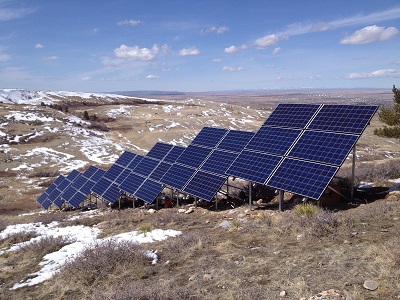 A privately owned small solar array on Casper Mountain in Casper, Wyoming. Photo by Stacey Schmid of Range Solar and Wind
“The problem is that renewable energy in a place like Wyoming has always been a culture war. This state has been supported by coal, oil, and gas since the beginning of the modern era,” Lieske says. “They’re the reason we have good times when we do have good times, they’re the reason we have bad times when we’re in the middle of a bust. People have a profound emotional connection to coal, oil, and gas in this state, and they see renewables as a threat.”
Because of its ties to the coal, oil, and gas industries, Wyoming’s legislators have done little to incentivize solar. Without tax credits or any state-wide incentives, solar installations remain quite expensive. Lieske says when something takes 12 years to pay for itself (partly because of extremely cheap electricity from coal in the state), it makes it a much harder sell. In the 12 years he’s been running Harmony Solar, he’s done only about five or six installations per year. But times are changing.
How Scaling Up Changes Minds
Wyoming’s first utility-scale solar project was built last fall. It creates 80 MW of energy, enough to power 12,000 homes. It’s not a lot, compared to say, California, which recently hit a new record of producing over 11,000 MW of solar. But there has to be a first project for there to be a second, and a third.
Kelley Welf works at Clean Grid Alliance, a nonprofit that educates and builds support for clean energy projects, like utility-scale solar and wind projects in nine Midwest states (not including Wyoming). Welf explains that it can be tricky to get a large clean energy project built in any community. Usually, solar or wind companies do their own research to find well-suited areas before approaching a town or county to start the project. But, plans can be delayed or halted by groups fighting against clean energy progress, because they think the array will be ugly, think they will have negative health effects, or generally are afraid of the unknown.
Though cities are more likely to have broad support for clean energy, rural communities are most likely to become home to these projects, because of the needed acreage.
Clean Grid Alliance’s website has resources for folks in rural communities whose towns have been sited for a clean energy projects. Trump administration officials argue that we need fossil fuels to have a strong economy. But that isn’t true. Since 2009, solar prices have dropped by 88 percent and wind prices fallen by 69 percent. Clean energy projects continue to cost less and fuel the economy more.
Welf explains the boom that happens when crews come to do a massive installation. Local businesses from hotels to hardware stores benefit not just during the install—often companies will set up offices with a few workers to manage the site. Projects also generate local tax dollars which pay workers like teachers and firefighters. Warehousing and manufacturing create jobs in other locales.
Wyoming may already be feeling a sea change. Lieske is already booked for 12 consultations this spring—and it’s not quite building season yet, with snow still falling in Laramie in late May.
But remember, Wyoming is a clean energy laggard, and large-scale projects can have an outsized impact. Indiana utility NIPSCO has been running on 65 percent coal energy, but recently decided to make the switch to 100 percent renewables in the next decade. Corporate purchases of renewables rose to 8.5 gigawats in 2018, equivalent to the capacity of all utility-owned renewables in the US. That growth is partly because of major purchases from AT&T, T-Mobile, and Amazon, all of which have been recent targets of clean energy campaigns by Green America.
“The solar business has been a bit of a sideline job for twelve years now,” Lieske says. “Our hope is for all [three] of us to be able to drop our day jobs to be able to do this full time.”
|
|
Green Industrial Jobs Energize Cities |
From Detroit to Baltimore, some old industrial cities are being revived by workers who are also getting a new lease on life.
When you think of American cities, what scenery comes to mind? For some, it’s towering buildings and congested traffic, while for others it may be vacant homes and slow-moving construction. Whether we’re talking about cities thriving with emerging businesses or those stagnated by economic crises, it can be easy to forget that urban spaces are homes to local communities and environments. And it matters what types of industries live there too.
For example, as a result of power plant energy production in Detroit, Michigan, the prevalence of asthma among adults was 46 percent higher in Detroit than Michigan as a whole in 2019. The Baltimore-Washington metro area is the second most traffic congested and ozone-polluted region in the US, according to the Chesapeake Bay Foundation. Though happening in different regions in the US, these cases illustrate the interconnected need for reform—reform as radical and ambitious as the Green New Deal.
When Massachusetts Senator Ed Markey and New York’s Rep. Alexandria Ocasio-Cortez introduced legislation for the Green New Deal in February 2019, its proposal for greenhouse gas reductions, smart energy, and green job creation was criticized for being lofty and costly. While Green America has made recommendations to strengthen the Deal, we don’t count its broad framework as negative. In fact, it represents the kind of positive radical change the global community needs to beat the climate crisis. Though skeptics may question whether the Deal’s vision is possible, the growth of the clean energy sector and the organizations leading training programs have already proven the possibility of jobs that steward the environment and promote socioeconomic mobility, and they’re gaining momentum.
Green job skeptics can also consider this: it took 40 years for the US solar market to reach its millionth installation in 2016, but in the eight years since, it's already installed over three million more. Wind power continues to break records with over 134 percent growth in the past 10 years, the US solar and wind industries produce enough combined energy to power 61 million homes. So far, 38 states and the District of Columbia have committed to renewable portfolio standards—programs that require utilities to source a portion of their energy they sell from renewable sources.
These statistics show that industries that barely existed 30 years ago are now driving demand for workers nationwide and this growth comes at a time when many people from under-resourced communities need well-paying jobs.
Powering Brighter Futures with Solar Energy
Maryland’s solar industry is expected to grow, thanks to the passage of the Clean Energy Jobs Act, which commits to 14.5 percent of the state’s power coming from solar energy by 2030. But in 2022, 41 percent of solar companies in DC, Delaware, Maryland and Virginia reported difficulty in finding skilled workers, according to a regional solar industry association.
Civic Works’ Baltimore Center for Sustainable Careers (BCSC, previously known as B’more Green) wants to change this by providing profitable trade skills to Baltimore residents with barriers to employment.
BCSC has connected Baltimore residents with sustainable job opportunities since 2003 and includes one of Maryland’s first solar panel installation training programs. Baltimore has long faced challenges in developing strategies for crime prevention and investments in public education. The prospect for a well-paying job can make all the difference in the lives of residents, especially those resisting the gravitational pull of recidivism.
“A lot of people in Baltimore city don’t have life-sustaining jobs. The national unemployment rate for African Americans is actually down, but it’s not about being unemployed. It’s about having employment that you can’t survive on,” says Christopher Dews, the Civic Works training coordinator.
Dews helps execute the program’s recruitment strategy, which targets Baltimore’s unemployed, underemployed, and at-risk of incarceration residents.
“We want to reduce incarceration rates for marginalized people by preventing them from resorting to illegal means to make money because a lot of their needs are fundamental, from housing to food to clothing, to paying for kids and transportation,” Dews says.
Through the BCSC solar training program, trainees receive a three-month course with 320 hours of the on-the-job training, as well as certifications from the North American Board of Certified Energy Practitioners and OSHA.
In Detroit, leaders are creating similar opportunities with the Detroiters Working for Environmental Justice (DWEJ) Future Build program. Founded in 1994, DWEJ distinguishes itself as the oldest environmental justice organization in Michigan and runs the Future Build program that provides trainings in solar installation, residential and commercial construction, and lead abatement. DWEJ hires its own trainees through the organization’s company, the Future Build Construction Group, and targets people who want to get out of a dead-end, low wage paying job cycles.
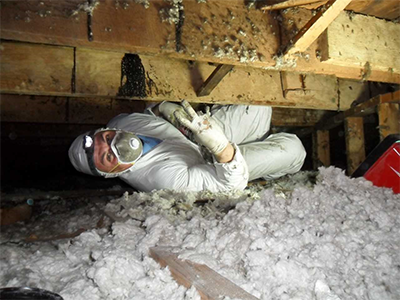
“The Future Build idea came about because we wanted to create a company that’s friendlier to people who don’t have the skills,” says Brian Duell, trainer and Future Build Construction Group Chief Operating Officer. “Most times people can’t get the job because they don’t have any experience and they can’t get the experience because they can’t get a job, so we want to break that cycle.”
Energizing Residents with Green Careers
Both Baltimore and Detroit are what the Brookings Institute calls “older industrial cities”—those that have held strong manufacturing industries historically but have struggled to grow jobs in new sectors and boost incomes, especially for communities of color. Green job training programs are relevant not just for their ability to accelerate economic mobility, but to encourage inclusivity in industries where some demographics aren’t always represented.
Detroit contains five of the most polluted zip codes in the state of Michigan, and its residents pay twice as much of their household income on electricity bills than other residents throughout the state. Because of that, Detroiters have a unique stake in the city’s construction and energy production industries. Consulting group Grand View Research reports that the energy retrofitting industry is projected to grow by nearly 7 percent from 2024 to 2030.
“We’ve had construction companies come here from outside Detroit to do major work to revamp commercial buildings and the hiring that’s been done isn’t reflective of the actual demographics of the city,” says Duell.
His observation reflects a larger challenge within the clean energy sector, where less than 32 percent of workers are women and less than 10 percent are African American. At DWEJ, the Future Build program is targeting those looking for living wage careers, and for Anetha Walker that journey was one of reinvention.
After working for years as an educator, at age 54, Walker connected with Operation Able, an organization helping people to re-enter the workforce and a simple flier led her to Future Build’s energy weatherization training program. Walker graduated from the program in May 2017 and has since become a trainer herself to Future Build students.
“When I teach people something that’s related to their everyday life, like how much energy their light bulb is spending, they’re so shocked and that’s the best part for me,” says Walker.
At Civic Works in Baltimore, leaders are confronting the realities of recidivism and discrimination head on, with a plethora of job-readiness services including transportation assistance, case management, resume workshops, interview preparation, and even cognitive behavioral therapy.
Instead of expecting trainees to transition immediately to full time jobs after graduation, BCSC pays for trainees to work at partnering businesses for a two-month probationary period to ensure a good fit for both the employers and employees.
“Even though graduates have the book knowledge and the hands-on experience, businesses may say they don’t have it in their budget or they don’t know the person and it may be difficult to build trust,” Dews says. “We mitigate that aspect by telling the employer that we will front the majority of the money for our trainee(s) to work there for two months.”
Since Civic Works entry level positions pay an average $14 to $18 an hour, these opportunities can be a game-changer in the lives of Baltimore residents.
“I had gone to one of the information sessions, and even then I was undecided. But I figured that I’d taken chances with so many other things, why not take this chance,” says Christian Jenkins, a Civic Works trainee in the energy weatherization program.
Jenkins learned about Civic Works through his probation office. “The staff seemed like they really had our best interest in mind. Now it’s all about putting my training to use.”
Stewarding Cities
One of the projects Duell and Future Build trainees worked on was an abandoned home acquired by the interfaith anti-poverty nonprofit, Focus Hope. The building became a candidate for LEED platinum certification and net zero energy use. Duell says that while not everything done on such a project can be incorporated into the homes of average Detroit tenants and homeowners, there are ideas that can be forwarded to help people make their homes healthier and more energy efficient.
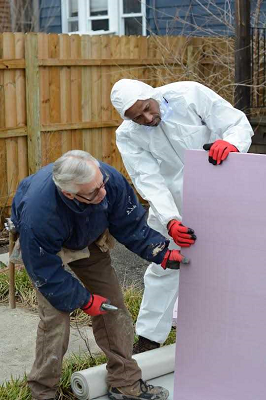
“For people in Detroit that have a low- to moderate or fixed income and live in older homes, incorporating things like air sealants can save hundreds of dollars for homes that are extremely drafty,” says Duell. He adds that installing insulation, and reducing lead exposure by getting rid of lead paint can be game-changers.
DWEJ’s Future Build program partnered with the nonprofit YouthBuild to create cohorts to engage in 12-14 week long trainings to rehabilitate houses, including those assigned to the city’s demolition list, so they can be re-sold to low income residents, at around $30,000 each. The work that goes into these projects include electrical wiring, plumbing, strategic insulation, high efficiency water heater installation, and painting with zero-VOC products.
Beyond cities like Detroit and Baltimore, green job training programs are continuing to gain popularity. From urban farming organizations in Columbus, Ohio, to solar installation trainings in Los Angeles, these programs make new deals with everyday Americans looking to reinvent themselves and make the prospect for a Green American Dream a little more real.
Updated September 2024
|
|
Be Your Own Green Boss |
These Green Business Network members didn’t wait around for their industries to get greener—they took the plunge and did it themselves.
Small business owners are big thinkers. Entrepreneurs, and our very own Green Business Network® (GBN) members in particular, have pioneered many green economy trends of today—socially responsible investing, community banking, organic clothing and foods, and reusable items to replace single-use. They’re not just visionaries—small business owners are big job creators too, adding .52 jobs per firm in February of this year, a 45- year high for new small business jobs.
As these ideas and products have been scaled up and entered the mainstream, GBN members continue to be on the forefront. Here are stories of three of our 2,500 GBN members—entrepreneurs that saw a gap in the market and decided to start a business to fill it in a green way. We spoke with three business members who saw an opportunity, got inspired, and created businesses to serve their communities—or the whole country!
Planting Gardens in The Swamp
Meredith Sheperd
Love & Carrots
Washington, DC
Member since 2013
Meredith Sheperd had farmed and worked in environmental nonprofits but saw an unmet need in her Washington, DC community. Looking around the city, Meredith could see plentiful yards, roofs, and patios that were sitting idle, despite abundant space and favorable growing conditions. DC’s building height limit means no skyscrapers, allowing more sun to get to ground-level gardens. Surely there could be a way to get people to grow food and increase environmental stewardship.
She put up a homemade flier in local coffee shops offering to help people and businesses start gardens, and she reached out to local listservs and her informal networks. It worked. The first summer she planted around a dozen gardens and purchased her first company vehicle, an old pick-up truck. From day one, Meredith’s been trying to keep up with demand.
Nine years later, Love & Carrots has grown over 800 organic, regenerative gardens—in homes and at businesses and organizations in DC, Maryland, and Virginia. What started as seasonal work with the help of friends and volunteers has turned into a successful small business that employs 17 people full time year-round. Countless others are impacted by the beautifying and greening of neighborhoods across the area. Sheperd’s fellow GBN members were so impressed with her work that they voted to have her represent them on Green America’s board.
For the greatest impact, Sheperd and her staff nurture their gardens regeneratively.
“I very much believe that restorative agriculture and organic gardening are an important part of our future—for the human race and the planet,” Sheperd says.
She and her staff have a deep knowledge of the effects of agricultural chemicals on communities and ecosystems and focus on building healthy soils in all the Love & Carrots gardens. Healthy soils lead to robust micro-ecosystems in backyards, which is better for the gardener, the community, and all the plants and animals that live in these urban and suburban spaces.
“That’s why I became a farmer, because I cared about the environment,” Sheperd says. Business owners and hobbyists who relate to Meredith’s attitudes on regenerative gardening might feel at home in Green America’s Climate Victory Gardening online community, at facebook.com/groups/CVGardeners.
Love & Carrots and its gardeners for hire aren’t just growing food, they’re growing a movement: the knowledge of gardening, healthy food, and awareness around environmental issues. They’re hands-on, offering coaching and an apprenticeship program for those looking to learn more. Creating excitement around fresh, healthy food is the first important step in helping people appreciate the natural world and embrace an environmental perspective.
Sheperd’s perspective on the future is positive. She’s working toward making organic vegetable gardens a common sight in urban landscapes. And, growth in the urban farming and agriculture sector has her hopeful.
“Young people especially feel high stakes in what’s happening to our planet, so I think they care very much about being green and protecting the environment,” Sheperd says. “I see the green economy really continuing to grow and thrive and expand and become a larger share of what keeps everything coming.”
Banking on a Green Retirement Fund
Rob Thomas
Social(k)
Springfield, MA
Member since 2006
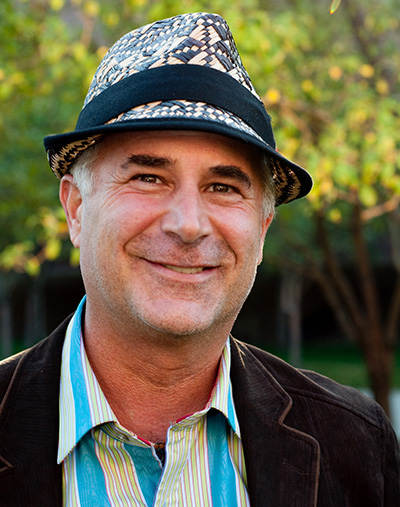
Rob Thomas was working for a Wall Street investment firm when the stock market crashed in 2000 and he found himself wondering where to take his career next.
Over the years, Thomas had engaged with sustainable communities as an inaugural member of the nonprofit Slow Money Movement and as a volunteer at Gasoline Alley, an organization that teaches youth entrepreneurship and uplifts neighborhoods with socially responsible business practices.
After witnessing the greed of the tech bubble and despair from the bust, Thomas wanted to use his background to green the investment sector. That’s when he came up with the idea of creating the country’s first 401(k) with ESG options. That is, Environmental, Social, and Governance criteria that ensured conscious investors were putting their money into businesses and causes that aligned with their values. [Editor’s note: ESG investing is often used interchangeably with socially responsible investing (SRI)]. In this new internet age, he thought this plan could be the first retirement plan to be fully paperless.
The mission hasn’t changed since he started Social(k) in 2005: “to provide people the option to invest their money in conscionable companies which prioritize social and environmental responsibility alongside continued profit growth.”
Research over the years has proven that socially responsible investments can compete with conventional investments. For years, it was believed that people had to choose between their values and profitable investments. Many advisors weren’t promoting or supporting SRI, instead pushing index funds with the suggestion that investors donate a portion of their profits after-the-fact. Thomas suggests this is an antiquated understanding of responsible investing.
“We need to fight that story. History is showing that this is outdated,” Thomas says.
As of 2018, according to the US SIF Foundation, there is $12 trillion under professional management now involved in a socially responsible investing strategy.
After the financial crisis of 2008, investors eased back into the market and SRI investing options experienced immense growth. Companies are adopting SRI as it makes its way into the mainstream, because those that don’t have an SRI fund in their 401(k) are missing out on something eco-minded staff might see as a big benefit. According to a 2019 survey from Natixis Investment Managers, 61 percent of employees said they would be more likely to save for retirement if their plan offered SRI options. Only 13 percent said they currently had access to those plans.
Thomas aims to make SRI retirement plans as easy as possible on employers and workers.
“We’re helping the employees have a better retirement product, and we’re helping employers attract these employees who care.”
He does this by allowing employers to outsource all this work, to him, so they can continue focusing on their mission.
Social(k) is still a one-man show, but the work he’s doing is leading to more and more advisors and investors who understand ESG and 401(k)s at some of the largest companies in the market. And of course, the impact of that investment is huge—it means whether your job is green or not, your retirement savings can be creating a green economy and more green jobs.
Creating a New Kind of Green Screen
Judy Mazzuca
Ink Forest
Chicago, IL
Member since 2014
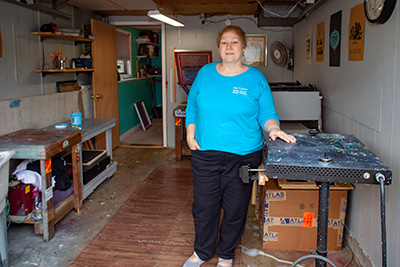
When Judy’s children left for college in 2013, she began exploring options for life after being a stay-at-home parent. Three decades earlier, she had seen a screen printing demonstration that stuck with her. She began researching and decided to start her screen-printing business, Ink Forest .
Quickly, Judy learned that the printing industry is full of chemicals that are known endocrine disruptors, carcinogens, and environmental pollutants. With her own concern for toxic chemical exposure, Mazzuca tapped into the ethical fashion movement that has been growing for decades and is being boosted by demand from millennials—73 percent of whom globally said they’d pay more for sustainable goods, according to a Nielsen report.
“The apparel industry is extremely polluting, so I choose organic cotton and water-based inks. Once I started doing research and realized how dirty it was, I knew I was going to find another way. I didn’t want to be around those chemicals—I’d lived a pretty clean life.”
Judy thinks back fondly on her first clients, Vegan Street, who she says gave her a chance to hone her skills and find the best methods to align with their shared values.
“A lot of my clients are people starting their own small businesses, and I will always help them out, because that’s how I got started—someone gave me a shot.”
Since then, Judy’s worked with businesses and organizations, large and small, including the Obama Foundation, Everlane, and you likely saw some of her shirts, posters, and baby onesies at women’s marches across the country.
In February 2019, Judy’s business Ink Forest became the country’s first certified woman-owned and certified Green screen printer.
Incredibly, Judy didn’t consider herself a creative person when she started. Today, she’s the owner, printer, manager, and accountant for all of Ink Forest’s work—with some artistic help from her husband, she mentions.
“If we couldn’t print green, we wouldn’t print at all” is Judy’s business motto, and it’s clear that this is at the forefront of all the work she does. She sources clothing from suppliers with organic, fair trade, made in America, and sweatshop free options. She uses vegan, water-based inks that are better for her, the wearer, and the planet. Judy lives a green life and wanted her business to reflect that. Luckily, there were customers out there looking for the same.
Many of Judy’s clients are ethically minded and care deeply about her efforts to green an industry that’s often plagued with chemicals. She’s had her business model questioned: Isn’t it too expensive and time consuming to print in a green way?
Judy’s response is simple: the costs aren’t that great and, anyway, it’s worth it.
“I don’t charge my clients extra to use the inks, because I choose to do this. I eat the cost, because this is important to me.”
For her, this green business model has been a success, with her business growing every year and happy, healthy clients.
|
|
Green American Feature: The Green Economy at Work |
At Green America, we get asked if a green economy could really provide good paying jobs and careers. The answer is that several million people nationwide are already working in green jobs. What we tell naysayers is that there are companies big and small that are making their green dreams work—and growing the green economy by hiring more folks to help them.
The much-anticipated Green New Deal was introduced by Alexandria Ocasio-Cortez (D-NY), Ed Markey (D-MA), and other supporters in Congress in 2019. It failed to pass through the Senate, but the Green New Deal for Public Housing Act was reintroduced in March by Ocasio-Cortez, Sen. Bernie Sanders (D-VT) and Rep. Delia Ramirez (D-IL). We at Green America see our work and the work of our members in the Deal. .
What’s especially exciting is that as much as the Green New Deal was about desperately needed clean energy jobs, which we work for through campaigns like Hang Up on Fossil Fuels (see page 4), it’s about more than that. The Deal represents a massive investment in a green economy that can radically reduce climate emissions and enhance social justice. In that way, it’s a representation of what Green Americans have been working toward for decades.
You can see the social justice commitment in the Deal when it comes to fossil fuels. It’s easy to say that they should go away and make room for the clean energy revolution.
The reality is that many jobs in dirty energy, like oil, gas, and coal-fired power, are well-paying jobs that are unionized and provide benefits to workers—often in regions with depressed economies where good pay can be hard to come by, as illustrated in the piece “Bringing Renewables to Coal Country” (p. 22). Whether jobs are disappearing because of a transition to clean energy or because technological innovation removes the need for many workers, people rationally fear losing the paychecks and benefits they have. We must ensure that jobs created in the green economy are ones that pay well and provide opportunity for growth for diverse populations in all states, not just the few that are on stores of oil and coal.
The clean energy industry now employs over 40 percent of all energy workers in the United States, and demand has increased by more than 10 percent in the past two years, according to E2’s Clean Jobs America report from September 2023.
While industries and utilities are scaling up demand for clean energy, the small business sector has an important role to play in the green economy as well—approximately 61.7 million Americans worked in small businesses in 2023. Companies with under 500 workers (the definition of a small business), do outsized work driving innovation in our economy, by creating products, systems, and patents that start small and scale up across the supply chain. In this issue, you’ll meet small businesses from all over the country that are part of this green wave.
Importantly, the Green New Deal and green businesses must address the disparities of women and people of color working in green jobs (see letter on p. 30), especially in the clean energy industry. For the economy to be truly green, it must include everyone.
When Brandon Dennison was talking about what made him want to start a green jobs training program in the heart of Appalachia (p. 22), it wasn’t just about doing the “right,” green thing.
“I feel like a lot of the problem in Appalachia was that our economy was so based in extractive industries and that’s what got us to the stressed situation we’re in economically, socially, and environmentally,” Dennison says of why he decided to start an organization based specifically in green jobs. “We’re trying to model what a new and better and more sustainable economy could look like. There’s a social and environmental angle. I also think there are real business opportunities in the green economy, and so we’re trying to seize on those.”
Updated September 2024
|
|
9 Smart Money Tips for Students Starting College |
This fall, many young people will be leaving home for the first time to begin the challenging and exciting experience that is college life. Some students will do well managing their own money for the first time, and some will struggle to manage their expenses.
“When I went to college, I was an idiot with my credit cards and money,” says Jill Geroux of Green Bay, Wisconsin. “I had never learned to save or use my money properly. So when I had credit cards for the first time, I was just like, ‘Yay, free money!’”
Soaring tuition costs coupled with financially unprepared students spell a recipe for financial setbacks. Today, the average American student leaves college with more than $37,000 in debt, including student loans. The total US student debt is at $1.56 trillion, according to data from the Federal Reserve. When it comes time for a young person to leave home and manage money for, perhaps, their first time, these steps can pave the way for a lifetime of financial wellness that also respects people and the planet.
1. Create a Budget
Though they sometimes have a negative association with restriction, budgets are your friend, and they’re fairly simple to make. First, identify your income for the year, including paychecks if you have a job, grants, loans, and family contributions. This will give you an idea of how much you have to spend each month, after which you can make a plan to fit your spending needs on groceries, transportation, etc. Whatever is left over can be set aside for future expenses like trips or simple pleasures: a latte every now and then is okay.
Free apps like Mint and EveryDollar can helpful plan and keep track of income and purchases.
2. Choose A Green Bank (and Credit Card) from the Start
“As students start on their financial life it’s a great time to consider having relationships with financial institutions that match their values,” says Morgan Simon, board member of the student activism group, the Responsible Endowments Coalition. “Students can do this by opening accounts in a community bank or credit union.”
Simon’s message is right in line with Green America’s philosophy. College is an opportune time to start building a green financial foundation. Students can get experience managing their money by taking advantage of customized student accounts offered by community development banks and local credit unions. Common features of these accounts include zero or waived maintenance fees, no minimum balance requirements, overdraft protections, and competitive interest rates. NerdWallet.com offers a list of accounts with these features and students can also search for socially responsible banks in their area at greenamerica.org/GetABetterBank.
“People often keep their first bank account all their lives,” says Fran Teplitz, Green America’s executive co-director. “So starting college is a good time to make sure you choose one that serves communities, not Wall Street.”
Green credit cards also exist, like Green America’s Platinum Visa credit card which includes a zero percent annual percentage rate for the first year, plus travel benefits and reward points. Students can also search for credit cards provided by community development banks and credit unions at greenamerica.org/GetABetterBank.
3. Keep Credit Card Debt Low
It’s important to not make Geroux’s mistake and treat credit cards as an infinite source of cash. High credit balances and missed payments can prolong the time it takes for students to get on their feet after graduation, as poor credit can jeopardize job searches, apartment rentals, and home purchases.
Establishing a solid record of credit card payments can help students build credit, which will, in turn, make future loans and purchases for a car or apartment a lot easier to secure.
If you’re about to sign up for a credit card for the first time, remember:
- Start with a prepaid card to get in the habit of budgeting a finite amount of money. (You can pre-pay with cash from your student loans, a part-time job, or gifts from relatives.) Keep an actual credit card handy in case of emergencies.
- Take the time for research. Look at spending limits, interest rates, and terms to make the best choices for yourself. You may want to check out credit cards that are designed specifically for college students. They may include benefits such as low interest rates and cash rewards. However, be just as aware of the cons like high fees for late payments.
- Build credit responsibly. Only spending what you can afford to pay back and paying your card off in full each month will keep fees away and build your credit score.
Lenard Cohen, owner of the financial planning company CF Services Group says, “if [students] do have a credit card, they should pay it off every month or avoid using it often. And always pay on time because those late fees rack up like crazy.”
4. Monitor Your Credit Score
Three major companies provide free annual credit reports: Experian, Equifax, and TransUnion. Get a credit report from all three companies at least once a year to check for errors or identity theft and to get as thorough a review as possible. Free sites like CreditKarma and FreeCreditReport.com give users access to just one of these reports, leaving room for error.
Note: it’s a myth that checking your credit score will lower it—that’s only the case when lenders or credit card issuers inquire about your score, for example when applying for many credit cards at the same time.
5. Get a Part-Time Job
Besides the main perk of putting some money in the bank, studies show that part-time jobs have real benefits for students, by helping them build community and sharpen organizational skills, according to the National Center for Education Statistics.
But, the same studies show that working full-time can have the opposite effect on students, especially those coming from lower-income homes who are under greater pressure to work.
So, it makes sense to also take advantage of financial aid, work study awards, and scholarships to help mitigate college costs. Folks who graduated in 2018 left $2.6 billion in federal Pell grants unclaimed. Don’t miss out: learn more about FAFSA requirements at benefits.gov. Forbes magazine also offers a guide to the FAFSA application.
6. Be discount-obsessed
It’s important to make time for fun and relaxation, but too much expensive entertainment can blow holes in your budget. Take advantage of free and discounted on-campus events, and use campus fitness centers instead of paying for costly gym memberships.
It’s common for companies that cater to students, from movie theaters to software programs, to offer discounts in the form of student membership programs. If you’re not sure whether a company has a student discount, it’s always worth asking. That student ID has power, go use it!
7. Take a class on financial wellness
Explore what low-cost financial literacy programs your college has in place and reach out to administrators and academic advisors who may have information on community-wide programs that are open to students. Students can also sign up for a free account at CashCourse.org, a project of the National Foundation for Financial Education. CashCourse offers students articles and videos on the how-to’s of budgeting, financial aid and loans, filing taxes, and paying rent.
8. Join Your Campus Sharing Economy
Buy textbooks from your friends. Share a Netflix account. Trade for goods and services among your peers. College campuses are full of people with diverse resources, talents, and emerging side hustles. You can utilize these all by tapping into campus networks through apps like GroupMe, WeChat, and Kik Messenger. The college journey is full of expenses, from clothes and class materials to textbooks and transportation. So, if you want your dollar to go far, go together.
BONUS TIP: Get an SRI Retirement Plan
Once you’ve landed a full-time gig after graduation, inquire about what socially responsible investment (SRI) retirement plans your employer offers. Unlike conventional retirement plans, those with an SRI focus can help you avoid investing in companies with interests and activities contrary to your green values. Even if it’s not an SRI plan, don’t delay contributions to a retirement plan, it can make a big impact in the long term. Learn more about SRI retirement plans at greenamerica.org/SRIretirement.
|
|
Diab Trading Group, LLC |
We provide a plethora of jobs for the Acacia tree farmers of the Kordofan plains of The Sudan. Moreover, we ensure that they are adequately compensated, that their children are educated, and that medical care is provided. Moreover, our supplier employs underrepresented groups in the Sudan - women and farmers from the margins of the country that have been traditionally marginalized by a central and urban elite.
Naturally, the plucking of the Gum Acacia from the Acacia trees leads to the overuse of the Acacia trees. On this end, we work with our supplier to ensure that the Acacia trees are replanted, that the landscape is adequately taken care off, and that the processing of the Gum Arabic into the fine powder minimizes industrial waste. |
|
Explore Widely, Tread Lightly |
Explosions of poppy flowers color the countryside of California in vibrant shades of gold and orange, signaling the end of long nights and the start of warmer days. Butterflies and people alike respond to the arrival of spring by visiting the blooming hills—but only one is trampling the sights.
This is the image of the 2019 California poppy “super bloom.” Yet, instead of being popular for its beauty, it’s infamous for the people destroying it for the perfect selfie. Many uninformed visitors have trampled vegetation by walking off-trail, leaving behind dead flowers and compacted soil. This isn’t the first time natural places have witnessed harmful human activity—parks including the delicate Joshua Tree National Park experienced vandalism and waste overflow during the government shutdown earlier this year.
Whether you’re heading out on a hike or paddle this summer, remember these guidelines to reduce your impact on our precious parks.
Follow Leave No Trace Outdoor Ethics
Whether you are a seasoned outdoor recreationalist or an occasional visitor, you have likely heard of “Leave No Trace.” It is a collection of principles that serve to educate visitors in minimum-impact practices based on extensive research on human impacts and attitudes towards the outdoors. These range from minimizing campfire debris to being considerate of other visitors. While the phrase itself is a mantra for seasoned outdoor enthusiasts, Mitch Warnick of the Leave No Trace Center says it’s meant for everyone.
“We can treat Yosemite National Park the same as Piedmont Park in Atlanta,” Warnick says. “They’re both public lands, open space that are a valuable natural resource. Everyone can benefit from understanding Leave No Trace principles.”
Pack it In, Pack it Out
Don’t leave behind litter when visiting any public land. Many locations have bathrooms and disposal bins, but you may have to bring bags with you when visiting more remote areas. While micro-trash (cigarette butts, fishing line, wrapper scraps) is easy to overlook, it is dangerous to wildlife that may confuse it for food.
It might seem like leaving biodegradable items behind could be an exception to this rule. Unfortunately, most things labeled as biodegradable or compostable are missing one important word: “commercially.” Many of these items can only be broken down in commercial composting facilities—throwing them into your backyard compost or leaving them at a park doesn’t mean they will break down on their own. Even items that are naturally biodegradable such as orange peels cannot be left behind. Essentially, if it is not natively found in the park you’re visiting, it does not belong there. This is critically important for popular parks that see thousands of visitors each year.
“There’s certainly a notion that with many people, their impact is very small,” Warnick says. “But if a thousand other people do that, then it starts to become fairly problematic and can have a large impact.”
Stay on the Trail
Going off trail compacts the earth and creates a new “social” trail. Social trails are tracks that others follow thinking it is a legitimate path; however, they can affect how water flows during a rain and wash out a previously safe part of the original trail. In particularly fragile places, going off trail means trampling delicate keystone species like cryptobiotic soil (a fungi “crust” that prevents desert erosion). Stay on the trail even when it means going through a muddy section—going around will only widen the trail.
Established trails are designed to have a minimal impact and are regularly maintained by park staff for safety and cleanliness.
Allyship in the Outdoors
Public lands are for everyone, but not everyone enjoys them. A 2012 study titled “Why Do So Few Minority People Visit National Parks?” found that Asian Americans, African Americans, and Hispanic populations often feel uncomfortable when visiting parks.
Historically, federal public lands have played a role in promoting racial segregation and suppressing indigenous rights. The latter struggle is yet ongoing.
Inclusion-minded Green Americans can take part of forging a new path by inquiring about park diversity, equity, and inclusion policies, sharing concerns with park officials and state legislatures, and supporting projects that work to make the outdoors more inclusive like Diversify Outdoors and Camp OUTdoors. These recommendations come from a diverse group of outdoors experts from a partnership between The Atlantic and REI.
Inclusion is a crucial part of outdoor advocacy—conservationists are born when a new visitor falls in love with the outdoors.
When Visiting Public Lands, Don’t “Do It for the Gram”
Summer means nature is in full bloom—and so are everyone’s Instagram feeds.
Being kind to public lands also means respecting them online. While social media has served to share the beauty of natural places, it has simultaneously made them more popular. That popularity has led to an influx of visitors many fragile places are unable to accommodate.
Hanging Lake in Colorado is a famous photo destination and a prime example of the effect of damaging human activity. In four years, visitation has doubled, and many of those visitors disregarded the National Forest’s rules for the sake of a perfect photo. As a result, management was forced to move to a permit system. Visitors must now purchase a hiking permit in advance, so rangers know who is on the trails and can hold them accountable to illegal activities such as walking off trail and swimming in the water.
To protect public lands, visitors can combat harmful social media practices by not geotagging specific locations and sharing ecosystem-kind practices to those who ask. Additionally, not sharing photos that promote illegal activity (including but not limited to: walking off trail, drone shots in no-fly zones, feeding animals) will safeguard public lands for future visitors.
Volunteer
Park clean ups are a great introduction to outdoor stewardship for children and are hosted by local community associations and environmental organizations. You can find a clean-up near you with volunteercleanup.org and americanrivers.org. Volunteer opportunities with the US Fish and Wildlife Service, such as tagging butterflies and planting native trees, may be found at wildlife refuges and hatcheries across the country. Visit volunteer.gov to learn more.
Clean-ups and local conservation projects aren’t the only way to get involved. Green America, among other nonprofits, leads campaigns in support of or against environmental policies. Signing petitions, volunteering on these campaigns, and showing up to rallies are additional ways to promote outdoor stewardship on the civic level.
Become an Advocate
The outdoors does not speak for itself in court rooms or legislative offices. We do. Therefore, the most valuable way to protect our public lands is to advocate for them. The damage to public lands during the government shutdown was a tough lesson on the importance of park management. Changes such as better infrastructure, holistic park management, and more funding are all items advocacy can support.
Not sure how to get involved? Outdoor Alliance is a coalition of national advocacy organizations that provides resources on the latest public land and conservation policies—their Advocacy 101 Series is an easy introductory toolkit for the novice conservationist.
Most importantly, vote. Advocacy can only go so far if our elected officials don’t serve conservation. You can learn how to register to vote at vote.gov and learn who your elected representatives are at commoncause.org and click “find your representative.”
“Public lands are important, whether that’s for ecological reasons, or recreation,” says Warnick. “It’s all of our collective duty to protect them.”
|
|
Washington Post Publishes Expose on Child Laborers in Cocoa Farming Industry |
In June 2019, the Washington Post published a damning expose on cocoa farming child labor, an issue that is still persistent in West Africa. Over 2 million children engage in hazardous child labor in Ghana and Cote d’Ivoire, the two largest producers of cocoa. You may or may not have known this, but the chocolate companies definitely did – and have not done much to address this issue in 18 years.
18 Years of Broken Promises
The Washington Post notes, “The world’s chocolate companies have missed deadlines to uproot child labor from their cocoa supply chains in 2005, 2008 and 2010. Next year, they face another target date and, industry officials indicate, they probably will miss that, too.” And not only will chocolate companies be missing another pledge to eliminate child labor, they have also lowered their goals – while the goals in 2001, 2008, and 2010 were to completely eradicate child labor, the 2020 goal is to reduce it by 70%.
Part of the challenge is that many interventions and plans were not able – or did not – address the root cause of child labor: extreme poverty. Many cocoa farms are small, and according to Fairtrade International, a farmer’s annual household income is $1,900 – well below the family poverty line as defined by the World Bank.
Another challenge is that companies started overly relying on certifications such as Fairtrade America, Fair Trade USA, Rainforest Alliance, and Utz as sources of sustainable chocolate. (Note: The latter two merged and will be releasing a new set of standards in 2019 under the name Rainforest Alliance). While certifications are helpful tools, they are not the silver bullets to addressing the root causes of child labor, such as farmer poverty and low wages. Furthermore, due to the remote nature of many cocoa farms, site visits happen occasionally and with advanced notice, allowing child labor to be hidden. Major companies cannot trace most of their beans to the sources.
Now, even the major companies, such as Mars and Hershey, have acknowledged that certification labels are not enough to address farmer poverty or child labor, nor are they strong enough indicators of a lack of child labor.
“We are hungry, and we make just a small amount of money.”
In the expose, the Washington Post also conducted interviews with child laborers working on Ivorian cocoa farms. One boy tells the reporter he’s 19; when the farmer who oversees him isn’t looking, he informs the reporter he’s only 15. The reporter also talked to boys who started working at ages as young as 11.
When we say work, we don’t mean a child helping out with age appropriate tasks after school. We’re talking about long days spent doing hard labor such as carrying heavy loads, wielding machetes, or applying pesticides -- often in hot temperatures.
Some child laborers come from neighboring countries, such as Burkina Faso, looking for better opportunities for work and a chance at a better life, earning about $0.85 a day. Others work on family farms if their families can’t afford the costs of sending them to school or hiring extra help.
And despite almost 20 years of industry efforts to curb this issue, the number of children engaged in child labor has actually increased; meanwhile, farmer poverty continues to be a pressing issue.
What can I do?
Take (and share!) our Godiva action: As the Washington Post noted, Godiva does not disclose much information about the cocoa it is sourcing for its chocolate, and hasn’t done as much as its competitors to address child labor and its underlying systemic causes. Take our action today and tell Godiva that it must step up its efforts.
Check out our chocolate scorecard: Our scorecard rates the major companies on their efforts to address child labor as well as gives you some ideas for more ethical alternatives you can shop from to get your sweet tooth fix. Reach out to your favorite companies and tell them that you expect them to do more for farmers. Shopping for fair trade chocolate—like your coffee—is a great way to vote with your dollars.
Support chocolate companies who are going the distance for cocoa farmers: Rather than boycott chocolate completely, we encourage you to support companies that are going the extra mile to support farmers. Green America’s scorecard and our Green Business Network are excellent resources. If you’re not sure what a company is doing to improve farmer income and combat child labor, ask!
Share this information with your networks: Companies started to source certified cocoa because of consumer pressure. Now that we know that certification on its own can’t solve the issue of child labor, we must continue to pressure chocolate companies to take substantive action to address this important issue.
|
|
The Green Economy at Work |
The Green New Deal is a call to create a truly green economy. But there’s no need to wait! Here’s what’s already happening around the country.
|
|
Oatly |
|
|
Farm Aid |
|
|
Linkage Research & Consulting |
|
|
scroll banner |
|
|
Issue #115, Green American Magazine - The Green Economy at Work (Summer 2019) |
|
|
I Care If You Recycle, And Here's Why You Should Care Too |
A recent Vox piece by NRDC staffer Mary Annaise Heglar starts with a bold headline, “I Work in the Environmental Movement. I don’t care if you recycle.” The author says that when she meets people and tells them she works at an environmental organization their first reaction is to express guilt for their poor environmental performance. The article then makes the argument that individual action on the environment (e.g., recycling) is not meaningful and that the focus on individual action just make people feel guilty for their failure to protect the planet, which disempowers people from taking action to create the systemic change we need.
While it is true that we need systemic change first and foremost to address environmental challenges like the climate crisis and mass extinction at the speed and scale that is required, it is questionable that encouraging individual action on the environment somehow prevents or hinders the collective action we need. It’s often quite the opposite – people take action to green their own lives, and through this process realize that there is only so much they can do on an individual level. They then take action in their community, with corporations, and nationally with others to create systemic change. But, for many people, it all starts with those individual actions.
It’s also questionable that Americans are feeling guilty about their personal environmental actions. I’ve been working at Green America for almost 20 years, and I’ve talked to many people all over the country. When I tell them where I work, they almost never respond that they are guilty of poor environmental conduct. Almost always, they ask questions about Green America’s work and the most impactful practices they can take to create a greener planet.
That is an encouraging sign because Americans are some of the least green people on Earth. For several years, National Geographic partnered with GlobeScan to produce the GreenDex, a survey of environmental attitudes and practices in countries around the globe. The surveys consistently find that US residents are amongst the least green people on Earth in practice and feel little guilt over it. In general, the developed world’s peoples are less green than the developing world. India and China consistently have the greenest populations. If anything, we need ways to encourage individual Americans to be more green, including recycling more, since our recycling rates in the US are low compared to much of the world. And, once they increase their own recycling and question their waste, encourage them to use their voices on the local and national level to increase re-use and recycling and reduce the production of inherently harmful products, like plastic bags and water bottles.
Being Green is Good for You and the Planet
It might help more Americans to go green if they better understood that being green actually improves their quality of life. It’s not about making people feel guilty, it’s about protecting themselves and others from harm.
Using greener products at home, such as green cleaners, reduces toxic exposures and protects your health. Drinking tap water instead of bottled water is better for the planet and exposes you to less microplastics. Eating produce and whole grains (especially organic) instead of process foods means a healthier diet for you and less impact on ecosystems. The list goes on. Being green is an act of self-preservation.
People who take environmental action in their own lives are more likely to be activists
From what we’ve seen at Green America, people who take action to green their lives are the ones who go on to take action in their community, to push large corporations to clean up their practices, and to promote national governmental action on environmental issues like climate change or toxins. For most people, their “aha moment” comes when they realize that the products they are bringing into their home are toxic, that the food they are eating is unhealthy, or that a new power plant or manufacturing facility coming to their community will threaten their health. A number of people then realize that individual action is not enough and move on to taking action collectively – either locally or nationally – to create systemic change that will benefit all.
It is much rarer for someone who’s never thought much about environmental impacts in their daily lives, or done anything to green their own life, to read about the climate crisis in the newspaper and suddenly say, “I’m going to become an activist on this issue.” Also, people who are not making personal environmental choices are less likely to prioritize national action on environmental issues like climate change in relation to other issues, like jobs, healthcare, or education. In the US, where people are taking less action than in other nations to protect the planet in their personal lives, for years we’ve seen that a bare majority of people tell pollsters that they agree human-caused climate change is real, and it has not been their top concern. That is starting to change, with more people agreeing that humans are causing climate change and we need government action on it, because people are seeing that climate change, and the increasing storms, floods, heat waves, and fire events it brings is threatening their own lives and the lives of their children down the road.
The Collective Acts of Individuals Change Corporate Conduct
At Green America, we totally agree that if we want to address the largest environmental challenges of our time, we need to act at the systems level. With the current dysfunction in Washington DC, some of the largest opportunities for change in the US are at the corporate level. Here, individual consumers are playing a major role in moving consumer-facing companies to adopt greener practices.
Take food as an example. As more and more consumers nationwide have woken up to the dangers in our agricultural system, and the risks to themselves, their families and the planet from toxic monocultures and CAFOs, they have been shifting their consumption from food produced with GMOs designed to be doused in toxic pesticides to organics and non-GMO options. Each individual purchase does not, in itself, have a large impact, but collectively, the shift in food habits is having a dramatic impact on major food companies, which are moving in the direction of regenerative agriculture that nourishes the soil and sequesters carbon, livestock that is more humanely raised with less antibiotics, and ingredients that people can recognize. Activists groups have been calling for these changes for years, but it is consumer pressure that is finally moving the dial – companies can’t afford to lose market share.
That consumer pressure is expressed through changes in purchases, with consumers, particularly millennials and Gen Z, foregoing brand loyalty and instead really understanding the supply chain and impacts of products they purchase. And, it happens through consumers calling on companies through email petitions, phone calls, and social media actions to adopt greener practices. Hundreds of thousands of consumers took action with Green America to get 12 major food companies –from General Mills to Sabra/Pepsi -- to offer non-GMO options and/or increase their organic options. These companies have told us that it is the combination of shifting purchases and consumer activism that got them to move on GMOs.
We need to get more Americans on board with being green
At a time when people are feeling increasingly hopeless about the future, it is important to help people understand that change begins with individuals, and when people start to question the choices they are making and shift their purchases and practices to support people and the planet, they are taking actions that matter. When we then ask these folks to take collective action to push corporations to be more responsible as well, they are far more likely to heed the call, because they understand what’s at stake, and since they are acting in their own lives to create a greener future, they feel more empowered to call on corporations to do the same. We need more people caring about recycling, toxins in the home, and safe food in order to have an educated and active group of Americans who will push corporate America to care as well.
|
|
June 10, 2019 Monica |
|
|
06/10/2019 Monica |
|
|
The Big Bad Woof |
The Big Bad Woof is a pet store that brings health and sustainability to the community.
Nestled in Washington, D.C.’s Takoma neighborhood is a one-of-a-kind pet store. Founded by business women Julie Paez and Pennye Jones-Napier in 2005, The Big Bad Woof merges green living ethics with pet supplies.
While they’ve always been committed to reducing their carbon footprint, these women business-owners have checked off several careers in their lifetimes – from web design to retail to property management. Yet it was their relationship with Artemis, a wolf-dog hybrid, that started their journey in sustainable pet supplies.
"She had diabetes,” Julie says. They realized that conventional dog food worsened Artemis’ health problems. “[The food] had corn in it, corn turns to sugar, which feeds the diabetes,” Julie continues.
They began searching for alternative dog food and discovered that raw foods would be a healthier option. This led them to investigate other pet supplies and their impacts. 14 years later, their store has established itself as a green pet care leader – it was voted as one of America’s Coolest Stores by Pets+ Magazine in 2018 and a Best of D.C. winner by the Washington City Paper in 2019.
“As a homage to our wolf pack, we named the store The Big Bad Woof,” says Julie, laughing.
Julie and Pennye are all about health, sustainability, and community. These three principles are the lifeblood of The Big Bad Woof and have sparked a green living consciousness among their partners and customers. They specialize in raw foods and opt for toxin-free alternatives whenever they can. They prefer purchasing close to home and will seek out local, regional, and USA-made businesses that are environmentally kind. And they have a unique relationship with their customers, who will come to them for advice and help them be as green as possible.
“We try to help customers solve problems,” says Julie. “We have an all-natural flea killer product that uses no chemicals, so the process is all mechanical... We’re very proud to be able to go the extra mile for our customers.”
They also go that extra mile to get products to the customer’s doorstep. The Big Bad Woof launched a delivery service in response to an old location’s terrible parking. While delivery services typically mean more single-use packaging, Julie and Pennye are always searching for new ways to repurpose waste.
“We reuse the boxes that our shipments come in...to go back out to our customers when we’re delivering packages to them,” says Pennye. “We try to see how we can improve the cycle, constantly.”
“Customers return packaging to us and we slap a label on it, send it to TerraCycle, and they upcycle it,” Julie adds. “There’s a huge amount of product we are pulling out of the waste stream, and we’re only one store.”
Julie and Pennye are proponents of business supporting business. “I would say over the last 14 years, we’ve seen more businesses becoming environmentally friendly,” says Pennye. “If there’s a local or regional company, we’ll give them first preference. As long as their product will be an asset to our business model.”
“It’s about businesses communicating with each other and figuring out how they can support each other in a really useful and meaningful way,” adds Julie.
Like The Big Bad Woof, the Green Business Network supports green businesses across the country. The Big Bad Woof is a certified Green Business Network member.
|