|
How do I make changes to my monthly or annual automatic giving? |
Please contact our Member Services department and we can make your desired changes.
|
|
How do I receive a tax report/summary of my giving for a certain year? |
After you donate to the organization Green America mails you a paper copy of the tax-deductibility of the gift. Please keep this document for your tax records. In addition we mail paper copies of your total annual giving in January of the following year to all monthly donors and donors who have made a gift of $250 or more to the organization.
If you need replacement documentation please contact our Member Services department, and we will be happy to prepare the information you need.
|
|
Where can I view your most recent IRS-990? |
All our financial information can be found here.
|
|
Do you share my name with like-minded organizations? |
Green America does not rent, share, sell or trade supporter e-mail addresses and telephone numbers. We occasionally have third parties perform services on our behalf, such as data processing, marketing, analytics, billing, etc. These third parties have access to your personal information only as needed to perform their services for Green America and are contractually obligated to maintain the confidentiality and security of the personal information.
If you are a Green America member and you do NOT wish to have your information shared with third parties, please call us toll-free at (800) 584-7336 from 9:00 a.m. to 5:00 p.m. EST, Monday through Thursday to speak to one of our Member Services representatives or email Members@GreenAmerica.org. It would be helpful if you had your Member ID available, as that will shorten the amount of time it takes to locate your member information.
If you are not a Green America member and you have provided personal contact information on our web site by signing up for a list, or sending us feedback, your information WILL NOT BE EXCHANGED.
See full privacy policy here.
|
|
How do I sign up to receive Green America's digital subscription to the Green American magazine? |
All members with automatic payments (either monthly or annually) have the choice to receive digital, paper (100% post-consumer recycled), or both kinds of publications.
If you are already signed up for automatic payments and would like to go paperless, you can contact us using this online form.
If you want to sign up for automatic payments, you can do this by becoming a monthly sustainer or by choosing “Annual” or checking off "Go Paperless" on the donation form—which will sign you up for automatic annual renewal.
|
|
How do I update my credit card information for my recurring gift? |
Please consider switching your gift from credit card to direct debit. When you switch to direct debit we will deduct your contribution directly from your checking account. This switch is easy and it is the safest form of auto-payment. You will never need to update your payment info again because of expiration date. All we need is a bank account and routing number, which you can provide to a Member Services representative via phone (800-58-GREEN) or by mailing a voided check to:
Green America
Attn: Member Services
1612 K St NW, Ste. 1000
Washington, DC 20006
If you are not interested in direct debit, you can update your credit card information at any time. Use this online form for updating you monthly donation, use this form for updating annual recurring donations, or give us a call Monday through Thursday 9am-5pm EST at 800-58-GREEN.
|
|
How do I reduce the amount of email I receive or unsubscribe from your email list? |
On all emails there is an unsubscribe link at the bottom of the email. We will then ask you if you would prefer to reduce the amount of email you receive. If you wish to unsubscribe all together, you will be provided this opportunity on this form.
|
|
I am not a Green America member, but I am getting mail from you. How can I remove my name from your mailing list? |
If you’ve received mail from us and you are not a Green America supporter, we may have received your name in a list exchange with another like-minded organization. We recommend you contact organizations that you have supported in the past and request they not exchange your information.
Green America is also happy to take your name and address and we will make sure we do not mail you again. Please use this online form. Include your name and address and a mention that you are not a donor and would no longer like to receive paper mailings from Green America. Please allow eight weeks for this request to take full effect.
Alternatively, you can contact the Direct Mail Association and be added to the National Do Not Mail List at www.dmachoice.org.
|
|
How do I update my mailing address and phone number? |
You can update your contact information using this online form.
Please include your old and new address and we will update our records.
|
|
Where can I learn more? |
You can find more research on the impacts of cloud computing and Amazon’s contributions here:
Greenpeace
Natural Resources Defense Council
|
|
I thought cloud computing saved energy? |
The short answer is that it does. Before cloud technology, businesses and organizations that wanted to store their data needed to do it themselves, usually at their own location. Cloud computing allows anyone to access their data remotely and securely, without the need for having their own servers.
The real issue at hand is how we choose to move forward. As technology and the cloud become an ever-larger presence in our lives, the amount of energy needed to sustain them also increases. AWS stands out among its competitors in that it has only just begun to address its continued use of dirty energy. While the company is making progress, it still has a long way to go.
|
|
What are some green alternatives to AWS? |
There are a number of companies that provide data services powered with renewable energy. You can find a few here.
|
|
What has AWS done so far? |
Amazon has begun generating renewable energy with the construction of Its own wind and solar farms. By 2018, 50% of the energy powering AWS servers came from renewable sources.
While these are welcome developments, in the coal-heavy regions such as Virginia, where more than half of US internet traffic passes through, Amazon purchases electricity that is up to 97% coal-powered. They have plans to bring several solar farms online in the state of Virginia to help address this issue, but it’s not enough. A 2019 Greenpeace report found that Amazon’s data centers in Virginia are powered by only 12% renewable energy.
|
|
How does AWS compare to its competitors? |
Despite its size and financial resources, AWS lags behind every other major company that operates data centers on a large scale. Unlike Google, Facebook, and Microsoft, Amazon has disclosed very little information about its energy use and its impacts on the climate, and it’s easy to understand why. Google and Apple have longstanding commitments to running on 100% renewables and have provided updates on their progress to the public for years. Amazon now has a goal of moving to 100% renewables but no stated timeline for doing so.
Greenpeace rates AWS as a C in their 2017 ClickClean report. While this is an improvement over previous years, AWS still seriously lacks in many areas, most notably in the transparency category, where it received an F. We must continue to push AWS to report accurate environmental impact data and to release comprehensive yearly reports to public. Without this transparency there is no way to hold them accountable for their energy use.
|
|
Where can I find a list of websites hosted by Amazon? |
A list of AWS clients, including businesses, governments, federal agencies and universities can be found here.
|
|
How does my Internet use affect the climate? |
When you turn on your laptop and connect to the Internet, you may think you’re only using electricity to power your computer. But information on the Internet is stored physically on servers, which require electricity. These servers run on a mix of power sources, including coal, natural gas, nuclear, and renewables. The breakdown depends on the company that owns the servers as well as the geographic location of the servers. Servers run 24/7 so that users can access their data at all times.
We know that as a result of burning fossil fuels to power human activities, the average global temperature is increasing. Until we pressure AWS to reach 100% renewable energy, each time you open a site hosted by AWS, you’re promoting the use of coal-fired power.
Tech- and investment-advisory firm Digital Power Group released a report estimating that the total energy input of streaming a full-length movie from the cloud is more than what it would have taken to manufacture and ship a the same movie as a DVD. This highlights the importance of pushing companies like AWS to transition to renewables as quickly as possible.
|
|
How much electricity does the cloud use? |
Researchers at Greenpeace estimate that if the cloud were a country it would be one of the biggest consumers of electricity on the planet—sixth in fact, after Russia, and before Germany. In 2012, analysts at the New York Times estimated that cloud computing consumed 30 billion watts of power per year, or as much as can be produced by 30 nuclear power plants. In the US alone, data centers use energy equivalent to the amount used to power 6.4 million average American homes in a year.
AWS owns and operates a crucial piece of the digital economy, which uses a tenth of the world’s electricity each year. Simply put, it takes a lot of power to keep the cloud running.
|
|
What do you want AWS to do? |
We are calling on AWS to commit to:
1) accelerate its goal to increasing the share of renewable energy powering data centers to 100% by 2020, and cease the construction of new data centers that rely on coal-fired power;
2) Submit complete and accurate data to the Carbon Disclosure Project;
3) Issue an annual sustainability report following Global Reporting Initiative Guidelines.
|
|
Why are you targeting Amazon/AWS? |
Amazon Inc.’s cloud computing branch, Amazon Web Services (AWS) is the single largest provider of cloud services, it is growing quickly, and its data centers consume massive amounts of energy. Amazon provides limited reporting on its energy use, lacks transparency compared with other large companies in the tech industry. After years of pressure from Green America and others, Amazon has taken steps committing to renewable energy sources.
Amazon reached 50% renewable energy use in 2018 and the company states it has a “long term commitment to achieve 100% renewable energy usage”. Unfortunately, this goal has no deadline. With more than 3 billion Internet users worldwide, demand for cloud computing is growing rapidly, and Amazon has a critical role to play. Now is the time for AWS to build a greener, cleaner cloud—powered by renewable energy. And we need to keep up the pressure to make sure they do so.
|
|
What is the cloud and what is it used for? |
“The cloud” is a term that refers to the computing infrastructure that collectively comprises the internet. It is a network of data warehouses that store and process information. The cloud allows any internet user to access files stored there from any compatible device. With more than 3.2 billion internet users, the network of servers and data centers that make up the cloud is vast and rapidly growing.
|
|
Cool It for Climate |
We're telling companies to cut dangerous HFC emissions — starting with Kroger, Walmart, and Trader Joe's.
The Problem
Appliances we use to keep cool are leaking gases that warm our atmosphere at a shocking rate.
Refrigerators and air conditioning units humming along are easy to overlook...but substances called refrigerants that are used in these appliances to keep things cool are melting the ice caps.
Refrigerants transform from liquid to gas and back continually as they cycle through coils in appliances, absorbing heat and promoting cooling. The most common refrigerants are greenhouse gases called hydrofluorocarbons (HFCs), which are intensifying the climate crisis.
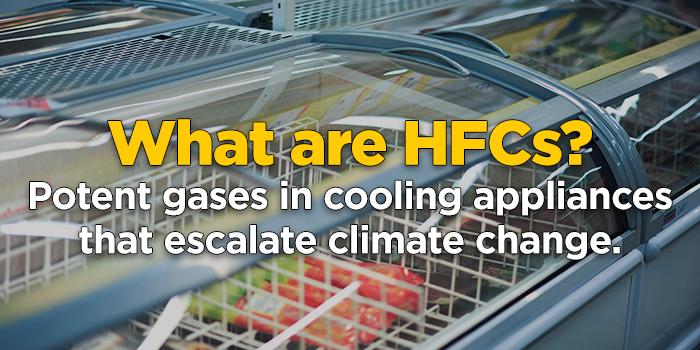
HFCs have thousands of times more warming power than CO2.
These harmful, human-made gases are leaking out of refrigeration systems and rapidly entering our atmosphere. As we do the crucial work of cutting CO2 emissions, we must also address dangerous, extremely potent HFCs.
Eliminating HFCs and adopting climate-friendly refrigerants is a top solution to address the climate crisis that can prevent nearly half a degree of global warming. Better cooling can help prevent 460 billion tons of greenhouse gas emissions in the coming years.
Climate Impacts of Supermarkets
Supermarkets use a lot of energy, and up to 60 percent is used for cooling and heating systems. But the largest climate impacts come from the refrigerants themselves.
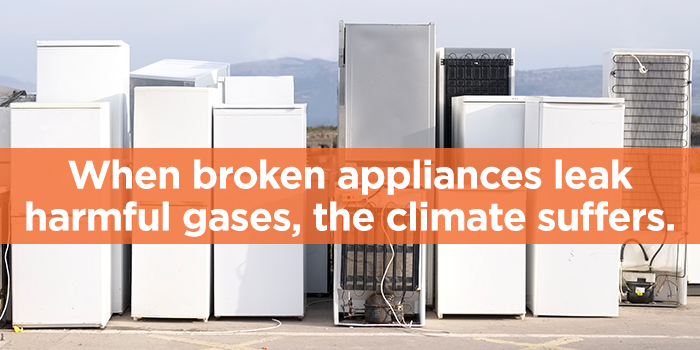
A typical supermarket consumes 4,000 pounds of refrigerants each year with a quarter leaking out due to faulty systems.
Refrigerant leaks from US supermarkets emit 45 million metric tons of greenhouse gases every year (the equivalent of 9.5 million cars on the road).
To address this issue, companies must commit to:
- Using only HFC-free systems in all new locations;
- Releasing concrete timelines to phase out HFCs from all facilities by 2030;
- Rapidly repairing refrigerant leaks and publishing annual leak rates;
- And ensuring responsible refrigerant disposal to reduce emissions.
Why Kroger
Campaign Update: Kroger said that it would address the issue in its latest Greenhouse Gas Emission Reduction Road Map which came out in January of 2023. Well, let’s just say the road doesn’t go very far. In fact, its own projections show HFC emissions going up before plateauing in 2025 onward. Not going down. Kroger must do better.
Kroger is the largest grocery chain in the US and is failing to take action on HFCs. HFCs account for a staggering 63% of Kroger’s direct climate emissions, but Kroger is only committing to install non-HFC refrigerants in 7 out of their 2,800 stores.
In June 2022, 35 percent of Kroger’s shareholders voted to encourage the company to take action on refrigerants. Join Green America in showing Kroger that customers also want the grocery giant to act fast.
Why Walmart
Walmart’s annual HFC emissions are over three million metric tons, or the energy equivalent of powering all the households in San Francisco.
Walmart has failed to honor past agreements to address HFCs, even though they make up nearly half of the company’s total direct emissions.
Over 100,000 people joined us to demand that Walmart eliminate its highly potent refrigerant emissions, and Walmart finally announced that it will transition to “low-impact” refrigerants by 2040.
But two decades is too long to wait when communities are facing devastation from the climate crisis today.
Why Trader Joe's
Trader Joe’s has a bad record of emitting refrigerant gases that hurt the climate and the ozone. It received the lowest score on EIA’s Climate-Friendly Supermarket Scorecard, which assessed the company on its insufficient action to reduce the use and emission of HFCs.
Additionally, Trader Joe's doesn't publicly report its climate emissions or social responsibility practices, as many other large companies do to show progress towards commitments.
Green America and Environmental Investigation Agency have teamed up to hold Trader Joe's accountable for its poor climate and labor practices and lack of transparency.
Progress on HFC Refrigerants
While most supermarkets are lagging way behind, a few supermarkets have made progress in tackling HFCs. You can show your support by shopping at these stores and thanking them for taking action on HFCs.
Find a Climate-friendly Supermarket
|
|
Chopper & Otis |
Welcome to Chopper & Otis! We’re two Boston Terrier bros busy living our best lives in Pittsburgh. We’re outdoorsy dudes—going on boat rides, playing in the creek, hiking the trails. We want to preserve nature for all of our two-legged and four-legged friends to enjoy for generations to come. Visit our shop for eco-friendly, non-toxic toys that have been personally tested by Chopper and Otis. We also carry clever and cute t-shirts made from organic cotton for pet parents and dog lovers. |
|
Tiny Garden Grows 300 Lbs of Produce Annually |
Written by Nicky Schauder of Permaculture Gardens, a member of our Green Business Network.
My family and I have a Climate Victory Garden in the suburbs of Washington DC. I wanted to give you a tour of our garden with the hopes it will inspire you. Permaculture designer Geoff Lawton is known for saying, “All problems can be solved in a garden.” The real problem of climate change is no exception.
Remember, you don't have to fulfill all the commitments to have a Climate Victory Garden but getting to all 10 is not as hard as you may think. Start with one and grow slowly but surely from there. We're a family of 8 living in what some consider a tiny townhome, and we grow over 300 pounds of produce each year. Here's how we try to live the Climate Victory Garden commitments:
1. Grow Edible Plants
We can all grow something, even during the cooler months. If you're going to grow a garden, you might as well get the most bang for your buck. Choose your plants wisely. Many people grow ornamental plants for their beauty. But selecting plants that are also edible allows us to capture carbon from the atmosphere and feed ourselves all in one go (not to mention, they're still beautiful). If your plant is also medicinal (i.e. herbs), then you have a 4th function to boot!
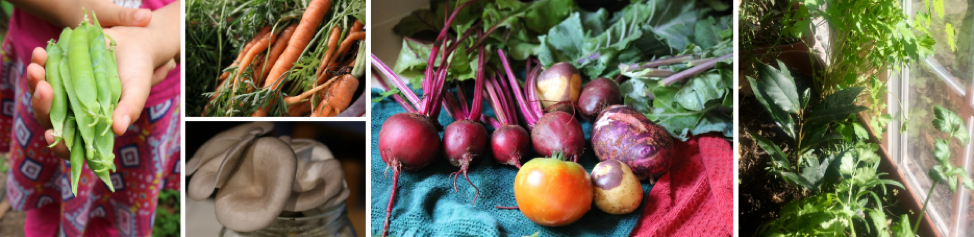
We grow food in our garden and home year-round. We grow over 300 pounds of produce per year in our townhome’s back and front yards (around 500 sq ft). In the spring and fall, we have cool weather crops like peas and carrots. We grow seasonal mushrooms both outdoors or indoors in logs, bags or mason jars. Summer harvests include beets and tomatoes, and in the winter we start seedlings and grow herbs and lettuce by the south-facing windows.
2. Keep Soils Covered
There are so many reasons to keep the soil covered. Here are some of them:
- We are trying to maximize our space and therefore maximize our yield, especially when growing in small spaces. No “plantable” space should be left uncovered.
- Nature will help you out. Go with her flow. When weeds come to cover those empty spaces you've left bare, don't take the weeds out unless you have a better idea of what should live there and are ready to plant it in the weed’s place.
- Covering the ground reverses soil erosion and depending on what you plant, may even build-up your soil fertility.
- Covering soil keeps moisture in. Even if some ground cover doesn't provide apparent edible benefits, it may be harboring beneficial animals as well as shading other plants from too much sun.
3. Encourage Biodiversity
Just as in a community of people, in our garden, diversity is the key to abundance. And by diversity, we mean we encourage the growth of all the 6 Kingdoms on the planet! We want a diversity of plants, animals, fungi, algae, archaea, and bacteria even if we are planting in a small space.

A monoculture (planting the same thing in rows) may give an appearance of neat and tidy-ness. But it is not a healthy one. If you must have rows of the same kinds of plants, consider planting what's known as a "polyculture" of alternating plants and planting diverse habitats around these production patches. From our experience, it is possible to design your gardens to be both beautiful and biodiverse at the same time.
4. Plant Perennials
Perennials provide stability to your garden. Less fussing with the soil, allowing plants to "take root" and establish themselves over time will lead to less work for you and the garden ecosystem. Perennials include powerhouse plants like trees, vines, and bushes. There is nothing like a tree to stabilize a garden. When you cut down a tree, you alter the weather. Trees are havens for biodiversity and great helpers in rain/water management. So, choose your trees wisely and remember that trees can outlive us!
In our backyard, we plant apples, pears, cherries, native trees called pawpaws, and figs. We even grow bananas indoors!
5. Ditch the Chemicals
When talking about balance and ecosystem health, permaculture designer Geoff Lawton says, "You don't have a mosquito problem. You have a lack of dragonfly (or bat or mosquito fish) problem." Your species and crops have to be in a balance that favors bountiful yields and keeps “pests” in check. That balance is not achieved when we use pesticides and unwittingly kill the good bugs (and plants, and ourselves) too!
We understand that everything affects everything else. So, we cannot in good conscience justify the use of chemical pesticides to wipe out a pesky population of mosquitoes (or rats or weeds) in our backyard. Instead, we have sought out natural alternatives that work in a holistic way. The balance in our yard is an ongoing process. But we have learned more and more every year how to slowly keep the "pest" population down and the favorable species population up! This takes more time than spraying chemicals, but it’s worth it!
As Ron Finley said, "If it's in the soil, it's in our food." We already know about all the evils of glyphosate. No thank you!
6. Compost
Our garden is a cyclical one. We try our best to have a zero-waste gardening process and teach others to do the same. Our main household aim is to eventually become a zero-waste household. I was shocked to learn that if global food waste were a country, “it would be the third largest carbon emitter in the world.” What an inspiration for composting. We use several methods:
- chop & drop - just prune or chop leaves and let them fall close to the plants.
- mulch with leaves - we use what we have or ask the neighbors if they want someone to rake their leaves for free!
- hot composting - we use an 18-day process called the Berkeley method.
- compost pile - when we are lazy we just let our compost heap rot and harvest the rich remains to feed our garden after 3 months.
- vermicomposting - we have worm pets that eat our kitchen scraps and turn them into "black gold" quality soil.
- Bokashi - we put all non-compostables such as meats, bones, and fish into an anaerobic air-tight bin filled with EM (effective micro-organisms) that ferment these foodstuffs so they can be safely added to the outdoor compost heap or directly into the soil.
7. Integrate Crops with Animals
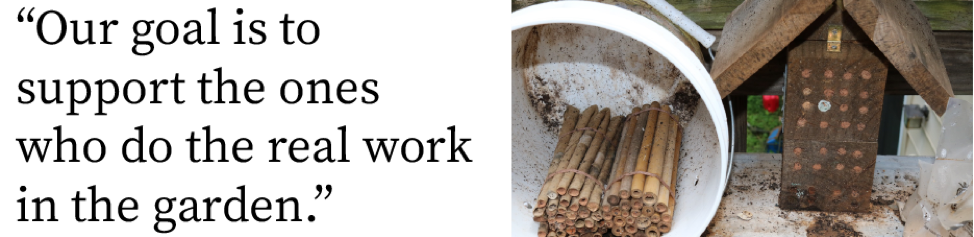
The backbone of every Climate Victory Garden should be a pollinator-friendly patch. Or better yet, several pollinator corridors sprinkled throughout your garden beds. Our goal is to support the ones who do the real work in the garden. Bees rely on plants and flowers for their homes and food and our crops rely on bees.
Integrating crops with animals has a lot to do with diversity and function. We want the garden to be an ecosystem, a web of functions and relationships. The more crops and animals, the more stable your garden will be. That means fewer diseases, fewer crop decimations, and more wildlife. A total win-win-win all around.
In our garden, we keep mason bees and have made a cute little bee lodge for these early spring pollinators. We plant native varieties of flowers and plants to support the native species of wildlife in our region. As we learn more and more about plants and animals, we begin to see that plants that we once thought of as "weeds" and animals that we once thought of as "pests" shoulder the burden of stabilizing our local ecosystems, our home gardens, and our nutrition.
We don't have chickens or other large animals (our HOA won't even allow us to grow crops in our front yard!), but we've asked neighboring friends with farms and stables for manure to add to our compost for a natural nutrient boost that makes this “waste” useful.
8. Use People Power, not Mechanization
There are so many benefits to getting "grounded." To us, low-tech people power means:
- less dependency on fossil fuels and therefore less carbon released into the air.
- a healthier, truly mobile, human body. Our bodies were made to move!
- a connection to the process of food production.
- no mechanized tilling to keep the soil biome alive.
When we teach students how to best water plants, we tell them what Brad Lancaster writes in his book Rainwater Harvesting for Drylands Vol 2: households that use automatic timers and other high tech approaches tend to use more water than those who water by hand. For example, households that water with a hand-held hose use 33% less water than those that do not. That's why we try to capture the water into our landscape passively instead of sourcing it from the grid and spraying it into the air.
9. Rotate Plants and Crops
We have written a whole boat-load about how we do crop-rotation in our garden. Basically, we try to keep renewing our soil's fertility with every action we take. How? By feeding it the way John Jeavon's teaches in his Grow Biointensive method: follow a “heavy-feeder” plant, with a “heavy-giver” plant.
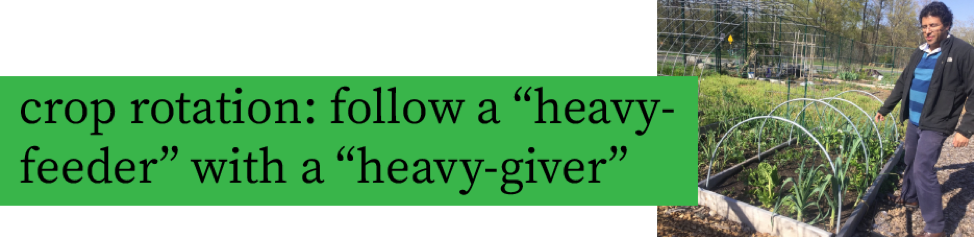
Tomatoes and most summer crops are heavy feeders. After the harvest, they can leave your soil depleted of trace nutrients and minerals. To help that cause, we plant nitrogen-fixing legumes in between large harvests. In fact, no garden bed is ever without a legume plant in our yard. It’s that important!
Rotating annual crops also helps confuse pests like squash beetles. We usually give the squashes a rest for two years before we try again for this reason. And, we try different bug-resistant squash and cucumber varieties to keep from crying after a bad year when all baby cucumbers have been lost to beetles!
10. Get To Know Your Garden
Finally, observe your yard. I cannot say enough about this. Don't just rely on garden manuals and Youtube videos. Find out what the weather is like by going outside and feeling it (in many areas of your garden). There is no replacement for your own personal observation. There are myriad ways to do this.
 Photo: Courtesy of botanical artist Lara Gastinger with permission
By getting to know your garden, you will find out what gardening techniques work or not. Getting to know your garden is directly proportional to your gardening success. And by doing so, you will be able to better plan and prepare for an epic next year. In essence, observation and reflection is where the cycle of growing begins again.
Together all our gardens make a difference.
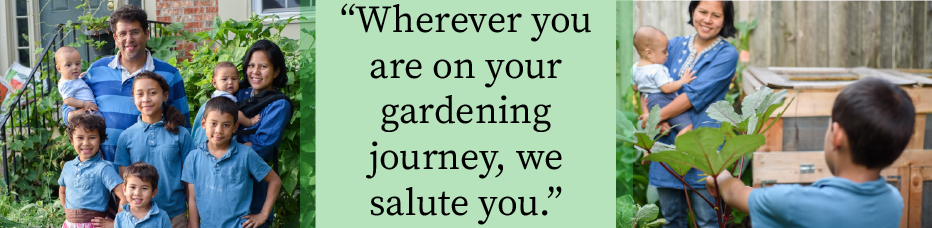
Our family of eight eating from our tiny townhouse garden is but one version of what a Climate Victory Garden could look like. Your garden may be on an apartment balcony or in a community garden plot. You may have been practicing these Climate Victory Garden commitments all your life. Or you may only be "Ditching the Chemicals."
Wherever you are on your gardening journey, we salute you. We celebrate you. And we encourage you on your way, at your own gardening pace.
Through our gardens, we are all connected in this environmental campaign. Each of our gardens, small or large, make more of a difference than we think. Together, they capture carbon in our soils and bring all of us closer to real global climate victory. With these Climate Victory Gardens, we all move the needle towards a greener, healthier, and happier life.
Read more inspiring Climate Victory Garden stories and tips.
|
|
A Steep Road to Victory: Veterans, Therapy, & Agriculture |
Written by Matt and Kara Rutter, founders of Project Victory Gardens, an agritherapy program in Aiken, South Carolina that brings together and supports veterans and a sustainable food system. They are also Climate Victory Gardeners, excited to share insight about how they identified and got started on their project.
Dig on for Victory
We have all seen the nostalgic posters promoting the World War II Victory Gardens. The posters are reminiscent of a time when every American was counted on to do their part. It was a time of great food insecurity due to a lack of labor, reallocation of transportation resources, and necessity to send food overseas. Americans responded in astounding fashion, with over 40 percent of the Nation’s produce supply raised in backyard gardens. Today we are once again on the brink of a food crisis and the need to mobilize.
According to the 2017 USDA Farm Census, the average age of the American farmer is 57.5 years, with one third over age 65. Our aging transportation infrastructure is unable to keep pace with demand. Record breaking weather across the Nation leaves farms unplanted and farmers holding the seed bag. Demand for year-round availability of produce and exotic food choices have increased food miles to an unsustainable level. Agriculture is a major contributor to climate change, and it’s also immensely impacted by the effects of climate change.
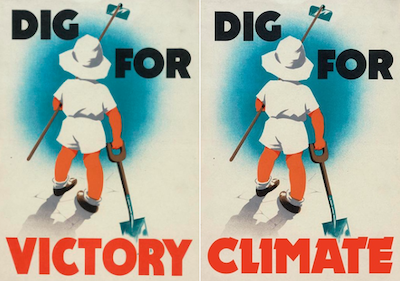 Victory Gardens were wildly successful during WWII, and it’s time to mobilize our grassroots food system again!
The Veteran Connection
At the same time, nearly 250,000 servicemembers transition out of the military each year. Almost half are under age 25 and lack a college degree, accounting for high unemployment rates. After almost two decades of sustained war, many veterans face PTSD, depression, and suicide. The US Departments of Agriculture and Veteran’s Affairs have identified that there may be a mutually beneficial solution to the issues that we see veterans face daily.
Encouraging veterans to enter agribusiness is a perfect match. Veterans have already demonstrated the drive, work ethic, and commitment to service needed to succeed in agriculture. Providing them with a launchpad to begin a career in agriculture is what is needed.
However, solving the farm labor problem is only half the benefit. The land is healing. Agritherapy and animal therapy have proven therapeutic for veterans suffering from PTSD and depression. Dirt contains microbes that trigger the release of serotonin in the body, improving mood, and decreasing anxiety. It’s a win-win solution.
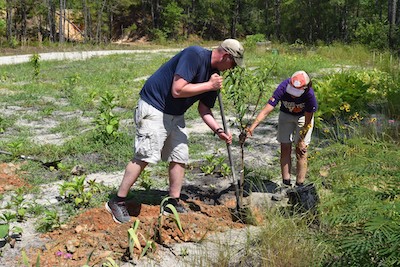 On Memorial Day, Project Victory Gardens worked with veterans to plant ten trees in memory of fallen heroes who had touched their lives.
Our Solution: Plant a Seed
As military veterans who retire next year after a combined 45 years of active service, we wanted to find a way to continue serving the Nation and our fellow military community. We knew that we wanted to find a way to utilize agritherapy to help veterans, servicemembers, and their families. But it had to be more than that.
In the Army we were trained to be problem-solvers. We saw three problems: food insecurity, the challenges of two decades of sustained war, and an aging farmer population. So, what is the solution to this national food crisis? The same solution that worked during World Wars I and II: Victory Gardens!
We decided to use our farm to train and encourage both our military family and the community-at-large to plant gardens. In doing so, they receive the benefits of agritherapy and animal therapy, combined with the education to launch their own agribusiness, thus increasing food security. Like our friends at Green America and Climate Victory Gardens, we know that if everyone plants a garden, we can address the food crisis in America. Regenerative soil practices can heal soil damaged by overuse or chemical treatments, while reducing harmful effects to the environment.
How We Got Started
In March, 2019 we started Project Victory Gardens on a picturesque 20-acre farm in Aiken, South Carolina and immediately the reaction and support were unbelievable, as was the work. While we had visions of petting chickens and planting seeds, launching an agribusiness requires you to don a lot of hats—caretaker, laborer, marketing director, financial manager, service provider—at times the list seems endless and daunting. And, yes, there’s paperwork.
Our first step was to form a Limited Liability Corporation. Once that was complete, we were in business!
The idea of getting back to the land resonates with many of our peers in the Army, and we know that eventually Project Victory Gardens will pop-up across the United States. So, we applied for federal servicemark status for the use of “Project Victory Gardens”. Applying for a trademark is an extensive, complicated, and lengthy process. Applications are often not even reviewed for months after filing. If you want to trademark a product name or servicemark your goat-yoga slogan, do your research! We put together a business plan based on several we found online.
Ultimately, we want to have heritage goats and pigs in our farm menagerie, but our current zoning restrictions limit the livestock we can keep, so we applied for rezoning from the county. This can be a long and often unsuccessful process. If you are planning on starting any business, please consult your local zoning regulations.
These are just some of the many decisions we had to make. Many Agricultural Extension Offices offer assistance on these higher-level activities, beyond pickle recipes and soil testing. Of course, we are partial to our local Clemson Cooperative Extension, but there are other great programs depending on your location.
To Tweet or Not to Tweet
We knew publicity was important too. We designed logos and marketing materials, bought the domain name, set up a website, and established a social media presence. Depending on your experience, much of this work may have to be outsourced. But don’t be afraid to just dive in and give it a try if you are on a shoestring budget. There are a lot of great website design sites out there or stick with the social media platforms until you get a little more established.
Do not neglect your online presence! Make do with what you have. Friends helped us shoot and edit an amazing promotional video. Use your resources and don’t be afraid to ask for help! After less than four months in “business” and with no official sales, we have an active following on Facebook and a presence on Instagram, LinkedIn, and Pinterest. This might ultimately translate into donor support, expanding our network for publicity, and helping veterans find our program.
Knock on doors! Do whatever it takes to get the word out about your passion. We are currently finalists for a large grant opportunity that we never dreamed was possible, simply because we applied. It may cost a few hours of your time, but it could be tremendously valuable!
Whether you are looking to start a full-scale agribusiness or plant a tomato on your apartment balcony, jump in! The time is now—our food system needs your help. Join the Movement, plant a Climate Victory Garden, and grow your own food now!
Read more inspiring Climate Victory Garden stories and tips.
|
|
All Secondary Calls to Action Report |
|
|
All Subsite Pages Report |
|
|
All Campaigns Report |
|
|
All Programs Report |
|
|
All Pages Report |
|
|
Lens |
|
|
Member Stories |
|
|
Plantain, More than a Weed |
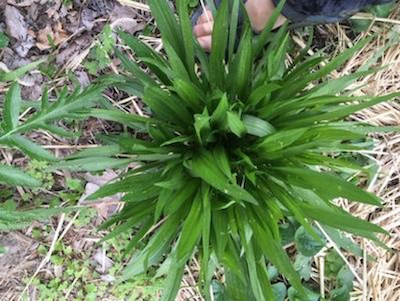
Plantain, known as Plantago major, grows all over North America and around the world. It is commonly found in yards and gardens where pesticides aren’t used. Chances are, if you’re a Climate Victory Gardener, you’ve come across this plant. And, while we’re often tempted to pull weeds to make space for fruit and veggies to grow, biodiversity and keeping plants like the plantain protects the soil and offers medicinal and nutritional benefits.
There are many types of plantain, easily identifiable by their tendency to lay flat and grow in areas that are often mowed. Their most noticeable feature are the parallel veins that run vertically along the leaves, that is, from stem to tip. If you’ve ditched the chemicals in your garden or yard, you may already have an abundance of plantain. When collecting, avoid plants in areas within eight feet of a road, where pesticides are used, and in areas frequented by pets.
Plantain’s Medicinal Uses
Any time you’re using herbs medicinally, seek advice from a local herbalist or your doctor. Do your research and educate yourself on the specific issues you’re treating. Herbalist and author of Heal Local, Dawn Combs, notes that there are no known contraindications for plantain, but do not eat this plant if you have a known allergy.
In Humbart Santillo’s Natural Healing with Herbs, plantain is called the bandaid plant, because it helps stop bleeding, supports tissue regeneration, and is naturally antiseptic. Chew or crush the leaves and apply directly to the skin and use a bandaid to keep it in place. After it dries, rinse the area with cool water. This also helps bring splinters to the surface for removal and neutralizes bug bites and poison ivy—all things we may come across in our gardens.
This medicinal plant can also be infused, essentially into a strong tea. Combs highlights plantain’s diuretic properties, meaning it moves excess fluid out of the system. In her book The Top 100 Herbal Remedies, Annie McIntyre points to the plant’s ability to act as a mild blood cleanser, reducing toxin-based health issues. The infusion can be used in eye compresses, spritzed on a sunburn, applied to itchy skin and rashes, and dabbed on acne and eczema. When consumed as an infusion, it may help with colds, sore throats, allergies, sinus, chest congestion, and some digestive issues. To make a plantain infusion, put three handfuls of fresh leaves into a one-quart canning jar with boiling water. Seep up to overnight, strain the plant material, and it’s ready to use.
Plantain can also be taken in tincture form. This is the most potent form and can be used in treating bladder infections and other internal concerns. Combs’s book Heal Local has detailed guidance on this.
Plantain’s Nutritional Benefits
Plantain is edible. According to herbalists and authors Combs and McIntyre, it’s a good source of bioavailable zinc, calcium, and beta-carotene. The plant can be eaten raw or cooked and used dried or fresh.
In the spring, when the leaves are more tender, they can be used in salads and shredded as a healthy garnish for any dish. When added to smoothies, they provide chlorophyll, which nutritionist Paul Pitchford points to for increased purification, renewal, and anti-inflammatory support.
Later in the year, you may prefer to cook the tougher leaves. They can be added to stir fries or wilted as a side dish. Remember to harvest and dry leaves throughout the summer for winter use, when they can be crumbled into bone broth or soups.

Many common “weeds” have medicinal qualities & are edible. Skip harmful pesticides, like Roundup, because they’ve been linked to many environmental and human health issues. By embracing these plants, we protect our local groundwater and biodiversity; we reduce the amount of labor needed to maintain our yards; we protect the soil by keeping roots in the ground to support soil communities; and we diversify our diet.
Please share images of your plantain plants, remedies, and favorite recipes on the Climate Victory Gardening facebook page. Laurel Hobden (Laurel@LoveDandelions.com), the author of this article, is an active member of the group and often posts about the benefits of weeds and other important Climate Victory Gardening practices. She also suggests this additional resource for a deeper dive into herbalism, eating weeds, and using them medicinally: Healing Wise, by Susun Weed.
|
|
Environmental and public interest groups demand EPA revoke Monsanto’s license to pollute |
WASHINGTON, D.C. – Today, environmental and consumer organizations are delivering more than 149,000 public comments to the Environmental Protection Agency advocating for a ban on glyphosate, aka Monsanto’s RoundUp, which is linked to cancer. The EPA is collecting public comments until July 5th for glyphosate’s proposed interim registration review, which could allow glyphosate to be used in the U.S. for another 15 years.
“The science is clear about glyphosate. This dangerous herbicide causes serious health risks, including cancer, and threatens our environment,” said Jason Davidson with Friends of the Earth. “EPA must do its job and ban this toxic pesticide instead of prioritizing corporate profits.”
Monsanto (now owned by Bayer (BAYRY), made $4.8 billion in revenue from glyphosate sales in 2015. The EPA claims that glyphosate does not cause cancer, ignoring the United Nations and California’s Office of Health Hazard Assessment, both of which have classified the herbicide as linked to cancer. However, EPA’s Office of Research and Development determined that the Office of Pesticide Programs did not follow proper protocol in its evaluation of glyphosate. EPA included Monsanto-funded studies in its evaluation of the chemical and has a history of collusion with industry.
“EPA is getting the science wrong on glyphosate, and needs to listen to international agencies and peer-reviewed literature on the dangers posed by widespread use of this herbicide,” said Drew Toher, community resource and policy director at Beyond Pesticides. “While continuing to pressure EPA, we encourage advocates to get active in their community, and work with their local elected officials towards organic policies that stop glyphosate and other toxic pesticides like it.”
"No company's profits are more important than children's health and the health of our fragile ecosystems. The EPA must uphold its mission and ban glyphosate," said Brandy Doyle with CREDO Action.
“It's time for the EPA to acknowledge that glyphosate, which is never used alone, if reapproved, will continue in the form of glyphosate herbicides, to contaminate our tap water, breast milk, baby food, formulas, cereals, thousands of food types, and cotton products,” said Zen Honeycutt, executive director, Moms Across America. “It will continue to destroy soil quality, which contributes to climate change, the decline of marine and wildlife and the environment. In short, the only way the EPA can do its job, is to revoke it's license.”
“Getting cancers like non-Hodgkin lymphoma shouldn’t be a condition of employment in agriculture or landscaping—or a risk of using a weedkiller at home,” said Alexis Baden-Mayer, political director of the Organic Consumers Association. “It’s time for the EPA to stand up to Monsanto-Bayer and protect farmers, farm workers, lawn care workers and consumers. If Trump’s EPA chooses to ignore the science, Congress should step in.”
“It is not enough for companies to offer some products that are organic to consumers who are willing to pay for them. We need the EPA to protect all consumers from toxins in foods. And we need to protect our pollinators, farm workers, and the environment, so we can ensure that future generations have safe and healthy foods,” said Todd Larsen, executive co-director, Green America.
###
Friends of the Earth fights to protect our environment and create a healthy and just world. We speak truth to power and expose those who endanger people and the planet. Our campaigns work to hold politicians and corporations accountable, transform our economic systems, protect our forests and oceans, and revolutionize our food & agriculture systems.
|
|
Amalgamated Bank |
Amalgamated is America’s socially responsible bank. For 96 years, our commitment to the greater good has inspired and driven everything we’ve done. Social responsibility is embedded in our history, our policies, our products, our programs, our operations and our DNA. It’s why we are the bank of choice for thousands of organizations, non-profits, sustainable businesses, unions, foundations and caring individuals who are striving to build a stronger, safer, smarter, cleaner and fairer world. It’s why we are the largest B Corp certified bank and a Real Leaders 100 Top Impact Company. If you bank at Amalgamated, you can take pride knowing that your money is in good hands – and is doing good along the way.
© 2019 Amalgamated Bank. All rights reserved. |
|
Tips and Inspiration from Climate Victory Gardeners |
Climate Victory Gardeners across the country are growing food, not only for their health but the health of our planet.
Every garden looks different and uses unique combinations of carbon-capturing practices—we encourage and embrace this diversity. From balcony gardens to backyard plots to large community gardens, these gardeners are contributing to the climate solution using the very soil beneath their feet.
With over 100 million gardeners in the United States today and increasingly more young gardeners, there is so much potential for Climate Victory Gardens to become a movement with major implications for food production, the climate crisis, and future generations.
|
|
"Skip the Slip" Report Finds Most Retailers Get Low Score For Receipt Practices |
WASHINGTON, D.C.—June 25, 2019—Only three retailers – Best Buy, Apple and Ben & Jerry’s – get top marks in how they deal with electronic and paper receipts, according to a Green America report providing an overview of the practices of 36 top US companies. On the other end of the spectrum, 17 companies earned a “D” rating, including Walgreens and Chipotle, for only offering paper receipts coated with bisphenol A (BPA) or bisphenol S (BPS).
The new edition of the Green America “Skip the Slip” report also shows that thermal paper usage and costs are increasing every year, and it discusses policy actions aimed to address unnecessary receipt waste.
The new “Skip the Slip” findings include:
- The majority of businesses (28) earned a “C” or “D” rating. A “C” grade designates that they offer an “opt-in” digital receipt program and use BPA or BPS thermal paper. This less-than-ideal approach is used by CVS, Target and Lowe’s. A “D” grade designates that they fail to offer a digital only option and use BPS or BPS digital paper. Companies exploring alternatives are noted in the report, but the grading reflects current in-store practices.
- Consumption of thermal paper for receipts is increasing worldwide, including in the US, according to recent market analysis conducted by Grand View Research. In 2018, US consumption was 256,300 metric tons of paper and this is projected to increase at least through 2025.
- There are escalating costs for businesses automatically printing receipts that often are tossed in the trash. In 2018, market revenue for paper receipts in the US was over $386 million. Due to a severe shortage of leuco dye needed for thermal paper, costs will steadily increase each year. It’s projected that market revenue for paper receipts will surpass $566 million by 2025.
- US receipt use consumes over three million trees and nine billion gallons of water each year, according to Green America estimates using Grand View Research’s analysis and the Environmental Paper Network’s Paper Calculator. Receipt production generates over four billion pounds of greenhouse gases (the equivalent of 450,000 cars on the road) and 302 million pounds of solid waste.
The new report includes an update on legislation addressing receipts. This includes the status of recent efforts in California to reduce unwanted paper receipts and ensure customers have a choice for the receipt mode they prefer. Named after Green America’s campaign, the “Skip the Slip” bill, or AB 161, was introduced by Assemblymember Phil Ting and was approved by the California Assembly.
“Customers should have a choice when it comes to receipts,” said Beth Porter, Green America’s Climate Campaigns director. “More and more people want no receipt or an electronic receipt, and when companies make these options available to customers it’s good for the environment, human health, and a business’ bottom line.”
Since 2017, Green America has campaigned to raise awareness on the unnecessary environmental impacts of paper receipts and the toxins coating paper receipts, most commonly BPA and BPS.
“Given the increasing cost of receipt paper and the shift of customer preferences, it makes environmental and economic sense for businesses to offer a digital option while providing phenol-free paper on request,” said Todd Larsen, Green America’s executive co-director. “There are digital alternatives that are being used by businesses from independent cafes and food trucks to nationwide retailers.”
MEDIA CONTACT: Max Karlin for Green America, (703) 276-3255, or mkarlin@hastingsgroup.com.
|
|
Skip the Slip Report (June 2019) |
|
|
Image for generic Blog - to keep for if no highlight selected |
Photo by Corinne Kutz on Unsplash
|
|
Moerani Inc |
By using organic natural oleochemical sources
we are avoiding toxic ingredients to include
toxic preservatives in our product line. We are
a sustainable company that uses organic natural oils, green cosmetic emulsifiers and renewable
resources bacterium or fermented radish root for uses in our all natural preservatives. We are globally conscious and against petrochemicals in conventional cosmetics that are toxic pollutants and degrade the environment as well as our bodies. |
|
US Lags in Pesticide Regulation |
The United States uses over a billion pounds of pesticides each year, many that contain chemicals banned in other countries. These toxic chemicals have major impacts on both people and the planet. US regulation has fallen behind other major agricultural producers to side with the agrochemical industry at the risk of our health.
Brazil, China, the European Union, and the United States are the world’s four largest agricultural producers, growing over half of the world’s food; they’re also the biggest pesticide users. Of these four, US regulation is lagging the most, still allowing 85 pesticides that are banned in at least one of these other nations.
Impact on People and Planet
Regulation isn’t improving. Over the past ten years, the US has even increased the use of some of these pesticides banned in other countries. We’ve seen an increase in impacts on human and environmental health as well.
Many pesticides are linked to acute poisonings. These chemicals are used to prevent certain pests—weeds, insects, fungi, and bacteria—but they also affect humans and non-target species like bees. Some of these pesticides contain known neurotoxins with over 2,000 reported health incidents annually—and many cases go unreported due to farm workers’ worries of retaliation and language barriers. Antibiotics are also used in agriculture as pesticides, contributing to antibiotic resistance that impacts over two million people annually, with 23,000 cases of death each year.
Maybe you’ve seen the news around the controversial pesticide RoundUp? There are currently over ten thousand cases against this Bayer/Monsanto product, which contains glyphosate. The World Health Organization has deemed glyphosate a probable human carcinogen. It’s also listed under California’s proposition 65 as a chemical known to cause cancer. It’s the most commonly used pesticide in the US and the world. And, while the lawsuits largely involve those using the chemical in agriculture and landscaping, residues are also found on foods and at alarming rates in honey. Yet US regulating agencies refuse to step in.
Farms and their surrounding ecosystems are negatively impacted by pesticide drift and runoff. Deep in the soils, pesticides kill the life needed to grow healthy foods, leading to soil degradation that has some scientists saying we have less than 60 years of farming left. High in the air, pesticide use and production contribute to climate change and kill pollinators. Streams become polluted, and diversity is lost. These chemicals leave a lasting impression on all aspects of the natural environment.
The State of US Regulation
Pesticides in the US are regulated by the Environmental Protection Agency (EPA), which is closely linked with the very industry it’s meant to oversee. On top of that, regulation can vary widely depending on the current administration. When regulating the chemicals in agricultural pesticides, the agency determines risk using a cost-benefit analyses, attempting to put prices on human and environmental health in order to measure the risks worth taking, an analysis fraught with issues and influence.
In the US, bans on these chemicals are extremely rare. Instead, the EPA relies heavily on industry-initiated, voluntary cancellation of pesticides, making this a business decision that keeps the most profitable chemicals on the shelf, regardless of their toxicity. Voluntary cancellation does not happen often either, but when it does, companies are given eight years to phase chemicals out, leaving many more opportunities for harm.
The US still has access to some of the most harmful pesticides because they didn’t sign the Rotterdam Convention, which allows countries to block trade of these toxic chemicals and effectively ban them from their country. The US is only one of six countries in the world who did not sign this treaty, essentially keeping our markets and fields open to harmful pesticides. Some states—including California, New York, and Washington—have adopted their own protective regulations that are more stringent than those at the federal level.
And, while the EPA is mandated to regulate the amount of pesticides found on food once it gets to consumers, residues almost always remain. For example, research from the EPA shows that kale—once the posterchild for healthy eating—can have up to 30 pesticides found on it in the US market.
Putting People and Planet First
Ten percent of the US’s pesticide use contains chemicals banned or unapproved in all three of the other top agricultural producers. That’s a sign that our regulatory agency isn’t putting people and planet first. It doesn’t have to be like that.
The EPA, agrochemical companies, and some producers will claim that these chemicals are necessary to feed a growing world. But, the European Union can be looked to as an example that toxic pesticides aren’t necessary to be a successful agricultural producer. Despite their limited arable land and some of the world’s tightest pesticide regulations, their agricultural exports are worth more than China, Brazil, and the US combined. More people- and planet-centric agriculture is not only possible but profitable.
This can be done in the US as well, and some Soil SuperHeroes are already using regenerative agricultural practices that reduce the need for chemical pest management. But, the reality is that US is currently a laggard in this field, allowing widespread hazardous use of chemicals that other agricultural nations have deemed unsafe.
Protect yourself by eating foods grown organically and regeneratively.
Take Action
1. Tell the EPA to ban glyphosate
2. Eliminate pesticides in your own gardens.
|
|
Curbed |
|
|
USA Today |
|
|
Map of Listings |
|
|
GBN Standards |
|
|
Categories |
|
|
GALLANT INTERNATIONAL INC |
Fair Trade Certified
our bags, aprons, and accessories are Faire Trade Certified.
By being Fair Trade Certified, we guarantee that your products will be ethically and fairly produced. Under Fair Trade, we can ensure that no child or forced labor is involved, living/legal wages are paid, safe working conditions are provided, the supply chain is transparent, and workers are paid an additional Fair Trade premium to invest back into their communities or to use however they would like. Your investment into Gallant’s products makes a positive impact in the lives of all our workers in our Fair Trade Certified factory.
Our Tote bags and accessories are made using GOTS certified organic cotton. Biodegradable, Recyclable and Reusable
Our products are made exclusively with GOTS Certified Organic cotton. Our organic cotton is grown free from harmful pesticides and insecticides, ensuring that we preserve the health of farmers, workers, eco-systems and you and your customers.
Soil Preservation:
By using Organic cotton, we help preserve our farm’s soil. Healthy soil is full of good bacteria, fungi and other microscopic organisms. Organic farming preserves the health of these organisms, while conventional farming often destroys soil, leaving it barren and unable to support plant life.
Water Conservation: Research has shown that organic cotton uses 71% less water than conventional cotton. Organic cotton is 80% rain-fed, allowing farmers and communities to conserve and divert their water for other essential uses.
Eco-System Preservation: Organic cotton allows for eco-systems to remain intact and undisturbed. Weeds are removed psychically or with intercropping, no toxic chemicals or pesticides are used. Organic cotton is better for the environment, benefiting animals, insects and the Earth as a whole.
Offsetting Our Carbon Emissions:
We have partnered with UPS to offset all of our carbon emissions created during our shipping process by using UPS’s Carbon Neutral shipment program. Through UPS’s Carbon Neutral shipment program, we are able to contribute to preserving waterways, forests and eco-systems throughout the globe.
|
|
CSV of all Store Orders |
|
|
CSV of Business Users |
|
|
CSV of all Business Listings |
|
|
CSV of GBN transactions, last 365 days |
|