|
United Credit Union |
|
|
United Credit Union |
|
|
United Consumers Credit Union |
|
|
Samsung Makes Progress on Ensuring Worker Safety |
After years of public campaigning, Samsung has finally begun to take steps to address some of labor issues in its supply chain – ones that Green Americans and our international allies have spent years demanding action on. On July 24th, 2018, Samsung signed a binding arbitration framework that will ensure victims of chemicals exposure are properly taken care of and would follow through with recommendations put together by a third-party mediation committee.
Samsung Finally Making Progress, Consumers Must Keep the Pressure Up
|
|
Samsung Finally Making Progress, Consumers Must Keep the Pressure Up |
While Samsung is quick to address issues within its supply chain to ensure the safety of its consumers, it has dragged its feet to take steps to ensure the safety of its factory workers.
But after years of public campaigning, Samsung has finally begun to take steps to address some of labor issues in its supply chain – ones that Green Americans and our international allies have spent years demanding action on.
On July 24th, 2018, Samsung signed a binding arbitration framework that will ensure victims of chemicals exposure are properly taken care of and would follow through with recommendations put together by a third-party mediation committee. The third-party mediation committee was set up in 2014 when Samsung and SHARPS, the occupational health advocacy and watchdog group, first began discussions to devise a way to compensate past and future victims of chemical exposure at Samsung’s chemical factories. Once talks fell through in 2015, SHARPS held a 1,023 day sit-in at Samsung’s headquarters.
The general framework that Samsung has agreed to includes:
-
Implementing safety measures proposed by the third-party mediation committee;
-
Formally apologizing to victims and their families;
-
Compensating victims that SHARPS has profiled under a compensation scheme proposed by the third-party mediation committee;
-
Continuing to compensate new victims for the next ten years.
Meanwhile, SHARPS will formally end its sit-in at Samsung headquarters once the proposal has been signed by SHARPS, Samsung, and the third-party committee.
This is a promising news to come out of South Korea, and we commend SHARPS for their tireless leadership on this issue.
But Samsung’s progress doesn’t stop there!
In its 2018 Sustainability Report, Samsung published a list of 11 substances that are regulated within its supply chain. Samsung banned benzene and n-Hexane from their supply chain, and has shared restrictions for the other nine chemicals.
Although this is a promising first step, it’s important to note that far more than 11 chemicals are used in electronics manufacturing. Furthermore, this demonstrates how behind the curve Samsung is compared to its competitors. Thanks to Green Americans and our allies, Apple banned n-hexane and benzene from its supply chains in 2014; meanwhile, it has taken four years of public campaigning and behind-the-scenes activism to get Samsung to commit to what Apple did four years ago.
This means that it is important for Green Americans to dial up the pressure on Samsung. While these updates are encouraging, Samsung still has a long way to go to ensure the safety of all of its workers. The victory in South Korea, for instance, does not mitigate horrific working conditions in Samsung’s Vietnamese factories. And while publishing a list of restrictions for 11 chemicals is better than publishing restrictions for zero chemicals, other industry leaders – including Apple and Google – have published more comprehensive plans regarding hazardous chemicals in their supply chains.
Join Green America in taking action today – let Samsung know that you’re keeping an eye on its labor practices, and expect even stronger commitments to protect its smartphone factory workers.
|
|
Plastic Free Toolkit |
Plastics have improved many aspects of human life, like health and food safety. But as plastic materials are cheap and available, we've become far too reliant on this petroleum-based product that will never break down. Learn about the problems with plastics, and how to cut back, or cut it out of your life altogether, right here.
|
|
Green America Vehicle Donation Program |
Donate your car to Green America
Want a simple way to support Green America? Donate your car, truck, boat, motorcycle, or RV to us. You'll be rid of an old clunker and could get a tax write-off. Green America will get a donation that supports our green economy work.
Green America works for a world where all people have enough, where all communities are healthy and safe, and where the bounty of the Earth is preserved for all the generations to come. Our mission is to harness economic power—the strength of consumers, investors, businesses, and the marketplace—to create a socially just and environmentally sustainable society.
You may have an old car, or other vehicle, hanging out in your driveway that is on its last legs, or won't even start. Vehicle donation is a win-win solution. If, after you donate your vehicle, you still need a car, you can buy an electric or hybrid vehicle (you can buy them used to be even greener). You will reduce your reliance on fossil fuels and help to create a greener world with your daily transportation. And when you donate your old vehicle to Green America, we benefit. Every vehicle donated becomes a contribution to our work.
Donate a car, truck, boat, motorcycle, or RV to Green America and support our outreach to individuals nationwide to take personal and collective action to further social justice and environmental responsibility. Our green living programs and our campaigns to create a greener world are all supported by donations by people like you. Your vehicle donation helps build sustainable communities in the US and abroad.
Call us today or click the button below. We will tow your vehicle at no cost to you, whether the vehicle is at your home, office, or the repair shop. You'll receive a tax deductible receipt.
We accept all types of vehicles:
How it Works
1. Call us at 855-500-RIDE or 855-500-7433
2. We will tow your vehicle at no cost to you!
3. Get a tax deductible receipt and help our cause.
|
|
Clean Tech Methods |
CleanTech Methods provides consulting and software services for the clean energy sector.
|
|
Choose Green Body Care |
Our bodies act as a sponge that absorbs the substances we put into—and onto—it. Just like the food we eat, the products our bodies consume can either have positive or negative impacts on our health. Choosing nontoxic body care products can help you protect yourself and the environment.
Choose Green
Know what to look for: In a world of seemingly infinite body care products, having ideas in mind about what properties you want in yours can help narrow your search. Aim for products that have pure, truly natural ingredients and are scented with pure essential oils.
Consider organic: There’s a wide range of organic personal care products to meet your needs. When you go organic, you ensure that the natural ingredients in your products were grown without synthetic pesticides or fertilizers—better for the Earth and your skin. A certified organic label on a body care product means 95 percent of the ingredients in it are organic.
Keep it simple: You do not want to cause unnecessary irritation or damage to your body by exposing it to too many ingredients and substances. Stick to products and brands that you already know are healthy and work. Also, a good rule of thumb is the shorter and simpler a product ingredient list is, the less toxic it may be. You may also consider getting creative in the kitchen and making your own, using substances already in your household. For instance, avocado, honey, and apple cider vinegar all make great natural facial cleansers.
Do your research: The cosmetics industry is largely self-regulated, and manufacturers do not always report customer complaints about adverse effects of their products to the FDA. To stay safe, it pays to look into what you put on your skin. One great resource is the Environmental Working Group’s Skin Deep Cosmetics Database, which informs readers of the potential health concerns related to over 70,000 cosmetics products and thousands of ingredients.
Not That
Avoid parabens: They’re in shampoo and many other products, and they are estrogen mimickers that can lead to cancer.
Stay away from vague “fragrances”: A company may legally hide hundreds of substances behind the vague term “fragrance” on product ingredient lists. A product’s fragrance may contain potentially hundreds of toxic chemicals and volatile organic compounds.
Say no to nanoparticles: Nanoparticles are so small, many scientists are concerned about their potential health effects, as they can penetrate cell walls and are highly reactive. Products with nanoparticles aren’t often labeled as such, so check your conventional body care products on the Skin Deep Database or the Project on Emerging Nanotechnologies.
Ditch products with phthalates: These hormone disruptors have been linked to male genital abnormalities, liver and kidney lesions, and higher rates of childhood asthma and allergies.
Don’t buy petroleum byproducts: Listed as mineral oil, petrolatum, liquid paraffin, toluene, or xylene, these chemicals are found in products, including many shampoos and soaps. They are often contaminated by toxic impurities like 1,4 dioxane, which is a probable carcinogen.
Ban all triclosan: The FDA banned triclosan in 2016 from antibacterial soaps and washes, due to its links to antibiotic resistance and hormone disruption, but it still appears in antibacterial hand sanitizer and other products.
You still have to look out for lead: It’s a potent neurotoxicant, and it’s been found in lipstick and men’s hair coloring kits.
|
|
Our Staff's Favorite Safe Body Care Products |
The following products from certified green businesses in the Green Pages received top marks for safety from the Environmental Working Group’s (EWG) Skin Deep Database.
Sunscreen can have all sorts of nastiness in it, like potentially carcinogenic retinyl palmitate. But All Good by Elemental Herbs sunscreens for kids and adults get their sunblocking power (up to SPF 30) from zinc oxide, and include natural ingredients like calendula and lavender. All Good sunscreens are also “reef-friendly,” so they’re free from ingredients that can harm coral reefs.
EWG Rating*: 1 (low-hazard)
The Tea Tree and E Oil from Derma-E is an antiseptic cream for a variety of skin conditions, including bug bites, rashes, blemishes, dryness, and dermatitis. All Derma-E products are non-GMO, vegan, and cruelty-free.
EWG Rating*: 1 (low-hazard)
Dr. Desai Tulsi Neem Goat’s Milk Soap is made to reduce acne and eczema and calm poison ivy rashes. Tulsi, also known as holy basil, is known as a divine herb in India and is an antioxidant. All Dr. Desai products are made according to the principles of ayurvedic medicine and with a handful of organic ingredients you’ll recognize.
EWG Rating*: 1 (low-hazard)
One World Renew Lip Balm in Moroccan Orange Spice from Eco Lips is Fair Trade Certified™, Non-GMO Project Verified, and contains certified organic ingredients. EcoLips manufactures its products in a facility powered by 100 percent renewable energy, and the packaging is 40 percent post-consumer recycled.
EWG Rating*: 1 (low-hazard)
Founded by Aveda founder Horst Rechelbacher, Intelligent Nutrients offers plant-based products with a commitment to full ingredient disclosure. The Renewal Eye Gel is designed to depuff, cool, and reduce the appearance of fine lines around your eye. The company chooses natural ingredients based on their low impact on the planet. All products are certified organic and cruelty-free, and made with 100 percent renewable energy.
EWG Rating*: 1 (low-hazard)
Dry Shampoo from Be Green Bath and Body contains natural ingredients like nettle and rice flour to soothe your scalp and absorb oil, so you can wash your hair less often. Organic and non-GMO ingredients.
EWG Rating*: 1 (low-hazard)
Green America has been working for over 40 years to keep you and your family safe from toxic chemicals, maintain a healthy and vibrant planet, and connect conscious consumers with green businesses.
* The Environmental Working Group rates body care products on a scale of 1-10. 1-2 is low hazard, the EWG’s best rating. 3-6 is a moderate hazard. And 7-10 is a high hazard, meaning the product contains many chemicals that could potentially harm your health and the environment. The database also rates individual ingredients.
|
|
Find Renewable Energy Products for Less |
Not ready for a full-scale renewable energy home system? You can still get some green energy in your life for less money.
Super cheap renewable energy products:
A Clothesline: If your neighborhood allows outdoor clotheslines, consider installing one and let the sun dry your clothes. (If it doesn’t, try an indoor drying rack—also a good option if you have pollen allergies.) The set-up cost is minimal (especially if you have a pair of optimally set trees to hold your line), and you’ll save nearly $11 for every ten loads.
Solar Battery Charger: Stop buying batteries and start using the power of the sun. Get a set of rechargeable batteries and a solar battery charger, and you’ll avoid needless battery waste. This 20-Watt Solar Battery Charger charges two or four AAA, AA, C, D, and 9V batteries at a pop. $149.95, or buy a DIY kit and build your own charger for AA and AAA batteries for $24.95, Sundance Solar.
Solar Bike Lights: Never run out of batteries for your bike lights again. Many solar bike lights can be powered either by the sun or a USB charge. Buy two, and use one as a headlight and one as a taillight. $16+, various stores.
Solar Holiday Lights: Tired of running extension cords through your yard when you want a little holiday cheer? You don’t need cords to put up this Multi-Color Solar Christmas Light String. The lights can run for eight hours on a charge. $19 with quantity discounts, OutdoorSolarStore.com.
Medium-priced renewable energy products:
Solar Attic Fan: Attic fans pull stale air out of your home and replace it with fresh air. They’ll also cool your home in the summer. The Fan-Attic Solar-Powered Attic Fan helps you save even more energy, since it gets all of its power from the sun. And it’s automatically programmed to turn on when your home reaches 80° F or higher, and turn off when it cools to 70°. $350.95, positive-energy.com.
Solar Water Heater: Replace your conventional water heater with one that harnesses free solar power. A solar water heater is reliable even in cloudy weather, and it’ll likely cut your water-heating bills in half. $3,000-$10,000, including installation, with additional tax incentives available in some areas—check dsireusa.gov. Available at various stores.
Solar generator: Do you keep a generator on hand in case you lose power? Go off-grid but still keep the lights on with the Nature SolarPak Solar 1800 Solar Generator. The generator provides up to 1800 watts of power and boasts six AC outlets and two USB charging ports. $999.99, Earth Tech Products.
Does your utility lack a renewable energy option?
You may be able to sign up with an independent provider like CleanChoice Energy, which operates in eight states and the District of Columbia, with more to come, or Inspire, which operates in six states. With both, you keep on paying your utility, and CleanChoice or Inspire works with that utility to ensure the energy you purchase comes from green sources. CleanChoice also donates to Green America with every signup.
|
|
Reports: Supermarket Supply Chains Exploit Workers While Raking In Sales |
When talking about ‘voting with your dollar’, we often talk about purchasing habits with specific brands or products, encouraging consumers to opt for the more sustainable and fair option when shopping. Another key player in our shopping habits are the grocery stores that we shop at, and learning more about how they source their products.
Oxfam recently published a report, "Ripe for Change," that examines how workers in grocery store supply chains are treated. The report revealed that grocery store supply chains exploit millions of vulnerable workers, including farmers and fishermen.
Some of the findings of the report include:
- Increased consolidation of grocery stores and food retail chains: Over half of food retail sales in the European Union are from just ten supermarkets. This gives the supermarkets enormous influence within their supply chain, especially when it comes cutting costs.
- Prices paid to suppliers are decreasing: A mix of supermarkets cutting costs and insufficient government support is leading to increased hardship amongst producers within supermarket supply chains. Suppliers of major commodities are not earning a living income, and many farmers cannot afford to feed themselves and their families.
- Supermarkets receive the largest cut from consumer purchases within the supply chain: Supermarkets earn 30.1 percent of what consumers pay for goods. Meanwhile, farmers (both small-scale and large plantations) earn 13.9 percent.
In addition to these findings, Oxfam rated major American and European supermarket chains on their policies regarding transparency & accountability; workers; farmers; and women. The scores are based on publicly reported reports from the companies. The chart demonstrates the need for companies to develop strong policies that align with international recognized best practices and support the most vulnerable workers in their supply chains.

How can consumers help pressure supermarkets adopt better practices? Oxfam suggest reaching out to supermarkets and asking them to protect and respect workers in global food supply chains by implementing practices such as investing in projects to improve farmer income, increasing transparency within supply chains, and conducting human rights due diligence in compliance with United Nations Guiding Principles on Business and Human Rights.
Green Americans can also ask grocery stores to carry brands that do have responsible supply chains, as well as opting to purchase products that are sourced more responsibly. Grocery stores track information about what their consumers are purchasing – and by voting with your dollar for more sustainable and ethical brands, you’re signaling to grocery stores that this issue is important. Finally, consumers can ask their favorite brands to become more sustainable and fair with their sourcing practices, whether by taking action such as signing our Godiva petition or directly reaching out to companies.
You can read the full report here.
|
|
Eco-Bags Products, Inc. |
Contact Ego-Bags Products: Website | Facebook | Instagram | Twitter
Thirty years ago, in 1989, Sharon Rowe was walking through Washington Heights in Manhattan, where she saw plastic bags everywhere, stuck in nearby trees or tumbling on the ground. Rowe was struck by the waste, since the bags are not sustainable nor reusable. Plus, she knew her sightings weren’t rare—a quick look around told her that across the city, plastic bags often wound up in gutters, trees, the Hudson River, or in the garbage. Her desire to curb the waste led her to create her own online store, featuring a line of reusable bags for nearly every purpose: Eco-Bags Products, Inc.
Plastic bags are made from petroleum, a non- renewable resource that contributes to global warming. These flimsy, single-use bags also take a lot of energy to manufacture and transport across the country.They do not break down in landfill sites and are difficult to recycle. In addition, their lightweight nature means they’re prone to blowing around recycling facilities, where they can contaminate entire batches of recycling.
Back in the ’80s, few people brought their own shopping bags to the store in the US. But Rowe had seen shoppers in Europe using stretchable string bags to transport their groceries, and she felt she could start a trend in the US.
Rowe started importing and selling those string bags in a street booth at the 1990 Earth Day Celebration in New York, where she encouraged people to opt for reusable shopping bags over wasteful paper and plastic. The bags were an instant hit and sold out in four hours.
Knowing that there was demand for reusable bags, Rowe launched Eco-Bags Products online.At the time, Rowe says very few companies offered any type of reusable shopping bag, much less eco-friendly and socially responsible bags, but she was determined that her company would be deep green.
“We rode the way,” Rowe says. “We literally pioneered the market.”
In addition to the ECOBAGS® Classic String Bags, she offered organic cotton tote bags before organic products had really taken off in the market.
“We realized the environmental significance of using certified organic cotton in 1996,” Rowe says, citing organic cotton’s environmental benefits, like fewer pesticides and healthier soil and workers.
Today, it’s much more common to see shoppers toting their own reusable bags to the store than it was in 1989.
“The concept of bringing your own bag to the store has really grown,” she says. “Now, the BYOB movement is strong and mainstream.” Thanks to this increased demand, the company now offers a variety of bags in a wide range of styles and sizes—from whisper-thin produce bags to full-size totes in recycled, organic, and conventional fibers to bags for lunch, travel, and wine.
It continues to sell the original string bag in several colors. Customers can also purchase blank totes and take advantage of the company’s custom printing services. The inks used on the printing bags and the dyes are nontoxic.
From Eco-Bags Products’ beginnings, Rowe has ensured that all of her bags are responsibly sourced.The company’s primary production partners are in India, so Rowe travels there regularly and has formed a relationship with her suppliers over the years to ensure that all workers earn a living wage and receive health coverage, retirement benefits, and a pension plan. In addition, her organic-fiber supply chain is certified for environmental and social responsibility through GOTS, and the supply chain for conventional and recycled fibers is certified through SA-8000.
The company sells its bags all over the world, including Iceland, Norway, and Korea, in addition to US orders. It has worked with a wide range of buyers on high- volume, wholesale, and private-label orders, from natural brands to Fortune 500 companies. ECOBAGS totes have been featured on the first Oprah Winfrey Show Earth Day segment, on MarthaStewart.com, and in Time Magazine.
While Rowe acknowledges that her products are competitively priced, she says her company is not all about profit, but about getting people to change the way we shop and what we put into the bags. Rowe hopes to set an example for other businesses around the world that “you can start a business and do good,” she says.
To further that mission, coming May 2018 is her new book The Magic of Tiny Business (Berrett-Koehler Publishers), in which she celebrates her success and offers guidance to others on building a “right-sized, profitable, and sustainable business.”
As for her business, Rowe says it’s special because the staff shares a set of core values and never departs from them. “We want to solve problems without adding any harm,” she says. “We work really hard to stay true to our core values.”
|
|
TY Fine Furniture |
Contact TY Fine Furniture: Website | Facebook | Pinterest
Tarik Yousef has been a hobby woodworker since he was 12 years old. He began by building furniture out of his basement in Ohio. Then, he decided to pursue engineering in college, which got him interested in the technical aspects of making furniture. So he continued to craft pieces on the side. His hobby got the attention of several local businesses and friends, who began requesting custom furniture from him, and that is what sparked the beginning of his eventual career.
After five years of designing stamping tools for Honda, Yousef decided to take a risk and launched TY Fine Furniture m as an online furniture store in 2008, offering his own handmade pieces. He eventually hired some staff—though he was and still remains the company’s only furniture designer and master woodworker—and opened the first showroom in July 2013 in Columbus, OH. As his success grew, he opened up a bigger showroom in mid-2017. He continues to sell his products online across the US, as well.
His engineering skills gave him his technical precision, which he combines with artistry to handcraft platform beds, dining and side tables, chairs, cabinets, and more, all made with solid wood and organic finishes.
“We focus on domestic hardwoods,” Yousef says. “Cherry, walnut, and maple are our most popular species.”
Yousef never imports wood. In fact, in an effort to be as sustainable as possible, he selects all the wood he uses for the furniture from naturally fallen trees from Ohio forests. In other words, no trees are ever cut to make TY Fine Furniture.
“The importing process is so wasteful and destructive, all for very little benefit,” he says.
Yousef uses organic, nontoxic, and zero-VOC finishes on his furniture that he researches and concocts himself, with some scientific assistance from his microbiologist dad. Yousef processes, mixes, and bottles the finishes in house, including his signature oil-and-wax blend finish, which helps minimize or erase scratches and creates a smooth, matte look. Certain oil bases in the finishes are food grade, because that guarantees the safest ingredients, says Yousef. He did not want to breathe in nasty chemical fumes while working on his furniture—nor did he want his customers to be exposed to toxins.
“You’re getting your money’s worth—you’re not getting crap,” he says of his products. TY Fine Furnishings also sells medically approved massage chairs, which means that they were tested by various associations to make sure that they can help you and your body. And the brick-and-mortar store offers a selection of Naturepedic m organic mattresses for the bedroom. Yousef also takes pride in taking care of his employees, he says: “My goal isn’t to buy myself a mansion. Everyone gets elevated together—our salaries are the same. We pay well.”
He says he often sees the same customers repeatedly and develops a relationship with them. He notes that their loyalty may be due to the fact that they care about the durability and sustainability of their furniture, and they know Yousef cares about these things as well.
“Almost every customer will call or e-mail a thank-you note once they receive an item,” says Yousef. “Those customers are typically shocked by the level of quality and workmanship that their money bought.”
|
|
Scott Pruitt Resigns from EPA |
Many allied organizations, along with Green Americans around the country, joined together to voice concerns over Scott Pruitt's leadership of the Environmental Protection Agency. In July 2018, Scott Pruitt resigned from the EPA.
|
|
What You Should Know About the Monsanto-Bayer Merger |
Through aggressive vertical integration, the Monsanto-Bayer merger represents a near-monopoly on the agriculture supply chain, which eliminates marketplace competition and forces farmers’ complete reliance on genetically modified organisms (GMOs). This phenomenon poses a massive threat to global food supply and environmental health.
In 2016, Green America’s Food Campaigns Team published an article detailing grave concerns over a potential Monsanto-Bayer merger. Now, it appears that our worst nightmare has come true.
After two years of controversial negotiations with regulatory agencies around the globe, the German pharmaceutical giant closed an all-cash $63 billion merge with Monsanto in June, creating the largest seed and ag-chemical company in the world. The newly-formed mega-corporation is estimated to receive approximately one-quarter of seeds and pesticides spending worldwide. That’s a near-monopoly with a massive market share at over 60% of global revenue. The seed, trait, and pesticide marketplace is more concentrated now than ever before.
The agro-chemical company plans to drop its American namesake, hoping to cast off the curse of the Monsanto’s bad reputation and successfully commercialize the merge as a necessary step towards much-needed agricultural research and innovation. Here’s why the merger is far from a saving grace and more like a wolf in sheep’s clothing.
US Farmers Will Pay the Price
During the 1990s, the agricultural sector experienced a shift in primary seed distribution from small, independent seed businesses to multinational, agrochemical joint ventures. This consolidation brought the increased use of seeds with genetically-engineered traits, like drought or insect resistance, over conventional ones, spurring even more consolidation and integration amongst the traited seed and agrochemical industries. As dependence on traited seeds and other agrochemical goods became more pronounced, farmers were subjected to higher prices attributed to seed treatments and technology fees.
Emerging from these developments, Monsanto became one of four formidable traited seed companies in the United States. By 2009, Monsanto’s crop protection and herbicide resistance traits had spread like wildfire across the nation, present in 77% of all acres of cotton, 82% of all acres of corn, and 95% of all acres of soybeans. Eventually, the GMO titan claimed its title as the world’s largest seed seller, driving up seed prices for farmers globally.
Consolidation of the seeds and pesticides business has never boded well for farmers, and the Monsanto-Bayer merger will be no exception. Combining the might of Monsanto’s traited seeds with Bayer’s agricultural chemical expertise results in a dangerous episode of expansive vertical integration in which smaller traditional seed sellers will be unable to compete, and farmers will pay more for fewer choices of seeds and agricultural services.
There are two main strategies at play for Monsanto-Bayer to succeed in its quest to establish supply chain dominance. First, the mega-corporation anticipates to add a central “digital agriculture” platform to its portfolio. FieldView is a software and application hub that would allow commercial farmers to receive real-time data on climate patterns and soil and irrigation conditions monitored by Monsanto-Bayer’s own in-field sensors, meters, and satellites. While the platform is intended to stay open initially for developers to create their own programs, the digital tool will eventually become monetized through a subscription process once it becomes a farming essential, touted as the central agricultural data hub.
Supply chain control will then be further established by bundling this new digital platform with seeds and other agricultural chemicals, instigating farmers’ further dependence on Monsanto-Bayer products. Monsanto already practices this technique: since Roundup tolerance is a seed trait in high demand, Monsanto can afford to offer seemingly generous discounts on Roundup Ready seeds by forcing farmers to purchase them in tandem with premium-grade Roundup. The Monsanto-Bayer union, bringing together specialties in traited seeds and agro-chemicals respectively, will be able to use bundling to secure its presence in all aspects of crop cultivation, from seed to harvest.
Consolidation Chokes Innovation
While Bayer claims that its merge with Monsanto will bolster the technological development necessary to feed the world, it is more likely that the mega-corporation will actually deter innovation. In fact, a 2017 report shows that consolidation of research and development (R&D) capacity does not necessarily increase the quantity or quality of innovation, but is more likely to reduce the kinds of innovation that take place.
With the exception of FieldView, Monsanto-Bayer does not have an economic incentive to pioneer new technologies. Instead, the mega-company is likely to use its R&D capabilities to commercialize and enhance existing seed and chemical products. Even if R&D funding remains robust, resources would be concentrated on specialized opportunities with particularly high commercial returns. For example, in the agricultural industry, about 40% of all private breeding research is dedicated to the cash crop corn. Following suit, Monsanto chose to focus on three cash crops — corn, cotton, and soybeans — in an effort to take over Argentina’s seed markets in 2004. Eyeing potential profits, Monsanto-Bayer is not interested in trying new things, but rather, committing itself to the tried and true to cultivate a handsome income.
Further, Monsanto-Bayer is incentivized to stifle R&D efforts to ensure a less competitive landscape. Monsanto holds a decade-long history of expressly forbidding seed purchasers from conducting private research on traited seeds, threatening litigation. Thus, scientists have been prevented from conducting experiments, such as comparing tampered and conventional seed performance in different climate conditions or measuring the toll of genetic modifications on the environment. These restrictions have been heavily enforced by Monsanto, likely out of fear that findings could either destroy its credibility in the seed marketplace or provide valuable information to a cunning competitor.
Pairing a lack of motivation to innovate internally with a monopolistic disposition, the Monsanto-Bayer merger is far from an open invitation to innovate, and the costs are serious. A profit-oriented mentality encourages “one-size-fits-all” formulas, in which case, seeds will carry stacked traits. Farmers dependent on Monsanto products will then have no choice but to buy seeds that have undergone more genetic treatments that drive up prices, degrade the environment, and grow less effectively.
Monsanto-Bayer Merger Means More Chemicals, More Problems
Among the chief concerns of the Monsanto-Bayer merger are its massive implications on the environment. Green America’s Food Campaigns have identified several key environmental concerns of growing GMOs, including ecosystem destruction, eradication of important pollinators, superweed and pest development, and soil degradation — all of which are left unchecked due to lack of proper regulation and environmental health reviews.
Monsanto-Bayer, with its intent to dominate the agriculture supply chain, will make it much more difficult for farmers to practice small, organic, regenerative farming. Conventional seeds will become less accessible as conventional seed farmers are unable to compete and non-genetically modified crops risk mass contamination. As a result, the agriculture industry is on track to become increasingly reliant on genetic modifications, leaving us with a chemical-ridden food supply and a damaged environment.
The next step is to take action. Check out Green America’s resources on sustainable food to learn more about GMOs and how consumers and businesses can avoid them. The Green America’s Food Campaigns Team has successfully partnered with Chobani to discuss organic, non-GMO options for cattle feed and pressured Mars, Inc. to make its pet food line GMO-free. But the fight isn’t over. Learn more about how you can make a difference in the fight against GMOs and corporate consolidation.
|
|
PureWrx |
CIRCULAR ECONOMY | SAVINGS | SECURITY | LEGACY EQUIPMENT. For the last 20 years, the PureWrx Team has focused on creating programs and partnerships that support the Circular Economy. We support the environmental and sustainability goals of our customers and OEM partners through deep rooted partnership and trust. PureWrx believes that environmental sustainability can be a profitable endeavor, bringing real economic gains as well as social benefit. It has been our experience that programs related to the circular economy, and OEM Certified Pre-Owned™ in particular, offer a unique business model where participants on all sides can make money even as they embrace more altruistic goals. We believe PureWrx is unique in its impact for a greener economy in the IT hardware and services industry.
|
|
SRI Investing |
Ken's focus is solely in socially responsible and sustainable investment strategies for socially and ecologically conscious people and organizations. With offices based in NYC, Ken is completely mobile to fit any professional lifestyle. He works closely with First Affirmative to design customized socially responsible portfolios, tailored to realize financial goals while mirroring your personal values and social concerns. Implementing integrity and discernment into portfolios that afford a fuller and more comprehensive investing experience. Offering services nationwide.
|
|
Verizon: Clean Up Wireless and Create Green Jobs |
Clean Up Wireless and Create Green Jobs
We are urging Verizon to commit to 100% clean energy to reduce its climate impacts and create quality, green jobs. Join us by calling on Verizon via social media or phone!
The Problem
The Telecom industry uses enough energy each year to power all the households in New York City. These networks have largely been powered by fossil fuels, emitting 20 million tons of CO2 every year. Investing in clean energy would reduce impacts contributing to the climate crisis and would also create thousands of green jobs.
The Solution
In the US, clean energy is already a huge job creator - and this will only grow as we shift to responsible energy sources. Solar energy has created over 350,000 new jobs and wind energy has created over 100,000.
AT&T's use of 830 MW of wind power will create 1,000 jobs and generate millions for local economies. Verizon currently uses 12.6 million MWh - if it committed to using 100% clean energy, there would be a big boost of green job creation.
Additionally, the renewable energy sector needs a range of skills and AT&T has announced its Wind Energy Scholarship fund. Investing in renewable energy leads to higher quality and better paid jobs. There are many ways for telecom companies to support clean energy and green jobs, and it starts with setting goals. But T-Mobile is currently the only telecom that has committed to reach 100% clean energy.
We're mobilizing people who are fed up with telecom's reliance on fossil fuels. Join us on social media or by phone!
Take Action
Send Verizon the message that we need clean energy and green jobs on Twitter and Facebook:
 
Paste the below message in your Facebook status:
@Verizon, you need to commit to 100% clean energy by 2025! Renewable energy is crucial in decarbonizing the economy and creates thousands of quality, green jobs. As a customer, I want you to #CleanUpWireless with @GreenAmerica today: https://greenam.org/2lFmk3q
Or contact Verizon on Facebook Messenger.
Don't Do Social Media? Call the Customer Line
Verizon makes it tough to contact them unless you're a customer. If you are a customer, you can call and use the below script:
"Hello, My name is _______ and I'm a Verizon customer. I am very concerned about Verizon's contribution to the climate crisis. I and joining Green America in asking Verizon to commit to using 100% clean energy by 2025. This will reduce your company's impacts and create thousands of quality, green jobs in wind and solar energy. Thank you and have a great day."
(You will need to have your account and login information handy for this option. To do this, call 800.922.0204 or dial *611 from your mobile phone.)
|
|
As You Sow Launches Plastic Solutions Investor Alliance |
From water bottles to clamshell containers to grocery bags, plastic pervades Americans’ everyday lives… and sea turtles’ stomachs. Nearly 8 million metric tons of plastic invade marine ecosystems annually, and if we keep up unchecked production and poor disposal, there will be more plastic than fish in Earth’s oceans by 2050. But are there plastic solutions?
Our friends at As You Sow are working to change that.
In June, the shareholder advocacy group launched the Plastic Solutions Investor Alliance in an effort to cut down corporate plastic pollution. This international community of investors seeks to spark a meaningful dialogue with publicly-traded companies on the threats posed by plastic waste. Together, these investors with $1 trillion in combined assets under management are committed to finding sustainable solutions for leading companies.
Unpacking a “Clear Corporate Brand Risk”
When it comes to marketing, an item’s packaging says a lot about its brand. Presentation differentiates your product from the competition, bolsters brand recognition, and makes shopping a memorable experience. After all, what would Tiffany’s be without its little blue box? Coca-Cola cans without their vibrant red hue? Packaging has become an essential channel for companies to communicate and connect with their customers.
Yet, packaging poses a unique threat. With only 14% of plastic packaging being recycled, current single-use packaging designs are expected to go straight from the supermarket to the landfill. When this waste doesn’t make it to the landfill, it often slips its way into the seas. In fact, nine of the top ten items retrieved from the Ocean Conservancy during its annual coastal cleanups are some form of single-use packaging.
That’s why the Plastic Solutions Investor Alliance is ready to green up packaging. As of June 13, 2018, its first twenty-five members have signed the Investor Declaration on Plastic Pollution proclaiming that plastic pollution carries a “clear corporate brand risk.” With this mentality, the group will approach four consumer goods giants -- Nestle, Procter & Gamble, PepsiCo, and Unilever -- to redesign and commit to recyclable, reusable, or compostable packaging.
But how exactly does the deployment of cheap plastic packaging, widely believed to be a key brand booster, risk financial repercussions?
Plastic Pollution Threatens Marine Life
A 2002 study identified plastic debris as a direct peril to marine animals, identifying plastic packaging entanglement and ingestion as two chief dangers. Entanglement by plastic litter is a particular problem for playful, curious marine mammals. Once entangled, their survival is greatly jeopardized. Animals may drown, make easier targets for predators, become unable to hunt, or suffer severe cuts and wounds likely to develop infections. Young mammals, like seal pups, who manage to get their necks through plastic loops begin to outgrow their unnatural collars and are eventually strangled to death.
Ingesting plastics similarly impairs marine life. Seabirds, turtles, whales, and fish will often mistake litter like plastic bags for food, which can then disrupt digestive systems, tear stomach linings, and reduce stomach space. As a result, animals starve to death, as their digestive tracts cannot process real food and their stomachs cannot store anything else.
The impact of plastic ingestion can reverberate throughout entire ocean ecosystems. Moving along natural water flows or in animals’ stomachs, plastics can absorb and introduce toxins to other ocean communities. This contamination can spread throughout food webs as infected animals are hunted. Further, a 2017 report speculates that these toxins eventually find their way to our dinner plates too.
When all said and done, the UN Environmental Programme estimates that plastic consumer goods cause about $75 billion worth of direct environmental damage annually.
Your Corporate Reputation Is at Risk
Consumers are becoming progressively more environmentally and socially-conscious. A 2013 report on consumer trends revealed that 55% of consumers are actively seeking to support green products, 82% are more likely to buy products that represent corporate social responsibility over those that do not, and 75% are more likely to buy from companies that prioritize sustainability. Another study found that 75% of millennial respondents were willing to pay extra for sustainable products and services, dubbing millennials as the “Green Generation.” Now, corporate sustainability initiatives are not only measures to help the planet, but market survival strategies.
Earlier this month, brand audits conducted by more than a dozen environmental groups in three countries slammed several global manufacturing giants for unchecked plastic use. Results pointed to PepsiCo, Unilever, Nestle, Starbucks, McDonald’s, and Coca-Cola as amongst the companies most responsible for plastic pollution in India, the Philippines, and Indonesia.
These findings were made public at the Global Sustainable Brands Summit where representatives of these multinational brands were present. While mainstream corporate narratives have blamed consumer habits and inadequate waste management, these results revealed corporate stubbornness and carelessness, pointing towards weak commitments and a refusal to take responsibility.
As a Business Leader, You Can Take Action with Plastic Solutions
In its declaration, As You Sow has identified several ways for companies to address plastic waste. You can follow suit.
Re-design your plastic packaging to be recyclable, reusable, or compostable, or look for alternatives. While a cup or straw may be used just once, plastic pollution can persist in our oceans for centuries. Looking for ways that your plastic packaging can be recycled and reused or transitioning to greener alternatives can relieve our oceans of further damage.
Track annual plastic packaging use and set reduction goals. Too often, plastic waste is little more than an afterthought. Monitoring your company’s footprint is a great way to ensure that plastic waste reduction remains a priority, and understanding the sources of your company’s waste is crucial to setting goals that are realistic and effective.
Use your business voice to support public policy initiatives that call for plastic waste reduction. Your influence can help your customers and local governments become more aware of plastic pollution issues. Your platform can also help establish a precedent for businesses to take accountability for their plastic use.
Here at the Green Business Network, we are proud to represent a community committed to corporate environmental and social responsibility. As shareholders, business leaders, and consumers, we must come together to find solutions to plastic waste that help profits, people, and the planet.
|
|
Climate Intern |
|
|
Your Voice is Needed on GMO Labeling |
For years you worked with us to fight for federal GMO labeling, but the fight isn’t over yet. In 2016, Congress passed legislation requiring the disclosure of GMOs in our food. Now, the USDA is finally developing the rule that will establish the requirements for GMO labeling. The USDA is accepting public comments on the proposed rule and they need to hear from YOU.
The USDA has proposed a rule that fails to require clear, on-package labeling, but instead proposes the use of QR codes and deceptive labels with smiley faces, providing little meaningful information to consumers.
Take action by July 3 and let the USDA know that you want a real and meaningful label. Submit your comment using the sample text below.
Rather than using terms that consumers recognize, such as GMO or GE, the USDA is proposing the on-package use of “bioengineered” or “BE.” This will only create further customer confusion and fails to provide clear on pack labeling.
The proposed rule fails to include ingredients derived from new unregulated technologies, such as gene editing. It also gives options to companies around disclosure that may lead to the exclusion of processed foods from the labeling requirement, even though these foods make up the majority of items in the grocery store and tend include GE corn and soy as ingredients.
The proposal also allows for web-based disclosures such as QR codes or URLs. Not only are these methods inconvenient for consumers, they are also inaccessible to many (including many poor and elderly consumers) and create a socioeconomic barrier to being informed. Everyone should have access to information about their food and be able to make informed decisions about what they feed their families.
The deadline for comments is July 3, so be sure to take action today to let the USDA know that you want real transparency. Act now using the sample text below!
The USDA’s existing proposal is clearly targeted at providing people with the least possible amount of information, serving big biotech and not consumers.
We need your voice now, more than ever, to get the strongest possible version of GMO labeling.
Sample text:
1) Reject “QR codes” and other discriminatory options to on-package labels.
QR codes are images that require a smartphone and reliable broadband connection to be read, which discriminates against more than 100 million Americans—especially rural, low-income, minority, and elderly communities. On-package URLs and text messaging should also be opposed, as these methods act as a disincentive for true transparency.
2) Allow for use of common, well-established labeling terms.
USDA proposes to restrict the terms “genetic engineering” and “GMO” despite their use for 30+ years by consumers, companies, and regulators. Instead, USDA would only allow the little-known term “bioengineered,” or the entirely unfamiliar acronym “BE”. Companies are already using the terms “GMO” & “GE” and should be permitted to continue.
3) Require neutral symbols.
The disclosure law permits the use of symbols instead of text. However, two of three symbols proposed by USDA are cartoonishly pro-biotech propaganda, with blatantly biased “smiley faces” (see below). Symbols should be content neutral and easy for consumers to understand.

4) Include all processed foods produced with genetic engineering.
The vast majority of GE foods are not whole foods but processed foods—such as cooking oils, sodas, and candies—made with GE corn, soy, canola, and sugar beets. Many of these products are so highly refined that current DNA tests may or may not “show” the GE content, despite the source of the ingredient(s) indisputably being GE.
5) Ensure future food products made with newer forms of genetic engineering are covered.
Companies are currently experimenting with newer forms of genetic engineering, such as gene-editing. Foods such as oranges, cacao, potatoes, soy, and canola “bioengineered” with CRISPR are in development. USDA must ensure that any foods made with these newer forms of GE are required to be labeled.
6) Harmonize with the European Union (EU) standard.
USDA proposes two options for disclosure of GE content arising from unintentional contamination—0.9% or 5%. The 0.9% threshold is best because it is high enough to cover contamination; has long been established in the EU and would facilitate trade with EU countries; and it aligns with existing standards of many US food companies.
7) Demand disclosure now, not postponed until 2022.
The labeling law requires regulations be finalized by July 29, 2018. However, USDA would allow companies to postpone GMO labeling until as late as 2022. This is an entirely unreasonable delay. Many companies are already labeling. Demand that companies be required to use GMO content labels by January 1, 2020.
|
|
Tell 22 Companies Involved with Detaining Immigrants and Separating Families to Do Better |
The short version:
This issue is long and complicated. Here's a quick summary of what you can do, followed by the full blog with explanations.
Call your representatives in Congress.
Divest from: Geo Corp, CoreCivic (CXW: NYSE), Wells Fargo (WFC: NYSE), Bank of America (BAC: NYSE), JPMorgan Chase (JPM: NYSE), BNP Paribas (BNP: NYSE), SunTrust (STI: NYSE), and US Bancorp (USB: NYSE), Accenture, and General Dynamics
Also divest from: "the Million Shares Club,"a list of companies that each own over 1 million shares in Geo Group and CoreCivic
Contact and complain: Accenture, Comprehensive Health Services Inc., Dynamic Service Solutions, LLC, Dynamic Education Systems, a subsidiary of Exodyne, General Dynamics, MVM, Inc., Southwest Key Programs, Frontier Airlines, JetBlue, Southwest Airlines, Delta Airlines
Thank for its policies: American Airlines, Alaska Airlines, United Airlines
March wherever you are on June 30th
Donate supplies like toothpaste and diapers, and funds for legal support.
The full issue breakdown:
There’s a lot of misinformation on the Internet about US immigrant detention policies. The facts, confirmed by multiple sources, are as follows: Conditions in immigrant detention centers have been horrible for years, under Trump, Obama, and presidents before them, especially in those that are run by private companies. However, what changed under the Trump administration is that adults—including those lawfully seeking asylum—are being forcibly separated from their children in huge numbers. The Associated Press reported on June 19th that even babies and toddlers are being sent without their parents to “tender age” shelters in South Texas.
The family-separation policy, announced by Attorney General Jeff Sessions in April and May, is nothing short of “torture,” as a Washington Post editorial noted. You can use your economic power to send a message to the companies involved in immigrant detention and family separation that they need to stop profiting from America’s broken and unjust immigration system.
What Trump’s Executive Order Really Will Do
While Trump recently reversed the family-separation policy through executive order after a massive public outcry, it still remains to be seen what kind of actions the government will take to reunite the families already separated. Experts note that that reunification is likely to be a complex, drawn-out process, if it happens at all.
“More than 2,300 children have been taken away from their parents and sent to shelters, facilities and foster families all across the country, with seemingly no clear tracking mechanism. The executive order does not say anything about the plan to reunite these families, and the administration confirmed that it will not be not be making any special efforts to do so," writes Lorella Praelli of the American Civil Liberties Union in a June 21st blog.
In addition, Trump’s new executive order now states that the government will keep families together but may detain them “indefinitely”—indicating that more human rights violations could occur under this administration, as immigrants are denied the right given to US citizens of a “fair and speedy” hearing or trial.
Under previous administrations, most immigrants who crossed the border illegally were deported within an average of one to two months from their detention, according to NPR, while asylum-seekers and legal permanent residents accused of committing a crime have had to wait an average of 13 months for their cases to be decided. Prior to Trump, many of those seeking asylum were allowed to be free on bail.
In addition to contacting your Congressional representatives to voice your opposition to inhumane immigration policies and practices, here’s what you can do to use your economic power to help change the system.
Divest from Private Prisons and Their Funders
Private prison companies Geo Corp. (GEO: NYSE) and CoreCivic (CXW: NYSE) (formerly Corrections Corporation of America) run several US immigrant detention centers and are profiting from unfair immigration policies, as Green America editorial fellow Sytonia Reid noted in her recent article, "On Sale Now: Prison Labor."
Reid notes that Immigration and Customs Enforcement (ICE) has been arresting those seeking asylum, locking them up for prolonged periods without bail—a violation of US and international law. In fact, she writes, “In March, the American Civil Liberties Union filed a federal lawsuit ‘to challenge the Trump administration’s arbitrary and illegal incarceration of thousands of asylum seekers who fled persecution, torture, or death in their countries of origin.’”
Conditions in these centers leave a lot to be desired. Reid’s article details some of the abuse, including forced labor, immigrant detainees experience under detention. And, as we were getting ready to post this article, the Associated Press broke a story about detained immigrant youth as young as 14 alleging they were physically abused while handcuffed and put in freezing solitary-confinement cells while naked.
Due to the poor conditions inside private prisons and detention centers—as well as the political lobbying these companies do to promote policies that encourage incarceration and immigrant detention—activists are calling for divestment from Geo Group, Core Civic, and the banks that fund them: Wells Fargo (WFC: NYSE), Bank of America (BAC: NYSE), JPMorgan Chase (JPM: NYSE), BNP Paribas (BNP: NYSE), SunTrust (STI: NYSE), and US Bancorp (USB: NYSE).
The nonprofit Enlace is also calling on investors to divest from what it calls "the Million Shares Club,"a list of companies that each own over 1 million shares in Geo Group and CoreCivic.
For assistance with screening your stock holdings and mutual or exchange-traded funds for these banks, prison companies, and other companies funding prisons, find a socially responsible investment advisor at GreenPages.org. And visit Green America’s BreakUpWithYourMegaBank.org for help moving your accounts out of the banks profiting from immigrant detention.
Put Federal Contractors on Notice
A handful of defense contractor companies are working with the government to detain and care for immigrants who have attempted to enter the US, and so are profiting from US immigrant-detention policies.
You can do two things regarding these companies:
- Divest from those that are publicly traded if you hold their stock shares or have mutual or exchange-traded funds that include them. Those listed below are noted by ticker symbols (shortened company names used for stocks) after the company names.
- Contact the companies to demand they stop profiting from unfair immigration policies. Click on the company names to go to their contact or investor relations web pages.
Accenture (ACN: NYSE)—This company won a five-year, $297 million contract last December to help Customers and Border Protection recruit and hire 7,500 additional agents “amid President Donald Trump’s push for increased border security,” according to Washington Technology, a magazine for government contractors.
Comprehensive Health Services Inc. (Private company)—Since September 2017, this company has been awarded nearly $65 million in federal contracts for emergency immigrant-detention shelters—including those for unaccompanied children (and likely those separated from families)—as well as other services for detained immigrants, according to Yahoo News.
Dynamic Service Solutions, LLC (Private company)—Another federal contractor that earned $8.7 million on a contract to provide shelter care to unaccompanied children. Yahoo News notes that this company is likely providing shelter to children separated from families, as well.
Dynamic Education Systems, a subsidiary of Exodyne (Private company)—This company provides emergency shelter operations for unaccompanied children and other immigrant detainees, according to Yahoo News.
General Dynamics (GD: NYSE)—According to multiple sources, General Dynamics provides services like medical care to children who have been detained, including those separated from their parents under the Trump policy.
MVM, Inc. (Private company)—MVM provides child care, transportation, and other services for detained immigrant children. It also recently advertised on Indeed.com for a compliance coordinator to help with “rapid deployment of an Emergency Influx Shelter for unaccompanied children,” the Daily Beast reports. MVM told Yahoo News that it has not accepted new contracts associated with immigrant families and children since the implementation of the family-separation policy.
Southwest Key Programs (Nonprofit)—The Washington Post reports that this company operates an immigrant detention facility in a former Walmart in Texas where hundreds of immigrant children who were separated from their families are currently being held. It plans to open another in a vacant warehouse in Houston.
Thank the Airlines Saying No to Family Separation
Detained immigrants, including children separated from their families, have been flown to detention centers in 17 states across the US, but federal officials won’t say how they get there, notes Bloomberg.
But the media and the public wanted to know. After fielding questions about whether they had helped separate immigrant families on June 21st, American Airlines, Alaska Airlines, and United Airlines asked the US government not to fly immigrant children who were separated from their families on their planes.
“Based on our serious concerns about this policy and how it’s in deep conflict with our company’s values, we have contacted federal officials to inform them that they should not transport immigrant children on United aircraft who have been separated from their parents,” United CEO Oscar Munoz said in a statement.
And American released a statement that read, in part: “The family separation process that has been widely publicized is not at all aligned with the values of American Airlines—we bring families together, not apart. … We have therefore requested the federal government to immediately refrain from using American for the purpose of transporting children who have been separated from their families due to the current immigration policy. We have no desire to be associated with separating families, or worse, to profit from it. We have every expectation the government will comply with our request and we thank them for doing so.”
Alaska Airlines released a similar statement on Twitter.
Other airlines followed up with their own statements, though most were weaker.
Frontier Airlines said it would not knowingly transport immigrant children away from their families but did not mention asking the government not to use its planes to do so.
JetBlue did not respond to media requests for comment, though it does have a statement on its website saying that it “does not transport deportees/detainees, with the exception of JetBlue's non-compliance with entry regulations, such as the required tickets and entry documents, results in a JetBlue customer being detained/deported according to Immigration Authorities.”
Southwest Airlines publicly appealed to “anyone making those types of travel decisions” not to use its airlines to separate immigrant families.
Delta Airlines responded late on June 21st, calling the policy “disheartening” but did not say whether it had helped separate families or would do so in the future. The company simply said in its statement, “We applaud the administration’s executive order resolving the issue of separating children from their families at the US border.”
Despite American’s statement, lawyer Michael Avenatti tweeted a picture of several immigrant boys awaiting an American Airlines flight to be transported out of the area. It’s clear that the public is on the lookout for immigrant children sans families being transported on US airlines. American released a statement saying the photo “concerned” its employees, and they approached ICE.
“We have been assured by the escorts of this specific group, and further confirmed by U.S. Immigration and Customs Enforcement, that these individuals are being reunited with family members who live in the United States," American Airlines said in a statement.
Click on the company names above to thank American, United, and Alaska, via their investor relations sites, for taking a stand (and let them know you’ll be watching their future moves on this issue), and tell the others to follow suit.
Raise Your Voice in Other Ways
Rep. Pramila Jayapal (D-WA)—a longtime immigrant-rights leader-turned-Congressional representative (as detailed in our 2017 interview with her)—recently announced a nationwide march scheduled for June 30th. While it was initially conceived to protest family separation, Jayapal and organizers note that Trump’s executive order does not solve the overall problem of inhumane immigrant detention, and it paves the way for long periods of incarceration for immigrants. The protest will go on as planned, “to say that families belong together—and free.”
As Jayapal tweeted on June 20th on Trump’s executive order, “Donald Trump’s new order is a response to the outcry from the American people. We must reject the false choice between separating children from parents and putting families in cages. Both are horrific. Both are wrong. We cannot let up until we have a humane system in place.”
Sign up for one of the June 30th protests via MoveOn.org. (For marchers who need buttons, posters, stickers, or books supporting immigrant families, the Syracuse Cultural Workers, a progressive publisher and Green America Green Business Network member, has several great options.)
In addition, several good organizations are working at the border to help immigrant families, especially those whose young children have been separated from them and could use financial support. The Daily Beast lists several, including two that have online wish lists for those wanting to purchase needed baby and toiletry items for detained children.
No matter what your stance on border enforcement is, it’s critical to not allow the government to abuse or indefinitely detain immigrants or separate families. Act now for a fair and just immigration system
|
|
AT&T Adds 300 MW More Wind Energy |
AT&T announced an additional purchase of 300 MW of energy from two wind farms, both in Texas. This follows up on its February 2018 agreement to purchase 520 MW from two wind farms in Oklahoma and Texas. Once these changes are implemented, this will take AT&T's use of renewable energy to roughly 30%. Using a total of 820 MW of renewable energy is equivalent to removing 530,000 cars off the road each year.
Green America's "Hang Up On Fossil Fuels" campaign has been calling on AT&T and Verizon to commit to 100% renewable energy by 2025. AT&T has not made a commitment to 100% clean energy yet, but these new wind purchases are a significant step in the right direction for the company. Verizon, by contrast, still uses less than 2% renewable energy. Please help us keep the pressure on AT&T and Verizon until they reach 100% renewable energy.
|
|
Want to Join the Climate Victory Garden Movement? Turn Your Yard into a Mini-Farm! |
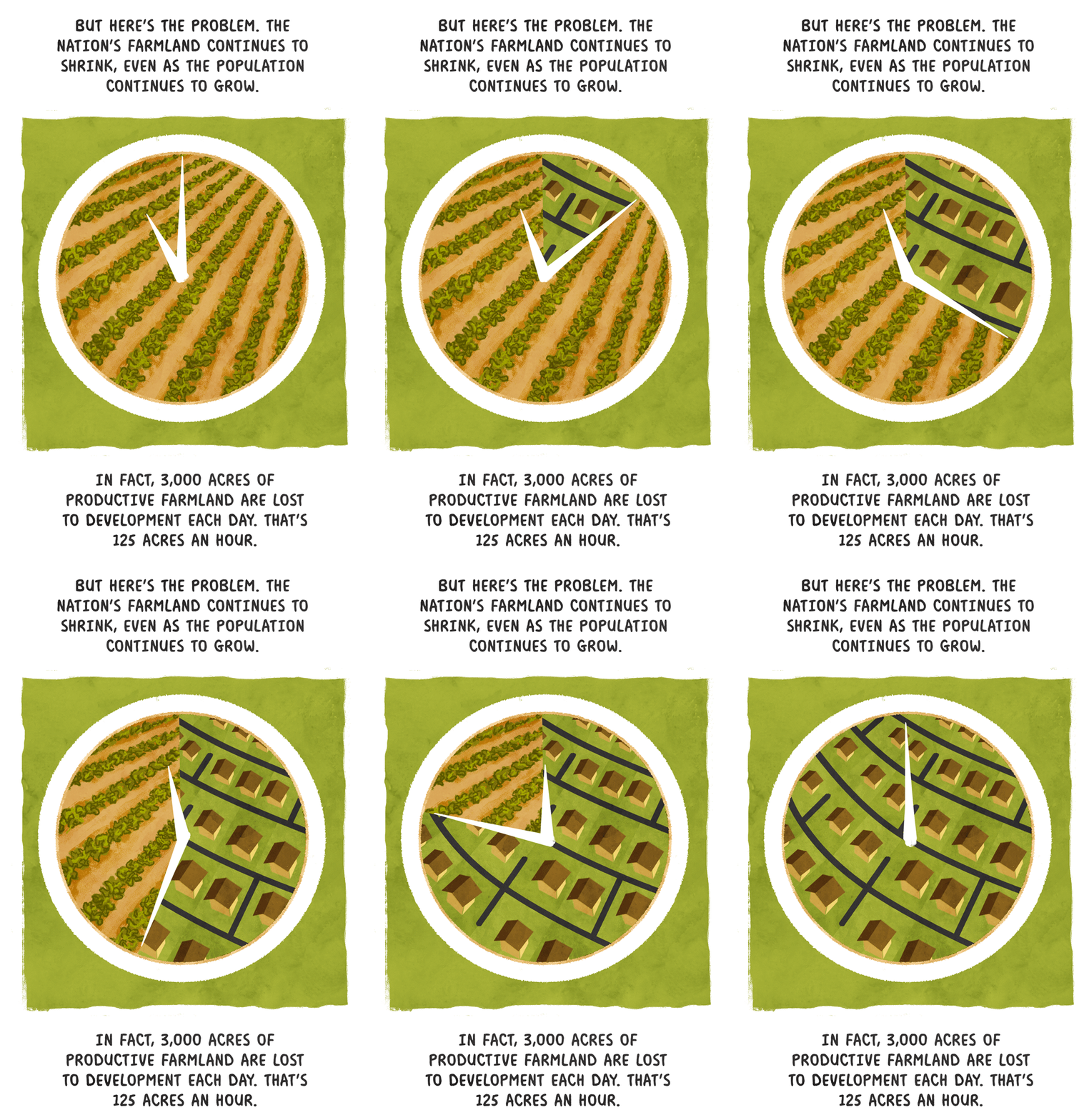
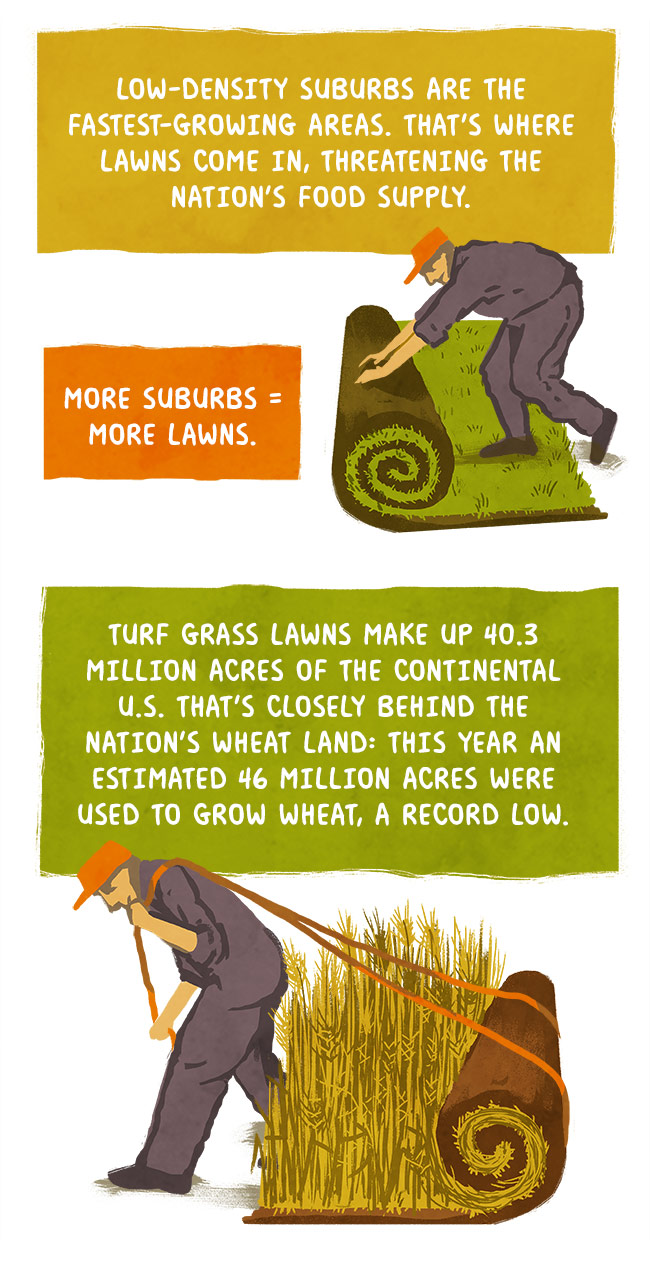
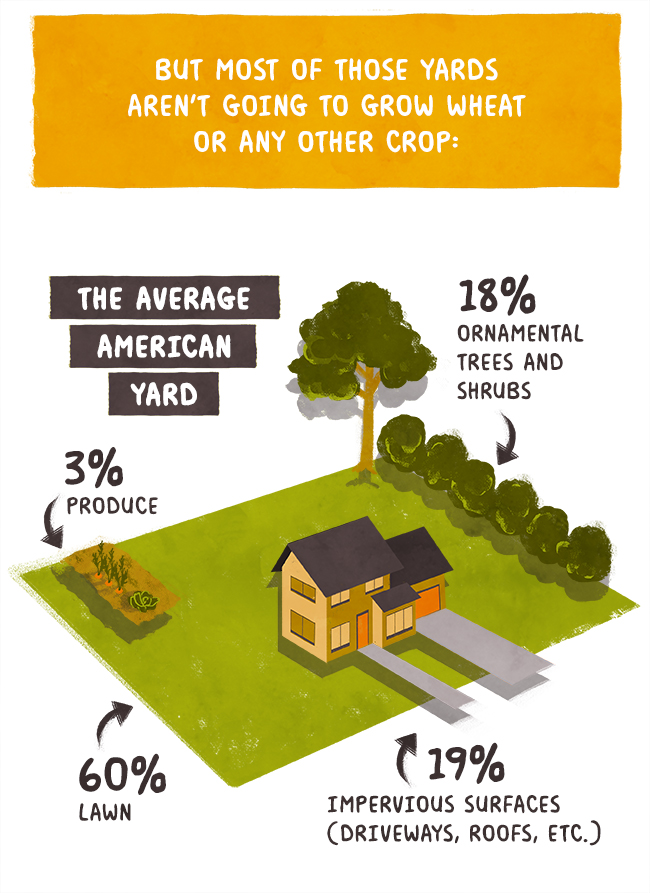
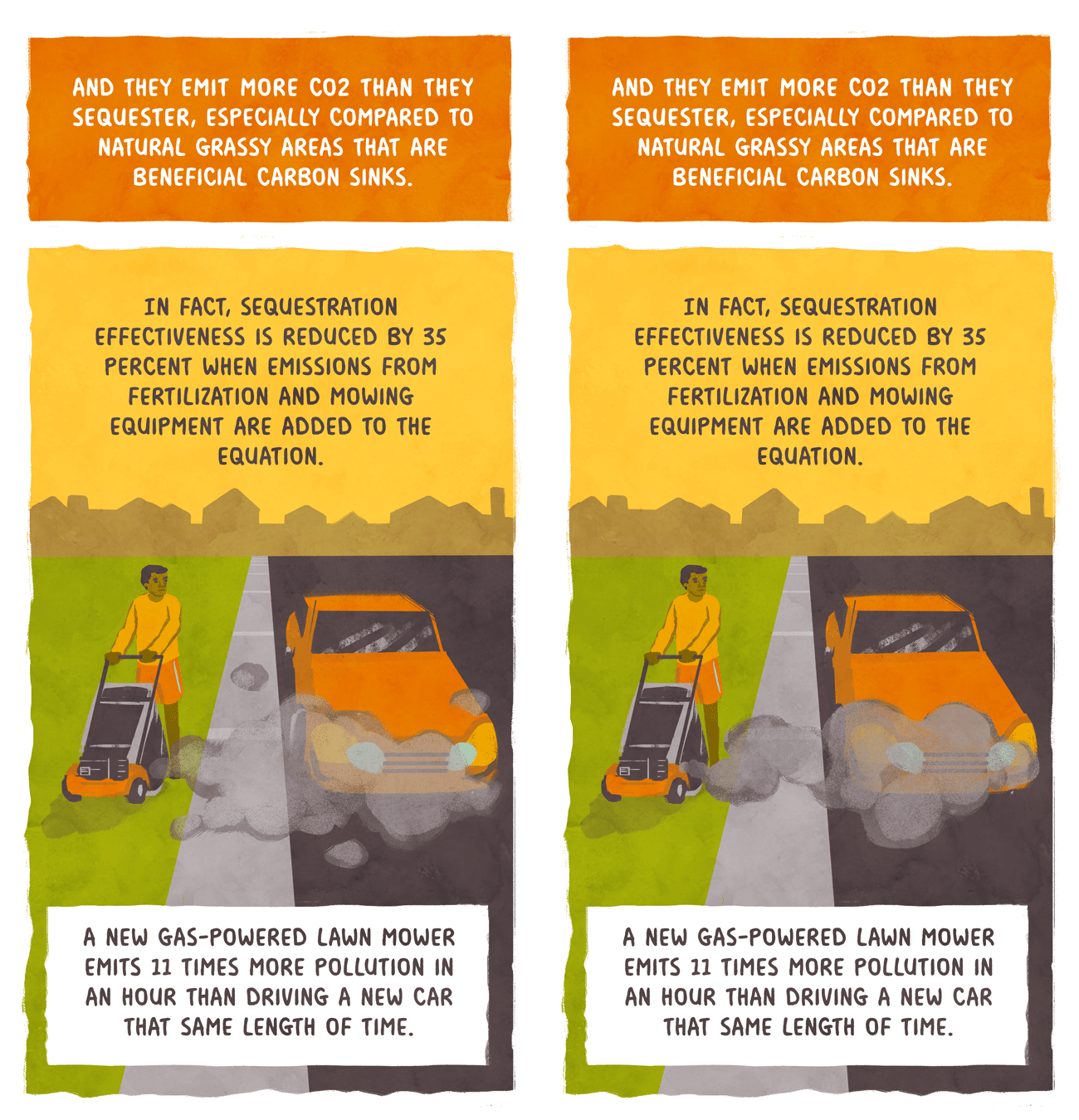
Are you excited about joining the Climate Victory Garden movement but not quite sure how to do it? If you have a lawn, then this comic is for you. There are so many benefits to ditching the lawn and planting a Climate Victory Garden—not only are you beautifying your yard, saving money, and producing delicious, healthy food, but you could actually be sequestering carbon dioxide and fighting climate change!
Already have a Climate Victory Garden? Great! Register it here to see others nearby. Also, join our Climate Victory Gardener facebook group to get weekly tips and join discussions around best practices.


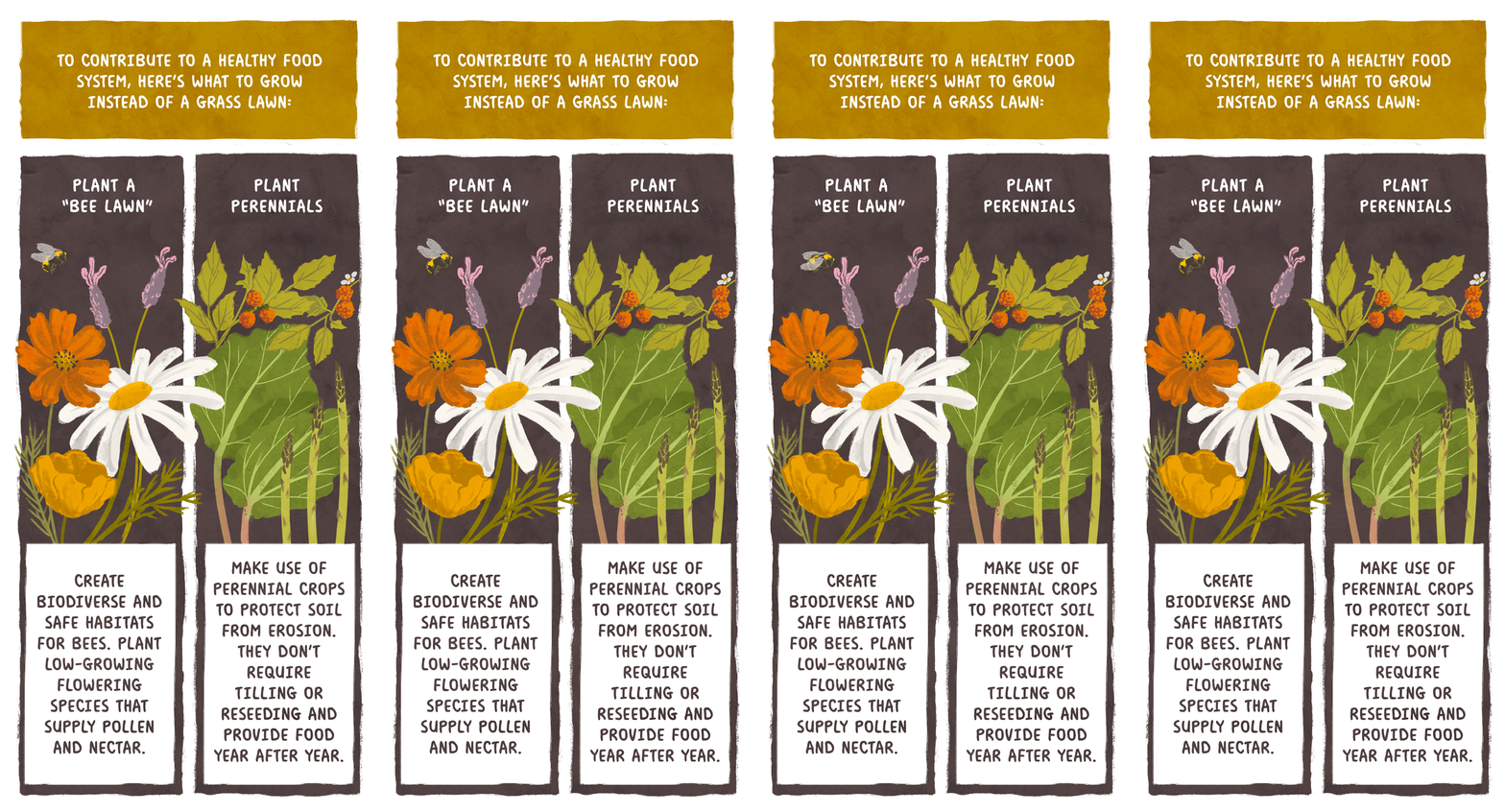
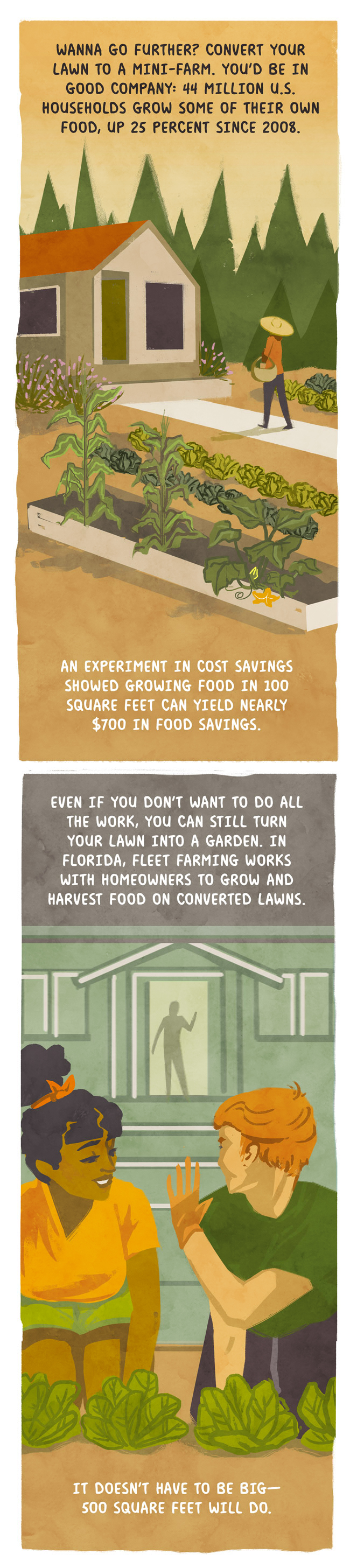
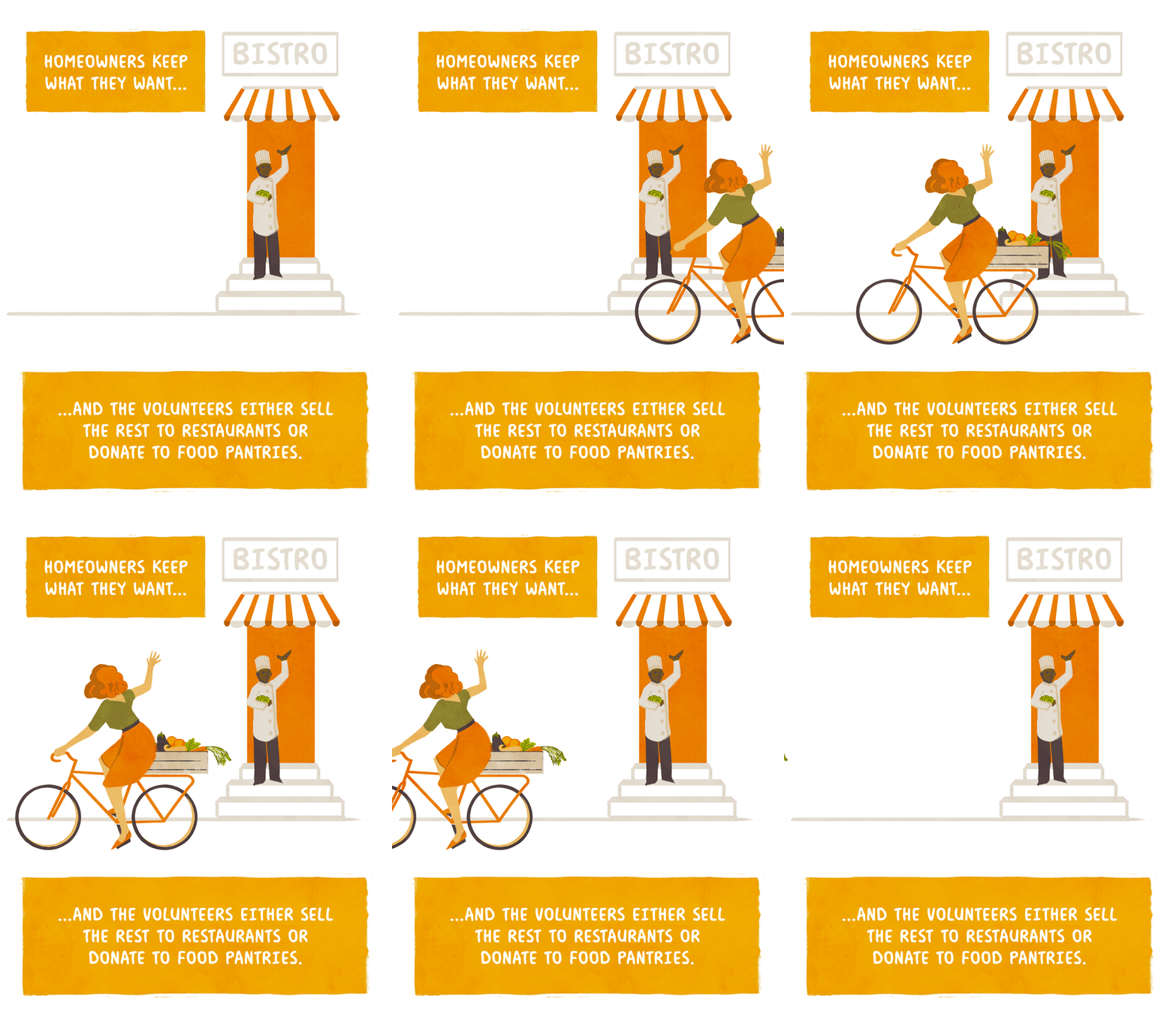
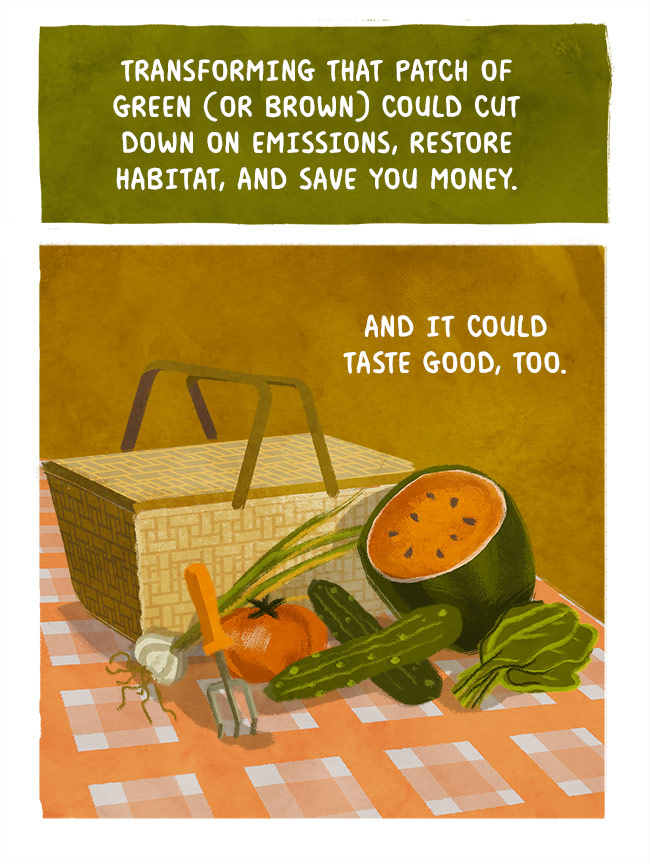
This article was originally published by YES! Media.
Jennifer Luxton and Erin Sagen created this comic for YES! Magazine. Jennifer is a journalist by training, graphic designer by profession, illustrator by passion, and amateur taxidermist by moonlight. She is the lead designer at YES! Follow her visual endeavors at www.jenniferluxton.com. Erin is an associate editor at YES! Magazine. She lives in Seattle and writes about food, health, and suburban sustainability. Follow her on Twitter @erin_sagen.
|
|
2018 Summer GAM |
|
|
Life in an Electronics Factory |
Your cell phone and other favorite electronics may have been made in an abusive sweatshop—and poisoned the workers who made them.
The nonprofit China Labor Watch (CLW), a longtime ally of Green America’s, has a history of exposing what life has been like in Chinese supplier factories, which make many of the electronics on US store shelves. CLW has sent a number of undercover workers into those factories to report on their experiences.
Most recently, from October 2017 to January 2018, CLW infiltrated the Catcher Technology Co. Ltd. factory in Suqian, China, which manufactures electronics for Apple, IBM, Dell, Sony, HP, and other brands. CLW identified major issues at Catcher regarding worker health and safety, pollution, and forced overtime.
CLW says the Catcher factory employs a complex shift rotation schedule that results in workers putting in overtime hours without earning overtime pay.
An average schedule at the factory was ten hours a day, six days a week, while the company promised an eight-hours-a-day, five-days-a-week schedule in a work regulation pamphlet. Production line workers had to stand for all ten hours, as the factory doesn’t provide seats, resulting in workers quickly becoming exhausted.
Catcher workers encounter toxic chemicals on the job, according to CLW. But the factory provided CLW investigators and other workers with less than one hour of safety training and only paper masks, as well as cotton gloves that appeared to be used. The factory did not distribute eye protection.
Catcher doesn’t disclose to workers—or the public—what chemicals its workers might encounter on the job. But one CLW investigator had to leave the factory after four weeks due to respiratory issues from chemical exposure.
In addition, states a CLW report, “there is a foul odor present in the workshop, but workers are unsure what object is producing the smell. Workers privately discuss how severe the pollution is at Catcher, and there were rumors that workers who worked at [a particular] workshop for a substantial amount of time might develop cancer.”
There is hope that things will improve. Some major tech companies (whose names you’re likely familiar with) are now working with Green America’s Center for Sustainability Solutions to make their supply chains safer.
The Center’s Clean Electronics Production Network (CEPN) is bringing together major electronics retailers and suppliers, labor and environmental advocates, and occupational health and green chemistry experts, along with the workers themselves, to eliminate worker exposure to toxic chemicals in electronics factories. CEPN convenes regular gatherings of these industry stakeholders to focus on the following:
- Creating a system to simplify data collection on toxic chemicals,
- Ranking chemicals used in the industry to prioritize those that are highest risk for action,
- Developing cleaner substitutes for toxic chemicals, and
- Devising a framework for factories to use to substantially involve workers in protecting themselves and others from chemical exposure. To read our exclusive from CEPN director Sarah O’Brien detailing more of this work, e-mail info@greenamerica.org for a digital copy of the article.
While CEPN has helped some big industry players make big strides for worker safety, Samsung continues to be a laggard in the industry, refusing to take steps to improve supplier factories. Green America and allied organizations from around the world delivered 200,000 signatures on various chemical-safety petitions to Samsung in April. The petitions addressed findings from reports about how Samsung factory workers in South Korea and Vietnam were being exposed to toxic chemicals.
“The fact that major brands are now working with their entire supply chains, including workers, to finally address this problem in a meaningful way is very exciting,” says Caroline Chen, Green America’s social justice campaigns manager. “Now, Samsung needs to step up and protect the workers in its supply chain.”
Sign our letter to Samsung, telling it to take action for worker safety from toxic chemicals.
|
|
Green Tech’s Underground Workers |
Big, rechargeable batteries are key to a green future. They’re required for electric and plug-in hybrid electric vehicles, which are a huge part of how the world plans to combat climate change. Norway, the UK, the Netherlands, India, and France have all set timelines for bans on the sales of new cars with fossil-fuel-powered engines. China has also made a commitment to phase out the combustion engine but hasn’t set a date. Home storage cells for saving solar energy generated by day for use at night, like Tesla’s Powerwall, have already mitigated reliance on dirty fossil fuels. But far from sleek electric cars and green homes, barefoot children and vulnerable adults make up the beginning of the green battery supply chain—all because these batteries they help create use a mineral called cobalt, a byproduct of nickel and copper.
The mining practices used to extract cobalt from the Earth involve child labor and dangerous working conditions. Even if you don’t have a taste for cutting-edge green tech, you’ve probably had your hands on something touched by problematic mining practices: Anything with lithium-ion batteries, including all cell phones, tablets, and laptops, uses cobalt.
Caption for header photo: A man enters a tunnel dug with shovels in a cobalt mine located 22 miles from the town of Likasi in the Democratic Republic of Congo. Schalk van Zuydam / Associated Press
Where Cobalt Comes From
Amnesty International and The World Bank estimate more than half of the world’s cobalt originates from the Democratic Republic of Congo (DRC). The DRC meets more than half of worldwide demand for cobalt through artisanal miners. (The rest comes from industrial mines in China, Australia, Zambia, and Russia.) Artisanal mining sounds quaint, but what it means is that miners don’t have an employer—they dig mines with shovels instead of power diggers and climb through them without safety equipment and without engineers to map out safe
mining routes.
An estimated 40 million people earn their living in artisanal mining (not just in cobalt), according to the World Bank. In comparison, industrial mining operations employ only seven million worldwide, meaning that most miners don’t have an employer.
Children as young as seven sift piles of ore coming out of artisanal mines, looking for pure cobalt. During this process, they may inhale toxic dust from heavy metals. The miners sell what they find to refiners at local markets, who may not give a fair price.
The Hazards of Cobalt Mining
Experts do not consider cobalt a “conflict mineral”—like tungsten, tantalum, tin, and gold—because the profits from the mines go to the miners, not to military groups for weapons purchases. But cobalt miners still have significant safety issues to worry about.
Amnesty International and Afrewatch’s 2016 report, This is What We Die For, compiled research about the human rights and health concerns of artisanal cobalt mining. The report highlights that since most miners do not have any safety equipment, they’re exposed to cobalt dust, which can cause asthma and breathing problems, and even a fatal disease called “hard metal lung disease.” One scientist from the University of Lubumbashi in the DRC told the Washington Post that a high number of premature births and birth defects may be linked to toxic exposure related to mining activity in the country overall.
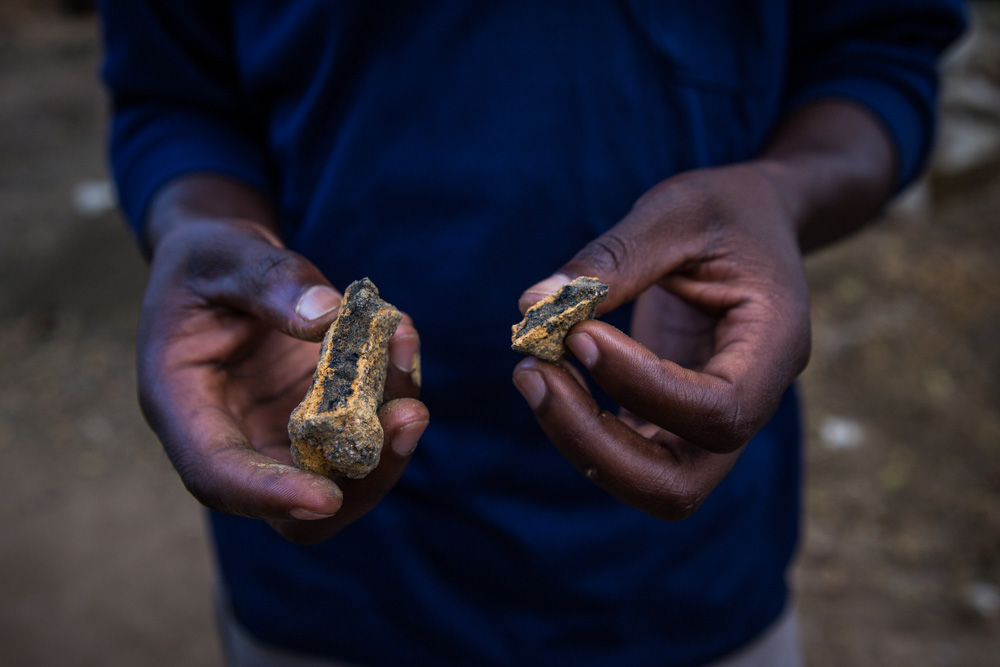
Hand-dug mines, which can be up to 330 feet deep, according to the Amnesty report, are poorly ventilated and are prone to collapse. There aren’t official data on the number of fatalities, but a DRC radio station tracked more than 80 miner deaths between 2014 and 2015. The report says, “The true figure is likely to be far higher, as many accidents go unrecorded, and bodies are left buried underground.”
Child Labor at the Mines
The DRC government has promised to eliminate child labor in mining by 2025. But with 40,000 children working there in cobalt mining alone, the problem is “massively complicated,” says Mark Dummett, business and human rights researcher at Amnesty International. He doesn’t believe the DRC can eliminate child labor that quickly.
“You can’t just send police in and chase kids out of the mines. You need to put in place all kinds of measures: They need to go to school instead, so there need to be schools in place. There need to be economic incentives for parents as well,” Dummett says.
He’s heartened by the country making such a commitment though. When Amnesty came into the country to do research on the problem in 2017, a government official had denied any children were working in mining at all.
What Big Tech Can Do
Darton Commodities, a company that buys and sells metals wholesale, says the world demand for cobalt is growing from 46,000 tons in 2016 to a projected 325,000 tons in 2030. That’s a 663 percent increase in only 14 years. In June 2018, at the time of print, a metric ton of cobalt cost $91,000.
Benchmark Mineral Intelligence analyst Caspar Rawles told Investing News Network (INN) that the supply for cobalt could become critical as soon as 2020, when most electric vehicles will come to market.
Cobalt mines do exist elsewhere in the world; Canada, Australia, and the US all have industrial mines that are far safer than artisanal mines and provide better pay. Even with new mines opening in these countries, both Rawles and Dummett say the demand for DRC cobalt will continue to increase.
“We forecast the DRC to become a bigger part of the cobalt supply pie, to become more dominant in the near term,” Rawles told INN. “There is no lithium-ion [battery] industry without the DRC.”
Tesla’s CEO Elon Musk promises that Tesla will only use cobalt mined in North America for its products, but Dummett thinks that won’t be possible because of the outsized portion of the supply that comes from the DRC.
Companies are racing to develop new batteries that use less cobalt content, so they won’t have to rely so heavily on the DRC, likely due more to the political instability in the country and the soaring price of the mineral, than to human rights concerns. But because the demand for lithium-ion batteries is so great for the booming electric vehicle market, Dummett says the demand for cobalt will rise even if the amount needed in each battery goes down.
The end game for tech companies wanting to be responsible is to tackle the health, safety, and human rights concerns around DRC cobalt mining.
“It’s very difficult for companies which rely on cobalt to avoid DRC cobalt, so they all have to address the problems [with mining in the country],” Dummett says.
In February, Apple announced that it would buy its cobalt directly from miners, instead of buying the complete batteries from manufacturers, which get their cobalt through refiners. Apple is looking to sign contracts for several thousand metric tons per year. Samsung, Tesla, BMW, and Volkswagen are all racing to follow suit, according to reports from Bloomberg.
Companies are making this change because the supply of cobalt is dropping while the demand is skyrocketing, explains Dummett. They’re not doing it to improve transparency. That said, by cutting middle merchants, companies are creating a system in which they could have a huge impact on the wages and safety of workers mining cobalt if they wished, as they’d have control over every step of the mining process.
“At the moment, these miners work in dangerous and exploitative conditions, because companies just want to buy the cheapest available cobalt, without caring about where it has come from,” Dummett says.
If they were working on the ground, , big tech companies could create an official industry where right now, artisanal mining is king. They could build mines that would pay adult laborers a fair wage, enough to feed their families and send their children to school, and provide safer conditions for mining.
Companies could also institute electronics take-back programs, to help increase the amount of old electronics that are responsibly recycled. Recyclers remove cobalt and other minerals from electronics so these minerals can be reused, which reduces the need to mine more.
Customers, Take Note
To start creating change in the cobalt industry, Dummett says that companies like Apple that are securing multi-year cobalt supplies first need to zero in on where it comes from, especially if they have no sense now.
Shockingly, 26 out of the 29 companies—including smelters, battery manufacturers, and consumer-facing tech companies—that Amnesty International contacted about their supply chains said they could not or would not disclose where they got their cobalt. It’s possible that some may not know their full supply chains.
“We think there’s a good chance that cobalt that’s been mined in these dangerous artisanal mines has entered the batteries of every major [tech] company. No company was meeting what we consider to be [best practices for] responsible sourcing of minerals,” Dummett says.
Consumers can do the following to pressure companies to do better for cobalt miners and the Earth:
- Ask questions: Dummett encourages consumers to ask tech companies questions, especially because there is no way to avoid cobalt without avoiding tech products altogether. The more companies get the sense that their customers care about cobalt miners, the more likely they are to change their supply chains for the better.
“A key question to ask companies is where they get their supplies from, and mention cobalt. Ask about tracing and sourcing, and about remediation, and what they’re doing to make things better,” Dummett says. “It has to start with transparency, before you even look at changing conditions on the ground.”
- Recycle old electronics: It’s also critical to recycle your electronics. Taking cobalt from a battery where it’s already refined means relying less on new materials from the Earth.
Call2Recycle is one of the largest battery recycling companies operating in North America. Last year, it collected 2.6 million pounds of lithium ion batteries, including cell phone and laptop batteries, and 85,000 of cell phones (It also recycles other types of batteries, including alkaline and nickel cadmium).
Call2Recycle CEO Carl Smith estimates those 2.6 million pounds represent less than five percent of the batteries on the market. He thinks a majority of unused, old batteries sit in drawers, as some folks forget about old technology in their homes, don’t know what to do with it, or are saving it for an emergency.
One thing to be sure of is that any old electronics go to a trustworthy recycler. Some “recyclers” and scrap shops will take used batteries but will ship them to open-air heap recyclers in Asia and Africa, where poorly paid workers will break down the metals with little protection from dangerous chemicals.
Recycling e-waste has more benefits than just yielding cobalt and other minerals for reuse. According to the 2017 United Nations report Global E-Waste Monitor, the estimated total potential value of materials in worldwide e-waste in 2016 was $68 billion. For every 1,000 tons of used electronics, 200 repair jobs can be created; a robust recycling system for devices could bring 45,000 new jobs.
Recycle Your Electronics!
To reduce the need for new cobalt, it’s critical to recycle your old electronics—don’t let them sit in a drawer!
- Find an e-Stewards Recycler: These recyclers, certified by the Basel Action Network’s e-Stewards program, recycle responsibly, in ways that minimize toxic exposure for workers and the Earth, and without shipping recyclables overseas. They also ensure that toxic electronics aren’t processed by prison, slave, or child labor.
- Drop your old electronics at a Staples store: All US Staples stores accept old electronics, ink and toner cartridges, and rechargeable batteries for recycling. Staples is an e-Stewards Enterprise, meaning it’s committed to using only certified e-Stewards recyclers.
- Become an e-Stewards Envoy. Envoys are individuals who pledge to reduce, reuse, and recycle their electronics responsibly. They also commit to spreading the word about how e-waste harms workers and the Earth.
- You can also responsibly recycle rechargeable, single-use, and cell phone batteries through Call2Recycle. Enter your zip code to find a battery drop-off box near you. You can also purchase battery-recycling kits from Call2Recycle, including kits for damaged lithium-based batteries.
|
|
A Life in California's Strawberry Fields |
Lucrecia Camacho comes from Oaxaca and speaks Mixteco, one of the Indigenous languages and cultures of Mexico that were hundreds of years old before the arrival of the Spaniards. Today she lives in Oxnard, CA. Because of her age and bad health, she no longer works as a farmworker, but she spent her life in Oxnard’s strawberry fields, and before that, in the cotton fields of northern Mexico.
I’ve always worked the strawberry harvest here in Oxnard. I’d finish that in July and go to Gilroy to work the jalapeño peppers, bell peppers, and cherry tomatoes. I brought my oldest daughter and son with me, and the three of us worked there. They would get out of school in June and worked July and August with me to earn money for their school clothes. They went back to school the 15th of September, so they worked with me 40 days.
I’d take my kids back to Oxnard for school and return to Gilroy to work all of September and October. I lived in a large room that was divided into smaller rooms. It had a stove and outdoor bathroom. We were paid by the piece rate instead of the hour. They paid 80 cents for a bucket of jalapeños—[those] with the stem were paid at $1.10 a bucket. I was able to fill 38 to 40 a day.
I’d get back to Oxnard in November, rest a bit, and then start the strawberry harvest again about January 20th. I worked a long time in Gilroy, starting in 1985. It’s been six to eight years since I haven’t gone. I couldn’t find housing one year, and after that, they wouldn’t hire me anymore.
 Lucrecia Camacho. Photo by David Bacon.
In strawberries, they also paid by the piece rate in April, May, and June. The other months, they paid by the hour. When I first started, it was three dollars an hour, and the piece rate was 80 cents a box. The year before, I was paid $8.25 an hour. The regular box rate was $1.25, the little box was $1, and the two-pound box was $1.50. If I was able to fill 40 boxes, it was a good day. The younger, faster men can pick 70 to 90 boxes a day.
The strawberry harvest looks easy enough, but once you try it, it’s hard. I don’t wish that kind of work on my worst enemy. When you’re young, you work hard and get tired, but once you get home and take a shower, you’re fine. Now that I’m old, I deal with arthritis and osteoporosis; my feet hurt, and they swell. Many workers have been permanently injured. I have a nephew who hurt his back working in the strawberries, and a cousin who died of pneumonia because we worked in the mud when it’s raining.
The fruit that brings the most money here is the strawberry crop, but they pay us a wage that hardly allows us to make a living, then they turn around and sell each box of strawberries for $18 or $20. If we pick 80 boxes, how much do you think they make from that? You’d think the owners would have enough money to pay workers higher wages, but they pay it to the foreman instead. He has a brand new car every year, and the worker doesn’t get anything.
The foremen now choose workers who can pick 100 to 130 boxes per day. I know one who only hires immigrants without papers because she says legal residents complain too much. They tell the ones without papers they’re going to call immigration officials or fire
them if they complain. These workers try and stay on the foreman’s good side by bringing her homemade tortillas, mole, and even Chinese food. I’m not going to bring her anything. I don’t get paid enough. If the foreman doesn’t like you, he makes you redo the work. In the strawberry fields, you’re always worried that the foreman is going to send you back and tell you to redo your box because it’s not full enough.
We just have to put our heads down and work quietly. There were many times I stayed quiet and didn’t defend a fellow co-worker, but one time I did speak up. I had a woman foreman who spoke to us disrespectfully; when I asked her why, she told me to give her my tools and fired me. I told her I didn’t understand why I was being treated that way, but the other foreman grabbed me by the arm and told me to leave.
Our work and life are hard here, and we don’t see many benefits. Have you seen the current gas prices? Before, we had to work an hour to cover our cost of gas, and now we have to work two hours. We don’t have anything left. The more we earn, the more they take away. We can’t move forward.
I tell my kids how much I’ve struggled. I’m old now, so the last four years, I was told I worked too slowly. But it’s difficult to work in the rain and mud. At times, you’re lucky and find a good foreman who gives you waterproof ponchos. Other places charge for them, $25 for ponchos and $25 for rain boots.
I felt so strong when I was young. I could work 24 hours. When I was picking cotton in Mexico, I could easily lift 50 kilos (120 pounds). I don’t know if it’s old age or my diabetes, but I work a lot slower now. The machine in the strawberry fields goes very fast, and it’s frustrating to get left behind. I can’t fill the amount of boxes I used to. I feel [nauseous] and get headaches.
They won’t give me a job anymore. If the foreman doesn’t like you, then you aren’t hired. They always choose the pretty women and family members first. As a woman working in the fields, if you didn’t have a good foreman, you were treated badly. You had to ask for permission to take a day off, but you were given a ticket. After accumulating three tickets, you were fired.
I’ve also heard complaints of sexual harassment from women. Sometimes, women don’t want to speak up. There are a lot who have
lived through it but are afraid to say something for fear that they’ll be reported to immigration officials.
In Culíacan, when I was young, I had a foreman who always sought out women to be alone with. He said he liked me, but I told him I knew he had a wife and mistress. He told me that if I let him do what he wanted to me, I would still have a job. If not, I needed to look for another one. I told him he would not see me there the next morning. Some of us women don’t take that kind of abuse, but many do what they feel necessary to keep their jobs, even if it means being in the hands of the foreman. My daughter tells me about her factory job and how that still happens there. The women that let the foremen do what they want move up in position. Those that don’t, stay in the same position.
We need someone to help us and provide us with support. There are only a few of us in Líderes Campesinas. [Editor’s note: Lideres Campesinas is a nonprofit organization that develops leadership among women farmworkers, so they serve as agents of political, social, and economic change in the farmworker community.] If I had a hidden camera, it would be so easy to show others what we face. I think a union would help, but it’s been difficult for one to get organized in the Oxnard area. When I began to wear my Líderes Campesinas T-shirt, I was told there wasn’t work for me anymore. I’ve been looking for work ever since.
When I came here, I didn’t expect a better life. I knew I would have to earn my living with physical labor. ... I hope to retire soon and go back to Mexico. I don’t plan on staying here, and I’ll leave neither rich nor poor. The only thing I’ll take with me is aches and pains, because it’s not like I have any money to take with me.
|
|
The Immigrants Who Feed the Country |
I n the fields of America’s breadbasket and beyond, from California to Florida, Wisconsin to Louisiana, farmworkers rise with the sun to pick the fruits and vegetables you see in stores, or to pull weeds on organic farms. It’s hard work, but someone has to do it to keep food on America’s tables. And usually, that someone is an immigrant worker—nearly three-quarters of farmworkers are immigrants.
Ninety-five percent of US farmworkers are from Mexico, three percent from Central America, and the rest from other countries, according to the US Department of Labor. A little over half have legal immigration status. But it really doesn’t matter if they have papers or not—what they all have in common is that many are subjected to too-low wages, unsafe conditions, sexual assault and harassment, and more.
“Agriculture [in the US] was founded with a slave labor force. It was profitable because farms didn’t have to pay for labor. That created a culture and an understanding of what farm work is worth,” says Rosalinda Guillen, a former farmworker and executive director of Community to Community Development (C2C), a “community-led, eco-feminist organization” in Washington state that supports farmworkers as they advocate for their rights.
As a result, she says, farmworkers are almost invisible to the general public: “The invisibility of farmworkers helps justify the low wages, the lack of rights,” she says. “If we don’t exist, then we’re not counted when it comes to opportunities to have an equitable position in the community—unless it’s in a charity model. But we don’t need saving. We just need the same opportunities and rights as white people.”
In the tradition of legendary farmworker-rights activists Dolores Huerta and César Chávez, farmworkers are fighting on the ground for those rights.
Caption for header photo: A boy picks strawberries in a crew of Mixtec migrants from Oaxaca. He says he’s 18 years old, a claim he’s been told to make if a photographer takes his picture. Photo by David Bacon.
 All photos in this spread are from In the Fields of the North by photographer David Bacon. University of California Press, 2017.
Union Power
Guillen’s colleagues say she’s brilliant at seeing connections between multiple areas of food sustainability and the farmworker rights movement, so C2C works at the intersection of a broad array of issues: labor rights, environmental sustainability, food access, immigration, and more. It’s also fundraising to develop a training center to help farmworkers create farming co-ops.
“We’re providing support to farmworker leaders already out there trying to improve conditions for the community,” she says. “Farmworkers tell us what issues are important to them.”
 Rosalinda Guillen (far right), director of Community2Community Development, an advocacy organization for farmworkers, talks with young women farmworkers on strike against Sakuma Brothers Farms. Sakuma finally signed a union contract with its farmworkers in 2017. Photo by David Bacon.
As part of this work, C2C supports unions like the United Farmworkers of America (UFW), the nation’s largest farmworker union, and Familias Unidas por la Justicia (FUJ), an independent union of over 500 Triqui-, Mixteco-, and Spanish-speaking workers at Sakuma Brothers Farms in Burlington, WA. These unions realized two prominent farmworker victories, with Guillen’s and C2C’s assistance.
The first occurred in 1995, when UFW won a union contract with Chateau Ste. Michelle wineries after an eight-year boycott over low wages, unpaid overtime, and a lack of collective bargaining rights for farmworkers in the company’s WA vineyards. At the time, Guillen was a UFW regional director in WA.
Today, Chateau Ste. Michelle has one of the best union contracts in the country, she says: “It’s union wine from vines to cork. The Teamsters have a [union] contract for the bottling component, and the vineyards have a contract with UFW.”
In 2013, FUJ farmworkers had been protesting working conditions at Sakuma Bros. for more than a decade, saying that they’d been subjected to wage theft, poverty-level pay, poor living conditions for migrant farmers, and worker abuse. Since they hadn’t made much progress, that year, the workers asked Driscoll Berries, a strawberry company that is Sakuma Bros. largest client, to use its clout to help them negotiate a union contract to address these abuses. When Driscoll refused to step in, FUJ called a state-wide boycott that soon turned into a national boycott.
After four years of boycotts, worker strikes and walkouts, and public pressure, Sakuma Bros. finally caved and signed a collective bargaining agreement in June 2017. The new agreement formally recognized the union; raised farmworker wages to $15 an hour; ensured that workers facing discipline would be treated fairly; arranged for regular meetings between Sakuma Bros. and union members; and agreed to develop a retirement plan for farmworkers by 2019. Guillen says that because of the union contract, things “are going really well” for farmworkers at Sakuma Bros. today.
C2C’s latest campaign supports farmworkers who come to the US on H2A guestworker visas, who say they’ve had to endure extremely oppressive working conditions, with no clear system for addressing abuses.
Under the program, farms in the US contract temporary farmworkers from Mexico to pick crops in their fields. Growers are supposed to provide housing, food, and travel under the program, says Guillen, but workers are being housed in terrible, barrack-like camps, and “exploitation at the farms is getting worse and worse every year.”
In 2017, 28-year-old farmworker Honesto Silva Ibarra died after falling ill on the job at Sarbanand Farms, a blueberry farm in Sumas, WA. While Sarbanand attributed his death to complications from diabetes, farmworkers and C2C claim Ibarra died from “extreme dehydration, malnutrition, and exhaustion.”
The Washington State Department of Labor and Industries ruled in February that no workplace or safety violations contributed to Ibarra’s death. However, the agency did cite Sarbanand for potentially up to $150,000 in fines for violations related to missed breaks and late meals for workers.
Farmworkers at Sarbanand held a protest in the days following Ibarra’s collapse and death, including a road march. Sarbanand fired about 65 of the protesting workers, according to the Lynden Tribune, a local newspaper.
“This year, we’re keeping an eye on Sarbanand,” says Guillen, noting that farmworkers could call for a boycott if conditions don’t improve. C2C is also calling for the H2A program to be modified or ended altogether.
Guillen says that the H2A program is being expanded under the Trump administration, even while states seem to lack the ability to ensure that guest farmworkers are safe on the job: “That’s their solution to farmers saying they don’t have a workforce [in the wake of the administration’s crackdown on undocumented immigrants], instead of humane immigration policies.”
Struggles on an Organic Farm
Organic certification does much to ensure a farm adheres to practices that are beneficial to the environment. But it does not address worker welfare. Even on organic farms, you’ll find farmworkers subjected to long hours, low pay, and abuse. Farmworkers are often fired when they speak up for their rights, but instead of stopping the fight there, some are taking farms to court.
In January 2017, two farmworkers, along with the US Equal Employment Opportunity Coalition (EEOC), filed a federal lawsuit accusing one of Florida’s largest organic farms of abuse.
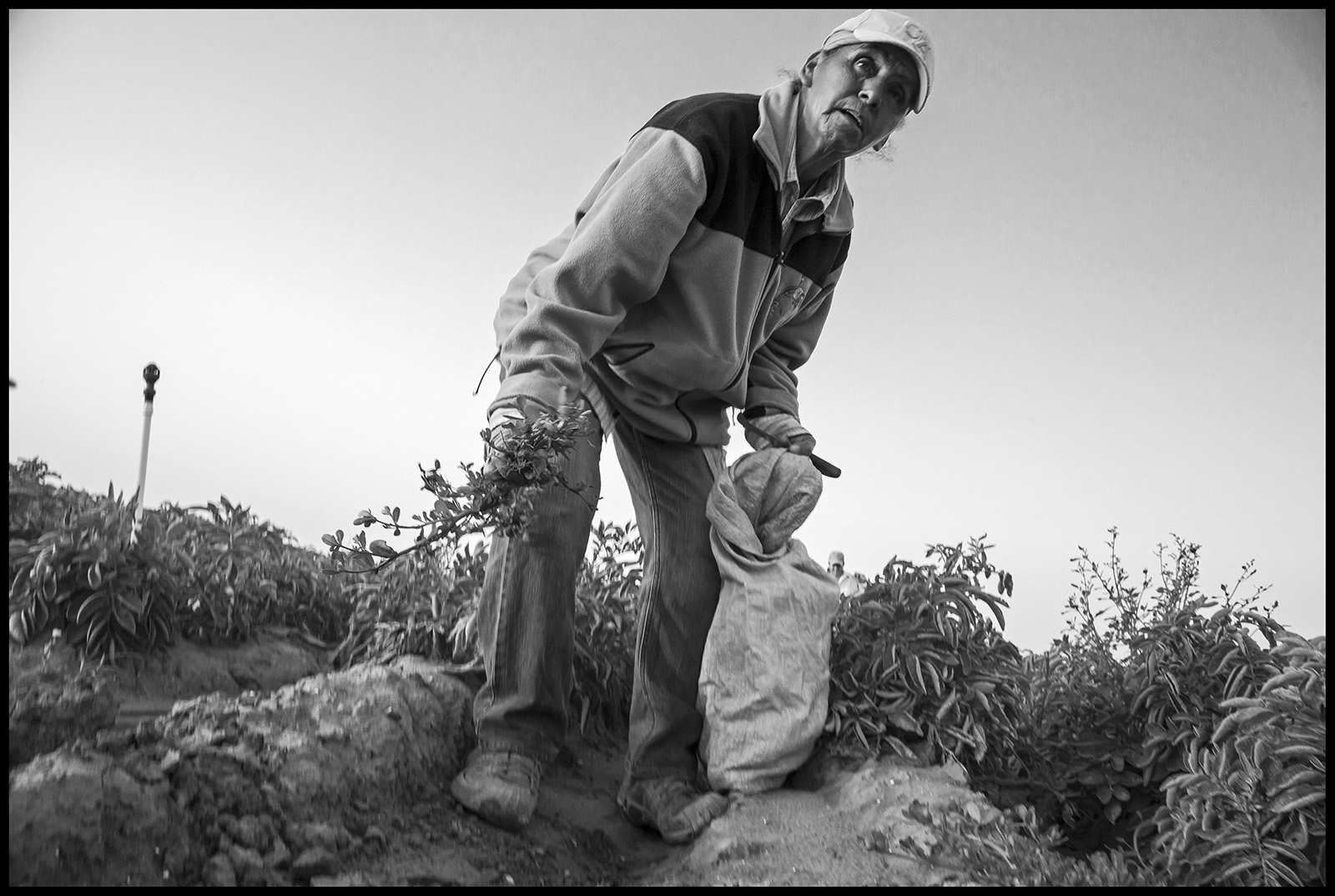 Margarita Beltran picks a weed growing amid the potato plants on an organic farm in Arvin, CA. She must bend like this to pull weeds several hundred times a day. Photo by David Bacon.
The lawsuits alleged that Glaser Organic Farms, which grows organic produce for Whole Foods and others, stole tens of thousands in overtime pay from vulnerable workers who were undocumented or spoke limited English. The lawsuits also state that Glaser allowed supervisors to verbally abuse workers, and the farm fired workers who spoke up.
The EEOC lawsuit alleged that Glaser subjected Latin American kitchen employees to racial abuse and discrimination, including managers telling workers, “You Mexicans are ignorant,” or “Mexicans are lazy,” and calling Deborah Velasquez, a Guatemalan worker, things like “burra,” and “the chocolate one.” Velasquez was fired after she complained. Owner Stanley Glaser denied the charges.
In April 2017, Glaser settled the suit by agreeing to pay Velasquez and another kitchen worker $15,000, to implement an anti-discrimination policy, and to provide bilingual training to workers on their federal rights against discrimination and retaliation, overseen by an independent monitor.
Domestic Fair Trade
Many Green Americans know about fair trade, a system that helps farmworkers and other workers achieve fair, living wages, safe and healthy working conditions, collective bargaining, and more transparency. The system also encourages sustainable production. To date, fair trade has been primarily for workers in the developing world. But now, farmworkers are advancing fair trade in the US and Canada.
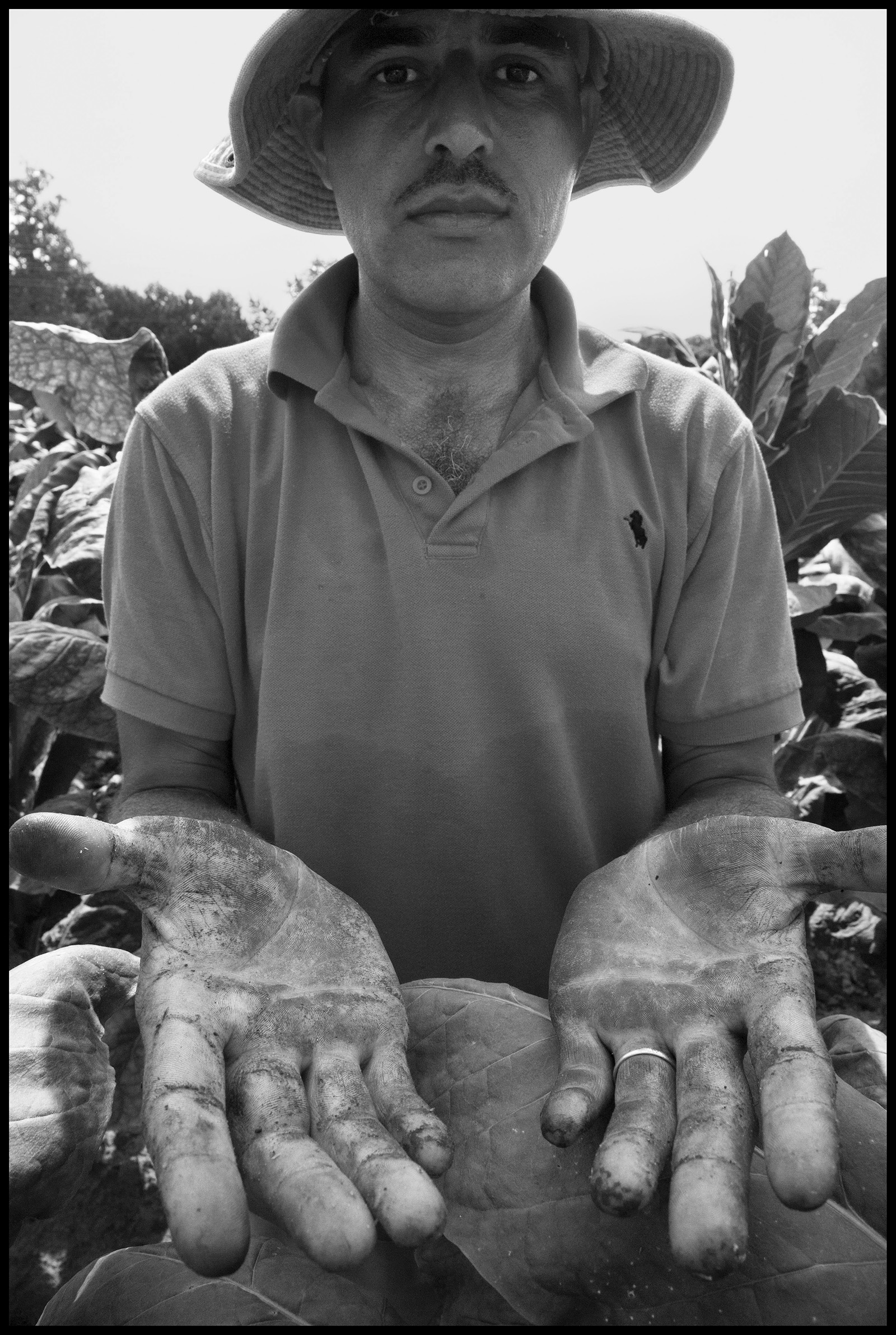 Manuel Garcia, a farmworker from Nicaragua, shows the juice from trimming tobacco plants on his hands and arms. He absorbs nicotine from his work, but the rancher discourages workers from wearing gloves. Tobacco juice is the source of
green tobacco sickness, an occupational health hazard. Photo by David Bacon.
The Domestic Fair Trade Association (DFTA) formed in 2008 as a membership organization to “unite the values of organic agriculture with the principles of fair trade” in the US and Canada. DFTA members include farmworkers, farmers, retailers, and processors. Five North American companies hold DFTA membership, including Maggie’s Organics, Dr. Bronner’s Magic Soaps, Maple Valley Inc., Farmer Direct Co-op, and the Organically Grown Co.
“The concept of domestic fair trade was created because farmworker and small-producer organizations in the US and Canada, as well as organizations and businesses already working internationally on fair trade, found that many of the injustices occurring abroad were also happening right here [at home],” says Erika Inwald, DFTA’s national coordinator. “At the same time, organic certification was growing in the US, but this label largely did not address worker welfare. The domestic fair trade movement seeks to help the public not only choose food that is healthy and sustainable, but also just.”
Rosalinda Guillen and several farmworkers helped launch DFTA and develop the standards for domestic fair trade, which closely match standards in farmworker union contracts. Guillen says she has no idea why companies like Chateau Ste. Michelle don’t label their union food and beverage products, as she thinks it would add value in the way that fair trade labels do for coffee, tea, and other commodities.
DFTA is mainly an advocacy and policy organization. Inwald recommends looking for Food Justice Certification and the Equitable Food Initiative label. Both certification programs adhere to DFTA standards.
A Penny Per Pound
In the tomato fields of Immokalee, Florida, farmworkers, most of them Latin American and Haitian, pick tomatoes in the hot sun, many of which are destined for prominent fast-food chains like Wendy’s and Taco Bell. In 1993, realizing that their wage of 50 cents per 32-pound bucket hadn’t increased in 30 years, those farmworkers started the Coalition of Immokalee Workers (CIW) to collectively bargain for a raise and for an end to worker abuses on Florida farms.
Since then, the CIW created the groundbreaking Fair Food Program (FFP), which fast-food, food service, and grocery chains can join to ensure independent farm monitoring to prevent worker abuses, and to provide tomato pickers protections in cases of wage theft, sexual harassment, and forced overtime. Companies that sign onto the program also agree to a rate increase for farmworkers of a penny more per pound of tomatoes, which they say makes a big difference in farmworker earnings.
In 2005, Taco Bell became the first to sign the agreement. Others include Walmart, Burger King, Chipotle, Subway, McDonald’s, Whole Foods, Trader Joe’s, Stop & Shop, Giant, Aramark, and more.
Bottom-dweller Wendy’s continues to balk at signing the agreement. The CIW says that rather than joining, Wendy’s pulled out of the Florida tomato industry altogether. The company did release a new code of conduct for its suppliers, but the CIW says it lacks the enforcement and monitoring of the Fair Food Program, as well as the higher wage.
“[It’s] a perfect example of the failed, widely discredited approach to corporate social responsibility that is completely void of effective enforcement mechanisms to protect farmworkers’ human rights,” the group said in a statement.
#MeToo in the Fields
In February 2018, CIW also released a powerful new report, Now the Fear is Gone, detailing the plight of women farmworkers in the fields. Women encounter the same wage theft, abuse, and harsh working conditions as men, but they’re much more likely to be victims of sexual harassment or assault.
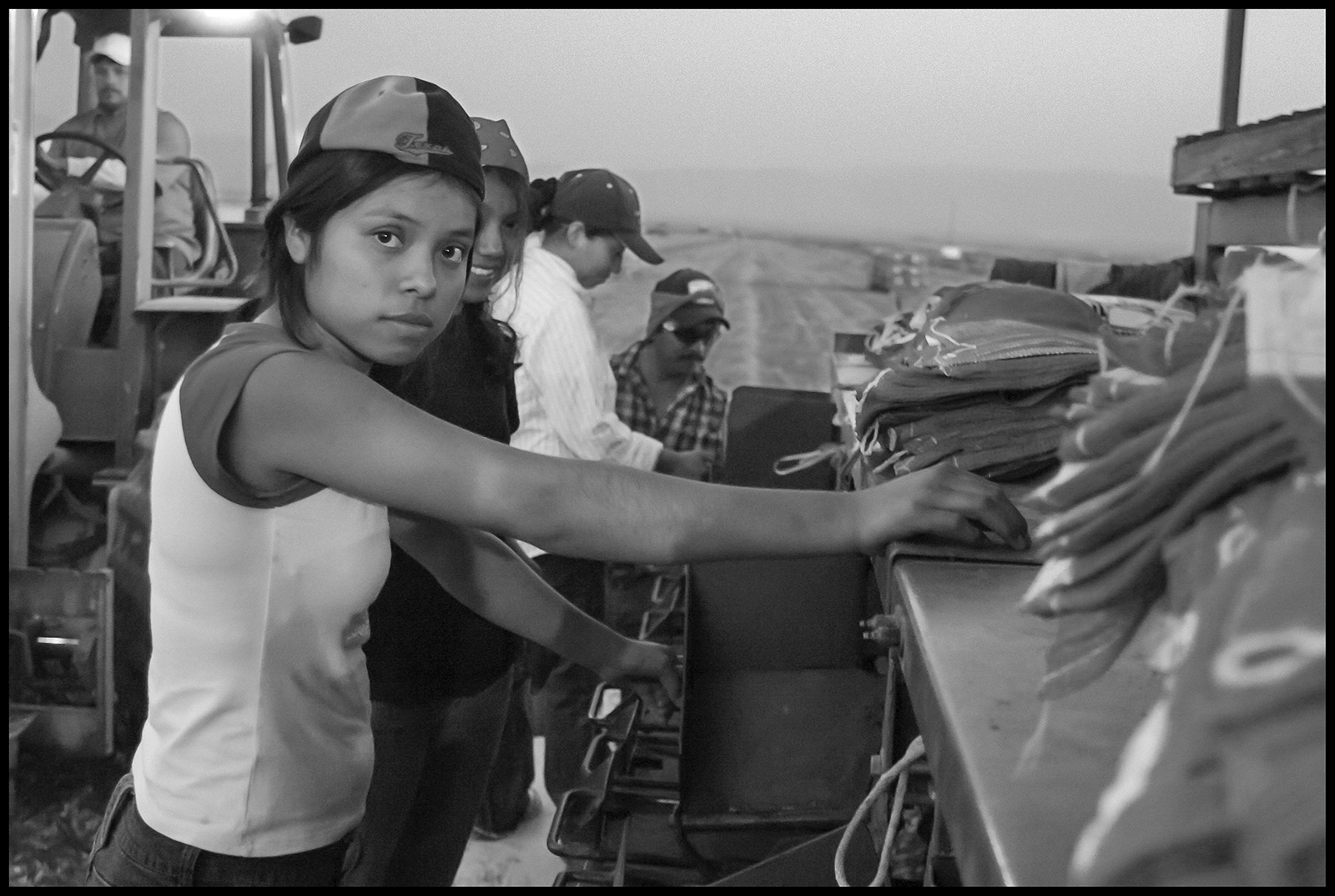 A young woman works on the sorting and bagging machine, which packs onions in the middle of a field. She wasn’t going to school because the foreman wouldn’t put her to work on the machine if she couldn’t work the full day-long shift. Photo by David Bacon.
As the report states, “Over eighty percent of women farmworkers suffer sexual abuse and harassment. Assault and the most extreme forms of harassment are so common that many women consider it unavoidable. ... As one female worker succinctly described it, ‘You allow it, or they fire you.’”
Rather than just detailing the problem, the report offers a significant dose of hope in the form of a powerful solution: the CIW Fair Food Program.
In 2010, the Equal Employment Opportunity Commission conducted a study of women farmworkers in California’s Central Valley. It found that the overall statistic remained true in the Valley: over 80 percent of the women had experienced some form of sexual harassment or assault.
“Hundreds, if not thousands, of women had to have sex with supervisors to get or keep jobs and/or put up with a constant barrage of grabbing and touching and propositions for sex by supervisors. A worker from Salinas, California, eventually told us that farm workers referred to one company’s field as the fil de calzón, or ‘field of panties,’ because so many supervisors raped women there,” states the EEOC study.
However, the Fair Food Program is making a real difference for farmworkers. Growers must abide by the FFP Code of Conduct, which has a zero-tolerance policy for sexual abuse. When a worker complains, the CIW says that “remediation is rapid, since growers must fix violations or lose the ability to sell their produce to Participating Buyers,” which are mainly large chains that make huge purchases. Those who violate any of the Code’s zero-tolerance stipulations find themselves terminated and barred from work on any FFP farms. The FFP provides education to terminated workers to help prevent future occurrences on other farms.
C2C’s Rosalinda Guillen says that union contracts provide similar protections for farmworkers against assault: “Contracts provide a legal mechanism for taking action—that workers trust. Nobody can be fired for complaining.”
In March, CIW farmworkers traveled to New York City to stage a five-day fast, calling on Wendy’s to help end sexual assault in the fields by joining the FFP.
“In the age of #MeToo, business leaders like [Wendy’s board chair] Nelson Peltz must use their power to end sexual violence in their companies’ supply chains, and not hide behind a shroud of silence that prevents survivors of sexual violence from obtaining justice,” said CIW farmworker Lupe Gonzalez in a statement. “Inaction in the face of a problem like sexual assault is unacceptable, but inaction in the face of a solution is unconscionable.”
|
|
Make a Difference: Join our national movement to build a more just and sustainable world |
|
|
Investing in Common-Sense Gun Safety |
Students from across the country participated in the March for Our Lives in Washington, DC, on March 24, 2018, to call for common-sense gun safety laws. The march was organized by survivors of the February shooting at Marjory Stoneman Douglas High School in Parkland, FL. Photo by Scott Serio via AP Images.
Shareholders Press for Change
Every day, an average of 96 Americans are killed with guns, and the gun homicide rate in the US is 25 times higher than that of other developed countries, according to the nonprofit Everytown for Gun Safety.
The US public largely supports enacting common-sense gun-safety laws to help reduce these fatalities, such as laws to ban attachments that allow a gun to fire bullets more rapidly. An NPR survey—conducted shortly after the shooting at Marjory Stoneman Douglas High School in Parkland, FL, last February that killed 17 students and faculty and injured 17 more—found that three-quarters of Americans want stricter gun laws than we currently have.
Unfortunately, Congress remains gridlocked on gun safety, even after another school shooting happened at Santa Fe High School near Houston, killing ten and injuring ten more, as the Green American went to press. Investors, however, are taking action.
Investor members of the Interfaith Center on Corporate Responsibility (ICCR), a nonprofit shareholder advocacy group, have been working behind the scenes with companies and through the shareholder resolution process to pressure weapons manufacturers and retailers to stop selling military- and assault-style weapons and accessories to civilians, make guns safer, and support gun-safety policies.
“Our end game is not to shut down the gun industry. We’re not talking about civilians who use guns to go out and hunt,” says Susana McDermott, ICCR communications director. “We are restricting [our investor efforts] to what are really military weapons [that are] being sold to civilians. At the very least, it’s about ensuring that those products don’t get into the wrong hands.”
Shareholder activists have already achieved important victories with gun manufacturers and retailers. Much of the leadership on the gun safety issue comes from Catholic sisters, who have been working on what Sister Judy Byron calls “militarism” issues since the 1970s, when they took part in anti-nuclear efforts. Byron is a member of the Adrian Dominican sisters and director of the Northwest Coalition for Responsible Investment, an ICCR member in Seattle.
“We’re about the mission of Jesus, and He certainly called us to care for people and have a just society,” says Byron. “I’m sure He would have done something about these weapons, if they’d been around in His day and age. Our Catholic social teaching also drives what we do.”
In 2016 and 2017, Catholic sisters across the US bought up stock in Dick’s Sporting Goods, Sturm Ruger and Co., and American Outdoor Brands (formerly Smith & Wesson), aiming to use their investor power to drive change at the companies. They then sent letters to all three asking for dialogues on gun safety.
“We were quiet about our work, because we thought if the companies were inclined to talk to us, it might not happen if we were out talking to the press,” says Byron. “There was no response. So we decided we would file our shareholder resolutions [for the 2018 shareholder season].”
St. Louis-based Mercy Investment Services—the investment program for the Sisters of Mercy and an ICCR member—led things off by filing a resolution at Dick’s in January, asking the company to commit to conducting background checks on gun sales, support universal background-check laws, and reevaluate its sales of assault-style weapons, including accessories like bump stocks and high-capacity magazines that increase a gun’s firing rate.
While most guns are sold at gun shows and smaller shops, corporate stores like Dick’s are responsible for 12 percent of assault-style weapon and 23 percent of rifle and handgun sales in the US, says the National Shooting Sports Foundation.
In addition, ICCR members Sisters of the Holy Names of Jesus and Mary, in Marylhurst, OR, and Catholic Health Initiatives in Colorado filed resolutions asking American Outdoor Brands and Sturm Ruger, respectively, to report on their efforts to make their gun products safer, to report on the reputational and financial risks associated with their products, and to monitor “violent events” associated with their companies.
But then the Parkland shooting changed everything, as the Stoneman Douglas High students catalyzed a nationwide movement for gun safety. The sisters and other ICCR members took the opportunity to approach Dick’s behind the scenes “about the clear business and moral case for immediate corporate action.”
On Feb. 28th, Dick’s agreed to stop selling assault-style weapons, and it raised the minimum age of gun purchasers in its stores to 21. The sisters dropped their resolution at the company.
In April, Dick’s took its commitment even further, committing to purge assault-style weapons and accessories from its shelves and destroy them, rather than selling them or returning them to the manufacturer. A month later, the company announced it was hiring a firm to lobby Congress on gun-safety policies.
“With Dick’s, we have achieved our goal regarding the positive role retailers can play in ending gun violence,” says Sr. Valerie Heinonen, director of shareholder advocacy at Mercy Investment Services.
Though not the subjects of gun-safety resolutions, Kroger announced it would end all gun sales in its Fred Meyer stores, and it would stop selling magazines about “assault rifles” in all of its stores; Walmart raised the minimum age for gun purchases to 21 and will no longer sell high-capacity magazines; it does not sell bump stocks and stopped sales of military-style rifles in 2015.
In May, the resolution at Sturm Ruger received a rare majority vote of 69 percent. While even a ten percent vote on a socially responsible shareholder resolution is often enough to bring companies to the negotiating table, a majority vote sends a clear message that a company’s stock ownership wants action.
“Sturm Ruger needs to not only take their fiduciary responsibility to investors seriously but also their broader and more important responsibility to society,” said Colleen Scanlon, chief advocacy officer at Catholic Health Initiatives, shortly after the vote. “We are heartened by today’s vote and look forward to dialoguing with the company on ways to make episodes of gun violence a thing of the past.”
Another 2018 shareholder resolution, filed by Stewart W. Taggart, an individual shareholder, asked Chubb Ltd. about the “Carry Guard” insurance it underwrote for National Rifle Association (NRA) gun owners worried about liability in self-defense shootings. The SEC ruled that Chubb could omit the proposal from the ballot on technical grounds, but shortly after the Parkland tragedy, Chubb disclosed that it ended its contract with the NRA three months earlier. While not targeted by shareholders, insurance broker Lockton Affinity said at the end of February that it would no longer act as Carry Guard’s broker and administrator.
A vote on the American Outdoor Brands resolution will take place at the company’s annual meeting this fall.
Mainstream Investors Get on Board
Responsible investors have also conducted outreach at mainstream investment companies like BlackRock and State Street Corp., asking them to use their financial might to press for gun safety, says McDermott. Those efforts have yielded impressive results.
BlackRock, the world’s largest asset manager, stated in February that it would speak with the weapons manufacturers and retailers in which it invests “to understand” their response to the Florida high school shooting. BlackRock also noted that it does not hold weapons manufacturers in its active funds—only in index funds, which are funds that mirror third-party stock indexes.
The company said in a March 2nd follow-up statement: “For manufacturers and retailers of civilian firearms, we believe that responsible policies and practices are critical to their long-term [financial] prospects. Now more so than ever. That is why, over the past week, we have reached out to the major publicly traded civilian firearms manufacturers and retailers to engage in a discussion of their business practices. We have already had constructive discussions with some, and we are continuing to pursue our engagement with them all.”
In April, BlackRock introduced two new exchange-traded funds and a line of pension plans that do not include companies that manufacture or sell civilian firearms. It also backed the gun-safety shareholder resolution at Sturm Ruger.
A few days after BlackRock’s initial statement, State Street Corp. announced it would engage with gun manufacturers and sellers over what these companies will to do support “safe and responsible use of their products.”
More Companies Make Moves
Several corporations took positive steps on gun safety this spring, bowing to public pressure after Parkland. On March 22nd, Citigroup announced a new US Commercial Firearms Policy “to do our part as a company to prevent firearms from getting into the wrong hands.” Under the new policy, Citi requires new retail-sector clients and partners to 1) refrain from selling firearms to those who have not passed a background check; 2) restrict weapons sales to people under 21; and 3) not sell bump stocks or high-capacity magazines.
On April 10th, Bank of America announced that it would stop lending to gun manufacturers that make military-style assault weapons for civilian use, prompting the powerful gun lobby to decry the actions of these two “gun-hating banks”.
Outside the financial sector, L.L. Bean announced that it would stop selling guns to anyone under 21. And Canadian-based Mountain Equipment Co-op said it was suspending further orders from five brands owned by Vista Outdoor, a Utah-based gun-manufacturer.
US outdoor company REI announced it would suspend orders from 50 brands owned by Vista, which include CamelBak water bottles and Jimmy Styk surfboards.
Shortly after Parkland, the NRA came under public fire for its extreme lobbying against gun-safety laws, including opposing measures to create a universal background check system in the US for weapons sales.
#BoycottNRA went viral on social media this spring, which may have at least partly influenced several companies to take anti-NRA action:
- Insurance giant MetLife tweeted that it would no longer offer discounts to NRA members on transportation insurance.
- Other companies ended discounts or deals for NRA members including: Symantec (Norton security software and LifeLock identity-theft services); Enterprise Holdings (Alamo, Enterprise, and National car rental); United Airlines; Delta Airlines; Allied Van Lines; North American Van Lines; TrueCar; SimpliSafe; and Starkey Hearing Technologies.
- And First Bank of Omaha announced in February that it would stop issuing its NRA Visa affinity credit card.
Credit Card Companies
On February 19, journalist Andrew Ross Sorkin, in an op-ed in the New York Times, called on the finance industry to “set new rules for the sale of guns in America”.
“Collectively,” he wrote, “they have more leverage over the gun industry than any lawmaker. And it wouldn’t be hard for them to take a stand.”
Sorkin called on the big credit-card companies to refuse to allow their cards to be used by retailers that sell assault-style weapons and accessories.
If that doesn’t work, Sorkin noted that banks and credit-card-processing companies could take steps to prevent their credit cards and card-processing services from being used at such stores. Finally, he urged retailers like Amazon, CVS, and Apple to pressure the payment-processing industry to act, since they’re among its largest customers.
McDermott says that the media pressure exerted by Sorkin and others “is making [the financial industry] realize we need to figure this out,” she says. She also notes that one coalition of responsible investors is currently talking behind the scenes to the big banks, pressing them to ban the use of their cards to purchase assault-style weapons and accessories. And another coalition is talking to big conventional mutual funds about encouraging such action.
In May, members of Green America’s Green Business Network® (GBN) launched a letter asking major financial institutions to restrict the availability of accessories like bump stocks, and to require gun buyers to be at least 21 and pass a background check. Individuals can sign our letter to the big banks with a similar ask.
Social Investors Take Action
Several GBN members in the responsible financial sector have taken action. Many socially responsible mutual funds offer weapons-free options—or, if they do hold weapons companies, it may be for the purpose of exerting shareholder pressure on them as ICCR members did with Dick’s and Sturm Ruger. If you want weapons-free investments, on May 31st, As You Sow launched WeaponFreeFunds.org, an online tool to help you check whether your mutual and exchange traded funds are exposed to gun manufacturers and retailers.
On March 27th, ICCR and nearly 150 other institutional investors, including many GBN members, released an “Investor Statement on Gun Violence.” The statement called on companies to embrace the Sandy Hook Principles, a set of gun-safety measures for corporations selling guns or ammunition. The principles were named after Sandy Hook Elementary School in Newtown, CT, the site of a school shooting that killed 20 children and six staff members in 2012. The principles encourage steps like developing tech-based safety measures for guns and supporting universal background checks.
“As shareholders concerned about the social impacts of our investments, we believe it is incumbent on all corporate actors to use their power and influence to contribute to the well-being of the communities where they operate and, more broadly, to society as a whole,” the statement reads. “The dangers presented by gun violence threaten the lives of our children, our communities, and the very fabric of our society. In the coming months, we will be engaging with companies we own to urge immediate and positive action that addresses gun violence.”
Investor Resources
Use your economic power to pressure companies for common-sense gun safety.
- Sign Green America’s letter to the big banks asking them to restrict credit card purchases of assault weapons and accessories.
- Share Newground Social Investments’ infographic: which gives a quick visual run-down of how you can start getting weapons out of your investments.
- Divest from weapons: Since the 1990s, responsible investors have been screening weapons out of their portfolios. You can screen on your own, or get help from a responsible financial advisor. Find one at GreenPages.org.
- Choose socially responsible funds. These mutual and exchange traded funds may hold some weapons companies, but it can be because they plan to use their investor power for change. Find them at GreenPages.org and WeaponFreeFunds.org.
- Vote for responsible shareholder resolutions on weapons. Visit ShareholderAction.org to view Green America’s list of resolutions to watch, including those on gun safety.
- Break up with your mega-bank. Some mega-banks help financially prop up weapons companies and retailers. Find a responsible bank at BreakUpWithYourMegaBank.org.
- Take charge of your credit card. By using a credit card from a responsible bank, you’ll know that your credit card fees aren’t bolstering weapons manufacturers and retailers. Find one at TakeChargeofYourCard.org.
- If you own a business that uses credit-card processing services, consider switching to a responsible processor like Dharma Merchant Services. Dharma does not serve companies that sell weapons or ammunition.
|
|
Mining on Sacred Ground |
Like the Standing Rock Sioux before them, the Menominee Nation has taken up the mantle of “water protectors” in the Midwest. They’re also trying to safeguard their Tribal history.
As the Green American reported in our Fall 2017 issue, Aquila Resources, a Toronto-based mining company, wants to site an open-pit sulfide mine, called the Back Forty Mine, in Upper Michigan, 150 feet from the Menominee River.
The Menominee, together with other local residents, are turning out in force to fight off the mine, which would be located on their traditional lands, in the area that’s the location of their origin story. Sacred burial remains of Menominee ancestors have been discovered near the mine site, as have mounds, dance rings, raised garden beds, and other features of cultural and archaeological significance.
While Aquila says it conducted its own archaeological survey and the mine will not encroach on those cultural sites, the Menominee counter that Aquila did not consult them or obtain their consent.
They do not trust that the Aquila survey was as thorough as an independent survey in which the Menominee themselves took part would have been.
Menominee Nation organizer Tony Brown conducted a tour in April of just some of the sacred and historical Menominee cultural areas near the mine site, pictured below.
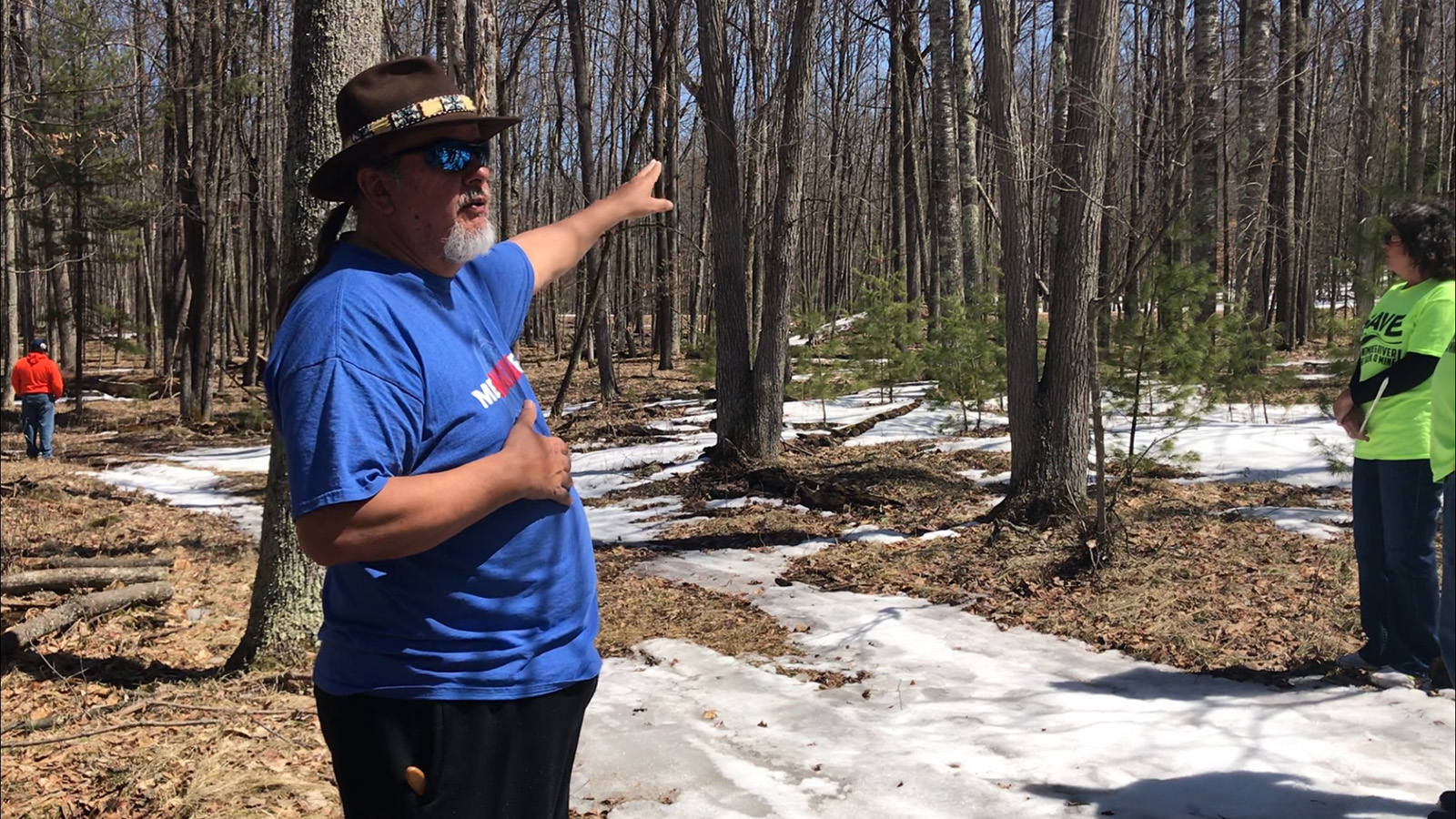
Menominee Nation organizer Tony Brown points to an ancient Menominee storage mound (raised ground behind the small pine trees, and inset photo) near the Back Forty mine site, located on traditional Menominee lands. Brown says the mounds acted as natural refrigerators, keeping goods cold. Anyone who needed something could simply take it from one of these mounds.

“Further up the river is where [archaeologists] found bones [of Menominee ancestors]. To support the people that were on this river, the Menominee had a gifting economy. Today, we all have things that can be sold or taken away from us. Here, everything was shared. ... We don’t have a big war history, the Menominee people, because we understood [the importance of cooperation]. Here was joy, love, everything you needed. Our Garden of Eden." --Tony Brown, Menominee community organizer
"This is a raised garden bed. At first, you might think it’s a road track. You can see how much they blend in if you weren’t looking. [Archaeologist Dr. David] Overstreet and his people put those stakes in the ground to mark it. These weren’t just one family’s garden. They stretch for big distances. It was a whole village garden. People were much more cooperative, much more interdependent. Part of what’s gone on with this society is we’ve become independent, and that’s really not healthy.” --Tony Brown
“If this raised garden is here, and that mound is there, you want me to believe there’s nothing over there on the mine site?” Brown said on the tour, gesturing toward Aquila’s fenceline. “I don’t. They haven’t been trained in the way [the Menominee have been]. How would they know that’s a garden bed? How would they know that’s a mound? They haven’t done the research, and they won’t let us, the Menominee people, go look.”

Brown noted that while archaeologists have dated the Menominee settlement near the Back Forty site as being more than 13,000 years old, Tribal historians say it’s even older.

The faint, ring-shaped outline in the grass is an ancient Menominee dance ring, marked by signs put up by the state of Michigan It’s located in the Shakey Lakes State Park, adjacent to the mine site.
“This area ... this was heaven. They found the oldest [type of] wild rice, which was plentiful, here. Wild rice used to grow here. We’re called ‘the people of the wild rice’ because [we knew] you go out there and you get what the Creator gives you. You don’t exploit it. You don’t plow it up. You don’t give up everything else. We’ve got a choice of paths. If we make the right ones, the people, as the Creator made them, will survive. That means all people, not just the Menominee. If we go down that burnt, black path [of siting the Back Forty Mine], it frightens me. You learn quick that cooperation benefits a lot more people than the destructive path.” --a Menominee water protector who wishes to remain anonymous

This ancestral burial mound is among the archaeological sites that could be impacted by the proposed Back 40 mine. Photo by Kevin Lancour
The Menominee and other local activists are also against the mine for the impact it could have on local water supplies. Since sulfide mining is more toxic than conventional mining—exposing sulfide ore to air and water easily creates corrosive sulfuric acid—any leakage from the mine could wreak havoc on the environment. It could also poison drinking water supplies, since the Menominee River feeds into Lake Michigan, the water source for millions.
Aquila received a conditional, final permit from the Michigan Department of Environmental Quality (DEQ) on June 4th to start construction on the mine. Aquila must provide the DEQ with plans to model, monitor, and prevent potential environmental damage from the mine, to secure the agency’s final approval.
Local activists say they won’t stop fighting the mine, and members of the Menominee Nation say they’ll put their bodies between Aquila’s equipment and their traditional lands if they have to.
For more information and updates on the water protectors’ efforts, see our article, “The Back Forty Mine: Is It the Next Standing Rock?”
Sign our letter urging the four main investors in Aquila Resources to pull their funding, as the company is moving forward with the mine without community support. To date, more than 14,000 supporters have signed onto this action.
|
|
Hidden Workers Fighting for Change |
Our economy rests on the backs of workers who are practically invisible, toiling in fields, mines, warehouses, and factories under unspeakable abuses. They’re fighting to change the system—and everyone can help.
|
|
Senior Fellow, Strategy & Training |
|
|
Director, Soil Health Initiatives |
|
|
3 Ways to Take Action Against Chocolate Child Labor |
For the past decade, Green America has been campaigning against chocolate companies to give voice to child laborers working in cocoa fields in West Africa. Chocolate companies earn billions of dollars in revenues from selling treats to consumers, and those resources should be leveraged to help farmers and children in West Africa. However, despite almost 20 years of industry and government initiatives, the number of child laborers working in cocoa fields in West Africa has increased. The University of Tulane estimated that in 2015, there were over 2 million child laborers in cocoa fields.
In 2015, the United Nations launched their Sustainable Development Goals (SDGs), a set of 17 goals to “end poverty, protect the planet, and ensure prosperity of all.” Goal 8 is about ensuring that everyone gets a chance for decent work and economic growth, with target 8.7 specifically setting goals to eliminate and prohibit child labor in all forms by 2025.
As part of global efforts to combat child labor, the United Nation’s International Labour Organisation (ILO) declared June 12 as World Day Against Child Labor. World Day Against Child Labor is a day to raise awareness on the plight of child laborers throughout the world, as well as highlight the work that governments, civil society, and workers organizations are doing to combat this pressing problem.
The ILO estimates that 152 million children are victims of child labor. Child labor is concentrated primarily in agriculture, with an estimated 71% of child laborers involved in the industry worldwide. Other industries with child labor include manufacturing and mining/quarrying. Child labor impedes on children’s ability to receive an education and a healthy childhood, which then can impact their development as well as the social and economic development of their communities.
It’s clear that the current approaches governments and companies are taking are not enough to eradicate child labor; they’re also not enough to eliminate farmer poverty, one of the root cause of child labor in cocoa.
So on World Day Against Child Labor (and every day!), we hope you’ll join Green America in standing up against child labor. You can start by taking action with us and telling Godiva to step up their commitments to combatting child labor in their supply chain, improve farmer livelihood, and publicly share their plans and progress – sign our petition here.
What else can you do to address child labor, both in cocoa and in the other sectors that it’s prevalent? The Department of Labor has some tips that will sound familiar to Green Americans!
- Ask questions: Ask companies and governments about what they’re doing to combat child labor. Challenge yourself and see if you can find out what products you purchase may have come from child labor.
- Take action: Stay updated on the issues, share the word amongst your communities and the companies you buy from and invest in, support organizations that are working to combat child labor
- Demand change: Hold companies accountable to their commitments; use your investments to promote responsible supply chain practices; and raise your voices against child labor.
And, remember to vote with your dollars every time you purchase chocolates for yourself and your loved ones. You can use Green America’s handy Chocolate Scorecard to help guide your purchasing.
|
|
Compare Membership Benefits |
Standard Membership
For green businesses & organizations
Starting at just $150/year for companies with 0-5 employees
Join Today
Marketing & Certification
Earn your Green Business Certification (at no additional cost) and gain exclusive access to Green America’s dedicated national membership. Grow your business through targeted marketing opportunities to reach committed, conscious consumers.
Promote your certification everywhere you do business: Display your seal on websites, social media, marketing materials, in storefronts and at events, and on product packaging.
Certification unlocks marketing opportunities:
- A robust Member Profile on GreenPages.org
- Advertising opportunities available in Green America publications, websites, and e-newsletters
- Reach consumers through online gift guides
Business & Financial Services
Cut expenses and time when you save on essential business services and connect to leading green providers.
- Save 20% off responsible credit card processing through Dharma Merchant Services
- Discounted shipping services, sustainable packaging, Fair Trade coffee, web hosting, and more
Resources & Networking
Join your green business peers, and get the tools you need to develop and deepen your sustainability practices while keeping up with the latest trends.
- Members-Only Facebook and LinkedIn Groups for B2B connections
- More online and in-person networking opportunities, including call-in sessions and regional events
- Online Member Portal for easy access to all benefits
- Connections – 2x monthly e-newsletter with business news, trends & events
- Subscription to Green American Magazine, Green America’s quarterly green living magazine, plus recent archives
- Webinars and in-person events
Mission & Advocacy
- Support Green America’s world-changing work to grow the green economy
- Join green business peers in advocating for a better world
Pricing
Annual dues based on the size of your business/organization:
- $150 0-5 employees
- $300 6-20 employees
- $500 21-99 employees
- $1,000 100-250 employees
- $2,500 Over 250 employees
Financial Services Membership
For socially responsible investing professionals & institutions (including mutual funds, ETFs, banks, and credit unions)
Starting at just $150/year for individual professionals and NGOs
Join Today
Marketing & Certification
Earn your Green Business Certification (at no additional cost) and gain exclusive access to Green America’s dedicated national membership.
Advertising opportunities in the Guide to Socially Responsible Investing and other targeted opportunities to attract new accounts and investors
Promote your certification everywhere you do business: Display your seal on websites, social media, marketing materials, in storefronts and at events.
Certification unlocks marketing opportunities:
- A robust Member Profile on GreenPages.org
- Advertising opportunities available in Green America publications, websites, and e-newsletters
- Reach consumers through online gift guides
Plus ALL the benefits of Standard Membership
- Business & Financial Services
- Resources & Networking
- Mission & Advocacy
Pricing
Annual dues based on the size of your financial services entity/institution:
- $150 Individual professionals & NGOs
- $250 Community Investing Institutions: Banks, Credit Unions, Loan Funds, and Venture Capital
- $300 For-profit service providers
- $500 Institutional Investors (e.g., Mutual Funds, Exchange Traded Funds): Assets Under Management – up to $50 million
- $1000 Institutional Investors (e.g., Mutual Funds, Exchange Traded Funds): Assets Under Management – over $50 million
|
|
Kamut Banner Ad |
|
|
Kamut Banner Ad |
|
|
Kamut Banner Ad |
|
|
Responsible Credit Cards |
Want to build a better world with every swipe? Our Credit Card Guide can help you find a card that benefits people and planet.
|
|
Is Recycling Really in Trouble? |
You might have heard a few scary things about recycling lately, like news headlines hinting at its demise. The industry is certainly at a crossroads but is not doomed to collapse if we mend its malfunctions. We’re going to break down what is happening and how your actions are essential in repairing recycling.
Why is this happening?
For decades, the US has exported a third of its collected recyclables, and half of that has gone to China1. American companies became reliant on overseas buyers for the flawed, low-quality recyclables not in demand domestically. But now, China is pushing back. A policy called the “National Sword” has gone into effect and has shaken up the recycling industry with its stringent requirements on contaminated items. The policy includes a ban on 24 types of imported scrap materials and has set what has been called a “nearly impossible” 0.5% contamination limit for bales of recyclables.
Contamination refers to either non-recyclable items being mixed in with recyclables or items that are still dirty with food or beverage residue being placed into recycling streams. Contamination is a problem in the US due to the way many people and municipalities practice recycling. Material recovery facilities (MRFs) are where our recyclables are taken to be sorted, baled, and sold to processing plants. About 65% of MRFs in the United States are single-stream, meaning all recyclables go into one bin. This removes the need for residents to sort before they put something in the bin, and makes participation easier, but it increases chances for contamination.
Think of putting a juice bottle with a bit of liquid in with a stack of old magazines. The residue can easily soak the paper fibers and contaminate them, making them unfit for sale. Contamination can also come from putting improper items in the bin, like plastic straws that aren’t recyclable and can easily be sorted incorrectly and contaminate paper bales. Considering the average MRF receives materials with up to 32% contamination2, this is not an easy problem to correct overnight.
What are the impacts?
The extent of how this policy may be impacting your local recycling program can depend on how reliant your area was on exporting materials (learn more about impacts in your state through Waste Dive). But stakeholders throughout the system have acknowledged that we’ve needed to clean up our recycling for a long time and while jarring, this policy should come as no surprise. Some MRFs have begun operating machinery and conveyor lines at a slower pace to more thoroughly pluck out non-recyclable items. Some companies are frantically searching for new foreign markets. A few municipalities are scaling back what materials they accept, and there are cases of counties suspending all recycling for the time being4. These are discouraging responses, but this change is a crossroads for the industry, not a death sentence.
How can you help?
Households and business nationwide need to be at the heart of solving the contamination issue. It might seem hard to believe that our daily choices can collectively result in massive improvements to the recycling system, but the idea that our actions are inconsequential is the myth that’s contributed to this problem. There are four key action steps we can weave into our daily habits that will bolster recycling and allow us to achieve even greater environmental and economic benefits.
- Don’t be a wish-cycler. Wish-cycling is putting something in the bin that you hope is recyclable instead of only things you know are. Follow local rules of what is accepted for recycling. These are made based on what your local program can collect, sort, and sell. Making sure to follow these rules reduces the odds of putting an unacceptable item in the bin and can curb contamination. You can find these listed on your town’s website or search using resources like Earth911.
- Empty and rinse recyclables. You don't need to scrub your recyclables perfectly clean, but it's important for them not to be coated with food or liquid. Make sure containers are emptied out and if needed, give a quick rinse and shake excess liquid off before tossing them in the bin.
- Choose recycled-content products. If we aren’t demanding recycled materials to displace the need for virgin material extraction, then we aren’t closing the loop in recycling. When purchasing a product, look for a label about its recycled content (not just that it’s recyclable). Often a company will print the percentage of a product or packaging that’s recycled content on the label. Not all products that have recycled content will specify, but picking items with a clear commitment to using recycled materials is one important way to signal that demand.
- Communicate to your local government that you value recycling and it needs to be a priority and tell companies you buy from to make products using recycled materials that are recyclable in all areas. You can do this through contacting entities directly via social media, email, or sending in letters. If you learn that your municipality is considering halting recycling collection, gather resident and business signatures together and submit it to your local officials to show how important recycling is to the community.
The actions of individuals and businesses are pivotal to making this a catalyst for positive, permanent change. Contamination that has spurred these issues is something we can prevent every day.
You can learn more about recycling wins and fails in our Rethinking Recycling issue of the Green American.
This blog was updated on 1/2/2019.
|
|
3 Sisters Sustainable Management |
Coming soon.
|
|
actionpopo |
|
|
Ground Floor Partners |
Ground Floor Partners provides strategic business advisory services to small businesses, start-ups and non-profits. We are located in Chicago, Illinois, but we serve clients throughout the United States. We have been in business since 2003.
We engage business owners and senior managers in an intensive, collaborative process to identify and resolve any issues and challenges that may be preventing your company from achieving its fullest potential.
We work with a variety of clients at almost every stage of the business life-cycle. We love to work with innovative businesses that don’t quite fit into any standard classification scheme. Most of our clients have annual revenue less than $10 million, but this is not an absolute requirement.
We love green, sustainable, and socially responsible businesses!
Services include:
- Management Consulting
- Business Plans
- Marketing Plans
- Feasibility Studies
- Market Research
- Strategy Consulting
- Business Assessments
|
|
Starbucks, Labor, and Social Justice |
In March, Starbucks found itself under a scorching spotlight for racial profiling when a manager called the police on two African American men who were waiting to conduct a business meeting in one of its stores.
Since then, the coffee chain has launched into a corporate crackdown on discrimination in efforts to restore trust with customers, and on May 29, all of its 8,000 US stores will close for racial bias training.
As Green Americans observe Starbucks’ effort to address this crucial social justice issue, evidence shows that the dominating coffee chain still has blind spots to other areas of concern—in particular, its labor practices—as employees continue to speak out against corporate failures to improve worker conditions.
In June 2016, ten-year Starbucks shift supervisor Jaime Prater published an online petition on Coworker.org to address what he described as an “infuriating” labor situation in which understaffed and overworked baristas are struggling to keep up with the demand for service. Prater’s petition also noted that Starbucks’ pay and the lack of full-time work hours made it difficult for employees to financially support themselves. Since its 2016 posting online, Prater’s petition has garnered 20,470 signatures.
While Starbucks provides a number of competitive benefits to employees, including college tuition assistance, 401(K) matching, and the opportunity to purchase Starbucks stock via the company’s Bean Stock program, the average Starbucks barista earns about $10 an hour and $20,000 a year. Though many Starbucks retail workers appreciate these benefits, they have also voiced frustrations with not being able to cover necessities.
One store employee told Business Insider, "My team wants to be able to afford rent and groceries. If you had asked partners if they could have the option for higher pay or the college achievement program, somewhere around 90 percent of all partners would have asked for increased pay."
Valuing Customers AND Workers
Starbucks executives call store employees “partners” to communicate how central baristas and other retail workers are to the corporation’s success, yet many employees have expressed concerns that the corporation prioritizes the customer experience over their strenuous working conditions.
In April 2017, Starbucks CEO Kevin Johnson introduced the North Star Initiative, a two-year program led by executive vice president Kris Engskov, which aims to strengthen the emotional connection between employees and customers. The North Star program emphasizes five pillars: Recognize me, Include me, Appreciate me, Support me, and Delight me, where the “me” represents the Starbucks customer.
Since its 2017 roll out, Starbucks baristas—the people largely responsible for establishing these connections, have criticized the North Star agenda for failing to outline specific and tangible practices to improve performance and for making it seem like baristas aren’t trying hard enough to provide good customer service.
For baristas, North Star’s expectation of personal connections and speedy, high-quality service cannot come without proper support. In 2017, Starbucks had $22.3 billion in revenue and operation expenses totaling to $9.6 billion, according to data collected by the NASDAQ stock exchange. NASDAQ also reports a net income of $2.88 billion for the company.
What's Next at Starbucks?
The world’s most successful coffee chain can afford to pay its approximate 250,000 store workers a living wage and hire enough of them so their workload is manageable.
Following the corporate tax cuts Congress approved earlier this year, Starbucks announced plans to roll out new employee benefits, including wage increases, $500 in stock grants to its retail workers and $2,000 to store managers, accrued time off for sick leave, six weeks paid leave for non-birth parents, and the creation of 8,000 new jobs, according to USAToday. The six weeks paid leave for non-birth store employees is half of what the corporation's salaried employees receive, and as Starbucks celebrates these improvements, there's still work to be done to ensure that all of its partners are supported fairly.
Green America's Green Business Network emphasizes the importance of caring for workers and improving communities, in addition to being a leader in social responsibility. To make the strides it desires in building personal connections, Starbucks should develop more rigorous frameworks in support of living wages and investments in community development. On the discrimination front, Starbucks executive vice president Rossann Williams said to employees, "May 29 isn't a solution; it's a first step." Experts say both recognizing individual privilege in race, gender, class, and sexual orientation—and the fact that everyone has unconscious biases— is essential to making this day of action effective.
|
|
Latest News |
|
|
TomatoInk |
TomatoInk is an eco-friendly, low-cost provider of ink and toner. By packaging ink in remanufactured cartridges, we pass along substantial savings both financial and environmental to you. Our products give the same vibrant, high-quality results you expect from the name brands but at prices up to 80% less! Combine that with our partnership with Eden Reforestation Projects, and you can print with ease knowing TomatoInk is thinking about you and the world you live in.
|
|
Self-Help FCU Roseland Branch |
|