|
Forbes |
|
|
Triple Pundit |
|
|
Daily Dot |
|
|
ULoop |
|
|
Our Future |
|
|
Bloomberg |
|
|
Our Team |
Learn more about Green America's board of directors, executive team, and staff. We'd love to add you to this page. See Green America's job openings here. |
|
What's Wrong with GMO Wheat |
Bob Quinn is the man behind KAMUT® Brand khorasan wheat, a unique ancient grain from Mesopotamia. After receiving a Ph.D in Plant Biochemistry from UC Davis and selling his business interests in Northern California, he moved back to his family farm in Montana. Through the use of a trademark he has dedicated his company to protecting the integrity of khorasan wheat and is able to set high standards for the ways in which it is grown. Kamut khorasan wheat can never be cross-bred with modern wheat and must always be grown organically.
There are a growing number of wheat growers joining Quinn in a movement to reestablish ancient grains and turn to organic growing methods. This is a forward-thinking movement looking at the least chemically intensive, environmentally destructive, while being the most profitable to farmers. At the same time there is a band of biotech companies determined to introduce genetically engineered (GE), or more commonly described, GMO wheat.
What’s wrong with modern wheat?
To understand the implications of GMO wheat, it is important to understand the concerns surrounding modern wheat in general and what differentiates it from ancient grains, such as Kamut khorasan. Ancient grains are those that are derived from ancient civilizations and have been left practically unaltered by human interference since that time. Ancient grains are gaining in popularity, with grains such as spelt, khorasan, einkorn, and emmer (faro) becoming more common to consumers.
The vast majority of the wheat we consume today has been drastically altered from its original form. According to Bob “what is inherent and drives modern wheat breeding programs are higher yields and more loaves of bread, linked with the national drive to sell cheap food in this country. Cheap food is the main food policy these days. With that being the main goal many things have been changed. To make higher yields, plants were made shorter and more uniform, they were made more disease resistant, and more resistant to insects.” But all of these changes plus others have had many unintended consequences. “What is probably even more significant is the change in the proteins and starches in the kernel to make more loaves of bread with less wheat. This is significant because this is the part we actually eat,” says Bob.
The cheap wheat most often consumed today is stripped of much of its nutrients and removes many of the benefits that can be found in ancient grains. All of this is done to lower costs. Research shows that it is how we have altered modern wheat that is resulting in so many health complications linked to wheat. The health implications of modern compared to ancient grains are a major focus area for Kamut International. Bob thinks, “recent changes made to modern wheat is probably at the heart of the troubles that people are having eating wheat, these unintended consequences are what people are struggling with.”
Why GMO wheat isn’t the answer?
The most common types of GMO crops, such as corn, soy, and alfalfa, are developed to be herbicide-resistant, allowing entire fields to be sprayed with herbicides without damaging the crops. This increases the amount of pesticide residue left on food and increasingly studies are finding high levels of pesticide residue in our water and our bodies. Major biotech companies are pursuing GMO wheat developed to be resistant to glyphosate, dicamba, 2,4-D, and glufosinate.
For Quinn there are a number of reasons that GMO wheat simply isn’t the answer. There is the general concern for the impacts resulting from the type of agriculture promoted by GMO crops: costly chemical inputs, monocropping, and the impact on surrounding ecosystems. But his concerns go far beyond these and are focused on the farmers growing wheat and consumers. In Bob’s own words, here are some of the main concerns surrounding GMO wheat:
The increased cost of production incurred to the farmer:
“In Montana the cost of chemicals is so high compared to what people are getting for their wheat, they can’t afford to grow it anymore. They can’t afford to farm in this way. They can’t pay their chemical bills with the amount they are receiving for the grain they are harvesting. I think that this is a crazy and unsustainable system that is going to lead, many into financial ruin. Many will be forced to sell their farms and suicide by those who feel trapped has already started to occur. Right now, the price of organic wheat is at 4 or 5 times the price of conventional. With organic you are taking so much more net profit to the bank that it puts you in a very comfortable position rather than being on the edge of break even all the time or even worse, farming at a consistent loss. The current system is an artificial system that is only propped up by large government subsidies, which are starting to disappear. This leaves farmers in a system where they are completely vulnerable and almost unable to make a living.”
Health concerns with herbicide use:
“More and more research is starting to point to the chemicals causing some of the trouble that people are having with wheat. Research in Canada has demonstrated that glypohsate residue is mimicking the symptoms that people have from wheat sensitivities and there have been all kinds of health problems that disappear, in children when they go on an organic diet.”
The economic viability of US wheat abroad:
“Montana’s main customers are Japan and South Korea, both countries have made it abundantly clear that they will not purchase GE wheat. The problem with wheat will be that there is no way to distinguish a GMO kernel from a non-GMO kernel. This will be the problem in the marketplace; there is no way to differentiate it. The first time we end up with a boatload of wheat in Tokyo bay where they find traces of GMOs will produce a huge fall out. Who will pay for the GMO contaminated wheat that is rejected in faraway countries. We have already seen some boycotts of US wheat in 2013 when unapproved GE wheat was discovered in fields in Oregon. More recently there were other cases of unauthorized, unapproved GE wheat found in a Montana experiment station and in a field in Washington. Although these finds did not trigger the economic fall out that the Oregon find triggered, they raise serious doubts about how GE wheat will be controlled if it is approved and released. Contamination seems a certainly and huge loss of markets to the detriment of US wheat growers seem a high probability. “
Lack of control of the seed system:
“The other problem is stripping farmers’ control over the seed and agricultural system. Surrendering those choices to just a few agrochemical companies who prohibit farmers from keeping seed they grow for planting means that the companies will now provide all the seed and all the chemicals in a very controlled way. Farmers will have no say over price, they will have no say over what seeds they can use, and what chemicals they can spray with. Farmers will be sold a promise that this will make them more money but once they buy into it they will be worse off than they already are now, because they bought into a closed system which is totally dependent on the chemical company. When the prices of the commodities go down and the prices for the chemicals go up they are stuck in a system they cannot escape.”
Beyond the many concerns around the impacts of GMO wheat on both the farmer and the environment there is an underlying tension that is being propagated by the chemical companies pitting the conventional and organic farmers against one another. But it doesn’t have to be this way. Bob believes that “farmers don’t need to be at odds. They are being put at odds. The chemical companies are putting out the image of conflict and controversy and battle. Of course they are afraid to lose market share. There main claim is that only they [the chemical companies] can feed the world and now people are starting to see research coming out more and more that debunks that notion.” The chemical companies are misleading consumers and policy makers. At the end of the day farmers simply want to support their families and farms and grow nutritious food for a hungry world, and chemical intensive crops are not the solution.
“The path forward is organic agriculture. The future is organically produced food. Only this type of agriculture can feed the world. It is important to understand that with every dollar consumers spend on food; they are voting for chemical or organic agriculture. If people would make the connections between organic food and health and nutrition, then it would be easy to justify choosing organic food. There are other benefits of organic agriculture compared to chemical agriculture such as the reduction of greenhouse gases released into the atmosphere from the production of chemical fertilizer and the reduction in chemical pesticides contaminating our water and soil. The impacts of chemical agriculture can be significantly reduced if we move towards more acres under organic production.,” says Quinn.
This interview has been edited for length.
|
|
Let's Talk About Miracle Whip and GMOs (Part 2) |
Kraft Miracle Whip is a household staple full of less-than wholesome ingredients produced in ways that put people, animals, pollinators, and the planet at risk. Half of the ingredients are likely produced from GE crops. The eggs are also problematic because Kraft sources them from factory farms where they are fed diets high in GMOs, as well as live in inhumane conditions.
Concerns about Eggs and CAFOs in Miracle Whip
Corporate and Geographic Consolidation
Gone are the days of pastures, barns, field crops, and farm animals. Eggs are produced in industrial operations with hundreds of thousands of laying hens in each facility, growing by nearly 25 percent from 1997 to 2007. Nearly half of egg production is concentrated in five states: Iowa, Ohio, Indiana, California, and Pennsylvania. Egg operations have grown in size by 50 percent in the same ten-year period, averaging 750,000 hens per factory farm. Though headquartered in Mississippi, Cal-Maine is the largest egg producer in the United States, selling 685 million dozen eggs in 2007 with a flock of 23 million hens.
Animal Welfare
The manner in which laying hens are raised directly affects their wellbeing and health.Egg-laying hens are subjected to mutilation, confinement, and deprivation of the ability to live their lives as the active, social beings they are. More than 90 percent of eggs in the US are produced in confinement conditions. Welfare abuses run rampant in egg CAFOs including: killing male chicks upon hatching because they have no value to the egg industry, debeaking young female chicks causing severe pain, living in battery cages with the equivalent of less than a sheet of paper of floor size, being subjected to a process called “forced molting” where hens are starved and deprived of food for up to two weeks to shock their bodies into the next egg-laying cycle, and slaughtering them after their egg production declines in 1-2 years even though the lifespan of an industry chicken would be 5-8 years.
There is growing concern about the living conditions in which food animals are raised; however, there is little oversight when it comes to product labels, as we have recently seen in the news regarding the label “natural”. The majority of egg labels have no official standards or oversight or enforcement mechanisms, nor much relevance to animal welfare. Labels include: cage-free, free-range, free-roaming, pasture-raised, certified organic, vegetarian-fed, and more. The highest-welfare eggs come pasture-raised with certification from Animal Welfare Approved. Unfortunately, few farms are certified to this standard. Check out the organization’s mobile app to find products near you.
Even certified organic is not without flaws. According to a report by Cornucopia, industrial-scale organic egg producers, with facilities holding as many as 85,000 hens each, provide 80 percent of the organic eggs on the market. This means that less than half of a percent of egg-laying hens in this country are on pasture-based farms. Therefore, it is important to dig deeper and do research into the company. Local producers offer a shorter supply chain and more transparency.
The eggs Kraft Miracle Whip sources come from factory farms and do not have any animal welfare certifications. Hellmann’s at least uses cage-free eggs; while that still results in thousands of hens are kept in an indoor structure with little to no access to outdoor grazing, it does not use battery cages.
Public and Environmental Health
Poor living conditions directly impact public and environmental health. Large-scale factory farm operations produce more than just that little white orb used in baking recipes and for brunch dishes; they are also breeding grounds for disease and pollution.
Large hen facilities house hundreds of thousands of animals in each structure and result in Salmonella poisoning of eggs. Due to a Salmonella outbreak in 2010 where close to 2,000 cases in three months were reported, the US experienced the largest shell egg recall in history—half a billion eggs. While Salmonella rates are higher in battery cage systems, it is still a problem for cage-free facilities due to the sheer number of hens living in such close quarters.
As seen in other factory farm operations for pigs and cows, chicken CAFOs produce higher levels of waste than can be disposed of in a timely and environmentally responsible manner. The imbalance of a large number of animals in an increasingly smaller space causes mountains of fecal matter to pile up. Ammonia levels increase, negatively impacting air quality by creating particles inhaled by animals and people and producing unpleasant odors. Elevated ammonia levels also negatively impact water quality, running off into local streams and rivers. According to the Natural Resources Defense Council (NRDC), ammonia can be carried more than 300 miles through the air before returning to the ground and then into waterways. The nutrients in runoff from animal waste can then cause algal blooms, which use up the water’s oxygen supply killing all aquatic life, leading to “dead zones.” Dead zones in the Gulf of Mexico are growing larger every year, in addition to those along the East Coast.
In addition to having a devastating impact on aquatic life, industrial egg production also contributes to climate change. After assessing the lifecycle of eggs from “cradle-to-grave” production, the Environmental Working Group reported that consuming two extra-large eggs isequivalent to driving a car more than one mile.
Kraft Miracle Whip, the Grocery Manufacturers Association, and GMO Labeling Opposition
Not only is Miracle Whip made of bad ingredients, its parent company, Kraft Foods Group, Inc. (formerly Kraft Foods Inc.), has its own tainted history.
Kraft has a long sordid history of company mergers and name changes. In 1915, J. L. Kraft and his brothers began producing processed cheese in tins. This is the company that created the epitome of processed food in America: Kraft Singles American Cheese. In 1988, Kraft, Inc. becomes a part of Philip Morris Companies, Inc., a company made infamous for cigarettes. In 2011, Kraft Foods announced its intent to split into two independent, publically traded companies, Kraft Foods Group, Inc. and Mondelez International, Inc. The new Kraft Foods Group is focused mainly on grocery products for the North American market, while Mondelēz is an international distributor of Kraft Foods snacks and confectionery brands. In March, 2015, 2015 Kraft Foods Group Inc, announced that it would merge with ketchup maker H.J. Heinz Co, owned by 3G Capital and Berkshire Hathaway Inc., contributing to the problem of corporate consolidation by forming the world’s fifth-largest food and beverage company. The new company is called The Kraft Heinz Company.
In addition to providing processed foods and continuously changing ownership, Kraft (under various legal names) has been a big player when it comes to funding opposition to state GMO labeling campaigns. Kraft gave $1.95 million to oppose California’s Prop 37. Though Kraft Foods Group did not contribute directly to oppose Initiative 522 in Washington in 2013, it is still a dues-paying member of the Grocery Manufacturers Association (GMA). The other Kraft spin off company, Mondelez Global, LLC gave $210,335. Kraft got back into the game in 2014 by spending a total of $1.9 million in Measure 92 in (OR) and Prop 106 (CO).
Additional Resources
GMO Inside released an updated mayonnaise scorecard showing how various major brands measure up in terms of GMO ingredients, prevalence of eggs from CAFOs, and sustainability. Within the scorecard you will find better alternatives and highlight which brands to avoid. We also posted recipes for making homemade mayonnaise to give consumers the ultimate ability to control the quality of ingredients used to make the ever-present spread.
*For our purposes, the term mayonnaise includes mayonnaise and mayonnaise-like products known as salad dressings that contain either whole or powdered eggs.
|
|
FAQs on Green Credit Cards |
Responsible credit cards from community development banks and credit unions create benefits for people and communities nationwide, while offering you all the conveniences you expect from a credit card. They make a great choice for anyone seeking a credit card.
Since many people are new to community banks and credit unions, they often have questions about how responsible, green credit cards work. People often have questions about the process of switching to a new credit card.
Here are common questions and answers about switching to a responsible credit card, with thanks to our allies at This! Is What We Did for answers to some of these questions.
How does a community development bank or credit union that issued the credit card benefit from my credit card transactions? If there is a non-profit group tied to the card, how do they benefit?
With each of your transactions, the community development bank or credit union and any partnering non-profit organization featured on the card, benefit financially from your credit card transactions. For cards that benefit nonprofit groups, with each purchase made using the card, a percentage of the interchange income is split between the bank or credit union and the non-profit group, providing both entities with a revenue stream to support their missions.
Will my credit card with a community development bank or credit union work overseas?
Yes. Credit cards issued by community development banks and credit unions use the Visa or MasterCard networks, and the cards will work anywhere that a Visa or MasterCard issued by a megabank will work.
Can I use my responsible card for online purchases and bill paying?
Yes. Your responsible credit card operates just like a conventional credit card. You can use it to make online purchases, pay bills, or anything else you would use a conventional card for.
Can I earn points redeemable for rewards or cash back with my responsible credit card?
Many responsible credit cards offer point programs redeemable for merchandise, cash, or services. Contact the financial institution or nonprofit organization that benefits from your specific card for information on their awards program.
Can I use my responsible card to withdraw cash from ATMs?
Yes. You can use your credit card to withdraw cash from ATMs that accept your card, subject to the terms of your card. Check the listing on the ATM to see whether or not a fee will be applied. If the ATM accepts Visa or MasterCard, then you may not be charged.
How secure is my responsible credit card?
Your responsible card has all the security of any credit card. You have all the same legal protections against theft or loss that you have with any other credit card.
Can I manage my responsible credit card account online? Can I get a paperless statement with my responsible credit card?
Online accounting and electronic statements are often available – check with the bank or credit union issuing the card.
Whom do I contact for customer service for my responsible credit card?
The customer service number for your responsible credit card is located on the back of your card.
If I end my airline credit card issued by a megabank, will I lose my airline miles?
Once your airline miles are transferred to your frequent flier account, your current miles are yours to keep. You will not be able gain more miles after you cancel your airline credit card. This is the same for all airline-bank partnership cards (for example, the Southwest Visa card issued by Chase), but not all miles-earnings cards (for example, the Chase Sapphire card). Learn more.
Will closing a long-held credit card negatively impact one’s credit score? How can one maintain a good credit rating if one ends a long-held credit card?
The short answer is, it can. The average age of your open accounts affects your score, but other factors have a greater impact on your score. This article from Nerdwallet compares the different factors. You may want to explore opening a new sustainable credit card with an equal or higher credit limit to help balance out the cancellation, as well as following these steps to close accounts safely. The impacts of closing a credit card account are temporary, and can be offset by other factors like using a new card with an equal or higher credit limit and maintaining a credit-utilization ratio below 30% (the lower, the better). If you are planning on making a big purchase (e.g., a house) or you are a renter and looking to move soon, you may want to wait until those processes are completed before ending a long-held or high-limit credit card.
Can opening a new credit card lower your credit score?
Opening a new credit card can potentially lower your credit score in the short term. When you apply for a new card, the company will likely do a hard inquiry into your credit history, which may temporarily lower your score. In the long-term, opening a new account and using the card responsibly (maintaining a ratio below 30%) will help your credit score.
Are Visa and Mastercard green?
Unfortunately, any mega-corporation is not likely to be “green,” in part due to investment and shareholder practices. For example, asset managers BlackRock and Vanguard are major shareholders for both Visa and Mastercard, and they are also major funders of fossil fuel projects worldwide. Only you can decide what is “green enough” for your personal situation. For now, our top focus is to put pressure on the worst climate-bad megabanks -- so we encourage folks to prioritize moving away from Chase, Citi, Wells Fargo, and Bank of America, and to announce your move loudly and widely.
Are you ready to switch? Try one of these better cards now.
And remember, please use your credit card responsibly: Only charge the amount of purchases you know you can re-pay.
|
|
Tell Godiva: End Child Labor |
This is a former Green America campaign, and progress was made! Thanks to the pressure of nearly 40,000 action takers Godiva has issued a public policy on responsible cocoa.
Within this policy, Godiva commits to taking steps to scale child labor monitoring and remediation systems to 100%, commits to working with suppliers so that cocoa farmers earn a living income, and to no deforestation, among other commitments.
Godiva’s golden boxes of chocolates and decadent chocolate-covered strawberries contain some unsavory ingredients: poverty and child labor.
Nearly 70% of the world’s cocoa, including Godiva’s, is sourced from Ghana and Côte d’Ivoire, where cocoa farmers and their families live on less than $1 per day—well below the global poverty line of $1.25/day.
Child labor, a symptom of extreme poverty, has been a known problem in West African cocoa fields for more than a decade. The US Department of Labor found more than 2 million children work in hazardous conditions growing cocoa—such as burning fields, applying agrochemicals, carrying heavy loads—and many do not attend school.
Thanks to pressure from Green America members, Godiva has been exploring what sustainability means to the company and what a policy might look like. While we applaud Godiva for taking an interest in sustainability, there is no need to reinvent the wheel. Many fair trade chocolate companies have sourced directly from cocoa farmers for years, ensuring fair payments, safe working conditions, and no child labor.
|
|
Throwing a Fair Trade Party |
Educate others about fair trade and help them go sweatshop-free.
When Carmel Jud decided to help Afghan women suffering from impacts of the Taliban regime, she started holding house parties. Not your everyday gathering, Jud’s house parties focused on selling fair trad goods that Afghan women had made in their homes and sold for fair prices.
“The response was amazing,” Jud recalls. “We would show a video about how the Taliban was forcing women out of schools and professions. Then, we would display the crafts we had for sale and explain how the Afghan women making them were now able to earn money to support their families and maintain their dignity. The guests would be so moved that not only would they buy many of the items we had for sale, but most of them would sign up on the spot to host their own parties.”
With the holiday season approaching, now’s the perfect time to think about hosting a fair trade house party. “The party can be your holiday gift to your friends,” suggests Nancy Potter, director of sales and marketing for A Greater Gift (a program of SERRV International). “You can show them that their choices do make a difference and that their purchasing dollars can provide hope and justice to fair trade artisans.”
Here are details on how you can host a successful party—one that pleases your guests and encourages their support of a fair economic system.
Why Fair Trade House Parties?
In conventional trade, much of the purchase price of a product usually goes to middlemen, and the workers who produce the products often earn poverty-level wages insufficient for supporting their families. Fair trade ensures that producers receive prices that cover their costs of production and allow them to invest in the well-being of their families, their communities, and the Earth.
Fair trade crafts—including jewelry, clothing, and household items—can be obtained from businesses belonging to the Fair Trade Federation (FTF), which screens its members based on fair trade criteria. Fair Trade Certified™ commodities such as coffee, chocolate, and bananas sold in the US bear the seal of TransFair USA, the organization that certifies that the producers have received a fair price for their products.
House parties are an excellent way to support artisans around the world by selling their fair trade products. A host will gather a group of friends, neighbors, or coworkers to explain what fair trade is and to encourage them to purchase fair trade crafts such as embroidered bags, colorful shawls, and handcrafted jewelry, or gift baskets featuring Fair Trade Certified™ chocolate, coffee, and tea. Perhaps most importantly, house parties educate guests about fair trade and spur them to spread the word about it.
“Most of the people attending fair trade house parties don’t tend to know much, if anything, about fair trade,” says Dana Geffner, who often sells fair trade items at house parties through the fair trade organization Pachamama, which she founded in 2002. “Then they get so inspired that they start going to their local supermarkets and asking for Fair Trade Certified™ coffee, or pledging that all of the gifts they buy will be fair trade.
The Gathering
Most fair trade parties are informal gatherings, and Jud suggests aiming for 10–15 guests to keep the group intimate. To encourage attendance, she advises sending invitations that emphasize the social aspect of the evening and the opportunity to purchase beautiful crafts. If you’re holding your party in holiday-shopping season, you can also tell your friends that it’ll be a chance for them to fill all their gift-buying needs in a single evening.
At the party, beverages and finger food—perhaps featuring Fair Trade Certified™ coffee, tea, or chocolate—can help encourage socializing as the guests arrive and everyone gets settled. Then it’s on to the two main activities of the evening: learning and shopping.
Educating Your Guests
To get your guests excited about fair trade, you’ll want to point out the injustice that exists under today’s economic system and explain the solution that fair trade presents. Geffner has brought guest speakers, including members of fair trade cooperatives and human rights groups, to parties, but she says that the host can also fulfill the role of fair trade educator. You can also show videos about fair trade, if you wish.
To brush up on your fair trade knowledge beforehand, consult an organization such as the Fair Trade Resource Network. Vendors from whom you request merchandise or catalogs may also supply educational materials, such as brochures or videos.
In Jud’s experience, a speaker who can talk firsthand about conditions in developing countries can help guests further understand “how their choices affect individuals around the world.” If you wish to go this route, you can appeal to friends, family, or coworkers to connect you to potential speakers; contact a community center of an immigrant group in your area; or appeal to a radio station that broadcasts in a non-English language.
“One of my most powerful speakers came to me through a Spanish-language radio station,” Jud says. “I wanted someone from Mexico who could talk about conditions in Juarez, because so many of the sweatshops that produce clothes for US consumers are located there.” Within ten minutes of the station broadcasting Jud’s request for a speaker, a woman who’d worked in a Juarez sweatshop volunteered to tell her story.
“The guests found her story shocking,” Jud recalls. “She talked about how the buses from the factories to the residential area didn’t have enough space for all of the workers, and how the women would fight to get on because they knew that if they had to walk home, they would risk being attacked and killed, the way several young women there have been.”
Once the host or speaker has highlighted the problem, it’s time to talk about the solutions that fair trade offers. You can provide an overview of how the system works and then use specific
products and producer groups as success stories.
Unveiling the Fair Trade Products
If you can manage it, a few representative craft items can be useful props when telling stories about individual artisans or cooperatives—and they can help show your guests how beautiful
and unique their products are. Jud recommends concealing the items before the initial presentation so that people won’t decide what they do or don’t want to buy until they’ve heard the whole fair trade story. She prefers to uncover items one at a time, introducing each one with the name of the person who made it and describing the impact that fair trade has had on that person’s life.
Some organizations have kits available for people holding fair trade sale events, and these kits will often include educational materials as well as sample products or products that you can sell on the spot. If you want to order products or kits, find out how soon before your party they can ship the items and how soon after the party you need to return them.
Ten Thousand Villages has a program designed for larger events, such as community days or church fairs; this is worth considering if you belong to a group that might like to host one of these “Ten Thousand Villages Festivals.” Pre-formed modules contain $4,000 worth of goods, plus promotional and educational materials; hosts are expected to sell approximately $2,000.
The Do-It-Yourself Model is flexible: You obtain a few catalogs (Visit the FTF Web site or peruse the Green Pages™ Online—our directory of green businesses that includes FTF members—and request catalogs from businesses whose products you find appealing), then have your guests fill out order forms at the party and take care of placing the orders on their own. If you own a few fair trade items already, you can show them off as samples. Or, you can buy your holiday gifts early and display them before passing them along to their intended recipients.
Jud’s nonprofit, Rising International, has been holding California fair trade house parties for the past two years. Recently, the organization decided to put the parties on hold while considering the best direction in which to expand. Jud says she’s still happy to serve as a resource for anyone with questions about holding fair trade house parties.
So, if you’ve got space for a small party and a dozen friends or coworkers who could use some help with their holiday shopping, think about hosting a fair trade house party. An evening of learning, shopping, and socializing can direct fair trade dollars to artisans around the world, and it can turn your guests into advocates for an economic system that treats workers fairly.
|
|
Green American Magazine Archives |

|
|
Green America at the Climate March |
|
|
Sunset |
|
|
Economic Action Against Hate |
A burst of over 1,000 hate crimes and incidents have occurred since Election Day, and the President's words and actions are only making perpetrators bolder.
With white supremacists in the cabinet and anti-Muslim and anti-immigrant rhetoric coming out of the White House, we need green, people-centered solutions that bring people together—and don't depend on Washington.
|
|
Green America at Climate March 2017 |
|
|
Yosemite |
This is a picture I took while in Yosemite
|
|
Clean Energy Victory Bonds H.R. Bill of 2015 |
|
|
Copyright Statement |
The entire content included in this Site, including but not limited to text, design, graphics, interfaces, or code and the selection and arrangements thereof is copyrighted as a collective work under the United States and other copyright laws, and is the property of Green America. The collective work includes works that are licensed to Green America. Copyright. ALL RIGHTS RESERVED.
All trademarks, service marks, and trade names (collectively the "Marks"), including Green America™, Green Pages Store®, WoodWise®, Green Pages Directory™ and National Green Pages™, are trademarks or registered trademarks of and are proprietary to Green America. |
|
In PET PRODUCT NEWS: Pet Businesses Win Green America’s People & Planet Award |
Three small green businesses offering green pet and animal products in New York, California and North Carolina are winners of Green America’s People & Planet Award. The winners of $5,000 prizes are: The Honest Kitchen and Front Yard Coop. The grand-prize winner, Full Circle Seed, will receive $10,000 in recognition of having received the highest number of votes.
The People & Planet Award recognizes innovative U.S. small businesses that integrate environmental and social considerations into their strategies and operations. The winners were selected by the public during a month-long online voting period.
“When we talk about benefiting people and the planet, it’s important not to forget how animals play a role,” said Fran Teplitz, Green America’s executive co-director. “Some business practices, including ones commonly used by the agriculture industry, put profits over corporate responsibility. Pet and animal products that are environmentally friendly and produced ethically are just as important today as ever.”
The winning companies are:
- Syracuse, N.Y.-based Full Circle Feed’s treats are made with vegetables, meats, fruits and breads from restaurant buffets that were prepared but not served. The result is a healthy, delicious, environmentally sustainable dog treat, according to the company. For too long, our society has disposed of billions of tons of extra food, which Full Circle Feed now upcycles into high-quality food, the company stated.
- According to San Diego-based The Honest Kitchen, the company offers 100 percent free-range, antibiotic-free and sustainably raised chicken and turkey; only wild-caught, MSC-certified fish and non-GMO produce and organic seeds and grains are used; and all of its manufacturing takes place in North America to reduce transportation and carbon emissions.
- The Front Yard Coop in Asheville, N.C., is the world’s first solar-powered, self-propelled chicken coop, according to the company. While chicken coops are a booming business and a growing segment of the DIY community, the Front Yard Coop is unique, offering technological innovations, solar power and contemporary design, the company states.
“Full Circle Feed will use the funds to set up a more environmentally friendly production process and drying method,” said Michael Amadori, founder of Full Circle Feed. “In particular, instead of using electricity or natural gas we plan to use waste heat or biogas generated from anaerobic digestion to bake our dog biscuits. This will greatly reduce our ecological footprint and give us the most sustainable dog treats on the market. We are very grateful to Green America for the recognition and being selected in the People & Planet award.”
Lucy Postins, founder of The Honest Kitchen, said: “It’s a huge honor to have our commitments to sustainable and humane ingredient sourcing and other environmental efforts recognized in this way. We’re working toward furthering our goals in these areas, including the integration of free-range eggs into our supply chain and increasing our usage of grass-fed beef, as well as other initiatives for packaging reduction and recycling. We’ll be using our prize to make a direct impact at our home office, by building a vegetable garden in our outdoor space and adding office kitchen composting facilities to help further reduce our environmental paw print.”
Peter Zander, founder of Front Yard Coop said: “Winning this award will especially help with new product initiatives as we continue to grow in our new home of North Carolina. The small homestead movement is particularly vigorous in the Asheville region, and we hope that the Front Yard Coop will be a helpful product for the new age homesteader.”
Green America is the nation’s leading green economy organization. Founded in 1982, Green America (formerly Co-op America) provides the economic strategies, organizing power and practical tools for businesses and individuals to solve today’s social and environmental problems.
|
|
Mark Image for Website |
|
|
Bryce at the Cafe |
|
|
Sunny day at the lake |
|
|
MLK Monument |
|
|
True Value and Walmart to phase out bee-killing pesticides |
Green Americans, GMO Insiders, and many of our allies took action against True Value and Walmart to get bee-killing neonicotinoid pesticides out of stores.
|
|
In DAILY DOT: Chinese laborers making ‘Frozen’ dolls are allegedly working under deplorable conditions |
She may be a beautiful ice princess, but the factory where Elsa is made is allegedly encrusted with mold and filth.
On Wednesday, the nonprofit Green America launched a petition asking Disney CEO Bob Iger to improve conditions at the Chinese factories where Disney toys are made—merchandise including Frozen and Disney princesses as well as Crayola crayons, Bob the Builder, Spin Master, and more.
The petition calls out Iger for his $45 million a year salary, noting the vast disparity between his hourly wage of $21,634 and the $1.32 paid to the factory workers making his company’s toys.
A June report from China Labor Watch exposed the disgusting conditions and labor abuses at the Zhen Yang toy factory in Dongguan, where Elsa and Anna dolls are made. The report details how workers live at the factory in cramped dormitories with crumbling prison-like walls and rotting bathrooms, and are fed food unsafely prepared in filthy canteens.
“The beautiful world of Disney is merely a fairytale,” Li Qiang, founder and executive director of China Labor Watch, said in a press release on Wednesday. “The real world is one where evil has triumphed over good, and where profits triumph over conscience. We need those who seek justice to come together and fight the villains in the world of Disney, to create a world where Disney is wholeheartedly kind and just.”
Photos from the factory show a hellish living environment that’s a far cry from the crystalline ice palace where Elsa resides.
According to the China Labor Watch report, workers making Frozen toys for Disney clock an average of 12 hours a day with no days off—over 80 hours per week. Their wages for such a grueling schedule amount to about $400 a month. The report details other labor violations as well: Bathrooms have no hot water, and no shower heads—forcing workers to bathe in freezing water using buckets. The Daily Dot has reached out to Disney for comment, but hasn’t heard back as of this posting.
China Labor Watch claims to have investigated dozens of other factories where Disney products are made, and says that deplorable conditions are the norm rather than the exception. The group has met with Disney executives, the report says, more than 10 times—with little result.
“Americans purchasing Frozen toys for their kids this holiday season need to know the truth behind the toys: Disney is using factories in China that engage in exploitative practices,” said Todd Larsen, executive co-director of consumer and corporate engagement at Green America, in a press release. “We’re asking all consumers to put pressure on Disney to address labor abuses in its factories.”
|
|
Finding Jobs and Finding Justice for Trans Workers |
Marie Angel Hoole moved to California happily in 2015. Her fiancée was about to start school in Los Angeles. Hoole had a bachelor’s degree and years of experience in the restaurant business, from service to management, and good references. She felt confident she would find a job and the couple’s new life in California would be better than it was in Texas.
She didn’t find work easily. As a transgender woman, Hoole had dealt with discrimination before, and she was not the only one to face that struggle. The US unemployment rate is three times for trans people what it is for the rest of the population—four times for trans women of color. The 2015 US Transgender Survey from the Center for Transgender Equality reported that 27 percent of trans people who had applied to or worked at a job in 2015 had been fired, denied a promotion, or not hired because of their gender identity or expression.
As the Green American goes to print, there are rumblings out of Washington that the president may soon sign an executive order on “religious liberty,” which could allow companies to fire employees for not adhering to the boss’s interpretation of religion. That could mean that some LGBTQ people will be out of work because their very existence is “against” someone’s religion. Such an executive order would likely make it even more difficult for transgender people to find good jobs.
Businesses and programs are stepping up to close this gap. Advocates see the trans community as a huge untapped and highly educated workforce, in part since trans people are twice as likely to hold a bachelor’s degree or higher than the general population. With poverty and suicide rates significantly higher for trans people than for the general population, it’s especially important for them to find meaningful work. Therefore, the trans community and allies are calling for economic justice: hiring practices that fairly reflect ability and potential instead of fear or stereotypes.
The US unemployment rate is three times for trans people what it is for the rest of the population—four times for trans women of color.
Journey To A Job
Back in Texas, Hoole had been pressured by employers not to express her gender identity, or had been denied jobs outright because she was trans. She had heard good things about California’s treatment of trans people—it’s one of only 19 states that has legal protections based on gender identity. But even once she arrived in her new state, she still had a hard time moving from applying for jobs to being hired.
“I have a strong resume, and I’m an educated person. And yet, that didn’t seem enough,” she says. “I came to know that Texas wasn’t the only place that needed help in getting the population to understand what the issues are. Laws are not going to change people alone. We have to change our hearts.”

Years before, in the Los Angeles area, Michaela Mendelsohn was having similar thoughts. Mendelsohn is a franchise owner of six locations of the fast food chain El Pollo Loco in Southern California. She’s also the first trans woman to serve on the board of The Trevor Project, a suicide prevention organization for LGBTQ youth. She was volunteering for the Project’s crisis hotline when she had an idea.
“As I was taking calls and helping youth in desperate need, I realized we’re giving them tremendous help. We’re de-escalating the suicidal risk behavior at that moment, and we’re giving them safety plans and resources to improve their lives, and we’re there for follow-up calls,” she says. “But to truly improve their lives on a more permanent basis, there have to be employment opportunities. And here I was, an employer with a possibility to do that in my businesses.”
Opportunities for Open Hearts
Though she bought her first franchise in 1988, Mendelsohn didn’t hire her first trans employee until 2012 after her “a-ha” moment at the Trevor Project. She was pleased by the performance of the employee and the positive response from customers. She kept hiring trans people, and the positive impact grew for her business.
In 2016, Mendelsohn started California Trans Can Work (CTCW), which creates trans-positive restaurant-industry workplaces in California by training management and mentoring trans employees. The program was modeled on the success of the employees in her own restaurants.
“This is a huge pool of employees that we can’t afford to not consider,” says Mendelsohn. According to a 2016 survey from the Williams Institute at UCLA, 218,000 transgender adults live in California, or 15 percent of the US trans population.
“And diversity is just good for business,” she adds. “I think almost all of the Fortune 500 companies have realized that and are on board as well.” Mendelsohn says that since the program has been testing at El Pollo Loco for four years, the next step has been placing transgender job-seekers with a “close-knit” community of employers, including several Dunkin’ Donuts locations in the L.A. area. The next phase, which she says will launch in April, will offer the program in a “much broader range” of restaurants.
Good For Employees & Customers
Mendelsohn’s claim that Fortune 500 companies are recognizing the value of diversity may be true. Every year the Human Rights Campaign publishes the Corporate Equality Index, to see how well Fortune 500 and other large US companies translate that value into LGBTQ-inclusive policies, benefits, and practices. Its 2017 edition rated 1,043 companies, and 49 percent of companies earned a perfect score. In 2002, the first year the index was published, only 4 percent had earned a perfect score. [Editor’s note: Thanks to the pressure socially responsible investors regularly put on large corporations, 89 percent of Fortune 500 companies now prohibit discrimination based on sexual orientation, and 66 percent based on gender identity as well.]
Recruiting and hiring trans employees may also be good for a company’s bottom line. Mendelsohn says she hears more compliments on her employees who are part of the program than on ones outside of it. She also notes that 30 percent of her trans employees move to management positions, which is a much higher rate than standard in the industry or in her stores in general.
"We’re de-escalating the suicidal risk behavior at that moment, and we’re giving them safety plans and resources to improve their lives... But to truly improve their lives on a more permanent basis, there have to be employment opportunities."
Because of the program, customers are meeting trans people in friendly interactions in their communities, which is “opening people’s hearts,” Mendelsohn says. “They may never have met or realized they had met a transgender person before. The customers are really loving it. And making our customers happy is, of course, one of the most important things.”
The most direct benefit, however, is to the employees. In 2016, Mendelsohn hired Marie Hoole as a cashier at El Pollo Loco through CTCW. And because of her natural leadership tendencies, Mendelsohn also hired Hoole last fall to be a paid trans-visibility advocate with CTCW. As such, Hoole talks to restaurant owners who might be interested in adopting the program about its positive impacts.
“The work that CTCW does has changed my life tremendously,” says Hoole. “It has provided me with a leveled playing field, where I got the chance to show my skills and be appreciated for my hard work. The opportunities [have been] life-changing, and they have made of me a happier Marie. The organization gave me something I really never had, and that is simply to succeed in my own true identity—and so it has for so many others. This is a reality I want the world to know and share.”
Building Economic Justice
The restaurant industry isn’t the only industry in California that’s recruiting transgender employees. As the director of economic development at the San Francisco LGBT Center, Clair Farley works on the Center’s Transgender Employment Program, which was the first of its kind when it was founded in 2007. The program provides job training and placement services to trans people in the Bay Area, as well as connections for businesses looking to hire from that diverse pool. It also is a resource for other organizations that want to set up similar programs.
Unlike the CTCW, the Trans Employment Program is not affiliated with one industry. The website boasts job placement successes in fields from health care to nonprofit leadership and the tech industry. The Transgender Employment Program works in an advisory role to the CTCW, and Farley says she hopes it can help connect the CTCW with hospitality-sector businesses and people as the program grows.
Because of her role at the LGBT Center, Farley has been approached by organizers trying to set up hiring programs in other cities in California, and places as far away as Hawaii and DC.
“We’re looking at how we can continue to support this kind of work across the country, because we feel, a lot of the time, LGBT funding in general ignores economic development or economic justice,” Farley says. “Building self-sufficiency is key to getting folks out of oppression and advocating for themselves and growing their support systems.” Farley says that the work is not done by getting individuals into jobs, though it is a start. The Center’s economic development department is also working with potential employees on job skills training and asset management, and working with employers to add diversity and inclusion to hiring practices.
A Green Economy is Inclusive
A green economy means one in which all people have equal opportunity to do meaningful work for a living wage, in safety and without exploitation. Going the extra mile to lift up trans workers helps level the playing field.
“Many gender non-conforming people are out there right now looking a for a job and are facing discrimination and/or are victims of unfair and unsafe treatment in their workplace, because of their gender identity—especially among people of color. This needs to stop,” says Marie Hoole. “Trans-visibility can change cultural barriers and misconceptions in the workplace about transgender employees. The proactive change we encourage employers to take advantage of creates opportunity and begins with education. There is such a lovely feeling to finally enter the doors of my workplace as Marie, and that’s a title I am most proud of.”
|
|
She can’t stand food waste, so she’s educating the world about it. |
If you want to know the ins and outs of wasting less food, you don’t have to look much farther than Dana Gunders’ book, Waste-Free Kitchen Handbook (Chronicle Books, 2016). In it, Gunders examines how and why we throw away food in America — then provides step-by-step instructions on how to generate less food waste, from reorganizing your fridge to ensure older foods get eaten first, to fine-tuning meal-planning and shopping habits to salvaging wilted or hardened ingredients.
Gunders is senior scientist at the Natural Resources Defense Council (NRDC), with a B.S. and M.S. in Earth Systems from Stanford University. She leads NRDC’s work on reducing food waste across the country. Her work on food waste has been featured by CNN, NBC, NPR, the New York Times, and Last Week Tonight with John Oliver.
Green America’s Tracy Fernandez Rysavy talked with Gunders about why food waste is such a big problem in the US and how we can curb it.
Green America/Tracy Fernandez Rysavy: What got you started caring so much about food waste that you wrote a book about it?
Dana Gunders: I got into this topic working on a project [for the NRDC] with the fruit and vegetable industry in California on sustainable agriculture in general. There were several different topics, and one I was focused on was waste on farms, which really dealt more with used irrigation piping and that type of waste. But as I started researching, I saw staggering numbers on how much food was wasted.
We were trying to get farmers to use a little less water, fewer inputs, but 40 percent of the food they grow isn’t getting eaten, and that’s crazy!
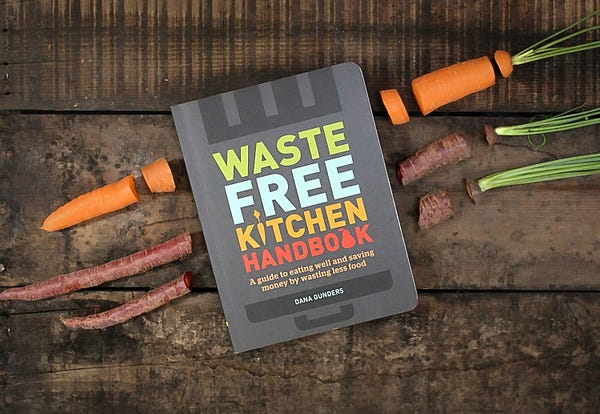 Photo courtesy of DanaGunders.com
That discovery led to 2012 report I wrote [“Wasted: How America is Losing Up to 40 Percent of its Food from Farm to Fork to Landfill”]. The report was, to our surprise, a complete success with the media, and it plunged me into center of topic. I noticed how much it resonated with people. They would often tell me, “You’re right: I waste so much.”
Nobody wants to waste food, but it’s happening daily in our lives. Part of that is that people are missing certain amount of information [on how to waste less]. So I wrote the book to try to provide the inspiration and information people need in their own kitchens.
Green America/Tracy: Why is food waste such a big deal when it comes to the environment? How serious of an impact does wasting 40 percent of our food have?
Dana Gunders: It’s huge! A quarter of all the water in this country is growing food that never gets eaten. Then there’s the greenhouse gas effects of growing, transporting, cooling, cooking, and letting that food go to a landfill and rot — equivalent to 39 million cars’ worth annually. To say nothing of land, fertilizer, and pesticide use. To add to that, food is the number-one product going into landfills.
“The greenhouse-gas effects of growing, transporting, cooling, cooking, and letting that food go to landfill and rot [are] equivalent to 39-million cars’ worth annually.”
Green America/Tracy: Your book is an excellent resource, and if I could, I’d put a copy in the hands of everyone reading this interview. But given the space we have here, what are the top three or four things people should start doing to curb their food waste?
Dana Gunders: There are a few things that can be really easy, which is a great place to start. Freeze your food. A lot of people don’t think, “I have leftovers — I should freeze them.” But it’s perfectly okay to freeze small amounts of food to eat later: leftover rice, milk, bread, juice. Especially before you go away for the weekend or on vacation.
Another is understanding expiration dates. For most foods, those dates are not telling you to throw the food out. Expiration dates are not regulated, but most are really meant to indicate freshness rather than food safety. Just learning when your food goes bad for real and not blindly throwing food out on those dates is an easy thing to do.
Many of us will throw a frozen pizza in the oven because we’re tired, instead of making the meal we planned. We have to be realistic about those tendencies when we’re shopping, not aspirational. And on a regular night, “Fridge Fridays” or “StirFridays” or whatever, make a leftover concoction with whatever’s in your fridge.
Green America/Tracy: I’m truly bad at improvisational cooking. Terrible things happen in my kitchen when I try it.
Dana Gunders: In the book, I try to give a lot of “use-it-up” recipes that work with a variety of ingredients to empower people who are bad at improvisational cooking!
Green America/Tracy: Let’s go back to expiration dates. I’ve always assumed those dates indicate when the food starts to spoil, but you’re saying that’s not the case. I feel like that’s going to be a hard mindset to let go of.
Dana Gunders: You’re not alone. About 9 out of 10 people at least occasionally toss food prematurely due to expiration dates. It’s really important to understand that those dates are not meant to indicate when food goes bad. They indicate when a product is at its peak freshness and quality. Start with a product that’s really safe like yogurt or cheese, and try it the day after or two days after it expires. Don’t leave it in there for weeks. Try to add a few days, and just see what happens.
Green America/Tracy: So what are the biggest areas of food waste for us as individuals?
Dana Gunders: Going out to eat is a big one. Food expenditures out of home now exceed those in the home. We’re going out to eat a lot. It really boils down to ordering carefully. Where possible, try to get a sense how big a portion comes. If needed, get a half portion, or ask if someone wants to split. Take leftovers when you can.
Green America/Tracy: How do we help businesses waste less?
Dana Gunders: That’s a little more complicated. It comes down to the consumer expectations and attitudes we bring into those businesses. Ultimately, it means having a little more understanding about what those expectations mean for the business.
A typical grocery stores carries thousands of items. But carrying that many items can be really challenging. How understanding can we be if they don’t have everything we want, if the salad bar doesn’t have a wide variety of items at the end of the day, or if we have to wait ten minutes at the rotisserie for an order?
Green America/Tracy: Speaking of portion sizes, in the book, you talk about how portion sizes have changed over the years. What has that meant in terms of how much food we waste?
Dana Gunders: It’s affected that waste tremendously. We waste about 50 percent more food now than we did in 1970s. Since then, we have seen portion sizes grow, as well. My favorite stat is that average cookie has quadrupled in calories since 1980s. When I think back to bake sales when I grew up in 1980s, cookies were a certain size. Then you go to Starbucks, and they literally are four times bigger.
The average Caesar salad has doubled in calories. The list goes on. There are two things happening to that extra food: We’re eating it, and that’s not necessarily a good thing. Or we’re not, and it goes to waste.
Green America/Tracy: You say in the book that curbing food waste can even save lives. How so?
Dana Gunders: At the same time we are wasting huge amounts of food, there are a huge number of Americans who don’t have enough to eat throughout the year. So there’s an opportunity for us to capture some of that uneaten food while it’s still good and fresh, and address the food scarcity issue.
Green America/Tracy: At Green America, we like to say that “the green life is the good life.” What are the benefits to us as individuals if we curb our food waste?
Dana Gunders: If done right, wasting less food means eating fresher meals. So while in the book I do spend some time talking about how to revive wilted food, the goal is to more precisely estimate your needs. When you do that, you wind up with fresher food.
Also, when you’re trying to waste less food, you end up getting more creative in your kitchen. You learn all of these tips. That’s a really fun part of it. And you save money. The average family could save up to $1,500 a year by curbing their food waste.
Green America/Tracy: You call yourself a “food-waste warrior” in the book. I’m picturing some rather funny scenarios when you’re out at restaurants….
Dana Gunders: There are some people who are scared to have dinner with me! But what I like to tell them, and I believe truly, is it’s a journey. It’s something where we’re not going to be perfect right away — or ever. Right now, we’re trying to get food waste on people’s radar. Just thinking about it, I’ve found, makes people make different little decisions that add up to wasting less.
It won’t fix everything, but being aware of it, you may find that on a day where you want to order out, you cook what you have at home instead.
In my life, I have an 18-month-old, so I’m confronting the challenge of not wasting food with kids. It’s the balance of trying to teach the whole spectrum of good eating habits while trying not to waste food: Trying to let her know she doesn’t have to finish if she’s not hungry. You don’t want her to overeat, but she can’t waste. Wanting to put things on her plate so she can try them, but then deal with it if she doesn’t like them.
It’s hard, and it’s been kind of comical at times. We’re refining as we go. Overall, when it comes to addressing your own food waste, it takes a mix of dedication and also understanding and humility. You need to continually address it, but give yourself a break that it’s not going to be 100 percent all the time. Don’t knock yourself too hard. Even just addressing it to a limited degree helps.
For more on Dana Gunders and her book, visit her website.
|
|
Expiration dates don’t mean what you think |
Those “expiration dates” printed on your food? In most cases, they’re not really expiration dates. The stamped “use by,” “sell by,” and “best by” dates on food most often do not indicate safety*.
Manufacturers establish and print the dates, in general, to indicate when an item is at peak freshness and optimal taste. In other words, they have nothing to do with your health.
But the fact that most people and businesses interpret the stamped dates as when the foods start to spoil means a lot of food is prematurely thrown out. In his book American Wasteland (Da Capo Lifelong Books, 2011), Jonathan Bloom reports that grocers toss an estimated $2,300 per day of food that is “out of date”. Most stamped dates on food are not federally regulated but are regulated “inconsistently and intermittently” at the state level, says Dana Gunders, a staff scientist at the Natural Resources Defense Council and author of WasteFree Kitchen Handbook (see the note at the bottom of this page). “Many foods will stay good for days or even weeks after the date on the package.”
The only federally regulated exception is baby formula, and the dates on it indicate when nutrients start to decline, not that it’ll make your child sick.
Bottom line: A food past its stamped date may not necessarily be bad, so don’t automatically toss it out. Gunders says that a lot of waste could be spared if people better understood food date labels: “Taste the product, smell the product. If it seems fine to you, it’s probably fine to eat,” she says. Try the tips below to tell when your staple foods are safe to eat and can be revived — and find more foods in Gunders’ book.
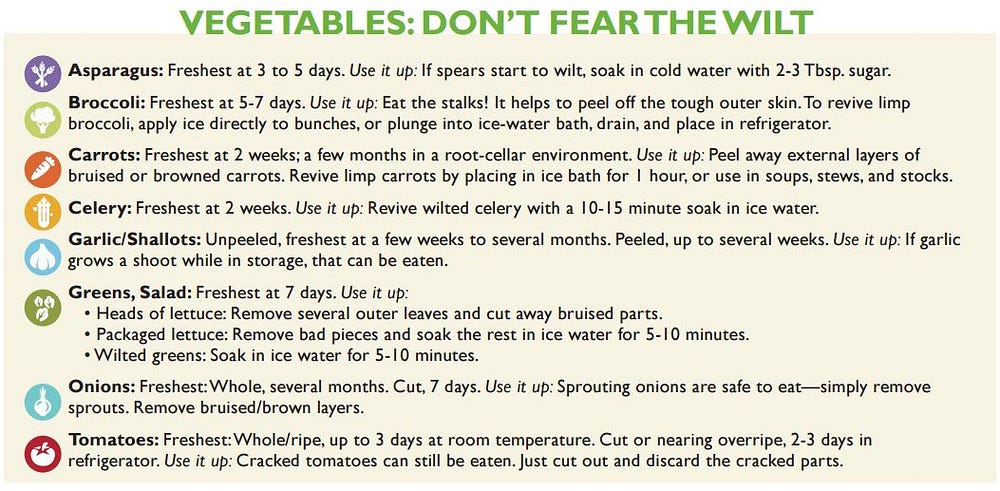
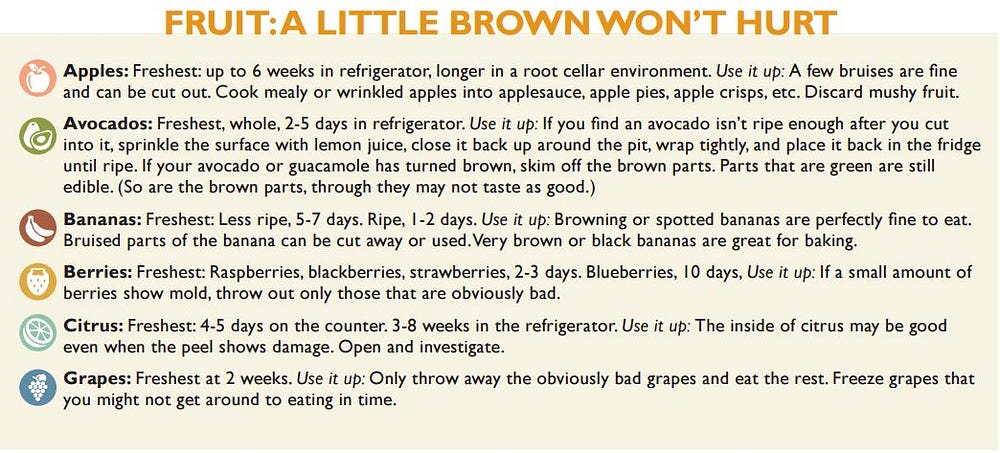
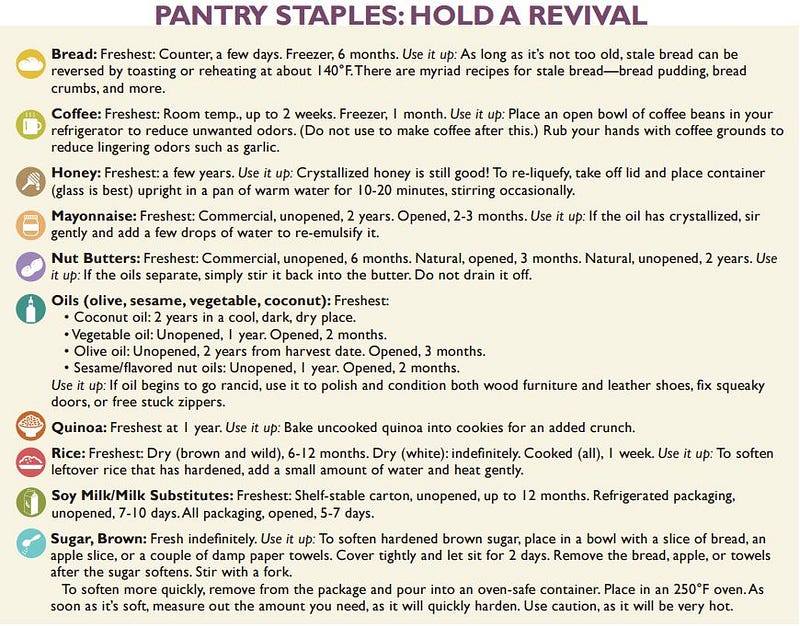
Adapted with permission from Waste-Free Kitchen Handbook by Dana Gunders (Chronicle Books, 2016).
- A NOTE OF CAUTION: Gunders advises being careful with products that experts tell pregnant women to avoid for safety, such as deli meats and unpasteurized dairy products. “The reason they tell pregnant women to avoid those is because of a pathogen called listeria. Listeria is exceptional in the world of bacteria because it can survive, and actually multiply, under refrigerated conditions, where others can’t.” While listeria is most likely to be found on those two foods, the Dept. of Health and Human services also calls out hot dogs, soft cheeses, refrigerated smoked seafood, and raw sprouts as having potential for contamination. Cooking the item kills the bacteria.
|
|
Waste Not, Eat Well at Daily Table |
Doug Rauch doesn’t care about food waste. Food waste to him is the scraps on your plate that get pushed into the trash. It’s the crumbs at the bottom of a box of cereal. What Rauch does care about is wasted food: Perfectly good tubs of yogurt, cans of beans, speckled peaches, and wilting veggies. Food that is going into a dumpster instead of making it from a field, warehouse, or grocery store onto the plate of someone who wants to eat it.
He’s dedicated to combating food waste, through an innovative grocery store called Daily Table, in Dorchester, MA. Since ten percent of food is wasted at the retail level, the store serves as a model for how a business can help strike down barriers to good-food access in a community, while simultaneously tackling the problem of food waste.
Doug’s Big Move
Rauch used to work in the upper management of a little grocery store you might have heard of: Trader Joe’s. In 2008, he retired after 31 years, including his last 14 as president of the company. He wasn’t sure what he was going to do next, but he knew it wasn’t going to involve a rocking chair.
As unsure people often do, he went back to school. He became part of Harvard University’s Advanced Leadership Initiative, a program for established leaders looking to make a social impact. There, he learned about the extent that food goes to waste in the US: Between farmers and consumers, about 40 percent of food that is produced is thrown out or wasted, according to the USDA. With so much experience in the grocery industry, Rauch also became concerned by the problem of food access.
The USDA defines a “food desert” in an urban area as a place that is more than a mile from a grocery store; in rural areas, the number changes to ten miles. When people live in food deserts, it’s more difficult to obtain healthy foods, especially if they are lower income and don’t have a car. So they may end up settling for what’s within reach — often, junk food snacks from convenience stores, or fast food.
“The problem … isn’t that you can’t get to the grocer. The problem is that you can’t afford what you should get when you’re there. So you end up getting food you shouldn’t be eating, because that’s what you can afford.”
But Rauch found that even when people could get to the grocery store, it wouldn’t necessarily help them eat better. Foods high in sugar and salt are often cheaper than more nutritious options. A 2007 paper from the California Law Review confirms and has a name for that problem: “food oppression.” So Rauch started a store called Daily Table to create a new model of grocery store that would address the twin problems of food insecurity and food waste.
“The problem … isn’t that you can’t get to the grocer. The problem is that you can’t afford what you should get when you’re there. So you end up getting food you shouldn’t be eating, because that’s what you can afford,” Rauch says. “So for me, Daily Table isn’t so much about going into areas that don’t have other grocers; it’s about going into an area that has food insecure [people] who can’t afford to buy the foods they should be eating.”
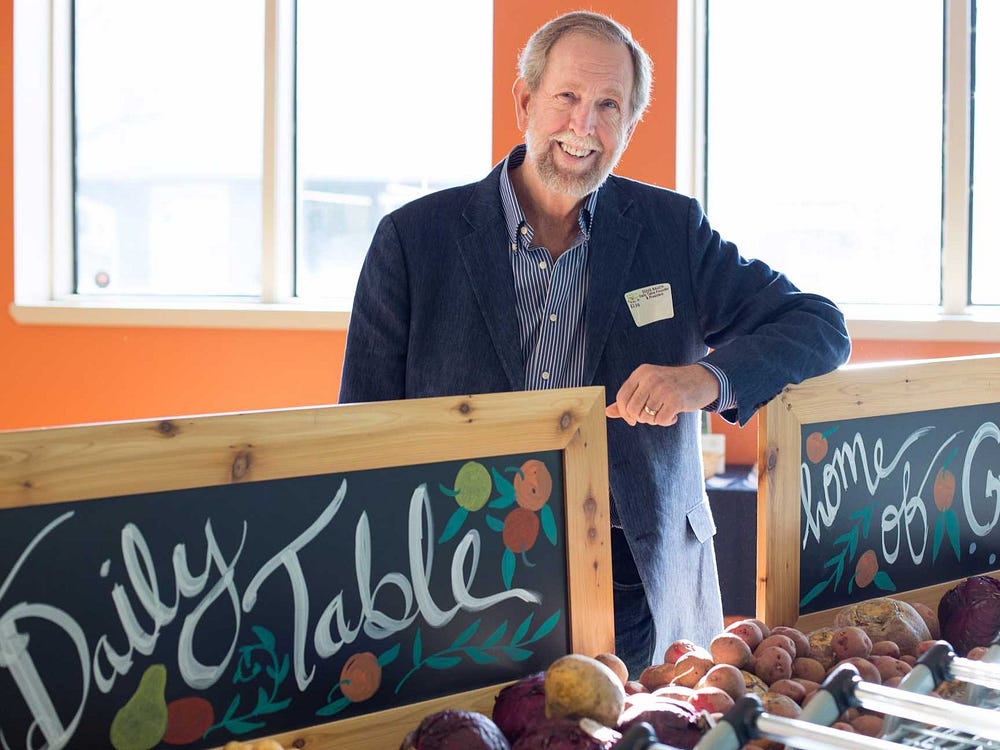 Doug Rauch, founder of Daily Table. Photo by Samara Vise.
Putting Health First
Daily Table sits in the heart of Dorchester, MA, Boston’s most culturally diverse neighborhood. While it’s not a food desert — there are plenty of grocery stores in the area — many residents do have trouble affording fresh, whole foods at every meal. Walking into Daily Table doesn’t feel like walking into a supermarket. Your average grocery store carries about 42,000 items as of 2014, according to the Food Marketing Institute, a grocery store trade group. Daily Table, on the other hand, is limited to 275 different products.
Right from the start, you can see all four of the store’s walls — it has a largely open plan, with shelves along the perimeter, but not rows upon rows clogging up the middle. The warm lighting and friendly staff make it feel a lot like a small Trader Joe’s without the trademark Hawaiian shirts.
Walmart might not be interested in milk only a week before its best-by date…But Daily Table is. It prices the food for quick sale — perhaps for half or two-thirds of what items would cost at a conventional store.
Though limited, the store’s shelving is similar to what you’d find at a health food store. Refrigerated shelves stock regular grocery items like milk, yogurt and hummus. Dry-goods shelves on the far side of the store have things like bread, canned vegetables, beans, pasta, and peanut butter. In the middle of the store, bins (both refrigerated and not) have meats, fish, and fresh fruits and veggies. The store has a Nutrition Task Force that reviews the nutritional value of each item before approving it to be sold. The task force looks for low sugar and salt content, high fibers, healthy fats, and other factors that would be considered part of a balanced diet. Candy, potato chips, and soda are not products you’ll see on Daily Table shelves, never mind hundreds of types of them. But all of this isn’t what really makes Daily Table a unique model.
A New Kind of Grocery Store
Rauch compares Daily Table to Goodwill Industries, except instead of running on donations of clothes and furniture, it gets food donations directly from producers or manufacturers. The donated food generally doesn’t have enough time before its stamped “best-by” date to be sold to a grocery store. For example, Walmart might not be interested in milk only a week before its best-by date, or a canned good four months before.
But Daily Table is. It prices the food for quick sale — perhaps for half or two-thirds of what items would cost at a conventional store. For example, Newman’s Own salad dressing has sold at Daily Table for $1.29 per bottle, compared to its $3.99 price at Stop and Shop (a New England grocery chain).
Both paid staff and a group of regular volunteers help keep the store running. After a shift, which tend to average three hours, volunteers get a $2 coupon to the store. That might not sound like much, but volunteer Mike Moloney says it goes a long way toward getting a good lunch.
“Whenever I shop there with the coupon, usually I’m able to get a full meal that you can heat up in the microwave, along with a salad and salad dressing for the $2,” Moloney says. “My bill’s always under $3 to $4, and I can get a bunch of stuff for a meal, so your dollar goes pretty far.”
Since Daily Table doesn’t give the food away, people don’t have to prove their income is low enough to get good food at a deep discount; they can just come in and shop. The original plan for the store had been to sell food that had passed its expiration date, since expiration dates often only indicate when a food is at peak freshness, rather than when it’s spoiled.
After extensive research on the community it was moving into, founders of Daily Table realized they couldn’t sell expired food, safe or not. Community members, mainly people of color, were concerned that being seen as people who would eat old food not sold to wealthier, whiter customers would only increase negative stereotypes. Giving space for people of all incomes to shop in a “manner that honors our customer, engendering dignity,” is part of Daily Table’s mission statement, so it pulled back on its plan to sell safe food past its recommended “best by” date. Even so, the store manages to recover about 10,000 pounds of food each week that conventional stores would have already trashed.
“It’s easy for people to go in and get things they need for their nutritional value or for their recipes. And they can do it quickly and within their budget. It’s really good for the community. It helps people to be able to have much healthier options.”
Good Food on the Go
While launching Daily Table, Rauch and his staff soon discovered a high demand for prepared foods for busy people on the go. So it began offering some as a way to both meet that need and to find a purpose for even more food headed for the landfill. At the back of the store sits a professional kitchen. Shoppers can watch through a large window as prep chefs take produce and meats to create the prepared meals that will be on the shelves later that day or the next. Instead of fried burgers, the chefs whip up soups, prepared salads, or a plate with meat and sides that can be heated up at home.
Here’s the best part: The chefs make use of food that might not be pretty enough to be sold fresh, like wilted greens or droopy broccoli, cooking it into something that is perfectly safe, healthy, and tasty.
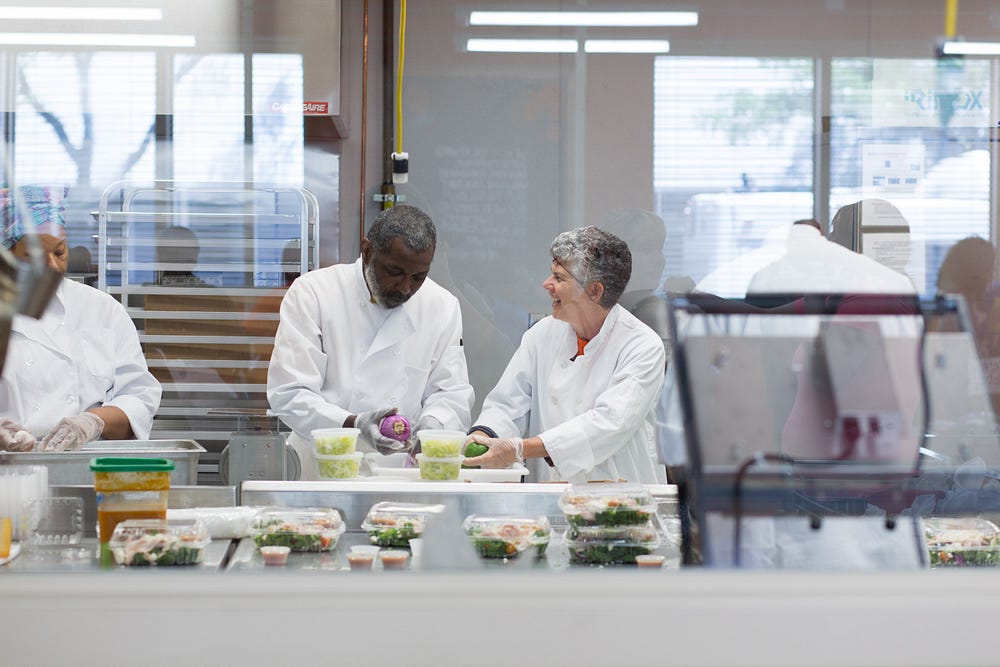 Daily Table prep chefs utilize “ugly” food to create safe, healthy, and delicious to-go meals. Photo by Samara Vise.
Once or twice a week during his volunteer shift, Moloney often preps fruits and vegetables there while chatting with employees and volunteers.
“If you’re someone who’s on a lower budget and might not be able to afford healthier food, at those prices, [Daily Table is] such a lifesaver,” he says. “It’s easy for people to go in and get things they need for their nutritional value or for their recipes. And they can do it quickly and within their budget. It’s really good for the community. It helps people to be able to have much healthier options.”
A Successful Model
Since its launch in June 2015, Daily Table has been a resounding success. The store did a record $170,000 in sales in August 2016, an amount that may look paltry to big grocers. But, since prices are about half to a third of what conventional grocery stores charge, that would be equal to a regular grocery store selling $340,000-$510,000 based on less than one percent of its inventory. Daily Table’s basket/transaction size has increased since it opened by an average of 65–70 percent.
“Now why is that [increase] so important?” Rauch asks. “Because the vast majority of our [5,000 regular] customers are economically strapped. They don’t waste money on food. When they buy it, they eat it. So we are becoming a larger part of their diet. That’s the important thing.”
It’s not just sales that show that Daily Table is making a difference. Cathy Schoen is a full-time mom who has been volunteering at Daily Table since it opened. Her 17-year-old son has worked at the store for two summers and plans to continue when he starts college in Boston next fall.
“Volunteering for as long as I have, and spending time with the staff and other volunteers, as well seeing the same customers come in, day after day, week after week — and having conversations with them about what they’re doing, where the food is from, their concerns as parents — the general feeling that I get is that we’re doing something in a very small way right now,” says Schoen, “but it’s giving people the chance to make better choices. It gives them an affordable option to eat some different food than they might have normally because of the cost.”
Rauch plans to open more Daily Table stores throughout greater Boston and, eventually, in cities across the US: “We placed Daily Table in a food nutrition desert, in the sense of an affordable nutrition desert,” he says. “And you know, it turns out that almost everywhere in America is an affordable nutrition desert.”
|
|
Are meal kits recipes for fun, or waste? |
Are you expecting a delivery? Mail-order meal kits are popping up everywhere, maybe even on your doorstep. Blue Apron and Hello Fresh might be the ones you’ve heard of, but there are dozens of similar plans out there.
The insulated boxes they deliver include enough goodies to quickly whip up a meal for two or four, and there’s no denying the childlike excitement of opening one up to see portioned, sometimes prepped, ingredients along with recipe cards, based on your dietary needs and preferences. Depending on the service, these kits cost from $8 to $12 per serving, which is cheaper than a typical meal of takeout or at a restaurant.
The meal-kit industry is growing fast: At the beginning of 2016, a market-research study by Technomic estimated that Americans alone, who then made up 40 percent of the $1 billion industry globally, would grow to become a multi-billion-dollar market share.
In the past year, Martha Stewart has come out with her branded box with Marley Spoon. Amazon has partnered with Tyson to create Tyson Taste Makers. The New York Times has its box, Chef’d, and in August, Whole Foods announced it would be entering the ring as well.
The perks are there — you don’t need to shop or plan, you don’t need to buy ingredients you’ll never use again, and there often isn’t much food waste at meal-time, since everything is perfectly portioned. Companies also claim these boxes cut down on overeating.
But does this model cut back on overall waste?
There haven’t been outside studies done yet, but a report Blue Apron released in August, comparing its food waste to that of grocery stores. Grocery stores waste 10.5 percent of food at the retail level, meaning the amount of food on the shelves that never makes it to a customer. In contrast, Blue Apron says it wastes 5.5 percent. Grocery store shoppers toss almost 24 percent of their food after buying it, while customers waste 7.6 percent of Blue Apron-sent ingredients.
The report doesn’t paint the entire picture when it comes to meal kits’ environmental impacts. Across the board, meal-kit customers have to deal with a lot of packaging. Each ingredient generally comes in a separate bag, plus the box, with its liners and plastic-wrapped ice packs. Some of the materials may be recyclable, and with some services, made of post-consumer waste.
It just depends on how much work you want to do to recycle them. Some items, like cardboard boxes, can be recycled in most residential areas, while others, like plastic baggies and insulating ice packs, need to be broken into composite parts or routed into a specialty recycling program.
Nick Taranto, the CEO of one mealkit company, Plated, told Fast Company that his goal is to make his company completely carbon-neutral, and it has already switched some packaging to recycled and renewable plant-based products. But it’s not easy.
“The challenge is that customers want perfect-looking ingredients with no packaging,” Taranto told the magazine. “This is, unfortunately, not realistic.”
Tristram Stuart thinks that food-box delivery has a lot of potential. He’s a British food waste expert, author, and activist. What he likes about the model is that a company can be certain of its demand on any given day or week, and need not waste food on displays. (For example, grocery stores usually carry much more produce than they can sell in order to make an inviting display.)
Stuart also likes that Blue Apron has measured its waste and reported on it, an action he sees few other companies taking.
Although he is “dissatisfied” with the amount of single-use plastic packaging meal kits use, Stuart does think the model may become more streamlined in the future, because of how specifically meal-kit companies can know their customers’ needs each week.
“Maybe it’s redundant for us to use our cars and our legs to go into supermarkets when delivery vans can come to our dwellings,” he says. “I personally am very excited for the potential for that different retail interface, and one of the reasons why … is that you can tackle food waste in that way.”
Whichever way you slice it, meal delivery kits have pros and cons.
Overall: Watch for Labor Issues
Since the meal-kit industry is growing rapidly, things are changing fast — and workers may suffer as a result. Be on the lookout for notices about workplace exploitation with your favored provider.
For example, Buzzfeed released an investigative report in October about the conditions inside Blue Apron’s largest warehouse, in Richmond, CA. The company has boomed in the past two years, going from 50 to 1,000 employees sorting ingredients and packing boxes for shipment at this refrigerated warehouse. In that time, it has been cited by OSHA for workplace safety violations like bad electrical wiring and icy freezer floors. Workers described the warehouse environment as “aggressive” and “cold as hell.” Police have been called for multiple bomb threats and reports of assault on premises. Blue Apron told Buzzfeed it has been working to address all of the violations and safety concerns.
Good Options
• Use whatever service you already have, and pressure them to reuse and recycle everything possible. Most sites we looked at (11 services) had at least some information about how to recycle each shipping or storage material.
• Find a local meal-kit provider,so your food doesn’t have to travel so far. Just Add Cooking sources from New England producers and delivers to the Boston area. Happy Food Company sources primarily from Missouri, Kansas, Nebraska, and Minnesota, and sells in grocery stores around Kansas City, KS. Peach Dish sources from Georgia and the Southeast, delivers nationally.
• Choose one that donates meals to food-insecure families. One Potato donates a meal for every box ordered. It has provided job training to the unemployed in Los Angeles.
Better Choices
• Look for companies offering organic options. If you’re not buying organic, you may be getting a delivery of genetically modified organisms and pesticides packed up in your dinner.
Green Chef, for example, is a certified organic business, and 95 percent of the ingredients that it ships are certified organic, as well. Sun Basket, Terra’s Kitchen, and One Potato base their meal kits on organic products.
• Vegetarian and vegan meal kits contribute to animal welfare and generate fewer carbon emissions associated with meat. Purple Carrot offers vegan-only food to entice non-vegans into learning how to cook more healthy and sustainably. Green Chef also has vegan boxes. And Green Chef, Hello Fresh, Blue Apron, Sun Basket, One Potato, Terra’s Kitchen, and Peach Dish all have vegetarianboxes.
• Top of the heap: Green Chef, Sun Basket, One Potato, Purple Carrot, and Terra’s Kitchen use recycled packaging and offer organic and vegan/vegetarian meal-kit options.
Best Bets
• Subscribe to a CSA (community supported agriculture) produce delivery to support local farmers and cut down on packaging and price. Some CSA providers offer recipes as well. Find one at localharvest.org.
• Sign up for weekly recipes, available from many cooking sites. Whole Foods is one grocery store offering free meal plans. Select your food preferences and local grocery store at TheDinnerDaily.com, and it will send you a shopping list and menu for dinners for the week, including coupons for your store. The service costs $4-$6/month, depending on for how long you sign up.
• Buy things that won’t spoil in bulk, like dry and canned goods.
• Start a dinner co-op in your neighborhood, where a group of households take turns cooking for each other. You’ll get to taste different types of foods, save money, and build community. Get tips on how to start one in Green America’s article, “Cook One Meal, Eat for a Week.”
|
|
Tackling Food Waste |
Forty percent of the food we grow in the US never gets eaten, it gets tossed out somewhere on the path from farm to table. That's billions of pounds of food that uses up land, water, fertilizer and pesticides, packaging, transportation, fuel, and more. For nothing.
|
|
A Sign of Inclusion |
During the presidential primaries, Matthew Bucher didn’t like what some candidates were saying about immigrants, refugees, and people of color. It frustrated him that people might take divisive language to heart. So he took his frustration and turned it into action.
Bucher is the pastor at Immanuel Mennonite Church in Harrisonburg, VA, a small city about 20 miles from the West Virginia border. The town has been growing increasingly diverse in recent years, so Bucher felt a strong need for his church to reach out to new arrivals and to people who might feel targeted by unkind rhetoric against immigrants and people of color.
“It’s important [to take a stand against hate speech], because there has been so much verbal and sometimes visual hatred and distrust of folks who are perceived to be different or perceived to be not valuable enough to be in the neighborhood or to be in the country,” he says.
He proposed the idea to make an inclusivity sign for the church lawn to his congregation, and they readily agreed.
Congregation member and artist Melissa Howard hand-painted the sign, which reads “No matter who you are, we’re glad you are our neighbor” in English, Spanish, and Arabic, the languages most commonly spoken in Harrisonburg. Bucher enlisted translation help from Spanish-speaking church members and from Egyptian friends he’d made during a previous job in Egypt with the Mennonite Central Committee.
When a group of nearby Mennonite pastors wanted to take similar action in their communities, one had a friend turn the hand-painted sign into a colorful, reproducible one (pictured below, courtesy o Cate Matthews, Aplus.com). Immanuel Mennonite printed 200, then another 300, then a thousand. The church posted a PDF for free on its website, ready to print as a 24” x 18” sign. The signs spread through the town, spilling into other towns and then into other states.
 Nobody expected what happened next—with no national campaign, the signs began popping up in neighborhoods across the country and even in Canada. People started requesting translations into languages to suit their own communities, so the website now boasts 11 more versions of the sign, including Somali, Hindi, German, Chinese, Swahili, Hebrew, and more. Nobody expected what happened next—with no national campaign, the signs began popping up in neighborhoods across the country and even in Canada. People started requesting translations into languages to suit their own communities, so the website now boasts 11 more versions of the sign, including Somali, Hindi, German, Chinese, Swahili, Hebrew, and more.
Bucher says the sign on his church’s lawn reminds the congregation to live the inclusive values of Christianity.
“It creates an awareness that convictions that might start in the heart or in the brain need to be, to use a Christian term, ‘incarnated,’” he says. “They need to be lived into, with our feet, with our hands, with our voices, to make it very clear that we may hold a conviction or hold a belief, but how does that shape our action? How do we walk, each day, each week, with our neighbors and those who are strangers?”
Learn more about Immanuel Mennonite Church and download the high-resolution PDF of the tricolor welcome sign at immanuelmennonite.wordpress.com.
|
|
An Organizer in the House |
In November 2017, Pramila Jayapal won her Congressional election bid and became the first Indian-American woman in the House of Representatives.
Jayapal (D-WA) is also an immigrant: Her parents sent her from her home in India to the US to attend college when she was 16 years old. She stayed, got an MBA from Northwestern University, and launched a more than 20-year career in community organizing, working for fair treatment for immigrants and for humane immigration reform. In 2013, President Obama named her a White House Champion of Change.
Prior to entering the House of Representatives, Jayapal served in the Washington State Senate from 2015 to January 2017. Before that, she founded the Hate-Free Zone Campaign of Washington to counteract the rise in hate crimes against Arabs, Muslims, and South Asians in the aftermath of 9/11. Under her leadership, the campaign developed into OneAmerica, a national immigrant-advocacy organization.
Green America editor-in-chief Tracy Fernandez Rysavy talked with Rep. Jayapal about her history-making election win, the powerful positive impact immigrants have on America’s economy, and her recent actions fighting President Trump’s anti-immigrant executive actions, as well as her plans for moving forward.
Green America/Tracy Fernandez Rysavy: Thank you for your work on President Trump’s recent anti-Muslim and anti-refugee executive orders. You’ve called them “inhumane and barbaric.” Would you mind elaborating on your powerful statement?
Rep. Pramila Jayapal: Those are very strong words, and I want people to understand the degree to which these executive orders are not just a piece of legal paper but are tearing at people’s humanity. When you say “inhumane and barbaric,” they hopefully pay attention and recognize and think about what’s inhumane and barbaric.
We’re leaving kids with their faces pressed against the glass, waiting for their parents to come home and not sure they will. We’re leaving family members sobbing in airports, because the person they thought they were going to hug after three years apart is on a plane being deported somewhere else. It signals intentionality from the president. You can do unfair and unjust things, but if you do inhumane and barbaric things, it signals intentionality.
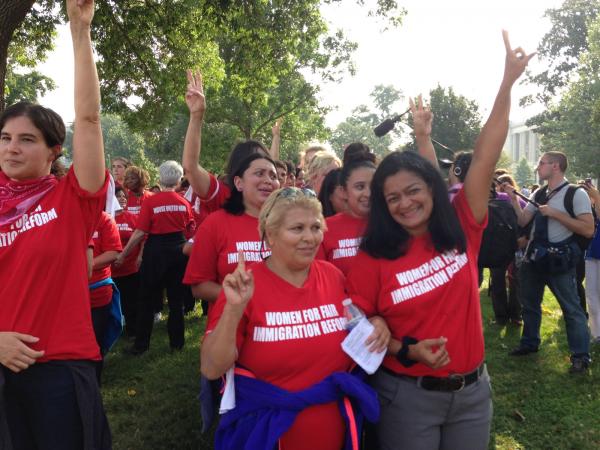
 In 2013, as a WA State Senator, Pramila Jayapal spoke at a OneAmerica rally to protest Congressional inaction on fair immigration reform. Photo courtesy of OneAmerica. In 2013, as a WA State Senator, Pramila Jayapal spoke at a OneAmerica rally to protest Congressional inaction on fair immigration reform. Photo courtesy of OneAmerica.
Green American/Tracy: After Homeland Security started enforcing Trump’s executive orders banning refugees and Muslims from seven countries, refugees who had just arrived in the US thinking they’d been granted asylum were sent back to their home countries, some perhaps to dangerous situations. Before a federal court blocked the executive orders from further enforcement, you were at the forefront of stopping at least one plane about to deport refugees from taking off at SeaTac Airport. Can you tell us what happened?
Rep. Jayapal: I want to give credit to Courtney Gregoire at the Seattle Port Authority, Rep. Suzan DelBene [D-WA], Jorge Barón and the Northwest Immigrant Rights Project, and the ACLU.
The ACLU filed a temporary restraining order [on behalf of two individuals who were on a plane and about to be deported under the executive order]. I’ve been in this situation before [as an immigrant advocate]. They asked me to sign a brief on it, and I signed.
Within four or five hours, we got the judge to grant a TRO [temporary restraining order]. We had to get to the plane, which was ready to take off, to get the two people on it. We literally had to get it to come back to the gateway. Jorge Barón was holding the phone [at the end of the jetway] saying, “This plane cannot depart,” while we were showing [gate agents] the TRO to get the plane to come back. They had to re-attach the bridgeway, so the plane would not leave.
Suzan DelBene and I were trying to push this to Customs and Border Protection. They would not talk to us. So I said, “Either they come here, or I will go to them.”
They were in a secured area, so [the gate agents] said, “You can’t go to them.” But I said I was going to go through, and if that shut down the airport, that wasn’t my intent, but that’s what I would do.
So they got a bus and took us through the back recesses of the airport to the CBP area. We started banging on their door, because it was locked, until the director of the CBP came. We also got the governor [Jay Inslee] and [Senator] Patty Murray [D-WA] on the phone and demanded that these people be allowed to get attorneys. CBP was telling us they weren’t going to have attorneys. We did finally get the two off the plane, got them attorneys, and got them released.
We are still hearing so many troubling stories. Not only Muslims from those seven countries are being barred from entering the US, but a Kashmiri Muslim Olympian in India who was coming to the US to compete was told he couldn’t have a visa because of Trump’s immigration order.
There’s so much fear and so much in limbo. Legal permanent residents still being stopped, even though Secretary Kelly [of Homeland Security] said it’s in the interest of national security that they be allowed in the country. But there are reports of them being stripsearched or subjected to additional searching sometimes for hours. It’s demeaning and totally outrageous.
[Editor’s note: Rep. Jayapal and Sen. Kamala Harris (D-CA) have introduced legislation that would guarantee access to legal counsel for anyone detained while attempting to enter the US. Hundreds were detained by Homeland Security at US airports immediately following Trump’s order. Many were held for more than ten hours without access to phones or the flood of lawyers who joined protesters at airports attempting to help them, according to the Los Angeles Times.]
Green American/Tracy: You’ve also co-sponsored legislation that would protect the DREAM Act, [keeping children who were brought into the US through no fault of their own from being deported]. This gets at my heart, as a mother. How hopeful are you that this legislation will get passed?
Rep. Jayapal: I really think there are a lot of representatives who believe we have to welcome these young people into the country. There’s bipartisan sponsorship for this bill in the House and in the Senate.
I wasn’t an original sponsor of the bill. A Democrat now has to bring a Republican to co-sponsor with you if you want to be on the bill. I was able to work with Dave Reichert [R] in Bellevue, and we signed on together. Congressman Newhouse [R] from Yakima also signed on.
I think the bill does have a real shot. There are the optics [to consider] for Republicans in deporting a bunch of kids who have never been to the country they may be sent to, many who are valedictorians.
The thing is, the bill is only temporary, only for three years—a first step. What we need to do is to fight for comprehensive immigration that keeps parents here, reform that keeps families together.
Green American/Tracy: There’s also these arguments that allowing Muslims and refugees into the US makes the country less safe, or that they’re taking away jobs. How do we respond to that, in a way that opens minds and hearts?
Rep. Jayapal All research shows that immigrants don’t take American jobs. They fill voids that American workers don’t want to fill, particularly in low-wage jobs. If we were to raise wages, we would find more people wanting those jobs. We need to level the playing field so no one is being exploited, and everyone has a fair shot.
As for security, this has been a red herring for a long time. The current ban doesn’t make us safer; it makes us less safe. I was talking to some very high people in the Iraqi government, and there’s tremendous fear that we are playing right into the hands of people wishing to do us harm, who one official said were “clapping and gleeful” because [Trump’s executive order] helps to drive a wedge between the people they are trying to recruit and the US.
"All research shows that immigrants don’t take American jobs. They fill voids that American workers don’t want to fill, particularly in low-wage jobs. If we were to raise wages, we would find more people wanting those jobs. We need to level the playing field so no one is being exploited, and everyone has a fair shot."
We’re locking out Iraqi translators who worked with American forces. We need them!
Here’s a more general comment: It has never been right—including during WWII, with the Japanese internment— to pit security against liberty. Benjamin Franklin said you can’t sacrifice temporary security for liberty; otherwise you’ll have neither.
Green American/Tracy: You’ve had quite a history of working on behalf of immigrants in the nonprofit sector. Why leave that and get into politics?
Rep. Jayapal: [laughs] I never thought I’d go into politics, but after 15 years of working to get the things done we need to do, I realized it’s important to have people from the movement, people who can help organize in politics, and to get immigrants, women, and people of color in politics—people whom you don’t have to explain everything to. It’s just another platform for organizing. And it’s important to have organizers in these platforms.
Green American/Tracy: What is empowering and what is challenging about being the first Indian-American woman in the House of Representatives?
Rep. Jayapal: It’s amazing to be the first, always. It’s empowering and challenging. A big challenge is, why are we only having it now? But it’s great to be one of only 11,000 who have served, to be the first, and to bring the perspective that we bring. It’s not just about what we look like and checking a box. But how do we share hearings, how do we look at legislation, how do we interact with our constituents?
It’s great to see people around the country, young and old, who are inspired to see someone they feel understands their perspective. It energizes them to see someone they can relate to. I get so much love from Indian-American women—and their husbands and fathers, too—who just see a different path for themselves. I take that really seriously. Every step I move forward, I want to make sure I bring people with me. What’s challenging: I wish there were more of us. We need more of us. I also think that it’s challenging because it’s very, very personal.
Green American/Tracy: I know you’ve gotten death threats for your proimmigrant activism in the past. Does that kind of thing still happen?
Rep. Jayapal: Not death threats, but I get nasty hate stuff. I try not to read comments at the end of articles; they’re just so horrible. You have to be strong. You have to pull yourself together because so many people are depending on you.
Green American/Tracy: You founded the nonprofit OneAmerica after 9/11 in response to a wave of hate crimes against the US Sikh and Muslim population. Do you feel we’ve gone backwards as a country in terms of prejudice since then?
Rep. Jayapal: In some ways we’ve gone backwards, in that the legislation and EOs are horrific and in some ways worse than what happened after 9/11. Maybe not as bad as 1942—it’s hard to know. 9/11 was a massive wedge in this country’s history, and in the name of security, we’ve allowed a lot of things to happen.
However, I was just saying in a speech this morning that after 9/11, we didn’t have a lot of people standing up for Muslims. It’s interesting to me now that the Muslim ban, more so than the orders on immigration, has been so resoundingly rejected by so many people— at protests, thousands of people at airports, on Twitter and social media. Trump has his base. Our base never showed up in the streets after 9/11 the way they are now. Communities do understand what the stakes are in a way that I haven’t seen for a long time.
Green American/Tracy: OneAmerica was originally called Hate-Free Zone, and you helped cities and towns declare themselves Hate-Free Zones after 9/11. That particular campaign seemed to taper off as, perhaps, post- 9/11 hate crimes died down. Is it time to bring that back?
Rep. Jayapal: That’s one of the things I want to do. We did a Hate-Free Zone press conference in December [declaring Washington a Hate-Free State]. We had some amazing signs we’d love to have people all across the country adopt.
Councils across the country have been passing legislation declaring themselves sanctuary cities or hatefree zones. It is coming back again.
We’re better, in part, because we’ve gone through it already, and we have this example of how we can win. We sued the Bush administration, and we stopped registration of Muslims and Arabs.
[Editor’s note: The Bush-era the National Security Entry-Exit Registration System, or NSEERS, required men from 25 so-called “higher-risk” countries—all predominantly Muslim countries except North Korea—to undergo interrogation and fingerprinting before they could enter the US. In addition, up until 2003, they had to report to government offices after 30 days in the US and on a regular basis for additional screening. NSEERS was suspended in 2011 largely due to the controversy surrounding it, and the Obama administration shut down the database at the end of 2016. Not a single person was ever charged with terrorism under NSEERS.]
Green American/Tracy: You were one of the first in Congress to boycott Trump’s inauguration. Why did you feel that was important to do?
Rep. Jayapal: We were getting so many calls from people who were terrified about what their place was in the country, whether they’d even have a place. I felt it was critical that I was with them physically on that day that was bringing so much despair to many of my constituents.
I did a round table, and it was emotional. It was difficult but also uplifting. I just felt I could not stand there with a man who has been so divisive. We kept waiting for him to go from being the divisive candidate to being the unifying president, but he didn’t—which was incredibly disappointing. Maybe not surprising on some level.
I wasn’t going to stand on a stage with someone who has put a Breitbart News editor in his cabinet, along with putting in someone who has joked about the KKK and used the N-word as Attorney General. I couldn’t see standing there and allowing my presence to be taken as condoning that president. It wasn’t meant to be a boycott, just my decision, but Trump turned it into a boycott when he Tweeted insults at [Congressman and Civil Rights activist] John Lewis.
Green American/Tracy: What else can people do to combat hate?
Rep. Jayapal: First of all, we can’t have people getting tired or thinking their voice doesn’t matter. Stay engaged. Do what you need to do to sustain yourself, but stay engaged.
There are a lot of us who have friends or family members—I have them—who voted for Trump and live in battleground states that are important. We have to have conversations with people we know and love. Many of us don’t want to bring that to the dining-room table with family. We don’t want to drive a wedge. But this is personal and political. Talk about how you get beyond this hate.
Engage with people: “I love you, I know you love me, but what you’re doing and saying and the person you voted for is so deeply hurtful to me. If we love each other, we have to have that conversation. I’m asking that you please open your ears, and I will do the same.”
Also, we don’t want to be like the other side, who hates government and wants to dismantle it. Government works. We need to build our government properly. We need to have people who care in government. We need to support and amplify each other.
|
|
Muslim Activists Build Bridges |
The Muslim world, representing one-fifth of the world’s population, is also among the hardest hit by the impacts of climate change. A March 2016 NASA study, for example, found that a drought hitting the eastern Mediterranean countries of Cyprus, Israel, Jordan, Lebanon, Palestine, Syria, and Turkey since 1998 was likely the worst to hit the region in the past 900 years. The NASA team behind the study found that the drought was caused, at least in part, by climate change.
Many Muslim countries also rely on their rich oil reserves to propel their economies, and all, like the US, burn climate-warming fossil fuels for energy. But if a growing movement of green-minded Muslims around the world has anything to say about it, that reliance on fossil fuels in the Muslim world could be in for a major shift.
In 2015, leading Muslim scholars from around the globe gathered at the International Islamic Climate Change Symposium to hammer out the Islamic Declaration on Global Climate Change (IslamicClimateDeclaration.org).
“We call on Muslims, wherever they may be … to tackle habits, mindsets, and the root causes of climate change, environmental degradation, and the loss of biodiversity in their particular sphere of influence, following the example of the Prophet Muhammad (peace and blessings be upon him), and bring about a resolution to the challenges that now face us,” the declaration states.
In April 2016—on the same day representatives from more than 150 nations signed the Paris Agreement on climate change—the Declaration authors presented their document to the United Nations General Assembly, where they also announced the launch of the Global Muslim Climate Network (GMCN). GMCN is a coalition of scholars, philanthropists, experts, and Muslim non-governmental organizations, including Islamic Relief Worldwide and the interfaith organization GreenFaith, who are working across the Muslim world on solutions to curb the climate crisis.
Many Muslim countries rely on their rich oil reserves....But if a growing movement of green-minded Muslims around the world has anything to say about it, that reliance on fossil fuels in the Muslim world could be in for a major shift.
At GMCN’s launch, the group called for all Muslim nations to increase the amount of renewable energy to 20 percent or more of their total energy mix. The group also called for Muslim investors to employ environmental, social, and governance criteria in their investment portfolios.
Meaningful action has already begun. The Moroccan government has been publicizing its program, launched in 2014, to retrofit all of the 15,000 mosques it owns across the country—some nearly 900 years old—with solar panels and energy- efficient technologies.
As Muslim activists spread their ecological message across the Islamic world, they’re also joining together with environmentalists from other faiths, finding common ground and forming cross-cultural bonds that are helping to break the stereotypes that lead to hate—all while caring for the Earth.

Connecting the Qur’an and Climate
Nana Firman is one of the leaders behind the Islamic Declaration and a co-founder of the GMCN. Today, she hopes the Muslim world can lead the transition from fossil fuels to clean energy, spurred on by teachings in the Qur’an.
She first started noticing the interconnections between religion and environmentalism while working abroad for the World Wildlife Fund (WWF). After the 2004 tsunami, which caused mass destruction in countries bordering the Indian Ocean, Firman joined WWF’s rebuilding efforts in Indonesia with her background in urban and industrial design. But she found herself having a tough time persuading local people to take sustainability into consideration in their rebuilding efforts.
Some colleagues noted that the area where she worked, the Indonesian province of Aceh, was predominantly Muslim and deeply religious, and they suggested using religion as a way to find common ground. Firman ended up going back to her own Islamic faith to look for environmental messages.
She found plenty. For example, the Qur’an states: “Eat and drink from the provision of Allah, and do not commit abuse on the Earth, spreading corruption.”
So she started connecting the dots between the environmental stewardship she wanted to catalyze and the faith she shared with the community.
“The people understood better when I actually used religious teachings to emphasize my points,” she says. “I got involved with the religious leader, and then people started to get involved in my programs. From then on, whether I worked on sustainable cities or climate- change issues, I tried to incorporate my own faith also.”
When Firman moved to the US in 2012, she found that American Muslims she met “didn’t have the connection between the Islamic teaching and the protection of the environment. Somehow, they thought those were two different things, like, ‘Oh yeah, it’s cool to be a green activist, but I’m a Muslim.’” When she visited a mosque in Southern California in 2013 for the breaking of that year’s Ramadan fast, she was surprised at the waste she saw there.
After the prayer service, Firman spoke to the Imam, the mosque’s leader, about how to reduce waste— and what doing so had to do with the teachings of the Qur’an. He was so impressed, he welcomed her to speak to worshipers on the issue.
That speaking engagement led to many others, and today, Firman often travels nationally and abroad to talk to Muslims about sustainability practices. In 2015, she was named a White House Champion of Change.
“As Muslims, we have a responsibility to take care of our world and this planet as the khalifa [steward] of this Earth,” she said in an interview at the 2016 UN climate conference in Marrakesh, which she attended on behalf of GCMN.
 2015 Obama White House Champion of Change Nana Firman
A Common Care For People
Muslim environmentalists like Firman are also reaching out to people from other faith traditions—and vice versa—to join together in spreading their message of caring for Creation.
In 2013, Firman joined GreenFaith, where she now works part-time as the Muslim outreach director. GreenFaith (greenfaith.org) is an interfaith organization that has organizers from many religions reach out to worshippers around the country. It provides educational resources linking religion and environment, and it brings people of different beliefs together for environmental stewardship events. The organization is one of several behind the GMCN.
Founded in 1992 in New Jersey, GreenFaith is an interfaith environmental organization that works with a diverse range of faith groups globally. With Jewish, Christian, Muslim, Hindu, and Buddhist partners, in the last four years alone, GreenFaith has helped lead the faith-based fossil-fuel divestment movement; led organizing that brought over 15,000 people of faith to the 2014 People’s Climate March in New York; coordinated an international, multifaith campaign in support of the Paris Climate Agreement; and led a march into St. Peter’s Square in Rome to celebrate the release of Pope Francis’s environmental encyclical. The organization has trained hundreds of faith leaders for environmental action and facilitated financing for over a megawatt of solar installations on faith facilities.
"It doesn’t mean that we worship the Earth. It does mean that there is a belief that we have a moral accountability for the way in which we treat the Earth, along with how we treat other people.” - The Reverend Fletcher Harper
The Reverend Fletcher Harper is an Episcopal priest and the executive director of GreenFaith. Harper says what brought him to GreenFaith was a recognition that he had many of his connections with God while outdoors in nature, which he thinks is common with people across religions.
“There are real, legitimate, and genuine differences between religions, culturally and theologically. Within that diversity though, there’s a clear sense, with religious groups, that we have a responsibility to care for the Earth, that the Earth is a remarkable gift for which we are to be grateful,” Harper says. “It doesn’t mean that we worship the Earth. It does mean that there is a belief that we have a moral accountability for the way in which we treat the Earth, along with how we treat other people.”
Indeed, Harper, Firman, and others, including Pope Francis, see pollution mitigation as part of their respective religious mandates to care for the poor.
“A theme that is really powerful and shared among religions is the priority we need to place on looking out for those who are the most vulnerable,” Harper says. “While it’s very clear the pollution hurts everybody, it hurts the poor the worst, and it hurts racial minorities the worst. And that’s wrong.”
Harper stresses that particularly in today’s divisive political climate, “it’s beyond vital that people of faith register their belief, publicly, that we must protect the environment and act on climate change.”
He suggests finding members of your congregation who are interested in sustainability and environmental topics and meeting regularly, as well as going to faith leaders with a request for a sermon on the topic.
Growing Solidarity
Divisive language ignited voters last year—Trump’s election was a clear loss for environmentalists, and also for Muslims, as peaceful people were lumped in with terrorist groups. But Nana Firman is full of hope as she talks about the months and years to come. She says since the election, there has been a huge outpouring of support for the Muslim communities where she lives, support people in those groups didn’t know existed before.
She also is quick to acknowledge her identity is not the only one that has come under fire; she talks about her mosques making new ties to other minority groups. In 2015, she connected with a group called Islam in Spanish, which has been trying to build bridges between Muslims and Spanish speakers. In at least a few cities where there are large communities of both groups, including Los Angeles, Houston, and New York, hate speech and governmental threats directed at Latin-Americans and Muslims have inspired both communities to reach out to each other in solidarity.
Firman says that the two communities have found things in common when discussing the environment, due to both having strong agriculture background and a culture of sharing communal goods. She says these few cultural nuances connect many.
“Even though a lot of us are not happy with the [political] situation, groups that did not even have any communication before are starting to communicate because of it,” she says. “There’s been this outpouring of support that we didn’t even think about before.”
|
|
Hate Has No Business Here |
On January 28th, the New York Taxi Workers Alliance declared a one-hour strike: From six to seven p.m., they would not pick up or drop off passengers at JFK Airport, to protest a Trump executive order banning refugees, as well as travelers from seven predominantly Muslim countries, from entering the US.
“We stand in solidarity with all of our peace-loving neighbors against this inhumane, cruel, and unconstitutional pure act of bigotry,” the union declared in a statement.
Uber, the popular ride-sharing service, crossed the virtual picket line, drawing fire from angry users. Though the company disabled “surge” pricing, or a rise in rates during busy periods, for that hour, critics still perceived that Uber was profiting from the strike. The hashtag #DeleteUber started trending like wildfire. Further exacerbating Uber’s poor optics was the fact that CEO Travis Kalanick was a member of Trump’s economic advisory group.
Meanwhile, Lyft, Uber’s chief competitor, swooped in to pick up the pieces—in the form of disgruntled former Uber users. Lyft executives remain mum on whether or not their drivers picked up passengers from JFK or not during the taxi strike, and though its executives may not regularly break bread with the president, Trump advisor Carl Icahn did make a $100 million investment in Lyft in 2015, according to Fortune. But when Lyft quickly released a statement condemning the Muslim and refugee ban and promised a $1 million donation to the American Civil Liberties Union (ACLU) as #DeleteUber swept across the nation, ride-sharers across the country swooned. For the first time in its history, the number of customers downloading the Lyft app beat Uber the day after the strike.
With all of this consumer pressure bearing down on him, Kalanick quickly buckled. Just a day later, he publicly condemned the “wrong and unjust immigration ban” and pledged a $3 million fund for Uber drivers affected by the ban. By February 2nd, Kalanick had quit Trump’s advisory council.
“The Uber-Lyft incident illustrates just how much power individuals have when we band together to demand corporate accountability,” says Todd Larsen, Green America’s executive co-director. “We can demand that companies stand up to hate, and they have to listen, because we’re their customers.”
Whether driven by their CEO’s moral compass or an eye for their bottom lines, corporations are standing up for immigrants, Muslims, and other targeted populations. Green businesses are also leading the way, without any prompting from outraged customers.
Standing Up To The White House
Lyft isn’t the only representative from Corporate America speaking out against Trump’s Muslim and refugee ban. In the aftermath of the ban, Airbnb CEO Brian Chesky released a statement on Twitter, stressing that “not allowing countries [sic] or refugees into America is not right.” The company pledged to match donations up to $100,000 to the National Immigration Law Center, the International Refugee Assistance Project, and the International Rescue Committee (IRC). Furthermore, it offered free housing to refugees and others who were left stranded by the travel bans, asking Airbnb hosts to volunteer their home or apartment and subsidizing other host facilities.
Facebook CEO Mark Zuckerberg publicly shared the story of his wife Priscilla’s parents, who were refugees from China and Vietnam. “Had we turned away refugees a few decades ago, Priscilla’s family wouldn’t be here today,” he wrote.
Google created a $4 million crisis fund to support four immigrant rights organizations, the ACLU, the Immigrant Legal Resource Center, the IRC, and the UN Refugee Agency. Starbucks pledged to hire 10,000 refugees in 75 countries over the next five years. Instacart donated $100,000 to the ACLU and announced the creation of office hours with immigration attorneys for employees. LinkedIn pledged to expand its existing Welcome Talent program, in partnership with the IRC, “to help newly settled refugees more quickly find jobs that leverage the skills they are bringing into the US economy.”
Even the billionaire Koch brothers, who have provided millions in campaign funds for many Republican politicians and for vice-president Mike Pence, announced that they would fight Trump’s refugee and Muslim ban.
Late in February, 97 companies, including Apple, Microsoft, Facebook, Levi Strauss, and others, filed an amicus brief to the Ninth Circuit Court stressing the importance of immigrants to the economy and society.
“Immigrants or their children founded more than 200 of the companies on the Fortune 500 list, including Apple, Kraft, Ford, General Electric, AT&T, Google, McDonald’s, Boeing, and Disney,” the brief read. “... Long-term, this instability [caused by the executive order] will make it far more difficult and expensive for US companies to hire the world’s best talent—and impede them from competing in the global marketplace.”
Inclusive Before Inclusive Was Cool
Green businesses have a long history of taking risks in the name of doing what’s right. Many were standing up for marginalized communities and saying no to hate long before the Uber- Lyft drama took place. And, unlike the corporations mentioned above, they take great care to ensure sustainability throughout their supply chains and across their entire business models, so you can feel good all around about being their customer.
Troubled by the rise in hate crimes, particularly against the US Muslim and Arab communities, the Main Street Alliance launched its Hate Has No Business Here campaign in 2015. The Alliance is an organization of independent companies advocating for public policies that promote vibrant small businesses, healthy communities, and social responsibility.
 The Main Street Alliance is urging businesses nationwide to print out and display its anti-hate posters in their offices and shop-fronts. Community Forklift turned theirs into a huge banner, seen here hanging in front of their Maryland warehouse store with several employees. Photo courtesy of Community Forklift. The Main Street Alliance is urging businesses nationwide to print out and display its anti-hate posters in their offices and shop-fronts. Community Forklift turned theirs into a huge banner, seen here hanging in front of their Maryland warehouse store with several employees. Photo courtesy of Community Forklift.
The Alliance created a “Hate Has No Business Here” poster and put a high-resolution PDF on its website for businesses to download for free and post in their stores and offices. The poster, pictured on p. 16, makes a point to emphasize that Black lives matter and to welcome women, the LGBTQ community, immigrants, refugees, and people of all faiths.
After Trump signed his Muslim and refugee bans, the Alliance’s national director, Amanda Ballantyne, came out swinging: “Today’s executive orders will not make America safer, stronger, or more prosperous. ... Research and experience show that the vast majority of refugees are working and paying taxes within a few short months. Refugees start businesses, create jobs, buy homes and cars, and renew neighborhoods. That means a stronger, more inclusive and thriving Main Street. ... Together, [our members] celebrate diversity, create safe spaces, and send a clear message of inclusion and opposition to this xenophobic policy.”
The Alliance also launched a petition in late January against Trump’s executive actions. The petition had received 1,400 signatures as of mid-April.
In a similar action, Green America’s Green Business Network® (GBN) and the American Sustainable Business (ASBC) Council are working with our green business members to sign on to a letter against the executive orders.
“As American business leaders and employers, we stand in opposition to the recent executive order on immigration,” the letter reads. “We believe the climate of fear and uncertainty that it fosters in our customers, our employees, and our communities will be damaging to business. The ban undermines the interconnections and workforce mobility upon which we depend. The Executive Order also runs counter to basic constitutional due process, which is essential to a well-functioning economy.”
Less than a week after the letter was launched, more than 300 businesses had signed on.
Power In Compassion
Individual businesses are also taking steps to address hate. Community Forklift(m*), a building-materials reuse warehouse in Edmonston, MD, put up the Main Street Alliance’s poster back in December 2015—and took things a step farther.
“It fit our ethos, and our staff loved it, so we put the sign on our door right away,” says Ruthie Mundell, Community Forklift’s director of outreach and education.
“One year later, and hate crimes are on the rise—the polarization has only gotten worse. In response, we decided to turn the little sign into a HUGE banner and now, no one can miss it! When you come to the warehouse, you’ll know that we aim to treat everyone with respect and expect others to do the same.”
The sign meant so much to the Community Forklift team, in part, because the warehouse boasts a culturally diverse clientele and staff, which Mundell stresses is “not just a feel-good thing.” “It gives us an advantage,” she says. “It has helped us survive serious challenges and economic downturns, take advantage of opportunities, and grow to a 40-person operation. Because it is so important to our success, every new employee learns that it is part of their job to create a welcoming environment at Community Forklift. This is a very strong part of the Community Forklift ethos: we lift and build people and communities.”
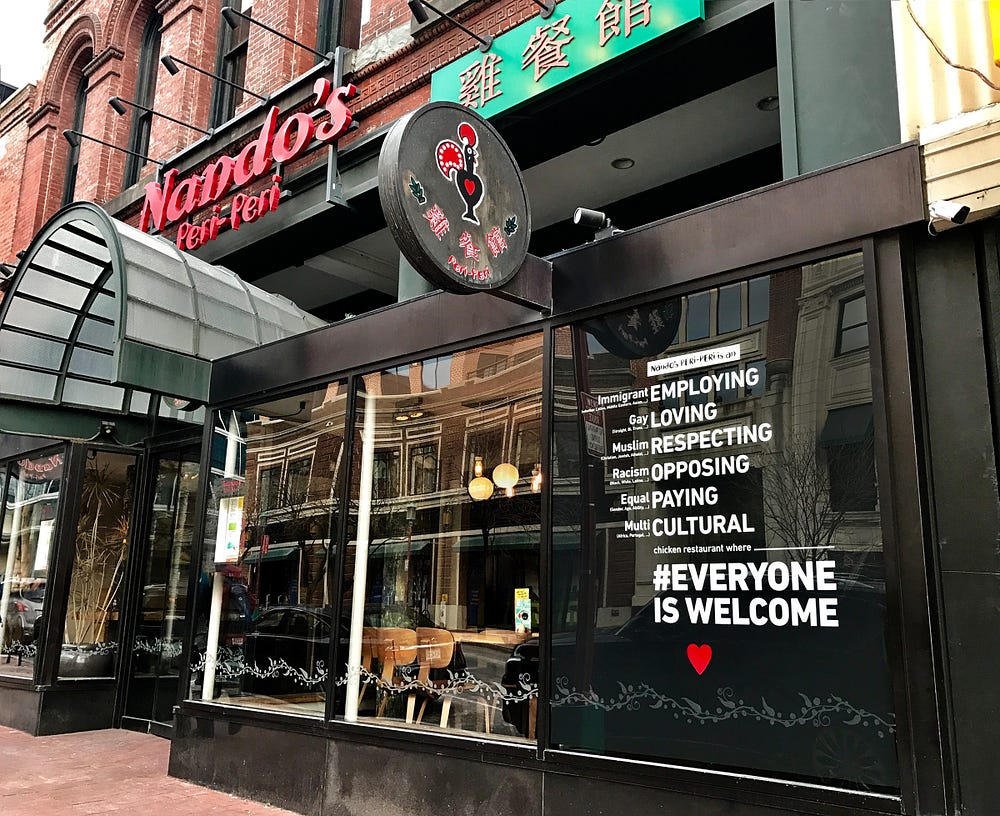
South African chain Nando’s Peri-Peri has been displaying its own signs in its restaurants’ windows to underscore that immigrants, people of color, the LGBTQ community, and Muslims are welcome inside.
South-African-owned restaurant chain Nando’s PERi-PERi celebrated inauguration week by displaying its own inclusivity signs in its DC restaurants.
The signs read: “Nando’s PERi- PERi is an Immigrant Employing, Gay Loving, Muslim Respecting, Racism Opposing, Equal Paying, Multi Cultural chicken restaurant where #Everyone Is Welcome.”
Nando’s distributed 60,000 free posters in Washington, DC, and it printed the poster in the free Express newspapers distributed at Metro stations across DC. Individuals can also download the poster at everyoneiswelcome.us. The company donated half of its DC proceeds from inauguration weekend to its “long-standing partner” DC Central Kitchen, which addresses hunger in the District of Columbia.
“Even if you’ve never sat at one of our tables, you’re welcome to stand with us,” said Burton Heiss, CEO of Nando’s PERi- PERi, in a statement. “This is a statement of who we are, and the values that our company and employees hold dear.”
Wildlife photographer Steve Kaye, owner of Steve Kaye Photom in Placentia, CA, doesn’t have a sign in front of his business. In fact, he barely has a sign at all, since he largely works outdoors. But what he does have is a statement on his website supporting the Charter for Compassion.
The Charter, the flagship document of the nonprofit Charter for Compassion International, affirms the need “to make compassion a clear, luminous, and dynamic force in our polarized world. Rooted in a principled determination to transcend selfishness, compassion can break down political, dogmatic, ideological and religious boundaries. ... It is the path to enlightenment, and indispensable to the creation of a just economy and a peaceful global community.”
“There’s a concept here [with the Charter] that I really like, and that’s the concept of cooperative partnerships,” says Kaye. “We’re working in harmony toward something in common. We need more of this type of activity, because through combined efforts, we become stronger.”
Last July, Steve Kaye Photo officially became a partner of the Charter. Partners pledge to “bring an awareness of compassion and compassionate action to everything we do.”
“If someone can scare you with lies and make you hate, they own you,” says Kaye. “If the whole progressive, green community tries to make a run as individuals, we’ll be decimated, because individuals are easy to pick off. If everyone shows up en masse as a unified effort, then it’s overwhelming. There needs to be a unified effort of kindness.”
m* denotes Certified Green Business Member
|
|
9 Ways to Take Your Recycling to the Next Level |
1. Reduce and Reuse
The less you throw away, the better off the planet will be.
2. Don’t “Wish-cycle”
Get a list of the items your local recycler accepts and put only those into your recycling bins.
3. Use recycling best practices
Fend off recycling contamination with our tips to Rescue Your Recycling.
4. Don’t landfill your food waste
Food waste is the single largest component of waste headed into US landfills, at 18 percent. Instead, it could be turned into rich compost to make the soil healthier and able to sequester more carbon. Check out Green America’s best composting tips.
5. Be mindful about E-Waste
Many “recyclers” send electronic waste to developing countries, where it’s dismantled by hand, harming workers and the environment. Certified E-Stewards recyclers ensure that your electronics are recycled responsibly. Find one near you at e-stewards.org.
6. Recycle your “weird” things
Check out Green America’s list of 21 Things You Didn’t Know You Could Recycle.
7. Support extended producer responsibility
Pressure corporations to use less packaging, make their packaging easily recyclable, and take back hard-to-recycle packaging and products. See p. 10 for ways shareholders are using their power, and encourage your members of Congress to support extended producer responsibility laws at the state and federal level.
8. Network with zero-waste communities
Eco-cycle’s “Zero-Waste Map” allows you to find zero-waste policies and programs working today in communities just like yours across the US. If you’re fighting off an incinerator, the Global Alliance for Incinerator Alternatives is a worldwide alliance of more than 800 groups working toward zero waste, environmental justice, and an end to incinerators.
9. Find expert assistance for your community
The Institute for Local Self- Reliance’s Waste to Wealth program helps communities across the US fight incinerators and landfills, and research, demonstrate, and plan recycling, composting, and zero-waste community programs.
|
|
Dirty Recycling Systems are Trashing Communities of Color |
For most people, recycling is a good thing. But for some, the impacts of recycling aren’t all positive. In fact, those 94 percent of Americans who recycle have devastating impacts on people of color.
“For those who make environmental and industrial decisions, communities of color — regardless of their class status — have been considered to be throw-away communities; therefore, their land [is most often] used for garbage dumps, waste transfer stations, incinerators, dirty materials recovery facilities, and other waste disposal infrastructure,” says Dr. Robert D. Bullard at Texas Southern University, who has conducted pioneering research and leadership on environmental justice.
In other words, recycling has environmental benefits and also raises some serious issues that all communities must consider to ensure that no one is bearing too much of the trash burden.
Dirty Recycling Does Exist
Community recycling systems come in two main types — and one inherently brings more environmental-justice problems than the other.
When garbage trucks come to collect your curbside recycling bins, their destination is usually a waste transfer station. At the transfer station, waste is sorted:
- Recyclables go to a Materials Recovery Facility (MRF)
- Organic waste goes to a municipal composter
- Everything else is taken to a lanfill or incinerator
Rural areas may have some combination of these in one or two locations.
At a MRF (rhymes with “smurf”), recyclables are sorted by type (paper, glass, plastic, etc.), then sent out to facilities that specialize in doing the actual recycling.
Here’s where the key differences lie. MRFs come in two types: clean or dirty.
In a clean MRF, recyclable materials arrive at the facility already separated from regular trash — generally by individuals who sorted them at home. Either all recyclables will arrive commingled, which is called single-stream recycling, or further sorted by separating fiber (paper and cardboard) from containers (metal, plastic, and glass), known as dual-stream recycling. Any additional pre-sorting is known as multi-stream recycling.
Along with the environmental benefits recycling brings come deep concerns that all communities must consider to ensure that no one is bearing too much of the trash burden.
Generally speaking, the more pre-sorting that occurs before the recyclables arrive at the MRF, the cleaner the MRF is. However, single-stream MRFs using best practices to recover as many recyclables as possible can still be top-notch.
A dirty MRF is one where trash and recyclables arrive mixed together, no at-home separation required. It’s the easiest for households because it requires no thinking whatsoever. Just toss everything into the garbage with the knowledge that it will all be sorted right at the end.
Or will it?
The city of Houston is currently fighting off plans for a dirty MRF. The proposed “One Bin for All” initiative would get rid of all recycling programs in the city and build one giant dirty MRF that would accept recyclables mingled with trash for sorting.
The problem with this plan is twofold, says Melanie Scruggs, Houston program director with the Texas Campaign for the Environment (TCE). First, she says, “recyclers are looking for materials that are clean and dry. The biggest problem when you combine trash and recycling is that it contaminates the recyclables and diminishes their value.”
Since China and other major buyers of US recyclables no longer want dirty materials that aren’t cost-effective to recycle, US waste management companies have become much more careful about what they send to recyclers. More often than not, they’ll divert dirty recyclables to landfills or incinerators as a precaution.
Dirty MRFs automatically cause excessive recycling contamination. Therefore, it’s very appealing for operators to pair them with incinerators, says Scruggs.
She points to a dirty MRF in Indianapolis that was trying to get a municipal contract last year. Representatives claimed the facility would recycle 100 percent of what went in, but it actually ended up incinerating 80 percent and recycling only 20.
“Dirty MRFs don’t have to set a particularly high recycling target and can still call themselves a recycling facility,” even with an incinerator on site, Scruggs says.
Incinerators spew a variety of toxins into the air, including carcinogenic dioxin, according to the Global Alliance for Incinerator Alternatives (GAIA). In addition, they create toxic “bottom ash” containing heavy metals, dioxin, and other pollutants that must then be landfilled.
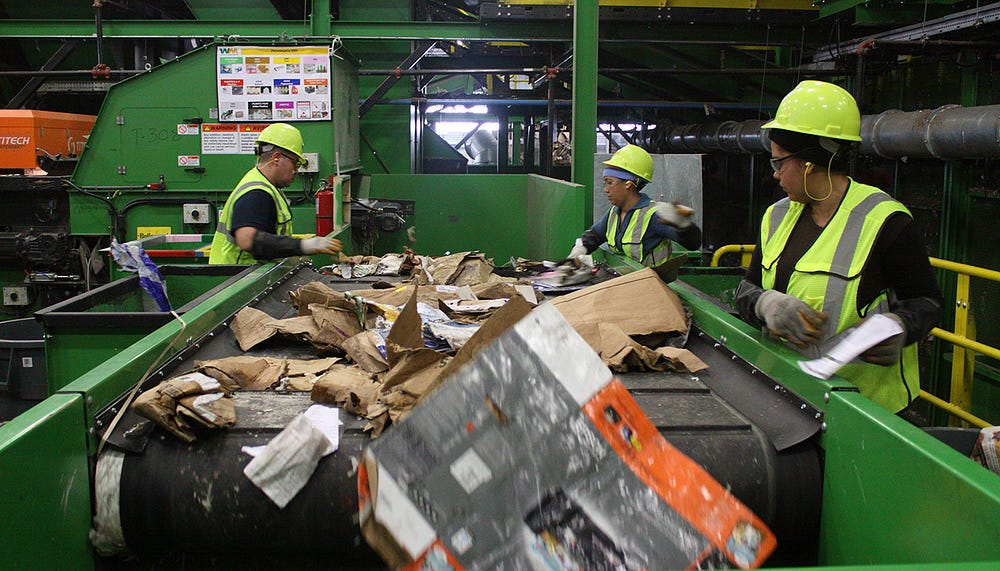 Sorting line at a Waste Management facility. Photo from Waste Management.
And while many incineration projects tout their “waste-to-energy” benefits, these are more than offset by the fact that incinerators emit more carbon dioxide per megawatt-hour than any fossil- fuel-based power source, including coal plants, according to GAIA.
Dirty MRFs also often tend to be located in communities of color. Houston’s proposed dirty MRF is no exception.
“The city was originally going to build [the dirty MRF] at an existing landfill or transfer station, which are all located in predominantly minority communities,” says Scruggs. “Houston’s trash is distributed to nine landfills and three recycling facilities right now. We don’t need to consolidate it into one neighborhood.”
But when Dr. Bullard, TCE, and their allies raised this issue with the city, “local officials were quick to respond that Houston would not be burdening one community like that,” says Scruggs. “They changed their tune very quickly.”
Trucks Bring Trash and Air Pollution In
New York City residents and visitors produce over 20,000 tons of solid waste every single day, according to the New York City Environmental Justice Alliance (NYC-EJA), a network of local environmental- justice organizations.
“About 75 percent of that solid waste is processed in just a handful of communities: specifically in Southeast Queens, South Bronx, and North Brooklyn,” says Priya Mulgaonkar, a policy organizer with NYC-EJA. The population in these areas is primarily African-American and Latino.
The resulting concentration of waste transfer stations and MRFs has been making people in those neighborhoods sick — literally.
“Especially in the summertime, when these facilities aren’t being closed properly, then people live and breathe garbage,” she says. “Some of the [waste-hauling] trucks aren’t sealed, so trash flies off during transport. It’s right in people’s backyards.”
Further exacerbating the pollution in these areas are the trucks that carry trash and recyclables to and from the facilities.
Mulgaonkar notes that the commercial waste haulers, in particular, tend to be very inefficient about their routes: “These huge diesel trucks chug pollution into the streets, traveling an unnecessary amount of miles in these three main communities.”
It’s not a matter of luxury for us. It’s about, ‘Can my kid breathe? Can I breathe? Can we have a healthy and happy family here in the places we have to live?’
Due in part to the number of garbage and recycling trucks that rumble in and out of the South Bronx, a 2013 University of New York study found the area to have one of the highest asthma rates in the US.
Mulgaonkar notes that this extra truck traffic also contributes to safety concerns.
“With over 250 carters competing to pick up enough waste to make a profit, drivers are often pressured by their bosses to speed, cut corners, and to ignore traffic signals,” she says. “This puts pedestrians at risk on the roads, and is also really unfair to the workers themselves, who are largely people of color, undocumented, and formerly incarcerated folks, and who often work 12–14 hour shifts.”
Fighting for Breath
Thanks to activist-led initiatives, municipalities across the country are waking up to the fact that there are ways to recycle that don’t put an undue burden on one neighborhood over another.
The Texas Campaign for the Environment is pushing for the state to embrace true zero waste — no dirty MRFs or incinerators. Austin and Dallas now aim to divert 90 percent of their trash from landfills and incinerators by 2020, and San Antonio aims to divert 60 percent by 2025. San Antonio and Austin have mandatory recycling and municipal curbside composting already in place, and Dallas is working toward both. TCE is pushing for Houston to adopt a zero-waste plan as well.
For those who make environmental and industrial decisions, communities of color — regardless of their class status — have been considered to be throw-away communities; therefore, their land [is most often] used for garbage dumps, waste transfer stations, incinerators, dirty materials recovery facilities, and other waste disposal infrastructure.
Dr. Bullard, TCE, and their allies have fought off One Bin for All — so far. Though the plan could come back, the city just signed a two-year curbside recycling contract that has stalled the dirty MRF.
NYC-EJA and its allies have been uniting their efforts around the Transform Don’t Trash NYC campaign, advocating for a cleaner, healthier waste system in New York City. In particular, they are calling for the city to award commercial waste-hauling contracts to companies that have the highest environmental standards, worker-safety and health standards, and worker salaries.
In 2006, NYC-EJA and other organizations worked closely with then-Mayor Bloomberg’s office to develop a 20-year city-wide waste-disposal policy that, for the first time, relied on environmental- justice principles. The plan called for a reduction in waste facilities and truck traffic in overburdened communities, and a reduction in overall waste processing.
Unfortunately, Mulgaonkar says that the plan has yet to be fully implemented. The groups continue to pressure city leaders to fulfill the promises they made in 2006.
Because, as Kellie Terrie, a resident of the South Bronx, told Transform Don’t Trash, environmental justice around recycling and waste hauling is critical.
“It’s not a matter of luxury for us. We don’t have a choice,” Terrie said. “It’s about, ‘Can my kid breathe? Can I breathe? Can we have a healthy and happy family here in the places we have to live?’ Environmental justice is not an option for us. It’s a life-or-death issue.”
|
|
Campaign FAQs |
From production to disposal, paper contributes to the dangerous impacts of climate change. Paper production is the fourth largest industrial source of greenhouse gas emissions in the US. Additionally, paper products account for 40% of solid waste in US landfills, where they decompose and release toxic methane gas in to the atmosphere, which has 23 times the heat trapping power of carbon dioxide. The EPA states that recycling one ton of paper saves 3.3 cubic yards of solid waste from entering a landfill – meaning fewer methane emissions. Every ton of 100% recycled copy paper (which can go into a magazine like Smithsonian) saves 17 million BTUs from being used in making virgin paper…that’s enough to power the average home for over two months!
Smithsonian Institution has made symbolic commitments to sustainability, but when it comes to producing its publication, Smithsonian Magazine, it’s falling short. Smithsonian Magazine is printed on 100% virgin fiber paper. Smithsonian Magazine acquires its paper through a partnership with Time, Inc. Time publishes 90 magazines, producing hundreds of millions of copies every month, none of which are on recycled paper. Encouraging Smithsonian Magazine to incorporate recycled content will start the conversation within Time to move more of its publications to recycled paper. Smithsonian is also a highly respected institution and publisher. By getting Smithsonian to go green with its magazine, it sends a message to the entire publishing sector that consumers expect recycled paper to be part of a publisher’s commitment to being green.
Smithsonian Magazine publishes over 19 million copies every year, requiring almost 65,000 trees, or enough trees to fill five National Malls. Just by incorporating 30% of recycled paper into its production, Smithsonian would:
- Lower its annual wood use by an equivalent of more than 19,000 trees.
- Reduce its greenhouse gas emissions by 2 million pounds of carbon dioxide each year.
- Lower its annual water consumption by about 14 Olympic-sized swimming pools.
- Keep 707,000 pounds of solid waste from going to the landfill.
Environmental impact estimates were made using the Environmental Paper Network Paper Calculator Version 3.2.1 For more information visit www.papercalculator.org.
We’re calling on Smithsonian to…
- Start by committing to switch to 30% recycled content paper in its flagship magazine, by 2017.
- Adopt and implement a “best in class” environmental stewardship policy that guides continual improvement of paper use practices.
- For the virgin paper needed, only use fiber sustainably managed from Forest Stewardship Council certified forests
Yes, more than 100 publications currently print on recycled paper. If National Geographic and Fast Company can use recycled paper, Smithsonian Magazine can, too! (We’re proud to report that at Green America all of our publications and printed materials are on 100% post-consumer recycled paper.)
Recycled Content Like many people, you might see the word “Recycled” on a product and assume that it’s a high quality recycled product. Unfortunately the product can contain anywhere from 1% recycled content all the way to 100%. Look for any indication of the percentage of recycled content on the product package, such as 30% post-consumer recycled paper. Also, be conscious of the terms “recyclable” or “please recycle”. While these mean that the product CAN be recycled, they do not signal that there is any recycled content in the product. Certification  There are a few different certifications to look for when buying a paper product. We advise seeking out the FSC seal (Forest Stewardship Council), a certification program that ensures products are made with as little impact to the environment and nearby communities as possible. If the product you are buying has non-recycled fibers in it, make sure it is FSC. Learn more here: http://betterpaper.org/everyone/resources.php
That’s great! If you love to support Smithsonian, take action with us! Smithsonian Magazine needs to hear from its visitors that making the move to recycled paper is the right choice for the planet and a great way to follow through on its sustainability aims. Sign our letter and consider calling Smithsonian to voice your concerns at 800-766-2149.
If you are a member and receive the magazine, it is very important for Smithsonian to hear from you! Please make sure to take action here and check the box that says “I am a Smithsonian subscriber and member!” You can also call the magazine at 800-766-2149.
The “Smithsonian: Practice What You Print” campaign is led by Green America, a not-for-profit membership organization founded in 1982. Green America’s mission is to harness economic power—the strength of consumers, investors, businesses, and the marketplace—to create a socially just and environmentally sustainable society.
If you would like to support the campaign or participate in events please email Beth Porter, program director, at bporter@ greenamerica.org. We would love to hear from you!
|
|
Americans are bad at recycling. Here's How the World Does It Better. |
Kamikatsu, Japan, a small mountain town of 1,700 on southern Japan’s Shikoku island, is going zero waste by 2020.
So are a lot of communities in the US. But when local political leaders make this pledge, they sometimes state their city will send “zero waste to landfill” — a phrase meaning that in addition to recycling and perhaps composting trash, the city will still incinerate some of its garbage. Incineration causes air pollution and, ironically, leaves toxic ash behind that must be landfilled.
In Kamikatsu, they mean it: zero waste, no incineration by 2020. Already, the town recycles 80 percent of its trash through a significant commitment and communal effort.
Prior to 2003, this small community used to dispose of its trash through open incineration, according to a short documentary from Discovery Network’s “Seeker Stories.” But burning their trash made residents sick and and the town smell, so in 2003, they adopted the zero-waste plan.
Today, Kamikatsu residents separate recyclables into 34 categories: various types of paper products; tin, steel, aluminum, and other types of containers; plastic bottles; plastic caps; and more.
The townspeople wash each container at home to ensure it’s free from food or liquid residue that can contaminate the recycling process. Then they haul it to the town recycling center, where employees make sure they are sorting items the right way. There’s no municipal trash pickup.
“Classifying the recycling can be difficult,” resident Hatsue Katayama told Seeker Stories. “To wash the containers thoroughly so there are no remains is hard work. It can be a pain, and at first, we were opposed to the idea.”
However, residents soon got used to the benefits of recycling: cleaner air, for one. And more jobs — in addition to the recycling center, the town boasts a factory that turns discarded clothing and more into new items. There’s also a free store, where residents can leave and take still-usable cast-off items for free.
Compared to incinerating Kamikatsu’s trash, the recycling effort has cut waste-management costs by a third. Katayama says that recycling has now become second nature: “Now I don’t think about it. It becomes natural to separate the trash correctly.”
The only difference I see [between high-recycling communities and low-recycling communities] is that the cities moving toward 90 percent have a very active grassroots network that consistently pushes for increased recycling and, in recent years, zero waste.
Dr. Neil Seldman, Institute for Local Self-Reliance
While few cities around the world have made the commitment to recycling and zero waste that Kamikatsu has, more are stepping up to lessen their burdens on landfills, recycle more, and recycle better. The US, quite simply, is lagging behind. The Environmental Protection Agency (EPA) estimates that 75 percent of the US waste stream can be recycled or composted, but we’re only doing so for just over 34 percent of it.
In comparison, the entire country of South Korea’s waste diversion rate is moving closer to Kamikatsu’s. After enacting legislation to get to zero waste by 2020, South Korea started having residents pay for trash by weight, in addition to making composting food waste mandatory by law — which has raised the country’s recycling and composting rate to over 83 percent and climbing, according to the Korea Herald.
Germany and Austria are recycling or composting 62 and 63 percent of their waste, respectively, states the European Environment Agency. And the European Union aims to lift all member-countries’ recycling/composting rates from an average of 43 percent to 50 percent by 2020.
The success of these places shows that Americans can raise our recycling rates. But it will take a combination of government policy, corporate responsibility, community will, and individual effort.
Fortunately, green-minded individuals have the power to push US recycling to the next level, says Dr. Neil Seldman. Seldman is director of the Institute for Local Self-Reliance’s (ILSR) Waste-to- Wealth Initiative, which helps communities across the US create policies and practices to get to zero waste.
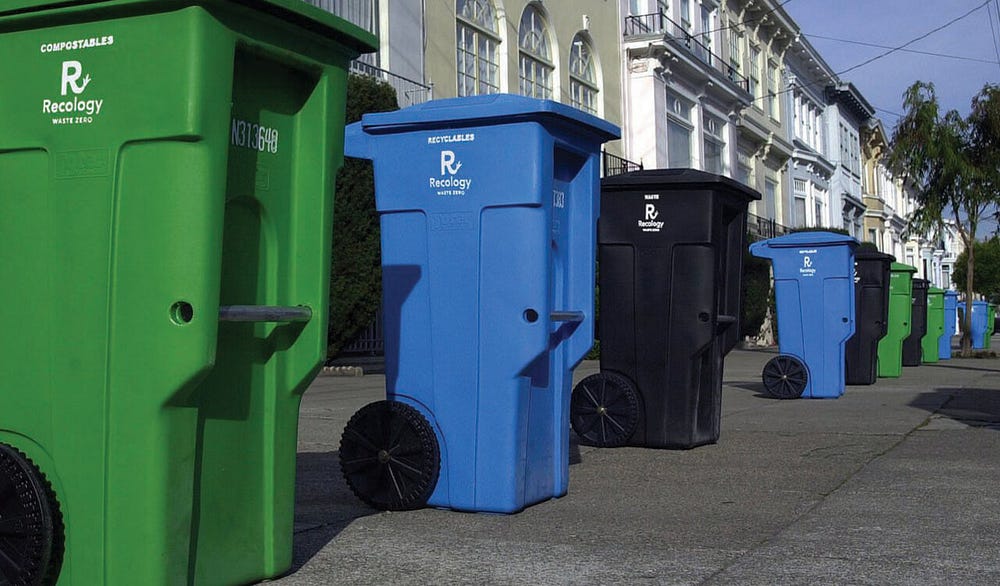
San Francisco’s “Fantastic Three” recycling program gives residents three colored bins to make sorting trash, recyclables, and organic waste easier. Photo courtesy of SF Environment
Activists Lead The Way
While many US cities are struggling at or below the 34 percent national recycling average, Seldman says there are dozens of cities with “high, unprecedented” recycling rates, including Portland, Seattle, San Francisco, Los Angeles, Austin, and smaller cities on the East Coast and in the Midwest. So what accounts for the discrepancy?
“The only difference I see is that the cities moving toward 90 percent have a very active grassroots network that consistently pushes for increased recycling and, in recent years, for zero waste,” says Seldman.
These cities are showing that diverting 50 to 80 percent or more from landfills to recyclers and municipal composters is doable — using existing technology. Seldman notes that for most, their robust recycling programs started with citizens fighting off an incinerator.
Los Angeles, for example, originally balked at instituting recycling back in the 1960s. But when regional landfills became overcrowded, the city entertained a proposal to build five incinerators — all located within communities of color, an all-too-familiar pattern in the US when it comes to toxic facilities .
Environmentalism has to be broadened to incorporate organizations and groups that may not necessarily have “environment” in their name.
Dr. Robert Bullard
Residents started forming coalitions to work against the incinerator plan, troubled by the potential for toxic air pollution and carcinogenic bottom ash. They brought in ILSR as a technical consultant to help fight the incinerators and formulate a sustainable alternative plan. Los Angeles eventually said no to the incinerators and yes to recycling — it now recycles or composts 76 percent of its waste — mainly because many of the grassroots activists involved in the incinerator fight got involved in local politics.
In fact, says Seldman, the phenomenon of activists-turned-city-leaders is another thing most US cities with high recycling rates have in common.
“Garbage decisions are made at the local level, where citizens can organize and take control,” Seldman says. “And that’s exactly what they did. People actually became mayors and county commissioners as a result of their resistance to an incinerator.”
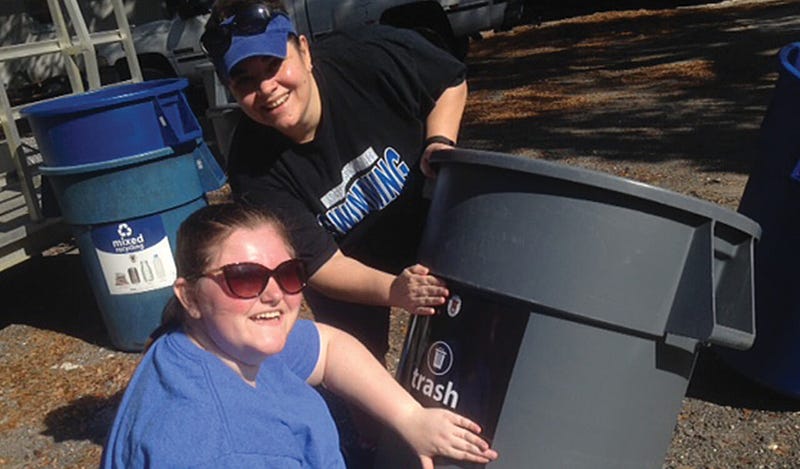
Recycle Across America claims it standardized recycling labels improve recycling rates 50 to 100 percent and dramatically reduce recycling contamination. Photo courtesy of Recycle Across America
SF Sets an Example
Once a city decides to go zero waste, the next thing that needs to happen is a series of public-policy and education decisions to ramp up recycling and ramp down incinerators and landfill use.
“To get to zero waste, you must have four things: First, mandatory recycling,” says Seldman. “People need to know it’s the law and become educated to be recycling-literate. You also have to have municipal composting and a pay-as-youthrow program, where you pay for your garbage based on how much you throw out. And the other thing you need is a reuse program.”
San Francisco boasts an 80 percent recycling and composting rate — the highest in the country — and aims to get to zero waste by 2020. To achieve its ongoing success, the city has embraced all of these policies and more.
In 2009, San Francisco passed an ordinance making recycling and composting mandatory by law for businesses and residences. With the help of Recology, a West Coast waste hauler committed to waste reduction, San Francisco implemented its “Fantastic Three” three-bin system to help residents easily sort their trash. Recyclables go into a blue bin, organic waste goes into a green bin, and anything destined for the landfill gets put in a black bin.
The system operates on the pay-as-you- throw model that Seldman asserts is the key to zero-waste success.
“The more material you send [to the landfill in the black bin], the more expensive your garbage bill is. The more material you send to the organic bin, the more your bill goes down,” says Guillermo Rodriguez of the San Francisco Department of the Environment (SF Environment).
He notes that while the pay-as-you throw plan does influence residents, it sends a particularly powerful price signal to larger entities: “If you’re the property manager for a 100-unit building, that’s huge savings.” The city has adopted other initiatives to further drive local behavior toward zero waste. It passed a ban on polystyrene food-service products, since polystyrene is not as easily recyclable as other plastics. And it enacted a city-wide single-use plastic bag ban, as well as a ban on bottled water sales on public property.
Americans can raise our recycling rates, but it will take a combination of government policy, corporate responsibility, community will, and individual effort.
San Francisco also has a robust community education program to help people separate their trash correctly. It has conducted public-education campaigns, and it has an easy-to-use online database with Recology to help residents find out which bin different types of trash go into.
The city even offers free trash audits at businesses and homes.
“Our auditors will [examine the bins] and provide owners with a report card to show where they can make improvements,” says Rodriguez.
For example, auditors helped US Postal Service outlets in the Bay Area cut down their garbage bill costs. Because the Post Office is run by the federal government, it doesn’t have to follow city waste-management rules — although it does have to pay the city to haul its trash. Auditors pointed out that simply by implementing the three-bin system at each location, the agency could save big. Area Postmasters and mail-center managers did just that — and shaved $200,000 off the agency’s annual trash bill.
Now that San Franciscans have embraced the three-bin system and gotten their recycling and composting up to 80 percent, SF Environment is working on ways to capture that last 20 percent.
“Nearly half of the material in the black bin can still be separated out,” says Rodriguez. “Most San Franciscans know exactly what to do with food scraps when preparing a meal. But that takeout food container or bag of salad that you have sitting in crisper that is now a weird science experiment? That’s what we’re seeing end up in landfill. So our latest campaign aims to convince San Franciscans to ‘free their food.’”
In addition, he says, the city is working with manufacturers to take responsibility for their packaging.
“Municipalities shouldn’t have to take responsibility for some things,” he says. “Juice boxes, for example. Outside, they’re made of cardboard, but inside, they’re lined with mylar. So you have to open up the box and peel off the mylar [to make them recyclable]. No one is going to do that! We need manufacturers to take responsibility for these complex end-of-life problems.”
Also with the goal of keeping that last 20 percent of the city’s trash out of landfills, San Francisco has a reuse program. First, when Recology employees spot anything coming through that still may be usable, they pull it out for donation.
The city government itself also runs an online database where government employees can post used furniture, office supplies, and other equipment in good condition. Schools, nonprofits, and other city departments can request items they can use. Since 2004, this “Virtual Warehouse” has redistributed over 900 tons of goods worth more than $6 million.
Is Recycling Doomed?
Even as cities like Los Angeles, Portland, and San Francisco make big investments in recycling, headlines have been dominating the news that the recycling industry is “collapsing” in the US.
Recycling is tied to commodity prices, which tend to fluctuate. Currently low oil prices mean it’s cheaper right now to manufacture new plastic than recycle used plastic, for example. And China — which purchased $10.8 million of our scrap metal and paper in 2011 and about $5 million of our cast-off plastic in 2014 for recycling — has started rejecting shipments of US recyclables in recent years.
Basically, the system once worked like this: China exported manufactured goods to the US. The US would fill Chinese shipping containers with recyclables, some of it packaging from those Chinese goods, before returning them. Then, China would recycle those materials and turn them into new products. As a result, US domestic recycling isn’t as robust as it could be, since we rely so much on China.
However, in 2013, China implemented Operation Green Fence, because the materials the US was sending back were too dirty to recycle cost-effectively. The new policy had China refusing contaminated shipments of recyclables — after US companies had already paid to send them to Chinese ports.
[Since China and other major buyers of US recyclables no longer want dirty materials], US recyclers are now extra cautious about what they [send out for recycling]. When they receive dirty materials, they’re more likely to just landfill or incinerate them.
According to Waste360.com, China turned away 22,000 shipping containers filled with US recyclables during the first year of the new policy due to contamination.
As a result, US recyclers are now extra cautious about what they ship to China. When they receive dirty materials, they’re more likely to just landfill or incinerate them, says Seldman.
Recycling contamination issues cause other problems, as well. Aimee Lee from the nonprofit Recycle Across America (RAA) says a lot of contamination problems could be headed off with proper sorting.
“[Better sorting] would save the billions of dollars currently spent to remove contaminants contaminants from the recycling stream,” says Lee. “There would be fewer plastic bags and other contaminants jamming the processing equipment. There would be significantly less wasted time and money spent while equipment is shut down for repairs, and far fewer injuries to employees at recycling plants. If we eliminate confusion at the bin, these costly inefficiencies would be remedied, and the demand for the materials would be strong. Recycling profit margins would be so far improved that they would then be able to weather any occasional fluctuations in virgin commodity pricing.”
Municipal education programs like San Francisco’s can help keep the wrong items out of the recycling stream. And RAA is advocating for a nationwide labeling system to provide uniform, easily recognizable labels on recycling, compost, and trash bins to minimize confusion about sorting. Lee notes that “standardized labels improve recycling rates 50–100 percent, while dramatically reducing contamination.”
ILSR’s Seldman says that using waste haulers committed to recycling right can help the industry turn more of a profit as well. Sixty percent of the country’s waste hauling is handled by two companies: Allied and Waste Management — and both, he says, have a vested interest in keeping recycling rates low and landfill and incineration rates high.
“They control billions of dollars in recyclable materials, but they say they can’t make a profit. It’s because they don’t want to,” he asserts. “They make an 80 percent return on putting things in landfills and incinerators.”
Other companies are passionate about landfilling and incineration. We are passionate about recycling and composting. If you’re really passionate about it, you can make it work. --Robert Reed, Recology
Recycling can’t compete, since the waste haulers have to share profits with the companies that recycle the materials, so “naturally they want to downgrade recycling and increase disposal,” says Seldman.
Even though Recology — which manages waste for San Francisco and 112 other communities on the West Coast — does take some waste to landfill, this independent, employee-owned company specializes in recycling and composting.
“We have a different business model: Our model is recycling, composting, helping communities we serve make progress toward zero waste,” says Recology spokesperson Robert Reed. “Other companies are passionate about landfilling and incineration. We’re passionate about recycling and composting. If you’re really passionate about it, you can make it work.”
So if you don’t want your recyclables to end up in a landfill, and your waste is picked up by a hauler that doesn’t prioritize recycling, it’s up to individuals and businesses to fend off contamination to ensure that as many recyclables make it to actual recyclers as possible.
Even better, says Porter, also help your community take control of its garbage: “Bypass the trash behemoths and find local haulers that will work with your community to get to zero waste.”
|
|
How recycling works and why it’s so often done wrong |
In an effort to boost recycling participation, cities and towns across the country have introduced single-stream recycling, where people simply dump all of their recyclables into one bin, and the waste management company collects and sorts them, sending them off to other facilities for recycling.
Public participation has increased due to the ease of single-stream bins, but the chances for contamination have skyrocketed. Reducing contamination is critical to making our recycling system effective and sustainable.
Unfortunately, contamination can occur anywhere in the recycling journey: Broken glass and food or liquid residues can ruin paper bales. Likewise, the wrong types of plastic and food/liquid residues can spoil plastic bales. These items then become non-recyclable and likely to end up in landfills or incinerators, or they may be sold to countries with lower contamination standards.
Follow the journey of your recyclables in a single-stream system to see how and where they might be contaminated and rendered unfit to recycle.
Your curbside bin is where you have the most control over reducing contamination (click the image to see our 9 steps for how to help). Toss in a coated paper receipt or #5 plastic bottle, a dirty aluminum can, or a handful of broken glass, and you can contaminate entire batches of recycling.
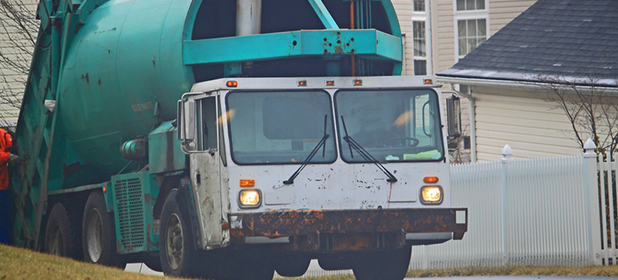
Waste management trucks scoop up your recyclables, where they remain commingled and are tossed in with all your neighbor’s bin contents. Glass may break, posing risk to recycling workers, and food and liquid residue can ruin batches of recyclables.
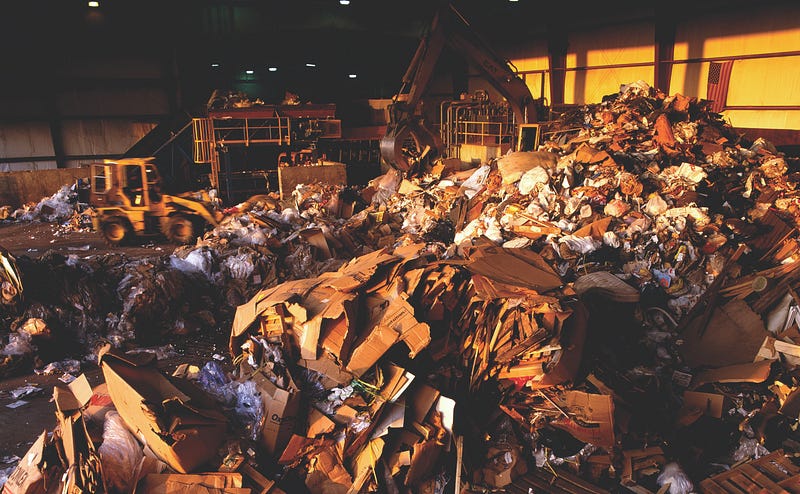 Trash & Garbage Transfer Station, New York. H. Mark Weidman Photgraphy/Alamy Stock Photo
The materials then arrive at a waste transfer station if you live in a larger city, which is like a pit stop for waste to be sorted into what goes to a landfill and what can be taken to a composting or recycling facility (depending on what your community offers.) Transfer stations offer another opportunity for glass to break or food and liquid to contaminate paper.
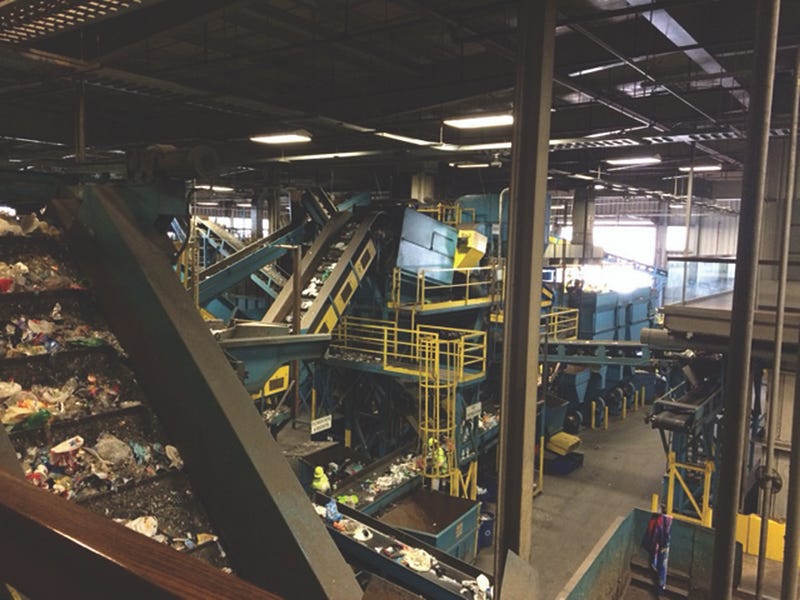 Interior of the Montgomery County recycling sorting facility in Derwood, Maryland. By André Floyd for Green America.
At last, the recyclables arrive at a materials recovery facility (MRF), where they are pre-sorted by hand. Mechanized screens separate items by weight and shape, and powerful magnets sort aluminum out. Each type of recyclable is packaged into bales, which are sent on to facilities specializing in recycling those particular materials. These facilities are where the contamination occurring at any point on the recycling journey takes effect. Broken glass may make its way into paper or plastic bales, making them unfit to recycle. And food or liquid can spoil entire bales of paper.
Mainstream waste-management companies will often landfill or incinerate dirty glass or plastic, as well as contaminated bales of recycling.
It’s up to us to maximize recycling. Wash and dry your recyclables and don’t “wish-cycle”!
|
|
Spring 2017 |
|
|
Industrial Agriculture |
The Problem with Industrial Agriculture: Energy Intensive and Damaging to Social and Environmental Health
The mass industrialization of the US agricultural system can be traced back to policies promoted during the Nixon administration by USDA Secretary Earl Butz, encouraging farmers to “get big or get out.” Support shifted from small family farms to large, highly mechanized mega farms dependent on vast monocrops and costly inputs. This system is proving to be unsustainable for farmers and highly damaging to the environment, polluting local ecosystems and contributing to global climate change.
Industrialization of the US agricultural system has resulted in increased chemical use, degradation of soils, poor animal welfare, and the death of the small family farm.
Mechanization Leads to Monocropping and an Increased Use of Chemicals
Our current agricultural system is highly dependent on monocropping. This system encourages farmers to grow one crop at a time, allowing for increased mechanization and distribution of pesticides and fertilizers. In fact, monocropping requires increased chemical use because vast swaths of the same plant are more susceptible to pests, and a lack of crop diversity deteriorates soil health. The use of genetically engineered (GE) crops or GMOs in industrial agriculture further promotes this unsustainable system of monocropping and overuse of synthetic pesticides, herbicides, and fertilizers.
The overuse of pesticides has led to a rise in resistant superweeds, requiring increased use of chemicals and dependency on more toxic varieties, such as 2,4-D and dicamba. This puts the health of farm workers, farm communities, wildlife, and waterways at risk. Microorganisms in the soil are also affected, leading to soil depletion and decreasing the soil’s ability to pull excess carbon from the atmosphere. In this negative feedback loop, poor soil health requires farmers to use additional energy-intensive synthetic fertilizers to make up for soil deficiencies.
Intensive Animal Agriculture: Too Big for its Own Good
Industrial agriculture includes the raising of millions of farm animals in unnatural conditions. Most GE crops are used as animal feed, allowing for intensive animal farming operations to take place indoors. Factory farms, or concentrated animal feeding operations (CAFOs), are one of the main reasons agriculture is a top contributor to climate change. CAFOs house hundreds or even thousands of animals per facility in crowded and unnatural conditions with little to no access to the outdoors. This system of agriculture focuses on efficiency and economy with little to no regard for the well-being of animals, the environment, or consumers. CAFOs are linked to numerous animal welfare and public and environmental health concerns.
Due to the mass quantity of animals in one area, animal waste builds up and releases high levels of methane into the atmosphere. Methane is one of the leading contributors to climate change, causing more short-term damage to the environment than carbon dioxide. Animal waste also poses a contamination threat to soil and waterways, impacting communities downstream from CAFOs.
To make up for the crowded and unsanitary conditions, animals raised in CAFOs are regularly given sub-therapeutic (non-medical, daily low dosage) doses of antibiotics. In addition, antibiotics are often used to aid in growth promotion, a usage discouraged by the FDA. The continued sub-therapeutic usage of antibiotics is contributing to the rise in antibiotic-resistant bacteria, an epidemic that claims over 23,000 lives a year in the US alone.
The Solution: Adoption of Organic, Regenerative Agriculture
Green America works with consumers, farmers, companies, and allies across the US to reduce the use of toxic chemicals, GE crops, and monocropping. We partner with stakeholders dedicated to improving the lives of farm animals and the health of farm workers and consumers. We advocate for regenerative agriculture that replenishes the soil, sequesters carbon, provides healthful food, and makes a place for small and mid-sized family farms. |
|
FAQs about Shareholder Activism |
Here are the most Frequently Asked Questions about shareholder activism.
I get proxy ballots in the mail (or e-mail). What do I do with them?
Your proxy ballot will arrive before a company's annual meeting, which usually happen in the spring, so look carefully at any correspondence from the companies in which you hold stock, or from your financial adviser. If you invest in mutual funds, you automatically delegate your proxy voting rights to the fund managers, so it is important to invest in funds that share your values.
Vote your proxy by filling out the form you receive and mailing it back before the due date; phoning your results in, if there is a call-in option listed on your ballot; or voting online using a link on your ballot. Mark all votes on your ballot, even if the instructions don't specifically tell you to do so, because ballots returned unmarked count as votes for management's position. For a look at a sample ballot, click here.
Some organizations such as As You Sow are now using a proxy voting app. Votes are recommended for board elections and shareholder resolutions in hundreds of companies; you can follow all the recommended votes, or review them individually to decide how to vote. Learn more
I heard that some shareholder resolutions get less than 10 percent of the vote. How could such a small proportion make a difference?
Historically, very few resolutions achieve majority votes at annual meetings. Many votes come in at the 5 percent to 25 percent range. Even those low numbers represent a significant number of unhappy shareholders. Since shareholder action campaigns are often accompanied by coordinated consumer and media campaigns, resolutions can damage a company's reputation and branding, and a potential loss of revenue through negative publicity, consumer boycotts, and loss of investor confidence.
Some companies have amended policies after a proposal is filed and before a vote, to avoid the conflict. When a resolution succeeds like this even before it comes to a vote, whomever filed it will usually withdraw it from the ballot.
If a resolution comes to a vote and the company doesn't respond, shareholder activists will often keep the pressure on by re-filing the proposal the following year. According to the newest rules of the Securities and Exchange Commission (SEC), approved in 2020, a resolution must receive 5 percent of the vote the first year it is filed, 15 percent the second year, and 25 percent every year thereafter to continue to be included on the proxy ballot.
I own stocks, but I’ve never seen a proxy ballot. Why?
Your financial adviser may be receiving your proxy ballots and voting on your behalf. When you hired your financial adviser, you may have signed paperwork saying you didn't want to receive these materials. Ask your financial adviser if you can get the proxy ballots so you can vote—or if you can give him/her instructions on how you want the votes cast and let him/her do the paperwork.
Warning: Many money managers or advisory groups have policies dictating that they automatically vote on the side of the management of the company in which the stock is owned. If this is the case, ask your adviser for a guarantee that s/he will follow your instructions. Otherwise, take voting into your own hands, since company management almost always recommend voting against social and environmental concerns.
If you invest in mutual funds, you automatically delegate your voting rights to fund managers. To find out how your mutual fund is voting on proxy resolutions, call the fund's investor relations department, request this information, and express your views on the position you want the fund to take. Mutual funds have been required to disclose how they vote their proxies since 2004.
Why does my socially responsible mutual fund invest in companies I don’t agree with, or that have questionable practices? How do I know if it is engaging in shareholder activism?
If you already have a socially responsible mutual fund, it could be investing in questionable companies and engaging in shareholder activism. Socially responsible mutual funds promote corporate responsibility by:
- targeting exceptional companies for investment,
- avoiding the most irresponsible companies, and
- putting their investment clout behind shareholder campaigns targeting companies that need to do better but aren’t the worst of the lot.
All mutual funds are required to provide investors with information about how they are voting all their proxy ballots. If you have a concern about a company included in your mutual fund, call the fund's investor relations department and ask for its proxy voting information.
Can I introduce a shareholder resolution?
In 2020, the SEC increased the shares that investors must own if they wish to file shareholder resolutions. Currently, if shares are owned for one year, $25,000 worth of shares must be owned in order for the investor to be able to file a shareholder resolution; if shares have been owned for two years, then $15,000 worth of stock are needed; shareholders must wait three years before they can file if they own at least $2,000 worth of shares (and below $15,000). Institutional investors tend to dominate the resolution filing process because they have resources for multi-year follow up and time to spend pressuring companies.
There are individuals who file resolutions, but it's less common than those filed by institutional investors. It is most helpful for individuals to vote their proxies, as many never return their ballots. But if an individual is intent on filing a resolution, it can be advisable to do that in conjunction with institutions that have likely been working on the issue for many years.
Often, the first thing a company will do upon receiving a resolution is to present it to the SEC and ask that it be thrown out; institutional investors or existing coalitions with experience introducing shareholder resolutions have the resources and legal backing to ensure that their proposals are written correctly and make it onto the ballot. An easier way to get involved in filing a proposal is to join an existing group of filers and be a co-filer, lending your shares to the coalition, being updated on its progress, and providing input when asked.
Individuals interested in co-filing or lending their shares to can contact an organization that works on an issue to ask if it is engaged in shareholder action and if they are interested in having co-filers, or in need of someone to attend a shareholder meeting.
Green America is not an investment adviser, nor do we provide financial planning, legal, or tax advice. Nothing in our communications or materials shall constitute or be construed as an offering of financial instruments or as investment advice or investment recommendations.
|
|
Greener Paths: Recyclable Plastics |
When plastic manufacturing took off in the early 20th century, plastic was heralded as a miraculous material—lightweight, flexible, and sturdy. Eventually, though, plastic’s downsides started to emerge: toxic chemicals such as benzene and dioxin are released into surrounding communities during the manufacture of certain types of plastic, and some types leach chemicals as we use them. A plastic bottle tossed into a landfill will take hundreds of years to break down. Plastic bags that litter the landscape will kill animals that try to eat them, and they’ll harm aquatic life when dropped into bodies of water. Several studies have uncovered health risks associated with exposure to fumes from its incineration.
Plastic recycling has lightened some of the environmental burden of disposal, but the majority of plastics are landfilled or incinerated after a single use; the US plastic-bottle recycling rate is less than 25 percent, according to the American Plastics Council. Even if we raised that percentage, recycling plastic isn’t an ideal solution; the plastic we recycle doesn’t turn into more of the same kind plastic we tossed into the bin, but has to become lower-quality plastic that has limited applications, such as plastic lumber.
By reducing your use of plastic, choosing plastic products carefully, and using them safely, you can reduce the risks that plastics pose to the Earth and your family’s health.
Problem Plastics and Better Options
- #1, PETE or PET (Polyethylene Terephthalate) — Used for clear beverage bottles. Widely recyclable; generaly considered safe, with some precautions.
- #2, HDPE (High-Density Polyethylene) — Used for colored or cloudy bottles and jugs, yogurt containers, and other tubs. Widely recyclable, but consumers need to verify with local recyclers whether tubs and bottles (which are made differently and can’t be recycled together) need to be separated. Generally considered safe, with some precautions.
- #3, PVC (Polyvinyl Chloride) — Used in some cling wrap and bottles, as well as pipes and other construction materials. Not widely recyclable; recommended to avoid because it can leach toxins into food and is an environmental problem throughout its lifecycle.
- #4, LDPE (Low-Density Polyethylene) — Used for garbage bags, food storage bags, and some cling wrap and bottles. Not widely recyclable; generally considered safe, with some precautions.
- #5, PP (Polypropylene) — Used in butter tubs, some baby bottles, and other rigid containers. Not widely recycled; generally considered safe.
- #6, PS (Polystyrene) — Used in foam trays, takeout containers, coolers, egg cartons, and packing peanuts. Not widely recyclable, although many packing and shipping stores accept packing peanuts for reuse. Recommended to avoid because styrene may leach into food and beverages.
- #7, Other (Includes Polycarbonate and mixed materials) — Used in five-gallon water bottles, some baby bottles, and some liners of metal cans. Not widely recyclable; recommended to avoid because bisphenol-A(BPA) can leach from polycarbonate into food and beverages.
Be a Smart Plastic User
Here are ways to make your plastic use healthier and more environmentally friendly.
Reduce and Reuse: There are a few cases—such as that of medical supplies—in which it’s necessary to use plastic once and then discard it, but it’s often possible to find a better alternative. Avoid single-use items such as disposable bottles, plates, and cutlery. Carry a refillable bottle or mug for beverages on the go, and bring reusable cloth bags to stores. For leftovers and takeout food, reusable containers are better than foam boxes or plastic wrap and bags. If you regularly buy products that are only available in plastic packaging, buy the largest container available, rather than the multiple smaller ones, to cut down on the total amount of plastic used.
Take precautions: When you do use plastic, it’s best to choose those labeled #1, #2, #4, and #5 and avoid those labeled #3, #6, and #7. Even if you’re choosing the best plastic, though, there are still chemical leaching concerns associated with long storage or heat. The Institute for Agriculture and Trade Policy has issued a “Smart Plastics Guide” that includes the following recommendations for using any type of plastic:
- Avoid using plastic containers in the microwave. Instead, use glass or ceramic containers free of metallic paint.
- Beware of cling wraps, especially for microwave use.
- Avoid plastic bottled water, if possible.
- If you do use plastic water bottles, take precautions. If you use a polycarbonate water bottle, to reduce leaching of BPA, do not use for warm or hot liquids, and discard old or scratched water bottles. Water bottles from #1 or #2 plastics are recommended for single use only. For all types of plastic, you can reduce bacterial contamination by thoroughly washing daily. However, avoid using harsh detergents that can break down the plastic and increase chemical leaching.
Take Care With Kids: The rapid development and immature immune systems of fetuses and children make them particularly susceptible to damage from toxins, so pregnant women and parents should exercise extra caution with plastics. The Children’s Health Environmental Coalition (CHEC) advises choosing cloth and wooden toys and avoiding plastic toys, which are often made of PVC and can leach harmful chemicals when chewed on. Or, consult Greenpeace’s Toy Report Card to learn which toy manufacturers have eliminated PVC from their products.
Plastic baby bottles are of particular concern to parents. Breastfeeding can eliminate the need for a lot of plastic, but parents may still want to use bottles for pumped breast milk or juice. CHEC recommends avoiding polycarbonate bottles, which are generally clear and rigid and bear the #7 symbol, and choosing bottles made of tempered glass or polyethylene and polypropylene (#1, #2, or #5); they note that Medela and Evenflo make bottles from safer plastics. CHEC also recommends using bottle nipples made of clear silicone rather than yellow rubber, because the silicone hides less bacteria and is heat resistant.
Recycle Plastics Responsibly: Recycle your plastics following the instructions given by your local recycling program. If you have a curbside program that doesn’t accept certain plastics, consult Earth911 to find an alternative drop-off site near you. Advocate for more extensive plastic recycling collections, and purchase items made from or packaged in post-consumer content.
Bioplastics
Concerns about the rising price and supply limits of petroleum, as well as environmental factors, have spurred the use and development of bioplastics synthesized from corn, soy, sugar cane, and other crops. Toyota has started using bioplastics in some of its cars; Wild Oats, Newman’s Own, and Del Monte have adopted them for deli and food packages; and even Wal-Mart has begun using a corn based packaging for cut fruit and vegetables. Most of the bioplastic packaging used in the US is polymerized lactic acid (PLA) made by NatureWorks LLC, a company owned by Cargill.
Bioplastic's Benefits: Unlike conventional plastics, bioplastics biodegrade relatively quickly under the right conditions, and they’re made from annually renewable crops rather than petroleum. PLA can also be recycled into more of the same product repeatedly, while plastic can’t.
Bioplastic may be an effective substitute for petroleum-based plastic. In 2005, the Los Angeles Times published an article about Cargill’s Nebraska facility that manufactures PLA from corn. “The end products—which include T-shirts, forks and coffins—look, feel and perform like traditional polyester and plastic made from a petroleum base,” the article reports. “But the manufacturing process consumes 50 percent less fossil fuel, even after accounting for the fuel needed to plant and harvest the corn.”
Concerns: Since relatively few people in the US have access to commercial or industrial composters, which help bioplastics degrade, lots of bioplastic is ending up in landfills or recycling bins. In landfills, PLA will lack the light and heat it needs to degrade. Plastic recycling is unlikely to be adversely affected by PLA, which can’t currently be processed by mainstream recyclers, until it makes up a far greater percentage of plastic than it does now. The best option would be to develop a separate recycling stream for PLA.
The Sustainable Energy & Environmental Demand (SEED) Initiative of the organization Future 500 brings together NGOs, corporations, and governments to develop markets for emerging technologies that will reduce petroleum dependence. SEED is helping NatureWorks and environmental groups work together to make PLA as eco-friendly as possible. Issues include the large amounts of energy and chemicals used to grow and process the corn, the use of GMO corn, and waste disposal. NatureWorks has already taken positive steps in these areas by purchasing green-power offsets, offering customers options to buy non-GMO-corn offsets or GMO-free PLA, and buying baled PLA back from recyclers. They continue to work with stakeholders through SEED.
One danger of increased bioplastic use is that people might end up buying a lot of it if they think it’s less problematic than petroleum-based alternatives. A shift to bioplastics still needs to be accompanied by waste reduction.
Best Uses: When reuse isn’t feasible, bioplastics can be the best alternative. For instance, Green Festival® events, are held in venues where vendors can’t wash and reuse food service items. Instead, we use compostable plates, cups, and utensils from Biocorp and serve BIOTA water, which comes in compostable bottles. Hundreds of volunteers help attendees sort their waste into the appropriate bins, and we send the composting to a municipal composter afterwards.
Bioplastic is also a good option for collecting kitchen compost and yard trimmings destined for commercial composting, because the bags can be composted along with their contents. With a little forethought, we can all reduce our use of plastics and make the healthiest choices for our families and the planet.
|
|
Most Popular Green Living Tips |
|
|
Green America In the News |
|
|
Press Releases |
|
|
Blog Posts |
|