|
CFL vs. LED Lights: Which is the Energy Efficient Light Bulb? |
Your home is a place of warmth and comfort, and your lighting has a lot to do with that. Green America recommends choosing energy efficient light bulbs, which are good for your home, your wallet, and the planet.
Energy experts agree the incandescent bulb is rapidly becoming a thing of the past. In fact, in 2007, Congress passed the Energy Independence and Security Act, which requires all light bulbs sold on the market to have a 30% increase in efficiency over today’s standard incandescent bulbs. Store shelves once stocked with only incandescent bulbs are now full of CFL and LED lights.
In the past decade, many consumers have shifted to using compact fluorescent light bulbs (CFLs) or light-emitting diode bulbs (LEDs). Lighting can account for 15% of a home’s energy costs, and switching saves the average home $225 on the monthly energy bill.
The US Department of Energy (DOE) approved the phase out of incandescent bulbs in favor of LEDs and compact fluorescent lighting (CFLs) in 2022. The DOE estimates that the new rule will reduce US carbon emissions by 222 million metric tons over the next 30 years. That's roughly equivalent to the emissions generated by 28 million homes in one year!
Why Abandon Your Incandescents?
Invented by Thomas Edison in last quarter of the 19th century, modern incandescent electric light bulbs have been lighting much of the world for more than 100 years. Incandescent bulbs are lit by heating a wire tungsten filament until it begins to glow. Because approximately 90% of the energy generated in these bulbs is heat instead of light, they are extremely inefficient. The average incandescent bulb has a lifespan of about 1,500 hours—a fraction of what you can get from a CFL or LED bulb.
Halogen lights are a more efficient form of incandescent lighting because they last longer; however, they get hotter than regular incandescent bulbs and pose fire and burn hazards.
For nearly every incandescent bulb still in use today, there’s a CFL or LED light bulb that can replace it—saving energy and curbing carbon emissions. If you still have incandescents at work or home, it’s time to send them back to the Dark Ages.
CFLs: An Improvement on Light Bulbs
CFLs (and fluorescent tube lights) are lit by an electric current that is sent through a tube containing argon and a small of amount of mercury gases. This in turn generates an invisible ultraviolet light, which then stimulates a fluorescent coating on the inside of the tube, producing visible light.
Pros of CFLS
- Longevity—With an average lifespan of approximately 10,000 to 15,000 hours, a CFL bulb lasts about ten times longer than an incandescent bulb—which means they need to be replaced less often, making them convenient for those hard-to-reach light fixtures and lamps.
- Efficiency—“CFLs are about four times more efficient than the equivalent wattage of incandescent bulbs,” says Naomi Miller, the senior lighting engineer at the Pacific Northwest National Laboratory in Portland, OR. “So if you take the wattage of the CFL and multiply it by four, that equals the incandescent bulb you would replace. So, for example, a 15W CFL is roughly equivalent in light output to a 60W incandescent bulb.” According to the Environmental Protection Agency (EPA), if every household in America replaced just one incandescent bulb with a CFL, the energy saved would be enough to light 3 million homes and prevent greenhouse gas emissions from the equivalent of 800,000 cars.
- Price—CFLs have dropped dramatically in price since they were first introduced to the market in the 1980s. They still cost a little more than incandescents; however, they will pay for themselves after a year or two of use. Because they last so much longer than incandescents, you will continue to see savings on your energy bills throughout the life of the bulb.
Cons of CFLS
- Mercury concerns—Many people are concerned about the mercury in CFLs, and with good cause: mercury is a neurotoxicant. The amount in a CFL bulb, however, is smaller than the tip of a pencil. Increased use of CFL bulbs instead of incandescents actually reduces the amount of mercury released into the atmosphere, since the main source of mercury emissions are smokestacks from fossil fuel burning power plants, according to the EPA. CFLs pose little risk to your family if they break, but proper clean-up is important.
- Some usage limitations—CFLs are not dimmable, and they are not efficient in recessed lighting, where they waste about half of the energy they produce. To maximize their efficiency, avoid exposing them to extreme temperatures.
Best uses:
CFLs were a placeholder for LED lights, because LEDs are even more efficient. LED lights are readily available in both brick and mortar stores and online and come in all shapes and sizes.
If you adopted CFLs as replacements for incandescent bulbs go ahead and use them until they stop working; just make sure they are disposed of properly at the end of their life cycle.
LED Lights: The Energy Efficient Light Bulb
LEDs were first introduced to the market in 1962. They work by the movement of electrons through a semiconductor material. Initially, LEDs only emitted red light, so their uses were limited to indicator lights and lab equipment. Now, however, they are available in the visible, ultra-violet, and infrared spectrums, which means they now have a much wider variety of uses, including inside your home.
Pros OF LEDs
- Longevity—With a lifespan of approximately 25,000–35,000 hours, an LED bulb lasts 2 to 4 times longer than a CFL, and 25 to 35 times longer than a standard incandescent bulb.
- Efficiency—While incandescent bulbs and CFLs generate most of their energy in heat, LEDs are cool to the touch—which translates into less wasted energy. It also means your air conditioner won’t have to run as high in hot weather. LEDs are more efficient than even CFLs: A 16.5-watt LED bulb is equivalent to a 20-watt CFL and a 75-watt incandescent. A report from the DOE states that LED adoption saved consumers $14.7 billion in 2018.
- Other benefits—LEDs have other advantages over incandescent lights, including a smaller size and greater durability and reliability. Unlike CFLs, LEDs can also withstand extreme temperatures, and they do not contain mercury.
Cons of LEDS
- Color quality—Some users may find LED light a bit stark as compared to incandescents. “LEDs are most efficient when they emit a blue-white color, but many homeowners prefer a warmer (yellower) color of light,” notes Naomi Miller. When selecting an LED bulb, look for a ‘Lighting Facts’ label on the box, she says. It includes a spectrum bar that will indicate whether you’ll get a yellowish or bluish light. There are more and more LEDs with warmer colors available, and for people worried about LED light impacting their sleep, there are LEDs that are specifically designed for nighttime use that do not emit blue spectrum color.
- Expense—LED lights are more expensive up front, but provide substantial energy savings over time. So, you may want to swap out your light bulbs over time, rather than changing all the bulbs in your house at once.
Best uses:
LED lights are now available for all uses—overhead and recessed lighting, lamps, and fixtures. They also make great indoor and outdoor holiday lights.
The Bottom Line
LEDs are your best bet for an energy efficient light bulb, reducing your utility bill, eliminating toxic mercury, and protecting the planet.
Updated September 2022
|
|
Eco-Friendly Flooring |
EPA studies have shown that indoor pollutant levels can be two to five times higher than they are outside. To find the source of many of these pollutants, just glance down. New carpet and flooring can fill the air with hundreds of volatile organic compounds (VOCs), including known and suspected carcinogens like formaldehyde and benzene. It can take years for these substances to dissipate. Additionally, carpets are often treated with toxic chemicals for moth-proofing or to repel soil and moisture. Carpeting is also notorious for trapping toxic lawn chemicals, VOCs, and allergens tracked in from outside.
There are several sustainable, eco-friendly flooring options that can minimize indoor pollution and mitigate health problems caused by toxic carpets. You can now choose from a rapidly growing line of carpets and flooring made from recycled and eco-friendly materials. Durable, stylish, and often less expensive than conventional floors and carpets, these sustainable options provide a responsible and healthy way to enhance your home.
Eco-Friendly Flooring: Roll Out the Green Carpet
The environmental and health costs associated with carpeting extend from the time of your purchase until your carpet’s disposal. Here are some ways you can minimize those costs:
Fast and cheap fix: If you are experiencing health problems that could be caused by your carpet, there is a cheap solution. Try a nontoxic, eco-friendly carpet finish like SafeChoice Carpet Seal, available from American Formulating & Manufacturing. This product forms an insoluble water- and odor-resistant barrier that prevents chemicals from offgassing from carpets for up to five cleanings or one year.
Carpet: There are a wide range of sustainable carpets and rugs sold at competitive prices across the nation. Look for carpets made from natural fibers with little or no chemical treatment. Also, purchase carpets with natural-fiber backing attached with less-toxic adhesives.
Padding: Many carpets and carpet paddings contain plastics made from petroleum, an unrenewable and energy consumptive resource. Choose a carpet with lightweight backing that requires no additional padding, or use padding made from recycled materials. Look for 100 percent recycled cotton padding or recycled “rag pads.”
Installation: Finding the right carpet is just the beginning of your journey toward eco-friendly floors. Next, you’ll need to have your carpet installed, a process that often involves chemical-based glues that have been linked to respiratory problems and other health issues. Tacking carpets down is a safe and easy alternative to gluing that eliminates many potentially hazardous pollutants. However, if you do decide to glue, you can take steps to minimize your ecological footprint. Look for water-based, low-VOC glues to install your carpets.
Disposal: Eventually, all the cleaning in the world won’t save an old and tattered carpet. But, when you finally decide to say goodbye to an older carpet, remember that every year people send 1.8 million tons of rugs and carpets to local landfills, and that most carpets will last up to 20,000 years. Instead of adding to that total, try to purchase flooring from companies that will recycle or donate your old carpet.
Few carpet recyclers exist who will take any and all old carpets off your hands. Carpet America Recovery Effort (CARE) is a nonprofit created to oversee the recovery, recycling, and reuse of post-consumer carpet. CARE’S database helps you locate carpet donation and recycling partners in your area.
Another way to minimize your ecological impact is to install carpet in tiles, if possible. This method allows you to replace smaller parts of it when they become worn down or damaged, rather than replacing the entire thing.
Finally, a professional carpet repairer can give your old carpets new life by mending, reweaving, refringing, and dying your old carpets. To find a carpet repair expert, consult your local yellow pages under “Carpet & Rug Repairing.”
Ranking Your Rugs
Rugs are a great way of adding style and comfort to any of your home’s floors, but they, too, can carry a steep environmental cost. Like conventional carpets, rugs frequently contain nylon and other petroleum by-products. To minimize the use of these resource-intensive ingredients, look for eco-friendly rugs made of natural fibers. For a list of companies that sell eco-friendly rugs or other flooring options, consult the GreenPages.org.
Many hand-woven rugs are made overseas, where labor restrictions regarding workers’ rights and child labor are much looser than they are in the US. This second problem can be solved in one word—Goodweave. GoodWeave (formerly Rugmark) is a nonprofit founded in 1994 to end child slavery in the handwoven carpet industry. GoodWeave conducts independent audits of carpet weaving factories to ensure no child labor laws are violated. To date over 11 million GoodWeave-certified rugs have been sold. More than 3,600 children have been rescued from carpet looms and the certification has deterred the employment of thousands more.
Other Eco-Friendly Flooring Options
While carpet and rugs can be responsibly purchased and installed, the most eco-friendly flooring option is often avoiding them altogether. Here are some of the best alternatives:
Hardwood Floors
For home-owners sold on traditional hardwood floors, the Forest Stewardship Council can make sure that your lumber comes from sustainably managed forests. Dozens of types of wood are produced in FSC-certified forests in which the trees are regenerated, biodiversity is conserved, and air and water quality are preserved. FSC-certified wood flooring comes in hundreds of different shades and styles. To find other sources for FSC-certified wood, visit the FSC Web site and database, or for certified green businesses that sell flooring, search GreenPages.org.
Cork
While softwoods are rarely considered ideal flooring material, cork is an excellent choice for many reasons. The natural elasticity of cork makes these floors especially comfortable; the wood provides thermal and acoustic insulation; and the durable floors recover well from marks left by furniture or high heels. The floors are also hypo-allergenic, so they won’t attract dust; are fire-resistant; and can even serve as a natural insect repellant. Better yet, the floors are produced using the bark of the cork oak tree, which grows back every three years.
Bamboo
Bamboo, a popular green flooring option, is 13 percent harder than maple and 27 percent harder than northern red oak, so it lasts longer and can withstand more use than conventional hardwood floors. The floors are naturally resistant to water, mildew, and insects, and they are sustainable since bamboo grows quickly and abundantly.
Tile and Linoleum
You can add life to any room with a colorful floor made of recycled glass tiles, which are ideal for modern bathrooms and kitchens. Natural linoleum floors are also hypo-allergenic and biodegradable.
It’s easy and cost-competitive to choose eco-friendly flooring when your old floors need upgrading. All you have to lose are some pollutants. Check the Green Business Network for green flooring businesses.
|
|
New GMO Frankenfoods on the Horizon |
If you’re concerned about genetically modified organisms (GMOs) in your food, brace yourself. A number of GM crops and animals currently sit somewhere along the US government’s research and approval process, meaning new GMOs could be coming to a store near you in the coming months. Since no laws require companies to label them, you might not even know when they show up in stores.
Many of the concerns surrounding GM crops are the unintended and unmeasured consequences of altering, inserting, and/or removing one enzyme or protein. There are also major concerns regarding the impacts these engineered varieties can have on existing species and biodiversity. The issues that engineered species aim to “fix” are often linked to poor resource management and could be addressed by an increased focus on sustainable practices and better management.
Salmon
Status: Approved by the USDA and FDA in 2015. The FDA announced a ban on the import and sale of GM salmon until the agency can publish guidelines on how it should be labeled—a process that could take years. (Editor's Note: In April 2019, the FDA lifted the ban on importing GM salmon into the US. This decision was made after the USDA agreed in 2018 to place labeling on bioengineered salmon.)
Type of GMO: Atlantic Salmon engineered with a growth-hormone-regulating gene from a Pacific Chinook salmon and a growth promoter from an ocean pout to make it grow to a larger size at a faster rate.
Who is behind it: AquaBounty Technologies
Concerns: GE salmon are farmed and bred so that all the females are sterile. But should any females develop the ability to breed and escape into the wild, this could have major impacts on wild salmon and ocean biodiversity.
So far, hundreds of retailers, including Costco, Target, Whole Foods, Trader Joe’s, Aldi, H-E-B, Meijer, Hy-Vee, Marsh, Giant Eagle, Safeway, Wendy’s, McDonald’s, and Kroger have committed not to buy GE salmon. See the full list here.
Arctic Apples
Status: Deregulated by the USDA and approved by the FDA in 2015. Headed for field trials in 2016. (Editor's Note: Arctic Apples first appeared in grocery stores in the Midwest in 2017, and advocacy organizations have noted that the GMO labeling is limited.)
Type of GMO: The apples are engineered to be non-browning.
Who is behind it: Okanagan Specialty Fruits, Inc.
Concerns: The natural enzyme that causes apples to brown also helps fight diseases and pests, so Arctic apples may require increased pesticides.
These apples have not yet entered the marketplace, but when they do, they are likely to be sold in fast-food restaurants and prepared-food products.
Some companies, such as Gerber, have stated that they do not intend to purchase the Arctic Apple.
Oranges
Status: In development.
Type of GMO: Engineered to resist citrus greening, a disease that is affecting the Florida orange crop.
Who is behind it: Southern Gardens.
Concerns: The rapid spread of citrus greening is a result of monoculture and unsustainable growing practices. The introduction of GE oranges would only delay the disease’s spread while putting the trees at risk to other diseases. A better strategy would be to increase the biodiversity of the orange plantations. Like any new GE crop, GE orange trees pose a risk to biodiversity, particularly since fruit seeds are easily moved by birds and other animals.
Golden Rice
Status: In development. (Editor's Note: In 2018, the FDA approved golden rice for US markets, but it has yet to reach stores.)
Type of GMO: Engineered to be dense in beta-carotene (Vitamin A).
Who is behind it: International Rice Research Institute/ Golden Rice Humanitarian Board/ Syngenta.
Concerns: Golden Rice has been in development for over 15 years and has yet to be approved or commercialized. Golden rice is often cited by the industry as an example of why GMOs are needed to feed the world. But this is a fiction. Golden rice is not delivering on its promise of vitamin-A enrichment. There have been a number of problems with its development, including the amount of rice that someone would actually have to consume to receive nutritional benefits from it.
This GM crop is aimed to aid developing nations where Vitamin A deficiency often results in childhood blindness. This problem is rooted in poverty and an imbalanced diet, and resources could be better used to alleviate poverty, improving supply chains and food access.
Trees
Status: In field trials.
Type of GMO: Eucalyptus, poplars, and loblolly pines are being engineered
for industrial purposes and to have traits that would tolerate colder temperatures and include “terminator” technology, meaning they would be sterile.
Who is behind it: ArborGen.
Concerns: In 2009, the USDA approved field trials for GE eucalyptus tree and had previously approved other field trials. ArborGen has applied to commercialize its eucalyptus trees, and the USDA is considering the environmental impacts as eucalyptus trees are not native to the US and are considered an invasive species. Eucalyptus trees require a heavy amount of water and burn very easily, both concerns considering the severe drought across the US and rising temperatures due to climate change. Here, too, biodiversity would be the better strategy.
Innate Potatoes
Status: Approved for commercial planting by USDA in 2014 and approved by the FDA in 2015.
Type of GMO: Potato engineered to produce less acrylamide, a compound suspected of causing cancer, which is released when potatoes are fried.
Who is behind it: J.R. Simplot.
Concerns: J.R. Simplot is a major provider for fast food chains, including McDonald’s. The Innate potato is most suited for high-temperature frying, such as for French fries and hash browns. While McDonald’s and a few other fast-food chains have vowed not to use it, to avoid this potato, it is best to purchase organic whole potatoes and organic or Non-GMO-Project-verified potato products.
Zucchini and Crookneck Squash
Status: Commercialized in 1995.
Type of GMO: Engineered to protect against disease.
Who is behind it: Monsanto.
Concerns: There is a very small amount of GE squash and zucchini being grown in the US. But due to the lack of GMO labeling, the only way to avoid purchasing GM zucchini and squash is to buy organic.
Wheat
Status: In development
Type of GMO: Research is focused on developing varieties of wheat engineered to be resistant to pesticides such as glyphosate, dicamba, and 2,4-D.
Who is behind it: Monsanto, Syngenta, Bayer, and others.
Concerns: If GE wheat enters the marketplace, it will be close to impossible to prevent it from contaminating the entire supply chain. GE wheat will likely be included in many processed foods and will be hard to avoid. The best way to avoid purchasing it will be to buy organic or Non-GMO-Project-verified ingredients and products.
GMOs focused on pest- and weed-resistance have started to fail, as the pests are adapting to GMOs and related chemicals, evolving into superbugs and superweeds
—Anna Meyer is Green America’s food campaigns coordinator.
For more information on GMOs, visit Green America’s GMO Inside campaign, GMOInside.org, and read our Green American article, “GMOs & the Case for Precaution". |
|
Tips for Yard Sale Success |
Running out of room to store things you don't really need anyway? Sell it off at a blow-out yard sale.
Summer is here, which probably means that the piles of clutter you discovered during spring cleaning are still, well, cluttering. Before you give in to the temptation to haul it all out to the dumpster behind your house, consider giving it a second life. You do what you can to recycle your paper and aluminum cans, so why not recycle your clothes, your old records, that vase your mother-in-law gave you three years ago, and the kids’ old toys—and make a little money while you’re at it?
The EPA found in 2017 that every day, Americans throw away an average of 4.51 pounds of garbage per person. Holding a yard sale can be your chance to keep reusable items in circulation. So gather your clutter and check out these easy steps to making your yard sale a smashing success.
Getting Started
The first step to throwing a great yard sale is assembling your merchandise. This is the time to go through your closets, cabinets, basements, attics, and cupboards. Make a night of it—have everyone in your household bring things down from their rooms and go through them together (to keep the peace, let the final decision to sell be up to the owner of the item). This will give you a chance to spend time together while reliving old memories stimulated by some of your belongings.
But watch out—once you unearth some of your old stuff from the depths of the closet, you may suddenly want to keep it. Before you put that long-unused item in the “keep” pile, ask yourself: How long have I lived with this in the closet? How often did I need it? How often will I use it now? Odds are, any item you dragged out of your closet will end up back there soon—why not give it a chance for a new life with someone else?
The More the Merrier
You probably aren’t the only household in your neighborhood looking to de-clutter your home. Check in with your neighbors and friends of the family to see if they want to join you and make it a multi-family sale. Live in an apartment? Check with fellow tenants—if you join forces and have a bigger sale, you’re likely to draw more potential buyers. Plus, tending to the yard sale is a great way to get to know your neighbors.
A Variety of Options
Even if you throw the best yard sale ever, no one will know about it if you don’t get the word out. The most effective way to advertise your yard sale is to place a listing in a local newspaper. Some local papers allow you to place a listing for free; others charge a fee. Keep in mind that the small cost of placing a classified in your daily paper may be worth the added exposure.
You can also hang up announcement flyers (on recycled paper) seven to ten days before the sale around your community. Online posting is also an option—websites like craigslist.org and garagesalehunter.com let you post ads for free.
On the day of the sale, make sure that large, bright signs are in the neighborhood to lead buyers to you. Instead of buying poster-board to make your signs, re-use pieces of cardboard from old boxes. (Make sure to take down the signs and flyers and recycle them when the sale is over.)
Cindy Skrzynecki, author of 50 Ways to Make the Most Money Having a Garage Sale, notes that “shoppers tend to equate the size of a sign with the size of a sale, so a few large, well-placed signs may draw more people to you than several smaller signs.”
When you have your sale could affect your buyer traffic. Skrzynecki says that holiday weekends or weekends that coincide with popular local events are excellent for holding sales, because “you’ll have virtually no competition and provide a fun activity for people who stay in town.”
Setting Up the Sale
How you set up your items could make the difference between selling them and hauling them back inside your house to darken your closets once more. Here are some tips to make your old stuff as attractive to buyers as possible.
• The cleaner the better. Make sure your items are presentable. Yes, they’re all used, but you’re more likely to sell that old vase if a buyer can see that lovely shade of blue, instead of a thick layer of dust.
• Place items where people can see them. Arrange a display that is both catchy and organized. To get your items in your buyers’ view, use tabletops and bookcases when you can; if you’re short on tables, an upside-down bucket with an old piece of plywood on top will work just as well.
• Display clothing effectively. Put clothes on hangers if possible, rather than folding them in piles that will soon get messed up. They’ll be more attractive to customers and not as easy to miss.
• Does this thing work? Have an extension cord handy so people can test electrical appliances, and provide a measuring tape for furniture and other large items. You may even want to have a set of working batteries on hand for people to test items like flashlights or electronic games. But don’t feel limited to selling only working items. You might have a buyer who knows how to fix a broken blender, or who wants to take that old radio home for its parts. Just make sure to label items that don’t work.
• Ensure the price is right. Make sure all of your items are clearly priced: buyers will quickly tire of asking you the price each time they’re interested in an item, and odds are you won’t remember what you said from time to time. Write the price on a small sticker, and place it on the item. If you’re having a multi-family yard sale, use a different colored sticker for each family, take the stickers off as you sell items, and use the totals from the stickers to divide the profits at the end. If you’re unsure how to price your items, check out other yard sales in your area the weekend before. A little preparatory snooping will you help get ideas for pricing and for displaying things.
• Use creative labeling. Have some items you’re afraid won’t sell? Help buyers think up uses for them. “If you have a bookcase, mention its use as a boot rack in the mudroom or basement,” writes Sunny Wicka in her book Garage Sale Shopper(currently out of print). “Sales can actually be made solely by suggesting a novel use.” Spark the shopper’s imagination by combining art supplies—like old magazines, papers, markers, paints, and knick-knacks—on a table that’s labeled “Great for Art!” or by placing household items, crates, and blankets together with a label that reads “Going Away to College?”
• Prepare for early birds. If you’re lucky, your advertising will bring yard sale gurus flocking to buy your stuff. These are the pros who will arrive early (Be prepared!) and scour your sale for the best deals. You’ll be lucky to have these enthusiasts at your sale, but you’ve got to be prepared to bargain with them over prices. If such haggling makes you uncomfortable, just make it clear that prices are fixed with the placement of a few friendly signs.
Once the initial rush is over, do consider accepting bargain offers. Replace those “no haggling” signs with ones that say “willing to bargain” or “make an offer.” During the final hour of your sale, consider cutting prices in half.
Ready, Set, Sell!
Summer and early fall are the times for yard sales, so why not make yours the best on the block? Make it a place where people will have fun and want to hang around (more browsing time often means more purchases). Pull out that radio and play some upbeat music, set up a play area for children, and maybe even have a lemonade stand. Having cool drinks on hand will keep your shoppers refreshed and cheerful; also, if children are involved in the sale, staffing a lemonade stand will give them a chance to get in on the action.
If there is a shy artist or a clever craft-maker hiding inside of you, use your yard sale as an opportunity to share some of your homemade items with your community. Do you have a green thumb? Try filling old jars with pebbles and water and using them to sell plant cuttings of that philodendron in your kitchen, or sell some cut flowers from your garden. Invite your children to hand-paint a few clay pots and use them to sell herbs and other small plants. These personal touches will take your yard sale above and beyond.
Dealing With the Aftermath
Your tables are almost empty, your lemonade supply is drained, and the last car full of your old stuff is driving away. What to do with your leftover sale items? Arrange a charity donation pick-up at your home ahead of time. Some charities will arrange a pick-up time with you: simply call ahead and schedule the pick-up to move your unwanted, but still useful, items into needy hands.
If you find that you enjoy throwing yard sales, consider organizing charity yard sales in your community. Join forces with your local place of worship, neighborhood association, or school to help people recycle their old stuff while also making money for a worthy cause.
Recycle Electronics Responsibly
While you can easily donate many items that you don’t unload at your garage sale to your local Goodwill or homeless shelter, electronics may be trickier. If they’re unusable or close to it, they could end up in a landfill, where they’ll leach harmful chemicals into the environment. Even if you try to do the right thing and recycle them, some so-called “recyclers” may ship them to developing countries like China, where they’re dismantled by hand by workers who lack protective equipment, and they end up poisoning people and the environment abroad.
To see your electronics responsibly to the end of their useful lives, recycle them through a certified e-Stewards recycler. These companies are independently certified by the nonprofit Basel Action Network to ensure their e-waste is not exported to developing nations, disposed into landfills, or recycled using forced or child labor. Your local Staples store is an e-Stewards enterprise, or you can find other local e-stewards outlets here. |
|
Decluttering Tips, Room by Room |
Living Room
Furniture
Most furniture is awkward to move and generally requires Aspirin to do so. Usually the endpoint is to just get rid of the thing. But that approach can be bad for our environment as even the most minimal pieces can include a number of materials that need to be disposed of differently.
First, look into donation to shelters. Some schools or universities may be able to use wood or metal pieces for various woodworking or metalworking shops. Give them a call too!
If it comes down to it and you really need to just get rid of the thing, here are a couple of responsible places to check out:
Light Bulbs
Disposing of light bulbs is tricky because various types of glass and different filaments need to be carefully recycled, or else they end up in a landfill. Figuring out what is in each light bulb is one challenge, removing the filament on your own is a skill Thomas Edison would be proud of but that’s not enough of a reason to learn how.
If you’re crafty, turning typical light bulbs into terrariums can be a fun project. The little ecosystems are an upgrade to any room and can enhance its fragrance and air quality.
Here's a zip code search to find a location that helps sort light bulbs by variety in order to most effectively recycle.
Also, Batteries Plus stores and The Home Depot have become good drop-off centers for light bulbs as well.
CDs/DVDs
There’s a lot to be said about the negative impacts of technology moving at hypersonic speeds. With most of our music and films digitized, the collection of CDs and DVDs we once thought impressive are now collecting dust.
The backs of CDs and DVDs have always fascinated me. Maybe because as children we’re taught to be fascinated by shiny objects, but the artwork on front can be even more interesting (if you’re past the phase I’m still stuck in). Whichever phase you’re in, cutting some up or pressing a rolling pin over them to create texture can make for unique looks for coffee or end tables.
However, if you’d rather not let anyone know of your secret Barry Manilow obsession, CD Recycling Center of America and Green Disk have a responsible disposal processes.
Bathroom
Magazines
These can go in your curbside recycling bin. Often, paper products can get contaminated in single-stream recycling (where all the materials go in one bin)…a great way to make sure your magazines arrive at the sorting facility in a clean state is to put all of them in to a paper bag and staple it. This will help keep the magazines from being dirtied so that they can be re-made into high quality paper!
Shower curtain
Your old shower curtains are sadly NOT recyclable. But there is good news! They can be repurposed into a variety of things: a painting cloth, a cover for outdoor furniture during the off season, an added layer under your tent when camping, or a way to keep your car trunk interior clean.
Garage
Old Tools
Find out if your community has a free tool library (a place to donate and borrow tools). If not, consider starting one with your neighbors! Tool libraries are great for saving money, community building, and encouraging self-sufficiency. If your local library doesn’t need the tools you are trying to clean out, you can donate to Tools for Self Reliance, an organization that sends needed tools to India or Africa, helping people help themselves.
Batteries
These are not recyclable and some landfills still have bans on alkaline batteries (although newer batteries have far less mercury than they used to, so your city landfill might accept them). You can take them to the hazardous household waste pickup in your community (this also goes for disposing of old smoke alarms).
Office
Ink cartridge
To create less waste, the best idea is to reuse your ink cartridges—Walgreens and Costco will refill ink cartridges, or if you are looking to discard, you can donate to Cartridges for Kids—a program that allows schools to collect cartridges and receive funding in return.
Books
You can donate these books to your local library or if the books are damaged and the library will not accept, you can recycle them in your curbside bin. Check earth911.com to make sure your city doesn’t require the hardcover to be removed, due to the glue on the book spine.
Moving
Packing peanuts & bubble wrap
These are not recyclable in your curbside bin. There are some shipping locations that accept plastic bubble wrap and packing peanuts. Call your local UPS store to determine if they will take your used moving materials. You can also reuse bubble wrap in your garden to protect plants from frost damage, or insulate your shed with it, cutting small holes to allow for ventilation.
Bedroom
Mattresses
In many ways mattresses are more annoying to get rid of than furniture. It’s well known that mattresses left on a curb tend to disappear…eventually. Properly disposing of them, however, is much safer for the environment.
Plug in your zip code to Bye Bye Mattress and they’ll likely have a facility nearby that can assist you.
This guide has information about donations near you, or recycling them if they're very worn.
If you’re in DC, these good folks will come to you AND do all of the heavy lifting.
Old linens/Bedding
These are important items that eventually we all replace; usually through a move or the sudden realization that Spiderman sheets are no longer appropriate because you’re 35. In any case, getting rid of bedding and linens can seem weird. It isn’t, and here’s why: Thee are so many options to repurposing or donating these items! These can be used as patches for clothing (so you can still support Spiderman, just more discretely), can become quilts of their own, or cut up and used as cleaning rags. In addition to donation places like the Salvation Army or Goodwill, this site takes bedding and gives it to the homeless. Or you can cut out the middle man, drive around, and hand them out to those in need. Also, many animal shelters can put most any piece of fabric to good use
Kitchen
Pots & Pans / Appliances
A lot of pots and pans are a combination of metal, Teflon, and/or ceramic. This stuff can be hard to dispose of and if tossed into a landfill, ensuring it’ll be at its most toxic when left to entropy.
If you’re handy or artsy enough, removing handles and adding flowers, rocks, or anything else of your choosing can transform some pots or pans into centerpieces.
However, like with bedding, these can be donated to a variety of shelters. A lot of soup kitchens, homeless shelters, and women’s shelters need pots, pans, and appliances to help maximize their service. Also, you can find other recycling options here.
K-Cups
OK, I don’t want to make coffee lovers feel terrible, but these little machines have created a disastrous recycling problem. Even though Keurig is promising to make the K-Cups out of 100% recyclable material by 2020 (why weren’t they from the beginning?), that still leaves us with four years and the average American 2.1 cups of coffee per day. That math adds up to a number that is very, very high.
So, until then, however, the millions in use every day pose a large problem. It can be curtailed by looking for areas close to you which recycle #5 plastic. Or check with your nearest waste management facility to see if they accept #7 plastic (sadly, most don’t). However, once you have a minimum of 50 of these little guys, Keurig has a recycling program which allows you to send them back so they can dispose of them properly.
|
|
Urban Gardening Made Easy |
Got a small patch of earth, but a big craving for fresh, organic food? Patti Moreno, a.k.a. “the Garden Girl,” wants you to know it’s easier than you think to grow that food yourself, even if you live in the city. It's called urban gardening.
Moreno is the face of and the brains behind GardenGirlTV.com and the web magazine Urban Sustainable Living, both of which offer articles, tips, and how-to videos detailing Moreno’s tried-and-true methods for creating a home garden and an organic lifestyle “designed to fit into your busy home, not take it over.”
With those impressive credentials under her belt, it’s easy to believe that Moreno has always had a magic touch with plants. Moreno has also contributed to Home and Garden Television and has cohosted the PBS show Growing a Greener World. Not so, she says. “When I first started 12 years ago, I was a serial plant killer,” she admits. “I had no background in gardening—it was just something I wanted to do. Nothing I planted grew, and I felt terrible that I couldn’t do this.”
Determined to stop “murdering plants,” she read everything she could about gardening, but what she found assumed she lived in the country with acres of space. Nothing gave her all the information she needed to make things grow in small spaces in Boston’s Roxbury neighborhood.
So she started experimenting, and the rest is Garden Girl history.
Getting Started with Urban Gardening
If you’ve wanted to grow your own food but haven’t started because you think you don’t have the time, the gardening talent, or the space, Moreno encourages you to think again.
“There aren’t a lot of people in their 30s and 40s who are gardening, but anyone can do this,” she says. “What’s unique about the way I do it is that I’ve taken a lot of the work out of
gardening.”
Which leaves busy city-dwellers to enjoy the most pleasurable parts of gardening—eating fruits and vegetables at the peak of their freshness, getting a healthier, organic diet free from toxins, and saving money by growing your organic food yourself.
Raised Beds Are the Answer
When you talk to Moreno about how to overcome a “black thumb,” she invariably turns to the topic of raised garden beds.
Raised beds are basically extra-large planters, generally made of wood, brick, or stone. Moreno likes four-ft. by four-ft. beds, because they keep everything planted in the bed within arm’s reach. Her own urban garden is made up of 30 raised beds she constructed herself.
Raised beds have many advantages, says Moreno. You can never be sure of what’s in your soil when you live in the city, so raising the garden beds gives you more control of the dirt, ensuring that it’s healthy and free from chemicals.
Because the beds are raised up from the ground, they help prevent back strain, since you won’t have to bend down far to tend your plants. Their height also discourages garden pests. And they have excellent drainage by design, so Moreno says you can “never overwater them.”
Although you can purchase ready-made raised beds, making your own can save money—and ensure that all of the materials are as good for the planet as your garden.
Moreno makes her own beds by first spreading out 2-3 inches of gravel over the area, for drainage. Then, she constructs a 4x4 bed out of two pieces of 2x10x8 lumber, cut in half. She fastens chicken wire to the bottom to keep out pests, and the bed is complete.
“I’m five-foot-nothing,” she says. “If I can build my own beds, anyone can!
Start with the Simple Stuff
Once you’re ready to plant, Moreno suggests trying out plants with which you’re sure to succeed.
“Start with surefire plants that you’re not going to kill—those are herbs,” says Moreno. “Herbs don’t have any natural pests or viruses, so those are easy to grow, especially mint. Mint will come back year after year and will spread like crazy. It smells amazing, you’ll have success with it with little care, and you can use it in so many things.”
Fruit trees and berry bushes that grow naturally in your geographic area will also generally flourish without too much intervention from you, she says.
Once new gardeners have literally tasted that success, they’re often motivated to move on to new types of produce. The important thing, says Moreno, is to not be discouraged by mistakes.
“Realize that you’ve never grown something before, and it might not make it. There are things beyond your control that can happen,” she says. “You’re not this horrible person if you don’t succeed right away.”
Then Have Some Fun
Once you’ve gotten comfortable with growing basics, Moreno suggests giving each of your raised beds a “theme.” She groups many of her beds by cuisine, including a bed that features Asian greens.
“Asian greens are so easy to grow, and it’s one of those instant-gratification gardens,” she says. “Within three to four days, you’ll see little sprouts come up. Within a couple of weeks, you’ll be able to start picking baby greens. And in a month, you’ll have three- to four-inch leaves to make a great stir fry with.”
Moreno grows Siamese stir fry greens, Asian eggplants and hot peppers, lemongrass, Thai basil, and Vietnamese cilantro (“which tastes different than regular Italian cilantro”) in hers. Because these greens grow so quickly, she simply plants more as her family eats them, winding up with about three rotations of Asian greens during the growing season.
Another one of her favorite themed garden beds is the Native American “Three Sisters” garden, which originated with the Haudenosaunee tribe, according to the University of New Mexico.
The three sisters are squash, pole beans, and corn, grown in a symbiotic way. Gardeners put the corn in the middle of the bed, plant the beans around the corn, and plant the squash in between.
“The corn depletes the soil of nitrogen, and the beans add nitrogen,” says Moreno. “The beans will use a stalk of corn as support, and they also give the cornstalk extra rigidity to withstand high winds or rain. The squash grows close to ground, so it will cover soil and keep it moist underneath, while keeping the weeds out.”
Since the three sisters grow together so well, they’re ideal for beginning gardeners. Moreno has added a small twist—she also plants edible nasturtium flowers, which won’t disrupt the three sisters and are a nice addition to salads.
Build Community, Save the World
As her first garden grew 12 years ago, Moreno was surprised to find that her ties to her Roxbury community also grew. She was outside in her yard more, and curious neighbors often stopped by to say hello.
When she eventually grew more produce than she knew what to do with, she put out a handmade sign that read “organic garden” with an arrow pointing to her house.
That sign ended up serving as an icebreaker as she met the “interesting and diverse” group of people in her community: “I met everyone from an older man who lived here all his life and wanted heirloom tomatoes to a homeowner who had just moved in and was showing his parents around,” she says. “Families with kids would come, because I have chickens and rabbits. And local chefs would come to buy ingredients.”
In addition to helping her make friends, Moreno’s garden has inspired others to start their own—and she feels that everyone who plants a garden can be part of that positive chain reaction.
“Roughly 70 percent of world’s population in next 10-20 years is going to live in cities. And cities drain the most resources out of any place to live. Everything has to be brought to them,” she says. “I’m fighting to change that mindset by showing people how to grow their own healthy food, organically. Everyone can set that kind of example.”
Watch More Here:
|
|
Herbs for the Health of It |
Most of us have been using immunity boosting medicinal herbs all of our lives without even realizing it. Just take a quick peek inside your cupboard or refrigerator, and you’re likely to find spice jars filled with garlic, curry, cloves, cardamom, cayenne, and turmeric. Certainly your crisper, at one time or another, contained fresh foods such as parsley, ginger root, citrus, red peppers, green peppers, or horseradish. All of these items pack an herbal wellness punch, and many of them can be grown in your own garden.
The best herbal medicines are those plants that we can easily grow near home, rather than having them shipped from thousands of miles away. Many herbs can be grown in one 3’ x 6’ raised garden bed or on a small garden plot.
Although your backyard medicinal garden is not going to cure all cold and flu evils, it will help hold symptoms at bay as you strengthen your immunity. Heading to your garden for your first line of defense could save your family the expense of over-the-counter medicine and, hopefully, a trip to the doctor.
Consider those issues that plague your family the most during the winter—and sometimes warmer—months, and then plant the herbs you need for those recipes. Make that garden organic to benefit your health and the Earth.
Herbs that Boost Immunity
It’s important to find a variety of ways to introduce herbs to our bodies that we enjoy. Don’t try to get your partner to become a tea drinker if s/he has never enjoyed drinking tea. Your children will not suddenly become thrilled about herbal salves if they dislike the greasy feel or the smell of essential oils. Each person will choose his/her own avenue for remedies.
There are many ways to administer herbal remedies; some of those include infusions, teas, tinctures, syrups, salves, balms, and simply eating fresh foods, herbs, and spices.
Study the herbs that you can grow in your area, how to harvest them, and how to properly store them. The healing herbs listed below grow abundantly, with ease for organic gardeners in a variety of zones.
- Catnip (Nepeta cataria) The leaf and the flowering top are typically used as a traditional cold and flu remedy. It is a diaphoretic (sweat-inducing) plant, which is helpful when suffering fever symptoms. Catnip is generally consumed as a tincture or as a tea drunk three times per day.
Safety precautions: There are no known side effects or drug interactions reported with the use of catnip.
- Cayenne (Capsicum annuum) is grown for its fruit, and tones the circulatory system. It is beneficial in warding off colds at the first sign. Cayenne is best consumed as an infusion that is then combined with hot water to drink as needed.
Safety precautions: There are no known side effects or drug interactions reported with the use of cayenne.
- Echinacea (Echinacea spp.) is commonly called purple coneflower and is useful to ward off infections of the upper respiratory tract, including the common cold, at the first sign. It can be taken as a tea or tincture. Remedies are best prepared using all parts of the plant. Echinacea is not intended to be used daily but at the first signs of an acute infection. Harvest echinacea leaves, stems, and flowers during the summer months; Echinacea roots will have the most potency during the fall months when the plant’s energy moves downward.
Safety precautions: Do not consume echinacea if prone to allergies from the Asteraceae (aster, daisy, sunflower) family or if you have auto-immune disorders such as lupus or rheumatoid arthritis.
- Elderberries (Sambucus nigra) or black elderberry have compounds that shorten the duration and complexity of flu symptoms. It is typically consumed as elderberry syrup or as a tincture.
Safety precautions: There are no known side effects or drug interactions. There are varieties of elderberry that are toxic and should not be consumed, including Red Elderberry. Cook elderberries before consuming, or they may cause stomach upset.
- Garlic (Allium sativum) is a common garden bulb that many people grow and eat for sheer culinary flavor. Garlic cloves have a volatile oil that helps battle colds and flu, particularly when eaten raw.
Safety precautions: Garlic taken in large doses can irritate the mouth and mucous membranes.
- Ginger Root (Zingiber officinale) is a rhizome or spice that can be purchased at any grocery store. It increases circulation and promotes perspiration. Ginger tea can be gargled for sore throat relief.
Safety precautions: The use of ginger may influence bleeding. Ginger root may enhance the effects of anti-coagulant drugs. Pregnant women should not use in large doses without consulting a doctor.
- Horehound (Marrubium vulgare) or white horehound is used by consuming the dried leaf and flowering top. Horehound is best known for its ability to promote mucus production as an expectorant. It can be prepared as a tea or tincture, as well as syrup or cough drops.
Safety precautions: There are no known side effects or drug interactions.
- Lemon Balm (Melissa officinalis) is harvested using the dried or fresh aerial (i.e. above-ground) parts and is high in oils that are beneficial in the treatment of the flu. Lemon balm is best consumed as a tea each morning and night as needed.
Safety precautions: Lemon balm may interfere with the action of thyroid hormones. Consult your doctor before using if you have a thyroid condition.
- Peppermint (Mentha x piperita) is a rampant-growing and sometimes invasive herb. Harvest the aerial parts of the plant. When inhaled, the volatile oil provides temporary relief for stuffy nasal passages and tension headaches. Peppermint is consumed as a tea and used in salves and balms for chest congestion.
Safety precautions: There are no known side effects or drug interactions.
- Rosehips (Rosa canina) are those bright red fruits you find in the fall once a rose bush had dropped it blossoms. They are a good source of immune-boosting vitamin C when made into an infusion. Harvest them from your rose bushes after the first frost, and remove the prickly center of the hips before consuming.
Safety precautions: There are no known side effects or drug interactions. Do not harvest rosehips from ornamental bushes unless you are certain they have not been treated with pesticides or herbicides.
- Thyme (Thymus vulgaris) is easily grown. Harvest the leaf and flowering top. Thyme is an excellent cough remedy and, used as a gargle, eases sore throat pain. It is best consumed as a tincture or as a tea drunk three times a day and is typically used in balms and salves.
Safety precautions: There are no known side effects or drug interactions.
- Yarrow (Achillea millefolium) The aerial parts of the yarrow plant are typically used as a fever remedy. Drink yarrow-leaf tea hourly when feverish.
Safety precautions: People that are allergic to plants in the Asteraceae family should avoid it, as should pregnant women, as it’s an abortifacient.
Do Your Research
Before you use any herbal remedy, consult your doctor, and always read at least three sources of information when using one either topically or internally. Also, use caution if you have any other medical conditions that could be impacted by the use of herbs, especially pregnant and nursing mothers, those with heart, kidney, or liver conditions; diabetics; and those who have blood-thinning concerns. Have fun turning the herbs you grow into home remedies. There is something very satisfying about knowing you are providing your family with Earth’s bounty and, hopefully, reducing the occurrence of illness in your home. |
|
Mortgages from Responsible Banks and CDFIs |
Emily Moore of Minneapolis was having problems with Citibank. No, they weren’t pulling any of the common predatory foreclosure tricks on her—they hadn’t wrongfully foreclosed due to a processing error, or used predatory fee-padding techniques, or strategically misapplied her payments.
Moore’s problem was that they were doing one of these things to her friend Rose McGee. A longtime Minneapolis community leader, McGee was unable to make her payments after being laid off from her job at a local nonprofit.
With her financial situation changing drastically, McGee immediately approached Citibank, her mortgage holder, hoping to work with the bank on a payment solution that could keep her in her home of 18 years. While it entered into mortgage modification negotiations with McGee, Citibank simultaneously started taking steps to foreclose on her home unbeknownst to her—a practice known as dual-tracking, which was recently made illegal after it was used extensively by banks during the mortgage crisis. The bank sold her home without notifying her.
“I was outraged to know that it was the same bank that I had a mortgage with,” says Moore. “It made me feel like I needed to do something.”
So Moore contacted the Citibank loan officer who had previously helped her. She called customer service, and she wrote and faxed letters asking the bank to provide better service to McGee.
After receiving no meaningful response, Moore began to look into taking her own mortgage away from Citibank. She knew that every mortgage payment she made to Citibank went to lining the pockets of the institution causing her friend’s suffering—and undoubtedly that of others.
“The failure of CitiMortgage to communicate effectively with Ms. McGee … makes me question whether I can continue with CitiMortgage myself,” Moore wrote in a letter to the bank. “I expect more from my mortgage company.”
Instead of financially propping up a bank that was hurting people, Moore wanted to support a financial institution that benefited her community.
If you haven’t refinanced in the last few years, now is the time to consider it and break away from Wall Street banks. And if you’re thinking about becoming a new homeowner, consider getting your mortgage through a community development bank or credit union that will use your money for good. Obtaining or refinancing a mortgage loan from a community development financial institution (CDFI) has several benefits: These institutions exist to support communities and the environment, so your money will help people and causes you care about, rather than building coal-fired power plants or financing mountaintop-removal mining. They strive to provide individualized, top-level customer service, rather than unfairly foreclosing on mortgageholders. And you’ll enjoy an interest rate competitive with what you’ll get at one of the mega-banks.
“CDFIs model the kind of banking we need more of from coast to coast,” says Fran Teplitz, Green America’s director of social investing. “These institutions are committed to grassroots economic prosperity, and they give hope and opportunity to individuals and neighborhoods that are either ignored or exploited by the big banks.”
Better Banking
CDFIs are certified by the US Department of the Treasury as having a “primary mission” of promoting community development, which means they have a federal mandate to provide loans and other financial services to historically underserved populations. They also often have community programs to help their loans succeed—such as financial advising, small-business counseling, low-income tax clinics, and mortgage foreclosure mitigation programs.
Hope Credit Union, for example, is a Gulf Coast CDFI that has a number of counseling programs to help both members and non-members stay in their homes. Hope has foreclosure-prevention services for people facing financial difficulties, as well as preventative counseling for new homeowners to help their home loans succeed.
“We are here for what is best for [our members],” says Hope’s Shirley Bowen. “They’re not just a person coming in, getting an immediate decision, and being sent on their way. We want to know what is best for them, and we want to put them in the product that is best for them.”
After years of working with a big bank, learning about what CDFIs are doing in your community could infuse a good dose of optimism into your life.
“We have affordable housing initiatives, we have business lending so we can invest in loans that do job creation,” says Dave Prosser, vice president of community development at Freedom First Credit Union, which offers mortgages throughout Virginia. “We try to live up to our slogan in all aspects of our business: ‘Where people bank for good.’”
Thinking of Refinancing?
Are you considering refinancing an existing mortgage to get it out of the hands of a mega-bank? According to conventional wisdom, it can be financially advantageous to refinance when you can reduce your interest rate by at least two percentage points, says Carol Chernikoff, chief lending officer at Alternatives Federal Credit Union. However, she cautions, everyone’s case is different.
“Refinancing generally costs money because of the fees involved, so it’s important to make sure you are reaching your financial goals when spending that money,” she says.
It’s possible to save money in the long term when refinancing but be hit by heavy closing costs up front. Refinancing a mortgage generally costs $4,000 to $9,000 in closing costs, depending on your state, financial institution, and home. This amount includes both third-party costs—like the cost of an appraisal and government taxes and fees—and in-house fees, which are what the bank or credit union charges for its services. It’s important to shop around, as rates can vary greatly by institution, and these in-house fees are often negotiable.
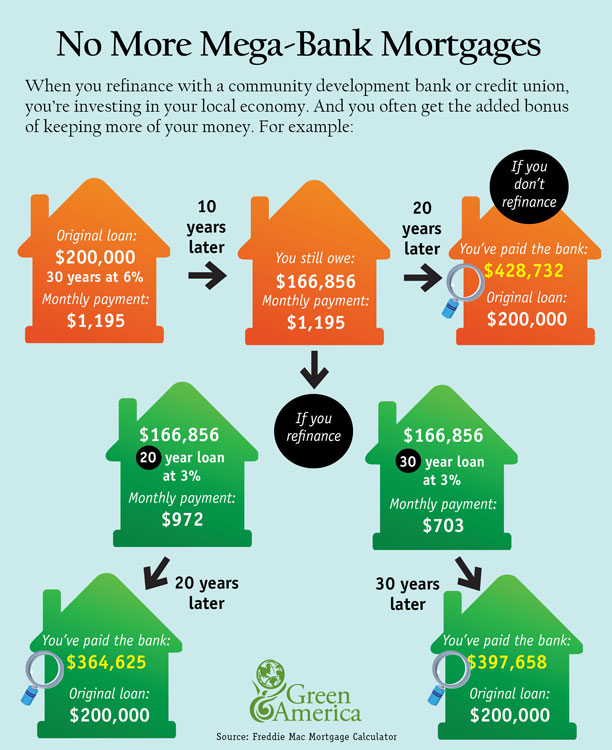
Here’s what you need to know to put your mortgage money to work for communities through a CDFI: Four Steps to a Better Mortgage
1. Find a CDFI: The best option is to find a CDFI that is working in your city, county, state, or region. Community development banks and credit unions exist in and serve areas all across the country. If you can’t find a CDFI in your region, a community bank or credit union is a good second option (see resources below).
2. Contact the CDFI: Intrigued? Call or visit your chosen CDFI to find out how to obtain or refinance a mortgage.
“We generally meet with people before they’re even ready to apply to give them a sense of what [the mortgage or refinancing process] means,” says Carol Chernikoff, chief lending officer at Alternatives Federal Credit Union.
You’ll want to discuss comparable interest rates and fees—which are the numbers that will help you decide whether a new or refinanced mortgage makes financial sense for you.
“The difference with coming to a [CDFI] in general is you will have more personal attention paid to your individual situation,” says Chernikoff. “You won’t just have numbers punched into a spreadsheet without any discussion on where the person wants to be in one years, five years, or ten years.”
During this initial discussion, be sure to ask the loan officer about whether the CDFI will keep your mortgage “in house,” as opposed to selling it to a larger—and potentially less socially responsible—company. Just because you’re banking with a CDFI doesn’t mean they won’t sell your mortgage off to another entity.
3. Fill out an application: The loan officer won’t be able to speak to your specific situation in detail until after you’ve turned in your new loan or loan refinance application. Many financial institutions allow you to apply online. You will need to provide basic information on income and assets, and give permission for them to pull your credit report.
4. Start the relationship! With your application in hand, the loan officer will be able to help you get down to the nuts and bolts of what moving your mortgage will mean for you. If you do decide to obtain a new loan or refinance with this institution, the officer may need additional information, such as an appraisal on your home in the case of a loan refinance.
Your process will depend a lot on the financial institution you work with and your financial situation. Your credit score will help determine the interest rate you can get, for example. If you’re refinancing, the appraised value of your home will show you how much your home has gained or lost in value since you took out your first mortgage, which factors into your refinance eligibility.
Regulations may vary by state, which means that there are relatively unique laws and loan options affecting you and your financial institution.
“One of the things about mortgages is that they are like snowflakes—there are never two alike,” says Prosser.
CDFIs: Willing to Stick By You
Once closing costs are taken into account, refinancing with a CDFI may or may not get you a better deal than the loan you already have. Keep in mind, however, that if you get an in-house mortgage with a CDFI, they will be much more likely to work with you should you ever have trouble making your payments, instead of jumping to foreclose as the mega-banks often do.
“When someone has trouble paying, we directly contact them—we don’t just send notices,” Chernikoff says. “We try to stay in personal communication. We have them come in and explain what the financial challenges are.”
The credit union then works with the borrower to find a mutually agreeable solution, she says.
For example, Shannon Sullivan, past Alternatives member and part of the Naval Reserve notes that she “really found out how caring Alternatives is” after she was called up to active duty after Hurricane Katrina.
“Navy pay is only a fraction of what I make as a nurse practitioner,” she writes, which caused her to panic over how she’d pay her mortgage on a reduced salary. So she called the credit union. “In 24 hours, Alternatives had arranged for me to pay interest only on smaller loans, and to forebear my mortgage until I returned from active duty… Because of Alternatives, I still have my home,” she writes.
This kind of teamwork attitude towards resolving payment issues is a far cry from the nightmare that Emily Moore’s friend has gone through in Minneapolis. Moore was able to move her own mortgage away from CitiBank in protest and chose Affinity Plus Credit Union, a local institution. “I was able to fold in a couple of other loans, and still my payment is about $100 lower than what I was paying to Citi- Mortgage,” Moore says. “I feel absolutely wonderful about having moved it.”
CitiBank sold Rose McGee’s foreclosed home to Fannie Mae, and she is still fighting to get it back. “I have been employed since January 2012 and am willing to pay,” she wrote in a letter delivered to Fannie Mae in April of 2013. “Why then would CitiMortgage and Fannie Mae choose to take my home and have it sit empty, further reducing [the] property value of the neighborhood?”
Choosing foreclosure over sincere payment negotiations is not something you would likely see a CDFI do.
The money you put into your home represents a huge investment on your part. Obtaining or refinancing a mortgage through an institution with strong ties to your community can protect that investment from predatory practices, while also strengthening your local economy. When it’s time to obtain or refinance a mortgage, consider a CDFI or green bank, instead of a mega-bank that has likely caused some of your neighbors to put up foreclosure signs. |
|
Dress Better: Buy from Certified Green Businesses |
Back to the Vote With Your Dollar Toolkit
2. BETTER: Independent, Certified Green Businesses
If you need a new clothing item, you can’t do much better than an independent green business that strives to make every aspect of its clothing sustainable, from the fields where the fibers are grown to the factories that assemble and dye the clothes to the retail or online store in which they’re sold. The following companies are just a few of the “deep green” businesses that specialize in sustainable clothing. Each is certified by Green America, meaning we screened them in all aspects of their business to ensure a commitment to social and environmental responsibility.
 A member of the Fair Trade Federation, Mehera Shaw ensures a living wage and healthy workplace for the people who print, dye, and sew its boho-chic women’s clothing. The company specializes in women’s clothing made with dazzling hand-dyed, artisan fabrics—including GOTS-certified cotton and other natural fibers. A member of the Fair Trade Federation, Mehera Shaw ensures a living wage and healthy workplace for the people who print, dye, and sew its boho-chic women’s clothing. The company specializes in women’s clothing made with dazzling hand-dyed, artisan fabrics—including GOTS-certified cotton and other natural fibers.
Circle Creations offers casual, comfy clothing, underwear, and accessories for men and women, made from hemp, organic cotton, Tencel, soy fiber, and locally milled wool. The company ensures workers throughout its supply chain aren't exploited and receive fair benefits.
Stay Vocal’s founder Alex Eaves points out that the average T-shirt requires 400 gallons of water to grow the cotton to make it. To save resources and promote reuse, the company searches out old and factory-discarded T-shirts for men, women, and children—which are then printed with clever designs and slogans touting the benefits of reuse.
Started by four former executives from major brands Ann Taylor, Lands’ End, and Macy’s, Fair Indigo sells Fair Trade, organic clothing and accessories for men, women, and children. As such, the company offers all of its employees, from Madison, WI, to Lima, Peru, a living wage, fair working conditions, and excellent benefits. Many of the items are made from ecofriendly materials.
All of the above and more can be found in the clothing/accessories category of our greenpages.org.
Find more options: Good, Better, Best.
Back to the Vote With Your Dollar Toolkit
|
|
21 Things You Didn't Know You Can Recycle |
Garbage. Americans produce more and more of it every year, when we need to be producing less. Even the most waste-conscious among us can feel overwhelmed by the amount of household waste that goes beyond what municipal recyclers and compost bins can handle. We've spent a lot of time investigating the state of waste management in our country, so we can explain how to get serious about the three R’s – reducing, reusing, and recycling — and divert more waste away from landfills. (To download the entire recycling issue of Green American, visit our archives page.)
1. Appliances: Goodwill accepts working appliances, or you can contact the Steel Recycling Institute to recycle them.
2. Batteries: Try Battery Solutions to buy a product to put batteries in to ship away. Staples also has a national battery recycling program for individuals or your office. Some Ikea stores have recycling stations for them as well.
3. Cardboard boxes: Contact local nonprofits and women’s shelters to see if they can use them. Or, offer up used cardboard boxes at your local Freecycle.org listserv or on Craigslist.org for others who may need them for moving or storage. If your workplace collects at least 100 boxes or more each month, UsedCardboardBoxes.com accepts them for resale.
4. CDs/DVDs/Game Disks: Send scratched music or computer CDs, DVDs, and PlayStation or Nintendo video game disks to CDFixers for refinishing, and they’ll work like new.
5. Clothes: Wearable clothes can go to your local Goodwill outlet or shelter. Donate wearable women’s business clothing to Dress for Success, which gives them to low-income women as they search for jobs. Offer unwearable clothes and towels to local animal boarding and shelter facilities, which often use them as pet bedding. Consider holding a clothes swap at your office, school, faith congregation or community center. Swap clothes with friends and colleagues, and save money on back-to-school clothes, Halloween costumes, or any season you want.
6. Compact fluorescent bulbs: Call your local Ikea store--many have units for recycling florescent bulbs, along with batteries and conventional recyclables. Earth911 has a great tool where you can enter your recyclable and zip code and it will give you a list of places that will accept that item.
7. Compostable bio-plastics: Compostable bioplastics include those cornstarch utensils and specially marked cups, which won't break down quickly in your home compost bin like your food scraps do. Find a Composter has a tool for finding municipal composters for these types of items.
8. Computers and electronics: E-Stewards has a tool for finding responsible recyclers for computing waste which can be toxic and hard to break down.
9. Exercise videos: If you've done the same workouts a million times, swap them with others at Video Fitness. If you're done with them forever, contact your closest e-waste station and see if they will accept them. Policies change frequently and the magnetic tape in VHS makes them particularly difficult to recycle.
10. Eyeglasses: Your local Lion’s Club or eye care chain may collect these. Lenses are reground and given to people in need. Often eye doctors' offices will collect them, or even local libraries. Glasses are most often donated as-is to someone with a similar perscription. Reading glasses and non-perscription sunglasses can often be donated as well.
11. Foam packing: Your local pack-and-ship store will likely accept foam peanuts for reuse. Or, call the Plastic Loose Fill Producers Council to find a drop-off site. For places to drop off foam blocks for recycling, contact the Alliance of Foam Packaging Recyclers.
12. Ink/toner cartridges: Recycleplace.org will pay a few cents for your old ink cartridges, up to $1 depending on the brand. If you bring your old cartridges to Staples, they will give you a $2 voucher you can use towards your new ink. Also, Best Buy accepts ink cartridges, as they have a large recycling program.
13. Oil: When the oil is being changed in your car, it can be re-refined and made into motor lubricants and other petroleum products. Earth911 has a tool to find which autoshops you can use to recycle oil in your zip code.
14. Phones: HopeLine is a program to provide cell phones to domestic violence survivors. Bring them to a Verizon or mail them in to donate. Office phones and corded phones can be recycled through Staples or another e-waste recycler.
15. Sports equipment: Resell or trade it at your local Play It Again Sports outlet or at Goodwill.
16. “Technotrash”: Staples' e-waste program will take iPods, MP3 players, cell phones and chargers, digital cameras, PDAs, palm pilots, and more. Also, easily recycle all of your CDs, jewel cases, DVDs, audio and video tapes, pagers, rechargeable and single-use batteries, PDAs, and ink/toner cartridges with GreenDisk’s Technotrash program. For $11.95, GreenDisk will send you a cardboard box (or you can use your own) in which you can ship them up to 25 pounds of any of the above. Your fee covers the box as well as shipping and recycling fees.
17. Athletic and other shoes: MORE takes donations of lightly used running shoes which are resold to fund sustainable farming programs. Soles4Souls was founded after Hurricane Katrina, which gives shoes as a measure of disaster relief and to create micro-enterprises with a low cost product.
18. Toothbrushes and razors: Buy a recycled plastic toothbrush or razor from Preserve, a brand sold in many pharmacy stores as well as online. The company makes its products out of Stonyfield Farms yogurt cups and will take back its products to be made into plastic lumber. Bins that collect these and other products with the number 5 recycling symbol are collected in Preserve's Gimme 5 bins, which are placed in 250 locations nationwide. They can also be sent in by mail.
19. Tyvek envelopes: Those tough, plasticky envelopes you get in the mail, those are Tyvek. The material is broken down and made into new plastics without consuming more oil resources. Quantities less than 25: Send to CFS Recycling, 337 A Industrial Drive, Petersburg, VA 23803. Quantities larger than 25, call 1-800/44-TYVEK.
20. Miscellaneous stuff: Get your unwanted items into the hands of people who can use them. Offer them up on your local Freecycle.org or Craigslist.org listserv.
21. Crayons: If you have broken crayons, or old mis-matched ones that are missing the box, send them to Crazy Crayons. This program collects crayons from around the country, melts them down, and sells 100% recycled crayons (in cute shapes and containers, too!). |
|
Sustainable Pet: 6 Ways to Green Your Cat or Dog |
Many pet owners will attest that having a cat or dog to cuddle can brighten your day. What they may not know is that it may also improve your health. A 2010 study from the University of Missouri School of Veterinary Medicine found that positive interactions with animals can raise levels of the hormone oxytocin, which helps encourage healing and new cell growth.
Since pets can be exposed to harmful toxins in their food, litter, and flea medicine, bringing green-living values to pet ownership may help extend the life of your beloved animal companion. Meanwhile, your pet-related purchases will also support the green economy.
If you don't have a pet yet, adopting from a shelter is the most sustainable option. If you do have one, make sure to spay or neuter it-- it helps to reduce the number of animals that end up homeless or living in shelters.
Here are Green America’s top five high-impact ways to green your dog or cat:
1. Put Your Pet on a Low-Carbon Diet
Just like a human, omnivorous cats and dogs eat food with a significant greenhouse gas footprint: namely, food with beef or lamb in it. The Environmental Working Group’s “Meat Eater’s Guide” notes that beef produces 13 times more greenhouse gases over its life cycle than vegetable proteins, and the carbon footprint of lamb is 50 percent higher.
Poultry produces four to five times as many greenhouse gases as vegetable proteins, so choose poultry-based foods for your omnivorous pet that contain no animal by-products or artificial preservatives, like the chicken and vegetable options in the Life’s Abundance and Natural Life lines of cat and dog foods.
Even better: Some companies make organic vegetarian and chicken-based pet food, which helps ensure that no synthetic pesticides have been sprayed on the food. The Honest Kitchen makes organic pet foods, and Onesta Organics sells organic raw food treats for cats and dogs. Bixbi’s Organic Superfood line of food for active and older dogs is made with turkey and free-radical-fighting “superfoods” to promote digestive, joint, or immune-system health.
Many veterinarians say that cats should not be fed a vegetarian diet; they need more protein and other nutrients found in meat than humans. However, dogs can go vegetarian, though it’s best to make the switch under the supervision of a vet to ensure proper nutrition.
V-Dog LLC offers vegan dog food. In addition to its omnivorous foods, Natural Life has a Vegetarian Formula for adult dogs. If you have the time and inclination, you can also make your own organic and vegetarian dog food. Find recipes at organicauthority.com.
2. Use re-purposed doggie bags
After diet, pet waste is where your dog or cat has the most impact on the planet. No truly responsible pet owner takes a dog out for a walk without a plastic bag for pet waste tucked in a pocket. There are a lot of pet-waste bags out there that trumpet the fact that they’re “biodegradable” or “compostable” on their packaging, but since most bags of poo are destined for the landfill, the biodegradable label doesn’t mean all that much. When buried in a landfill and cut off from oxygen, even a biodegradable or compostable bag won’t degrade aerobically and turn into compost; instead, it’ll degrade very slowly and odoriferously, with the help of anaerobic bacteria.
A better option is to repurpose the plastic bags that were used to package your clothing, food, or junk mail. Perhaps the best option, however, is to forego the bags altogether and actually compost your pet’s waste.
3. Even better, compost it
You don’t want to add dog or cat waste to the compost pile destined for your garden, because it can contain pathogens that aren’t safe on your food. However, you can set up a separate compost system for it that will reduce the volume of your pet’s waste by at least 50 percent, kill off most of the pathogens, and add nutrients to the soil, according to the US Department of Agriculture.
Canada’s Office of Urban Agriculture has step-by-step instructions for a separate pet waste composting system. It involves drilling holes in a small, lidded garbage can, burying it with the lid sticking out, and dropping pet waste inside, as well as a packet of nontoxic enzymatic septic starter (available at your local hardware store) and a liter of water every month. The site says you should only need to empty the can every two to three years.
You can safely compost an herbivorous pet’s waste in your garden compost (i.e. rabbit, hamster, guinea pig, etc.).
4. Choose better litter
Conventional cat litter—clumping and non-clumping—is made from bentonite clay, which is extracted from the Earth through environmentally damaging strip mining. In addition, clay litter contains crystalline silica, a known carcinogen according to the World Health Organization.
Clay litter is also near the end of its decomposition cycle, so if you try to compost waste with clay litter mixed in, the litter will just sit there.
The solution: natural, non-clay litters. To avoid silica dust, try World’s Best Cat Litter, which is made from 100 percent US-grown corn, or Swheat Scoop, which is made from wheat. Both corn and wheat are naturally clumping and odor-controlling.
If you’d rather not buy cat litter made from a food crop, try Feline Pine, which is made from reclaimed pine shavings and guar bean gum, or Yesterday’s News, made from recycled newspaper.
While it’s best to buy litter from a smaller green company, Arm & Hammer’s Essentials line of clumping litters may be easier to find in a pinch: the company claims it’s made from corn fibers, baking soda, and plant extracts.
5. Prevent fleas naturally
Fleas are itchy nuisances, but flea collars and conventional flea shampoos usually contain pyrethrins and organophosphates, which are suspected neurotoxicants and carcinogens.
To keep fleas at bay, tend your pet with a flea comb weekly. And use nontoxic shampoos like the organic, ayurvedic products from Dr. Desai Soap. Dr. Desai also sells a nontoxic neem oil flea and tick repellent for pets.
If you’re experiencing a full-out flea infestation in your home, head to your local home improvement store for a bag of food-grade diatomaceous earth (DE). It’s made of the skeletons of deceased diatoms, a type of algae. Don’t be troubled that food-grade DE contains amorphous silica—it’s crystalline silica (found in pool-grade DE) that has been linked to lung toxicity and cancer.
Annie Bond, author of Home Enlightenment (Rodale Books 2008), recommends doing the following:
- Though food-grade DE is safe for plants, pets, and humans, cover your mouth and nose and your pet’s to prevent uncomfortable inhalation.
- Then, rub it all over your pet’s fur, starting with the spine and working your way down. The fleas should die within 24-72 hours, though you may need to repeat every three days until they’re gone.
- Sprinkle DE across floors and carpets and surfaces. Leave it sitting for four days (best if you can leave the home), and then vacuum. Repeat if needed.
- Spread DE on lawns and outdoor surfaces to kill fleas outside, too.
6. Sustainable pets are always in style
There are numerous green products available for your everyday pet needs. Find collars and leashes made from hemp or dog and cat toys from organic fibers, organic pet beds, and even reclaimed cotton dog sweaters, from certified green businesses at GreenPages.org.
|
|
How to Start a Bike Co-op |
Perhaps you want to bike more, but you don’t actually own a bike and would rather not shell out the money for one. Bike-sharing programs are a convenient, low-cost alternative to buying a bicycle that also build community.
Bike-sharing programs are generally either bike shares or bike libraries. With bike shares, there are typically multiple kiosks of bikes throughout the city, and people rent bikes for short day-trips. In a bike library, people check out bikes for longer periods of time. At some, members can borrow bikes for as long as two weeks at a time and also have access to a repair shop.
Co-ops now serve as a collection point for used, broken, and old bikes—as well as those abandoned by college students forced to leave them behind when they can’t find a way to transport them home at the end of the school year. Members pool their bike mechanic skills to refurbish the donated bicycles, which then go into the bike-share fleet. Eric Cornwell, an avid cyclist from Athens, OH, visited Austria last summer and was inspired by a bike share program he saw in Vienna. He was already a member of the Athens Bike Co-op, a student group at Ohio University aimed at encouraging students and community members to bike more and drive less. When he came back from his summer vacation and told the co-op about Vienna’s program, and they all agreed to start a bike share of their own. (Note: since the publishing of this article, Athens Bike Co-op was renamed to UpCycle Bikes, but still serves the same purpose and is run by Cornwell)
Their initial goal for the bike share was to start with at least 25 bikes. They had just started pounding the pavement, asking local citizens and businesses for donations, when the manager of an off-campus apartment complex provided more than enough abandoned bikes to start the program. Cornwell estimated that it took eight hours and about $25 to $30 to refurbish each bike. Some local businesses helped by donating their services, such as Athens Paint and Decorating donating sheets of coroplast, which Cornwell used to make the bikes’ baskets.
Some bike-sharing programs are solely based on trust and don’t require a fee for bike rental—a fleet of specially marked bikes are simply parked around a city for people to use at will. However, to prevent bike vandalism or theft, many have introduced a mechanism—such as a fee, deposit, or electronic kiosk that can track the bike sharer’s credit card—to regulate bike use. Some bike shares customize the design of the bike fleet with unique wheels or frames that aren’t compatible with any other type of bike, making them useless to thieves looking for parts.
The Athens bike share’s yellow bikes are chained to various bike racks around Ohio University’s campus, all with uniform locks. For a $10 membership fee, bicyclists get a key that unlocks any of the bikes. The bike share currently has about 20 to 25 members on and off campus (including the city’s mayor), who can unlock any yellow bike they see, ride it to their destination, and then lock it to the nearest bike rack for another member to use.
Cornwell says that the program was fairly simple to launch. “There’s no requirement that you have to have some special instruction to do this. People can pretty much figure it out for themselves,” he says. “It basically takes the will to want to do something like that, and the rest follows.”
In the year that it’s been operating, the Athens bike share still has all of its original bikes in working order, and the co-op continues to gain a lot of positive buzz. “People I don’t even know will tell me what a great thing it is, and what a valuable resource it is for the community,” says Cornwell. |
|
Cook One Meal, Eat for a Week |
When the Betz-Essinger family sits down for dinner in Birmingham, AL, it doesn’t take the children long to identify the provenance of their meal. “Is this a Caroline?” they ask, “or a Leigh Fran?”
Caroline and Leigh Fran are not brands of frozen dinners—they are the two friends with whom Ruthann Betz-Essinger has shared the preparation of weeknight meals for more than a decade. Ruthann’s children “know how each of us cooks,” she laughs.
Through an arrangement known as “cooperative cooking,” the friends each prepare a single, large meal that will feed all three families, and package it up. One share goes into their own refrigerators, and on Sundays, the women meet at Betz-Essinger’s house to give each other the other two shares. So in exchange for cooking one meal, each family gets three meals—which, with leftovers, is often enough to provide dinner for every weeknight.
“When you get your sack, it’s got everything in it, with directions about what to do, and how long it will take to cook or reheat,” says Betz-Essinger.
On busy weeknights, when Betz-Essinger gets home from work, she and her children open the refrigerator to find a “Caroline” or “Leigh Fran” meal already assembled. “It’s like eating at a restaurant every night,” says Betz-Essinger, “only you take whatever the chef is making.”
From college campuses to apartment buildings, and from suburban neighborhoods to cohousing communities, many busy people have found that cooking cooperatively, especially for the after-work dinners on weeknights, can save time and money, and deepen connections with family and community—all while supporting healthy, green food choices. Though cooking co-op arrangements vary, they all take advantage of the fact that cooking one meal for a crowd, once a week, requires less money, less planning, and less time than cooking five to seven different meals for one’s own family.
In the process, cooking co-ops also ensure food variety; minimize the temptation to go out to eat or purchase expensive, highly processed convenience or fast foods; share food traditions among members; and inspire participants to try out special recipes. And co-op cooking can free up some room in your food budget to shift to greener food choices.
How It Works
Cooking co-ops across the country have established a range of systems for sharing
the cooking of family meals.
A potluck group may ask participants to contribute a component of the meal each time, and then eat together on a specific day of every week or month.
A meal group may rotate the preparation of a meal among the participants, and gather regularly at the host’s home to eat together.
The residents of the Eastern Village Cohousing community in Silver Spring, MD, do both. They begin the week with a standing Monday evening potluck, which anyone can join by bringing a dish to share. And they close out the weekend with a rotating Sunday meal group, in which each participant takes about two turns every three months to make dinner for 12 others.
As with Ruthann Betz-Essinger’s group, the members of a “pick-up” cooking co-op share cooking responsibilities but do the eating at home, with their own families.
In Bakersfield, CA, Jan Limiero organizes ten friends once a month to each prepare one recipe, for ten families, that will freeze well; each family takes home a freezer’s worth of different meals ready to reheat and serve. In Occidental, CA, six families stop by a member’s home from 6–7 p.m. on Mondays and Wednesdays to pick up a meal that one member has prepared for the others, according to the Sonoma County Independent. In Berkeley, CA, Laila Ibrahim is one of six adults in three neighboring households who have each rotated cooking, six nights a week, for more than seven years. The family that cooks delivers a meal to each of the others by 6 p.m.
All three types of cooking co-ops have a wide range of policies about what participants make for dinner. Betz-Essinger’s group in Alabama, self-identified “foodies,” endeavor to rotate entrees every week, and to never repeat a recipe. The Berkeley co-op is free to cook anything, but always in a way that accommodates vegetarian families. The Bobolink co-op in Rutledge, MO, eats organic, local, and vegan. And most of the student-organized dining co-ops at Oberlin College come to consensus at the start of each semester about the sourcing of the food they will cook for each other.
Benefits of Cooking Cooperatively
Co-op cooking saves time and money at every step: When planning and shopping, purchasing for a single meal in quantity is less complicated than purchasing for a week of different meals. It saves time in the evenings, when families don’t have to cook after work and can instead spend more time talking to and enjoying each other. And it saves clean-up time, since the kitchen only gets really messy on the night when the meal is cooked there.
Co-op cooking also saves money. On the Oberlin campus, students save $4,000 a year by cooking cooperatively rather than eating in the dining halls. Ruthann Betz Essinger estimates that she saves 25 percent at the supermarket compared to cooking all of her family’s meals herself. And Amy Seiden at Bobolink, a food co-op at Dancing Rabbit Ecovillage in Missouri, says the members manage to eat a delicious lunch and dinner for just $6 per person per day. In addition to purchasing fewer ingredients, families in cooking co-ops can save money by purchasing food on sale or in bulk for the one meal they plan to make in quantity.
By rotating the planning of meals among a large group of households, each with their own favorites recipes and food traditions, cooking co-ops also enjoy a much greater variety of food than isolated families cooking for themselves.
“We can’t get into a rut, because we don’t eat the same thing over and over again,” says Betz Essinger. “It was an amazing thing for our children. They were exposed to a huge variety of food that if I had been the only one cooking for them, they would never have tried.”
Cooking co-ops help families save money and eat more healthfully in other ways: They eat fewer meals out, including fast food. Consequently, they’ll save energy and resources, and reduce waste—no styrofoam take-out containers and foil wrappings, fewer car trips, and more room in their dinner menus for local, organic food.
Co-op cooking builds community. Becca Rosen says her responsibilities as a student member of the Oberlin cooking co-ops built connections with more than just her meals: “I built my social life around food,” she says. “I made my closest friends at Oberlin because we ended up cooking together.”
Co-ops that dine together build connections over shared meals and lively group conversation, and celebrate diverse family food traditions through the dishes they serve to each other. Even a “pick-up” co-op builds long-term connections when neighbors pick up or drop off meals, often exchanging friendly greetings and checking in on each other in the process. All forms of cooperative cooking mean less time that each person spends cooking and cleaning up, and more time spent talking, laughing, and connecting over food with family and friends.
Making It Easier to Cook Green
One of the best perks of co-op cooking is that the money you’ll save can make it easier to afford to green your food choices.
“Cooking co-ops are a perfect example of the ways that greening a whole category of our purchasing can work,” says Alisa Gravitz, Green America’s executive director. “An organic, local apple may cost more than a conventionally grown apple, and Fair Trade Certified™ vanilla may still cost a little bit more than conventional vanilla. But if you cook cooperatively, then the savings on your food budget from buying in bulk can make it possible to green your remaining food purchases. By thinking about the whole category of food holistically, you can eat greener, healthier, more varied meals—at the same cost as your old way of eating.” (See below for a sampling of Green America’s resources for eating green.)
Some cooking co-ops, like the Bobolink and Oberlin co-ops, establish green guidelines about preparing local and organic foods, or emphasizing vegetarian and vegan menus. Co-op cooking lends itself to making use of the bounty of seasonal vegetables or fruits that a farmers’ market or Community Supported Agriculture (CSA) box can offer. Making a large meal for a co-op crowd can help singles or small families put a box of CSA produce to good use before the next share arrives.
Tips for Forming a Cooking Co-op
What would families who have cooked cooperatively for years recommend to those considering forming their own cooking co-ops?
- Pick families who make it very easy to get the food to them, either through a common drop-off/pick up point, or by forming a co-op with neighbors or coworkers. Set up delivery times that fit with everyone’s schedule.
- Find people whose families are similar sizes, because it makes portioning easier.
- Find people with similar food tastes and practices.
- Establish clear guidelines for what the group expects each member to make when it’s his/her turn. A planning calendar can help to ensure a variety of foods.
- Find people who are prepared to accept and eat whatever is served, but are also willing to share honest feedback. “We might send a note with a meal we’ve made, saying, ‘This is hideous. I won’t ever make it again,’” laughs Betz-Essinger. “And sometimes I’ll get calls that say, ‘That wasn’t so bad.’ But sometimes they’ll call and say, ‘You’re right. Don’t ever make that again.’”
- Package foods in containers that can be both frozen, reheated, and then reused, such as Pyrex baking dishes. Secondhand stores such as Goodwill can be an inexpensive way to acquire additional containers. If you’d like to eat well, save time and money, and build community in the process, consider forming a cooking co-op.
“I love the co-op,” says Laila Ibrahim in Berkeley, whose family recently enjoyed a tasty pasta with onions, capers, and salmon delivered to their door, along with bread and a salad. “It makes our lives so much better. Cooking a nice meal once a week is just perfect.”
|
|
Caring for Children and Elders, Cooperatively |
For Susan Gunn, it all started with a haircut. New to her home in Washington, DC, with a young daughter, a working husband, and no extended family nearby, Gunn found scheduling her much-needed trim to be a logistical nightmare.
“I just couldn’t find the time to get away go to the salon,” recalls Gunn. “We were young and on a budget, and hiring a babysitter was out of the question.”
At the same time, the Gunns were seeking out friends in a similar stage of life, with whom, as Susan Gunn puts it, “we could share in the ups and downs of everyday parenting.”
Some online research introduced Gunn to babysitting cooperatives—an arrangement between several families where parents exchange babysitting responsibilities for each others’ children, giving everyone the break they need with no money passing hands.
“What a great concept!” Gunn thought at the time, “I could get a haircut, my child could play with other kids, and we might make friends with other parents.”
So Gunn circulated a proposal at local playgrounds, eventually organizing a planning meeting at her home. Now, nine years later, the Meridian Hill Coop is still thriving, providing members not only with free child care, but with friends and a sense of community.
Care cooperatives are becoming increasingly popular—and they don’t have to focus on child care. You can set up a similar arrangement to watch over elderly parents, adults with disabilities, or pets. Consider starting a care cooperative of your own to build community and resiliency while saving money.
Getting Started
Most successful care co-ops involve a written agreement, a point system for earning and spending care hours, and community building within the co-op to encourage communication and fun.
First, gather families together. Think about the size of the cooperative you want to form. Too few members will mean not having enough people able to help, but too many could mean losing the community feeling of a care cooperative. Many care co-ops have found the “sweet spot” at 12-20 families.
Then, take the time to talk about, and write down, your expectations.
“Setting clear expectations is key to any sharing arrangement,” says attorney Janelle Orsi, coauthor of The Sharing Solution (Nolo, 2009), which guides people through sharing everything from child care to a car or a house. “A common problem in sharing arrangements is thatpeople disappoint each other.”
Orsi’s book contains a list of 20 questions to ask in any sharing arrangement, such as: How will we make decisions? How will we divide expenses and manage money? How will we bring new people into the group?
Orsi also recommends covering other ground particularly relevant to sharing care, such as: Are there ground rules about what kids eat/drink while being babysat? How are disciplinary matters with children approached? What are the ground rules for watching TV/ movies? How will medication be handled for children or adults? Do you want to exchange care for elderly parents, or share a hired caregiver?
And don’t forget to talk to the people receiving care as well, whether its your child or an elderly parent or friend, to ensure their comfort in any arrangement.
There are also stickier questions, says Orsi, like what to do if there is a conflict between families. Orsi recommends having good conflict-resolution procedures in place, perhaps even taking the time to get trained in nonviolent communication. The Center for Nonviolent Communication has primers on resolving conflicts peacefully and a schedule for formal, local trainings at cnvc.org.
Establish a Record-Keeping System
In any care co-op, you need some way to keep track the hours people are earning and spending. Gunn’s babysitting co-op uses a point system. Each new family starts with 20 points. One hour of babysitting is worth four points. A sitter earns two extra points for each additional child and two extra points for coming to the family’s home.
In some cases, families dole out tickets, tokens, or even popsicle sticks to signify how much “capital” they have to use in the co-op, but it’s also easy to keep track of points electronically.
You can record points in an online spreadsheet like Google Documents, which allows many people to view files. Several online systems also exist to help coordinate a care co-op of all kinds, including BabysitterExchange.com and BabysittingCoop.com.
Orsi says it’s a good idea to appoint an administrator to help keep the books, and your co-op may need some other organizational roles as well. Gunn’s co-op has a secretary to track points, a chair to manage applications from new families, and a social secretary to plan monthly get togethers for members. These roles can rotate every few months, or come with the perk of earning extra points to entice people to hold onto them.
Get it in Writing
Once you’ve established your ground rules and procedures, put it all in writing for members of the co-op to sign.
“We aren’t necessariliy talking about a legally binding contract,” says Orsi, “but a written agreement that ensures everyone is on the same page.”
You can also use this agreement to create an application process for new families who want to join the co-op. Orsi’s book contains a sample agreement, and many are also available online at the Web sites mentioned above.
Start Caring
Let the caring and sharing begin! The way members request care will vary depending on how you set up the co-op, but the basics are the same. When you need caregiving, you send out a message stating your needs (some groups use an e-mail listserv, like Yahoo Groups or Google Groups; others use online services that manage communication), and other parents respond if they can take the job. You’ll also receive requests from other parents—and you’ll earn points when you babysit their kids. Or if the care you need help with occurs regularly, like checking in on an elderly parent or dropping off meals to a home-bound friend, members of the co-op can use an online calendar to schedule care.
Build Community
Establishing good lines of communication is essential for a successful co-op. That’s why it’s a good idea to schedule regular get-togethers, like a monthly potluck meal, where co-op members can talk about any issues that may have come up. And getting together regularly doesn’t just let the co-op get its business done—it helps build a community of support and friendship. While Susan Gunn has valued the time and money saved through participation in the Meridian Hill Co-op for almost a decade, it’s the close community that she values most.
“Our children have great friendship with kids in the neighborhood and feel close to lots of adults,” says Gunn.
“There’s a closeness that comes when you share in caring for each other’s children that feels really wonderful.” |
|
7 DIY Cooperatives at Home |
You don’t have to belong to a worker-owned co-op to get the benefits. Cooperative models can also help you lower costs and build community at home. Here are our seven favorite ways to save money with cooperatives at home:
Share goods
Items you don’t use every day make great things to buy together and share with your neighbors, to save money and reduce clutter. Consider sharing things like: tools, vacuum cleaners, small cooking appliances like juicers or yogurt makers, yard tools like lawnmowers or snow and leaf blowers, video cameras, camping gear, large sports equipment like kayaks, extra tables and chairs, and more. Each neighbor could contribute an item, or you can pay for them together. Keep them in a shared shed or location to which everyone has access. For practical and legal advice on starting up informal sharing groups, read Janelle Orsi and Emily Doskow’s book The Sharing Solution (Nolo, 2009).
Share child, pet, or elder care
Many groups across the country have banded together to swap care hours. Most track hours on a shared spreadsheet, like those available at babysitterexchange.com and babysittingcoop.com—so if you spend two hours caring for someone’s toddler, for example, you can get two hours of babysitting for your ten year-old in return from someone else in the co-op. Find out more in our article,“Caring for Children and Elders, Cooperatively.”
Share a car
Live in a city where you don’t need a car every day? Car-sharing programs across the country provide access to a fleet of cars when you need them, for much less money than you’d have to spend buying and maintaining your own car. Find a car-sharing network near you via carsharing.net, or see if you live in one of the 50+ cities or 250 college campuses across the US that has a Zipcar.com car-sharing program. Prefer to keep your car but share rides on occasion? Our article “Carpool for the Climate and Community” has valuable tips for you. Or, get advice to start a bike share here.
Share food
Meal cooperatives help busy people eat healthy, home-cooked food more often with less time required in the kitchen. Participants either agree to bring an item for a regular potluck, or take turns cooking meals for each other—usually on a weekly basis, with coworkers in the office or with neighbors at home. Meals can either be shared together, for an added sense of community, or dropped off, for a low maintenance sharing of labor. For more details, see our article, “Cook One Meal, Eat for a Week.”
Share solar power
Solar buying co-ops are popping up across the US as people join together to share in the pre-purchase research and to negotiate lower group rates for solar panels. Several report shaving from 50 to 80 percent off the cost of their solar home systems. Consult our article, “Solar Buying Co-ops,” to learn more.
Share tools and home repair
Need to do some repairs or energy-efficiency retrofits on your home? Chances are your neighbors do, too, but are balking for the same reason you are: the costs. So pool your home repair knowledge while saving lots of money as you fix up each other’s houses. Find out more in our article, “Neighborhood Home Repair Teams.”
Save money at your local co-op
The stories of cooperatives here focus on models that are transforming local economies in significant ways. But co-ops can transform the contents of your pocketbook, too, by helping you save money on green necessities.
Many food co-ops offer a program where members can volunteer a couple hours a week in exchange for a discount on organic food and body care items. At People’s Food Co-op in Portland, Oregon, for example, member-owners can opt to work in the store in exchange for an up-to 15 percent discount on their purchases. Since the co-op’s mission is to provide good food to its members at the lowest cost, its prices are already lower than what consumers would see in the organic section of a chain grocery store.
If you don’t have a food co-op nearby, save money by gathering five friends and form a buying club with Frontier Natural Products Co-op. Frontier provides everything from organic foods and body care items to Fair Trade herbs and essential oils. The worker-owners of this national co-op have committed to prioritizing “purity and quality, environmental responsibility, and respect for the people involved in growing the products,” says CEO Tony Bedard.
Buying clubs enjoy wholesale prices (35 to 50 percent off) when shopping by paper catalog or online, and they save shipping costs and reduce related climate emissions, too. |
|
Why Bottled Water Isn’t Better |
First time here? Check out the most recent and updated version of this article: Bottled Water VS. Tap.
It seems like the demand for bottled water in the US will never run dry. In 2015, the equivalent of 88.4 billion bottles of water were sold in the US (equivalent because of different-sized bottles). When we first published with story, we reported 2005's record-high use of 29.8 billion bottles in a year vs. 3.8 billion in 1997. Container Recycling Institute (CRI). That enormous rise in bottled water consumption wasn’t just more expensive for consumers—the Container Recycling Institute says those consumers pay 240 to 10,000 times more for bottled water than tap. That water also comes with hefty social and environmental costs.
Here’s why bottled water isn’t worth the price many pay for it
No safer: A four-year study conducted by the nonprofit National Resources Defense Council (NRDC) in 1999 found that “bottled water regulations are inadequate to assure consumers of either purity or safety.” Bottled water is regulated by the Food and Drug Administration (FDA), while the Environmental Protection Agency (EPA) oversees tap water standards. FDA testing for bottled water is more lax than EPA testing for public water—tests are conducted less often, and for fewer contaminants. For example, the FDA does not mandate testing of bottled water for cryptosporidium, a parasite that poses a serious health threat to those with weakened immune systems and the elderly. Tap water is regularly tested for cryptosporidium. The NRDC study authors also tested 1,000 bottled water samples from 103 brands, and found that one-third contained contaminants that exceeded FDA-mandated levels.
Not always from a pristine source: The NRDC found that one-fourth of bottled water is actually just tap water, with or without extra filtration (labeled “from a municipal source.”) FDA rules allow bottlers to label their water “spring water,” even though it may be treated with chemicals or mechanically pumped to the surface. And there’s no guarantee that the spring itself is a pure one: One brand of spring water traced to its source by the NRDC came from a spring that bubbled up into an industrial parking lot, adjacent to a hazardous waste site.
Worse for the environment: The production and transport of bottled water unnecessarily uses large amounts of fossil fuels. (Fiji-brand water, for example, is transported to the US from Fiji, over 6,000 miles away.) And the plastic water bottles Americans use and toss in one year use up more than 47 million gallons of oil, the equivalent of taking 100,000 cars off the road and removing 1 billion pounds of carbon dioxide from the atmosphere, says the CRI. Sadly, about 84 percent of those bottles aren’t even recycled.
Bad for human rights: Today, more than one billion people do not have access to safe drinking water. Bottled water corporations are exacerbating the world water crisis by privatizing aquifers around the world and pumping them dry. For example, Nestlé has been criticized by activists for heavy water extraction in areas of Pakistan that suffer from severe public water shortages. For more on how specific bottled water companies affect communities—and how to join consumer campaigns fighting this practice—visit ourResponsibleShopper.org database.
|
|
The Facts About Water Filters |
First time here? Check out the most recent and updated version of this article: Bottled Water VS. Tap.
Beverage companies have made a fortune on marketing bottled water on the premise that it’s “pure,” from “pristine, natural sources,” and thereby safer than tap water. Bottled water marketing campaigns have been so successful in making people suspicious of their tap water, that sales skyrocketed 700% between 1997 and 2005. And from 1999 to 2017, per capita bottled water consumption ballooned from 16.2 gallons to 42.1 gallons.
Skyrocketing as well—the environmental degradation, landfill waste, and human rights abuses associated with bottled water. Plus, studies have shown that it’s no safer than tap water. The EPA notes that bottled water, like any water, can be expected to have some contaminants, although that does not make it unsafe.
There’s a much better option for ensuring that the water you and your family drink is as safe as it can be: water filters. Putting a safe water filter in your home is less expensive and far less environmentally damaging than bottled water. And if you choose the right filter, you can minimize or eliminate the contaminants of the highest concern in your area. Here’s what you need to know:
How Safe Is Public Water?
Under the Safe Water Drinking Act, the US Environmental Protection Agency (EPA) is responsible for setting national drinking water standards. The EPA regulates over 80 contaminants—including arsenic, e-coli, cryptosporidia, chlorine, and lead—that may be found in drinking water from public water systems. While the EPA says that 90% of US public water systems meet its standards, you may want to use a water filter to further ensure your water’s safety.
A 2015 study by the nonprofit Natural Resources Defense Council (NRDC) found that due to a combination of pollution and deteriorating equipment and pipes, the public water supplies for 18 million Americans have lead violations or other EPA-restricted contaminants (either legal limits or unenforceable suggested limits) and may pose health risks to some residents. So even though it may test fine at its source, public water may still pick up contaminants on the way to your house.
Contaminants that snuck into city water supplies studied by the NRDC include rocket fuel, arsenic, lead, fecal waste, and chemical by-products created during water treatment.
“Exposure to the contaminants [sometimes found in public and private drinking water] can cause a number of health problems, ranging from nausea and stomach pain to developmental problems and cancer,” notes Physicians for Social Responsibility (PSR) in its booklet, Drinking Water: What Health Care Providers Should Know.
PSR estimates that up to 900,000 people get sick and 900 die in the US per year from contaminated public and private drinking water. Despite the problems with public water, it’s still just as safe as bottled water, despite the billions of dollars beverage companies spend to make you think bottled is better.
Step One: Assess Your Tap Water
There isn’t a one-type-fits-all kind of safe water filter: not every filter type will eliminate every contaminant. You’ll save money and ensure that you’re targeting the contaminants of concern in your area by doing a little research upfront.
“Most people purchase the wrong equipment because they skip this very important step, and then they’ve wasted money and resources on a system that isn’t making their water any safer,” says James P. McMahon, owner of Sweetwater, LLC, which provides consulting and products for people wanting to purify their air or water.
To start, check your water utility’s “Consumer Confidence Report,” which it must mail to you each year before July 1 by law. The report details where your drinking water comes from, what contaminants have been found in it, and how contaminant levels compare to national standards. You can also call your utility and ask for a copy, or see if it’s online.
While your report can tell you what’s going on with the water in your area, only a test of the water coming out of your tap will tell you what you and your family are drinking for sure.
If your water comes from a private well, it’s not regulated at all by the EPA, so you should have your water tested annually in late spring (when pesticide runoff will be at its worst), and anytime you notice a change in the color or taste of your water.
Step Two: Find the Best Water Filter
Water filters come in a dizzying variety, from plastic pitcher filters and built-in refrigerator filters, to faucet and under-the-sink filters, to whole-house models that combine a variety of media types and treat all of the water in your house. What type you want depends on your needs.
If, after examining your Consumer Confidence Report (or, preferably, your current and several past reports), you find that your water regularly tests better than EPA levels, you may just want a filter that can remove the chemicals your local utility uses to treat the water.
These chemicals may or may not show up on your report. Call and ask your utility if it uses chlorine, which can cause neorological and respiratory harm, or chloramine, which can be harmful to circulatory and respiratory systems. Chlorine combines with organic elements during the water treatment process to produce carcinogenic byproducts.
The best type of filter to remove chlorine and its byproducts is a combination carbon/KDF adsorption filter (which is a different chemical process than absorption), which range from shower and faucet filters to sink and whole-house filters, like those from Sweetwater. A regular carbon filter won’t remove chloramine, so look for a catalytic carbon filter instead.
If you only have one or two contaminants, a smaller unit, such as a countertop or under-the-sink filter, may meet your needs. To find a filter certified to remove the contaminants you’re most concerned about, visit the NSF’s online database.
Finally, if you find your water has serious safety issues, consider a multi-stage filter that can tackle a variety of contaminants. Many combine a variety of filter types. Sweetwater sells multi-stage whole-house or sink filters, for example, that combine KDF and carbon adsorption with ultraviolet light, among other steps—and it also sells customized filters.
Step Three: Look at the Labels on Water Filters
Some experts recommend looking for a water filter certified by NSF International, a nonprofit organization that conducts safety testing for the food and water industries. NSF tests and certifies water filters to ensure that they both meet NSF safety standards and are effective at removing contaminants as claimed by the manufacturer. Underwriters Laboratories and the Water Quality Association also offer similar certification, based on NSF standards.
NSF has different certifications, so when you read the label, first make sure it says the filter will remove the contaminants you’re most concerned about. A filter certified by NSF to remove chlorine isn’t going to be helpful if you need it to remove nitrates. Then, look for the NSF seal, Underwriters Laboratories’ “UL Water Quality” mark, or the Water Quality Association Gold Seal for added assurance that your filter will actually do what the box claims.
Safe Water for the Future
Filters aren’t perfect—they can be expensive and energy intensive, and the filter cartridges are nearly impossible to recycle. But when you compare throwing away a couple cartridges to the billions of water bottles we toss each year, filters are a preferable option. When it comes to ensuring better water for the future, here are the most important steps:
First, we need to stop drinking bottled water. It’s not any safer than tap, and it wastes a mind-boggling number of resources.
Then, we need to ask companies to take back and recycle their cartridges. Besides using up resources, filter cartridges trap and hold contaminants. If the cartridges are not disposed of in a sealed landfill, those contaminants could end up right back in the environment.
Brita—which sells a popular carbon adsorption pitcher filter, faucet-mounted filters, and cartridges for refrigerator filters does accept recycling shipments of Brita products. If you buy from another manufacturer, research whether their products can be recycled or email them and say you would like them to implement a recycling program.
Finally, US water treatment and distribution systems date back several decades, and they need repairs and upgrades to make water safer for for human and environmental health. While the EPA won’t attach a dollar amount, Dale Kemery, a former EPA spokesman, says more money is needed to make these upgrades. Food and Water Watch is demanding that Congress increase funding to secure our public water system.
That said, public utilities will be using treatment chemicals well into the future, and our systems may never be perfect. Take responsibility for your family’s health by carefully considering whether you need to take additional steps to make your water the healthiest it can be.
FEATURE ARTICLE - JULY/AUGUST 2007 (Updated 2023)
To find more screened green companies offering water filters, search "water purification" in the National Green Pages™.
|
|
Are Your Candles Toxic? |
One of the simplest pleasures in life is coming home from a stressful day of work and lighting an aromatherapy candle with a special scent intended to make you feel calm and relaxed. Unfortunately, that seemingly harmless candle could be filling the air in your home with harmful pollution and supporting the fossil fuels industry.
Alternatives to toxic aromatherapy candles abound. For example, beeswax candles and soy candles are safer, greener options. With very little effort, you can fill your home with soothing scents without filling it with toxic gases.
Is Something Wrong with My Candles?
The biggest issues with candles are petroleum-based wax and air pollution.
Burning Oil, Now Inside Your Home
Avoid aromatherapy candles made of paraffin or gel, both petroleum byproducts. In all things, avoiding the fossil fuel industry when you can makes sense for living a green life. Just like if you don’t have to drive a car to get to your destination, don’t; if you don’t have to burn a petroleum-based candle, don’t.
Vegetable-based waxes are becoming more and more common and are a great substitute for paraffin or gel wax. Because being greener is a selling point for many customers, it will usually be labeled—soy, vegetable, coconut are common labels you’ll see. Beeswax candles are also natural and renewable, and often smell great even without added scents. If the label says blend without noting what has been blended, or is unlabeled as to what type of wax, skip it, as it’s likely paraffin. Plant-based waxes burn at a lower temperature, meaning they will last longer and come from renewable sources.
Polluting Indoor Air
One often-cited 2014 study concluded that “under normal conditions of use, scented candles do not pose known health risks to the consumer,” and even that carcinogenic chemicals that were released by burning the candles, including benzene and formaldehyde, were still less than half the recommended limits set by the World Health Organization. That study was peer-reviewed, but it was carried out by scientists who had affiliations with candle manufacturers, including SCI Johnson & Son, and Procter & Gamble.
A 2015 study by university-affiliated researchers in South Korea found that scented candles release volatile organic compounds (VOCs) both before being lit and while lit, concluding that scented candles “should act as potent sources of VOC emission in indoor environments.”
Exposure to VOCs can cause headaches or irritation to eyes, nose or throat, nausea, and even damage to the liver, kidneys, or central nervous system. Some VOCs are suspected or proven carcinogens. That means if you do choose to light candles in your home, be sure to vent the space after with a fan and/or open window, as you would for other VOC-emitting items, like a freshly painted room or gas stove.
Besides endangering your health, soot from candles can cause damage to your walls, appliances, ductwork and even your personal “ductwork.” Soot can look like a black film around the top of the jar, on your walls, or even inside your nose if you have the candle lit too long and fall asleep, for example.
Experts recommend trimming the wick of your candle to 1/8 or ¼ inch before every use, not using petroleum-based candles (which create more soot than natural wax candles), and not burning the candle for longer than recommended on the label—usually 3 hours.
Do Scents Make Sense?
Many people are sensitive to synthetic scents—if that’s you, either skip candles altogether or go with unscented or naturally good-smelling, like beeswax, candles.
In the New York Times, odor perception and irritation researcher Dr. Pamela Dalton says that human noses are more sensitive than we might think, and candles use concentration levels of fragrance chemicals in the equivalent ratio of a teaspoon of chemicals for an Olympic-sized swimming pool.
What About the Wick?
Once upon a time, many scented candles on the market contained lead-core wicks. Fragrance oils soften the wax, so the manufacturers used lead to make the wicks stand firm. A candle with a lead-core wick releases five times the amount of lead considered hazardous for children and exceeds EPA pollution standards for outdoor air, says the Consumer Product Safety Commission (CPSC). Exposure to high amounts of lead has been linked to hormone disruption, behavioral problems, learning disabilities, and numerous health problems.
Lead wicks were banned by the US Consumer Product Safety Commission in 2003, but by 1974, the National Candle Association members had all voluntarily agreed to stop using lead wicks, including major brands like Yankee Candle.
If you do have a candle from before 2003 in your home, you can still test for a lead wick by rubbing the tip of the wick of an un-burnt candle on a piece of paper. If it leaves a gray mark, like a pencil, the wick contains a lead core. If you have already burned a candle you suspect might have a lead wick, toss it out.
Find safe candles from certified green businesses at our GreenPages.org.
Candle-Free Aromatherapy
If you can’t find the right nontoxic aromatherapy candle to get rid of tension headaches or rejuvenate your tired body, you may want to try using pure essential oils. Pure, organic oils can give you the same aromatherapy benefits as scented candles, and you can choose and blend your own scents.
Essential oils are derived from plants and have been used for hundreds of years. That does not mean they are completely safe—some can be poisonous when absorbed through the skin or if aspirated.
Many people love using essential oils in their homes for the scents they provide. They should be stored away from children and pets and used with caution around those family members and by pregnant people.
Be sure to consult a reliable website, reference book, or qualified aromatherapist when bringing essential oils into your home. Once you’ve chosen your favorite oils blends, there are a few ways to release the scents in your home:
- Use a diffuser. These are simple containers—most often made of glass, marble, or ceramic—which release the scent from essential oils when heated either with electricity or a small tea light candle. Usually, six to ten drops of essential oil in a diffuser is all it takes to scent a room.
- Use a ring burner. These metal rings have a reservoir that holds a few drops of essential oil and will fit around a lightbulb, using the heat to disperse the oil’s scent.
- Take a bath. Add five to ten drops of essential oils to a warm bath. Close the bathroom door and soak for 15 minutes. Remember, essential oils can mark plastic bathtubs, so be sure to clean the tub when you’re finished.
- Make a spray. Blend ten drops of essential oil in seven tablespoons of water. Shake well before filling the sprayer.
Whether you choose to go candle-free or opt for a nontoxic candle like 100% beeswax candles, you can relax knowing that these healthier alternatives will be easier on your lungs and the air in your home.
In summary, to safely use scents at home:
- Skip oil-based paraffin and gel waxes and burn plant-based and beeswax candles only
- Trim the wick to 1/8 or ¼ inch before every use
- Don’t burn the candle longer than recommended
- Diffuse essential oils at home for aromatherapy without the air pollution
- Read up on essential oils’ safe use before bringing them home
Along with helping you live green, for over 40 years, Green America has been working for safe food, a healthy climate, fair labor, responsible finance, and social justice.
|
|
Global Sugar Workers |
My colleagues Martha van Gelder and Tracy Fernandez Rysavy have been sharing their experience with kicking the sugar habit on this blog for the past week or so.
We’ve all been delving deeply into sugar issues recently, working to prepare “Sickeningly Sweet,” the latest issue of our Green American magazine, all about the American sugar habit, and its effects on our bodies and our health.
For my part, I confess to being a little stunned at the amount of sugar Americans consume per capita, partially because I don’t tend to consume that much sugar myself. I don’t keep any sugar-boosted foods in my house — no soda pop, no sugary breakfast cereals, no sweet treats like boxed cookies or or ice cream, and no processed snacks with hidden sugars. I don’t even put sugar in my coffee, and if a recipe calls for a bit of sweetness, I’m likely to either leave the sugar out, or replace with a few drops of organic honey, maple syrup, or molasses.
All that being said: I do have sugar in my house. I share an apartment with two other housemates, one of whom loves to bake. Among the staple foods lining the shelves of our kitchen, we’ve got a big metal can full of sugar. And while there are many staples that rarely cross our threshold unless they’re Fair Trade certified — coffee, rice, and olive oil come to mind — I’d never made a Fair Trade commitment for the sugar in my house until I researched the sugar supply chain for the Green American.
While much of the sugar consumed in the US was grown here, much of THAT sugar is controlled by Monsanto, and its patented genetically modified herbicide-resistant sugar beet. I don’t really want that kind of sugar in my home. Plus, sugar production worldwide can be tainted with various environmental and social ills, from the destruction of the Everglades in Florida, to labor-rights abuses in the Caribbean, Latin America, Africa, and Asia.
Looks like I’m going to need to add another Fair Trade choice to my household’s shopping list.
And while Fair Trade sugar can cost a little bit more than a conventional bag of cheap sugar from the supermarket, you know that the extra premium embedded in the price of that sugar is going to provide a decent living for farmers, environmental protections for their communities, and a better life for the children of farming families. Plus, if you’re trying to cut down on sugar for your health, paying true-cost for a bag of sugar can be a blessing. You could spend no more per month on sugar than before, but resolve to purchase only fairly traded, organic, GMO-free sugar. Your budget will go untouched, you’ll bring somewhat less sugar into your house to start with, and your spending will benefit people and the planet.
Here are some sources for Fair Trade, organic, & GMO-free sugar: Alter-Eco, Dean’s Beans, Frontier Natural Products, Grain Place Foods.
Subscribe to the Green American.
Your subscription helps power the work of our Fair Trade program,
GMO Inside program, Climate Action program, and more.
Dean Cycon (center right) of Dean’s Beans poses in the sugarcane fields in Peru with Esperanza Castilo (manager of the Pangoa cooperative), and with sugar farmers Miguel and Raul (far left and far right) |
|
The Bangladesh Tragedy and Our Clothing Choices |
A small bit of light came out of Bangladesh today in the wake of the Rana Plaza building collapse that has to date killed at least 244 people—most of them garment factory workers making clothes for US retailers. The CBC reports that 40 people have been found alive, and local rescue workers hope that number will rise as their efforts continue.
Perhaps the worst part of this story is the fact that police had ordered the Rana Plaza building to be shuttered a day before the collapse, due to deep, dangerous-looking cracks in the building’s structure. But the garment factory owners on the fourth floor of the building ignored the police instructions and ordered their more than 2,000 workers back inside to sew.
According to the CBC, the fourth-floor garment factories made clothes for American retailers including Walmart, The Children’s Place, Dress Barn, and Benetton.
“Our deepest sympathies go out to the families of workers lost in this tragic event,” Kalpona Akter, executive director of the Bangladesh Center for Worker Solidarity, told our allies at the International Labor Rights Forum (ILRF). “It must be said, these tragedies can be prevented by multinational corporations like Walmart and Gap that operate in Bangladesh. Because of these companies’ negligence and willful ignorance, garment workers are in danger every day because of the unsafe working conditions. … The largest retailers in the world hold tremendous power to transform conditions for garment workers—mostly young women—in Bangladesh. Today’s news is yet another reminder that multinational companies must immediately sign onto and implement the Bangladesh Fire and Building Safety Agreement, a legally-binding program with worker representation and fair pricing for mandatory building repairs and renovations. This safety agreement is the first step toward ensuring no more lives are lost.”
Green America has joined with the Bangladesh Center for Worker Solidarity and the ILRF to call on US clothing companies to sign the Bangladesh Fire and Building Safety Agreement. Support our action asking Gap clothing to sign the agreement—which it had publicly promised to do but then reneged on that promise. 29 workers were killed at a Gap supplier garment factory in Bangladesh in 2010. Where Gap goes, other companies may follow to avoid public pressure.
Meanwhile, we’re urging Green Americans to direct their clothing budgets to responsible companies that are committed to protecting workers all across the supply chain. In our July/August 2012 issue of the Green American, we ranked some of the top choices as follows:
GOOD CHOICES: If you need something new in a pinch, perhaps for a gift, national retailers Hanna Andersson, Nau, Patagonia, and Eileen Fisher have made strong commitments to fair labor and environmental sustainability. Eileen Fisher, for example, makes more than a quarter of its products from eco-friendly fibers like organic cotton that’s certified less-toxic by Oeko-Tex and certified both less-toxic and made through fair labor by GOTS. (Click here to learn more about eco-fabrics and certifications.) Its Peruvian cotton products come via a supply chain that adheres to Fair Trade Federation standards. And it has a program to take back gently used Eileen Fisher clothing for resale.
BETTER CHOICES: Certified Green America Green Business Network (GBN) members go the extra mile to protect workers and the planet. ShariBe makes soft, lovely women’s clothing (in regular and plus sizes) from eco fabrics like organic cotton in sweatshop-free facilities in the USA. And Stay Vocal takes in used and remaindered T-shirts, prints sustainable-minded messages on them, and resells them (including a men’s large navy T-shirt in which 100 percent of the profits will support those most affected by the recent bombing in Boston). Go deeper, and you’ll find all of the clothing companies listed at GreenPages.org to be deep green throughout their operations. A purchase from a GBN member business supports the US economy at its best and greenest.
BEST CHOICES: Buying used saves precious resources, keeps old items out of landfills, and saves you money, making it the best option of all when it comes to restocking your wardrobe. In addition to resale clothing boutiques, secondhand stores like Goodwill, and garage sales, there are several options to help you buy used. One of my personal favorites is ThredUp.com. You can send them a bag of used children’s clothing (still in good shape), and the ThredUp staff will assess the clothing’s value and send you a percentage of the sale. You can find high-quality used items to buy on the site at garage-sale prices, as well. Adults in the market for new-to-them clothes can consult sites like Refashioner.com, DignSwap.com, Swapstyle.com, and more.
To find out everything you ever wanted to know about the problems with conventional clothes and how to find the best options, including more resources for buying used, check out the “Green Fashion” issue of the Green American. In fact, as a happy spring present, here’s a FREE link to the entire digital “Green Fashion” issue.
We also have our popular Guide to Ending Sweatshops for more on what you can do prevent labor abuses and support workers around the world.
To get the Green American regularly—in either digital or paper format, or both—join Green America here. |
|
Human Trafficking in Thailand |
Last Friday, the US State Department released its 2014 Global Trafficking in Persons Report—an annual report that documents human trafficking around the world and each country’s efforts to combat the issue. In this report, State downgraded Thailand to Tier 3, demonstrating that the Thai government is not compliant with the minimum standards of the Trafficking Victims Protection Act, particularly with regard to its treatment of migrant workers. This is especially evident in the fishing sector.
In fact, there are an estimated 3-4 million migrant workers in Thailand. The majority of them, 80 percent, came from Myanmar and work in the most dangerous, dirty jobs, including seafood harvesting and processing, manufacturing, and domestic work.
This decision came after Green America and our allies sent a letter to Secretary of State John Kerry, urging him to make this decision so that economic sanctions could be imposed to influence the Thai government’s efforts in preventing human trafficking.
You can read the original letter we sent to Secretary Kerry as well as the thank you letter we sent with our allies on Friday applauding this decision.
While it’s not good news that Thailand has fallen to Tier 3 status, we hope that this decision will lead to urgent action in Thailand to improve the situation for migrant workers.
In the last year, reports from, CNN,BBC,Reuters, The Associated PressandThe Guardian have drawn unprecedented attention to the issue and consumer pressure campaigns have also launched to push companies to be accountable as well.
We believe the Tier 3 ranking, as well as the research and recommendations contained in the report, will be an important informational tool for international and Thai institutions, companies and investors that continue to press Thai authorities to move beyond their current approach. Its our hope that by next year Thailand can be revoked of its Tier 3 status. |
|
FAQs about Smartphone Sweatshops |
Smartphones, like many electronics, are regularly made in factories where workers do not have adequate training or protective gear for handling toxic substances. Exposure to dangerous chemicals can lead to cancer, leukemia, nerve damage, liver and kidney failure, and reproductive health issues, depending on the chemical and level of exposure.
Factories use hundreds of chemicals in the electronics manufacturing process—some are known carcinogens and reproductive toxins, and others are largely untested. Manufacturers do not readily disclose the chemicals they are using. Protective gear and rigorous trainings on safe handling are needed but often not enforced, and problems of exposure are sometimes not detected until workers are already sick.
Seventy-five percent of the world’s population owns a cell phone, billions of which are made in China. In the United States, there are nearly 330 million active cell phones, more than one phone per person. As manufacturers rush to meet the rising demand for new and ever-cheaper consumer electronics, they often sacrifice the health and safety of workers.
Roughly half the world's smartphones are made in China, where tens of millions work in the electronics-manufacturing sector. These workers are regularly exposed to dangerous chemicals without protective gear or adequate training, and some are developing serious illnesses such as leukemia and nerve damage. Sick workers do not always receive sufficient treatment.
It’s difficult to quantify exactly how many workers have been diagnosed with occupational poisoning in China, and human rights experts that incidents are underreported. One 2010 study, “The current status of occupational health in China”, showed that between 1991 and 2008, 42,890 work-place poisonings had been documented with a mortality rate of 16.5 percent.
Enterprises with occupational hazards were widely distributed, the exposed population and cases of occupational diseases were numerous, and occupational risks were being transferred from the city to the countryside and from developed areas to developing ones.
Journal of Environmental Health and Preventative Medicine, June 2010
This problem is, of course, not limited to factories in China. In 2016, AP conducted an investigative report on worker injuries from Samsung factories in South Korea and discovered that, at the request of Samsung, South Korean officials withheld information from sick factory workers about what chemicals they worked with.
Samsung is a global leader in smartphone and electronics manufacturing, employing millions of factory workers in China, South Korea, and elsewhere. As the second largest, Samsung has the power to improve working conditions throughout the electronics-manufacturing sector by influencing its suppliers.
Samsung is also a highly profitable company. Removing dangerous chemicals from its supply chain is not expensive, and is something Samsung can easily afford to do, as demonstrated by Apple. Industry experts have estimated it would cost Samsung roughly less than $1 per phone to eliminate the most dangerous chemicals.
Finally, Samsung cares about what its customers want - and there are many of them. This campaign is not calling for a consumer boycott of Samsung products. Rather, we are asking Samsung customers to raise their voices to a company they patronize, and to avoid needlessly upgrading their devices until Samsung has made changes to protect workers.
- Eliminate Toxic Chemicals. Stop the use of the most dangerous, toxic chemicals in Samsung supplier factories and replace them with safer alternatives. Factories making Samsung products use toxic chemicals that cause cancer (carcinogens such as benzene), chemicals that cause birth defects and miscarriages (reproductive toxins such as toluene), and chemicals that cause brain damage (neurotoxins such as n-hexane). Samsung must identify and disclose all chemicals used in supplier factories as well as those in all Samsung products. In situations where the danger of a chemical is unknown, Samsung must require proper testing. Samsung must institute and enforce appropriate exposure monitoring, medical monitoring, and effective training and management systems must be in place to ensure worker health and safety. Supplier factories must provide workers with adequate safety training and protective gear free of charge.
- Ensure Adequate Medical Treatment. Create a fund to pay for the treatment of injured workers and ensure that all workers injured while making Samsung products receive adequate treatment. For workers struggling to access care, Samsung and its supplier factories must institute a safe and rapid mechanism for workers to report illnesses.
- End Worker Abuse. Samsung and its supplier factories must ensure compliance with the ILO’s eight Fundamental Principles and Rights at Work, article 32 on the UN Convention of the Rights of the Child, and national laws regarding occupational health and safety, worker benefits, and minimum wage for all workers, including young, migrant workers. Samsung and its suppliers must ensure worker empowerment to effectively oversee and enforce these rights without interference or retaliation from management.
In 2011, Greenpeace succeeded in pushing global footwear manufacturers including NIKE, adidas, and Puma to commit to a roadmap to remove and reduce 11 priority chemical groups from their supply chains and replace them with safer alternatives. This list is a good place to start, however, the electronics sector is reliant on hundreds of chemicals that are less known, tested, and regulated than those on this list. Companies using unregulated chemicals must take extra precautions to ensure worker health and safety by instituting a Hierarchy of Controls. In this system, elimination and engineering controls are most important, personal protective equipment is the last resort, as it is least effective.
The International Chemical Secretariat (ChemSec) has created helpful resources for businesses on hazardous chemicals and suggestions for substitution. Their Substitute It Now (SIN) List details 626 hazardous chemicals for which substitutes should be made to ensure a safer, toxic-free world. They also provide free assistance for chemical substitution via SUBSPORT, their substitution support portal.
Unfortunately, Samsung is not alone in manufacturing electronic devices in dangerous factories, either in China or elsewhere. For instance, although Apple announced that it would remove remove benzene and n-hexane from its supplier factories in 2014, there are still other health and safety concerns at Apple factories in China and elsewhere. Workers need urgent, sector-wide reform to protect their rights, safety, and communities.
The best way to ensure your next phone does not contribute to worker abuse is to buy a used or refurbished phone, or repair the phone you have. This ensures your purchase does not add to the growing demand for new, exploitative phones.
Mobile Karma is a great resource for used phones, and they help to divert phones from ending up in landfills.
iFixit is also a great resource to learn how to repair your electronics and order needed parts.
You can also refuse to upgrade your phone as often as advertised to avoid contributing to increasing demand for electronics.
Sadly, the problems with phones do not start or end at the factory. Conflict minerals, such as tin, tantalum, tungsten, and gold, are commonly used to make electronics components and are often mined in conflict regions, such as the Democratic Republic of Congo. Demand for these minerals finances warlords and can lead to forced and child labor.
In 2012, a provision of the Dodd-Frank Wall Street Reform Act (Section 1502) required American companies to disclose information about conflict minerals they source, and the steps they are taking to ensure minerals in their supply chain are not contributing to the conflict in the Democratic Republic of Congo. Although the results of this law are mixed, it did help companies develop a foundation to monitor their supply of conflict minerals. In 2017, the Trump administration announced their intent in rolling back Dodd-Frank, including suspending Section 1502; despite this announcement, many major electronics companies, including Apple and Intel have committed to continuing their efforts to monitor conflict minerals in their supply chain.
High demand for newer, faster, better smartphones also produces an astonishing amount of electronic waste. US consumers dispose of an estimated 140 million phones each year. This New York Times exposé details the afterlife of cellphones which can leach toxic chemicals into landfills or end up in massive dumps in countries throughout Asia and Africa where unprotected workers sort through the waste to salvage resellable scrap metal and minerals. This is very hazardous work.
The Story of Stuff Project made a great film explaining how we’ve ended up with so much electronic waste and where it ends up.
Ethical Consumer provides tips when considering a new phone and the Electronics Take Back Coalition explains the labels to look for when choosing greener electronics.
To donate a still-working phone to a good cause you can check out Cell Phones for Soldiers.
To recycle a broken phone you can send it to an e-Stewards certified recycler, to ensure it is recycled responsibly. There are numerous e-stewards recyclers around the country. Find one near you.
iFixit is a great resource to learn how to repair your electronics and order needed parts.
You can also refuse to upgrade your phone as often as advertised to avoid contributing to increasing demand for electronics.
If you use Samsung products, take action with us! Samsung needs to hear from their consumers that improving worker health and safety is a number one priority. Sign our petition, and consider calling Samsung to voice your concerns at 1-800-SAMSUNG (1-800-726-7864).
You can also choose not to upgrade your Samsung phone as frequently as advertised; Samsung products can last several years. Get the full life out of your electronics before discarding them for a new one.
If you own Samsung shares it is very important for Samsung to hear from you! You can write to the company as a shareholder here.
There are many great resources to learn more about labor issues in the electronics sector. Here are a few we recommend:
The End Smartphone Sweatshops campaign is led by Green America, a not-for-profit membership organization founded in 1982. Green America’s mission is to harness economic power—the strength of consumers, investors, businesses, and the marketplace—to create a socially just and environmentally sustainable society.
If you would like to support the campaign or participate in events please contact Caroline, Social Justice Campaigns Manager, at cchen@greenamerica.org. We would love to hear from you!
|
|
Introduction to Sustainable Clothing |
When you shop for new clothes, a number of factors can affect the social and environmental impacts of your purchases. For example, about 14.2 million workers worldwide are trapped in forced and exploitative working conditions, including those in clothing manufacture, according to a June 2012 report from the International Labour Organization (ILO).
Also, toxic pesticides can harm farm workers and the Earth; clothing dyes may contain heavy metals (look for low-impact dyes); and many companies apply toxic finishes to promote fire-, wrinkle-, and stain resistance. Clothing made from petroleum-based polyester has a high carbon footprint, and clothing made from rayon requires a toxic chemcial soup to turn wood pulp into fabric.
To find the greenest clothing when you shop, look for these fabrics and labels:
Look for These Eco-Friendly Fabrics
Bamboo: This hardy plant grows quickly, generally with few chemical inputs. However, toxic chemicals may be used to turn the plant into fabric. The Federal Trade Commission mandates that companies using this process label their products “bamboo-based rayon” rather than just “bamboo.”
Organic cotton: More than 25 percent of the world’s pesticides are used in conventional cotton production. Organic cotton is grown without toxic, synthetic chemical inputs.
Industrial hemp: Hemp is rapidly renewable and requires little or no pesticides.
Recycled polyester: This fiber is made from cast-off polyester fabric and soda bottles, resulting in a carbon footprint that is 75-percent lower than virgin polyester. Recycled polyester contains toxic antimony, but some companies are working on removing it from their fabrics.
Soy cashmere/silk: This fabric is made from soy protein fiber left over after processing soybeans into food. The soy may be genetically engineered unless noted on the label.
TENCEL: Like rayon, Tencel is made from wood pulp. The difference is that it uses Forest Stewardship Council certified wood pulp and less-toxic chemicals in a closed-loop process.
Wool: Wool is renewable, fire-resistant, and doesn’t need chemical inputs. Look for chlorine-free wool from humanely-treated animals.
Look for These Labels

BLUESIGN
Ensures that a piece of clothing is not exposed to harmful chemicals throughout the supply chain, from raw materials to finished product.
CERTIFIED ORGANIC
Ensures that thec clothing's raw materialswere grown without chemical fertilizers and pesticides. Does not prevent toxic finishes.
GOTS ORGANIC
The Global Organic Textile Standard (GOTS) requires clothing be 95 percent organic, with no toxic dyes or finishes. Supply chains must comply with GOTS' waste and labor standards as well.
OEKO -TEX
This independent certification system limits the use of toxins in everything from raw materials to finished clothes.

SA8000
A designation from the non-governmental organization SAI, which is applied to factories and farms to show they meet standards for social responsibility and labor rights.

UNION-MADE PRIVATE LABELS
These labels indicate that your clothes were made by workers who were allowed to organize and advocate for better wages and working conditions.
FAIR TRADE
(Fair Trade Certified, FLO International, Fair Trade Federation, IMO Fair for Life)
These independent certification and membership systems ensure that workers who grow raw materials or who make clothing earn a living wage, labor under healthy conditions, and earn a premium for community development |
|
Make Do and Mend (GAM) |
During WWII, the British Ministry of Information released a pamphlet titled “Make Do and Mend.” It provided tips on how to be both frugal and stylish in times of harsh rationing. Readers were advised to create pretty “decorative patches” to cover holes in warn garments, unpick old sweaters to reknit into new styles, turn men’s clothes into women’s, as well as darn, alter, and protect against the “moth menace.”
Times have changed. We’ve lost those skills—seven out of ten young adults don’t know how to sew on a button. Often, clothes end up in the discard pile because they need a simple mend.
If you are one of the seven, Martha Stewart has an extended list of how-to tutorials on marthastewart.com under “Homekeeping Solutions.” The site has tips on sewing on a button, patching a hole, fixing a hem, even darning a sock.
iFixIt.com has repair manuals for almost every item in your closet.
Alternatively, your neighborhood dry cleaner is also usually a tailor who can do repairs at affordable prices.
Here are some online salvage and repair services that can help preserve the life of your favorite pieces of clothing:
- Cashmere: Stella Neptune—Sells iron-on cashmere patches in unique shapes and styles for self-mending.
- Denim: Denim Therapy— Ship them your favorite jeans, and they will repair and reconstruct.
- Knits and Sweaters: Alterknit New York—Mail them your treasured knits or sweater to have moth holes, burn holes, and tears repaired by reknitting. Other types of damage like snags, runs, and breaks in seams are also repaired.
- Leather Coats and Jackets: Leather CARE Specialists—will repair, re-dye, and restore all jackets.
- Shoes: NuShoe—are masters at handcrafted shoe or boot renewal; they also rebuild shoes.
Think your garment is beyond repair but you are loath to part with it? What about a refit? These designers and brands that will help you reshape existing pieces into new treasures:
- Deborah Lindquist (also in Special Occasions) will take your cashmere sweater and design a unique, reincarnated, bespoke sweater for you, your child or a beloved pet.
- Shannon South (also in Handbags) runs Remade USA, a custom service that repurposes individual vintage leather jackets into handbags.
- Project Repat will help you wrap yourself in your T-shirt memories. Send them your collection of T-shirts, and they’ll send back a quilt or blanket.
image: Magnifeco book cover
Kate Black has lived and worked in the major fashion centers of the world and written over 1,000 articles about designers and ethical fashion from her global perspective. She is the founder and editor-in-chief of Magnifeco.com, the digital source for eco-fashion and sustainable living. Kate is also the founder of EcoSessions, a global platform bringing together designers, industry, and consumers to discuss sustainable change.
Adapted with permission from Magnifeco,Your Head-to-Toe Guide to Ethical
Fashion and Non-toxic Beauty, by Kate Black (New Society Publishers, Gabriola
Island 2015). |
|
Victory: Eliminating Chemicals in Apple products |
This spring, Green America’s End Smartphone Sweatshops campaign, in partnership with China Labor Watch (CLW), called on Apple to remove toxic chemicals including benzene and n-hexane from its supplier factories in China. Only five months into the campaign, Apple announced in August that it would “explicitly prohibit the use of benzene and n-hexane” at 22 of its final-assembly supplier factories.
“If you’ve ever wondered if signing a petition can really make a difference, now you know. With 23,000 signatures since March of 2014, we’ve been able to push one of the biggest companies in the world to change its practices,” says Elizabeth O’Connell, Green America’s campaigns director.
A known carcinogen, benzene can cause leukemia, a blood cancer, and leukopenia, a dangerously low white blood cell count.The chemical n-hexane is a neurotoxicant that can cause nerve damage and paralysis after long-term exposure. As reported in the April/May Green American, workers in electronics supplier factories—including those making Apple products—use both chemicals to clean touch screens. Undercover CLW representatives have found such workers using little to no protective equipment, with inadequate safety training.
In a statement released August 13th, Lisa Jackson, former EPA Secretary and current Apple vice-president of environmental affairs, stated that Apple had investigated 22 final-assembly supplier factories that make iPhones, iPads, iPods, and Mac computers, “and found no evidence of workers’ health being put at risk from exposure to [benzene and n-hexane].”
O’Connell, however, says the campaign’s work is not over. “Benzene and n-hexane are still allowed in factories that produce the components for iPhones and iPads,” she sas. “Beyond benzene and n-hexane, there are thousands of chemicals used in electronics manufacturing—some which are largely untested—and many chemicals used by Apple suppliers remain undisclosed. Apple needs to do more to protect workers.”
With production set to ramp up this fall with the release of the iPhone 6, Green America and CLW are now calling on Apple to extend the chemical ban to substances other than benzene and n-hexane, and to all of its supplier factories, including early-production facilities where chemical usage and safety measures are less controlled.
In July, the campaign also began targeting Samsung, after news broke that five children below the age of 16 and many minors between 16 and 18 were found working in Shinyang Electronics Co., Ltd., one of its Chinese suppliers. Workers are also exposed in Samsung’s factories to toxins like benzene and n-hexane.
Sign our new petition to Apple, as well as our petition to Samsung and demand they take action to protect all workers across their supply chains.
|
|
Apple Undercover Report |
Green America and China Labor Watch (CLW) today released the findings of an undercover investigation we conducted in August 2014 at one of Apple’s 2nd tier supplier factories: Catcher Technology in Suqian.
|
|
Samsung Scorecard |
Recently, Dan Watch and Electronics Watch released Winds of Change, a report which details the harsh working conditions of the electronics manufacturing sector, particularly the problems caused by occupational exposure to dangerous chemicals.
The report compiles all known cases of occupational illness among people who have worked at Samsung since 2006/2007. The total number of illnesses is likely much greater due to the fact that unlike work-related accidents, the symptoms of the illness will present over a long time span, making it difficult to pinpoint the specific time and place where the cause of health deterioration was encountered.
Victims of occupational illness in South Korea
- 289 South Korean workers in the semiconductor industry who were diagnosed with various forms of leukemia, multiple sclerosis and aplastic anemia.
- 233 of the cancer patients were employed at South Korean Samsung subsidiaries, while the other 56 worked at other electronics manufacturers.
- 119 have died.
- 98 of the workers who died have been employed at Samsung subsidiaries.
(Data collected by SHARPS)
In addition to these illnesses, workers have encountered reproductive problems. One worker profiled, MiYeon Kim, had difficulty getting pregnant and later got cancer and had to have an involuntary abortion because of cancer complications. Kim worked at a Samsung semiconductor plant for 15 years and 2 months.
The report also included the unfortunate, but not uncommon, story of sick employee from Shenzhen, China who was handling toxins without adequate protective equipment. (His suit and mask only protected the product, not the person.) This 21 year old was hospitalized for ten months after being exposed to n-hexane on the job for six to seven months. Within his workshop of 16 people, who made iPhone screen replacements, 5 were poisoned and hospitalized.
Winds of Change is the latest revelation of the severe health and safety risks effecting workers in the electronics manufacturing sector. Beyond health problems, it also sheds light on the the weak or absent ability for workers to organization in this sector.
Read the full report>>
Take action to push Samsung to improve worker health and safety>> |
|
Where to Buy Fair Trade |
Finding Fair Trade products has never been easier. Not only has the steady growth of the Fair Trade market brought more and more products into supermarkets and local retail stores, but the internet has brought almost every possible Fair Trade product within the reach of a mouse click.
Below is a list of Fair Trade retailers in the United States. The companies on this list are either part of our Green Business Network selling Fair Trade Certified™ products (and listed in our National Green Pages™), a member of the Fair Trade Federation, or both.
FRUIT
Oké USA/Equal Exchange,
West Bridgewater, MA
774/776-7400, www.beyondthepeel.com
Interrupcion* Fair Trade, Brooklyn, NY
718/417-4076, www.interrupcionfairtrade.com
Visit www.FairTradeUSA.com to find a local food co-op near you offering
Fair Trade fruit.
RICE
Alter Eco,
San Francisco, CA
415/701-1212,
www.altereco-usa.com
Eighth Wonder,
Ulm, MT
406/866-3340,
www.heirloomrice.com
SPORTS BALLS
Global Exchange Fair Trade Store,
San Francisco, CA
800/505-4410,
www.globalexchangestore.org
SUGAR
Alter Eco,
San Francisco, CA
415/701-1212,
www.altereco-usa.com
Cocoa Camino/La Siembra Cooperative, Inc.,
Ottowa, Ontario, Canada
613/235-6122,
www.cocoacamino.com
Dean’s Beans,
Orange, MA
800/325-3008, www.deansbeans.com
Equal Exchange,
West Bridgewater, MA
774/776- 7400, www.equalexchange.coop
Food for Thought,
Honor, MI
888/935-2748, www.foodforthought.net
(sells organic jams made with Fair Trade sugar)
Frontier Natural Products Co-op,
Norway, IA, 800/669-3275,
www.frontiercoop.com
SPICES
Frontier Natural Products Co-op,
Norway, IA, 800/669-3275,
www.frontiercoop.com
VANILLA
Frontier Natural Products Co-op,
Norway, IA, 800/669-3275,
www.frontiercoop.com
WINE & SPIRITS
FAIR.
www.fairtradespirits.com
OLIVE OIL
Alter Eco,
San Francisco, CA
415/701-1212,
www.altereco-usa.com
Canaan Fair Trade
Camas, WA
360/980-2580
www.canaanfairtrade.com
Holy Land Olive Oil,
Berkeley, CA
510/830-8804
www.holylandoliveoil.com
Interrupcion* Fair Trade, Brooklyn, NY
718/417-4076, www.interrupcionfairtrade.com
COFFEE
The following list includes roasters and local coffee-shops that offer online ordering; many of them offer Fair Trade tea • and
chocolate • as well.
Alter Eco,
San Francisco, CA
415/701-1212, www.altereco-usa.com • •
(also sells Fair Trade sugar, rice, quinoa and olive oil)
A&E Custom Coffee Roastery
Amherst, NH
603/578-3338 www.aeroastery.com
Bean North Coffee Roasting Company,
Whitehorse, Yukon Territory, Canada
867/667-4145, www.beannorth.com • •
Café Campesino,
Americus, GA,
888/532-4728, www.cafecampesino.com •
Café Fair,
Madison, WI,
800/876-1986, www.cafefair.com
Café Mam/Royal Blue Organics,
Eugene, OR,
888/223-3626, www.cafemam.com
Caffe Ibis Coffee Roasting Company,
Logan, UT, 888/740-4777, www.caffeibis.com
Coffee and Tea, Ltd.,
Minneapolis, MN
612/920-6344, www.coffeeandtealtd.com •
Coffee Exchange, Inc.,
Providence, RI,
401/273-1198, www.coffeexchange.com •
Conscious Coffees,
Boulder, CO,
800/365-8616, , www.consciouscoffees.com
Conscious Cup Coffee Roastery and Café,
Crystal Lake, IL,
815/356-0115,
www.consciouscoffees.com
Cooperative Coffees,
Americus, GA
229/924-3035, www.coopcoffees.com
Dean’s Beans,
Orange, MA,
800/325-3008,
www.deansbeans.com •
(also sells Fair Trade sugar)
Earth-Friendly Coffee,
Denver, CO,
866/807-6089 , www.earthfriendlycoffee.com
Equal Exchange,
West Bridgewater, MA,
774/776-7400, www.equalexchange.coop• •
(also sells Fair Trade sugar and bananas )
Equator Estate Coffees and Teas, Inc.,
San Rafael, CA,
800/809-7687,
www.equatorcoffees.com •
Fair Trade Coffee Company, Westfield, NJ,
800/909-8575, www.fairtradecoffee.org
Frontier Natural Products Co-op,
Norway, IA,
800/669-3275,
www.frontiercoop.com
(also sells Fair Trade sugar and vanilla)
Global Exchange Fair Trade Store,
San Francisco, CA
800/505-4410,
www.globalexchangestore.org • •
(also sells Fair Trade crafts and sports balls)
Green Mountain Coffee Roasters,
Waterbury, VT,
866/639-2326,
www.greenmountaincoffee.com
Grounds for Change,
Poulsbo, WA,
800/796-6820, www.groundsforchange.com •
Heine Brothers’ Coffee, Louisville, KY,
502/802-9803, www.heinebroscoffee.com
Higher Ground Roasters,
Leeds, AL,
800/794-8575, www.highergroundroasters.com
Higher Grounds Trading Company,
Traverse City, MI
877/825-2262,
www.highergroundstrading.com •
Just Coffee,
Sonora, Mexico,
011-52-633-121-60-42, www.justcoffee.org
Larry’s Beans,
Raleigh, NC,
919/828-1234, www.larrysbeans.com
Moka Joe Certified Organic Coffee,
Bellingham, WA,
360/714-1953,
www.mokajoe.com
Montana Coffee Traders, Whitefish, MT,
800/345-5282, www.coffeetraders.com
Mother Earth Coffee Company,
Kansas City, MO,
913/722-5711,
www.motherearthcoffeeco.com
New Harvest Coffee Roasters,
Pawtucket, RI,
866/438-1999,
www.newharvestcoffee.com
Peace Coffee,
Minneapolis, MN
888/324-7872, www.peacecoffee.com
Philly Fair Trade Roasters
Philadelphia, PA
267/270-2563
www.phillyfairtrade.com
Providence Coffee,
Faribault, MN,
507/412-1733, www.providencecoffee.com • •
Pura Vida Coffee Company, Seattle, WA,
877/469-1431, www.puravidacoffee.com
Santa Cruz Coffee Roasting,
Watsonville, CA,
888/ 725-2827,
www.santacruzcoffee.com
Thanksgiving Coffee Company,
Fort Bragg, CA,
800/648-6491,
www.thanksgivingcoffee.com
Traditions Café & World Folk Art,
Olympia, WA
360/705-2819, www.traditionsfairtrade.com
CHOCOLATE
Alter Eco,
San Francisco, CA
415/701-1212,
www.altereco-usa.com
Bean North Coffee Roasting Company,
Whitehorse, Yukon Territory, Canada
867/667-4145, www.beannorth.com
Camino,
Ottowa, Ontario, Canada
613/235-6122
www.lasiembra.com/camino
Dean’s Beans,
Orange, MA,
800/325-3008,
www.deansbeans.com
Divine Chocolate USA,
Washington, DC,
202/332-8913, www.divinechocolateusa.com
Equal Exchange,
West Bridgewater, MA,
774/776-7400, www.equalexchange.coop
Global Exchange
Fair Trade Store,
San Francisco, CA
800/505-4410,
www.globalexchangestore.org
Grounds for Change,
Poulsbo, WA,
800/796-6820, www.groundsforchange.com
La Chiwinha,
San Juan, Puerto Rico
787/925-0707, www.lachiwinha.com
Madecasse,
Brooklyn, NY
917/382-2020, www.madecasse.com
SERRV International,
Madison, WI
800/422-5915 , www.serrv.org/divine
Shaman Chocolates,
Soquel, CA,
877/990-3337, www.shamanchocolates.com
Sjaak's Organic Chocolates,
Petaluma, CA,
707/775-2434,
www.sjaaks.com
Taraluna,
Eureka, CA, 877/325-9129,
www.taraluna.com
Travel Chocolate,
New York, NY,
718/841-7030, www.travelchocolate.com
Theo Chocolate,
Seattle, WA,
206/632-5100, www.theochocolate.com
TEA
Aha-Yes!,
Mountain View, CA
650/641-0003,
www.aha-yes.com
Alter Eco,
San Francisco, CA,
415/701-1212, www.altereco-usa.com
Choice Organic Teas/ Granum, Inc.,
Seattle, WA,
206/525-0051,
www.choiceorganicteas.com
Coffee and Tea, Ltd., Minneapolis, MN,
612/920-6344, www.coffeeandtealtd.com
Davidson’s Organic Tea, Sparks, NV,
800/882-5888, www.davidsonstea.com
Eco Teas,
Ashland, OR,
866/972-6879,
www.ecoteas.com
Equal Exchange,
West Bridgewater, MA,
774/776-7400, www.equalexchange.coop
Equator Estate Coffees and Teas, Inc.,
San Rafael, CA,
800/809-7687,
www.equatorcoffees.com
Frontier Natural Products Co-op,
Norway, IA, 800/669-3275,
www.frontiercoop.com
Garuda International,
Salem, OR,
www.garudainternational.com
Grounds for Change,
Poulsbo, WA,
800/796-6820, www.groundsforchange.com
Higher Grounds Trading Company,
Traverse City, MI,
877/825-2262,
www.highergroundstrading.com
Honest Tea,
Bethesda, MD
800/865-4736, www.honesttea.com
La Chiwinha,
San Juan, Puerto Rico
787/925-0707,
www.lachiwinha.com
Lake Champlain Chocolates
Burlington, VT
800/465-5909,
www.lakechamplainchocolates.com/
Light of Day Organics,
Traverse City, MI,
231/228-7234,
www.lightofdayorganics.com
Numi Organic Tea,
Oakland, CA,
888/404-6864 ,
www.numitea.com
Rishi Tea,
Milwaukee, WI, 414/747-4001
www.rishi-tea.com
SerendipiTea,
Manhasset, NY, 888/TEA-LIFE
www.serendipitea.com
Taraluna,
Eureka, CA, 877/325-9129,
www.taraluna.com
Zhena’s Gypsy Tea,
Ojai, CA,
800/448-0803,
www.gypsytea.com
APPAREL
The following businesses specialize in Fair Trade apparel. Throughout the “Home Décor, Etc." section (below) you will find businesses that offer apparel selections as part of a broader product line.
Ananse Village,
Fort Bragg, CA
877/242-4467, www.anansevillage.com
Avatar,
Santa Cruz, CA,
800/443-7668
www.avatarimports.net
Casa Bonampak,
San Francisco, CA
415/642-4079, www.casabonampak.com
Cheppu Himal,
Carmel Valley, CA
831/659-0390, www.cheppu.com
Colores del Pueblo,
Houston, TX,
432/247-1407, www.coloresdelpueblo.org
eShopAfrica.com,
Accra, Ghana,
www.eShopAfrica.com
Fair Anita,
Minneapolis, MN,
612/524-9570
http://www.fairanita.com/
Fair Trade Winds,
www.fairtradewinds.net
Fibre Athletics,
https://fibreathletics.com/
Ganesh Himal,
Spokane, WA
509/448-6561,
www.ganeshhimaltrading.com
GREENOLA Style,
Chicago, IL
888/331-0553,
https://greenolastyle.com/
Global Mamas,
Minneapolis, MN,
800/338-3032, www.globalmamas.org
Just Apparel,
Boston, MA,
203/903-2879, www.justapparel.org
Kusikuy,
Brattleboro, VT,
866/587-4589,
www.kusikuy.org
Lanart International,
Huntersville, NC,
877/257-2228,
www.lanart.net
MadeFAIR,
Denver, CO
www.lanart.net
Mata Traders,
Chicago, IL
773/944-5418, www.matatraders.com
Oliberte,
Ontario, CA,
905/901-3660,
www.oliberte.com
Raven + Lily,
Austin, TX
737/209-1072
www.ravenandlily.com
Rupalee Exclusifs,
Wyncote, PA
215/576-7188,
www.rupalee.com
Sakaad,
Alexandria, VA,
866/499-4995,
www.sakaad.com
Sevya,
Charleston, SC,
303/440-4900,
www.sevya.com
Taraluna,
Eureka, CA,
877/325-9129,
www.taraluna.com
Traditions Café & world Folk Art,
Olympia, WA
360/705-2819, www.traditionsfairtrade.com
Unique Batik,
Raleigh, NC
919/856-0448, www.uniquebatik.us
Yellow Label Kids,
San Rafael, CA,
415/847-6901, www.yellowlabelkids.com
HOME DÉCOR, JEWELRY, HANDICRAFTS, AND MORE
The following businesses offer a wide range of products, including jewelry, accessories, textiles, toys, home furnishings, baskets, artwork, stationery, and more. Businesses offering apparel (•), greeting cards (•), sports balls(•), and musical instruments (•) are marked as such.
Seven Hopes United - Fair Trade Gifts
San Diego, CA
347/746-7378
www.sevenhopesunited.com
7 Loaves,
Grand Blanc, MI,
734/786-8223,
www.7loaves.com •
A Thread of Hope,
Brookline, MA
617/308-7026, www.athreadofhope.org
African Market Baskets,
Boulder, CO
800/766-6049, www.basketafrica.com
Ananse Village,
Fort Bragg, CA,
877/242-4467, www.anansevillage.com • •
Asha Imports,
Harrison, AR,
888/549-3416, www.ashaimports.com
Au Lac Designs Ltd.,
Hanoi, Vietnam
(84) 4625 81474, aulacdesigns.com
Basket Africa,
Broomfield, CO,
800/766-6049, www.basketafrica.com
Baskets of Africa,
Albuquerque, NM
800/504-4656, www.basketsofafrica.com
Baskets of Cambodia,
Lynnwood, WA
866/774-8800, www.basketsofcambodia.com
Bead for Life,
Boulder, CO,
808/339-5901, www.beadforlife.org
The Blessing Basket Project,
St. Louis, MO
888/618-1503, www.blessingbasket.org
Bridge for Africa,
San Francisco, CA,
415/244-0604, www.bridgeforafrica.org
Cadeaux du Monde,
Newport, RI
401/848-0550, www.cadeauxdumonde.com
Cards from Africa,
Kigale, Rwanda
www.cardsfromafrica.com •
Cebra,
Norfolk NR231HF, UK
www.cebraonline.com
Clean & Green Trading Co.,
Felton, CA,
888-873-4800, www.cleangreentradingco.com
Cojolya,
Doral, FL,
www.cojolya.org •
Community Friendly Movement,
New Delhi, India,
www.whycfm.org
Corazon Fair Trade,
Houston, TX,
713-526-6591, www.corazonfairtrade.com •
Crossroads Trade,
Arlington, MA,
617/975-2001, www.crossroadstrade.com •
Didi Bahini,
Chelsea, QC,
819/827-3066,
www.didibahini.ca • •
Dsenyo,
New York, NY
720/224-8649,
www.dsenyo.com
Dunitz and Company,
Hollywood, CA
800/870-4042,
www.dunitz.com
dZi: The Tibet Collection,
East Hampton, MA,
800/318-5857,
www.dzi.com
Eastern Art Arcade,
Rolling Meadows, IL
800/443-1334, www.easternartarcade.com
El Quetzal,
Seattle, WA,
206/723-1913,
www.elquetzal.com •
Eternal Threads,
Abilene, TX
888/487-4549, www.eternalthreads.com
Expo Peru Collection,
Norwood, MN,
612/414-3851, www.expoperucollection.com
Fair Anita,
Minneapolis, MN,
612/524-9570
http://www.fairanita.com/
Fair Earth,
Chicago, IL
630/532-7050, www.ourfairearth.com
Fair Trade Winds,
Bar Harbor, ME,
207/288-0056, www.fairtradewinds.net • •
Gifts With a Cause,
San Diego, CA
858/334-8308, http://www.giftswithacause.com/
Gifts With Humanity,
Edgewater, FL,
866/468-3438, www.giftswithhumanity.com • •
Global Girlfriend, LLC,
Seattle, WA
888/355-4321, www.globalgirlfriend.com
Global Goods Partners,
New York, NY,
212/461-3647, www.globalgoodspartners.org
Global Hands—A Fair Trade Shop LLC,
Lake Geneva, WI,
262/248-6920 www.globalhandsfairtrade.com
Global Sistergoods,
Portland, OR,
503/285-6780, www.globalsistergoods.com •
Good Weave,
Washington, DC
202/234-9050, www.goodweave.org
Greenheart,
Chicago, IL,
312/264-1625, www.greenheartshop.org • • •
Jamtown,
Seattle, WA,
888/526-8696, www.jamtown.com •
Karma Market,
San Diego, CA,
619/501-1206, www.thekarmamarket.com
Kindred Handcrafts,
Santa Rosa, CA
707/579-1459, www.kindredhandcrafts.com
Kizuri,
Spokane, WA
509.464.7677, www.kizurispokane.com
La Chiwinha,
San Juan, Puerto Rico
787/925-0707, www.lachiwinha.com
Lucia’s Imports,
Lexington, KY
859/537-6502, www.luciasimports.com
Lucuma Designs Folk Art Gallery,
Sarasota, FL,
800/952-1810, www.lucuma.com
MacroSun International,
St. Louis, MO,
888/962-6278, www.macrosun.com •
Malia Designs,
Chicago, IL
773/857-0779, www.maliadesigns.com
Mango Tree Imports,
Ballston Spa, NY,
518/288-3554,
www.mangotreeimports.com
Matr Boomie,
Austin, TX
512/535-5228, http://matrboomie.com/
Matur Suksema,
Kenmore, WA
206/718-3029, www.matursuksema.com
Manos de Madres,
Memphis, TN,
901/680-9889, www.manosdemadres.org •
Mariposa Indigenous Art,
Friday Harbor, WA,
360/378- 9425, www.mariposaimports.com
Maya Traditions,
San Francisco, CA,
415/587-2172, www.mayatraditions.com
MayaWorks,
Chicago, IL,
312/243-8050,
www.mayaworks.org
Mercado Global, Inc.,
New Haven, CT,
203/772-4292, www.mercadoglobal.org
Mira Ethnicity LLC,
Pittsburgh, PA
412/849-0893,
www.shopmira.com
Mountcastle International Trading Co.,
St. Pete Beach, FL,
800/343-5844
www.mountcastleinternational.com
Mr. Ellie Pooh,
Brooklyn, NY
701/746-1489, www.mrelliepooh.com
My Bolga Baskets,
Orange City, FL,
386/801-4513, www.mybolgabaskets.com
Ojoba Collective,
Lopez Island, WA,
888/510-7432, www.ojobacollective.com • •
The One Eyed Turtle LLC,
East Windsor, NJ
609/865-2070, www.theoneeyedturtle.com
One World Projects,
Batavia, NY,
585/343-4490, www.oneworldprojects.com
Otavalito,
Saugatuck, MI
269/857-7199,
www.otavalito.com
Paisley Valley,
Sterling, VA,
703/636-6368, www.paisleyvalley.com •
Partners for Just Trade,
St. Louis, MO,
314/ 707-2831,
www.partnersforjusttrade.org
Pueblito,
Toronto, ON,
888/326-5395,
www.pueblito.ca
Puresa Organics,
Boca Raton, FL,
561/ 826-7527, www.puresa.org
Rishashay,
Missoula, MT,
800/517-3311,
www.rishashay.com
River Jhelum Handmade Wool Rugs,
Concord, MA,
978/621-6073
www.riverjhelum.com
Rupalee Exclusifs,
Wyncote, PA,
215/576-7188, www.rupalee.com •
Rwanda Basket Company,
888/ 893-9914,
Bellevue, WA, www.rwandabaskets.com
Sanyork,
Denver, CO,
800/754-2583,
www.sanyorkfairtrade.com •
SERRV International,
Madison, WI,
800/422-5915,
www.serrv.org
Shanti Boutique,
Helena, MT,
415/354-0798, www.shantiboutique.com
Shiana LLC,
Bangkok, Thailand,
www.shiana.com
Siempre Sol,
Mill Valley, CA,
916/663-9512, www.siempresol.org
Simple Peace Bags,
Corona del Mar, CA
949/720-8092,
www.simple-peace.com
Singing Shaman Traders, Newman Lake, WA
208/773-5616, www.singingshamantraders.com
Sol Fair Trade,
Seattle, WA
206/307- 1738, www.solfairtrade.com
The S.P.I.R.A.L. Foundation,
Pacific Palisades, CA,
310/459-6671,
www.spiralfoundation.org
Susan Hebert Imports, Inc., Portland, OR,
503/248-1111,
www.ecobre.com
Sustainable Threads,
North Brunswick, NJ,
732/940-7487, www.sustainablethreads.com
Sustaining Cultures,
Taos, NM
575-613-3490, www.sustainingcultures.org
Swahili, Inc.,
Eugene, OR,
541/684-0688
www.swahili-imports.com •
Taraluna,
Eureka, CA, 877/325-9129,
www.taraluna.com
Ten Thousand Villages,
Akron, PA,
877/883-8341, www.tenthousandvillages.com
(see Web site for more
than 150 store locations
in North America • •)
Terra Experience,
Madison, WI
608/231-1247, www.terraexperience.com
Unique Batik,
Raleigh, NC
919/856-0448, www.uniquebatik.us
Upavim Crafts/Mayan Hands, Ijamsville, MD,
301/515-5911, www.upavimcrafts.com
Virunga Artisans,
Orinda, CA,
925/254-0358, www.VirungaArt.com
Women of the Cloud Forest,
Pittsburgh, PA,
412/475-8580, www.womenofthecloudforest.com
Women’s Work,
Poughkeepsie, NY
845/849-1858, www.womensworkbw.com
WorldFinds,
Westmont, IL
800/609-9303, www.worldfinds.com
Yoga Nine LLC/Buddha Body Fair Trade Store,
Smithville, NJ,
609/404-0999 www.yoganine.com
Zambian Soap Company, Boulder, CO,
720/323-5975, www.zambiansoap.com
|
|
What Is Fair Trade and Fair Labor? |
Fair Trade is a system of exchange that honors producers, communities, consumers, and the environment. It is a model for the global economy rooted in people-to-people connections, justice, and sustainability. Businesses such as Equal Exchange and Ten Thousand Villages pioneered this model of connecting consumers to producers and supporting worker-owned co-ops. They are the leaders of Fair Trade, and many of them are members of Green America's Green Business Network.
When you make Fair Trade purchases you are supporting:
A Fair Price for Products
The rise in interest in Fair Trade led to the development of Fair Trade certification. Certifications like Fairtrade America and Fair Trade USA (formerly known as TransFair USA) certify parts of a company's supply chain/product line to ensure that minimum standards related to labor, sustainability, and more are met. Fair Trade prohibits forced labor, child labor, and discrimination, and protects freedom of association and collective bargaining rights. If child labor should surface, remediation guidelines are in place. Certified farmers are guaranteed a Fair Trade floor price for their cocoa beans as well as a social premium. Individual farmers In order to use the Fair Trade label, 100% of the primary ingredient must be certified. Although a helpful tool for responsible shoppers, it is important to note that certification alone is not enough to solve all fair labor issues within a supply chain.
Fair Trade Invests in People and Communities
Many Fair Trade producer cooperatives and artisan collectives reinvest their revenues into strengthening their businesses and their communities. In addition, for each Fair Trade product sold the cooperative also receives a set amount of money, called the social premium, which is invested in community development projects democratically chosen by the cooperative. Examples of projects funded through Fair Trade include the building of health care clinics and schools, starting scholarship funds, building housing and providing leadership training and women's empowerment programs.
Environmental Sustainability
Fair Trade farmers and artisans respect the natural habitat and are encouraged to engage in sustainable production methods. Farmers implement integrated crop management and avoid the use of toxic agrochemicals for pest management. Nearly 85% of Fair Trade Certified™ coffee is also organic.
Learn more about Fair Trade's environmental standards »
Fair Labor is Economic Empowerment for Small Scale Producers
Fair Trade supports small scale producers, those at the bottom of the economic ladder or from marginalized communities, that otherwise do not have access to economic mobility. Fair Trade encourages and supports the cooperative system where each producer owns a portion of the business, has equal say in decisions and enjoys equal returns from the market.
Direct Trade
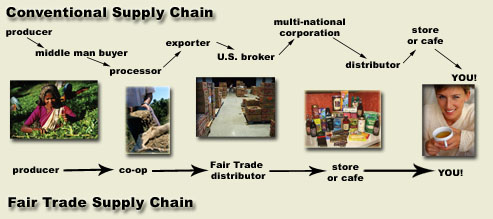
Importers following the Fair Trade model try to purchase from Fair Trade cooperatives as directly as possible, eliminating unnecessary middlemen and empowering farmers to develop the business capacity necessary to compete in the global marketplace. Ideally, the certification also secures long-term, stable relationships between producers and importers; however, as Fair Trade certifications expand to include larger companies, some supply chains contain more steps than as described in the ideal chart (above).
Recently, Direct Trade companies have started becoming an alternative to Fair Trade certification, primarily within the artisinal coffee and chocolate markets. These smaller businesses work directly with farmers and cooperatives to source their ingredients. Due to their relatively recent entry into the American market, there isn't a Direct Trade certification body.
Fair Labor Conditions
Workers are guaranteed freedom of association and safe working conditions. Fair Trade also encourages women's participation in and leadership of cooperatives. Human rights and child labor laws are strictly enforced.
Learn about Fair Trade products and the farmers that produce them »
Promote Fair Trade in your community!
|
|
The Sugar Industry |
In the U.S., about 80% of consumed sugar is produced domestically. However, what is imported often comes from impoverished sugarcane farmers in the global south. Fair Trade Certified™ sugar protects sugarcane farmers against the volatile world marketplace, hazardous working conditions, and environmental degredation.
Fair Trade Sugar Cooperative
 ACOZC ACOZC
Paraguay
photo and profile provided by TransFair USA
La Asociación de Cañicultores Organicos de la Zona Central (ACOZC ) is a 60 member co-operative formed in 2002 by sugarcane farmers of Guarambare, Paraguay. The farmers cultivate about 10,000 tons of sugar cane per year on their 8-10 hectare plots, and a local sugar processor transforms the cane into about 600 tons of raw sugar. The small-scale, family farmers favor traditional techniques, cultivating 100% organic sugar.
Since their Certification in 2004, Fair Trade has provided for:
- Productive Investment: The co-op provides free technical assistance and organic certification services to its members. Television programs tailored to quality improvements are broadcast throughout the community on Visión Rural por Telefuturo.
- Credit Program: ACOZC provides low-interest loans to members.
- Health: ACOZC created a social security medical program, which provides healthcare to members at a reduced cost.
More about sugar:
- Large amounts of herbicides and pesticides are commonly sprayed on to sugar cane crops. Burning and processing of sugar crops can also cause serious pollution of the ground, waterways, and the air.
- On Fair Trade farms, producers must adhere to strict standards regarding the use and handling of pesticides, the protection of natural waters, virgin forest, and other ecosystems of high ecological value, and the management of erosion and waste, according to TransFair USA.
- Following the success of Fair Trade Certified™ sugar in Europe, the sugar became available in the U.S. in March of 2005
|
|
New Phone: to Buy or Not to Buy? |
As word spreads about the dangerous chemicals used in electronics manufacturing, we have been getting asked “well, what phone should I buy then?” (Would you prefer to view this graphic as a PDF? Click here to open)
.jpg)
For smartphones and other electronics, the best way to ensure your next phone does not contribute to worker abuse is to buy a used or refurbished phone. Before you make the choice to buy though, you may try to fix the phone you have (if broken) or simply pledge not to upgrade needlessly. Phone manufacturers and service providers like to encourage customers to upgrade their devices at least every year, but phones can in fact work for much longer.
FIX:
iFixit is also a great resource to learn how to repair your electronics and order needed parts.
BUY USED:
There are many vendors out there for used or factory refurbished phones, which help to divert phones from ending up in landfills.
RECYCLE:
If and when your phone does stop working, recycle it with an e-Stewards recycler.
e-Stewards recyclers are certified monitored by the nonprofit Basel Action Network to ensure that they recycle e-waste responsibly and do not ship it overseas where workers in scrapyards are exposed to dangerous work with without protection.
Green Americans know that when we make purchases we are voting with our dollars, and we want to know that our spending does not finance unsafe working conditions or unfair treatment. By pledging to fix your phone, not upgrading, or buying a new phone, you are helping to curb the ever-growing demand for new, exploitative phones.
Do you have any other tips for choosing electronics responsibly?
|
|
Cocoa Farming: The Importance of Fair Trade |
 Cocoa is a $16 billion a year industry, but the average annual revenue the cocoa farmers receives is between $30 and $110 per household. The Fair Trade certification for chocolate has given over 42,000 cocoa farmers in West Africa, the Caribbean, and the Americas a decent price for their crop. Since 90% of the world's cocoa is grown on small family farms of 12 acres or less, Fair Trade cocoa is directly improving the standard of living for cocoa farmers in the poorest regions of the world. Cocoa is a $16 billion a year industry, but the average annual revenue the cocoa farmers receives is between $30 and $110 per household. The Fair Trade certification for chocolate has given over 42,000 cocoa farmers in West Africa, the Caribbean, and the Americas a decent price for their crop. Since 90% of the world's cocoa is grown on small family farms of 12 acres or less, Fair Trade cocoa is directly improving the standard of living for cocoa farmers in the poorest regions of the world.
Fair Trade Cocoa Cooperative
 Kuapa Kokoo Kuapa Kokoo
Ghana
Photo and profile provided
by TransFair USA
Kuapa Kokoo is a 35,000-member cocoa producer cooperative founded in Ghana in 1993. It represents a unique empowerment effort that enables small cocoa farmers to have a voice in government and attain more information regarding their dealings with cocoa buyers. Kuapa Kokoo is made up of village societies that elect committees and representatives at a regional level, who in turn elect representatives to the National Union. This Union represents farmers’ interests to government and industry bodies, and shares information that is beneficial to its members.
Kuapa Kokoo owns 33% of the Day Chocolate Company that in turn sells Fair Trade Certified™ Divine and Dubble chocolates in the UK and US. This unique venture allows Kuapa Kokoo’s members to increase their profits from their cocoa and enhance their knowledge of the western chocolate market.
“A bite of Fair Trade chocolate means a lot to peasant farmers in the south. It opens the doors to development and gives children access to healthcare, education, and a decent standard of living.” —Mr. Ohemeng-Tinyase, Managing Director of Kuapa Kokoo
More about chocolate:
- West African countries are dependent on cocoa. The six largest cocoa producing countries are the Ivory Coast, Ghana, Indonesia, Nigeria, Brazil, and Cameroon. In Ghana, cocoa accounts for 40% of total export revenues, and two million farmers are employed in cocoa production. The Ivory Coast supplies 43% of the world's cocoa, according to Global Exchange.
- In many families, the children work on farms with their family members. In the Ivory Coast, 66% of cocoa farmers have never attended school.
- Trafficked child labor and child slave labor are also problematic in this industry. According to a USAID and International Institute of Tropical Agriculture (IITA) study in 2002, "an estimated 284,000 children are working in cocoa farms on hazardous tasks such as using machetes and applying pesticides and insecticides without the necessary protective equipment. Many of these children work on family farms...but about 12,500 children working on cocoa farms had no relatives in the area, a warning sign for trafficking".
- Many Fair Trade producer cooperatives use their Fair Trade premiums to invest in community projects such as construction of schools and health clinics, as well providing organic agriculture training.
- Over 50,000 cocoa growers in eleven countries are members of Fair Trade cooperatives. Fair Trade cocoa is grown in Belize, Bolivia, Cameroon, Costa Rica, Dominican Republic, Ecuador, Ghana, Haiti, Cote D’Ivoire, Nicaragua, and Peru.
|
|
Cocoa Barometer Report: the status of fair trade chocolate |
The Cocoa Barometer is a biennial report on the current state of sustainability in the cocoa farming industry. In 2015, the report found that West African cocoa farmers were living well below the global poverty level of $2/day; chocolate company mergers are increasingly consolidating most of the power to just a handful of chocolate companies; and younger farmers are less interested in cocoa farming, leading to an increase in the average age of cocoa farmer. Since the publication of the 2015 report, much has changed in the cocoa industry.
In 2015, Tulane University, under contract with the US Department of Labor, published a report revealing that the number of children working in cocoa fields increased over the 15+ years companies, governments, and activists have been working on this issue. Then, beginning in 2016, farmers were hit with record low cocoa prices as well as an oversupply of cocoa in the market. However, since there is little transparency or accountability in the industry, it is unclear what the true size and scope of the problems are, and how effective current approaches to addressing farming income and child labor are.
In light of these updates, the 2018 Cocoa Barometer notes that continuing with ‘business as usual’ is nowhere near sufficient to address all of the pressing problems that face farmers and the industry.
Some key points from the 2018 Cocoa Barometer include:
- Scale of problem is larger than solutions: Although chocolate companies and producing governments have been working together to try to address sustainability in cocoa supply chains, their efforts have not matched the size of the problem. Most sustainability programs only effect a small percentage of cocoa farmers, and due to a lack of publicly available information, it’s unclear how much of an impact these programs have made. Meanwhile, certification, although a helpful tool for both companies and consumers, has not reached as many cocoa farmers in West Africa as industry and activists once hoped it would, and on its own cannot solve the underlying structural issues related to poverty that farmers face.
- Low cocoa prices and a need for living income: The price of cocoa dropped significantly in 2016, from above $3,000 to below $1,900 in a matter of months, and has not fully recovered. Due to low cocoa prices, companies are saving billions of dollars in purchasing costs; meanwhile, farmers are hit hard by low market prices. Cocoa farmers were already living below the poverty line before the crash, and the fall in income makes clear that more needs to be done to ensure that cocoa farmers can earn a living income from their work.
- Large scale deforestation: Over the past year, deforestation has been a hot-button topic in the cocoa industry. Cote d’Ivoire and Ghana have lost most of their primary forest areas to legal and illegal deforestation. At this point, more than ninety percent of West Africa’s original forests are gone. An estimated 30-40% of cocoa from Cote d’Ivoire comes from illegal plantations in deforested areas. In 2017, the global cocoa sector announced the Cocoa and Forests Initiative, a multi-stakeholder commitment to combat deforestation in Cote d’Ivoire and Ghana. Although this is a promising first step, it is crucial that the non-deforestation commitments are expanded to other cocoa producing regions as well.
RECOMMENDATIONS AND NEXT STEPS
Although some progress has been made in the cocoa sector, overall, the entire industry still has much to do to achieve companies’ stated sustainability goals and support farmers. Some recommendations from the Cocoa Barometer include:
- Implementing prices that provide farmers a living income;
- Prioritizing elimination of structural poverty as a sustainability commitment;
- Expanding current deforestation commitments to a worldwide moratorium on deforestation;
- Developing and implementing transparency and accountability mechanisms in cocoa growing countries and throughout the cocoa supply chain.
It’s clear that current sustainability efforts will not fix the problems plaguing the cocoa industry. Companies and governments need to reevaluate their current programs and commitments, and approach new solutions with an increased sense of urgency and ambition. While some of the major companies have announced investments in new sustainability programs, others still lag behind in sharing what their plans are. One of the biggest laggards in the industry is Godiva.
The cocoa industry is at a crucial turning point right now. Join us in asking Godiva to not only step up their commitments to meet their competitors’, but to become a leader on this issue – take action today!
Read the full Cocoa Barometer here.
The Cocoa Barometer is published by the VOICE Network, an international consortium of NGOs that work in the cocoa sphere. Green America, International Labor Rights Forum, and Oxfam America are American members of the VOICE Network.
|
|
Let's Talk about Miracle Whip and GMOs |
Summertime would not be the same without picnics, potlucks, and cookouts. Some would say it would not be the same without the common dishes we all whip up to bring to these events, such as potato salad, coleslaw, and deviled eggs. All of these dishes have something in common: mayonnaise*. Health-conscious people avoid it and few people admit to using it, but it is everywhere. Made mostly of oil, eggs, and vinegar, not only is it used as a dressing, some people even mix it with ketchup and put it on hot dogs and burgers, or use it alone on French fries.
It is likely that either Hellmann’s Real Mayonnaise, which holds 31 percent market share in the US (and 52% in Canada), or its close competitor Kraft Miracle Whip will likely be the brand in your potato salad. Other similar culprits may include Duke’s, Best Foods, Kraft Real Mayonnaise, and Heinz. We recently reported that Hellmann’s launched a mayo option made without genetically engineered (referred to as GE or GMO) ingredients. We are now asking Kraft to go above and beyond this commitment by removing GMO ingredients from Miracle Whip, as well as the GMOs in the animal feed that produce the egg ingredient.
Miracle Whip was introduced as a cheaper alternative to Hellmann’s during the Great Depression. The main difference between the two products at the time is that Miracle Whip used powdered instead of whole eggs; therefore, it was designated a salad dressing rather than mayo due to a technical definition that “real” mayo could only contain whole eggs, vinegar, and olive oil. The rivalry between the two products is staunchly still evident; you are either a Miracle Whip person, or a mayo one, and likely Hellmann’s (known as Best Foods in some parts of the country). Despite Hellmann’s best efforts, Miracle Whip soared in popularity and remains a direct competitor today.
What is the Problem with Miracle Whip?
While Miracle Whip originally used powdered instead of whole eggs, the ingredients used in the original product were far simpler than today. Now, the product is made with less-than wholesome ingredients produced in ways that put people, animals, pollinators, and the planet at risk. Half of the ingredients are likely produced from GE crops. The eggs are also sourced from concentrated animal feeding operations (CAFOs), commonly referred to as factory farms.
The actual list of ingredients in Kraft Miracle Whip are (those that are likely directly or indirectly GMOs are in bold): water, soybean oil, water, high fructose corn syrup, vinegar, modified cornstarch, eggs, salt, natural flavor, mustard flour, potassium sorbate as a preservative, paprika, spice, dried garlic.
Greenwashing Alert: Before Kraft replies claiming it is making more natural products as well, we would like to alert readers to one of its product lines created to appeal to consumers seeking better food made with better ingredients: Pure Kraft Mayo. The company said an original recipe inspired it. The first ingredient listed is soybean oil, which is most likely GMO. The ingredients also include sugar, which is most likely from GMO sugar beets. Other ingredients that are likely directly or indirectly GMOs are vinegar and eggs. Sorry, Kraft, but we are not falling for this greenwashing marketing technique.
Concerns about GMOs in Miracle Whip
GMOs and growing herbicide resistance have increased the use of toxic chemicals on crops, polluting our soil and water and posing a significant negative environmental impact. Corporate control ofGMOs hurts small farmers. The biotech and chemical corporations spend millions to support anti-labeling efforts and keep consumers in the dark about their food. There are also health risks. GMOs are not yet proven safe for human health—the FDA does not require independent testing of GE foods, allowing for many of the studies on GMOs to be industry-funded and heavily biased. Among the list of ingredients in Kraft Miracle Whip, the following products are of particular concern:
- Soybean oil: 93 percent of soy in the US is GMO
- High Fructose Corn Syrup: Made from corn, of which 89 percent is GMO
- Vinegar: Also made from corn
- Eggs: Laying hens (egg-producing chickens) are fed GMO corn and soy
- Natural flavors: A nebulous term that includes many ingredients that people don’t consider to be natural
Additional Resources GMO Inside released an updated mayonnaise scorecard showing how various major brands measure up in terms of GMO ingredients, prevalence of eggs from CAFOs, and sustainability. Within the scorecard you will find better alternatives and highlight which brands to avoid. We also posted recipes for making homemade mayonnaise to give consumers the ultimate ability to control the quality of ingredients used to make the ever-present spread.
Read Part 2 of this series here.
*For our purposes, the term mayonnaise includes mayonnaise and mayonnaise-like products known as salad dressings that contain either whole or powdered eggs.
|
|
Why is Starbucks’ Milk an Environmental Issue? |
You may be asking, “Why Starbucks?” when you see GMO Inside's “What the Starbucks: From Crop to Cup” infographic covering the impact of sourcing industrial conventional milk.
Why focus on one company and the milk it is using when there are so many pressing environmental issues going on in our country and around the world, like the drought in California? It is estimated that CA’s wells only have 1 year’s supply of water and that the snowpack the state depends on is only 8 percent of what it should be. These are concerning facts considering that CA produces 50 percent of the nation’s fruits and veggies, including 90 percent of the grapes, broccoli, almonds, and walnuts. Yet Starbucks milk is more connected to the CA drought than it appears.
Considering CA’s drought, dairy production is one of the most pressing issues, yet it receives very little attention. California is the top dairy producer in the nation, with nearly 1.78 million dairy cows. The USDA calculates that dairy farms require 150 gallons of water per cow per day. Industrialized dairy cows are fed a diet of GE crops made up of corn, soy, alfalfa, and cotton. Alfalfa is California’s most water-intensive crop; none of that production goes directly to human consumption.
Overall our goal is to open up the conversation to discuss the deeper issues within the dairy supply chain: animal welfare, pollinator health, antibiotic overuse, and the environmental and health impacts of CAFOs. Starbucks milk provides us with an excellent lens and connecting point to do so. Dairy and meat are large contributors to environmental problems but there are so many deeper issues that need to be discussed. This campaign creates a meeting point to discuss them all in connection to one another since they are ultimately all interconnected. In order to create a more sustainable food system it is important that we address all of the impacts of dairy and other forms of industrialized agriculture.
We call on Starbucks specifically because it is one of the largest purchasers of milk in the US, purchasing over 140 million gallons of milk each year. This volume of milk is expected to grow as the company plans to add 1 store every 6 hours over the next five years. It is a powerful company and has the ability to create systemic change by guaranteeing contracts for farmers, a necessary incentive to move beyond the industrialized system toward more organic and sustainable practices. Starbucks is also a visible company that cares much about its public perception and being seen as an agent of good. Read more about our specific Starbucks plan for change and reasoning.
So yes, while the campaign is targeted at Starbucks, it really is about so much more. To learn more about the industrial convention milk supply chain read the full report that accompanies the infographic.
|
|
What does Generally Recognized as Safe (GRAS) Mean? |
In 1986 the Reagan administration determined, through the Coordinated Framework for Regulation of Biotechnology, that it was not necessary to create any new laws for the regulation of biotechnology as these new products did not pose any risk. Yet, the first GE crop, the Flavr Savr tomato, wasn’t approved for cultivation until 1996. The current laws that regulate GE crops and pesticides were established before we could understand the true impact of this technology. This decision set the precedent that GE crops were substantially equivalent to its non-GE counterparts; this bases regulation on the product, not on the process. Substantial equivalence determined that GMO crops are virtually the same as its non-GMO counterparts and therefore pose no substantial risk and should not be treated or regulated differently.
Who is responsible for biotech regulation?
The responsibility of regulating GE crops lies within three different federal agencies; the Environmental Protection Agency (EPA), United States Department of Agriculture (USDA), and Food and Drug Administration (FDA). The FDA is responsible for determining whether or not GE food is safe to consume and does such under the authority granted by the Food Drug and Cosmetics Act(FFDCA). Part of this determination allowed for products to be deemed generally recognized as safe (GRAS). Dating back to 1958, GRAS “is a legal term describing certain food ingredients that are safe enough to enter the market without prior government approval or restrictions.” The GRAS process established streamlined decision making, allowing manufacturers to get their products to market faster and with minimal (if any) oversight.
Who determines GRAS status?
GRAS determination is not made by any federal agency, rather it falls under the decision making of the manufacturer that created the ingredient or product, a blatant conflict of interest. A company determines for itself whether it meets the GRAS standards. With GRAS status, an item requires no prior FDA approval before going to market. Companies can voluntarily submit their GRAS determination for review by the FDA, but are not required. In reviewing GRAS determination, the FDA does not perform any independent research or testing, relying solely on information provided by the company and handpicked relevant published studies. The FDA allows companies to market and use chemicals while under review. The report, Generally Recognized as Secret published by NRDC, found that a shocking number of chemicals had been deemed GRAS and did not participate in the voluntary review process, leaving the FDA with no information or review of the chemicals in question.
In all, the FDA does not determine the safety of new food ingredients and products. GRAS status, which holds that a product has the same structure, function, and composition of food already on the market, is self-determined by biotech companies without consideration for the impacts of its corresponding pesticides.
What else falls under GRAS?
GMOs are not the only GRAS items that are controversial; sweeteners, MSG, and caffeine are all products that were deemed GRAS without consideration for the levels at which they are consumed. These items have infiltrated grocery store shelves leaving consumers with a steady stream of them without true consideration for potential long-term health impacts. Further concern over these regulations is that they contain extremely vague language using words that have no legal definition and can be broadly interpreted, such as qualified experts and adequately safe.
The GRAS process and the hastened approval of a number of new more harmful, GE crops and pesticides raises major concerns and fails to instill much faith in the existing safety regulatory framework. There is a reason teachers don’t let children grade their own exams; so why is the FDA allowing Big Ag and biotech companies to grade themselves, especially when it is at the risk of citizens everywhere? |
|
GMOs Don’t Feed the World |
Feeding The World Without GMOs from Gringo Starr Productions on Vimeo.
One of the most often touted benefits of genetically modified organisms (GMOs) or genetically engineered (GE) crops, is that they are essential to feed the world’s growing population. There are currently over 7.5 billion people on this planet and expected to rise to 9.5 billion by 2050. If consumption trends continue, in order to feed that many people, we would need to grow one-third more food.
But GMOs are not the solution—GMOs will not feed the world.
First, let's look at this argument from an agricultural perspective.
The vast majority of GMO crop production does not go towards direct food consumption; rather, it is used for the production of animal feed and ethanol. These are crops engineered to withstand, work in partnership with, and self-generate pesticides. They are not engineered to increase yield or face climate-related challenges to growth, such as drought tolerance. There is one variety of corn has been bred for drought resistance, but it is likely to only be effective in 15% of US corn fields and is not effective in severe or extreme drought, which we are expected to have more of in the coming years.
Industrial agriculture isn't the answer.
Increases in yield from GMO crops are a result of a decrease in yield lost to pests from Bt crops, pesticides, and an increase in fertilizer use (made from petroleum, defeating the purpose of ethanol). Unfortunately, growing weed and pest resistance is already decreasing their effectiveness, requiring much more dangerous pesticides and making useless one of the most used organic pesticides, Bt. These minimal increases in yield have come with major externalities, including but not limited to water pollution, pollinator loss, and soil degradation, that put future food security at risk. After decades of attempts, Big Biotech has not been successful in breeding GMO seeds that increase yield or reduce water use. Conventional breeding outperforms genetic engineering when it comes to nitrogen use efficiency (the ability for crops to pull nitrogen out of soil, developing a more efficient use of fertilizer, ultimately decreasing the demand for fertilizers) and water use efficiency (WUE).
Overall, conventional breeding is responsible for most of the successful advances in yield. It also happens on a much shorter timeline at a much lower cost. Industry studies show that it takes a minimum of ten years to develop a GMO crop and nearly $150 million; whereas conventional crops take only $1 million to develop, improvements WUE and drought resistance naturally occur at an estimated 1 percent each year. While Big Biotech develop GMOs in a lab, farmers are improving traditional crops in the field. Due to this drag rate by the time GMO crops are finally released they are actually behind their conventional counterparts.
Conventional crops could also be more effectively bred to work in partnership with the cultural food needs and geographical climate and soil challenges unique to specific regions. Forcing GMO crops into developing countries with higher existing biodiversity puts that biodiversity and future food supplies at risk by threatening native species and practices. There is an abundance of types of crop varieties (both already in use and wild) accessible to breeders and growers. It is important that we tap into this vast resource to expand nutrient diversity and accessibility.
The Alternative to GMOs: Agroecology
Considering the changing climate and increasing pressures on and demand for our scarce resources, expanding the industrialized system of agricultural is not the answer. Agriculture is already one of the largest contributors to climate change. In order to sustainability produce the food we will need, we must support a transition to more regenerative, agroecological methods of farming. Agroecology as a “science is the ‘application of ecological science to the study, design, and management of sustainable agroecosystems.’ As a set of agricultural practices, agroecology seeks ways to enhance agricultural systems by mimicking natural processes, thus creating beneficial biological interactions and synergies among the components of the agroecosystem.”
It is essential to look at the entire system and how plants work with one another and their surrounding climates. Regenerative agriculture works to rebuild soil health and biodiversity; sequestering carbon, preventing soil erosion, protecting water sources, and reducing harmful pesticide and fertilizer runoff in the process. Agroecology is also a much better system of management for small holders and provides a more balanced diet with more nutrient dense crops. Smallholders already produce 70% of the world’s food on only 25% of the land. More diversified planting is better for soil health and biodiversity and will better handle the challenges presented by climate change and the damage we have already done to our resources.
Lack of Equity + Poverty = Hunger
Hunger is not an issue of agriculture or food quantity, but one of poverty and equity. There is currently enough food in the world to feed 10 billion people. That means that we actually have an excess of food.
Despite that, there is still a shocking number of people who are hungry, 791 million (the majority of which live in developing nations). More than anything, hunger is a result of poverty. The World Bank estimates that there are over 1 billion poor people in developing countries. Continued hunger leads to continued poverty as those suffering from chronic hunger are unable to perform manual labor (the most common source of income in developing countries) and increase their standard of living. Much of this poverty and hunger is caused by existing economic inequity as a result of current political systems that favor those with higher incomes. The current industrial food system emphasizes the need for countries (regardless of size) to export food crops despite the local demand for basic nutrients. If poverty and livelihoods are not improved it will not matter how much food is produced if the poorest, and in turn hungriest, do not have the financial ability to access it.
At the same time that there is great hunger there is also excessive food waste throughout the world. It is even worse in the western hemisphere; the US alone wastes 40% of its food. In western countries, grocery stores throw out a lot of food and will not purchase unattractive produce. Food is wasted simply because it is visually unappealing or goes uneaten. In developing nations food waste is a result of a lack of infrastructure, capital investment, and basic necessities. Lack of access to road ways, storage facilities, and basic refrigeration prevents food access and increases spoilage rates. With proper investment and support these problems could be remedied.
Despite the hunger epidemic we also have an obesity epidemic as a result of poor nutrition, high meat consumption, and increased processed food consumption. Worldwide, most of the expected demand for an increase in food is not based on a baseline need for nutrients, but rather the growing trend of developing countries to adopt the western diet of meat consumption. It takes substantially more calories to produce meat and ultimately results in a number of health challenges. Not only does this require a higher production of animal feed crops, the raising of animals for meat puts a number of stresses on the environment due to the current system of large concentrated and confined animal feeding operations, or CAFOs.
Hunger is an issue of politics and justice.
It is a choice that we make as a nation and as group of developed countries. In order to tackle these problems of access we need to drastically change our food system. We need an international system of agriculture that supports food sovereignty, regenerative agroecological farming practices, and food security on a regional and local level. GMOs are not the answer.
If GMOs are not feeding the world, then what do we do to decrease worldwide hunger? Find out here.
|
|
Food & Climate Change: The Importance of Sustainable Agriculture |
We all know that climate change is driven by our energy and transportation systems, but we don’t hear as much about how our current food systems also create climate change. However, sustainable agriculture and food systems could be a huge part of the solution instead.
The Problem: Fossil Fuels & Soil Degradation
Currently, modern industrial agriculture uses enormous amounts of fossil fuels – particularly for fertilizers – and degrades the soil so that it doesn’t retain carbon. Energy consumed during fertilizer manufacture was equivalent to 191 billion liters [50.5 billion gallons] of diesel in 2000 and is projected to rise to 277 billion [73.2 billion gallons] in 2030. All of this energy is being used to produce an input that is richer and more nutrient dense when produced naturally, without carbon emissions.
The Solution: Organic Agriculture & Sustainable Practices
There’s a better way to practice agriculture – one that nourishes the soil and sequesters carbon. Modern organic agriculture, which produces yields similar to conventional agriculture, has the potential to sequester enormous amounts of carbon. Organic, sustainable agriculture takes carbon from the atmosphere and puts it back in the soil. The microorganisms in healthy soil convert organic waste into humus, which stores carbon rather than releasing it. These microorganisms also store carbon themselves, because they consume plant sugars, which are made with carbon through photosynthesis.
If 10,000 medium-sized US farms converted to organic farming, the emissions reduction would be equivalent to removing over 1 million cars from the road. If all US croplands became organic, it would increase soil carbon storage by 367 million tons and would cut nitrogen oxide emissions dramatically.
In fact, research from the Rodale Institute demonstrates that if we practiced organic agriculture globally, we would be able to reverse climate change. Rodale Institute created a model of a global carbon sink around the world through a 100 percent transition to organic agriculture. They compared that to the emissions that we had in 2012 globally and found that the world would have been able to sequester 111 percent of 2012 emissions. That’s how powerful organic agriculture could be as a climate change solution, and just one of the reasons we need to move to organic farming as quickly as possible.
|
|
Organic Food & Farmers |
To combat the long lasting environmental impacts of industrial agriculture, we need to farm in a way that preserves soil health, removes toxins, and protects the health of farm workers, farmers, and consumers.
Agriculture is the most polluting industry in the world because of the prevalent use of chemical pesticides and herbicides. Overtime, these toxic chemicals not only degrade soil health, but also pollute water supplies and harm the health of surrounding communities. In addition, a majority of US crops are genetically engineered.
Organic farming, and regenerative agriculture in particular, are holistic approaches which do not use chemicals. This approach improves soil health, does not cause toxic run-off, and protects farmworker health.
What Does the Organic Label Mean?
The USDA organic standard is maintained by the government and incorporates policies for maintaining soil fertility and crop nutrient levels, limiting pesticide and fertilizer usage, and preventing overall negative impacts on surrounding environments. Choosing products with the USDA organic label is a trustworthy way to avoid GMOs.
Key Practices of USDA Certified Organic:
- Prohibits use of most chemical/synthetic fertilizers and pesticides.
- Prohibits antibiotic and synthetic hormone use.
- Prohibits GMOs in all aspects of farming and processing.
Family Farms: An Invaluable Part of a Sustainable Agricultural System
Family farmers are farms, often small-scale, that take a holistic approach with concern for the broader and long-term impacts that agriculture has on the environment and community. The current generation of farmers works to ensure the sustainability of natural resources and livelihoods for future generations and surrounding communities.
However, many small-scale and family farms have been squeezed out of business by the consolidated power of corporate agribusiness and a shift to “factory farm” production.
In 2014, Green America began expanding our collaboration with farmers, gardeners, and growers across the US. We are committed to celebrating our nation’s food producers. We work to amplify the voice of the farming community and bridge the gap of communication between farmers, consumers, and policy makers.
Thank you to all those growing our food. We appreciate you |
|
Genetically Engineered & GMO Crops |
Genetically engineered (GE) crops [more commonly referred to as genetically modified organisms (GMOs)] are crops that have been engineered to produce certain qualities not intrinsic to the plant itself. An organism is inserted with genetic material from a different species to create a new organism not developed in nature or through traditional breeding.
The most common GMO crops are developed to be resistant to an herbicide, such as glyphosate, 2,4-D, and/or dicamaba, and engineered with the pesticide Bt to protect against pests (the plant itself produces the Bt toxin).
Concerns with GMO Crops: Health, Regulation, and Environment
- Lack of Proper Regulation: Uncertainty of the safety of GMO crops due to the lax regulation by the FDA, USDA, and EPA and the lack of unbiased scientific research on the long-term human and environmental health impacts. Several studies conducted by scientists have called into question the safety of consuming GE crops. Further unbiased research regarding health and safety issues is needed.
- Destruction of Ecosystems: Majority of GMO crops are engineered to work in partnership with a specific herbicide, most commonly glyphosate. Since the crops themselves are engineered to resist the effects of the herbicides, the chemicals are sprayed freely and extensively on the farm negatively impacting surrounding communities and ecosystems.
- Eradication of Key Pollinators: Increased use of pesticides on GMO crops has led to a decline in key pollinator species, such as honeybees and monarch butterflies.
- Development of Superweeds & Pests: Excessive use of pesticides and herbicides in connection with GMO crops has led to superweeds and pests that have developed resistance to the most commonly used pesticides. As a result, farmers and chemical companies are turning to much more toxic pesticides including 2,4-D and diacamba.
- Community Health Impact: Both glyphosate and 2,4-D—herbicides used extensively on GMO crops—have been deemed probable carcinogens by the World Health Organization and have a major impact on the health of surrounding communities.
- Soil Degradation: GMO crops encourage mono-cropping, where one large area is grown with the same crop variety year after year. This method of agriculture damages soil health and fertility and quickly depletes nutrients. Poor soil health requires farmers to rely on external inputs such as nitrogen fertilizers produced from fossil fuels. The overuse of nitrogen fertilizers is not only continuing our dependence on oil and perpetuating climate change, but it is also polluting our water ways and creating dead zones void of aquatic life.
GMO crops are not part of a sustainable system of agriculture. In order to sustain our soil and food supply, we must move to a regenerative system of agriculture, with its basis in the principles of organics. This means moving away from destructive chemical inputs such as pesticides and synthetic fertilizers and moving towards systems that work in tune with the natural biology of soil and the environment. We actively engage with members of Congress, federal regulating agencies, and companies to open up the dialogue on the necessary steps towards a more sustainable food landscape. We are committed to educating consumers, like you, around the impacts of GMO crops and industrial agriculture and the steps that we can all take to protect and improve our food and the environment.
What To Look For
Look for these seals to ensure that the food you're eating does not contain genetically engineered ingredients.

What To Avoid: Genetically Engineered Crops & Ingredients
These are the genetically engineered crops that are currently on the market: corn, soy, alfalfa, canola, cotton, papaya, sugar beets, zucchini and yellow summer squash.
In the US, GMOs are in as much as 80% of conventional processed food. The following product ingredients are likely derived GMO crops: Amino Acids, Aspartame, Ascorbic Acid, Citric Acid, Dextrose, Flavorings (“natural” and “artificial”), High-Fructose Corn Syrup, Hydrolyzed Vegetable Protein, Lactic Acid, Maltodextrins, Molasses, Monosodium Glutamate, Sodium Ascorbate, Sodium Citrate, Sucrose, Textured Vegetable Protein (TVP), Xanthan Gum, Vitamin C, Vitamin E, Yeast Products, and many more.
Green America's GMO Inside campaign is working to get GMOs and toxins out of our food. We've had a number of recent victories including Campbell’s offering Goldfish and soups with organic ingredients, Hershey removing GE sugar from its Kisses and chocolate bars, Hellmann’s launching a non-GMO mayo, and Similac introducing three non-GMO baby formulas.
|
|
The Shame of Stereotypes as Team Mascots |
Despite a love of football, Suzan Shown Harjo has attended exactly one of her home team’s NFL games, back in 1974. The team was the Washington Redsk--s. [Editor’s note: Green America has made it our policy not to print this racial slur in its entirety. From here on, we will use the term “R-word.”]
Harjo—a poet, writer, lecturer, and policy advocate who has helped Native Peoples protect sacred places and recover more than one million acres of land—recalls one fan who was seated behind her and her husband saying of the couple, “I think they’re [R-words].”
She gently replied, “No, I’m Cheyenne and Muscogee, and he’s Muscogee.”
But the odd fan behavior continued. The couple heard people whispering behind them to “look at the [R-words]” or “look at the Indians,” and some even started petting their long hair, asking others to “look at this [R-word] hair.”
The game hadn’t even started.
“We had to get up and leave,” she says. “That is the real effect of objectification—where you take away a person’s humanity and are just touching them in inappropriate ways.”
As part of building a socially just economy, Green America joins Harjo and other tribal activists in calling for an end to the use of all stereotyped mascots and team names—starting with the R-word as the worst example. Whether you’re a sports fan or not, you can use your economic power as a potential purchaser of sports tickets and team logowear—as well as a customer or shareholder of corporate team sponsors—to discourage the use of racial slurs and caricatures.
A Slur with Tragic Origins
While some sports fans dismiss concern over use of the R-word as a case of political correctness going too far, the vast majority of Native Americans feel this word is tremendously painful, given its tragic history, the fact that it is a dictionary-defined “racial slur,” and the manner in which it ignores their cultural heritage and contributions.
Washington football team owner Dan Snyder has maintained that the R-word name is a point of honor that celebrates William “Lone Star” Dietz, the team’s first coach, whom they claim was Sioux.
They are mistaken, says Harjo. FBI documents show that Dietz was a German-American who stole the name of James One Star, an actual Sioux man, hoping to both avoid being drafted into WWI and to cash in on famed athlete Jim Thorpe’s fan base. He even went so far as to write letters to One Star’s sister pretending to be James, as she testified at Dietz’s draft-evasion trial.
But even if you ignore the Dietz connection, the R-word itself has truly shocking origins. Harjo says that even near the turn of the 20th century, bounty hunters traversed the country killing Native Americans and bringing in “their bloody red skins,” or scalps, as proof. And while Western films would lead us to think that “scalp” solely means the skin on the top of one’s head, Harjo says it was also often the genitalia.
“They were paid on a sliding scale—so much for a man, so much for a woman, so much for a child,” she says. “The only way they’d know gender or age was from the genitalia.”
And so, the people who were being killed became known by a word that their murderers saw as descriptive of their sole value—one describing the skins that they could rip away and sell.
“This is the worst word that we can be called in the English language,” she says. “This is the N-word for us.”
The Effects on Native Youth
While the R-word may be the worst example, all Indigenous stereotypes used as team names or mascots—from the Cleveland Indians to the Seminole High School Chieftains—contribute to an epidemic of depersonalizing and reductive behavior that many say is especially harmful to Native youth.
Photo by Vincent Schilling @VincentSchilling
Dahkota Brown was elected a 2013 Champion for Change by the Center for Native American Youth for his work with Native students.
A new report from the Center for American Progress (CAP) found that “these team names and mascots can establish an unwelcome and hostile learning environment for [American Indian/Alaska Native] AI/AN students.” The report also says these mascots “directly [result] in lower self-esteem and mental health” for these young people. And, says the report, studies show that these mascots “undermine the educational experience of all students, particularly those with little or no contact with indigenous and AI/AN people.”
The American Psychological Association concurs, calling for “the immediate retirement” of these team names and mascots in 2005 for all of the reasons stated in the CAP study.
Dahkota Franklin Kicking Bear Brown, a 15-year-old Wilton Miwok, knows these reasons firsthand. He says that while growing up, he always dreaded the days when his school plays their arch-rival—the Calaveras [R-words].
Brown describes the Calaveras sideline routines as featuring “a war-bonnet clad warrior on top of the announcer booth who does the stereotypical Indian drumbeat after every touchdown, fans throwing tomahawk chops,” and “cheerleaders in skimpy outfits resembling traditional buckskin outfits.”
Worst of all, he said in a speech for the Center for American Progress that went viral online this spring, “By having a racial slur of a name, Calaveras has granted all schools that they go against the right to mock and make fun of Native Americans. ... I’ve heard my friends yell ‘Kill the [R-words]!’ or ‘Send them on the Trail of Tears!’”
While some have argued that using a team name like the Chiefs or the Indians is meant to “honor” Native Americans, too often schools fail to respectfully celebrate their Native students’ individual cultural heritage.
As reported by the Indian Country Today Media Network, one egregious case was that of Seminole High School in Seminole County, OK, which uses a headdress-wearing mascot to represent its Chieftains teams. Last spring, 25 senior students at the school, who were members of the Seminole, Creek, Choctaw, and Chickasaw nations, received eagle feathers from their tribal leaders to honor their impending graduation. The students tied the feathers to their graduation caps, some adding tribal beads as well—only to be ordered by the school not to wear them. (At least one student, Kaden Tiger, wore his anyway.)
“Native youth have the highest dropout rate, the lowest graduation rate, the highest suicide rate among any ethnicity,” says Brown. “I think it is tied in part to these mascots. Our teens see these images, and it gives this false sense that we’re savages. These teens lose their cultural identity and don’t feel they fit in anywhere.”
When he was just in eighth grade, moved by “friends and cousins I saw who were on the verge of dropping out,” Brown took matters into his own hands. He started a nonprofit called NERDS (Native Education Raising Dedicated Students), which provides peer-to-peer tutoring and mentoring for Native students in seven California chapters with more to come nationwide.
“A lot of what I hear from the students is that these Native mascots really do have an effect on their lives an their self-esteem,” says Brown.
A Victory in the (Trademark) Courts
The tide of public opinion does seem to be turning against the use of stereotyped Native team names and mascots. In the 1960s, the National Indian Youth Council, Native students, and supporters attempted to persuade the University of Oklahoma to retire its mascot “Little Red,” which it did in 1970. At that time, there were more than 3,000 similar mascots at K-12 and post-secondary schools. Today, there are just over 900.
One recent victory may make it more difficult for teams to profit from merchandising if their name or logo is a Native stereotype. In 1992, Harjo and others filed a request with the US Patent and Trade Office’s Trademark, Trial, and Appeal Board (TTAB), asking it to cancel the six federal trademark licenses owned by Pro Football, Inc.—the corporation headed by Dan Snyder that owns the Washington NFL team—because the R-word is “disparaging to Native Americans.”
After two separate filings (due to the first being dismissed on appeal on a technicality by a DC District Appeals Court), TTAB agreed to cancel the six trademarks in June.
Pro Football filed an appeal in August, and it may legally keep its trademarks for now. But with people like President Obama and Hillary Clinton speaking out against the name, and high-profile news sources like the Seattle Times refusing to print the R-word, it’s clear that public sentiment is shifting. If Washington changes its name, others may follow.
Beyond Political Correctness
When Green America contacted the Washington team, it sent this statement: “Thanks for your interest on this. We appreciate and respect your opinion, like everyone’s. We will consider it as we move forward.”
They and other teams with similar names will undoubtedly have to do more than consider such opinions if they hear from enough unhappy potential ticket-holders. Take action today:
- Speak out. Talk to people, write letters to the editor, and take to social media to argue for change. Harjo says that social media has given a powerful shot in the arm to the campaign against offensive mascots, unifying and amplifying the voices of concerned citizens.
- Write to NFL commissioner Roger Goodell and your favorite team’s owner. Harjo notes that all teams share in revenues generated from the R-word, so they have a right to ask the Washington team to change its name. She hopes the NFL owners will one day unite against the R-word, much as NBA owners stood against the racist remarks made last spring by Los Angeles Clippers owner Don Sterling, whom the NBA ultimately forced to sell the team.
- Call, e-mail, and boycott FedEx. The delivery company sponsors FedExField, home base for the Washington team. The Native Voice Network (NVN) recently launched a campaign demanding that FedEx revoke its sponsorship from the team and the field.
“Anheuser-Busch and Budweiser immediately pulled their sponsorships from the L.A. Clippers” after Sterling’s racist remarks went public, says NVN’s Chrissie Castro. “And yet the corporate sponsors of the Washington team continue to stay silent."
NVN is asking people to share the social media memes they are creating for the campaign. You can also sign a petition on NVN’s website and participate in their national call-in days to FedEx.
As for why FedEx continues to sponsor the team, the company had this to say: “FedEx has a long-standing, binding, contractual commitment with [Pro] Football, Inc. ... Under the agreement, FedExField not only hosts the Washington [R-words] but is home to many other civic and community activities and a variety of ... events. We are proud of our sponsorship of the field and its positive impact on the community and defer questions regarding the name of the team to the franchise owner.”Unmoved by this argument, NVN is asking people to boycott using FedEx until it takes responsibility.
- Counteract spin with meaningful contributions. In an effort to stir up good publicity in Indian Country, the Washington football franchise recently launched the Original Americans Foundation to “address the urgent challenges” on US reservations. Foundation representatives offered to pay in full for a skate park for the Quechan tribe in Yuma, AZ. The offer was turned down.
“We will not align ourselves with an organization to simply become a statistic in their fight for name acceptance in Native communities,” said tribal representative Kenrick Escalanti in a press statement. “We’re stronger than that, and we know bribe money when we see it.”
- To support real efforts to lift up tribal communities, donate to Native-run efforts like those in the box below.
A Civil Right
Harjo isn’t asking Washington football fans to boycott their team, stressing that it’s perfectly okay to “support the team and hate the name.”
And while people often ask why she doesn’t have something more important to worry about, she would like them to realize that this issue is important: Any stereotyped mascot “is a symbol, and symbols come out of attitudes, create attitudes, and lead to actions,” she says.
NVN’s Castro agrees, calling the fight against these mascots “an important civil rights issue.” She says: “We have a right not to be discriminated against. When we show up to public events, everybody should have a right to feel safe, but we don’t when we hear people saying, ‘Kill the Indians!’ [The country] can and should be doing better.” |
|
Campaign FAQs |
|
|
Why Recycled Paper? |
Making the case for recycled paper
From protecting forests to curbing climate, recycled paper use is essential for sustainability. With the below reports produced by Green America and our allied organizations, we make the case for using recycled paper, including the many ways it benefits the environment. We also share how you can better your recycling practices at home and work to help the entire system.
How does using recycled paper help the environment and climate?
Recycled paper use saves resources and reduces the paper industry's impact on the planet.
Using 100% recycled copy paper instead of 100% virgin fiber paper saves:
If you don't recycle your used paper and instead throw it into the trash, it goes where all trash goes -- to the landfill. The EPA cites landfills as the single largest source of methane emissions to the atmosphere, and has identified the decomposition of paper as among the most significant sources of landfill methane. A potent gas with 21 times the heat-trapping power of CO2, methane is a major contributor to global climate change.
Find the answers to all your recycled paper questions in Environmental Defense's Q&A sheet...
How can publishers make a difference?
In the United States we use enough paper in a single day to fill the 838 miles of the Library of Congress nearly FIVE times. By using recycled fiber paper, publishers can ensure that existing paper gets a longer life. By reducing your paper usage and choosing recycled paper for what you do buy, you can lessen your environmental footprint.
Esker shows more jaw-dropping comparisons to our paper use here...
Too often, publishers are told that recycled paper is not the best environmental choice for their magazines. This only makes sense if there is a scarcity of recovered paper and we are forced to allocate our limited supply to only certain paper grades, however there are millions of tons of paper that we could be collecting for reuse. Printing and writing papers have the most intensive manufacturing process of nearly all paper types. Including recycled content in magazine-grade paper has a very significant and important role in reducing environmental impacts of paper production.
Read more in our Green in All Grades report...
We are helping universities use recycled paper for their alumni magazines in our One Million Trees campaign. We are collecting stories from universities already using better paper, including Washington State University. "Moving to 100% recycled stock was daunting at first, but we couldn't be more pleased with the outcome of our magazine on recycled paper."
Read our interview with Washington State University Alumni Magazine on their switch...
How can you help?
Have you added these tips into your recycling practices? These are especially important to do if your city uses single stream (co-mingled) recycling bins.
Check these Tips for Using the Blue Bin...
When considering a new paper or wood product for purchase, the best way to help is to first think through the original R's: reduce and reuse (they come before recycle!). Make sure that you truly need this product and if you do, then look for products made with recycled content.
Learn how to spot better paper products here... |
|
How to Identify Better Paper |
Back to the Vote With Your Dollar Toolkit
Everyone has the power to reduce pressure placed on forests worldwide. By choosing recycled paper, you are voting with your dollars for a cleaner and healthier planet. You can look for environmentally responsible magazines and only buy recycled and FSC-certified paper for your homes and offices.
1.Recycled Content
Like many people, you might see “Recycled” on a product and assume that it’s a high quality recycled product, unfortunately most countries do not have strict rules for how much recycled content a product needs to put “recycled” on their label. This can vary anywhere between 5% all the way to 100%. Look for any indication of the percentage of recycled content on the product package, the higher the better!
2. Next Step
Post-consumer content: This means that the product has used material that was previously consumed as a product – like a newspaper or box. We consider this to be the better choice of the two, since it has completed an entire life cycle of consumption before making its way to you!
Pre-consumer content: This means the product was made from waste produced by some type of manufacturing process. Some products are a mix of these two types of content, just make sure to check the label or review the product online.
Better Paper Pro-tip: Make sure to not be fooled by just the term ‘recyclable’. This just means that the product can be recycled, but doesn’t signal any recycled content in the product. It's better to look for actual recycled content.
3. Certification
There are a few different certifications to look for when buying a paper product. We advise on seeking out the FSC seal (Forest Stewardship Council). The FSC certified forestry products that use sustainably-harvested wood fibers. If the product you are buying has virgin (non-recycled) fibers in it, make sure it is FSC certified.
4. Bleaching
Most paper requires bleaching, and chlorine bleaching creates very toxic chemicals and is bad for the environment. Find paper that is PCF (processed chlorine free) for recycled paper or is labeled TCF (totally chlorine free) for virgin fiber products.

Back to the Vote With Your Dollar Toolkit |
|
Eco-Leaders |
Yes! Magazine ·

Printing on 100% post-consumer recycled paper, Yes! Magazine has shown a strong commitment to the environment, and has a loyal following of readers who appreciate that the company reflects their sustainable values.
Dirt Rag

This mountain biking publication has committed to using 90% recycled paper.
Modern Cat ·

This magazine, as well as Modern Dog, prints on an FSC certified stock with 30% recycled content and vegetable based inks.
Natural Health

Since 2005, this magazine has been committed to better paper. An average issue uses 63,000 pounds of 10% post-consumer recycled paper, saving thousands of trees.
MORE LEADERS IN THE PUBLISHING INDUSTRY
- Adelphi University Magazine offers Adelphi University alumni worldwide the opportunity to read about events at the university.
- The Ark features photography and stories on Nature Conservancy of Canada's leading-edge conservation and stewardship work.
- Audubon Magazine inspires readers to conserve the natural world through explanatory journalism and vibrant photography.
- Bay Nature educates the people of the Bay Area about, and celebrates the beauty of, the surrounding natural world.
- British Columbia Teachers' Federation magazine informs the 41,000 public school teachers in British Columbia, Canada.
- Colby Magazine is the semiannual alumni publication of Colby College in Maine.
- Green American Magazine is Green America's magazine dedicated to discussing the economic benefit of environmental practice for everyday Americans.
- KIWI is dedicated to helping parents raise their children the healthiest way possible.
- Modern Dog is the lifestyle magazine for modern dogs and their companions.
- National Green Pages is the directory for products and services for people and the planet.
- National Wildlife, NWF's award-winning, full-color nature magazine.
- Natural Awakenings has been printed on recycled paper since its inception 17 years ago.
- Optimum Wellness magazine celebrates not just food, but family, friends, relationship, Spirit, and connection.
- Organic Spa Magazine is a lifestyle magazine promoting the marriage of spa and wellness with your sustainable and organic lifestyle.
- Phi Kappa Tau: The Laurel is the print magazine published each year by the Phi Kappa Tau Foundation.
- The Progressive Populist reports on issues of interest to workers, small-business owners and family farmers and ranchers.
- Russian Life is a 50-year-old bimonthly magazine covering Russian culture, history, business, society and travel.
- Washington Gardener magazine is a gardening publication published specifically for Washington DC and its suburbs.
- Yes! Magazine highlights positive stories of a transformation toward a more just, sustainable, and compassionate world.
|
|
For Publishers: Why Switch to Recycled? |
What we mean by "better paper"
Better Paper refers to paper with a cleaner, greener, more efficient paper production process at every stage - including pulping, paper-making, printing, distribution and recycling. Green America's Better Paper Project has helped hundreds of publishers choose better paper by developing smart purchasing policies to ensure the use of recycled and FSC certified papers. Consumers have made it clear: they want sustainable products from companies that reflect their values. Your company must consider environmental and social impacts to remain relevant in today's market (we also think it's just the right thing to do).
Far too many magazines in the US contain most of the “brand-risk” ingredients instead of the better paper ingredients. The good news is that doesn’t have to be the case. There are many different environmentally-responsible paper options on the market from a variety of different paper mills, merchants and printers. Publishers have an opportunity to create the market for ever-increasing rates of recycled paper.
Click here to receive free copies of our publisher resource kit and our Green In All Grades Report.
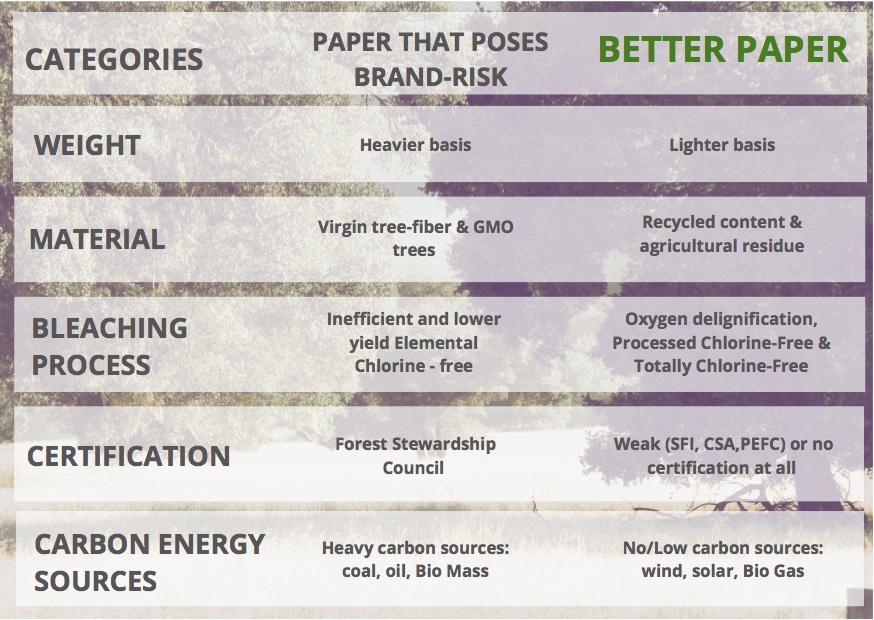
Nearly 50% of all trees harvested in North America are turned into some type of paper product. Using post-consumer recycled paper reduces the need to log forests. Additionally, the paper industry consumes much more than just our forests. Producing paper from virgin fiber is both energy and water intensive, and releases significant amounts of greenhouse gases into our atmosphere. Using recycled paper measurably reduces these impacts.
Every ton of recycled fiber displacing a ton of virgin fiber saves:
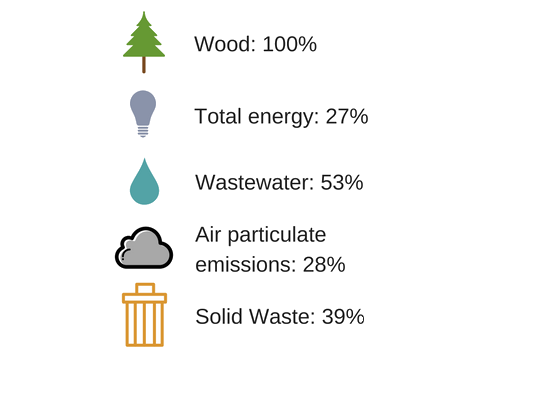
Using recycled paper is the most important step in reducing a publication’s ecological footprint. Paper accounts for approximately over one quarter of the solid waste clogging up U.S. landfills, and while recycling has increased in years past, recovery of printing and writing grades of paper remain extremely low.
We lend our expertise to create an environmental stewardship policy that illustrates a long-term vision for sustainable publishing, articulating key principles and demonstrating a commitment to environmental stewardship. Publishers that factor sustainability into their core business strategies are well positioned to take advantage of emerging opportunities in the radically changing market environment. Developing a sustainable, strategic paper policy set you up to grow profitably, and the Better Paper Project can assist you every step of the way!
Publisher Responses
The Green America Better Paper Project helps publishers cut through the clutter in order to understand the environmentally beneficial paper options available.
- Bryan Welch, CEO, Ogden Publications
The Better Paper Project helped us attain our wish to publish a greener magazine by providing the information needed to fit our magazine and budget… As a magazine publisher, we consider them a valuable resource in helping to protect our forests and planet.
- Sita Stuhlmiller, Editor, Light of Consciousness: Journal of Spiritual Awakening
Green America’s Better Paper Project director… agreed to guide us through the thicket of rules, paper suppliers, and acronyms we’d need to learn about to go green.
- James Shaheen, Editor & Publisher, Tricycle
|
|
Coal: Carbon Capture and Storage Is NOT the Solution |
Carbon capture and storage uses existing technology on new power plants or retrofits old power plants in order to capture up to 90% of carbon dioxide produced in the combustion of fossil fuels. The CO2 is then transported by pipeline or ship where it can be injected into underground geological formations for long term storage (1).
Carbon capture and storage is not a viable option for both environmental and economic reasons.
- Building and retrofitting plants with carbon capture technology, and constructing the transport infrastructure, like ships and pipelines, represents a huge cost investment that could be better spent on clean energy.
- Carbon capture technology exacts an “energy penalty” of 25-40% on power plants, meaning that more coal must be burned to keep up the same rate of energy production (2).
- Since the demand for coal from each plant will be higher, more coal will have to be mined and shipped, increasing the public health and environmental costs associated with coal mining.
- Storing CO2 underground can acidify aquifers, which can cause leaching of heavy metals into groundwater (3).
- Injection of CO2 into geologic formations can cause fracturing, which could cause earthquakes or release large quantities of stored CO2 into the atmosphere (4).
(1) "What Is CCS?" – The Carbon Capture & Storage Association (CCSA). Web. 20 Sept. 2016.
(2) Supekar, Sarang D., and Steven J. Skerlos. "Reassessing the Efficiency Penalty from Carbon Capture in Coal-Fired Power Plants." Environmental Science & Technology Environ. Sci. Technol. 49.20 (2015): 12576-2584. Web.
(3) "IPCC Special Report on Carbon Dioxide Capture and Storage." Intergovernmental Panel on Climate Change, 2005. Web. 20 Sept. 2016.
(4) Renard, F., E. Gundersen, R. Hellmann, M. Collombet, and Y. Le Guen. "Numerical Modeling of the Effect of Carbon Dioxide Sequestration on the Rate of Pressure Solution Creep in Limestone: Preliminary Results." Oil & Gas Science and Technology - Rev. IFP Oil & Gas Science and Technology 60.2 (2005): 381-99. Web. |
|
Why Clean Coal Is A Myth |
While some policymakers support "clean coal," coal can never be clean. It is harmful to both people and the planet. Here are a dozen reasons why.
Coal Contributes to Climate Change
The burning of fossil fuels releases greenhouse gases into the atmosphere, increasing levels of CO2 and other gasses, trapping heat, and contributing to global climate change.
- Coal combustion releases the greenhouse gases carbon dioxide (CO2) and nitrous oxide (N2O) during combustion. Coal power plants release more greenhouse gases per unit of energy produced than any other electricity source (1).
- Coal supplies around 33% of the energy used for electricity in the United States, which makes coal-fired power plants a prime target for reducing greenhouse gas emissions (2). (Coal use for electricity is declining, by 2018 the electricity energy share for coal has fallen to 27%).
- Luckily, coal power plants are closing down throughout the U.S. as the fuel becomes less profitable due to state and federal regulations, an aging fleet, and competition from other sectors such as natural gas, wind, and solar (3).
- The coal mining process releases methane, which is 87 more potent as a greenhouse gas than CO2 over a 20 year period (4).
- Carbon capture and storage (CCS) technologies have been marketed as a way to address climate emissions from burning coal, by pumping CO2 produced through burning coal underground instead of into the air. However, the technology is extremely expensive, and even if the carbon can be sequestered, the coal-fired plant will still result in destructive coal mining as well as toxic coal ash as a byproduct.
Coal Creates Local Air Pollution
Air pollution is another side-effect of fossil fuel use. Air pollution is generally more regional than the effects of carbon dioxide, and can have devastating impacts on local populations and ecosystems.
- Coal combustion releases sulfur dioxide (SO2) and nitrogen oxides (NOx), which react with water and oxygen to form acid rain. Acid rain corrodes buildings and structures and acidifies freshwater environments, damaging aquatic ecosystems (5).
- Volatile organic compounds (VOCs) react to form ground-level ozone, or smog. Smog can cause a variety of respiratory and cardiovascular effects and is especially dangerous to the elderly, young children, and people with asthma (6).
- Fine particulate matter (PM10 and PM2.5) is released into the air in the form of fly ash. This particulate matter gets lodged in the lungs when inhaled and increases the risk for pulmonary diseases, including lung cancer (7).
Coal is Devastating for Water Pollution
Like air pollution, water pollution is another more localized effect of fossil fuel use. Water is usually polluted during the process of extraction or in the handling of waste products. Water pollution can also have devastating impacts on human health and the environment.
- Coal-fired power plants account for 41% of anthropogenic (human-caused) mercury emissions, which can travel long distances before being deposited in soil or water. Mercury accumulates in food-chains and can reach very high levels in many types of fish that are consumed by humans. Mercury is highly toxic and is especially dangerous to children (8).
- Coal combustion waste contains many toxic chemicals and heavy metals, which are known to cause birth defects, reproductive disorders, neurological damage, learning disabilities, kidney disease, and diabetes (9).
- This waste is often stored in large impoundment ponds. Massive spills from breaches in these ponds are documented, and many ponds are currently classified as “high hazard” by the EPA. This means they are at risk to spill and cause significant property damage, environmental damage, injuries, and deaths (9).
- Under certain conditions, impoundment ponds are also known to leach contaminants like arsenic into the soil and groundwater, potentially poisoning freshwater sources (10).
(1) “Carbon Dioxide Emissions Coeffecients.” EIA.gov U.S. Energy Information Administration. Feb. 2016. Web. 23 Aug. 2016.
(2) “Frequently Asked Questions.” EIA.gov. U.S. Energy Information Administration. Apr. 2016. Web. 23 Aug. 2016.
(3) "Impact of EPA’s Regulatory Assault on Power Plants." IER.org Institute for Energy Research, June 2012. Web. 23 Aug. 2016
(4) "Overview of Greenhouse Gases." EPA.gov. Environmental Protection Agency. Web. 23 Aug. 2016.
(5) “What is Acid Rain?” EPA.gov. U.S. Environmental Protection Agency. March 2016. Web. 23 Aug. 2016
(6) “Health Effects of Ozone Pollution.” EPA.gov. U.S. Environmental Protection Agency. Web. 23 Aug. 2016
(7) “Coal Ash Basics." EPA.gov. U.S. Environmental Protection Agency. June 2016. Web. 23 Aug. 2016
(8) Trasande, Leonardo, Philip J. Landrigan, and Clyde Schechter. "Public Health and Economic Consequences of Methyl Mercury Toxicity to the Developing Brain." Environmental Health Perspectives 113.5 (2005): 590-96.
(9) "Coming Clean: What the EPA Knows About the Dangers of Coal Ash." The Environmental Integrity Project and Earthjustice. May 2009. Web. 24 Aug. 2016.
(10) Clean Air Task Force. Dirty Air, Dirty Power: Mortality and Health Damage Due to Air Pollution from Power Plants. June 2004. Web. 24 Aug. 2016.
|
|
Natural Gas: The Myth of Transition Fuels |
Natural gas has been promoted as a so-called “transition fuel,” the bridge to renewable energy. Combustion of natural gas emits about half as much carbon as coal, so it has been touted as a potential bridge between an economy that runs mostly on coal and one that runs entirely on renewables.
Despite the fact that natural gas burns cleaner than coal, there are several good reasons why we should focus on renewables and why investment in transition fuels impedes progress:
- Economic resources are better spent on efficiency and renewable energy. The resources and technology exist to move towards 100% renewable energy. Extra investment in this technology only makes it better and cheaper.
- Investing in a transition fuel is a dead end. The money spent on natural gas power facilities and infrastructure takes decades to recuperate. Companies would need to use these facilities for their full lifetimes, delaying the switch to renewables for far too long.
- Investment in natural gas does not incentivize a move to renewable energy. Stakeholders will be actively opposed to laws and regulations that promote clean power at the expense of natural gas companies.
- Energy companies want to export natural gas from the U.S. overseas and are currently building export facilities on the U.S. coasts. The exporting of natural gas will cause increased investment in pipeline infrastructure, increase natural gas fracking in the U.S., expose communities to the potential for catastrophic leaks or explosions, and slow the transition to renewable energy worldwide.
Green America’s role:
Green America is opposed to natural gas fracking, the building of new natural gas infrastructure, and natural gas exports. Working with our allies, we have mobilized our business and individual members to oppose natural gas fracking at the state level, supported increased federal regulation of natural gas wells to reduce leaks, and opposed export facilities on both coasts. (link to blog posts)
What you can do:
Take action with Green America to oppose natural gas and dirty energy.
Adopt clean energy sources for your electricity, install solar power at home, and increase your energy efficiency at home.
|
|
Earthshade Natural Window Fashions |
Contact Earthshade Natural Window Fashions: Website | YouTube
If you have conventional window shades, they could be making you sick. C.W. Swanson originally worked for a major window fashions dealer. While on a service call, he realized that the older vinyl shades he was working on still gave off the same strong chemical odors years after installation that the new shades he installed day after day emitted. The persistent smell made him curious, so he started researching. He discovered that vinyl, also known as polyvinyl chloride or PVC, is highly toxic throughout its lifecycle. Making and incinerating vinyl at disposal generates carcinogenic dioxin, and vinyl often releases hormone-disrupting phthalates during use.
Even fabric shades could have toxicity issues, he found, since companies may treat both fabric and vinyl shades with chemicals to repel water, mold, sun-bleaching, and stains. Manufacturers may add toxic heavy metals, untested nano-finishes, and carcinogenic formaldehyde to their products, along with chemical fungicides and UV protectants.
“[I discovered the] emerging ties between basic household items, indoor air quality, and quality of health or life,” says Swanson, who was very surprised to discover that such commonplace items could cause severe health problems.
Swanson says that in his experience, many retailers do not know the origins of or ingredients in the treatments used on the materials they receive from manufacturers. Plus, he says, “Import and trade laws often add another level of potential exposure [to chemicals] through often-required fumigation of certain raw materials.” Raw materials such as woods, bamboo, reeds, grasses, etc. are often fumigated for insects, molds, and mildews when they are imported to the US.
In addition, he says, “most of the third-party rating systems [for window coverings] fail to test products under the true operating circumstances such as sunlight,” he says, noting that heat and light can cause certain chemicals to offgas from some window-covering materials.
So in 1999, Swanson decided to put his research skills toward finding nontoxic window covering alternatives, and he founded Earthshade Natural Window Fashions.
While at a trade show, he met with a man representing a family with three generations of experience in fabric weaving and creating textile products by hand. The two joined together to make Earthshade the natural and chemically sensitive company it is today.
Earthshade Natural Window Fashions has three lines of shades: HappyShades Roman shades, SafeShades roller shades, and Better-Blinds mini- and Venetian blinds. All are low-emission or synthetic-chemical-free.
The company creates HappyShades Roman shades from natural materials, including untreated grasses, reeds, bamboo, and other fibers. It sources these materials from as close to where they will be woven together as possible, directly from farms or small villages in places like Central and South America and Vietnam. Earthshade often works with the indigenous populations of these areas, sometimes creating new sources of income by buying strong, untreated grasses whose only purpose previously was to control erosion.
As a testament to their all-natural make-up, all HappyShades products are compostable when they reach they end of their service life.
“The compostability at the end of the service life is truly a remarkable achievement, as there is no other shading product in the world (We look for others on a regular basis!) that has been tested for compostability,” claims Swanson.
The SafeShades line came into existence after years of the company being asked by green-minded architects to create less-toxic roller shades for schools, hospitals, airports, and other places. SafeShades roller shades come in varieties for light blocking, heat reduction, privacy, insulation, noise reduction, and more. SafeShades are made from polyester, recycled polyester, or a mixture of polyester and cotton. Polyester is an easy-to-clean fabric and lasts for many years, making it practical for schools and hospitals.
The reason Earthshade held out against roller shades for so long was due to the high emissions from conventional roller-shade polyesters.
“Today, all the fabrics we use average many hundreds of parts per million lower in emissions than anything else that’s out there,” says Swanson.
Earthshade also makes mini and Venetian Better-Blinds using recycled aluminum and “minimal plastic”. The slats for Better-Blinds are uncoated.
95 percent of the HappyShades and 50 percent of the Safe-Shades line is suitable for people with chemical sensitives.
Since Earthshade is committed to making its products last a long time, it will send customers replacement parts or walk them through do-it-yourself repair procedures to keep its window coverings in working order. But Swanson is quick to promise that Earthshade products don’t often need repairs.
Selling products through select retailers in seven states or via online mail-order, in a “highly personable and detailed manner,” Earthshade Natural Window Fashions has stayed true to its mission of providing window treatments that are as unique and safe as possible. And that comes from being authentic, which Swanson highly values.
“We want to be transparent,” he says. “We want to tell people what something is rather than what it’s not because we feel people deserve at least a basic level of respect. So authenticity, absolutely.
|