|
A Discussion Guide for Climate Justice |
If you've read our spring 2016 Green American issue "Climate Justice for All," it might have brought up a number of questions and ideas. In the issue, we included this list of questions intended for community or reading groups who’d like to use the climate-justice articles in this issue as the basis for a discussion. Green America invites you to make extra copies of this issue for your group or share the digital issue.
1. What surprised you the most in reading these articles?
2. How is the climate justice movement connected to the water crisis in Flint, Michigan, (see People of Color are on the Front Lines of the Climate Crisis) and other environmental-justice battles?
3. Environmental- and climate-justice fights have been going on for years. (See Green America’s 2007 article on an egregious Flint-like case in Dickson, TN), but they usually don’t get the national media coverage Flint has gotten. Is the Flint coverage a positive sign that change might be slowly happening? Or just random chance?
4. The Black Lives Matter (BLM) movement has taken heat from those who mistakenly think its name means that non-Black lives do not matter, who then respond with “all lives matter.” BLM activists have said that what their name means is that “Black Lives Also Matter.” Discuss how “all lives matter” distorts the conversation.
5. What do the stories in this issue of the Green American about different communities have in common? How are they different? What do the similarities and differences say about how environmental injustice manifests?
6. Environmental justice pioneers like Dr. Robert Bullard and Dr. Beverly Wright have been working on these issues for more than a quarter century. What do you think it would be like to confront environmental racism and inequities on a daily basis? What would you do if you had to live with it, like the residents of Miami Beach? Or if you are living with it, how are you coping?
7. If you belong to a community group, how can you make sure that all voices in your home city are represented? How might your group go the extra mile to make every- one feel invited?
8. Dr. Robert Bullard says, “People of color may not belong to an environmental organization but are members of churches, civic groups, civil rights or faith- based organizations that do work in areas of environmental and climate justice. Environmentalism has to be broadened to incorporate organizations and groups that may not necessarily have ‘environment’ in their name.” In light of that statement, if you belong to an environmental group, how might it be encouraged to broaden its outreach to more people from different backgrounds?
9. What other climate-justice stories do you know about that weren’t included in this issue? |
|
Mohamed Nasheed: Climate Champion for the World’s Most Vulnerable |
For the past several years, scientists had established the threshold of danger as two degrees Celcius, or about 3.6 degrees Fahrenheit. World temperatures could rise 2℃ above pre-industrial levels, they said, and after that point, coastal flooding, extreme weather patterns, widespread droughts and heat waves, and other climate-crisis impacts would become severe.
Island nations around the world begged to differ. Two degrees, they said, was suicide for them.
Because many lie only a few feet above sea level, they are already experiencing the most negative impacts of the climate crisis, and they will be the first to go underwater and lose their homes as sea levels rise higher. In 2003, in fact, Papua New Guinea’s Carteret islanders became the world’s first climate-change refugees as they began evacuating their islands when encroaching saltwater began to make them uninhabitable.
Prominent among those sounding the call for immediate, critical action on climate is Mohamed Nasheed, a political dissident who became the first democratically elected president of the Maldives in 2008. The Maldives is a country made up of 2,000 islands and atolls in the middle of the Indian Ocean. Like many small island nations, such as Papua New Guinea, Kiribati, or Tuvalu, rising ocean waters have washed away hundreds of feet of coastline, contaminated soil and drinking water, destroyed fisheries, and eaten away at sea walls that are supposed to protect the islands from flooding.
[I]t’s not something in the future. It’s something we are facing right now. Mohamed Nasheed
With the United Nations International Panel on Climate Change (IPCC) predicting that the oceans will rise between .85 to 2.5 feet by 2100 if the world continues business as usual when it comes to the climate, experts say that 77 percent of the Maldives will be underwater by 2100. (Incidentally, that’s enough to swamp several east coast cities in the US as well.)
“The Maldives is just 1.5 meters above sea level,” he said in the 2011 documentary film The Island President. “And, because of climate change and sea-level rise, a number of islands are eroding. And it’s not something in the future. It’s something we are facing right now.”
Even once he was ousted from office in a 2012 coup led by a political ally of former Maldives dictator Maumoon Abdul Gayoom, Nasheed continued to tell the world that climate change posed an imminent threat to the islands’ 400,000 residents and others from island nations.
Nasheed is currently serving a 13-year prison sentence on what his lawyer Jared Genser says are “trumped-up charges”. As his legal team and activists around the world work for his release, he still soldiers on—both for the health of democracy in his country and for the health of the planet.
Mohamed Nasheed, The Climate Hero of Copenhagen
Nasheed rose to worldwide fame after the 2009 United Nations Climate Conference in Copenhagen, where attendees were attempting to hammer out an international agreement to take action on the climate crisis. Throughout the 11-day conference, media reports had leaked that the talks were in disarray, and no one expected any sort of climate agreement to result from the talks.
With a warm smile and a talented politician’s natural gift for crafting powerful soundbites, Nasheed worked the halls of the conference, as well as the international media, pressing for some kind of action, particularly from power players China, the US, Brazil, and India.
“Ultimately, we’re talking about New York. Manhattan is as low as [Maldives capital city] Malé,” he savvily told US reporters during the conference.
Well aware that he had to make his time in the international spotlight count, he took the stage at the People’s Climate Summit with a barn-stormer of a speech that succeeded in captivating reporters and activists alike.
“There are those who tell us that solving climate change is impossible,” he told attendees at the Summit, an “alternative climate conference” taking place in Copenhagen concurrently with the UN talks. “There are those who tell us taking radical action is too difficult. There are those who tell us to give up hope. Well, I am here to tell you that we refuse to give up hope. We refuse to be quiet. We refuse to believe that a better world isn’t possible.”
A Planet-Saving Step Forward
Nasheed’s goal going into the Copenhagen talks had been for a legally binding agreement that would require countries to take action to limit carbon to 350 parts per million and world temperature rise to 1.5℃. What he got was a voluntary agreement in which countries recognized the need to keep temperatures below 2℃ and pledged several billion US dollars to help developing countries adapt.
But even that was considered a miracle considering the gridlock the talks had become—a gridlock that Nasheed is widely credited with loosening.
“I understand this is not a legally binding document, but it has features that can migrate to become a very good, planet-saving document,” Nasheed told The Island President filmmakers at the time.
Fast-forward to the 2015 UN climate conference in Paris, and Nasheed’s small victory in Copenhagen laid the groundwork for a major step forward in France. In December, 195 attending countries agreed to adopt the Paris Accord, pledging to hold the increase in global temperature “well below” 2℃ and to “pursue efforts” to limit it to 1.5℃. The agreement will enter into force if 55 countries ratify it.
Though global leaders lacked the political and moral will to include legally binding protections for human rights, particularly Indigenous rights, the Paris Accord is widely considered a positive gain for climate activists.
“This didn’t save the planet,” Bill McKibben, co-founder of 350.org, said of the agreement. “But it may have saved the chance of saving the planet.”
Sadly, Nasheed was not in Paris to enjoy the fruits of his labor. He was arrested in February 2015 and sentenced to 13 years in prison by the current Maldives government.
A Leader Falls … and Returns
The United Nations Working Group on Arbitrary Detention reviewed the current case against Nasheed, who was convicted for allegedly ordering the illegal arrest of a senior judge when he was in office. The working group concluded last October that there was no legal basis for his conviction, and that he’d been targeted for political reasons.
Allies of former dictator Gayoom initially levied the charge against Nasheed in 2012 while he was still president, which spurred them to launch the coup against him. Once they succeeded in unseating him, they initially didn’t detain Nasheed. Things changed in 2013, when he ran for president once more.
Nasheed won that election, at which point “the Supreme Court inexplicably and unfairly annulled the results,” says Nasheed’s lawyer Jared Genser. “They rescheduled the election two more times in a two-week period to confuse the hell out of voters.”
Gayoom’s half-brother Abdulla Yameen won that second election. Well aware of the political threat Nasheed posed, Yameen’s administration upgraded the dormant illegal arrest charge to a terrorism charge.
“From there, the trial was egregious and outrageous,” says Genser. “[Nasheed] wasn’t allowed to call a single witness in his defense.”

Former Maldives president Mohamed Nasheed (pictured second right) at a press conference in London upon his release from prison for medical leave in January. Also pictured, left to right: Human rights lawyers Jared Genser, Amal Clooney, and Ben Emmerson. Photo by Associated Press/Alistair Grant
As the Green American went to press, international pressure had resulted in Nasheed being granted a temporary 30-day release from prison to get treatment for a back injury in the UK. The question now, Nasheed told reporters at a London press conference shortly after his release, is when and how he will return to the Maldives.
Nasheed and his lawyers are currently calling on political leaders worldwide, including President Obama, to impose “targeted financial sanctions and travel bans on senior [Maldivian] officials and financiers who are implicated in undermining democracy and committing gross human rights abuses,” Genser says.
The sanctions would put pressure on the Maldivian government to free the 1,700 people currently facing charges for peaceful political activity and speech, as well as Nasheed. (See the Resources Page to take supportive action.)
Even though Nasheed couldn’t attend the Paris talks, Genser says, “He’s just thrilled, completely thrilled with where it’s gone. He’s concerned these are voluntary and not binding commitments, but this is a dramatic step forward.”
[W]e refuse to give up hope. We refuse to be quiet. We refuse to believe that a better world isn’t possible. Mohamed Nasheed
Sadly, the Maldives are no longer leading the world in taking meaningful action on climate change. Where Nasheed had pledged that the Maldives would be carbon-neutral within ten years of his taking office, the current administration is moving toward increasing climate emissions in the Maldives by 300 percent.
In addition, says Genser, they’ve entered into a deal with Shell to start exploring offshore oil drilling in the Maldives, and they’ve removed a number of environmental protections Nasheed’s administration put in place.
But even though he’s fighting to secure his freedom and bring democracy back to his embattled country, Nasheed’s example shines on for the rest of the world.
“Although he wouldn’t say it, I’ll say it,” says Genser. “If he hadn’t pulled off the minor miracle in Copenhagen that he did, they wouldn’t have had the basis to achieve what was achieved in Paris.”
|
|
On the Duties of Privilege |
Bernard Yu, Green America’s content strategist and information architect, has experience facilitating dialogue among participants from different backgrounds. Bernard offers this advice to groups working on climate justice who would like to become more diverse and inclusive.
The modern environmental movement‚ which has done much good‚ was started by White people. As such, historically, the movement’s focus has tended to be in preserving open space.
But as this issue demonstrates, this doesn’t serve all communities, so we need to take a hard look at the movement and discover whose voices are left out when we decide what issues deserve our focus. Privileged communities cannot define sustainability purely on what reaches their consciousness. Because communities of color‚ which are often the most vulnerable to climate change‚ have needs and considerations that those outside of them may not know or understand.
And so…
The first duty of those with additional privileges is to listen.
The second is to try to truly understand what others are saying before responding.
We all have privileges, and we all have disadvantages. Our unique set of each shapes our particular worldview. But this is not a ladder of privilege. Rather, it is best to think of privilege as a set of lenses through which the world sees us and through which we see the world. And having one lens does not preclude or prevent having another. So we must use our disadvantages to understand and empathize with the disadvantages of others, and redirect our privileges to amplify the voices of those without.
Those of us with the most privileges have a duty to work harder to raise others up because we are the ones with the resources to do so. Our role is not to co- opt their voices, but to hear them, understand them, amplify them, and find ways to work together to create the change in the world we all seek. Only then, when everyone’s voice is heard and understood, will we be able to create a society that sustains and nourishes all.
|
|
Climate Justice Resources |
People of color are on the front lines of the climate crisis, and are leading the call for equitable protection and meaningful action. Green American published its issue, Climate Justice for All, as part of our mission to amplify the voices of those on the front lines of the climate crisis, working to protect the most vulnerable areas around the world. These resources represent those interviewed and featured in our issue-- when you interact with them, you might just find ways you can make a difference adding climate justice to your life and community.
Organizations
- Black Lives Matter (BLM)
- A national civil rights organization founded to fight racism and spark dialogue, particularly among Black people. Though several unofficial groups using the BLM name exist, the official BLM organization has and is forming local chapters nationwide.
- California Latino Water Coalition
- A nonprofit dedicated to crafting solutions to California’s water crisis, in ways that include and benefit all Californians, particularly Latinos.
- Center on Race, Poverty, and the Environment
- A national environmental justice organization providing legal, technical, and organiz- ing assistance to low-income communities and communities of color. Currently focusing efforts in fracking communities in California and in the Native village of Kivalina, Alaska.
- Climate Justice Alliance (CJA)
- A collaborative of over 35 organizations uniting front-line communities to forge a scalable and socio-economically just transition away from unsustainable energy towards local living economies to address the root causes of climate change. (Green America is an endorsing organization of CJA.)
- Cooperation Jackson
- Addresses climate, environ- mental, and economic justice issues in Jackson, MS, anchored by a network of worker- owned enterprises.
- Deep South Center for Environmental Justice
- Based at Dillard University in New Orleans, the center works to address environmental/climate justice in the South, and provide training to develop leadership in communities of color.
- Indigenous Environmental Network
- A nonprofit formed by Indigenous peoples and individuals that organizes direct-action and public aware- ness campaigns and builds tribal capacity to address environmental, climate, and economic justice issues.
- NAACP’s Environmental and Climate Justice Program
- Educates and mobilizes people nationwide to address envi ronmental and climate justice.
- Northwest Indian Applied Research Institute (NIARI)
- Located at Evergreen State College in Olympia, WA, NIARI assists local tribes in meeting their economic, governance, and resource goals.
- Union of Concerned Scientists
- A nationwide organization of scientists and engineers working to develop practical solutions to our planet’s most pressing problems, including climate change.
Experts
- Kali Akuno
- Twitter: @CooperationJXN
- Dr. Robert Bullard
- DrRobertDBullard.com
- Twitter: @DrBobBullard
- Facebook: Robert.D.Bullard
- Dallas Goldtooth
- Twitter: @g0ldtooth
- Nicole Hernandez Hammer
- Twitter: @NHH_Climate
- Mohammed Nasheed
- raeesnasheed.com
- Twitter: @MohamedNasheed
- Jacqui Patterson
- Twitter: @JacquePatt
- Sarra Tekola
- Twitter: @Sarra Tekola
- Dr. Beverly Wright
- DrBeverlyWright.com
Legislation to Support
- Clean Energy Victory Bonds
- This amendment to the energy bill that is currently in the Senate would establish Treasury Bonds to fund the clean-energy future.
- Targeted Sanctions Against Maldives Officials
- Contact the White House and ask the President to issue an executive order calling for targed financial sanctions and travel bans against senior Maldives officials who have imprisoned 1,200 political dissidents, including former President Mohamed Nasheed. Then call your Congressional representatives and ask them to support the bipartisan Global Magnitsky Human Rights Accountability Act (already passed in the Senate), which gives the President to impose financial sancations and travel bans on major human rights abusers around the world.
Social Investments
- Green America’s Divest/Invest Campaign
- Information and resources on divesting from the top fossil-fuel companies and reinvesting sustainably. Find fossil-free mutual funds, exchange-traded funds, reitrement investments, financial planners, and asset-management firms on the website.
- Green America’s Break Up With Your Megabank Campaign
- Mega-banks are often the biggest financers of projects like coal plants that exacerbate climate change and disproportionately affect communities of color. Our campaign can help you move your money away from mega-banks and into community development banks and credit unions that lift up low- and middle-income areas and vulnerable communities of color. (Find a bank or credit union certified by Green America on the Green Pages)
- Hope Community Credit Union
- This community development credit union has African-American leadership and works to lift up low- and middle-income communities in the mid-South, particularly communities of color. Hope’s post-Katrina work has helped people many hit hardest by Katrina recover and rebuild their homes, workplaces, and lives. Offers online banking services nationwide.
- New Resource Bank Impact CD
- Issued by a gree bank in San Francisco committed to sustainability, this fossil-free Certificate of Deposit (CD) includes investments in solar, biogas, and energy-efficiency projects and products
- Self-Help Credit Union CD
- This fossil-free CD includes invetment in renewable-energy projects and businesses as well as energy-efficient affordable homes. Issued by a community development bank in Durham, NC, with branches in IL, CA, and FL, that works to life up low- and middle-income areas.
Films
- The Island President
- A flim about Mohamed Nasheed, leading up to the Copenhagen climate conference.
- Sun Come Up
- Nominated for an Oscar, this documentary details the beginnings of the evacuation of Papua New Guinea’s Carteret Islands, due to climate change.
- This Changes Everything
- Based on the book by Naomi Klein, this film looks at how unfettered capitalism is exacerbating the climate crisis around the world.
- Trouble the Water
- Oscar-nominated film about Hurricane Katrina, climate justiec, and resilience.
If you've already read our Climate Justice for All issue, check out Communities on the Frontlines of Climate Crisis. Plus, take part in Green America's social justice campaigns to make the Earth healthy and safe for all people, for generations to come.
|
|
The Power of Latino Voices in Environmental Justice |
Early in 2015, a national poll revealed that 54 percent of Latinos in the US say that global warming is extremely or very important to them personally, compared with 37 percent of white Americans. The poll was conducted by Stanford University, The New York Times, and a polling group called Resources for the Future, and its results made national headlines for a short time because many found them surprising.
Nicole Hernandez Hammer did not.
“I wasn’t surprised,” she says. “Another poll by EarthJustice and GreenLatinos found that 78 percent of Latinos feel that climate change is impacting our lives now.”
 Nicole Hernandez Hammer, Southeast climate advocate for the Union of Concerned Scientists. Nicole Hernandez Hammer, Southeast climate advocate for the Union of Concerned Scientists.
Hernandez Hammer realized that Latinos across the country were bearing the brunt of climate-change effects when she was the assistant director of the Florida Center for Environmental Studies at Florida Atlantic University. There, she made a career of studying sea-level rise, its impacts on the planet, and its links to global warming.
“I’ve seen the worst-case projections, and it’s a scary world out there if we don’t do something,” she says. “I looked at maps of the areas in the US most vulnerable to climate change — Florida, the Carolinas, New York, Texas, California — and I realized I had a lot of family in these areas. So then I pulled up maps showing the areas with the fastest-growing Latino populations. They were almost identical.”
If we are able to prevent the worst effects of climate change, I want my son to know that I was a part of it. And if not, I want him to know we tried really hard.
From Academia to Activism
After 15 years in academia, Hernandez Hammer decided to shift her work to environmental justice, particularly in the Latino community. Her work has garnered enough attention that First Lady Michelle Obama invited her to be her personal guest at the 2015 State of the Union Address.
Part of what drove her career switch was the fact that her family’s home was “completely destroyed” when Hurricane Andrew hit Miami Beach in 1992. She says they thought they were safe, because they’d heard Andrew was going to hit east of where they lived.
“I wanted to give people a heads-up so they could make informed decisions” about how to respond to increasingly severe weather and other climate-change impacts, she says. “Projections of sea-level rise and global-warming impacts exist in academia and in government, but they’re not getting out as quickly as they need to the public. I’m a scientist, and I speak Spanish, so I was in a position to do really good work and help my community.”
Hernandez Hammer joined the staff of the Moms Clean Air Force, a national organization made up of mothers united against air pollution and climate change. There, she knocked on doors and held educational events to talk to other mothers in south Florida about climate change and what they could do about it.
While she still volunteers for the Moms Clean Air Force, Hernandez Hammer is now the southeast climate advocate for the Union of Concerned Scientists. While her focus is still informing and organizing people, particularly Latinos, about climate change, she works with a broader spectrum of those who live across the entire southeastern United States.
Fighting for Environmental Justice
A big focus of her work is environmental justice, she says, because while Latinos are disproportionately affected by the climate crisis, they’re not always receiving the same level of protection from it as Anglo communities.
As an example, she points to her home city of Miami Beach, which sees its highest tides of the year in the fall — a phenomenon locals refer to as the “king tides.” In the last 50 years or so, she says, people in Miami have been experiencing more and more flooding during the king tides.
“People think it’s because the pipes are breaking, but the infrastructure is working,” she says. “Florida is a very low-lying state, and that infrastructure was built 50 to 70 years ago based on the highest tides at the time. The problem is that the current degree of sea-level rise wasn’t factored in. We’ve had eight or nine inches of sea level rise since then.”
The city’s drainage systems can’t cope with these higher seas, so salt water corrodes pipes and seeps over roads and into homes and buildings each year, contaminating soil and drinking water wells.
In flood waters, there is bacteria and all sorts of toxins floating around. Kids were walking in that water to get to their school buses.
Hernandez Hammer and volunteers from local community groups go into Latino neighborhoods to tell people that the flooding they’re seeing is due to the climate crisis, not busted plumbing.
During a recent king tide flooding cycle, she went into the affluent neighborhoods of Miami Beach.
“There were pumps, sandbags, construction to raise the roads. Millions of dollars were being spent to protect the high-end areas,” she notes.
In contrast, when she went over to the lower-income neighborhoods populated mainly by Latinos, the situation there was a stark contrast. “There was nothing being done,” she says. “There were no pumps, no sandbags. People were wearing trash bags to take out the garbage. And the trucks didn’t even come get the garbage for months [in those areas] during the flooding. Power lines had fallen into the water.”
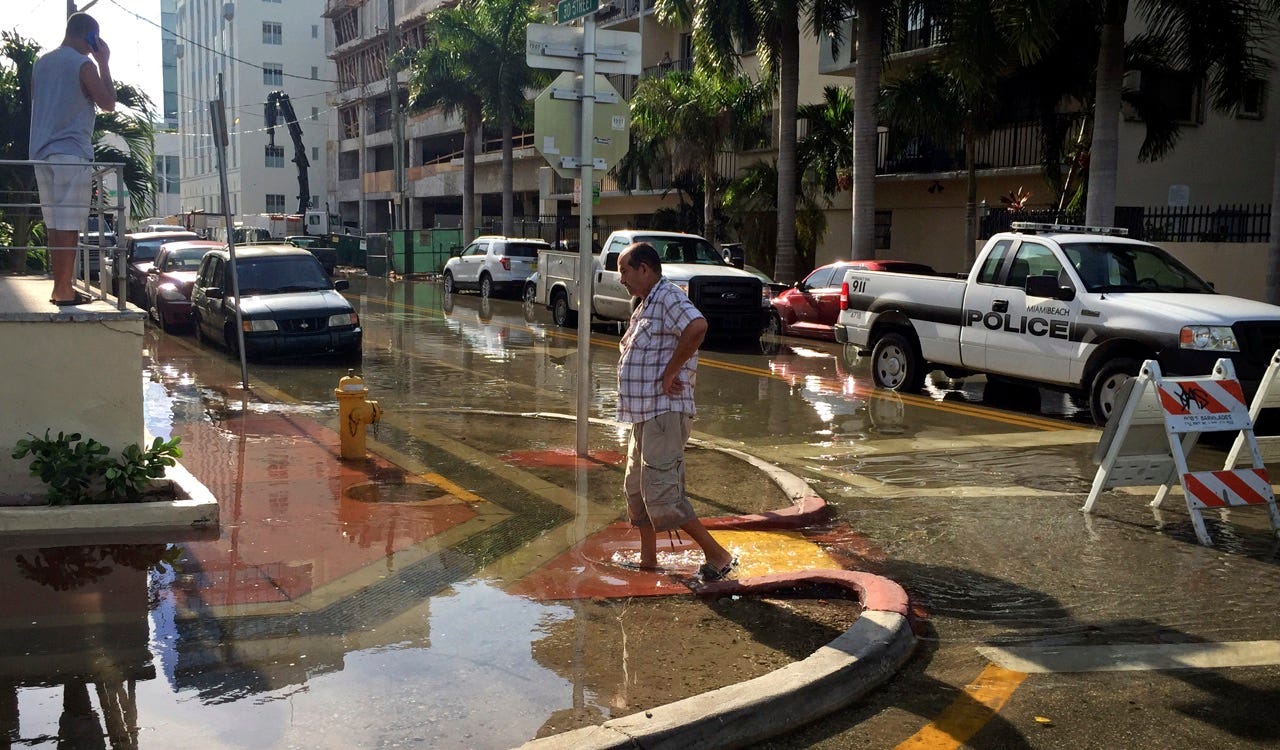 Coastal communities like Miami Beach are vulnerable to flooding from rising sea levels, and Latino areas often receive less protection and infrastructure development than White areas. Photo by Emily Michat / The Miami Herald via AP Coastal communities like Miami Beach are vulnerable to flooding from rising sea levels, and Latino areas often receive less protection and infrastructure development than White areas. Photo by Emily Michat / The Miami Herald via AP
She and other scientists tested the water standing in those under-served areas, confirming it was indeed salt water. “In flood waters, there is bacteria and all sorts of toxins floating around. Kids were walking in that water to get to their school buses.”
Residents called their elected officials for help, but she says the response they received was always, “Oh, it’s the king tide. It’s part of living in Florida.”
Latinos: A Force for Change
When Hernandez Hammer knocks on doors, she finds that her Latino neighbors are only too willing to join her — to protect their homes and to protect the environment.
A lot of the information they get is from international news sources like Telemundo and Univision that are pulling data from scientists, so their information is accurate.… They have no doubt that climate change exists and is a major issue.
Consequently, once given the opportunity to join the national conversation on climate by leaders like Hernandez Hammer, Latinos in Florida and elsewhere have been turning out in droves to push for climate justice and renewable energy.
“We’re looking for solutions,” she says. “There’s been a lot of work letting people know what climate change is and what might happen, but we’re living now with climate change.
At this point, we’re asking, “How do we address impacts and take clean, renewable energy into account?’”
Currently, the Latino community and others across the state are collecting signatures for Florida’s Solar Choice ballot initiative, which would allow Floridians the option of choosing solar power. (The “Sunshine State” is currently one of four states that prohibits residents from buying electricity from any entity that is not a utility, in effect making putting up rooftop solar panels largely illegal.) They’re adding their voices and efforts to local initiatives like the Southeast Florida Regional Climate Change Compact, an agreement among four counties to “coordinate mitigation and adaptation activities across county lines,” in particular to call for the use of renewables. And they’re getting out their word about the growing power of the Latino vote in the 2016 elections.
Organizations like Voto Latino and Mi Familia Vota are urging Latinos across the country to upgrade their immigration status if needed to become naturalized citizens, so they can flex their voting might during this election year. While both organizations say Republican presidential nominee Donald Trump’s words about Mexican immigrants being largely “rapists and murderers” last June have been a huge driver for that effort, Hernandez Hammer believes that Latinos’ care for the environment will be a major catalyst as well.
One thing is certain: Hernandez Hammer is passionate about the role Latinos can play in mitigating climate change, and she won’t be hanging up her activist hat anytime soon.
“I want to do everything I can to educate, so kids of this generation know we’re working hard to give them a better future,” she says. “If we are able to prevent the worst effects of climate change, I want my son to know that I was a part of it. And if not, I want him to know we tried really hard.”
|
|
Native Leaders Lend Strength to the Climate Change Fight |
Longtime activist on environmental issues and how they affect Native communities, Tom Goldtooth (Mdewakanton Dakota and Diné) became passionate about climate justice in 1991, when he was appointed spokesperson of the Native Peoples Caucus at the first annual National People of Color Environmental Leadership Summit in Washington, DC. Goldtooth is the executive director of the Indigenous Environmental Network (IEN), which works with tribal communities at a local and global level to protect sacred sites and the environment through direct action.
The conference drove home for Goldtooth the reality that, because of the lack of jurisdiction and federal support, tribal territories are often targeted by companies with climate-changing infrastructure such as pipelines, oil extraction through fracking, and the extraction of oil in the Canadian Tar Sands.
“It was the grandmothers, sisters, and brothers who were there that really got my heart,” he says. “They were talking about life and death issues, … and people from the coal power plant regions were dying from respiratory illness. I also heard testimony from … African-American people from the southeast who had been around the chemical-polluting industries along the Mississippi River corridor from Baton Rouge to New Orleans.”
Since then, Tom and his son Dallas Goldtooth have continued to take action on climate justice, working in collaboration with tribes across North America. Though they’d be hard-pressed to admit it, the Goldtooths and IEN have played a key role in spearheading national Native activism on this issue, most notably in raising awareness of human rights issues at the United Nations Framework Convention on Climate Change (COP21) in Paris and providing critical support in pulling off what many thought was an impossible feat: stopping the Keystone XL (KXL) pipeline.
The Case Against the Pipeline
The battle to stop the KXL pipeline from being constructed is a prime example of the direct effect climate-changing fossil-fuels have on Indigenous communities.
Proposed in 2008, the 1,700-mile-long, $8 billion KXL pipeline was to bring 800,000 barrels per day of bituminous crude oil from the tar sands of Alberta, Canada, to the Texas coast.
The KXL pipeline’s projected path across the country involved the entire central portion of the United States from Canada to the Gulf of Mexico, and many tribal populations were gravely concerned about the pipeline crossing over tribal territories and the massive water sources supplying them. If the pipeline were ever to leak, the pollution could have potentially destroyed the water supply to millions of Native and non-Native people.
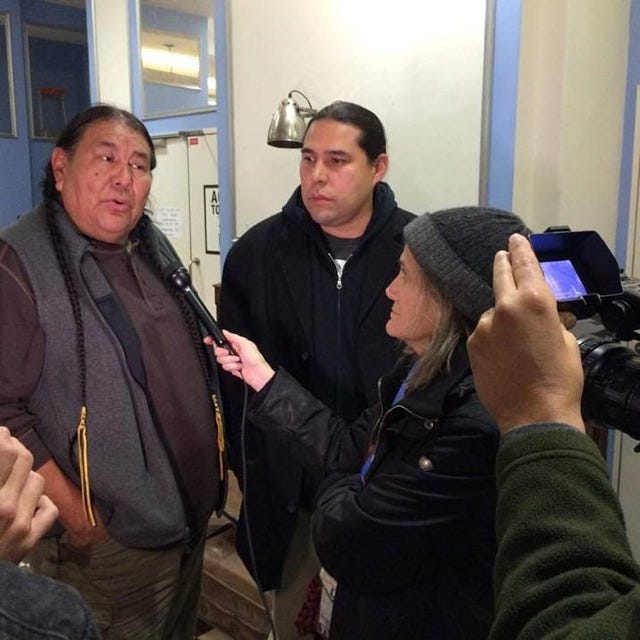 Left to right: Tom and Dallas Goldtooth talk with Democracy Now! radio host Amy Goodman. Photo courtesy Dallas Goldtooth.
If the people do not understand the sacredness of Mother Earth, I do not see how we can develop any global plan to stop the climate crisis.
— Tom Goldtooth
The tar sands are located approximately 250 miles north of Edmonton, Alberta, Canada, and cover 10 million acres of boreal forest. Underneath these lands lies bitumen, a tar-like form of petroleum that can be converted to fuel. To access the bitumen, the trees must be cut and cleared, and the bitumen must be converted to liquid fuel through an extraction process that creates up to four times the amount of greenhouse gases as standard oil drilling.
The bitumen also contains toxic substances known as polycyclic aromatic hydrocarbons (PAH), which can cause cancer, and which are reported in substantially higher numbers by surrounding First Nations communities than most other communities because their lands are closer to the tar sands.
Alberta’s First Nations communities, particularly women, had been fighting against the effects of tar sands extraction on their lands when plans for KXL started to emerge in the public eye around 2010. It was then that IEN launched one of the first anti-KXL campaigns to gain national attention in the US and Canada.
The Battle to Stop KXL
Knowing full well the potential impact of the KXL, activists from all over Indian Country joined IEN in the fight to stop the pipeline.
As Dallas Goldtooth told UK’s The Guardian “Our resistance to the Keystone XL pipeline and other tar-sand infrastructure is grounded in our inherent right to self-determination as Indigenous peoples. As the original caretakers, we know what it will take to ensure these lands are available for generations to come. This pipeline will leak; it will contaminate the water. It will encourage greater tar sands development, which, in turn, will increase carbon emissions.”
They took to the media, pointing out that Indigenous people in the US and Canada have treaties in place obligating the governments to care for tribes in exchange for natural resources from their lands. However, they said, these treaties have been unheeded throughout history, including when it comes to the Alberta tar sands. While Canada claims there are 1.7 trillion barrels of oil trapped in the tar sands, First Nations do not benefit from the financial gains of the oil, though they experience many of the negative impacts.
Indigenous people in many parts of the world are trying to maintain their subsistence lifestyle. They attempt to live off the land, and they continue to struggle to maintain these original instructions that we have maintained from time immemorial. Sadly, some of these extreme places are the same places where we are seeing these impacts of climate change happening. Because these places are targeted by industries, this ability to maintain a reconnection to the lands and animals is now limited.
— Dallas Goldtooth
The Goldtooths helped launch an Earth Day action in April of 2014 in which thousands of protesters, including the Cowboy and Indian Alliance and Winona LaDuke’s Honor the Earth Foundation, arrived in Washington, DC, to protest KXL. They started getting tribal councils across North America to pass resolutions against KXL, and they sent a declaration opposing KXL, signed by thousands of Native people, directly to President Obama. They also helped lead the People’s Climate March on September 21, 2014, in New York City.
A few weeks later, President Obama rejected the KXL pipeline proposal, citing its negative environmental repercussions. According to many, the world would not have seen such a victory if it hadn’t been for the organization and solidarity of Indigenous people.
Disappointment in Paris
Native leaders, including the Goldtooths, didn’t stop after KXL’s defeat. Many attended the COP21 in Paris, held November 30 through December 11, 2015, to push for a climate agreement that would include legally binding protections for Indigenous rights.
The Goldtooths participated in panels and events organized by the Committee in Solidarity With the Indigenous People of the Americas. During his time in Paris, Tom Goldtooth was awarded the Gandhi Peace Prize for his efforts in Native climate justice at a global level.
While the Paris climate agreement was lauded by many as a step forward in the fight against climate change, it tragically left out protections for human rights, including Indigenous rights. Native activists from around the world had called for such protections, particularly because Indigenous communities around the world are often forcibly relocated by governments colluding with corporations to raze rain forests or construct pipelines.
Dallas Goldtooth told Green America the rights of the Indigenous being slighted in Paris is admittedly old hat. “A lot of non-native allies asked us, “Why are you even going?’” he says. “I tell them, “We still need to acknowledge the message that needs to be told in terms of Indigenous people. We are still here.’”
While the Paris climate agreement was lauded by many as a step forward in the fight against climate change, it tragically left out protections for human rights, including Indigenous rights.
The Need for Native Values
Both Tom and Dallas say they will continue to deliver that message, primarily because they believe a profound respect for Native values is critical in the fight against climate change.
“If the people do not understand the sacredness of Mother Earth, I do not see how we can develop any global plan to stop the climate crisis,” Tom Goldtooth told Indian Country Media Today shortly after the Paris talks. “That is why Elders continue to encourage campaigns for the spiritual awareness of Mother Earth.”
“We need to connect to our original ways. It is more than just me,” says Dallas. “It is more than just my family and you. It is our future and the seven generations and the seven beyond that. This is something that deserves that passion.”
Written by:
Vincent Schilling (Akwesasne Mohawk) is vice-president of Schilling Media, Inc. and an editor at Indian Country Media Today. Follow him @VinceSchilling.
|
|
Black Lives Matter in a Changing Climate |
On December 10th, 2015, a delegation of 50 members, most from 15 historically Black colleges and universities held a rally. The familiar, and frequently polarizing, chant of “Black Lives Matter” echoed in the hallways of the Le Bourget Conference Centre. This was Paris, France; this was the United Nations’ 21st Conference of the Parties (COP21). The movement/delegation was there on behalf of minority communities calling for “climate justice.” “Dirty Air = The Silent Killer of the Black Community,” read one sign, “Don’t Frack Up My Neighborhood,” read another.
The Black Lives Matter (BLM) movement is perhaps best known for attempting to open a national conversation in the US around police brutality. But some BLM activists are now connecting the dots between the inequities in how police interact with communities of color versus White neighborhoods, and inequities in how communities of color are protected from the effects of climate change — as they are often hardest hit by them.
Black Lives Matter in Paris
Sarra Tekola, a climate justice and Black Lives Matter campaign activist, was one of those speaking about these connections in Paris. “When you think about a cop shooting you, it’s an immediate death,” she explains. “But climate change — with [related] pollution that’s mostly in our backyard — is still killing us. Respiratory diseases, asthma, and various cancers are slower killers, but connecting them to Black Lives Matter is really important.”
 Sarra Tekola, activist. Photo from Sarra Tekola
These issues are all connected, so you can’t solve climate change if we do not also solve other inequities.
— Sarra Tekola, Black Lives Matter campaign activist
According to a 2012 study by the National Association for the Advancement of Colored People’s (NAACP), Black and Latino families are more likely than White households to live near coal-fired power plants, for example. And African Americans and other communities of color are often more vulnerable to drought, heat islands, and extreme weather events, due to a legacy of socioeconomic inequalities or unequal protection from local and national government officials.
The delegation staged various actions such as protests, speeches, and workshops to educate anyone interested on the plight of low-income communities and people of color.
“At the end of the speeches, we put breathing masks on to represent the air quality in our neighborhoods and walked out into the green space of the COP21, where the public is allowed to be, [to stage a die-in] and chant “We Can’t Breathe!’” recalls Tekola. Afterwards, the delegation rose to their feet and started to chant “Black Lives Matter.” “It was really dope because there were Africans and Indians and people from around the world who joined in.”
While some may have been initially confused, thinking the climate change discussions were being co-opted to amplify concerns of stateside police brutality, Tekola and the delegation soon explained why Black and Brown lives also matter when it comes to the climate crisis.
“These issues are all connected, so you can’t solve climate change if we do not also solve other inequities,” says Tekola. “Eric Garner died because he couldn’t breathe [after being put in a banned chokehold by New York City police], and there are so many kids in communities of color who are dying because they can’t breathe [from coal pollution]. In the end, I think everyone who heard us realized that, and it was a very powerful moment.”
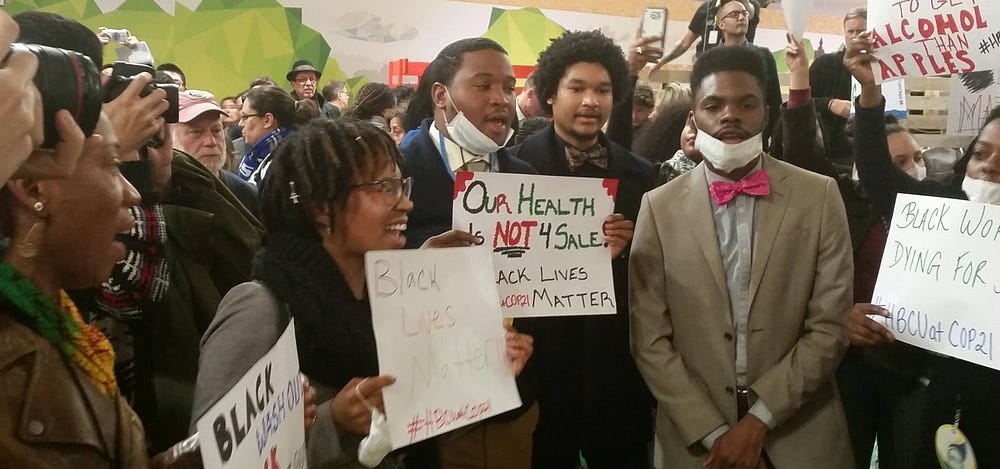 The delegation from historically black colleges and universities in Paris for COP21. Photo courtesy of Dr. Robert Bullard
Bringing in Diverse Voices
Part of the reason people of color haven’t been as able to contribute to the larger conversation around climate change — the one that includes inequities in race, class, and other socioeconomic factors — is that mainstream environmental groups have largely failed to reach out to them and hear their stories, says Dr. Robert Bullard, Dean of the Barbara Jordan-Mickey Leland School of Public Affairs at Texas Southern University. Dr. Bullard was one of the organizers of the delegation.
 Dr. Robert D. Bullard. Photo by the Washington Post via Getty Images
“People of color may not belong to an environmental organization but are members of churches, civic groups, civil rights or faith-based organizations that do work in areas of environmental and climate justice,” he says. “Environmentalism has to be broadened to incorporate organizations and groups that may not necessarily have ‘environment’ in their name.”
Environmentalism has to be broadened to incorporate organizations and groups that may not necessarily have “environment” in their name. — Dr. Robert Bullard, “Father of Environmental Justice”
Jacqui Patterson, director of the NAACP’s Environmental and Climate Justice Program, was also well aware of that need. The NAACP sent its own delegation of youth and front-line community leaders to Paris, led by Patterson.
“People are really being starved for conversations around race and climate change,” she says. Back in 2009, when the program first launched, she started by going out in communities of color to obtain the firsthand accounts of experiences dealing with impacts of climate change that would shape the program’s strategic objectives.
She was flooded with responses.
“We got stories like, ‘Yeah, as a matter of fact, my wife or husband or brother or sister died of lung cancer, and they’ve never smoked a day in their life,’” recalls Patterson. “Time and again, you heard people like teachers talk about all the kids in their school with inhalers, and others talk about having people in their church needing respirators.”
The stories had a striking repetitiveness, but looking at the numbers — including that 68 percent of African Americans live near coal-fired power plants despite making up only 13 percent of the US population — things became obvious and, to an extent, uglier.
“It was really a listening time,” explains Patterson, “but at the same time, we started drawing connections between what our communities are experiencing and climate change. Then we started working on solutions.”
Cooperation Jackson Leads the Way
It isn’t just climate change that’s affecting communities of color; it’s also the greening process that’s largely excluding them. But African-American communities are taking action where governments are stalling.
Much of the Gulf Coast region is still struggling to recover from Hurricane Katrina, the superstorm that hit the Gulf Coast in 2005. Kali Akuno, co-founder of Cooperation Jackson, a cooperative network in Jackson, Mississippi, points out that there are several climate-change impacts in the region that were, and are, having pervasive adverse effects.
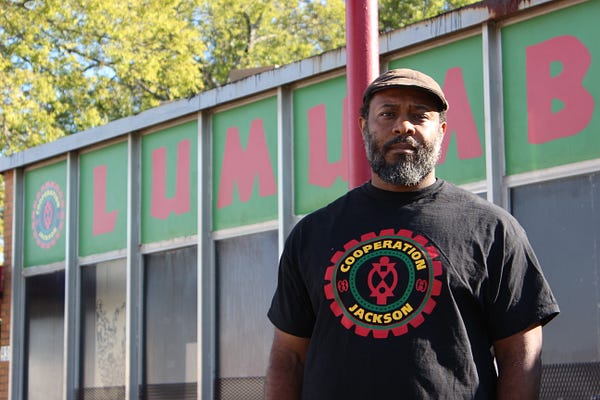 Kali Akuno of Cooperative Jackson
We are the product of a resilient community, and a resilient people who have had to make a way out of no way. — Kali Akuno, co-founder of Cooperation Jackson
“The swamp and marsh lands of the Mississippi Delta are disappearing at a rapid rate before our eyes due to rising sea levels,” he says. “And over the past 20 years, our growing zones have shifted rapidly, as the overall climate is becoming more tropical in certain places and more arid in others.”
The changing of these zones, which were once well-suited for agricultural crops, is gutting the state’s economy, which is still heavily dependent on food production.
So organizations like Cooperation Jackson have sprung up to address these deficiencies related to climate change, as well as the region’s history of discrimination and economic inequality. Cooperation Jackson aims to transform Jackson into the green capital of the South in such a way that benefits everyone and can be replicated in other resource-strapped and low-income communities. The overall goal is to create a network of worker-owned cooperatives and enterprises in Jackson to keep a greater concentration of earned income circulating locally.
Cooperation Jackson’s community Housing Co-op has purchased a number of vacant lots and abandoned homes to develop sustainable low-income housing, with an eye for energy-efficiency. It also plans to develop a zero-waste, highly energy-efficient “EcoVillage” co-housing community. Much of this work will be completed by other Cooperation Jackson co-ops, including the green Construction Co-op and the Waste Management/Recycling Co-op.
“We live in an extremely poor community,” says Akuno. “Energy-efficient houses, powered by solar and thermal energy will radically change the quality of life in our community by reducing energy costs by at least half.”
The group has already established and is expanding a network of cooperative urban farming plots around the city, to supply Jackson with affordable, high-quality food to fight against food deserts, which have only become more prevalent since Katrina.
Cooperation Jackson also plans to launch a child care co-op, to provide affordable child care and a “multicultural education” to the city’s children. And soon, the Nubia Lumumba Arts and Culture Co-op will expand the arts, entertainment, and hospitality industries in the city.
From Akuno’s perspective, sustainability and resilience isn’t a new concept people of color have turned to in an effort to fight climate change. “We are the product of a resilient community, and a resilient people who have had to make a way out of no way,” he says. “So we draw our inspiration and lessons from this rich history to add to its legacy. In Jackson, we can be an example for other oppressed and exploited communities throughout the US and the world.”
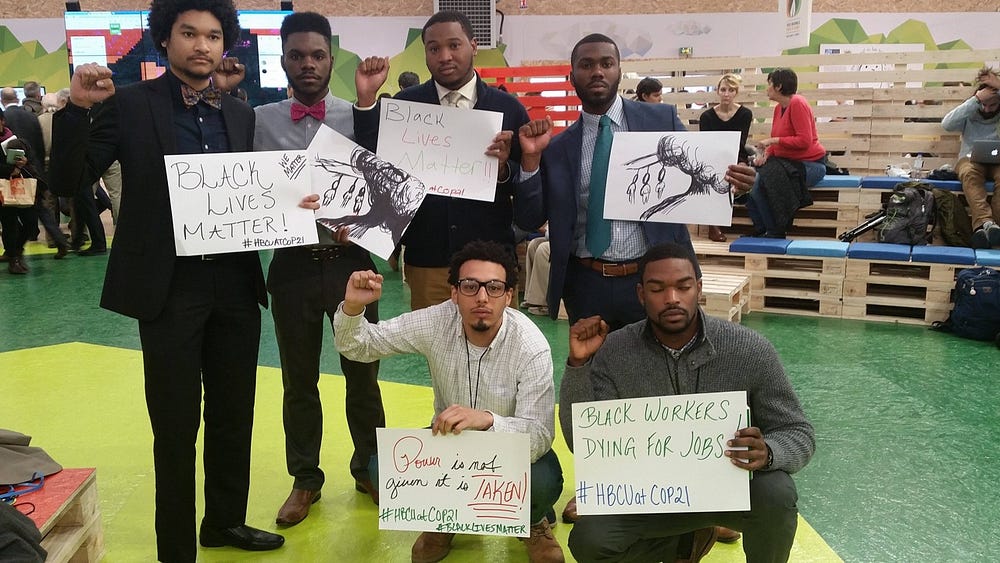 Black Lives Matter activists from the historically black colleges and universities delegation at COP21. Photo courtesy of Dr. Robert Bullard
Taking it to the Streets
Both communities of color and White communities are looking at solving the climate crisis, but for a different set of reasons, says Akuno. Communities of color often start from the pragmatic viewpoint of having access to the worst food, and of not having jobs or sustainable farming. White communities, on the other hand, are more likely to already have their basic survival needs met and come more from a standpoint of environmental conservation, he says.
Wherever there is an injustice and wherever people are exploited, the ecosystem as a whole will collapse. — Sarra Tekola
“The challenge that we’ve had is to get these two points to converge and see the need each has for the other,” says Akuno. “[It’s not about] trying to shame people or exclude them or make them feel bad. The point is to call this out so we can address it and come up with a practical, concrete, and strategic solutions that’ll help us all go forward.’”
Most importantly, he says, decision makers in all communities need to be representative of the changing demographics of the world, to ensure everyone can afford sustainability.
It’s to everyone’s benefit that we make both happen sooner rather than later, says Sarra Tekola.
“Our economy is measured by growth, but it’s a finite planet,” she says. “Those inequalities [that currently exist] will eventually affect all of us because we all share the same atmosphere. Wherever there is an injustice and wherever people are exploited, the ecosystem as a whole will collapse. These things are very much connected.”
The best way for all people to help is by spreading awareness, through conversation and activism, says Tekola.
“I’ve worked in nonprofits and government agencies, and the ecology side and also in academia,” she says, “but what I’ve seen get the ball rolling more than anything is when people get out in the streets and push for change.”
|
|
Climate Justice for All |
People of color are on the front lines of the climate crisis, and are leading the call for equitable protection and meaningful action.
Green American published this dedicated to amplifying the voices of those on the front lines of the climate crisis, working to protect the most vulnerable areas around the world. No matter what your background is, it’s vital to join the climate-justice conversation where you live — and work to ensure that everyone is included.
|
|
Reduce, Reuse, Recycle |
The average American throws away 4.4 pounds of trash in a single day. We use less and recycle more to treat the planet better. Here are some ways how.
|
|
Sustainable Shopping Tips |
Supporting the green economy is more than being informed—it’s about following through and “voting with your dollar” as we call it. Where you shop and what you buy when you do sends a message to business owners. And it helps sustainable businesses stay afloat in a deal-driven market. Here are our favorite sustainable shopping tips.
|
|
Sustainable Personal Care |
|
|
Reduce Your Carbon Footprint |
Individual action can make a difference on climate change. Here are easy tips for lowering your carbon footprint significantly.
|
|
Sustainable Food |
|
|
Growing Sustainable Communities |
|
|
Sustainable Kids |
|
|
Economic Action |
Throughout our lives we're likely to spend $1 million or more. We each have a lot of economic power to move the economy in a greener direction.
First, we can choose not to purchase items we don't really need. On average, the American home has over 300,000 items in it. Many of those are never used. Before making a purchase, it's a great idea to really think about whether we need it. Many times the answer is no.
Second, we can shift our purchases in a greener direction. Look to purchase organic and local foods. Purchase clothing and furniture used. Shop at local stores that are owned by women or people of color. When we need to buy items new, check to make sure that they are truly green. Green America's Green Pages is a great place to find the greenest businesses in America.
Third, with the money we save from buying used and buying less, we have more money to invest in better banks and credit unions that invest in communities nationwide and in mutual funds that are divested from fossil fuels, private prisons, and sweatshops. That way we're saving for our retirement while creating a better world.
|
|
Environmental & Climate Justice |
Climate change is threatening the whole world, but communities of color and lower incomes are experiencing the effects at a disproportionate rate. Exposure to toxic pollutants also typically hits low-income communities and communities of color the hardest. Green America strives to expose these disparities and share what these communities are doing to combat the potentially deadly threats their neighborhoods face.
Environmental and climate justice calls for new policies on the climate crisis and emphasizes the need for action within the communities that are affected most by the changing climate. According to the NAACP, race is the number one indicator for the placement of polluting facilities in this country – a clear example of how change is needed on a country-wide scale.
From environmental activism, like growing community gardens, to pushing for policy change, people across the country are standing up for clean water, clean food, and clean air. By participating in efforts to decrease global warming and its effects on human health, we can do our part to fight the climate crisis.
Be inspired by what these communities are doing to make a difference, and find out what you can do to help.
|
|
Voices for Justice |
People all over the country are standing up for justice. Leading the charge are marginalized communities, people of color, and advocates of underrepresented groups speaking out on the issues they face. These voices are crucial leaders we must listen to in order to create a more equitable and just world. Together, we can build a society where the planet and all its people are able to live healthy and safe lives.
But first comes hearing, amplifying, and helping these voices for justice. Read about these leaders making big changes in their communities and for the world, highlighted in our quarterly magazine, Green American.
|
|
Fighting Pipelines |
Green America is active in fighting pipelines nationwide. Pipelines for fossil fuels provide the infrastructure to keep America addicted to fossil fuels. That addiction to fossil fuels is, in turn, fueling climate change. The US is the number two contributor to climate change in the world (second only to China, which has a far larger population), and the energy and transportation sectors drive most of that climate change.
Pipelines don’t only fuel climate change. They also cause massive amounts damage on a local level:
- Building pipelines results in deforestation and the destruction of habitats for multiple species
- There have been approximately 9,000 significant pipeline spills over the past 30 years. Over 500 people have died because of these spills, in addition to 2,576 people injured, and over $8.5 billion in financial damages [1]
- Property owners around the country have had their land seized under eminent domain to build pipelines. Lower income people and people of color are disproportionately affected by this, including Native Americans.
Fighting Back Against Pipelines and Fossil Fuel Infrastructure
Local people impacted by pipelines are the leaders in fighting these deadly fossil fuel projects. Several of the largest pipeline projects in the US directly impact American Indian communities, including the Keystone XL and Dakota Access pipelines, and it is these communities are on the front lines of fighting back. Green America has joined with allies nationwide to support impacted communities in opposing the following:
- The Keystone XL Pipeline, which would bring 830,000 barrels of tar sands oil to the US each day
- The Dakota Access Pipeline, which would bring over 570,000 barrels of fracked crude oil from the Bakken Shale each day. The pipeline threatens the lands of the Standing Rock Sioux and the water supply of millions of people
- Cove Point, a natural gas pipeline and liquefied natural gas export facility in Maryland, that would export fracked natural gas oversees
- The Jordan Cove liquefied natural gas terminal in Oregon, which would have exported fracked gas oversees. In 2016, the Federal Energy Regulatory Commission denied a permit to Jordan Cove, making it one of the rare fossil fuel projects rejected.
- The Atlantic Sunrise pipeline, which would bring fracked natural gas through Pennsylvania
Fighting the Federal Energy Regulatory Commission (FERC)
FERC is the federal agency that is charged with reviewing and approving natural gas pipelines and infrastructure in the US. FERC approves almost every pipeline that it reviews. Green America has joined with dozens of allies nationwide to call for Congressional hearings regarding FERC’s rubber stamping of fossil fuel industry projects.
Specifically, Green America is working with allies to call attention to:
- FERC’s bias in support of the industry it is supposed to regulate. Since FERC is 100% funded by the industries it regulates is has no incentive to deny any project that comes before it. FERC has denied only one natural gas pipeline project in the 30 years since it has been funded this way
- The revolving door between FERC and the industry it regulates
- FERC’s process discourages public comment, and the agency does not allow people impacted by proposed pipelines to speak at all at FERC’s public hearings
- FERC’s use of consultants who work for the pipeline industry and clearly have a conflict of interests
Fighting Funding of Pipelines
We must put pressure on the Wall Street banks that finance the fossil fuel industry. Several banks that claim to have strong climate commitments, but simultaneously finance pipelines, fracking, and oil exploration in the US.
We urge individuals and institutions to divest from fossil fuels and the banks that support the industry. Green America is at the forefront of the movement to encourage individual investors divest from fossil fuels, and our Break Up With Your Megabank program has helped thousands of Americans move their money from megabanks to community banks and credit unions.
|
|
12 Green Alternatives to Amazon |
Back to the Vote With Your Dollar Toolkit
Like many, you probably shop online. Amazon.com is the world’s largest retailer and is synonymous with online shopping. 55% of shoppers in the U.S. turn to Amazon as their first stop. In 2014, we dug into the company’s record on environmental and social responsibility and found Amazon performing poorly across the board–from dirty energy to worker exploitation. While Amazon has responded to consumer pressure by adopting more renewable energy, it is still a laggard on environmental and labor issues.
Choosing to spend money wisely, in ways that support our value, can have a major impact. This year, if you are shopping online, consider one of these green alternatives to Amazon.
See our expanded Amazon alternatives list here!
Green Alternatives to Amazon
Company
|
Products
|
How They’re Green
|
 |
Books, Audio Books, DVDs |
Operates a fleet of biodiesel-powered trucks, purchases wind power, and generates electricity from solar panels on their roof. |
 |
Books, Audiobooks, eBooks, Textbooks, DVDs, CDs |
By offering previously-owned merchandise BWB has recycled and re-used over 250k tons of books and offset 44k tons of carbon emissions. |
 |
Home Décor, Accessories, Artisan Goods |
Offers a wide range of organic, fair trade, recycled, and chemical-free products, made by artisans in more than 20 countries, including the U.S.  |
 |
Crafts, Jewelry, Art |
By sorting for “handmade” consumers can connect directly with artisans around the world to purchase their products. |
 |
Fair trade Arts and Crafts, Jewelry, Music, Food |
Handmade jewelry and textiles provide equitable returns to artisans in developing countries. |
 |
Used Goods — hundreds of categories |
Largest online engine for reuse on the planet; allows people to sell items they own and are not using, reducing demand for new manufactured goods and landfill space. |
 |
Fair Trade Arts and Crafts |
Supports environmental education in Mayan communities, uses post-consumer recycled paper, hybrid vehicles, and website hosted by 100% wind power. |
 |
Fair Trade Gifts & Textiles |
All products are handmade from repurposed materials and empower women in India through fair trade. Plus, items are shipped using eco-friendly packaging materials. |
 |
Fair Trade/Eco Clothing |
Makes high-quality clothing from natural and organic fibers such as cotton, silk, wool, and alpaca; committed to using environmentally-friendly dyes. |
 |
Fair Trade, Organic Clothing |
Uses certified organic fibers, purchased directly from growers. Fair labor practices are in place through all stages of production, and manufacturing is limited to North & South America to reduce carbon usage. |
 |
Fair Trade Coffee, Tea, Chocolate, Gifts |
Sources from over 40 small farmer organizations in Africa, Asia, Latin America and the United States. |
|

|
Fair trade jewelry, gifts |
Fair trade jewelry made from new and recycled materials, made using fair trade practices in Guatemala. |
 Designates a certified member of Green America’s Green Business Network® Designates a certified member of Green America’s Green Business Network® |
Amazon’s Sustainability Record:
Environment
Amazon uses huge amounts of electricity and most of the company’s energy comes from coal-fired power plants. In 2015, in response to mounting public pressure, including our Build A Cleaner Cloud campaign, Amazon’s hosting company, Amazon Web Services (AWS) announced it would invest in both solar and wind energy projects. As these projects came online, AWS is now using 50% renewable energy to power its massive network of data centers. The company has committed to move to 100% renewable energy by 2030, but is still behind competitors like Apple and Google.
However, Amazon’s commitment to a cleaner cloud is being called into question due to its overtures to the fossil fuel sector. Online tech news site Gizmodo published an explosive exposé showing that Amazon is actively courting business from the largest oil and gas companies to put the power of Amazon’s giant servers to work to make it easier to drill for fossil fuels. Amazon aims to make millions or billions of dollars. The resulting climate impacts will exact a huge cost on all the rest of us, in the form of extreme weather, failing crops, and social instability.
In addition, Greenpeace has called into question Amazon's commitment to clean energy in Virginia, where many of Amazon's servers are located, and found that those servers are powered by 12% renewable energy.
Amazon is also still stalling in terms of transparency, refusing to report its energy usage and climate impacts to the Carbon Disclosure Project.
Workers
Amazon got a lot of positive press when it increased the minimum wage in its warehouses to $15 per hour, but that move came in response to intense public pressure and hides the reality of working conditions throughout the company's supply chain.
First, while Amazon raised the minimum wage, it cut benefits at the same time. It is difficult to determine if workers are better off overall after the benefits cut and the minimum wage increase, as one of the benefits that was cut was giving workers stock in the company.
Second, Amazon warehouse workers labor under brutal conditions. Workers in Amazon’s “Fulfillment Centers” (warehouses) have been found to work non-stop on their feet in non-air conditioned buildings. These same workers are forced to sign 18-month non-compete agreements, which prevent them from finding other similar work, should they be let go. The author Simon Head concluded when it comes to labor practices, “Amazon is worse than Walmart.”
Just recently, a warehouse worker died while working in Amazon’s warehouse. Amazon waited 20 minutes before calling for help and demanded other workers immediately go back to work, granting workers no time to process the loss of their co-worker, and this is not the first time this type of incident has occurred. NYCOSH recently published a great report on the negative health effects of Amazon’s high daily quotas for warehouse workers.
Third, Amazon uses many contract workers to deliver its packages, and these workers are paid by the number of packages delivered, which creates incentives for overwork and unsafe driving. This summer, an Amazon contract driver killed a woman.
Fourth, concerns have been raised regarding the overseas labor that manufactures Amazon's devices. Workers are not being protected from toxins, and reports have found underage workers in Amazon factories.
Finally, even white collar workers are not protected. The New York Times’ explosive expose on Amazon’s white-collar workers revealed that while employees at Amazon’s Headquarters may earn a great deal, they are often subjected to a ruthless working environment. Current and former employees conveyed tales of working for four days without sleeping, developing ulcers from stress, never seeing their families, even being fired for having cancer or a miscarriage and needing time to recover.
Corporate Citizenship
Like many corporate behemoths, Amazon has a history of shielding profits overseas, and for years, it fought against charging sales tax on its products. In 2018, Amazon paid $0 in taxes on $11 billion in profits.
Amazon has also been spending money to influence local politics. The company has spent money to defeat a tax on large companies in Seattle where the proceeds would help address the homeless crisis.
Back to the Vote With Your Dollar Toolkit
|
|
Green American Magazine Header image |
|
|
Home Energy Efficiency to Save Money |
Energy efficiency refers to ways of improving products or systems so that they require less energy to do the same amount of work. Increasing energy efficiency is one of the fastest, easiest, and most cost-effective technological solutions for cutting carbon dioxide emissions and mitigating climate change.
Energy efficiency also makes economic sense: people and businesses can save money by reducing the amount of electricity, heating, and cooling that they use. Energy efficient appliances, like those rated by Energy Star®, the EPA’s energy efficiency program, can save a lot of money. Home appliances like refrigerators and washing machines account for about 13% of all household energy costs. Even replacing just your washing machine with an Energy Star® rated machine can save $360 over the lifetime of the product.
Here are some ways Green America recommends to increase your efficiency:
Optimize heating and air conditioning
The air conditioning and heating unit in your house uses an estimated 40-50% of all energy costs. Cutting your energy use here, therefore, is one of the most effective ways to reduce your home’s ecological footprint.
- Get an energy audit and shave 5-30% percent off your energy bill. Simple fixes like caulk and weatherstrip doors and windows, cover your air conditioner, shrink-wrap window glass, and install insulating shades to keep icy drafts out of your home in winter.
- Turn the thermostat or air conditioner down when you're away from the house. Programmable thermostats can store as many as six temperature settings per day, returning to pre-set schedules automatically.
- Open south-facing shades during the day, and close the curtains at night to make the most out of the sun's energy during winter. During the summer, close these shades during the day.
- Read our article: Buying Energy Efficient Appliances to discover the best options for efficient home appliances.
Take the five lightbulb challenge!
In 2021, 4% of electricity use in the US went to lighting our homes. Commercial buildings, like retail, institutions, and public street lighting used about 11% of the US electricity budget that same year. Many of those bulbs are incandescent, which are energy inefficient.
In contrast, light emitting diodes (LEDs) use 90% less energy and last 25 times longer. On top of saving energy, since they're so long-lasting, you'll save resources and landfill space. Challenge yourself to replace at least five of your incandescent bulbs in your home with energy efficient bulbs. You won't just be doing the environment a service—you'll save $225 a year in energy costs.
Control “vampire” loads
Vampire loads is the term used for when appliances and electronics continue to draw electricity when they are turned off or on in standby mode. One way to reduce vampire loads is to unplug your electronics while they are not in use.
TVs pull the most energy when turned off. Try a smart or advanced power strip, which stops energy flow to plugged in appliances when not in use. It can cut your electric use 20-48%, saving you money in the long run.
Turn down (or replace!) your refrigerator
The refrigerator is the biggest energy consumer in most households—adding up to a quarter of an average home's energy use.
You can save energy by ensuring that you don't keep your refrigerator below the recommended temperature setting of 35°-38°F for refrigerators and 0°-5° F for the freezer section. To test the temperature, place an appliance thermometer in a glass of water inside your refrigerator or freezer and take a reading after 24 hours.
Also, make sure your seals are airtight, cover liquids foods stored in the refrigerator (uncovered foods release moisture and make the compressor work harder), and regularly defrost manual-defrost freezers and refrigerators.
Maximize your dishwasher’s efficiency
Some dishwashers will allow you to turn down the internal temperature. Other recommendations include: use cold water only to rinse dishes before loading them if necessary; be sure your dishwasher is full, but not overloaded when you run it; and let your dishes air dry instead of running the drying cycle.
Reduce the cost of cleaning your clothes
Despite popular misconception, washing your clothes with cold water will still get them clean, as well as create less wear and tear. Switching to cold water also reduces your carbon footprint by 10%. Most of the energy in the washing machine goes to heating the water!
Dryers use an egregious amount of electricity, and they're not even necessary household appliances when the sun is right there. While it's not always perfect for all times of year, air drying can go a long way in electricity savings as well as extending the life of your clothes. You can set up more efficient ways to dry clothes, such as using an outdoor clothesline or an indoor drying rack.
|
|
In OUR FUTURE: Concerned About Climate Change? Change Where You Bank |
OurFuture.Org: OpEd byTodd Larsen, Green America, April 19, 2017
At the end of April, hundreds of thousands of people will take part in the People’s Climate March in Washington, D.C. and around the country. The march will send a clear message that the majority of Americans understand that climate change is all too real — and they’ll continue to raise their voices until the government takes action.
The march is also a great way to inspire people to take action for climate solutions in their own communities — whether by calling their elected officials or speaking up at town halls, pushing their local and state governments to act, or working with schools and houses of worship to address the climate crisis without waiting for Washington.
If all that’s not for you, there may be an even simpler option: Move your money.
Many people might not realize that their savings may be working directly against efforts to address climate change. If you bank with any of the largest American banks — including Citibank, Bank of America, and Wells Fargo — then every dollar you put in to your checking and savings accounts is funding fossil fuel development across the country.
The Dakota Access Pipeline? Funded by megabanks. Keystone XL Pipeline? Same story.
Megabanks are expanding fracking, oil drilling, pipelines, compressor stations, and export terminals from coast to coast. They’re underwriting decades of reliance on fossil fuels, and directly undermining the important work of cutting climate emissions by 80 percent by 2050.
Many big banks claim that they understand the risks of climate change and promise to increase their investments in the clean energy economy. Over the next 10 years, Citibank pledges to invest $100 billion in clean energy. Bank of America says it’ll spend $125 billion by 2025.
But these are pledges, not actual investments. They can’t undo all the harm that these two behemoths are causing through past and current investments in fossil fuels.
Between 2013 and 2015, Citibank bankrolled coal-fired power plants alone to the tune of $24 billion. Over the same period, Bank of America invested at least $10 billion in coal power, $24 billion in liquid gas terminals, and over $29 billion in underwater, tar sands, and Arctic oil extraction.
And, while megabanks have started moving away from financing coal in wealthy nations like ours, they still bankroll coal in poor nations, where environmental regulations are weaker.
Ceres, a national nonprofit organization that mobilizes investors and business leaders to build a green economy, estimates that in order to keep global temperatures below catastrophic levels, we need to be investing $1 trillion additional dollars per year in clean energy. Against that, even the big banks’ multi-billion-dollar pledges are insufficient.
It’s not like the banks don’t know this. Citigroup itself estimates that the climate change impacts will cost us $44 trillion globally over the next 50 years.
So what can we do as average Americans? One thing we can all do is not let Wall Street destroy the planet with our money. There’s a growing movement of Americans moving their money away from megabanks and into community banks and credit unions.
These local institutions invest in their communities, creating jobs and housing — not dirty energy projects. Community-based banks and credit unions are helping to put solar panels on roofs, end food deserts, and help people start thriving local businesses.
And you can shift your other investments, like your retirement savings, to fossil-free mutual funds that invest in clean energy. You’ll get competitive returns, and you’ll know that your money is working for a cleaner world.
|
|
High Impact Community Investing |
Community investing is using your investments to create resources and opportunities for disadvantaged people who are under-served by traditional financial institutions. Your participation in this kind of impact investing could help people attain home ownership, start small businesses, or address other community needs. If you open an account at a community development bank or credit union, you’re already doing community investing!
High-impact community investments are not necessarily the best way to grow your wealth, but rather to better the world and also diversify one's portfolio. High impact options are generally one to five-year investments that offer market or below-market returns (0 percent to 4 percent) depending on how the market is performing, and may not be insured. Community development banks and credit unions can be FDIC or NCUA-insured. Community investments have high impact because investor money can reach borrowers who are most in need of funds to strengthen their communities.
If you're trying to grow your wealth while also changing the world, there are other ways to engage in socially responsible investing.
As a reminder, always do your research before investing.
Main types of high-impact investing:
-
Community development banks or credit unions support job creation, affordable housing, small business, and healthy communities. They area a great alternative to conventional mega-banks that finance fossil fuel infrastructure, sweatshops, factory farms and other destructive industries.
-
Community Development Loan Funds provide affordable financing for housing and economic development projects, cooperatives, and community-based nonprofit organizations. These loan funds are not insured, although they use grant money and loss reserves to help protect individual investors.
-
Micro-enterprise Loan Funds provide small loans and training to entrepreneurs in the US and overseas to create economic development and jobs.
-
Community Development Venture Capital Funds provide loans to businesses that are creating jobs in low-income communities.
-
Pooled Investment Portfolios are a great option if you want to diversify your community investments. You invest through one large facility, which spreads the money out within a pool of institutions that serve many low-income areas in a variety of ways.
-
Mutual Funds are collections of stocks and bonds that are managed by professional money managers, meaning that expert investors are doing the research to pick investments. Anyone can invest in mutual funds. Some socially responsible funds devote up to ten percent of their assets to community investing, and several even put 100 percent of their assets into underserved communities. With these funds, you can use your investment dollars to promote corporate responsibility and contribute to improving disadvantaged communities, while saving for your own retirement. These funds are not federally insured.
How much will my investment returns be affected?
It depends on what type of community investing product you choose.
- If you choose to open accounts at a community development bank or credit union, you'll find the interest rates to be comparable to those at traditional banks and credit unions.
- With community development loan and microenterprise funds, you will often find the returns to be in the 0 percent to 4 percent range.
- The interest on venture capital funds varies.
No matter what the market is doing overall, experts agree that every investor should have a diversified portfolio to minimize risk and achieve a variety of investment objectives. Community investing can be an important part of a diversified portfolio.
How safe is my money when I do community investing?
Accounts at community development banks and credit unions that are federally insured are just as safe in these institutions as they are in traditional banks or credit unions.
Community development loan funds, microenterprise funds, and venture capital funds are not insured—and the same holds true for mutual funds with community investment components—so the risk is higher. Be sure you're fully educated about these options before you decide to invest.
How much of my money should I use for community investing?
Even one percent can make a big difference for communities. If every socially responsible investor put one percent of their portfolios into community investments, it would triple the funding put into rebuilding disadvantaged communities. That money could build more day care centers and schools. It could provide micro-loans to single parents or former welfare recipients wanting to start small businesses. It can help a low-income family build a home, save for their children’s education, or pay debts.
|
|
Our Mission - in a nutshell |
Green America's Mission is to harness economic power- the strength of consumers, investors, businesses, and the marketplace - to create a socially just and sustainable society. |
|
Development Officer |
Hours: 32 hours/week, 4 days/week (full time)
Salary: $60,000 -66,000 contingent on experience; (This position is grant tracked)
Benefits: Excellent benefits package, including health insurance, dental & vision coverage, sick days, holidays, and vacation
Supervisor: Director, Center for Sustainability Solutions
Deadline: May 15, 2017
Green America is a non-profit organization dedicated to creating a just and sustainable society by harnessing economic power for positive change. Our unique approach involves working with consumers, investors and businesses. Our workplace reflects our goal of creating a more cooperative, environmentally sound economy. We have a participatory decision-making process, which aims to build consensus within the departments and teams.
The Center for Sustainability Solutions at Green America supports several innovation networks, focused groups of stakeholders with the objective of making significant, industry-wide system change. The program team of the Center for Sustainability Solutions provides the strategic direction, stakeholder engagement program, facilitation and coordination services, and program management for participating individuals and companies in each working group.
- seek an experienced senior level position as a Development Officer who can hit the ground running to play a major role in raising major donor and foundation support for Green America’s Center for Sustainability Solutions. This includes cultivation of new major donors, grant support and the launch of a new initiative - the Thought Leader Network. We expect the Development Officer to manage a portfolio of 20-30 major donors, build the major donor pipeline with increased and new gifts, oversee the Center’s foundation fundraising, and effectively coordinate with the Center Director, CEO and the Director of Development Green America.
The position may involve occasional domestic travel (5-8 times per year). The position would be based in Washington, DC at the Green America offices.
Duties and responsibilities
Design and Implementation of an effective development strategy. Create and execute a comprehensive plan to expand our base of support and achieve fundraising targets for the Center for Sustainability Solutions. Proactively identify and pursue foundations and prospective major funders with potential to support the Center and/or specific programs and initiatives. Expand the breadth and depth of major donor and foundation support and continually grow the funding pipeline across time.
Coordinate with Innovation Networks within Center to identify intersection of funder priorities and key program areas. Support Center team to identify new programs/initiatives based on the existing and emerging priority areas of foundations and existing/prospective major funders. Liaise with funders and program staff to provide insight and resources for Center program development strategy.
Take active role in launch of Thought Leader Network. Take leadership role in strategy and recruiting members who will play both and advisory and funding role. Support Center Director and team with launch of a President Council-like network to grow Center and Green America.
Play a direct, lead role in forging productive long-term relationships – yielding significant sustained support – with existing/prospective major donors and foundation executives. Achieve personal fundraising targets for major donors and foundations. Build relationships based on credibility, trust and knowledge/understanding of prospective supporters’ values and priorities.
Effectively articulate Green America’s mission, objectives, programs, impacts and asks. Participate in creating compelling, effective fundraising messages and collateral. Effectively convey the organization’s mission, objectives, programs, impacts and asks in one-on-one conversations and with larger groups. Play a significant role in helping to increase Green America’s profile as a green thought/action leader within funding networks.
Effectively leverage the Executive Director, Development team and others in fundraising efforts. Proactively identify when it will be effective to strategically involve the President/CEO, Center Director and other leadership staff, in fundraising efforts and manage/coordinate their targeted participation. Track, manage and pursue leads, prospects and follow-ups passed on by others in the organization.
Skills/Experience
- Bachelor’s degree and at least 6 -10 years of proven high-level major gift fundraising experience.
- Demonstrated experience working with foundation programs including conducting research, meeting with program officers, producing successful proposals and reports.
- Certified Fundraising Executive (CFRE) certification (or working toward certification) preferred.
- Good relationship building experience
- Demonstrated ability to utilize technology and donor databases to manage fundraising efforts.
- Donor research skills and the ability to effectively identify, segment, and prioritize prospective major donors and foundations.
- Proven ability to effectively work in coordination with other team leaders.
- Strong project management and organizational skills with ability to meet tight deadlines.
- Exemplary communications skills, interpersonal skills, professionalism, and ability to build long-term relationships with key stakeholders.
- Excellent written skills with demonstrated ability to craft compelling, effective messaging and collateral for fundraising purposes.
- Strong intrinsic interest in issues directly related to Green America’s mission.
- Ability to obtain a deep understanding of Green America’s main program areas (safe food, clean energy, fair labor, and responsible finance) and communicate this understanding to donors.
How to Apply:
Send cover letter and resume to Center for Sustainability Solutions, Green America, 1612 K Street NW, Suite 600, Washington, DC 20006, or email centerjobs@greenamerica.org.
No calls, please.
Green America is an equal opportunity employer.
|
|
Economic Action Against Hate |
A burst of over 1,000 hate crimes and incidents have occurred since Election Day, and the President’s words and actions are only making perpetrators bolder. With White supremacists in the cabinet and anti-Muslim and anti-immigrant rhetoric coming out of the White House, we need green, people-centered solutions that bring people together—and don’t depend on Washington.
We believe in using the power of our wallets to create change in the world. And with the White House either unleashing hateful policies or hateful speech, it’s clear that government isn’t going to be leading the way on solutions for equality any time soon.
Hate has no place in the world Green Americans are working for: a world where everyone has enough, where all communities are healthy and safe, and where the abundance of the Earth is preserved for all the generations to come.
At a time when political leadership sets a tone of hate and division, we need solutions that don’t rely on Washington to create the world we want to see. So we invite in the light through our economic activism—hitting hate with our wallets. Together, we can use our economic power against hate and work to build bridges across the divides that split our country.
- Push for corporate responsibility—through your purchasing and banking choices, your investor voice, and direct communication with companies. Demand that corporate leaders stand against hate and use their power to push Washington in a better direction (p. 14). Encourage market forces to keep going and do more.
- Stand against hate though your workplace. Businesses are making a point to welcome immigrants, people of color, and the LBGTQ community into their stores and onto their employee rosters (see p. 20). Local businesses have a huge voice—use it!
- Break down stereotypes. Reach out to communities that are outside your normal path, particularly groups that are common targets of hate. For example, Muslim groups are collaborating with other faith groups on climate solutions (see p. 17). • Stand up for Black and Brown lives. A truly sustainable economy and movement is inclusive and diverse, makes space for all—and makes room for exploring how class, race, gender, ethnicity, religion, and sexual orientation affect our interactions.
- Be creative. Check out our “30 Ways to Say No to Hate” (p. 26). Dr. Martin Luther King, Jr. once said, “The arc of the moral universe is long, but it bends toward justice.”
We’re at a challenging time in our history where we may just have to reach up together and bend it a bit ourselves. We’ve done it before. —Tracy Fernandez Rysavy, editor-in-chief
|
|
Is a Green Roof Right for You? |
The sound of the rain pattering on your roof during a summer storm may also be the sound of a missed opportunity—for you and for the planet. Increasingly, homeowners are discovering the benefits of “green roofing”—or covering a flat section of their rooftops with an expanse of small plants growing in a few inches of engineered soil.
In addition to reducing household cooling and heating costs and extending the life of the roof, green roofs also assist with a host of urban environmental problems—they filter stormwater, help to cool and clean city air, and help prevent flooding. And, they add a cheerful touch of greenery that can be appreciated by those who look down on the roof from taller homes and buildings.
Green roofs defined
The design of green roofs are much more than meets the eye—from above, you might see an expanse of growing media or pebbles dotted with patches of small plants. But the real action takes place in the layers between the leafy surface and the roof.
An extensive green roof is placed like a rug over a swath of roof on which people don’t walk much. Moving from bottom to top through a slice of green roof, you’d find a special membrane covering the roof itself. This bottom layer is either a hot-applied rubberized asphalt or a cold-applied layer of synthetic rubber, which, in combination with a root-repellant material, is designed to block moisture and roots from damaging the roof. A drainage layer of pebbles or a geo-composite drain mat lies on top of the membrane; a filter cloth lies atop the drainage layer. The top, visible layer of a green roof is the several inches of a growing medium, which hosts a crop of hardy low-lying plants, like sedum, chives, talinum, and delosperma. These sandwiched materials provide a natural sponge and filter for rainwater, and protection for the rooftop itself.
An extensive green roof is super low-maintenance. The drought-resistant plants used on these green roofs do fine with rainwater and don’t need supplemental watering after establishment, except in extreme conditions. They usually require weeding once or twice a year.
An “intensive” green roof, which has several feet of growing media and much larger plants.
Benefits of green roofing
Green roofs can save homeowners on cooling and heating costs. The leafy cover of a green roof helps cool the air through evaporation, by providing shade, and by forming a more lightly colored surface than the dark roof underneath. In the summer, a house wearing a green roof can keep cooler than a house with heat-absorbing black roof tiles—thereby using less energy on air conditioning. During winter, the insulation provided by the green roof can also help lower heating costs.
A green roof can help to reduce noise in your home, and the protection offered by a green roof may more than double the life of your home’s existing roof. Some homeowners with new roofs topped with green roofing have been able to negotiate especially long 20-year warranties for this reason, says Linda Velazquez, editor of Greenroofs.com.
Benefits for the planet
Green roofs are also a great solution for the environment. Urban waterways become polluted in part because falling stormwater runs off nonporous sidewalks, roofs, and parking lots and directly into area waterways. Green roofs can absorb up to 90 percent of the rain that falls onto them. Their layers filter that water, removing pollutants before the water continues on its way to streams and rivers. By delaying the rush of stormwater into sewers after a rainfall, widespread green roofs can also help prevent flooding. The plantings on green roofs help absorb airborne toxins and carbon dioxide as they photosynthesize, and can provide welcome habitat for birds.
In the summer, a home with a green roof can keep city air cooler. The expanse of dark surfaces in heavily-developed areas are to blame for the “urban heat island effect,” in which many cities are two to ten degrees Fahrenheit warmer than the surrounding countryside, exacerbating smog (which forms more readily at higher temperatures) and driving up air conditioning costs and energy use.
The City of Chicago has undertaken a massive investment in greenroofing, beginning with a 20,000 square foot rooftop garden on Chicago City Hall, with the goal of reducing the heat island effect in America’s third largest city. An energy study estimated peak demand would be cut by the equivalent of a small nuclear power plant if all of Chicago’s roofs were greened, according to Weston Design Consultants, because more Chicagoans could give their air conditioners a rest.
Is a green roof right for you?
Would your home or building be a good candidate for a green roof? If your roof is flat or no more than 30 degrees sloped, and in a sunny location relatively unshaded by trees, then you might be able to greenroof your home. Because green roofs weigh more than conventional roofing, you will also need to ensure that your home can support the added weight of the soil after a rainstorm—about 20 pounds per square foot. (Check out the rebate offered by DC's Department of Energy and the Environment, to explore whether your home is “green roof ready.”) The cost of residential greenroofing generally ranges from $12–$35 per square foot, and should be installed by a professional. Look for an installer who brings both green roof experience and training from Green Roofs for Healthy Cities, which is has a Green Roof Professional accreditation.
If you’ve been thinking about going solar at home, you may be wondering which is better—greenroofing or solar panels? Well, homeowners may not have to choose as studies have shown that photovoltaic (PV) panels can be integrated with greenroofs with results showing reciprocal benefits for both. The cooling effect of the plants are thought to increase the electricity production of solar panels, which are temperature-sensitive and in turn, the shade the panels provide cools plants and soil.
One thing that might drive a decision would be cost, as solar systems can cost from $25,000 to $45,000 and green roofs generally cost around $2,000. But, most solar installations are leased nowadays, meaning that a company will pay for panels and install them, and will charge you per month for the array, generally less than what you already pay for your electric bill (that's why people put in solar, to save money). So if you have a green roof, you may also be able to find a company that would be willing to put an installation on a roof with a green element already, since large, flat roofs are ideal for both.
Next time the summer rain is drumming on your rooftop, decide to put those raindrops—and that space—to better use: cool the air, clean the water, and support plant life with a living green roof.
|
|
Green Business Network Digital Products Intern |
- Compensation: $50 travel stipend per week
- Supervisor: Scott Kitson, Membership & Marketing Manager
- Dates: Starting ASAP, 12 weeks, with possibility for extension
- Hours: At least 20 hours/week (Monday – Thursday)
Green America's Green Business Network® is the first, largest, and most diverse network of socially and environmentally responsible businesses in the country. This internship works with some of the most cutting-edge, social enterprise businesses in the county. Comprised of 3,000 businesses, the Green Business Network is home to both rising social and eco enterprises and the most established green businesses around. We provide the tools, the information, and the consumer base to help businesses thrive in today's competitive green marketplace.
Working alongside our Digital Products Director and Membership Marketing Manager, this internship will primarily focus on migrating our Green Business Network “daughter website” and member database into a new content management system (Drupal). The end result will improve internal processes and provide an enhanced user experience for our business members. In addition, this internship provides an inside look at how a nonprofit, green business association operates.
Qualifications:
- Available at least 20 hours a week in Downtown Washington, DC office.
- Experience with Drupal content management system (preferred, but not required).
- Experience with HTML/CSS (preferred, but not required).
- Strong eye for effective and eye-catching design.
- Detail oriented and effective problem-solver.
- Comfortable with multiple tasks and competing deadlines; ability to prioritize.
- Proficiency in Microsoft programs (Word, Excel, SharePoint, Outlook).
Visit our website to learn more about the Green Business Network.
HOW TO APPLY:
If interested please send cover letter and resume to Scott Kitson at businessintern@greenamerica.org. No calls please.
Green America is an equal opportunity employer.
|
|
Our Story |
Green America is a national, 501(c)(3) not-for-profit, membership organization founded in 1982. We went by the name "Co-op America" until January 1, 2009.
 Some of Green America's staff in the 1980s. Seated to the left, with glasses, is current CEO Alisa Gravitz. Kneeling, in a striped sweater, is founder and president emeritus Paul Freundlich. Directly behind Alisa is cofounder Denise Hamler.
Green America's Mission
Green America harnesses economic power—the strength of consumers, investors, businesses, and the marketplace—to create a socially just and environmentally sustainable society.
Green America's Vision
We work for a world where all people have enough, where all communities are healthy and safe, and where the abundance of the Earth is preserved for all the generations to come.
Our Focus
We focus on these four areas for system transformation, insisting on social justice and environmental health across all sectors. We believe if we can get these right, the rest of the economy will follow:
- Climate and clean energy
- Sustainable food and agriculture
- Responsible investing
- Fair labor
Our Powerful Strategic Areas
Consumer Education and Mobilization
- Theory of Change: Consumers are the pressure point for economic change-- it always starts with the customer demanding change
Green Business Network
- Theory of Change: Small businesses are the innovators and job creations-- a green economy requires a vibrant small green business sector. Learn more about the Green Business Network.
Center for Sustainability Solutions
- Theory of Change: Direct engagement with major supply chain players for solutions at scale-- consumers demand the change, green businesses prove it can be done, and major players bring it to scale for system transformation. Learn more about the Center for Sustainability Solutions.
What Makes Green America Unique
- We mobilize people in their economic roles—as consumers, investors, workers, business leaders—to address issues of social justice and environmental sustainability.
- We empower individuals to make purchasing and investing choices to build a just and sustainable world.
- We empower people to take personal and collective action.
- We work on issues of social justice and environmental responsibility. We see these issues as completely linked in the quest for a sustainable world. It’s what we mean when we say “green.”
- We work to stop abusive practices and to create healthy, just, and sustainable practices.
- We demand an end to corporate irresponsibility through collective economic action.
- We promote green and fair trade business principles while building the market for businesses adhering to these principles.
- Our democratically-constituted board is elected by our members from our consumer, business, and staff stakeholders.
- Green America operates as a collaborative and participatory workplace, where staff members are encouraged to give input and to reach consensus through democratic decision-making processes on key issues affecting staff of the organization.
Our History
In 1982, a small group of people got together, united by a belief that we could create an economy that works for people and the planet—and Co-op America, now called Green America, was born.
This visionary group of individuals bravely put forth a revolutionary idea to Americans: “Every time you spend or invest a dollar, it goes to work in the world. Too often, it goes to support institutions and corporations that perpetuate injustice, pollute the environment, and destroy communities. But we can change that. We can use economic power to push for socially and environmentally responsible businesses ... and put our society on a more sustainable path.”
More than 30 years later, the impact of the work we do together with our members is truly phenomenal.
We help people in their roles as consumers, investors, business owners, homeowners, community activists, teachers, people of faith, children and parents, to take both personal and collective action that promotes positive social and environmental progress. Together, these people are growing the market for green products, promoting renewable energy, promoting fair wages and fair trade, and building healthy communities here and abroad.
Over the years, we have helped millions of people use their money to create a life they can feel good about living, and to cultivate a social and environmental legacy worth leaving behind. And we've helped these people join hands with others to help put our world on a more just and sustainable path toward the future.
Indeed, leadership for a better world will come from people like you and me. Together, we must act boldly, creatively, and with a tremendous amount of cooperation and love.
We look forward to working with you! I hope that you'll join us.
Alisa Gravitz, CEO and President
|
|
Policy on Accepting Company Funds |
Green America's Policy on Accepting Company Funds
Green America is committed to creating an economy that works for people and the planet. An important component of the organization’s work is engaging with companies of all sizes to encourage them to increase their environmental and social responsibility.
Green America has strict policies about accepting company funds.
Green America does not accept donations from companies that generate revenues primarily from tobacco, fossil fuels, mining, production of toxic chemicals (including synthetic pesticides), weapons, and/or armaments.
Dues
Green America accepts dues from companies that meet our published standards for economic and social progress in their industries, or, that are interested in receiving our resources to help them improve their practices so that they can meet our standards. Only businesses that have successfully completed our certification process may advertise in Green America print publications, Web sites, emails, and other electronic platforms. See section below on Advertising for additional information.
Advertising
Only businesses that have successfully completed our certification process may advertise in Green America publications, Web sites, emails, and other electronic channels. Subsidiaries that meet our standards may be certified, even if the parent company does not meet our standards, if those subsidiaries have their own sustainability criteria that meet our standards. Brands, which are fully part of a company with no separate governance structure like a subsidiary, do not qualify for our certification unless the parent company qualifies. Green America will be transparent, in print and online, about the ownership structure of companies it makes public facing. Green America reserves the right to decline dues, donations, sponsorships, fees for service, and partnerships with any subsidiary.
Donations and Sponsorships
We believe that companies should provide funding to support nonprofit organizations that are growing a truly green economy, and that this funding should not influence the mission or programs of the nonprofit. Green America does accept donations and sponsorships from companies that successfully complete the organization’s Green Business Certification and receive certification. These are the leading green business in the US. Green America also accepts donations and sponsorships from companies that demonstrate a clear commitment to the organization’s mission and promote goods and services that benefit people and the planet. Green America provides the logos of sponsoring companies on the Web site pages of the programs being sponsored, and allow sponsors to share content through our social media and email channels.
Green America promotes the products and services of select green businesses to our individual members, and in return, receives a portion of the proceeds. Only businesses that have earned Green America’s certification are eligible to promote products and services to these members. Green America promotes royalties to business members as well. We promote the greenest options available to these members. In limited cases (such as shipping services), there are no green businesses providing a particular service needed by Green America’s business members.
Fees for Service
We believe that when nonprofits assist companies in greening their supply chains those companies should pay for the service. These payments, in turn, provide revenues that the nonprofit can use to promote a more sustainable and equitable economy.
Green America accepts fees for service from companies that are engaged in increasing the sustainability of at least some of their goods or services. Green America provides consulting and educational services to companies to help them adopt social and environmental practices.
Partnerships
Green America may partner with organizations that do accept donations from companies that Green America won’t accept donations from. Green America will only partner with those organizations on projects that further Green America’s mission.
Green America may also partner with companies that have received Green America’s certification in order to execute a campaign or program. These companies may play an active role in executing and promoting a campaign or program but will not influence or change Green America's goals or policy positions.
Disclosure of Funds and Programmatic Independence
Green America discloses the existence of donations, sponsorships, dues, and fees received from companies.
The receipt of company funds does not influence Green America’s position on any issues, or any public statement Green America wishes to make on issues, or critiques of any company’s practices, or campaigns related to those practices. Green America reserves the right to terminate any relationships with a company and/or return company funding at any time. |
|
Green Business Network Logo for Header Logo on Subsites |
|
|
Placeholder Image for Lefthand News Section |
|
|
Dress Best: Buy Secondhand Clothing |
Back to the Vote With Your Dollar Toolkit
GOOD, BETTER, BEST: Secondhand Clothing
Refashioner.com: This unique women’s clothing swap site allows you to display photographs of your higher-end, unwanted clothes in your personal online “closet.” Once your photos are up, the site’s “fashion police” will assign your clothes a value. You’ll get half of that value immediately to spend purchasing items from other people’s closets on the site. The other half appears in your account once someone accepts your item and confirms receipt of it.
ThredUp.com: If you want to get rid of some children’s clothing and earn some cash without the hassle of holding a garage sale, consider this site. You can request a ThredUp bag for free, and once you receive it in the mail, stuff it with children’s clothing that’s still in very good shape. The ThredUp personnel will assess the value of your clothing, and you’ll receive a percentage of the sale. You can also buy used children’s clothing from the site.
Poshmark: An online storefront made up of regular folks trying to sell their gently used and unwanted items. Clothes abound, but sometimes other items do, too.
Name brand stores are starting to offer return, repair, and resale programs, too. REI outlet, Patagonia Worn Wear, and Madewell's Do Well program are all designed to keep used clothing in circulation longer.
Done with some of your clothing items? Help them find new owners with our article, “Finding New Life for Old Clothes.”
Find more options: Good, Better, Best.
Back to the Vote With Your Dollar Toolkit
Updated April 2024.
|
|
Dress with Good in Mind at Green Corporations |
Back to the Vote With Your Dollar Toolkit
1. GOOD: Green Clothing Corporations
While many national clothing corporations are behind some of the greatest sins against workers and the environment, a handful of smaller retailers with a national presence are leading the way toward a better way of doing global business. While they aren’t perfect in every aspect of sustainability, they’re much better than most of the clothing behemoths that often sit next to them at your local shopping center.
Four Corporate Leaders
 Patagonia: This US chain sells rugged outdoor clothing and gear for men, women, and children, some of it from organic cotton, hemp, chlorine-free wool, and recycled polyester. The company recently disclosed the location of all of its supplier factories, and it works with the Fair Labor Association to provide all workers in its supply chain with a fair wage and decent working conditions. Thirty percent of total fabric used in its products meets the bluesign standard. And under its Common Threads Initiative, customers can, for a small fee, send torn Patagonia items back to the company for repair—or for repurposing once they’ve worn out. Patagonia: This US chain sells rugged outdoor clothing and gear for men, women, and children, some of it from organic cotton, hemp, chlorine-free wool, and recycled polyester. The company recently disclosed the location of all of its supplier factories, and it works with the Fair Labor Association to provide all workers in its supply chain with a fair wage and decent working conditions. Thirty percent of total fabric used in its products meets the bluesign standard. And under its Common Threads Initiative, customers can, for a small fee, send torn Patagonia items back to the company for repair—or for repurposing once they’ve worn out.
Hanna Andersson: This Swedish company sells virtually indestructible cotton and organic cotton clothing for children—including older kids—and women. Nearly 60 percent of its pieces are Oeko-Tex 100 certified, and the company is working to certify more.
Eileen Fisher: Designer Eileen Fisher sells elegant casual and dressy clothing for women. Twenty-six percent of the company’s clothing is made from eco-fibers like organic cotton, hemp, recycled polyester, and organic linen. Its organic fibers are Oeko-Tex and GOTS certified, and its Peruvian organic cotton pieces are made according to Fair Trade Federation guidelines. Its silk pieces meet bluesign standards. The company will take back its gently used clothing to resell in support of causes that benefit women and girls. It repurposes worn-out clothing via “Green Eileen” workshops with local artisans in New York City.
NAU: This retailer sells sustainable urban and outdoor apparel for men and women, much of it made from GOTS certified organic cotton, wool, and recycled polyester, free from toxic antimony (look for the “75 denier” on the label or product description). Its wool is certified as sustainable and from humanely treated animals through the Zque or New Merino certification systems.
Find more options: Good, Better, Best.
Back to the Vote With Your Dollar Toolkit
|
|
Sorry Donald: Coal Will Never Be Clean and It Is Not Making a Comeback |
When Donald Trump signed an Executive Order this week to roll back the Obama Administration’s Clean Power Plan, he did so surrounded by coal miners and executives. The event was deliberately staged at the EPA just to make clear his complete contempt for the agency’s work to address climate change. His message to the coal industry was also clear: the US is going to turn back the clock and increase our use of coal to generate electricity.
This is one area where Trump is consistent: throughout his campaign, he promised that he would bring back coal mining, and bring “clean coal” power to the country. However, reality just won’t cooperate. Coal is not clean, and the industry is not going to make a comeback, no matter what the White House or Congress does.
Coal’s decline is going to continue no matter what
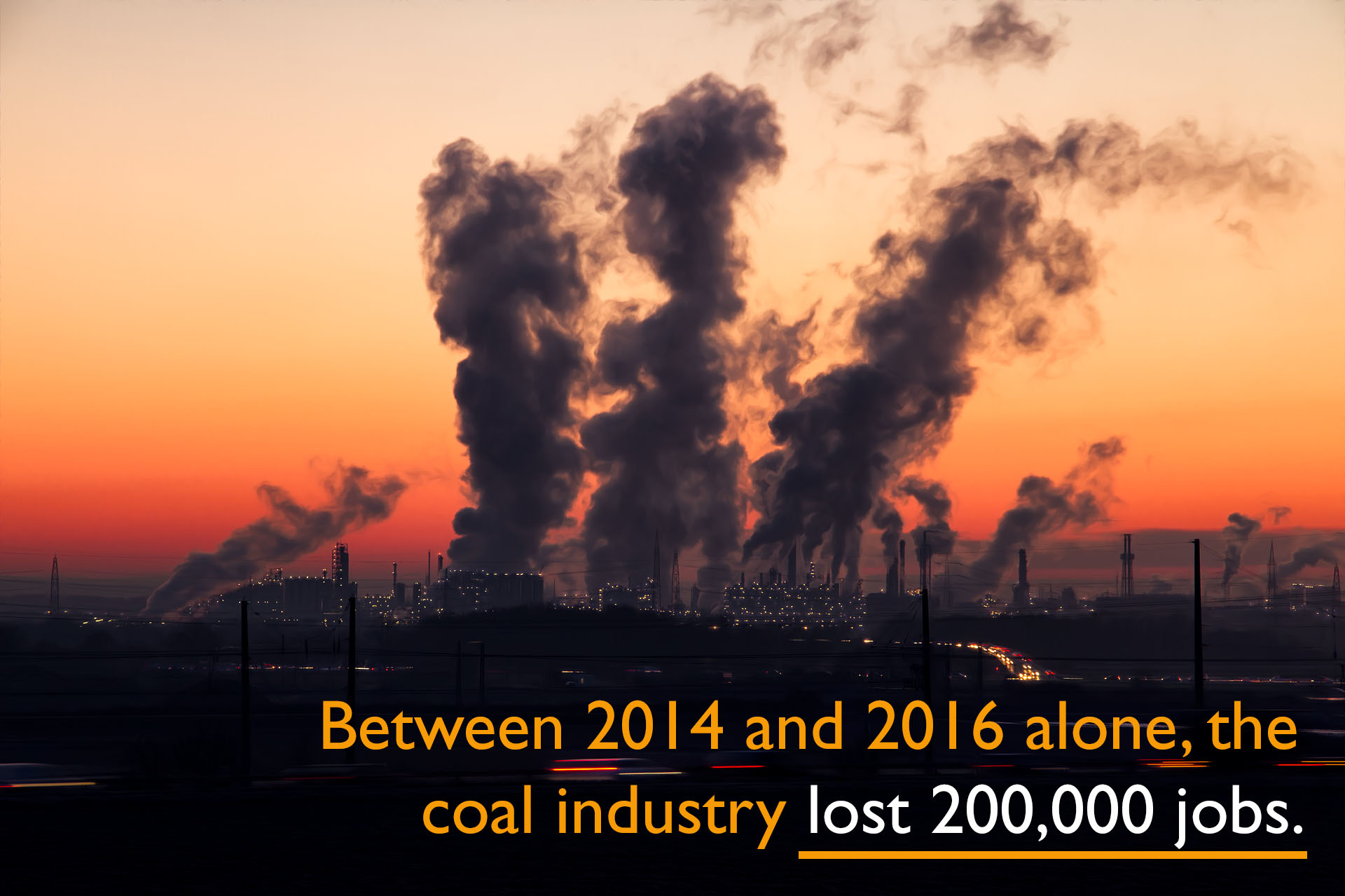
Coal is the MySpace of electricity production—everyone’s abandoning it for better technologies. Natural gas, wind, and solar are all cheaper. Even American Electric Power (AEP), one of the dirtiest utilities in the US, has made it clear that the decline of coal is inevitable. In a recent Bloomberg article about the decline of coal, AEP spokeswoman Tammy Rideout said, "We will continue our transition to more natural gas and renewables as we balance out our generation portfolio and provide cleaner energy." When even coal’s best friend in the utility sector is running in the opposite direction, all hope is lost for coal.
Not surprisingly, the coal-mining industry has been shedding jobs at a precipitous rate for years. Between 2014 and 2016 alone, it lost 200,000 jobs.
Undoing Obama’s Clean Power Plan may slow the decline of coal slightly, but it will continue to decline. When he promises to bring back coal-mining, Trump is playing on the nostalgia of coal-mining regions, which have seen a sharp decline in their living standards, but he may as well have traveled to New Bedford, Massachusetts—once the whaling capital of the world—and promised to give everyone a harpoon and a whaling ship.
Coal will never be clean
Proponents of coal say that it can be burned cleanly, and if it’s burned cleanly, it will make a comeback. What they usually mean is that the carbon emissions from coal-fired power plants can be captured and pumped underground. There are two major problems with so-called “clean coal” technology: 1) it is ridiculously expensive, and 2) it does not address the environmental and health impacts of mining coal, or the waste that remains from burning it.
First, the problem with the economics. The US has been trying to build a commercially viable carbon-capture coal plant in Georgia for years (partially funded by taxpayer dollars). However, the cost of Southern Company’s Kemper “clean coal” plant is approaching $7 billion, and is about 300 percent over budget. The plant is slated to generate just 500 MW of energy, enough to power a little over 300,000 homes, and will likely be the most expensive power plant per megawatt hours of electricity ever built in the US.
To put that into perspective, Southern Company could have built a 500 MW solar power plant for just $1.8 billion. Or, they could have built four solar plants, generating four times as much power, for the price of one carbon capture coal plant. Of course, Southern Company can pass the cost of this boondoggle onto its ratepayers and taxpayers, but clearly, spending four times as much as needed to generate power is not a recipe for success for the country as a whole.
Second is the environmental problems with “clean coal.” Even if you are capturing the carbon, you are still mining coal, and coal mining is a very dirty business. Congress and Trump recently made it even dirtier by repealing the Stream Buffer Rule, which would have protected waterways from some of the worst impacts of coal mining.
And coal’s toxic impacts don’t stop at mining. When you consider the full life-cycle of burning coal, the environmental and health impacts are truly alarming. A landmark 2011 study, published in the Annals of the New York Academy of Sciences and written by faculty at the Center for Health and Global Environment at Harvard Medical School, found that the true cost of coal is up to one-half trillion dollars per year, when all environmental and health impacts are added in. Based on this true cost accounting, all clean energy sources are much cheaper than coal. Of course, this cost accounting cannot put a real value on the shortening of the life of a miner, or a person with asthma, or a person living in a community with polluted drinking water.
Check out Stephen Colbert's take on Trump's climate change rollback.
Trump’s campaign played on the nostalgia of coal country for a time when coal was king. This is a cruel and cynical ploy on his part. He knows that coal is not making a comeback. What he should be offering these communities is assistance in moving their economies to cleaner technologies and better-paying jobs.
Right now, he’s doing the opposite. Trump’s proposed budget actually cuts funding for programs that retrain workers in coal country for jobs in the technology and clean-energy sectors.
If all of this is making you angry, the best thing you can do is call your representative and senators and let them know that you support full funding for the EPA, and you support fully funding job-training programs that will actually help people in coal country. Call the Congressional Switchboard at (202) 224-3121 today to be connected to your two senators and representative to let them know you oppose the Trump budget and expect them to pass a budget that supports people and the planet.
|
|
Greening School Fundraisers |
For several years, the Parent-Teacher Organization (PTO) at the Charles E. Smith Jewish Day School in Rockville, MD, had held an annual fundraiser selling Sally Foster gift wrap to raise money for the sixth-grade field trip. But the gift wrap chosen for the sale contained no recycled content and couldn’t itself be recycled, which concerned a group of green-minded students so much, they called a boycott.
“This particular group of friends called themselves ‘the Treehuggers,’” says Miriam Glaser, who teaches sixth grade science at the school. “I got wind of the boycott, so I met with them, and we started working together as an official school group on green issues.”
As a result of the boycott, the PTO saw a significant reduction in the amount of money they earned, and it didn’t take them long to agree to meet the Treehuggers to discuss sustainable fundraiser alternatives.
Though it was too late to stop the Sally Foster sale, the Treehuggers decided to conduct a sale of their own, to raise money for compost bins and recycled paper for the school. Glaser helped them find an eco-friendly fundraising company.
“I was very excited about how much we raised,” says Glaser. “We were all happy with the variety of green products, and the kids felt good that they’d made a difference.”
Are you a parent or grandparent who is tired of seeing your child sell unsustainable products to raise money for her or his school? Does your house of worship or nonprofit run fundraiser programs through businesses whose products could be cleaner and greener? Read on for a variety of responsible alternatives to conventional fundraisers.
Sustainable School Fundraisers
Fair Trade Chocolate, Coffee
As many US students are learning, the coffee and cocoa industries have been tied to worker exploitation and environmental degradation. Now, schools and other nonprofits can raise money and support cocoa and coffee farmers through a Divine Chocolate or Grounds for Change fundraiser.
Farmers in the Fair Trade system work cooperatively and earn a living wage that allows them to improve their lives, communities, and local environment.
Divine sells Fair Trade Certified™ chocolate from Ghana. Schools and other organizations can buy 1.5-oz. dark, milk, and crispy rice Divine Chocolate bars at wholesale prices, then resell them at retail and keep the profits.
Through Grounds for Change, your group can hand-sell 12-oz. bags of organic, shade-grown, Fair Trade coffee, using the company’s order forms and information cards, or you can purchase it in bulk at a discount and resell it, pocketing a percentage of the profits.
Both companies will also provide materials to help you educate buyers about Fair Trade.
Fair Trade Gourmet Food
A catalog of gourmet treats can be a popular fundraiser, too—especially around the holidays. Equal Exchange’s program helps your group raise money by selling Fair Trade chocolate, coffee, tea, and cocoa, as well as certified-organic, US-grown cranberries, almonds, and pecans.
Equal Exchange will send order forms and recycled paper catalogs displaying its organic, Fair Trade, premium-quality products. Once your organization has completed its sales, you order the products at a discount and pocket the profits.
By request, Equal Exchange will provide recycled paper posters and flyers to advertise your sale and the benefits of Fair Trade. It also offers a Fair Trade curriculum for grades 4–9, as well as an incentive program where students earn green prizes for achieving certain sales quotas.
Fair Trade Crafts
If you like import stores like Pier One and World Market, you’ll love the Fair Trade craft items from FairTrade Caravans, which provides ethically made and sustainable products through school fundraisers including handmade jewelry, scarves, home goods, greeting cards, children's gifts and holiday items. These unique products replace the unsustainable fundraising products such as magazines, candles and wrapping paper that families and friends feel obligated to buy to support their children's school.
The FairTrade Caravans program includes an online platform for ordering high-quality fair trade certified products, marketing support to ensure a successful fundraiser and enrichment materials for students to learn about the people, places and stories behind the items. It returns 25% of product sales back to schools.
Another option is from Global Goods Partners, which includes recycled cotton handbags from India; glass pendants from Ecuador; soccer balls from Pakistan; and more.
A Global Goods fundraiser is held entirely online. The company gives your school or nonprofit a special code for supporters to use when shopping from its online store, and you’ll earn a percentage of the profits from those sales. For schools, it will also provide posters and other promotional materials.
Reduce E-waste for Cash
Your group can provide a valuable recycling service for your community while earning needed cash with an e-waste recycling fundraiser. Your group collects unwanted cell phones and chargers, ink cartridges, MP3 players, digital cameras, and PDAs to send to the company for cash. Some websites that you can work with are RecyclingFundraiser.com, or Funding Factory.
Books for Sale
Better World Books (BWB) helps high school and college students raise money through book drives to benefit their school and literacy programs around the world.
Students collect used books, including old textbooks, from their community. They ship the books to BWB at no cost to them, and then BWB resells the books online, donating or recycling those that can’t be sold. The school gets a percentage of the profits and designates one of four literacy programs to receive an additional portion: Books for Africa, Room to Read, WorldFund, or the National Center for Family Literacy.
BWB also offers a similar program to help libraries raise money in exchange for book discards.
Two other organizations provide green-themed books at a discount to schools and nonprofits, which can resell them at retail to raise money: Contact Kids Think Big to get its brightly illustrated children’s book, Think Green!, which is about simple ways kids and adults can help green our world.
Greeting Cards
If your group likes the idea of selling greeting cards, consider offering beautiful cards made from 100% post-consumer recycled paper and printed with soy inks. Plymouth Cards has a fundraiser like this.
Reusable Shopping Bags
Reusable shopping bags are increasing in popularity, so why not sell them and make some much-needed cash?
Ecobags offers fundraising with lots of reusable products, from bags to bottles and beyond, or you can choose products yourself, designed or blank. The Eco-Bags team can custom print or you can buy blanks and decorate yourself.
Trees
You can't get a greener fundraiser than selling trees! Trees for a Change will help you sell "Tree gift cards" for your next fundraiser with a 40% profit. Every card sold means a tree gets planted in a fire-devastated U.S. National Forest.
A Final Word on School Fundraisers
Next time your school or organization suggests selling toxin-laden cleaners or conventional candy that may be tied to worker exploitation, feel free to send around the link to this article and lobby for a sustainable school fundraiser. With fundraising, you can help spread the word about high-quality green products and support the green economy, while raising money for schools or causes that are close to your heart.
Updated August 2023
|
|
The Benefits of Biodiesel |
Tim Zang of Kansas City, Missouri, bought a diesel Jeep Liberty last year. When he drove off the lot, instead of heading to a fuel pump, he headed straight home, where a 55-gallon drum of Missouri-grown, 100-percent soy-based biodiesel sat waiting for him in his garage.
“Every gallon of soy we use replaces a gallon of fossil fuel,” says Zang. “The money I spend on soy stays right here in Missouri, biodiesel is better for my engine and better for the environment, and if we as a society wake up to the benefits of biofuels, they can put a lot of people to work here in the US.”
After using fuel from the drum in his garage for several months (sometimes mixing it with conventional diesel, which is necessary to keep biodiesel at temperatures below freezing), the Kansas City fuel market caught up to Zang, and in April the first public biodiesel fueling station opened a few miles from his home.
Zang switched back to fueling up at a pump, and other Kansas City residents, pinched by ever increasing petroleum costs, started giving biodiesel a chance as well.
“Biodiesel was an easy choice for us,” says James Brooks, vice president of the Kansas-City-based United Beverage Company, which switched its entire fleet to biodiesel in April. “We’re an urban wholesaler with lots of trucks on the streets of downtown. Using biodiesel is something we can do for ourselves and for the city.”
Furthermore, adds Zang, the last time he filled up from the public biodiesel pump, his cost was ten cents per gallon cheaper than if he had filled up with conventional diesel.
Why Biodiesel?
Studies show that biodiesel outperforms gasoline, ethanol, and conventional diesel in reducing climate-altering carbon dioxide emissions and in overall fuel-efficiency (see sidebars below).
Using 100-percent biodiesel (B100) eliminates all of the sulfur emissions associated with conventional diesel, cuts emissions of carbon monoxide and smog-producing particulate matter almost in half, and reduces hydrocarbon emissions by between 75 and 90 percent. Perhaps most significantly, using B100 reduces the emissions of carbon dioxide—the main greenhouse gas causing global warming—by more than 75 percent. Even using a blended biodiesel fuel like B20 (a 20-percent biodiesel/80-percent petrodiesel blend offered at most biodiesel fueling stations) still reduces carbon dioxide emissions by 15 percent, according to the Department of Energy.
Besides lowering emissions at the point of use, biodiesel fuel—made from corn, soy, or other plant matter—had a past life absorbing carbon dioxide while it was growing as a crop in the field. With its past carbon dioxide absorptions balancing its later carbon dioxide emissions, biodiesel results in an overall life-cycle lowering of carbon dioxide emissions over both conventional diesel and gasoline. The industrial processes used to produce biodiesel are cleaner than conventional diesel processes, reducing emissions associated with the life cycle of the fuel by more than 80 percent.
As a cleaner burning fuel, biodiesel is better for a car’s engine than conventional diesel, providing greater lubrication and leaving fewer particulate deposits behind. Biodiesel’s high ignition point (350°F vs. –43°F for gasoline) makes it a safer fuel as well. Biodiesel is biodegradable and considered nontoxic by the Environmental Protection Agency. All diesel vehicles have 20- to 30-percent higher fuel economies than comparable gasoline vehicles.
Biodiesel also frees car-drivers from reliance on dwindling fossil fuel resources and the world politics associated with obtaining those resources. It also keeps fuel dollars in the US. Biodiesel is more accessible than ever, with the number of public fueling stations in the United States rising from zero in 1997 to over 1000 today. To find a biodiesel fueling station or local biodiesel supplier near you, visit the National Biodiesel Board’s Web site.
Recycled Waste Oil as Fuel
Taking an even bigger step toward sustainability, some drivers bypass fueling at the pump or ordering a drum from a supplier and make their own biodiesel from the waste oil produced by local restaurants, converting what would have been garbage into a usable product.
Any organic oil you can find can be converted into fuel for a diesel vehicle through the use of a chemical catalyst and an alcohol—most commonly lye and methanol, which must be handled with care. The process of making your own fuel is not difficult, but is somewhat labor intensive and takes about a week from start to finish. You can find several biodiesel recipes online at Biodiesel Community, or by joining the forums at Biodiesel.org (Find supplies online from Green America's Green Business Network™ member Real Goods)
Other drivers choose to modify their diesel cars to accept straight vegetable oil (SVO), rather than modify the oil into a fuel. The quality and condition of the waste oil used as straight fuel matters more than the condition of waste oil converted into diesel fuel. Therefore, even if you modify your car, you still might need to spend time filtering and purifying your waste oil before you can pour it into your car’s tank. You can find more information about SVO and purchase conversion kits for your diesel car from Web sites like these: Golden Fuel Systems, Greasecar Vegetable Fuel Systems, and Neoteric Biofuels.
Biodiesel and the Future
In the long term, renewable energy experts differ on the upper limit of biodiesel’s possibilities as an industry, should biodiesel become wildly successful., adopted as America’s primary choice for fuel
With the country already consuming more than 40 billion gallons of diesel fuel every year, a massive shift to biodiesel would make impossible demands on our available agricultural land. Cornell ecology professor David Pimintel explained in a 2005 study how he had studied large-scale bio-fuel production based on corn, switchgrass, wood biomass, soy, and sunflowers, and found each to be unsustainable. Others argue that even if such land-use was a possibility, the resulting agricultural shift toward fuel farming would trigger unintended consequencs, such as spikes in the price of food crops. For example, in Europe, demand for biodiesel has triggered increasing imports of Indonesian palm oil, which in turn has accelerated massive deforestation in Indonesia, as farmers clear forests for palm plantations.
Meanwhile, University of New Hampshire physicist Michael Briggs explained in a 2004 paper how aquatic farms could be used to grow resources for biodiesel production, taking pressure off land intensive crops like corn and soy. With high oil content, fast growth rates, and less land-use, some aquatic crops like algae make practical sense as future sources for biodiesel fuel, as demand grows. A 1998 report prepared for President Clinton by the National Renewable Energy Laboratory reached a similar conclusion, but with the caveat that biodiesel production from aquatic resources would “only be competitive if petroleum diesel cost more than $2 a gallon.”
What to Do for Now
For now, such questions about the industry’s future underscore the dramatic imperative for Americans to consume less fuel. We already know that a fossil-fuel-based transportation system is unsustainable, but consuming bio-fuels at our current gasoline levels would likely make unsustainable demands on our agricultural capabilities as well.
To stay away from dirty fuels and preserve the maximum capabilities of bio-fuels, try switching to pedestrian power, pedal power, and public transportation when at all possible. Then, see if biodiesel might work for you.
If you already drive a diesel vehicle, a switch to biodiesel—especially biodiesel recycled from waste oil—is without question the less destructive choice, based on biodiesel’s decreased pollution levels, status as a renewable fuel, and carbon-absorption as a crop in the field.
If you are thinking about your next car purchase, and you have access to B100 biodiesel or can make your own, purchasing one of the top five fuel-efficient diesels will significantly lower your carbon dioxide emissions and throw your support behind renewable fuels. Even if you must use a lower blend like B20 on occasion, a biodiesel car will likely trump the life-cycle carbon dioxide emissions of a comparable hybrid, though the more you use B20, the more that distinction between the cars will diminish.
If you do not have easy access to biodiesel, which is still currently most accessible at the pumps for Midwestern drivers, a hybrid car remains the best choice. Finally, if the most efficient diesel or hybrid car doesn’t meet your transportation needs due to size or hauling capabilities, running a diesel vehicle on the highest blend of biodiesel you can will still minimize your carbon dioxide emissions.
Stay Tuned
Transportation technologies in the United States are changing rapidly. If you’re not looking to purchase a new car right now, stay tuned. In five years, the choices available to the American driver are likely to be different. Biodiesel pumps will likely be more widely available, ethanol may become a cleaner and more efficient fuel as innovators bring down the cost of producing ethanol from waste, and automobile companies will hopefully complete the development of hybrid diesels, which would combine the benefits of both our current best choices.
Also in development are hybrid cars that can be recharged through plug-in power, which, when powered by solar or wind, will become the most sustainable option of all.
In the short term, however, biodiesel remains cleaner and more efficient than gasoline, ethanol, or conventional diesel, while ethanol is cleaner and more efficient than gasoline, but on a smaller scale. Until other options become available, and in cases where biodiesel is not a feasible option, then the best bet for the health of the planet is to reduce the amount of fuel you must use— by driving a hybrid, and by cultivating a lifestyle that depends on cars as little as possible.
|
|
The Many Benefits of Backyard Chickens |
Updated 10/2022
When Green America member Laura Gidney and her husband John were househunting in New York state, they knew their new home had to be in a neighborhood zoned for backyard chickens. The Gidney family now has ten adult chickens, with 20 newly hatched chicks this spring. They make their home in a comfortable coop with plenty of space to roam. Each morning, the Gidneys enjoy fresh eggs from their mini-flock.
As the Gidneys have learned, keeping a small flock of chickens in your backyard has many benefits, from supplying you with fresh, healthy eggs from well-cared-for animals, to giving you great fertilizer for gardening, to providing lively pets—as well as being part of the drive to local, sustainable food systems.
Why Backyard Chickens?
Most chicken-owners have the same reason for starting up their flocks: eggs. By getting eggs from your own chickens, you avoid supporting industrial farms that produce the majority of eggs sold in the US. Egg-producing hens on factory farms are often kept in such close, inhumane quarters that they cannot stretch their legs or wings, walk around, or participate in normal social behaviors.
Also, a 2010 Cambridge University study demonstrated that pasture-raised eggs, from chickens given space to peck for food, are more nutritious than industry-sourced eggs, with pasture-raised eggs containing twice as much vitamin E and long-chain omega-3 fatty acids. With certified organic chicken feed available, you can keep your chickens healthy while supporting sustainable farming.
Those healthier eggs may cost a little more than factory-farmed eggs at the grocery store, but they’re competitive with and often cheaper than the cost of local, free-range eggs. Taking into account only the cost of food but not coop materials or other one-time expenses, most backyard chicken-keepers estimate they pay about $3 per dozen for backyard eggs. Eggs at most farmers’ markets tend to run from $5+ per dozen.
Backyard chickens also serve as great composters for your kitchen scraps. Andrew Malone, who runs Funky Chicken Farm in Melbourne, FL, says he can’t think of much you can’t feed a chicken.
“They’re omnivores and will eat just about anything that comes out of the kitchen, including meat,” he says. Just make sure to supplement kitchen scraps with proper feed, Malone warns, to ensure your chickens are getting the nutrition they need to stay healthy and lay strong eggs.
You can then add the chicken’s waste to your compost pile and use it on your garden as a fertilizer. In addition, chickens will happily eat up insects and pests in your yard.
Provided that children are gentle with the chickens, Jim Dennis, owner of Phoenix-based chicken company Rent-a-Hen, has observed that chickens can make social and even affectionate pets.
“For my children, every morning it’s a race to see which one of them gets to collect the eggs,” says Laura Gidney. “Today most kids are in a race to play a video game, so we are happy to have our kids out in the fresh air, playing in the dirt with their chickens.”
Check Local Ordinances
Before you run out and buy a clutch of chicks, make sure you’re ready for the commitment. First, check with your local officials to ensure backyard chickens are allowed where you live. Some municipalities have bans on chickens, or limits on how many chickens you can keep on your property. Because of their infamous early-morning cockadoodle-doos, roosters are banned from many cities.
If your city isn’t yet chicken-friendly, CommunityChickens.com has articles on how to change local ordinances.
Building a Happy Home for Your Backyard Chickens
If your local ordinances approve of backyard chickens, you’ll want to provide your birds with a chicken coop, or a secure hen house that will offer the birds a place to lay eggs, as well as a “run” where they can roam and peck. Make sure your coop also protects them from predators.
“If you’ve never seen a raccoon on your property, I can almost guarantee you’ll see one within the first few nights that you bring those chickens home,” says Malone.
Each chicken needs three to four square feet of space in the coop, and another three to four square feet in the run. Because chickens are social animals, Malone suggests a minimum of six chickens—which would require an 18-sq foot coop and a run of equal size.
If you’re a do-it-yourself-er, the Internet is rife with ideas and instructions—from coops on wheels that can be moved from place-to-place in your yard to designs to build a coop for under $100.
Your local feed store and online companies like backyardchickens.com also carry ready-built chicken coops.
Experts also recommend having one nesting box inside the coop for every three to four chickens—you can use a pre-fabricated wooden box from a feed store, or utilize any number of things you may have at home, like old milk crates, plastic tubs, and even a five-gallon bucket placed on its side. Or your chickens may choose their own place to lay. Green America member Rob McLane of Tucson, AZ, says that one of his chickens wanders inside every day to lay an egg in the family laundry basket.
Daily Care Concerns
Taking proper care of your chickens will ensure that they stay healthy, and will help you get the most eggs out of your flock. Each chicken requires about ¼ cup of feed per day, as well as a supply of fresh, clean water. Chickens can survive both hot and cold weather, and will be fine outside with temperatures as low as 15 degrees, but their laying patterns will change with the seasons.
Be sure to be vigilant about cleaning your chicken coop every two weeks and cleaning your hands and shoes after handling chickens and their eggs. A report from the Center for Disease Control this summer traced a seven-year salmonella outbreak to a hatchery that shipped chicks to consumers around the country. The outbreak has since ended, but the report emphasizes the importance of good hygiene when handling your chickens.
Pickin' Chickens
From Rhode Island Reds to Plymouth Rocks, there are many breeds available for your flock. Different breeds come with different personalities and different rates of egg-laying—and you can combine breeds in one flock for variety. While Malone says choosing a favorite chicken breed would be “like picking a favorite child,” he notes that brown-egg- laying breeds tend to be more social and docile.
The website MyPetChicken.com’s Breed Selector Tool can help you to find the breed of chicken right for you.
Depending on where you live, there are several ways to get your own backyard chickens. Some chicken keepers choose to raise their chickens from chicks. This requires providing the chicks with additional heat and special feed; chicks can be found at local feed stores and farms. You may also be able to find older chickens locally— old enough to be outside without extra heat, but not yet laying eggs.
According to the Humane Society of the United States, many chickens with years of egg-laying ahead of them are brought to shelters and farm sanctuaries, and while they may not produce eggs at the rate of younger hens, they may be a perfect match for families who want to raise humanely treated chickens and save an adult chicken from slaughter.
Most hens start laying eggs at about six months old and will lay with the greatest frequency for that first year—giving you about four to seven eggs each week, though it may vary with the seasons. The number of eggs she’ll produce will reduce by about 10% each subsequent year, and most backyard hens can live from eight to ten years.
Different people will make different decisions about what to do with a chicken at the end of her productive egg-laying period. For many, backyard chickens are seen as pets, and their owners will choose to continue to care for them for the duration of their natural lives. Others will butcher their older hens, using them as an additional source of food. Because of the increased numbers of hens being given to shelters and sanctuaries, the US Humane Society asks that people not drop off their non-productive chickens.
If you think chickens might be right for your family, keep in mind Laura Gidney’s words: “I always encourage anyone who can to totally do it!” she says. “Besides the fact that the eggs taste better, you know the quality of the food you give your birds, you know the conditions they live in, and it’s a beautiful thing to see your kids are out there taking care of and loving these birds and getting nutritious food out the whole deal."
|
|
Safe, Sustainable Seafood |
As media attention causes more and more consumers to become aware of the troublesome levels of toxins in certain kinds of fish, the seafood industry is starting to feel the effects.When the Food and Drug Administration (FDA) and Environmental Protection Agency (EPA) issued an advisory in March 2004 suggesting that pregnant women and children limit their consumption of canned tuna due to mercury contamination, tuna sales were already in a decline, and continued to drop. Canned tuna sales dropped 30 percent between 2000 and 2014, according to the Washington Post.
"There’s news circulating that there are contaminants in seafood, but it’s so confusing, I think many consumers just walk past the seafood counter altogether and get their protein from other sources,” says Henry Lovejoy, president and founder of EcoFish, a sustainable seafood company.
As a consumer, how do you know which types of seafood are safe for you and your family? How do you know which are being overfished, contributing to the decline of our oceans? Fortunately, it’s getting simpler every day to get the health benefits of seafood without the toxins, and without harming the marine environment.
Fish and Human Health
The health benefits of eating seafood are considerable:
- Seafood is low in fat and calories.
- It’s a great source of high-quality protein.
- Omega-3 oils, which occur in abundance in mackerel, albacore tuna, salmon, herring, sardines, and lake trout—for their abundance of omega-3 oils. Omega-3s help prevent blood clots, promote a healthy heart, and may even help alleviate rheumatoid arthritis, allergies, irritable bowel syndrome, cardiac arrhythmia, and depression.
Despite its benefits, seafood can be dangerous to your health when contaminated with industrial chemicals, pesticides, and heavy metals—most notably mercury and PCBs—which has too often been shown to be the case in recent studies.
Mercury
"Acute or chronic mercury exposure can cause adverse effects during any period of development. Mercury is a highly toxic element; there is no known safe level of exposure," according to a 2011 paper called "Mercury Exposure and Children’s Health" from the National Institutes of Health. "Ideally, neither children nor adults should have any mercury in their bodies because it provides no physiological benefit."
The National Institute of Health (NIH) notes that “exposure [to mercury] results principally from consumption by pregnant women of seafood contaminated by mercury.” And the EPA and FDA issued a joint statement in March 2004 acknowledging that “nearly all fish and shellfish contain traces of mercury.”
In the 2004 statement, the FDA and EPA warned pregnant women, women of child-bearing age, nursing mothers, and young children against eating shark, swordfish, king mackerel, and tilefish due to high mercury levels. They also warned these vulnerable groups to eat only six ounces of albacore tuna per week, also due to mercury contamination.
The nonprofit watchdog Environmental Working Group (EWG) finds the FDA-EPA fish consumption guidelines to be too lax, stating that if pregnant women, women of child-bearing ages, and children follow these guidelines, EWG studies indicate they will go over the safe level for mercury in their blood.
Corroborating the EWG’s warning, the National Institutes of Health released a study in March 2005 stating that the annual cost of mercury’s damage to babies’ developing brains is $8.7 million. Study researchers explain that between 316,000 and 637,000 children each year have cord blood mercury levels at levels associated with loss of IQ, which not only results in quality of life issues, but “causes diminished economic productivity that persists over the entire lifetime of these children.”
Polychlorinated biphenyls (PCBs)
Another problematic group of toxins that has made headlines after being found in fish are PCBs. These are synthetic chemicals released into the environment through industrial manufacturing. California’s Proposition 65 recognizes PCBs as carcinogens, and the EPA says that PCBs act as endocrine disruptors in rats exposed to high levels.
Recent studies have pointed to farmed salmon as being particularly vulnerable to PCB contamination. This is most likely due to farmed salmon being fed ground-up fish with high concentrations of PCBs in their fat and oils, according to three independent studies, including one conducted by the School of Public Health at the University of Illinois at Chicago.
As is the case with mercury, researchers are still trying to assess what effect PCBs have on human health at low and moderate levels, or due to the fact that they build up in your body over time. Since concerns about PCBs in food are relatively new, it’s difficult to know what types of fish to avoid besides farmed salmon. Henry Lovejoy of EcoFish recommends avoiding larger fish at the top of the food chain, since they accumulate more PCBs than small fish. You can also look for seafood that’s specifically been tested for PCBs.
Though not as prevalent as mercury and PCBs, other toxins have also been found in fish, including the known carcinogen dioxin, as well as the EPA-banned pesticide dieldrin, which is a neuro-, liver- and immunotoxin.
Fish and the Environment
Some types of fish have environmental problems associated with them, making them a not-so-good choice for your dinner plate. These include:
- Overfishing: We’re catching and eating certain types of fish, such as Chilean sea bass, faster than they can replenish their populations.
- Catching Methods: Environmentally unsound catching methods are a major contributor to the decline of our oceans. The ocean floor and coral reefs are being severely damaged by bottom trawlers, for example, which scrape the sea floor in an effort to catch bottom-dwelling fish. Also, when fishers use large nets and bottom trawlers, which take in everything in their path, they’re usually searching for a specific type of fish. Consequently, only a small portion of what they catch is kept, and the bycatch, or what’s left over, gets thrown back—usually dead or dying. The United Nations estimates that 27 million tons of fish are unintentionally caught and thrown away by commercial fishers each year.
- Farming Methods: Certain types of fish are conventionally farmed in ways that are harmful to their aquatic environments. For example, corporate fish farms often create fish monocultures that pollute their surrounding environments with waste, chemicals, and even antibiotics.
Our "Safe, Sustainable Seafood Guide" contains everything you need to know to choose those types of fish that are harvested in ways that aren't contributing to our oceans' decline. (Environmental data from the Monterey Bay Aquarium, the Blue Ocean Institute, and Environmental Defense.)
Safe, Eco-Friendly Alternatives
For nearly every type of seafood you’re craving, there’s a sustainable alternative. For example, many types of salmon contain high levels of toxins and are likely to be farmed in unsustainable ways. But if you purchase from Copper River Seafoods, you’ll enjoy wild Alaskan salmon that is sustainably fished by locals—who are paid a fair price for their fish—and that are tested as having low levels of PCBs and mercury.
EcoFish offers one of the country’s widest varieties of sustainably farmed and wildly harvested fish, independently tested for PCB and mercury levels and labeled with consumption recommendations for women of child-bearing age by Seafood Safe. Their selections include several alternatives to the otherwise “problematic” and “avoid” categories of our seafood card, from wild sashimi-grade Oregon albacore tuna, to organic Florida white shrimp, to wild South American mahi-mahi.
Several other sustainable seafood companies, listed below, sell healthy, eco-friendly seafood direct to consumers. You can also look for the following labels at your local seafood outlet:
- Marine Stewardship Council (MSC): The MSC label appears on several different types of wild fish, indicating that they have been caught using eco-friendly methods. The fisheries are certified sustainable by MSC-approved independent certifying organizations. Though MSC is an independent nonprofit, it was started by Unilever (with the World Wildlife Fund) and still takes contributions from the grocery giant.
- Fishwise: The Fishwise label appears on a variety of seafood. Fishwise labels tell consumers what kind of fish it is, how the fish was caught, where it came from, and how sustainable it is. The labels also bear a color—green for sustainable, yellow for seafood with some environmental problems associated with it, and red for unsustainably caught seafood.Grocery stores must join the Fishwise program to use the labels, and it has been adopted by Target, Albertson's stores, and many natural grocery stores.
- Seafood Safe: Started by EcoFish founder and president Henry Lovejoy, Seafood Safe is the only seafood label that provides consumers with at-a-glance consumption recommendations based upon independent testing for contaminants. The initiative is still very much in its beginning stages—currently, EcoFish is the only company carrying the label, though the program will open up to all seafood companies by next year. How it works is this: Fish carrying the Seafood Safe label display a number, which indicates how many four-ounce servings women of child-bearing age can safely eat of that species per month. (People who fall into other categories can visit the Web site to view their consumption recommendations.) The number is determined by independent testing (by random sample) of the fish for mercury and PCBs—the methodology for which is reviewed by an independent panel of experts. Other toxins will be added to the testing platform as the program develops.
“My dream is to have all seafood sold in the US bear the Seafood Safe label, because consumers deserve to know what they’re eating,” says Lovejoy. “We as a nation need to be a lot more careful in how we use toxic chemicals, and where we put them. What goes around comes around.” |
|
The Money-Saving Perks of a Hybrid Car |
In light of the climate crisis and wildly fluctuating gas prices, many Americans are looking for ways to drive less, bike more, and choose public transportation—and Green America members are leading the way. But unless you live in the heart of a city with an excellent mass transit or car sharing system, driving your own car can often be a necessity.
If you can afford to trade in an older, inefficient car for a much more efficient one, the greenest choice is to do so. For those who need to purchase a car right now, one of the greenest options is a hybrid car that gets at least 40 miles per gallon (mpg). There are also over 30 models of plug-in hybrid or pure-electric vehicles, which get up to 315 miles on a charge (Tesla Model S).
Some car buyers might assume that they can’t justify the up to $5,000 more it can cost to purchase a hybrid vehicle over a comparable conventional one, especially when gas prices are low. But in fact, hybrid cars bring their drivers a variety of financial savings and other perks that go beyond saving money at the gas pump—and can make a hybrid purchase more budget- savvy than buying a conventional car.
Save Money, Save the Earth
In today’s hybrid cars, a battery provides an electric assist to the gas-powered engine, achieving 20–35 percent better gas mileage than conventional cars. The 2017 Toyota Prius, for example, gets 50 mpg overall in real-world driving, and has been the leader in best mpg for hybrids for years. Of course, models from other makers do nearly as well.
In 2012, President Obama signed a law that will increase the fuel economy to 54.5 mpg for cars and small trucks by Model Year 2025. Drivers who choose more efficient hybrid cars today are helping to support this target in time to prevent the worst impacts of the climate crisis. Also, hybrid cars emit less ground-level air pollution than other cars, including 29 percent less smog-producing nitrogen oxide. Even if some very efficient conventional cars can get “hybrid-style” mileage, only hybrid cars also help maintain healthier air.
(Note: Although President Trump froze fuel economy standards at their projected 2020 level in 2018, in January 2020 the administration agreed to slowly raise standards again, this time at a rate of 1.5 percent per year. This, however, is still far below the Obama-era standards, making ethical consumer choices even more important in the auto industry.)
When Bryan Palmintier and his wife were looking to purchase a car, he was working as a fellow at the Rocky Mountain Institute, a think tank focusing on energy and other resource issues. So he set out to quantify how some financial benefits to hybrids aren’t reflected in the sticker price. In his widely-circulated blog post, “Rethinking the Cost of Hybrid Cars,” which he co-write with Noah Buhayar, Palmintier proves that drivers in need of a new car shouldn’t assume they can’t afford a hybrid until they’ve taken a full accounting of all of the ways that hybrid cars can save them money.
“A lot of people get sticker shock when they look at the price of a new hybrid,” he writes, because “the added expense won’t pay itself back very quickly on fuel savings alone. ... But this quick analysis misses a number of hybrids’ other economic benefits.”
Federal Incentives for Hybrid Cars
New hybrids may entitle their owners to federal tax credits ranging from $250 to $3,400. How much a given hybrid owner can expect to get from the federal hybrid tax credit depends on many factors, including the car’s fuel economy, and how popular a given model is. Some models have already exceeded their quotas and are no longer eligible for any tax credit, and the recently passed economic stimulus bill did not extend or expand these credits. To see how much of a tax credit you might be able to claim, consult the Internal Revenue Service. Additionally, as of 2019, the federal Plug-In Electric Vehicle Credit offers a tax credit of between $2,500 and $7,500 for any car with charging capabilities, which includes plug-in hybrids.
State and City Incentives and Perks
Some states and cities offer incentives for hybrid drivers, including tax credits, and the convenience of being able to drive solo in “HOV” (high-occupancy vehicle) highway lanes. Many cities also offer privileges to hybrid owners, including free or discounted parking. Contact your city clerk’s office to find out if a new hybrid would entitle you to parking perks when driving around town.
Employer Incentives and Perks
A growing number of employers are encouraging their workers to commute in hybrid vehicles. At some forward-thinking companies, including Green Business Network™ members My Organic Market, Patagonia, and Clif Bar, employees receive up to $5,000 for purchasing or leasing a hybrid, essentially eliminating the price premium. A list of businesses that offer hybrid employee benefits can be found here.
Some universities provide special parking rates for faculty- and student-owned hybrids, and some hotels reward hybrid drivers with free parking. Be sure to ask your employer, school, and the other institutions in your life if they have special benefits for hybrid owners—or if they’ll consider creating some.
Loan Discounts on Hybrid Cars
Financing a hybrid purchase can be cheaper than financing a conventional car. Many banks, especially credit unions, offer preferential loan rates for hybrid cars. For example, Meriwest Credit Union in the Greater Bay Area and Tucson, AZ, offers a 0.25 percent rate discount on any auto loan for new or used hybrid vehicles.
Insurance Discounts
A number of car insurance providers, including Farmers Insurance Group, Geico, and Travelers, offer discounted insurance rates to hybrid drivers in some states. Be sure to inquire about how choosing a hybrid might save you on insurance.
Repair Costs and Brakes
Hybrid owners shouldn’t expect any higher or more frequent maintenance or repair costs than owners of conventional cars, according to Consumer Reports. Generally hybrid cars come with a standard three-year/36,000 mile warranty, as well as an additional warranty guaranteeing the special hybrid technology (100,000 miles for Toyota hybrids and 80,000 in Honda hybrids, for example). In fact, the technology that a hybrid uses to recoup energy during braking actually means that hybrid cars’ brake pads last three times as long as those in a conventional car, reducing the frequency of break pad replacement.
Resale Value
When it comes time to resell a car, hybrid owners have been delighted to discover that their cars have held their value better than non-hybrid versions of the same model. For a quick estimate of the average resale value for a car of the type you’re considering, Buhayer and Palmintier suggest consulting the Kelley Blue Book to look up models of the car you’re considering that are about as old as you’d expect your car to be when you resell it.
For example, Palmintier thought he’d drive a 2008 Prius for three years, so he looked back at the current resale value of the 2005 Prius, in contrast to comparable non-hybrids. The 2005 hybrid was reselling for $4,000–6,000 more than the resale values of two 2005 non-hybrid models.
Gas Savings
Even if gas prices have dropped temporarily, we can count on them going back up again eventually as we approach peak oil supplies worldwide. So the real-dollar value of a hybrid car’s better mileage is likely to increase over the course of the time you would own and drive it.
Benefits Beyond Money
When Shira Fischer moved away from a transit-friendly city to begin medical school in Worcester, MA, she needed to purchase a car; and she was willing to spend several thousand dollars more to get a hybrid.
“I didn’t want to own a car,” recalls Fischer, who’s since come to love her Toyota Prius. “But I knew I had to get one, and I knew I wanted to minimize the effect on the environment.”
For Fischer, economic perks have combined with less tangible benefits: “Accounting for the hours I spend in it, the tax rebate, the saved gas, and how good I feel about it, [the price premium] was definitely worth it.”
“The best part is all the people who stop and ask me about my mileage,” she says. “I feel like I’m a commercial for environmentalism wherever I go."
|
|
Less-Toxic Dentistry: Silver Fillings and Other Concerns |
When you visit the dentist, you’re probably hoping that you’ll get a clean bill of dental health. Keep in mind, though, that you should also be looking closely at the health of your dentist’s office. Many dental procedures that have been used for years—from fluoride applications to amalgam fillings to root canals—are now under scrutiny for their possible role in causing health problems. Learning about the issues surrounding these procedures can make you a more informed and safer dental patient.
Silver Fillings
[2020 Editor's Update: Since the publishing of this article, new evidence and clarifications have emerged. Today, both the ADA and the APHA do not consider amalgam to be an unsafe material for fillings, although it can have a negative environmental impacts when it enters waterways. The FDA has reviewed the evidence on amalgam and found it to be safe for adults and children over 6. This classification of "safe" does not indicate that no mercury is released into the body via amalgam fillings, but rather that it has not been linked to any negative health impacts. Part of the reason for this is the distinction between different types of mercury, as the kinds of mercury found in fish is considerably more potent than the mercury found in amalgam. The article as originally published is below.]
Amalgam, or silver, fillings, which have been widely used by dentists for more than a century, are about 50 percent mercury; the balance is made up of other metals, mainly silver, copper, tin, and zinc. According to the American Dental Association (ADA), amalgam is an ideal substance for dental restorations because it’s durable, easy to use, highly resistant to wear, and cost-effective. The ADA claims that the presence of mercury in fillings is not a problem, because the fillings release only minute amounts of mercury vapor, and such low-level exposure has not been proven to be harmful.
A growing number of dental professionals disagrees. “The ADA warns that amalgam is toxic before placement and after removal, so dentists have to take precautions with these procedures,” says Dr. Robert Johnson, a biologic dentist who heads the Natural Horizons Wellness Center in Fairfax, Virginia. “There’s no reason for amalgam to suddenly not be toxic once it’s in someone’s mouth.” There’s little dispute about one thing: everyday activities like brushing your teeth, eating, and drinking hot liquids cause amalgam fillings to release mercury vapor.
The ADA acknowledges that chewing and grinding teeth may cause amalgam fillings to release one to three micrograms of mercury per day, while the World Health Organization (WHO) estimates that the average amount is actually three to 17 micrograms per day.
There’s also no doubt that mercury is dangerous: According to the Agency for Toxic Substances and Disease Registry (ATSDR), a federal agency under the US Department of Health and Human Services, exposure to “high levels” of mercury can permanently damage the brain, kidneys, and a developing fetus.
What’s still being debated is exactly how much mercury exposure it takes to cause these effects, and how much of that is likely to come from fillings. Proponents of amalgam fillings say that the amount of mercury released from them is nowhere near a dangerous level, while critics contend that research hasn’t conclusively proven that amalgam is safe.
“The bottom line is, there’s of lack of attention to this issue in the dental field,” says Dr. Michael Ziff, DDS, executive director of the International Academy of Oral Medicine and Toxicology (IAOMT). “When physicians prescribe drugs, they’re very aware of the toxicology of the medications—but when you ask dentists what the absorption rate of mercury vapor from amalgam fillings is, many of them have no idea. They take the ADA’s word for the safety of fillings instead of looking at the science.”
If potential health hazards aren’t enough to make you exercise caution around amalgam fillings, consider their effect on the Earth. Scientists agree that mercury needs to be kept out of the environment. According the nonprofit Mercury Policy Project (MPP), many dentists contribute to the prevalent problem of mercury pollution in waterways by failing to separate mercury from their wastewater, and by incinerating dental waste that contains mercury, which releases that substance into the atmosphere. Urging your dentist to adopt best management practices for mercury waste disposal—a step also endorsed by the ADA—can greatly reduce the amount of dental-related mercury pollution.
“The good news is that 25 percent of dentists across the US no longer place mercury fillings. Many recognize that mercury use reduction is good for the environment, for their patients, and for business, too,” says MPP executive director Michael Bender.
Fluoride
Since the 1940s, fluoride has been added to community water supplies around the US in order to prevent tooth decay. Many dentists credit fluoridated water with dramatically lowering the incidence of cavities in the population, but a reassessment of the original studies on fluoride’s contributions suggest that it might not be quite as beneficial as originally supposed. Studies on fluoride published in the Journal of Dental Research have shown that fluoride’s action occurs mainly on the surface of the teeth, meaning that the benefits of ingesting the substance are negligible. Other research suggests that fluoride might be harmful.
Fluoride is generally not considered dangerous at low levels—the key is to make sure you don’t get too much. Data from the National Toxicology Program indicates that fluoride may be a carcinogen. And a University of Utah study found “a small but significant increase” in the risk of hip fracture in elderly men and women exposed to artificial fluoridation at one part per million—a low level that’s within the range recommended by the US Environmental Protection Agency (EPA). Though the links between fluoridated water and cancer or hip fractures haven’t been definitively proven, some scientists are urging caution and calling for an end to the practice of adding fluoride to drinking water.
Sealants
Advocacy groups are also raising questions about the safety of sealants. Sealants, which are usually applied to back teeth as barriers against decay-causing bacteria, are under fire because they may leach bisphenol-A (BPA), an endocrine disruptor. Endocrine disruptors have been linked to declining male fertility and increased cancer rates in humans.
Controversy began with a University of Granada study, published in Environmental Health Perspectives in 1996, which found that BPA had leached into patients’ saliva shortly after dental sealant application. In response to this study, the ADA tested the 12 brands of sealants that carry its seal of acceptance and found that 11 of them leached no detectable BPA; they contacted the manufacturer of the twelfth, who implemented additional quality control procedures and whose product then leached no detectable BPA in subsequent testing. However, many experts say much more research is needed before it can be concluded what kinds of sealants leach BPA, and whether BPA can be absorbed from saliva at harmful levels.
Root Canals
Some dentists are also challenging conventional wisdom on root canals. These invasive procedures are performed when bacteria infiltrate teeth through cavities or cracks and compromise the soft tissue inside. The root canal procedure removes diseased pulp and seals the tooth to prevent infection from spreading.
Some research—based largely on studies conducted by Dr. Weston Price in the early 20th century and detailed in a 2008 book by Dr. George Meinig—suggests that bacteria can continue to spread despite root canal procedures, possibly entering the bloodstream and causing harmful infections in the liver, kidney, heart, eye, or other tissue.
The American Association of Endodontists states that more recent attempts to duplicate Dr. Price’s research have not yielded the same results, and root canals are safe; the IAOMT says that contemporary studies show microorganisms persisting in root canals after treatment. Unfortunately, the current alternative to a root canal is tooth extraction, which dentists are reluctant to recommend.
“We need more research on the actual health risks to patients from this treatment, and whether techniques can be improved to reduce risk,” says Dr. Ziff. Dr. Johnson notes that the use of biocalyx, a special cement that expands as it hardens, is a developing technique that shows promise for reducing infection risk from root canals.
The Bottom Line
“The dental establishment feels threatened at the idea of finding anything harmful in the materials or practices it’s been recommending for decades,” says Dr. Johnson. “But just as we must urge the auto industry to reconsider its reliance on fossil fuels, we must urge the dental industry to support additional research on its favorite materials in order to protect human and environmental health.”
There’s reason to be hopeful, adds Dr. Ziff. “Individual dentists are making more of an effort to educate themselves, and I expect we’ll see some major positive changes over the next couple of decades,” he says.
|
|
Are Your Art Supplies Toxic? |
If life were fair, taking time out to indulge your creative side through art would be a naturally green endeavor. You could paint a mural, mosaic a table, or take your children to a pottery shop without a single worry about toxic art supplies.
But this is the real world, and in it, paints, glues, glazes, and even markers can pose hidden health hazards that we should be aware of. Paints can contain volatile organic compounds (VOCs) that may include formaldehyde, benzene, and ethyl acetate, which can cause headaches, nausea, and difficulty breathing. Exposure to paint thinner fumes can have similar effects on health and are harmful or fatal if swallowed.
Children are particularly vulnerable to chemicals because of their small size, higher metabolisms, and immature immune systems, so it pays to exercise extra care with the products they use.
The good news (and yes, there is some!) is that it’s easier than ever to find greener, safer alternatives to hazardous art supplies.
Art Supply Labels to Look For (and to Look Out For)
All art supplies sold in the US must bear the phrase, “conforms to ASTM D 4236,” confirming that they have been properly labeled for chronic health hazards, in accordance with the federal Labeling Hazardous Art Materials Act (LHAMA). Under LHAMA, art supplies must contain warnings if they cause acute hazards—such as “harmful or fatal if swallowed” or “may cause skin irritation”—as well as warnings if they could cause chronic health effects, such as cancer, sterility, blindness, birth defects, or allergic reactions.
However, LHAMA does not mandate that manufacturers provide consumers with an ingredient list, so the substances in many art supplies are often kept from consumers. States are considering and proposing mandatory warning labels and/or ingredient disclosure on packaging related to consumer products, but this is not uniform throughout the nation. Toxicologists from the Consumer Products Safety Commission (CPSC) evaluate all US art products for compliance with LHAMA at least every five years and whenever a product’s formula is changed.
To go even further when it comes to art materials and safety, also look for labels from the Art and Creative Materials Institute (ACMI). ACMI is a nonprofit membership organization made up of art supply manufacturers, who voluntarily agree to have their materials evaluated by independent toxicologists and tested by accredited, independent labs for safety every five years, as well as randomly and whenever product formulas change.
“Our lead toxicologist, Dr. Woodhall Stopford of Duke University, evaluates every color formulation of every product, and he must approve every formula change,” says Deborah Fanning, ACMI’s executive vice president. “He looks at everything as though it were going to be used by a one-year-old.”
Any art material evaluated by ACMI will bear one of the organization’s seals. The AP (approved product) label appears on all supplies evaluated as nontoxic to both children and adults. Some older products may have a CP (certified product) or “nontoxic” HL (health label) seal instead of an AP label.
The Perils of Paint
If a product contains potentially harmful ingredients, ACMI will mandate a CL label (caution label). No material with these labels is appropriate for children.
Fanning says that ACMI’s evaluations prohibit AP-labeled products from containing chemicals at or above California’s Proposition 65 level. Prop. 65 is widely considered one of the most exhaustive and complete lists of known chemicals known to be carcinogens and/or cause reproductive harm. AP-labeled products also avoid toxic levels of known or potentially harmful chemicals as classified by the US Environmental Protection Agency (EPA), the National Institute of Health, and other agencies.
One thing to note is that the AP and CP labels do not indicate that a product is completely free of toxicants—rather, that it contains no chemicals “in sufficient quantities to be toxic or injurious to humans.”
As an example of how that might pose a problem to the most cautious of us, Healthy Child Healthy World states that though polymer clays are labeled nontoxic by ACMI, they are made of polyvinyl chlorides (PVC) softened with phthalates. Phthalates have been linked to reproductive and organ damage, and manufacturing or burning PVC creates dioxin, a potent carcinogen. ACMI continues to label polymer clays with the AP label, says Fanning, because “the amount of phthalates in them is too small to cause harm, and the clays would not be expected to release hazardous materials unless burned.” Healthy Child Healthy World counters that children are subject to multiple exposures of phthalates from different sources every day, and no one knows what the cumulative effect of such exposure is.
“No label can be a perfect guarantee that an art product contains no toxins* of any kind,” says Fanning. “But our approach is very conservative.”
Find it green: Try nontoxic paints from Green Business Network member Natural Earth Paint.
Want to be extra cautious? Here's our advice on art supplies:
The primary toxicant in certain art supplies are chemical solvents, which are substances that can dissolve other substances to create a solution. In paints, solvents—including methyl alcohol, which can cause blindness if swallowed, and toluene, linked to kidney and liver damage—dissolve pigments and allow paint to spread evenly. Also, some pigments in art paints can contain highly toxic metals such as cadmium, arsenic, and lead, says the Washington Toxics Coalition.
“Paints in the ACMI program, even oil paints, very rarely contain solvents,” says Fanning. “Solvents may be contained in sprays and fixatives, some permanent markers, mediums and varnishes, silkscreen inks, etching grounds, rubber cement and some other adhesives, enamels and lacquers, and turpentines.”
What to do: Though the base formulas of water-based paints do not contain solvents and are therefore safer than those of oil paints, Fanning says it’s the pigments in any type of paint that can be the most problematic. Look for the AP seal on any color of paint you buy, even watercolors.
If you use oil-based paints, make sure you use AP-certified oil paint thinners and brush cleaners.
Children should only use water-based AP-certified children’s paint.
Crayon and Marker Madness
There are three types of markers: water-based, alcohol-based, and aromatic solvent-based. Aromatic solvent-based markers are the most toxic—many contain xylene, a neuro-, kidney-, reproductive-, and respiratory toxicant, says the Washington Toxics Coalition. Alcohol-based markers contain toxins, but they’re not as potent as xylene, says the Coalition.
As for crayons, they no longer contain talc and are made from beeswax or paraffin. ACMI mandates that all children’s crayons under its watch be AP nontoxic.
What to do: Avoid alcohol- and solvent-based markers, both of which are often marked “permanent” or “waterproof.” Look for water-based markers with an AP label. If you need dry-erase markers for white boards, look for those marked “low-odor,” which are alcohol-based and less toxic than other kinds.
Find it green: Hazelnut Kids carries natural crayons, pastels, and other supplies in its Arts & Crafts section.
Clay Calamity
Potential hazards abound in a potter’s studio. According to the EPA, certain ceramic glazes contain toxic heavy metals such as cadmium, chromium, and lead. Firing glazes in a kiln can further release harmful fumes into the air, says the EPA. In addition, the clay itself contains silica dust, a respiratory danger. As for popular children’s clay, be cautious with polymer “modeling” clay, for the reasons stated in the “Labels to Look For” section.
What to do: If you have a home kiln, make sure it’s properly ventilated outside. Working with wet clay minimizes the silica you may breathe in. Also, clean up with wet mops and rags to avoid spreading dust.
Keep children out of a pottery studio with an on-site kiln, and make sure they work only with wet clay to limit silica exposure. Check the labels of any glazes for an AP seal. When choosing play clays, stick with Play-doh types that dry when exposed to air, or make your own.
Find it green: Check Peek a Green's "Eco Art & Craft" section of its site for a variety of safe clay modeling kits, and other supplies.
Gluey Goodness
Many readers may remember using model glues and rubber cement as children—which are two of the most toxic kinds of glues available. Rubber cement is especially dangerous, as it contains hexane or heptane, potent neurotoxins.
What to do: That elementary school standby, white Elmer’s glue, is much less toxic than other kinds of glue. Yellow wood glue, white library paste, and mucilage glue are also good choices.
Finding Non-Toxic Art Supplies
Here’s what else you need to know to get the best possible art supplies for your family and the earth.
- Look for labels that state: renewable materials, natural dyes, recycled content and packaging, Forest Stewardship Council (FSC) certification, and no to low volatile organic compounds (VOCs).
- Look for the AP or CP seal.
- When possible, avoid products with a warning label of any kind.
- To find out which chemicals are in a given product, check its Materials Safety Data Sheet (MSDS), which lists ingredients and potential health hazards, and can be obtained from the manufacturer.
- By law, US schools cannot give art supplies with any hazard warning to K-6 school children. California provides a list of prohibited art supplies.
- Take a look around GreenPages.org to find more companies selling safe art supplies and tons of other natural products.
*After publishing this article it came to our attention that toxin refers to naturally occurring poisons such as snake venom or poison ivy oils. We've replaced the word toxin in this article with "toxicant," where possible, but did not alter this quote. Toxicant means manmade toxic chemical or poison, such as pesticide or solvents.
Updated September 2022
|
|
The Ugly Side of Cosmetics |
Suzanne Anich of Minneapolis, MN, has a morning routine similar to that of many women. She shampoos and conditions her hair with products that contain “natural ingredients,” according to the labels. She brushes her teeth, then washes her face with an upscale facial wash with the word “purity” emblazoned across the jar. Then, she applies a moisturizer and what she calls a “low-maintenance” selection of makeup.
Suzanne was surprised to find out that nearly all of the personal care products she uses on her face and body contain ingredients suspected of causing cancer; potential neuro-, liver-, and immunotoxins; and suspected hormone disruptors that could cause birth defects in any children she might havein the future.
Fortunately, it’s easier than ever to find products that won’t endanger your health—and companies that do care about their customers’ well-being. Here’s what you need to know about the personal care products you may be using and what your alternatives are.
Are Cosmetics Regulated or Not?
Like Suzanne, many consumers may be surprised to learn that the US federal government doesn’t require health studies or pre-market testing on personal care products. Manufacturers are free to put just about anything they want into cosmetics—a far-reaching category used by the US Food and Drug Administration (FDA) to include everything from make-up and deodorant to lotions and mouthwashes.
Instead, the safety (or not) of the ingredients in these products is looked into almost exclusively by a manufacturer-controlled safety committee called the Cosmetic Ingredient Review (CIR) panel. Consequently, “89% of 10,500 ingredients used in personal care products have not been evaluated for safety by the CIR, the FDA, nor any other publicly accountable institution,” says the nonprofit Environmental Working Group (EWG). “The absence of government oversight for this $35 billion industry leads to companies routinely marketing products with ingredients that are poorly studied, not studied at all, or worse, known to pose potentially serious health risks.”
Without government surveys into chemical use in cosmetics, recent data is scarce, but EWG found that black women may be particularly at risk, with a 2016 analysis showing that less than 25% of products marketed for black women have low levels of potentially hazardous chemicals.
Also of particular concern are the inclusion of phthalates—a group of industrial chemicals linked to birth defects that are used in many cosmetic products, from nail polish to deodorant. Phthalates are not listed as ingredients on product labels; they can only be detected through laboratory analysis. Two of the most toxic phthalates, DBP and DEHP, have been banned from cosmetics products sold in the European Union (EU). Phthalates are regulated by the Consumer Product Safety Commission and the FDA and states like California, Vermont, and Washington have their own restrictions.
Another class of chemicals that’s gotten some press recently is parabens, short for “para hydroxybenzoate.” These preservatives are widely used in cosmetics, particularly nail polish. Recent studies have shown parabens in breast tissue, though more testing is needed to determine adverse health affects.
Though there isn’t always definitive evidence that a given chemical can cause adverse health affects, the fact that so few have been studied for safety is of significant concern. Plus, there’s the effect over time of all these chemicals we’re applying to our bodies to consider. The average person’s morning routine puts him/her into contact with over 100 chemicals before breakfast, according to Aubrey Hampton and Susan Hussey, founder and vice-president of marketing, respectively, of Aubrey Organics. The cumulative effect of all of the chemicals in these products can add up over time, and no one truly knows what the results are.
Is There Change on the Horizon for Cosmetics?
There are signs of hope that the cosmetics industry could be poised for a major overhaul, however:
- Major Companies Phase Out Phthalates: Cosmetics companies L’Oréal, Revlon, and Unilever have voluntarily removed phthalates DBP and DEHP from products sold in the US. Whole Foods and Target have removed or restricted personal care products with phthalates in their stores.
- California Bans PFAS "forever chemicals": Several states are making efforts to eliminate toxic chemicals from cosmetics. In 2022, California banned PFAS "forever chemicals" from cosmetics sold in California.
- The Campaign for Safe Cosmetics: The CSC is calling on all cosmetics companies to phase out toxic chemicals. “Consumers have real power they’re not exercising,” Janet Nudelman of the CSC told Dragonfly Media. “We need to let cosmetics companies know we’re not going to buy their products unless they make a strong commitment to safety.”
How to Avoid Harmful Cosmetics
Here’s how to find the safest personal care products for you and your family:
- Be Suspicious of Labels: Though words like “natural” or “hypoallergenic” look reassuring, on some products, they’re basically meaningless. The FDA has no control over these labels. Products labeled “natural,” for example, may contain some natural ingredients, but they may also include synthetic dyes and fragrances. “Hypoallergenic” merely means that the most common irritants are left out, but other potentially problematic chemicals may still be in the mix. “Fragrance-free” means a product has no perceptible odor—synthetic ingredients may still be added to mask odors. The FDA notes, however, that if "fragrance" is not included on an ingredient list, phthalates are not included.
- Scrutinize Ingredients: The EWG's Skin Deep online database makes it easier than ever to check the safety of over 7,500 personal care products, from OPI nail polish to Aveda shampoo to Johnson’s Baby Oil. Some products even carry the EWG Skin Deep label on their packaging to let you know its safe when shopping in-store.
- Go Organic: Cosmetics that contain certified organic ingredients generally contain mainly natural ingredients, including those that have been grown without the use of toxic pesticides. Unfortunately, organic doesn’t necessarily mean problem-free. Even organic companies need to keep their products from rotting away on store shelves, in warehouses, and in your medicine cabinet. Some may turn to synthetic chemicals to keep their products fresh and useful. Be sure to check the ingredients list on your favorite organic products.
To find safe cosmetics and personal care products, visit EWG's Skin Deep Database and Green America's Green Pages Online.
Updated December 2022
|
|
The Search for a Non-Toxic Salon |
When hair stylist Luis Alfonso and his partner Caroline Holley decided to start their own beauty salon, they knew they wanted to go green to lessen their impact on the environment. That’s why Swing Salon, located in New York City’s Soho neighborhood, uses truly natural and organic products.
Many of Swing Salon’s clients started going there because of the salon’s location, but Holley notes that clients can’t help but notice that they are in a different, healthier, type of hair salon.
“People are surprised to walk into a hair salon and not be hit in the face with the smell of ammonia,” she says. “They are so used to hair color treatments that burn their scalps that they are surprised to experience a healthier alternative.”
That surprise isn’t uncommon. Many people assume that if a hair or body treatment is used at a local salon, it must be regulated and safe for use. But they’re wrong—in fact, due to loopholes in the Toxic Control Substance Act (TSCA), the US Food and Drug Administration (FDA) has no authority to require companies to test products for safety, placing the authority with states instead.
As a result, consumers and workers are being exposed to dangerous toxins through salon products like nail polish, hair straighteners, and more. Fortunately, you can find healthy alternatives, either by finding a green salon or going green with beauty treatments at home.
Incomplete Ingredient Lists
Over-the-counter body care products are required by law to include a list of ingredients on their labels—the only exception being the chemical soup that goes into a given product’s scent, which can be hidden under the term “fragrance” as it’s considered proprietary information.
However, the loophole is bigger for salon products, says Jamie Silberberger, who works at Women’s Voices For the Earth’s National Healthy Nail and Beauty Salon Alliance, a coalition of public health advocates pushing for better safety in nail and hair salons. “Products sold for professional use in spas and salons are not required to be labeled with ingredients,” she says.
Silberberger notes that while salon products often come with Material Safety Data Sheets (MSDS) that list “hazardous” ingredients, they don’t list all chemicals of concern, and they are typically only available in English. English fluency is not required to become a certified hair or nail technician. Keep yourself and your family safe by avoiding the worst treatments and products.
Hair Straightening
One salon treatment—the Brazilian Blowout hair straightening treatment—can be so toxic that it continues to expose customers and salon workers to toxic fumes for months after it is done. Brazilian Blowout and other straightening products contain formaldehyde, a known human carcinogen.
For salon worker Jennifer Arce, performing just one Brazilian Blowout treatment exposed her to what her doctor suspected was “possible chemical poisoning.” After suffering breathing problems and migraines, bloody noses, blistery rashes, and bronchitis, Arce moved to a salon that banned hair straighteners, but her trouble didn’t end there.
“Exposure to formaldehyde doesn’t end with the treatment—the fumes are reactivated every time heat is applied to the hair,” says Arce. “So when a client who’s had a Brazilian Blowout done elsewhere comes into the salon to get a haircut or color and has her hair blowdried, flatironed, curled, or processed under the hood dryer, the fumes that come out of her hair make me and several of my coworkers sick all over again.”
After hearing similar stories from other salon workers, Jennifer gathered letters to send to the FDA, and in the summer of 2012, she went to Washington, DC, as part of the National Healthy Nail and Beauty Salon Alliance Week of Action.
Actions like these resulted in a victory in November 2012, when the California Superior Court ordered GIB, the makers of the Brazilian Blowout, to stop selling its product in California after finding that it emits smog-forming pollutants at levels higher than allowed by the California Air Resources Board. GIB was asked to present a new, reformulated product to meet California Air Quality Standards.
“This is a great victory, but certainly not the end of our work,” says Silberberger, “Brazilian Blowout is just the tip of an iceberg.”
What to do: Avoid chemical hair straightening treatments. Sign on to the Campaign for Safe Cosmetics’ petition requesting that the FDA take greater action to get the Brazilian Blowout off US shelves by visiting SafeCosmetics.org.
Hair Dyes and Extensions
About two-thirds of conventional hair dyes in the US contain para-phenylenediamine (PPD), a chemical banned for use in such products in Germany, France, and Sweden. Exposure to PPD can cause allergic reactions ranging from skin irritation to, in the case of a teenager in 2010, death from anaphylactic shock.
And an ingredient analysis by the Environmental Working Group found that many conventional hair dyes include known carcinogens in ingredients derived from coal tar. A 2009 report from the University of Santiago de Compostela reviewed studies examining the risk of cancer among hairdressers and related workers. They report that the 247 studies showed these workers having a higher risk of cancer than the general population.
Hair extensions can also be a point of concern. Many adhesives used on extensions may contain 1-4 dioxane, which is listed as a probable carcinogen by the US EPA, and styrene, a neurotoxin and suspected endocrine disruptor.
What to do: Look for a green salon that uses natural hair color treatments free from synthetic chemicals, ammonia, or PPD (see resources below). You can also
order your own from EcoColors.
Nail Polish
When getting a mani-pedi, beware of the “toxic trio”: dibutyl phthalate, formaldehydeand toluene. These chemicals, which are used to help nail products hold color, are linked to reproductive and development problems, as well as dizziness, eye and lung irritation, and more. Formaldehyde is a known carcinogen.
Facing pressure from consumer groups and salon workers, some polish companies are now producing “nontoxic” nail polish without the “toxic trio”—or so they claim. However, “nontoxic” labels are not verifiable. A 2011 study by California’s Department of Toxic Substances Control tested 25 nail polishes sold for salon use, 12 of which made claims to be free of toxic-trio ingredients; the study found that 10 of 12 products claiming to be toluene-free still contained toluene, and five of seven products claiming to be completely free of the “toxic trio” contained one or more of those chemicals.
“This is a perfect example of the failure of our regulatory system,” says Silberberger. In addition, nail polish and acrylic nails can contain other chemicals linked to cancer, birth defects, and more, according to the Campaign for Safe Cosmetics.
What to do: Bring your own less-toxic nail polish and make sure the salon is well ventilated. For New Yorkers, The Nail Belle is the first Green America-certified nail salon.
Find a Green Salon
Many conventional body products, like shampoos and massage oils, can contain a litany of ingredients that add to your chemical exposure. Visit a green salon, like Swing Salon, which makes sure all of their products are as low-toxicity as possible.
A large network of independently owned “concept salons” across the US are connected with Aveda, a national leader in developing hair and body products free from the most dangerous ingredients. More than 90 percent of Aveda’s essential oils and 89 percent of its raw herbal ingredients are certified organic.
“We review all ingredients from a personal health and environmental standpoint and are always working to increase the amount of our products that are certified organic,” says Marc Zollicoffer, Aveda’s director of spa education and sales.
If you’re going to the spa, look for a member of the Green Spa Network, a coalition of green-minded spas across the US that pledge to be energy efficient and sustainable in all their practices.
If there isn’t a green salon near you, bring your own nontoxic products to your salon if allowed. Buy from screened green businesses listed at greenpages.org, and visit the Skin Deep Database to find least-toxic products for at-home use
|
|
Eco-Friendly Children's Clothing |
Kristen Suzanne started her green lifestyle years before her daughter Kamea was born. But Suzanne, a raw food chef, realized that “green” took on a whole new meaning when she became a mother—and became fully in charge of keeping little Kamea free from harm. One of the biggest steps she took toward that goal was to ensure she bought eco-friendly clothing for her daughter.
Today, Kamea’s closet is filled with organic cotton, hemp, and bamboo clothing from green retailers, says Suzanne, who looks for deals from green retailers [Editor's note: Parents can also find green bargains at Green America's GreenPages.org.].
“It’s important that I do everything I can to keep my daughter safe while preserving our home for future generations,” says Suzanne. “I don’t want chemical-laden materials touching my baby’s delicate skin, so choosing eco friendly clothing has eased much of my worry about what she is being exposed to.”
Most chemical finishes on conventional clothing fade away with multiple washings, so buying used is still a great way to save resources. But when you need new items, choosing sustainably grown, sewn, and finished children’s clothing made from eco-fabrics can help you protect your children’s health, workers, and the Earth.
Issues with Conventional Fabrics
Most children’s clothing is made of cotton, and if that cotton isn’t organic, it’s been sprayed with dangerous chemicals. For example, the pesticide Aldicarb is acutely poisonous to humans, yet it is still commonly used on cotton fields in 25 countries and the US, according to the Organic Trade Association (OTA).
More than ten percent of the world’s insecticides and 25 percent of pesticides are used in cotton production. While pesticides are removed from finished clothing during processing, says author Debra Lynn Dadd (Toxic Free, Tarcher, 2011), they can harm farm workers and the Earth.
Children’s clothing is also made from other synthetic fibers like polyester and nylon, which are made from petrochemicals that have significant environmental impacts. Nylon manufacturing creates nitrous oxide, a greenhouse gas.
Another artificial fiber of concern is rayon. Since it’s made from wood pulp, old-growth forests are often cleared to make way for the pulpwood plantations. Also, to turn the pulp into rayon, it is treated with toxic chemicals such as sulfuric acid, considered a potential skin, organ, and muscular-skeletal toxicant by the National Institutes of Health—which affects those exposed during manufacturing.
Fearsome Fabric Finishes and Dyes
Green-living expert Annie B. Bond, author of Home Enlightenment (Rodale, 2005), notes that many conventional fabrics are coated with toxins for stain-, fire-, and wrinkle-resistance. These can affect both clothing workers and wearers.
Formaldehyde, a known carcinogen, can be found in some permanent-press and fire-retardant clothing, says Bond—including children’s polyester sleepwear up to size 14, which is legally required to meet federal flammability requirements. Also, perfluorocarbons (PFCs), linked in several studies to hormone disruption, can be found in stain-resistant fabrics.
And heavy metals such as the carcinogens chrome, copper, and zinc are often used in conventional fabric dyes, says OTA spokesperson Sandra Marquardt. “For the consumer, the most toxic part of clothing comes from fabric treatments,” says Bond. “Chemicals that resist flames, moths, stains, soil, and wrinkles have been impregnated into the fabric and are often hard to remove through washing.”
Bond says that the “new” smell in clothing often indicates the presence of these toxins. She recommends soaking new clothes overnight in water and a small box of baking soda, then laundering as usual. If the smell doesn’t go away after washing, neither have the chemicals.
For more information about the toxins used in clothing manufacture, see the Detox Your Closet issue of Green American magazine (Fall 2015).
Labor Practices
Not only does conventional clothing harm the environment, but it can harm the people who make it possible for your child to wear denim jeans and cotton T-shirts.
Each September in Uzbekistan—the second-largest cotton exporter in the world—the government shuts down schools when the cotton season begins. Children as young as seven are forced to pick cotton by hand until the harvest is brought in. Uzbek workers receive little pay and poor quality food and water, and they are often punished if quotas are not met.
While many US retailers have pledged to stop buying Uzbek cotton, popular children’s and youth clothing retailers Gymboree, Abercrombie & Fitch, and Carter's only adopted similar pledges in 2011, after months of activist pressure on the issue, including from Green America.
Also, much of the cheap clothing sold in the US is made in China, where the average hourly rate for a factory worker was $1.36 in 2008, according to the Bureau of Labor Statistics, far below many of the country’s neighbors. Although the wage rate rose to $3.60 by 2017, according to Euromonitor, it is still comparatively low.
Sustainable Fibers
Items made from sustainable fibers are the safest and Earth-friendliest clothing for kids and adults. Here’s what to look for:
- Organic cotton: Organic cotton is grown without the use of chemical pesticides and fertilizers. Be careful of cotton that is described as “undyed,” “untreated,” “natural,” or “green.” These labels are not regulated and are sometimes used to market conventional cotton. Also organic cotton may still be coated with toxic finishes.
- Industrial hemp: Rapidly renewable industrial hemp produces three times more fabric per acre than cotton, and it requires little to no pesticides or herbicides.
- Bamboo: Bamboo is a hardy plant that grows quickly and easily. However, toxic chemicals can be used to turn the plant into what is basically rayon. The US Federal Trade Commission mandates that companies using this process must label their products “rayon made from bamboo,” rather than just “bamboo.” Companies that use an eco-friendlier process may label their clothing as made from “bamboo.” Consumers should note that true bamboo fiber will not feel “silky smooth” like bamboo-based rayon.
- Recycled polyester: Recycled polyester is made from recycled soda bottles, cast-off fabrics, and worn-out garments.
- Wool: Wool is renewable, doesn’t need chemicals to grow, and is naturally fire-resistant. Animal rights activists, however, have expressed concern about “mulesing,” a surgical technique in which farmers remove skin around sheep's buttocks that can become dirty from feces. Farmers say mulesing helps prevent fatal blowfly infestations, but activists say the process is painful and ask shoppers to look for wool from sources that do not use this technique.
- Soy cashmere/silk: This fabric is made of the soy protein fiber left after processing soybeans into tofu, oil, and milk. Look for non-genetically engineered soy.
Other Top Qualities for Eco-Friendly Children's Clothing
Truly eco-friendly clothing will also display the following qualities:
- No chemical finishes: You’ll often have to take a company’s word that its clothes are not treated with chemicals, although as stated earlier, the “new clothing smell” is a common giveaway. One label to look for is the Oeko-Tex Standard, a certification system that limits the use of a list of toxins in everything from raw materials to finished clothes.
- Nontoxic dyes and inks: Most green companies will tout their eco-friendly dyes and inks on clothing labels, but you can call the company if you’re unsure. Another option is to look for “colorgrown” cotton garments, made of undyed cotton that naturally grows in shades of green, brown, beige, and ruby.
- Fair labor practices: Look for a union label to ensure that clothing workers had a voice on the job and earned fair benefits. You can also buy from companies that belong to the Fair Trade Federation, which ensures workers labor under fair, healthy conditions and use green production methods.
- The Global Organic Textile Standard (GOTS): This standard sets both environmental and social criteria for clothing throughout the manufacturing process. GOTS requires that clothing wearing its “organic” label be 95 percent organic and have no toxic dyes or finishes. Manufacturers along the supply chain must comply with GOTS standards to minimize waste and to ensure that workers labor under key norms as established by the International Labour Organisation. Under the Nile and Levana Naturals sell baby clothes and Econscious sells clothing for adults with the GOTS label
|
|
Finding New Life for Old Clothes |
We all find ourselves with clothes that have gone out of style, no longer fit, or look like they’ve seen better days. But think twice before gathering up your closet’s misfits and heading for the nearest dumpster. The Environmental Protection Agency (EPA) estimates that textiles make up approximately five percent of landfills. However, 99 percent of those textiles are reusable, and options for reusing old clothing abound. Read on for ways in which you can give new life to your old clothes.
DIY: Revamping and Repairing Old Clothes
Do you have a favorite item of clothing that you’re not quite ready to part with? The good news is: you may not have to. Old clothes can easily be revamped in just one sitting. For example:
- Revive a frayed collar by carefully cutting it off, flipping it over, and reattaching it for a look that’s good as new.
- Cut tattered or torn jeans to make a great pair of shorts, or patch them with colorful or patterned fabric.
- Disguise stains by embroidering or appliqué-ing a design over the top.
- Get creative! You may be surprised at how hemming or lengthening a skirt or replacing buttons on a shirt, can cheaply and easily liven up an item that you were planning to throw out.
A quick web search (try “revamping old clothes” or something similar) will turn up ideas and instructions for ways to breathe life into old clothes. If the task seems too daunting for the do-it-yourself approach, contact your local shoe repair or alteration shop. They may be able to resole that once-perfect pair of boots, fix a stubborn zipper, or otherwise salvage an article of clothing that you wouldn’t have thought you could wear again
If you need a ballgown, for example, check out designer Angela Johnson’s website. Johnson will take your old T-shirts (think travel, concert, or athletic shirts) and make them into a formal dress that’s both funky and surprisingly fashionable.
My Trash, Your Treasure
There are many options for getting clothes you don’t want into the hands of someone who can use them.
Consign old clothes
Clothes that are clean and in good condition but no longer fit or have been hanging untouched in your closet since you bought them are prime candidates for consignment shops. Consignment shops display your old clothing and give you a pre-determined fraction of the profits (usually between 30 and 50 percent) once your items sell. It’s an easy way to recycle and may even earn you a few dollars. When dealing with consignment stores, it’s always a good idea to call ahead. Some only accept specific items, seasons, and sizes, or require an appointment.
Other stores, like Buffalo Exchange will give you cash on the spot for in-season trends, instead of making you wait for it to sell. Anything they don't buy they may offer to donate for you.
Sell them online
Can’t find a consignment shop in your area? Try an online auction site, such as eBay or Shop Goodwill, to sell unwanted clothing from your home computer.
Swap them
Another great option for saying goodbye to old clothes is to host a swap party, a great way of merging reuse with socializing and community building. Invite friends and family to bring articles of clothing that they’re looking to give away but are still in wearable condition. Party attendees exchange items for a win-win deal: they rid their closets of unwanted items and take home new ones for free.
At Green America, we organize an annual clothing swap in our office. You and your colleagues can sponsor a swap at your office, house of worship, senior center, day care center, or community group.
Donate to Those in Need
Perhaps the most popular route for disposing of old clothing is through donation to charities. It’s the perfect deal: you get rid of your unwanted clothing while helping others in need.
Many homeless or women’s shelters are happy to receive clothing donations, particularly during the winter months. However, not all shelters can accept donations, and many are looking for specific items or sizes. Before heading over, call your local shelter to find out if your old clothes would be helpful. More often than not, if your needs don’t match up, they’ll be happy to direct you to another organization or shelter wanting what you have to offer.
Don’t forget Goodwill, a nonprofit provider of education and career training for people with disadvantages or disabilities, which accepts donations of clothing and household items to be resold at its 2,000 retail stores throughout the country. Its convenient pick-up program makes donation almost effortless.
For business clothing, Dress for Success, a nonprofit with chapters in 94 US cities, accepts donations of women’s suits, shoes, and briefcases, which are passed on to economically disadvantaged women entering the professional world.
Donate old clothes and household items to these organizations that support veterans: Clothing Donations.org and Vietnam Veterans of America. Men's Warehouse hosts the National Suit Drive for a month every year, which gives donations to at-risk men transitioning into the workforce.
And we all know at least one high-school graduate who nostalgically keeps old prom dresses in her closet. A number of organizations throughout the country solicit donations of used prom dresses, which they then provide or sell at greatly reduced prices to girls who would otherwise be unable to afford outfits for their proms. "Fairy Godmothers" is a popular name for such organizations, a quick search of it with "prom dress" will give local options.
Even your old athletic shoes can find new homes. One World Running, a Colorado nonprofit formerly known as Shoes for Africa, sends still-wearable running shoes and gear, soccer cleats, and baseball equipment to athletes in sub-Saharan Africa, Central America, and Haiti. More shoe-donating options here, at #18 of things you didn't know you could recycle!
Also, if you can part with your wedding gown, consider donating it to Brides for a Cause, which collects and resells gowns and donates profits to women's charities. Adorned in Grace collects dresses and wedding accessories and uses proceeds to promote awareness and prevention of sex trafficking and restoration for trafficking victims.
Too Worn to Wear
So you’ve unloaded at the consignment shops and sent off bags for donation, but you’re still left with a pile of clothing that’s simply too old, stained, or undesirable for resale, swap, or donation.
Un-salvageable items can be cut into rags for use around your home. They’re washable and reusable, and provide a perfect, eco-friendly substitute for paper towels.
A little-known option for clothing that’s too worn to wear is the nearest animal shelter. Many animal shelters, pet boarding kennels, and veterinarians will happily accept old clothes to use as bedding for animal cages.
And many large charities like Goodwill actually sell unwearable clothing they receive as donations to textile recycling centers (which generally do not accept donations from individuals). Call your local Goodwill to find out what it does with unwearable clothing. It may take your worn clothes off your hands—possibly in exchange for a donation of usable goods or money to cover any associated costs—for resale overseas or recycling.
Once you’ve tackled your own closet, help others with theirs. Consider organizing clothing drives, swap parties, or crafting events at your local school, neighborhood association, workplace, or place of worship. No matter which of these green options you choose, you’ll rest easy knowing that your clothing isn’t contributing to landfill waste.
|
|
Three Steps to Energy Efficient Windows |
Thinking of replacing your windows? You’re not alone. Many homeowners are concerned about the energy efficiency (or lack thereof) of their windows. As Barbara Campagna of the National Trust for Historic Preservation says, “You’re sitting next to a window, and you’re feeling cold, and your energy bills are high.” Windows are an easy-to-identify culprit.
The windows in many homes are candidates for repair or restoration—which saves resources and can save money over replacement. Many homes built before the 1980s have single-paned wood windows, which can be repaired to seal as tightly as new vinyl, aluminum, or wood ones. If your home has vinyl or aluminum windows, these can’t be repaired or restored, because they are all one piece. You’ll need to replace them entirely if they’re leaky—although you can try adding a storm window first. (See Step Three for details.)
Here’s a step-by-step guide to energy- efficient windows:
The Case for Repairs
Heat loss through windows actually represents a modest (10 to 20 percent) portion of a house’s energy leaks. If you have a limited amount to spend, adding insulation and sealing up major air leaks in the basement and ductwork should come before windows, says Jim Conlon of Elysian Energy.
But 10 to 20 percent is significant to your energy bill and carbon emissions, and drafts can affect your comfort. If you’re ready to do something about your windows, the first step is to understand what makes a window efficient, or not.
Most of the heat lost through windows is lost through drafts (air leaks), not through the pane of glass itself. Heat loss happens between the glass and the non-glass frame. Old wood windows can be repaired to seal as tightly as new ones. If they were made before 1940, they are likely made with old-growth heartwood, which has a much higher insulating value than vinyl, aluminum, or even new wood.
Old wood windows can last another 100 years or more with proper maintenance. Modern replacement windows, on the other hand, only last 15 to 20 years. Most replacement windows rely on a double pane of glass for efficiency, and if sealant around their double panes fails, the whole window has to be replaced. In addition, they are usually made from vinyl, a toxic substance to produce and dispose of.
If you’re not planning on window replacements, what do you do about your old, drafty windows? There are three major steps. ...
Step One: Repair or Restore
Cold air leaks in your windows from cracked panes, disintegrating glazing (the putty that holds the glass onto the frame), cracks in the frame, or drafts where the window doesn’t close properly. If your windows have been well-maintained, but have a few problems, such as a cracked pane or some crumbling glazing, you can probably get a lot of mileage out of a few targeted repairs. But if your windows are sticking, don’t shut tightly, or have years of deferred maintenance, a full restoration can make them weather-tight and weather-hardy.
In general, a full restoration should include: window removal, all paint stripped off, all cracks and rot addressed with epoxy or new wood, new sash cords (if needed), lock repair (if needed), reglazing, new glass if any is cracked, repainting, and reinstallation with an eye to tight fits and reduced drafts. Some paints and epoxies contain harmful chemicals, so search the “Paints” or “Construction Materials” on Green America’s GreenPages.org for less-toxic alternatives, and talk to your contractor about them.
If your window just needs a few repairs, many are easy enough for a DIY-inclined homeowner. Historic HomeWorks sells a report with detailed instructions for every step of the process, or check out the National Trust for Historic Preservation's 13-step retrofitting tip sheet.
Consider hiring contractors with historic preservation experience, even if your home isn’t in a historic district—they are more likely not to pressure you to replace your windows instead. Contact your local historic preservation organization for a list of recommended contractors. Be aware that the restoration process will be slower than simply replacing windows.
Please note that as soon as you say “historic preservation,” many people will warn you that your costs are going to skyrocket. But in fact, many homeowners find that when comparing the costs of window restoration and decent-quality replacement windows, restoration is often more affordable. Replacement windows can run anywhere from $200–$1,000 per window before labor costs, while window restoration generally ranges somewhere between $300–$400 per window, including labor. And that’s not even counting the fact that restoration lasts much longer. A full restoration will add 50 to 100 years to your window’s life, with minimal maintenance (such as painting every 15 to 20 years).
Step Two: Weatherstrip
To go that extra mile, or if your window is very drafty, weatherstripping—or adding strips of insulating materials to gaps in the window to seal air leaks—can make your window super tight. Since all types of weatherstripping are best installed when the window has been taken apart, it’s a good idea to combine weatherstripping with repair and restoration work.
Your local hardware store will carry most types of weatherstripping, or contact Architectural Resource Center.
There are three separate places to consider weatherstripping in a window: First, consider the top and bottom, where the sashes (the framed pieces of glass that move) meet the rails (or sills). You can get some benefit from weatherstripping here with a sticky-backed foam, but pros recommend a silicone and rubber gasket that conforms to the irregularities of your window.
Second, look at the spaces between the jambs, or the vertical surfaces that the window slides along. Pros recommend a strip of “spring bronze” that can be bent to cover any gaps here.
Finally, there’s the place in the middle where the upper and lower sashes meet. What you use here depends on how much of gap you have—more spring bronze might do it, or for bigger gaps of several millimeters, putting two interlocking, U-shaped metal pieces that meet on the sides of the sash can seal out drafts.
Step Three: Get a Storm Window
You don’t need a replacement window to get a double-pane effect and seal off drafts. All you need is a storm window, which is about one-sixth to one-eighth of the cost. In fact, just adding a high-quality storm, without changing the existing window at all, has an energy savings payback time of only 4.5 years, compared to 40.5 years for a regular replacement window, and 240 years for a low-e glass window (another type of window considered to be energy-saving). If your leaks seem minor, a storm window by itself may be all you need. If your window has been restored, a storm window will still double the r-value (resistance to heat flow), and an external one will protect your window from the weather.
There are four major types of storm window:
- Interior acrylic panel, with a magnetic seal: Acrylic (the most common brand is Plexiglas) is a better insulator than glass and is lighter weight. With these systems, a homeowner installs a small steel track around the indoor side of the window frame, and a magnetic frame around the outside of an acrylic panel. The acrylic panel snaps in place on the track with an airtight seal. These kits are sold by retailers such as Magnetite and Window Saver Company.
- Interior “insulated panel”: These windows are basically a double layer of clear plastic film with an insulating layer of air between the plastic panels, in a plastic frame. They fit snugly into the indoor side of the window frame and are held in place with small hardware. They may not fit in all window frames. You can find them at a store like Advanced Energy Panels.
- Exterior, triple-track aluminum: This has been the traditional storm window for decades, and they are easily available. Installed permanently on the outside of the window, they are made of two panels of glass—the bottom panel slides up, with a screen you can lower in its place.
- Exterior, wood: The traditional wood-framed storm window is enjoying a comeback both for durability and aesthetics. Choosing acrylic panes improves their insulating power. These storm windows do have to be removed and reinstalled from the outside at the change of seasons. Local craftspeople or contractors can custom-build them to each window, or you can order them from specialty stores.
Save Energy, Save Money
Jennifer Quinn, who owns a historic house in downtown Albany, NY, recently had all her windows restored and added interior storms. She spent less on the restoration than she would have on replacements, and she’s thrilled with the results: “They were leaking, rotting, some of them stuck, others wouldn’t stay open. Now they all open with one hand and close with one hand. Now we know for sure we have no lead paint. We have no more drafts. And I know we’re doing the right thing for the environment.” Best of all, the Quinns’ restored windows have also insulated them from rising energy costs.
|
|
Green Dry Cleaning |
You’re bound to have a few items around the house that can’t be laundered in the weekly wash. And while you may have detected the faint whiff of chemicals when you picked up your freshly dry cleaned sweater last week, perhaps you didn’t think much of it. But it’s something to be concerned about.
If you’ve ever taken your clothes to a professional dry cleaner, the likelihood that they were cleaned with dangerous chemicals is quite high. Fortunately, green dry cleaning is an option and there are ways to clean clothes bearing a “Dry Clean Only” label without harming workers, putting toxic chemicals into the environment, or bringing dangerous chemicals into your home.
Are Your Clothes Full of Perc?
According to the Occidental College’s Pollution Prevention Center, 85 percent of the more than 35,000 dry cleaners in the United States use perchloroethylene (or perc, for short) as a solvent in the dry cleaning process.
Perc is a synthetic, volatile organic compound (VOC) that poses a health risk to humans and a threat to the environment. Minimal contact with perc can cause dizziness, headaches, drowsiness, nausea, and skin and respiratory irritation. Prolonged perc exposure has been linked to liver and kidney damage, and cancer. Perc has been identified as a “probable” human carcinogen by California’s Proposition 65.
Perc can enter the body through drinking water contamination, dermal exposure, or most frequently, inhalation. This is not only a health hazard and environmental justice issue for workers in the dry cleaning business, but for consumers who bring home clothes laden with perc. The US Environmental Protection Agency (EPA) has found that clothes dry cleaned with perc can elevate levels of the chemical throughout a home and especially in the room where the garments are stored. Nursing mothers exposed to perc may excrete it in their milk, placing their infants at risk.
Perc is not only hazardous for people who work in dry cleaning shops or bring home dry cleaned clothes. Perc can also get into our air, water, and soil during the cleaning, purification, and waste disposal phases of dry cleaning, according to the EPA.
What Are Your Green Dry Cleaning Options?
The good news is that there are nontoxic, green dry cleaning alternatives that are just as effective as dry cleaning with perc.
You might be able hand wash your delicate items at home. If you're able to wash at home, you can take your washed clothes to a local cleaner for pressing only, to get a professionally crisp look without the poisonous chemicals. If you’d rather forego do-it-yourself methods, two alternatives rise to the top in terms of environmental and health impacts— professional wet cleaning and liquid carbon dioxide (CO2) cleaning.
There are no toxicity issues associated with either of these methods, says Peter Sinsheimer, director of the Pollution Prevention Center at Occidental College, who has been studying the effects of perc dry cleaning and its alternatives for over ten years. professional wet cleaning is a safe, energy-efficient method of cleaning “Dry Clean Only” clothes that uses water as a solvent—rather than chemicals—with a combination of special soaps and conditioners.
Wet Cleaning
When you have your clothes professionally wet cleaned, they are laundered in a computer-controlled washer and dryer that gently clean clothes, sometimes spinning as slowly as six revolutions a minute (a typical home washing machine may rotate clothes several dozen times per minute). These special machines can be programmed for variables such as time, temperature, and mechanical action, which allow cleaners to tailor the wash according to the type of fabric.
Noam Frankel, owner of Chicago-based wet cleaner, The Greener Cleaner, says there is no need for toxic chemicals in this cleaning process, where the key lies in knowing the pH level of the stain and treating the stain accordingly. Water-based stains, which he says make up the majority of the stains most cleaners see, generally come out with the standard wet-cleaning process. The remaining stains are oil-based and can be removed using specialized water-based pre-spotting solutions.
Because wet cleaning is free of VOCs, it eliminates health and safety risks, as well as environmental risks associated with traditional dry cleaning. As an added benefit, the equipment and operating costs are lower. While the biggest disadvantage to wet cleaning is that it produces waste water, Sinsheimer says it is still the most energy-efficient method. Unlike the other techniques, wet cleaning does not have an energy-intensive solvent recovery system. It also saves more water than dry cleaning. So, if wet cleaning is good for people and the environment, the real question lies in the quality of the wash.
According to Sinsheimer, just about every garment that can be dry cleaned can be wet cleaned. Occidental did a comparison study between dry and wet cleaning methods, performed by establishments that switched from dry to wet cleaning, and found no major differences in quality. While Consumer Reports tested this method in 2003 and was less than thrilled with the results, Sinsheimer notes that wet cleaning machines are more sophisticated today, and cleaners well-versed in proper wet cleaning techniques are more than satisfying their customers.
“We have helped over 60 cleaners switch to wet cleaning, and they are all growing very rapidly [due to happy customers],” he says.
Liquid carbon dioxide cleaning
Liquid carbon dioxide cleaning is a method that uses pressurized liquid CO2 in place of perc, in combination with other cleaning agents. CO2 is a nonflammable and nontoxic gas that occurs naturally in the environment. It becomes a liquid solvent under high pressure.
In this process, clothes are placed in a specialized machine, which is emptied of air. The pressure in the chamber is raised by injecting gaseous CO2, and then liquid CO2 is pumped into the mix. Clothes are rotated in a cycle that lasts five to 15 minutes at room temperature. The liquid CO2 dissolves dirt, fats, and oils in the clothing. At the end of the cleaning cycle, the liquid CO2 is pumped back into the storage tank, to be reused again, if possible. The remaining CO2 is released in the air.
While CO2 is a main greenhouse gas, no new CO2 is generated with this technology, so it does not contribute to global warming, says Sinsheimer. Liquid CO2 companies recapture the CO2 that’s already a by-product of several manufacturing processes, and they then recycle it into the liquid solvent for cleaning clothes. The main drawback is that, while the CO2 itself is both cheap and abundant, the cost of a CO2 dry cleaning machine is very high. Few dry cleaners are adopting this technique for this reason.
However, in the long run, these machines will save money by eliminating the disposal and regulatory costs associated with perc. With both wet and liquid CO2 cleaning, your clothes are also professionally finished, so you get a wrinkle-free pressing and an attention to detail that likely surpasses what you can do at home.
Wash, don't Greenwash
If your cleaner claims to be Earth-friendly, be sure to ask about the specific non-toxic dry cleaning methods and chemicals she or he uses. Some dry cleaners will advertise as “green,” “organic,” or “environmentally friendly” when they are anything but safe for the Earth.
Hydrocarbon cleaning methods are not green at all. Hydrocarbon is a petroleum-based solvent and carries all the environmental concerns of petroleum, including the fact that it’s a major source of greenhouse gases.
Some hydrocarbon cleaners claim their methods are “organic,” which Sinsheimer says is misleading. “It’s the same thing as petroleum,” he says. “It’s also a VOC, though it’s not as toxic as perc.”
You might also run into cleaners that use the GreenEarth method, which replaces perc with a silicone based solvent called siloxane or D-5, which is similar to the base ingredients in deodorant and shaving creams. D-5 degrades to sand, water, and carbon dioxide. It’s chemically inert, which means no chemicals mix with your clothes while they are being cleaned.
However, Dow Corning, D-5’s creator, did a study that revealed an increased risk of uterine cancer in female rats that were exposed to D-5, which has led the EPA to note that it may be a carcinogen. Also, manufacturing D-5 requires chlorine, which releases carcinogenic dioxin during its own manufacture.
Green Dry Cleaning For the Future
The shift towards green dry cleaning is headed by New Jersey and California. In 2007, the states committed to phasing out perc by 2021 and 2023, respectively. California has indicated that they are on track to compete the phase-out and held workshops in 2019 for dry cleaners to make the shift to wet cleaning. Illinois has also committed to getting rid of perc. Contact your representatives, and ask them to support efforts to phase out perc. Also, encourage your local dry cleaner to switch to CO2 or wet cleaning.
Next time you spill coffee on your “Dry Clean Only” sweater, remember that you don’t have to put your health, workers, or the environment at risk.
To find a certified green dry cleaner in your area, visit GreenPages.org.
|
|
Eco-friendly Paints and Stains |
When renovating a room or a piece of furniture, choose less-toxic, eco-friendly paints or stains and breathe clean indoor air while preserving the Earth.
Fresh, clean indoor air is the foremost priority for an ecologically sound home.
Of course, you might also want to enhance the aesthetic quality of your home or office by applying a fresh coat of cheerfully colored paint, or re-staining a battered piece of furniture to make it new again. Unfortunately, there are serious health hazards posed by this kind of project. A 2002 study by the National Cancer Institute found that men and women working in the painting trades had a “significantly increased” risk of cancer, a result that indicates that paints may be dangerous to your health, your family, and the environment. In 2011, a study for the National Center for Biotechnical Information found similar results. Since furniture stains contain many of the same chemicals in paint, you’ll fare no better with most stains.
Even if your furniture looks like it’s been through a tornado and the paint inside your home is covered with muddy handprints and errant smudges, it’s worth standing firm in your resolve to have clean air for your family. Attractive, simple-to-use non-toxic paints and stains are easier to find than ever before.
The Basics on Toxic Paints
The problem with most commonly available paints lies in their ingredient list, including:
VOCs
Many paints contain volatile organic compounds (VOCs), which refers to a class of chemicals that evaporate readily at room temperature. When these VOCs off-gas, a process that can last for weeks depending on the type of paint, they may cause a variety of health problems like nausea; dizziness; irritation of the eyes and respiratory tract; heart, lung, or kidney damage; and even cancer.
In addition to polluting our indoor air, they can make their way outside to contaminate outdoor air as well. More than two-thirds of the 176 million pounds of VOC emissions generated in California come from paints and coatings, according to the California Air Resources Board. Oil-based paints generally contain more VOCs than water-based paints, making up around 40 to 60 percent of the paint’s contents. VOCs are the main solvents in oil-based paints, meaning they are used to dissolve and disperse the other ingredients. Water-based paints use water as the main solvent, but they still often contain five to ten percent VOCs
Fungicides and biocides
Paints also contain toxic fungicides to prevent mildew growth, and biocides, which are used as preservatives to extend the full shelf life. Toxic biocides can be detected in the air five years after paint is applied. Like VOCs, fungicides and biocides contaminate both indoor and outdoor air. If paint is not disposed of properly, they can also seep into groundwater.
Pigments
Some of the toxic chemicals in paints come from the substances used to color them. Instead of chemical pigments, look for paints made with all-natural pigments.
Eco-Friendly Paints: What to Look For
Ideally, you’ll want to use paints that meet all three better health requirements—low VOCs, low biocides, and natural pigments. Keep in mind that many paints labeled “low-VOC” simply meet the Environmental Protection Agency’s minimum requirements—which call for no more than 250 grams per liter (gm/l) of VOCs in “low-VOC” latex paints and no more than 380 gm/l for “low-VOC” oil-based paints. There are paints available with even lower VOC levels (0-100 gm/l). To find the VOC level, check the paint can label, or call the company and ask for a material safety data sheet.
You’ll need to tailor your eco-requirements to whether you’re looking for an exterior or an interior paint as follows:
Eco-Friendly Exterior paints
All exterior paints have fungicides, and low-biocide paints are not available for exteriors. The best choice for an exterior paint is one that has zinc oxide as the fungicide. Next best choices are zero- to very low-VOC paints, acrylic or latex paints, and recycled water-based paint. Avoid oil-based paints because of their high VOC content, as well as paint from old cans that may contain mercury or lead.
Earth-Friendly Interior paints
Milk paint and natural paints are the first choice for commercially available interior paint. Natural paints are derived from substances such as citrus and balsam, as well as minerals. Although these paints are made with natural materials and are petroleum-free, they often contain terpenes, which are VOCs derived from plants. However, natural paints do not off-gas biocides and fungicides.
Milk paint, which is made with milk protein (called “casein”) and lime, was the interior paint of choice in colonial America. Milk paint is excellent for interiors and also gives wood a rich, deep color, allowing the grain to show through.
Latex paint with very low biocide and VOC levels is another top-tier choice. Again, latex paint is safer for the environment than oil-based paint, but it needs to be used with great care due to the strong terpenes.
Acceptable paints, although they contain biocides, include latex, acrylic, and recycled latex paints, assuming they don’t contain mercury or lead. Avoid oil- and solvent-based paints.
No matter which kind of interior paint you use, it’s best to keep the room well-ventilated during painting and for at least a few days following painting. Never use old paint that may contain lead. Lead-based paints are extremely toxic, especially to pets or children who may eat dry paint chips. If you suspect that your home contains lead-based paint, call a certified professional to inspect and, if needed, remove the paint. You can also buy test swabs cheaply online to test for lead paint.
Eco-Friendly Stains: What to Look For
Like paints, stains can also contain high levels of biocides, fungicides, and VOCs, which pose the same problems outlined in the paint sections above. Paint is preferable to stain due to the higher levels of pesticides in stain.
To avoid polluting your indoor air and outdoor environment, use water-based stains and sealants without biocides and added dryers, or those made with beeswax or carnauba wax. Acrylic urethanes manufactured without the addition of biocides are acceptable choices for those who aren’t chemically sensitive. So is shellac (the alcohol evaporates). Avoid epoxies and oil-based formulas with dryers.
Besides darkening wood, stains also protect wood from the sun’s ultraviolet (UV) rays. The more pigment, the more protection from UV light. Clear sealants without UV protection won’t last long when exposed to the sun. Clear stains are loaded with pesticides and wood preservatives. Darker stains and sealants tend to be less toxic.
Making Eco-Friendly Paint, Disposing of Paint
You can also make your own paints and stains with natural ingredients and pigments. The most important reasons to make your own paints and stains are to avoid biocides, minimize your exposure to VOCs, and ensure the use of natural dyes and pigments. Author Annie Berthold-Bond offers paint and stain recipes, as well as recipes for natural pigments and dyes, in her book, Better Basics for the Home (Potter Style, 1999).
When it comes time to dispose of your unused paint, do so responsibly. Buy only the paint you need so you can use it all, and then recycle the steel cans. If you end up with a substantial amount of paint left, save it—store the can upside down to create a tight seal around the lid. Or, donate it to a local theater, neighbor, or community group. As a last resort, take it to a local hazardous waste collection program.
The Best Eco-Friendly Paint and Stain Brands
To find the best paints and stains available, look for businesses in the National Green Pages. All businesses in our directory are certified green businesses with the Green Business Network and have gone through a rigorous process to guarantee green and socially just practices.
Most of the information in this article comes from Better Basics for the Home (Potter Style, 1999).
|