|
2023 GA Snapshot Part 1 |
|
|
Save Your Green and Go Green with Eco-Friendly Holiday Sales |
The holidays are officially on our doorsteps and with them, a rush to get our loved ones the perfect gifts—or ourselves! Why not save money and show kindness to the planet by shopping eco-friendly holiday sales?
Save on everything from fair trade jewelry to plant-based skincare and organic pet products.
Every sale recommended in this article comes from our thousands of certified Green Business Network members, which meet or exceed Green America’s standards for social and environmental responsibility.
Up to 60% Off Beds, Bedding, and Mattresses
Looking to upgrade your bedroom, or gift someone a luxurious bedding set? Then check out PlushBeds’ sales for the holidays.
Here are the details of the company’s sale on sustainable and organic bedding products:
- $1,250 off Bedroom Mattresses + Receive $599 in Free Bedding with Purchase (Free: 2 organic pillows, organic sheet set, organic mattress protector)
- 25% off sitewide
Get Free Goat's Milk Soap with $75 Purchase
Luxe out your bathroom with goat's milk soap from Be Green Bath + Body!
- Free goat's milk soap and free shipping with $75 purchase (thru 12/11/23)
25% off Sitewide for Fair Trade Products
The fair trade green business WorldFinds is running a holiday sale to encourage more conscious shopping amongst consumers.
- Get 25% off sitewide with code GREEN25 (thru 12/31/23)
Get 10% Off Fair Trade Jewelry
Dunitz & Company offers beautiful, fair trade jewelry made of fused glass, laser art, and more.
- 10% off sitewide with code HOLIDAY23 (thru 12/25/23)
Up to 50% Floral Ointments, Cremes, and More
Use the power of florals with FES Flowers' tinctures, cremes, and more to treat everything from muscle tension, sleep difficulties, and beyond.
- Up to 50% off on various products (thru 12/17/23)
10% Off and Free Shipping of Fair Trade Woven African Baskets
Give the unique gift of woven African baskets from the fair trade business Baskets of Africa.
- 10% OFF everything and free shipping in the 48 states (thru 12/31/23)
Get 20% Off Plant-Based Skincare
Shop functional + plant-based skincare from Lotus Moon at SMB Essentials to address the changes in our skin safely and naturally.
- 20% off with the code GREEN20 (thru 12/31/23)
Get 25% Off Eco-Friendly Shampoo and Laundry Bars
One great way to adopt sustainable habits at home is avoiding plastic packaging—bars packaged in recyclable materials, for everything from showering to laundry and hand soap, is the new frontier. Tangie is encouraging this with its holiday sale on all products!
- 25% off all products with code GREEN25
Daily December Deals on Sustainable Products
Sustainable retail shop What's Good is running daily deals throughout December for the holidays, on everything from shampoo bars and more.
- Various daily deals (thru 12/12/23)
Get 20% Off Ethical Candles
Many candles are made with toxic materials, but not the fun and vast collection of candles at Big Dipper Wax Works. From carved candles to pillar candles in so many scents, you can find a great gift for anyone.
- 20% Off Winter Holidays & Gift Sets Collection (from 12/5-12/7/23)
Get a Free Gift Certificate or Products for the Bedroom
White Lotus Home wants to give back to you for shopping eco-friendly bedding this holiday season!
- Free gifts for shopping at White Lotus (thru December)
Get 20% Off Fair Trade Jewelry and Gifts
Get unique fair trade gifts like jewelry or these mushroom salt and pepper shakes from Lucia's Imports!
- 20% off sitewide with code GBN20 (thru December)
Get 20% Off Bamboo Bed Linens
Enjoy the comforts of bamboo linens for the bedroom with BedVoyage’s holiday sale this year!
- 20% off sitewide with code GreenBamboo20 (thru 1/1/24)
Get 20% Off New 100% Natural Organic Hand Towels
Gilden Tree is offering 20% off their new tassel hand towels, made of 100% natural cotton and Oeko-Tex Standard 100 Certified. They're also absorbent and quick-drying.
- 20% off with code TASSEL20 (from 12/10-12/16/23)
Get 10% Off Mrs. Meyers Products and More
Dolphin Blue is offering a 10% discount on various products for the holidays.
Up to 50% Mattresses and Bedding
Make your bedroom the most comfortable room in your house with Keetsa's end of year sales, featuring mattresses and bedding up to 50%.
- Up to 50% various products (thru December)
Get 50% Off Sustainable Jewelry
Gift beautiful, sustainable jewelry for the holidays from Aid Through Trade.
- 50% off sitewide with code GREENAMERICA
Get 10% Off Reusable Food Savers
Make sure none of your delicious holiday food goes to waste with Food Huggers' reusable food savers, allowing you to make everything last longer, from producer to butter and beyond.
- 10% off sitewide and free shipping on orders over $39.99 with code HOLIDAYHUGS10 (from 12/8-12/11/23)
Get 50% Off Egyptian Cotton Baby Clothing
Everyone from one to 83 deserves lush, sustainable, and enjoyable gifts for the holidays. The organic Egyptian cotton clothing at Under the Nile meets all the standards and more.
- 50% off sitewide (thru December)
Get 10% Off Corporate Gifts
Are you a business looking to get gifts for your employees or clients? Then check out EcoPlum, a B2B (business-to-business) green business, selling everything from customizable apparel to wellness products.
- 10% off orders of $2500 or more (thru December)
|
|
Why This Black Friday, We’re Not Buyin’ It |
Wherever you go—from your inbox to your favorite radio station—you’re probably hearing a lot about Black Friday. Companies would like you to be thinking about “doorbusters”, sales, and a rush to get the good stuff before it’s gone this shopping season.
Here at Green America, we cringe when we hear “shopping season” because for big box stores and massive online retailers, the winter holidays are a time to get people to spend as much as possible, when stores lure customers in with sales that trick people into spending more than they intended or buy without thinking of what they truly need.
Here’s why this Black Friday, we’re not buying it.
Sweatshop labor and worker abuses
From fashion to phones, most items sold on Amazon or in big box stores and department stores are made by people in factories across the globe who are paid far less than what their labor is worth. Being paid just a few dollars a day leaves workers in a cycle of poverty they are not able to escape. This is the case in the US too, where retail workers make far less than the cost of living and retail and warehouse jobs around the holiday season can be punishing to the point of being dangerous.
Remember also, that we have far from eradicated child labor—an estimated 160 million children are victims of child labor and could be the ones making anything from rugs to chocolate.
For chocolates made without child labor and deforestation, try these A-rated chocolate companies.
Toxic chemicals
Conventional clothes, furniture, and tech gadgets more often than not have toxic chemical finishes that provide stain-, water-, fire-, or wrinkle-proofing, or make the manufacturing process easier and have been linked to health effects like hormone disruption and cancer.
The effects of these toxins are the most serious for workers, including those in the factory, warehouse, and retail fronts, as long as they are handling the toxic chemical finishes.
PFAS is among the most harmful that we are currently aware of and has been found on water-resistant and waterproof clothing. PFAS is linked to reproductive issues and birth defects. It persists in the environment for so long that it is also known as "forever chemicals."
Waste
It’s not wasteful to buy things that you need—warm winter boots, a new computer when yours can’t be repaired, toys and books for growing kids. What is wasteful is buying way more than what you need or can use. Presents that end up in the trash next year or fall apart after a few uses just aren’t worth it.
One aspect of voting with your dollar is choosing not to spend when you don’t need to. We think some of the best gifts are the gift of experience, that have no waste—like a dinner at a favorite restaurant, a concert, or gift certificates for services you can give, like baking or babysitting.
Dirty energy and climate change
Did you know that despite Amazon’s pledge to reduce its climate impacts, its climate footprint is actually growing and is equal to Norway’s? A lot of that impact comes from all the products Amazon sells, including materials like plastic for toys, cobalt for phone and computer batteries, and all sorts of clothing materials that can have negative impacts on the planet.
In fact, the fashion industry emits more carbon emissions than all international flights and maritime shipping combined.
When you can, buy local products made from sustainable materials to reduce your climate impact. Find all sorts of great gifts from certified sustainable and socially just businesses at Green America's Green Pages.
Join us this year. Skip Black Friday.
This year, we encourage you to skip shopping on Black Friday. Instead, take some time to appreciate what you already have, like the items that make your house feel homey or the people in your life you love.
When you do decide to buy gifts:
While we cannot shop our way to sustainability, we can purchase with purpose and vote with our dollars to support businesses who reflect our values and treat people and the planet with true respect.
|
|
Christmas Trees: Green Options for this Classic Holiday Tradition |
If your family tradition is to lay your (homemade, secondhand, or recycled content) gifts under a brightly decorated Christmas tree, you’ve likely wondered what the most sustainable option is to keep the festive feel while reducing your impact on the Earth.
Green America is here to help! There are a variety of Christmas tree options and ways you can make the earth-friendly choice for your family to be more sustainable.
Potted Christmas Trees
You can still enjoy decorating a tree and that delightful pine smell by selecting an organic potted tree, available at organic nurseries and some tree farms. Choose a tree that’s right for your climate, and the soil and light conditions where you will be planting it (the folks at the nursery or tree farm can help you with this). Make sure to keep it watered, since young trees are very thirsty!
You can absolutely decorate this tree but try to keep your Christmas lights to smaller and LED bulbs to prevent damaging the tree with heat.
Plant it! You can leave the tree in your house for a week and half, but then move it to the garage or patio for one day after the holiday, so it can readjust to being outside. Then plant your tree outside and water it well once it’s in the ground.
Sustainable Christmas Tree Alternatives
There are many creative ideas you can use to create a tree of your own through recovered or reusable materials. Some great ideas include:
- Using beloved books in your house, stack them in the shape of a Christmas tree and hang ornaments on the book corners.
- Look for sturdy fallen branches around your neighborhood and connect them with colorful ribbon or twine. Hang your ornaments along the branches and rejoice that there will be no need to sweep up fallen pine needles.
- Another fun idea is attaching your ornaments onto a decorative board and hanging it to your wall. This nostalgic ‘tree’ is easy to take down and store to use year after year.
Cut Trees
Almost all cut Christmas trees are harvested from tree farms, many of which are family owned and operated. These farms generally plant about two trees for every one they cut, and often use rocky soil that does not support other types of agriculture. This means that instead of barren land, the farm hosts trees that provide oxygen and combat climate change.
It’s very important to make sure that you obtain your tree from an organic tree farm, as many companies use pesticides which contaminate groundwater and are harmful to wildlife. Check out Local Harvest to find listings for organic tree farms across the country. Many conventional trees are treated with chlorpyrifos, a neurotoxin most harmful to children. A cut tree that isn’t organic might still have chlorpyrifos on it when it reaches your home.
When Christmas is over, resist any temptation to burn the tree in your fireplace after the holiday is over, since evergreen smoke will distribute pine tar in your flu and chimney, which can clog the chimney and may even catch fire.
For proper tree disposal, look for local opportunities to recycle and compost your fir friend. Visit search.earth911.com to learn the best way to recycle trees in your town. Some municipalities will accept Christmas trees after New Years for a certain amount of time.
If you have a compost pile, you can compost both organic and conventional trees, since most pesticides rapidly degrade during the composting process and do not persist in harmful concentrations.
Artificial Christmas Trees
Since live trees have the potential to harbor pollens and molds, those who suffer from severe allergies might consider an artificial tree. Artificial trees can be used year after year and are made from a combination of plastic, steel, and aluminum.
The way these trees are constructed make them unrecyclable in your municipal recycling program. Once discarded, your artificial tree will spend centuries in your local landfill. The majority of these trees also come from factories in China, where many workers spend long hours in sweatshop conditions.
While these trees can be used sustainably throughout their lifetime, the creation and disposal of them have severe consequences to people and the planet. If you already have an artificial tree, the most sustainable option is to use it for as long as you possibly can.
As for disposal, artificial Christmas trees cannot be recycled due to their mixed materials. If you need to dispose of it, check with local charities, shelters, and churches to see if they could reuse your old artificial tree. You will have the most luck in November, when thrift stores can resell.
If you’d like to learn more about small steps you can take to greener, happier festivities, check out our Green Holiday Checklist to find more tips for a more sustainable season!
|
|
How We're Greening America |
From the most recent issue of our magazine, Green American, where we update readers on the progress we've made over the last quarter on climate, finance, food, labor, social justice, and more.
Addressing the Climate Crisis
We are working to eliminate the major sources of greenhouse gases—from energy use to refrigerants. Our Cool It! Campaign urges supermarkets to upgrade their refrigerants, and to reduce leaks of highly polluting conventional hydrofluorocarbon refrigerants, which are around 1,400 times worse for the climate than carbon dioxide.
VICTORY! We pressured Trader Joe’s to announce that all of its new stores will use more climate-friendly refrigerants. The announcement came after more than 20,000 Green Americans urged Trader Joe’s to take action, and after the Environmental Investigation Agency, a Green America ally, ranked Trader Joe’s poorly on its Climate-Friendly Supermarkets Scorecard.
“Consumer awareness and concern about Trader Joe’s climate emissions is having an impact,” says Dan Howells, Green America’s climate campaigns director. “But Trader Joe’s has a long way to go to catch up with grocery chains like Aldi, Target, and Whole Foods on climate-friendly refrigerants. Trader Joe’s now needs to retrofit its 530 existing stores to use ultra-low Global Warming Potential refrigerants.”
Our campaign to urge the telecom sector to adopt clean energy and support energy justice got AT&T to support community solar and Verizon to add more wind power this year. And, we mobilized 150,000 people to support a recently issued US EPA rule to slash methane emissions throughout the country.
WHAT’S NEXT: We’ll keep the pressure on Kroger, which operates more than 2,600 stores nationally, with only seven using refrigerants that are better for the planet. And we are expanding our “Hang Up on Fossil Fuels” campaign to get more major players in the communications sector to adopt renewable energy and energy justice. We’re also joining community groups to reduce the harmful impacts of biomass fuels that are destroying forests and damaging communities throughout the country.
Advancing Regenerative Agriculture
Conventional industrial agriculture drives climate change, while also destroying soil health, and depleting the nutrient density of our food. That’s why Green America is leading the way to expand regenerative agriculture practices and help farmers nationwide create healthy soil, sequester carbon, and produce more nutritious food.
VICTORY! This year, we enrolled farms representing a total of 126,000 acres under cultivation in our Soil Carbon Initiative (SCI), a commitment and verification program that supports farmers in restoring healthy, living soil on their land. Healthier soil grows healthier food, so this year we also launched our Nutrient Density Alliance. We’re working with food companies, nutritionists, and the medical community to drive demand for regenerative agriculture, so healthier food will be available in all communities.
Our Climate Victory Gardens (CVGs) Campaign empowers tens of thousands of people nationwide, by providing guidance and resources to new and experienced gardeners. The more than 21,000 CVGs registered on our website drew down 4,740 tons of carbon this year, eliminating emissions equal to 39 million miles driven!
WHAT’S NEXT: We’ll bring more brands on board with our regenerative agriculture work, partner with more farmers of color, and increase our work highlighting the increased nutrition that regeneratively grown crops provide. We’ll also go live with our Soil Carbon Initiative verification, and consumers will be able to see the new “Soil & Climate Health Initiative” label on products in stores.
And we’ll work to increase the number of registered Climate Victory Gardens to 25,000 and grow and expand community gardens throughout the US.
Protecting Workers from Toxic Chemicals
Exposure to toxic chemicals is one of the leading sources of worker injury in the world, and the electronics and apparel sectors are major offenders. Our Clean Electronic Production Network (CEPN)—a multi-stakeholder collaborative network including some of the largest tech companies—runs our “Toward Zero Exposure” Program, a commitment and verification program supporting companies in eliminating priority chemicals from factories, protecting millions of workers. This year, CEPN added 16 more toxic chemicals to the list of priority chemicals for elimination or substitution.
VICTORY! Our Toxic Textiles campaign convinced Amazon.com, one of the largest clothing retailers in the US, to announce its private label brands will comply with AFIRM’s Restricted Substance List (RSL) of toxic chemicals for apparel, accessories, and footwear products in North America, Europe, and Japan. The AFIRM RSL ensures that chemicals of concern are below certain thresholds in products sold to consumers. The move came after nearly 40,000 Green Americans urged Amazon to act quickly on dangerous chemicals.
WHAT’S NEXT: CEPN plans to launch a pilot program in Vietnam to help smaller suppliers (deep in the supply chain where other programs don’t reach), protect their workers from chemical exposure.
Our Toxic Textiles campaign will continue calling on Amazon.com to adopt an official Manufacturing Restricted Substances List (MRSL) to reduce toxic-chemical exposure in all its supplier factories, and to join The International Accord for Health and Safety in the Textile and Garment Industry.
“People spending their hard-earned money at Amazon shouldn’t have to worry whether they are exposing their family to toxic chemicals,” says Jean Tong, labor justice campaigns director. “No one wants workers harmed by making these products.”
Also in 2024, we will be releasing a major report on the toxic impacts to workers of leather and alternative leathers and putting pressure on companies that are laggards on leather.
Promoting Responsible Finance
For more than 30 years, Green America has educated the public about how to use the power of socially responsible investing (SRI) to push corporations to address climate, environmental, and social justice crises. Because SRI has been so effective, it is under attack in Congress and many states by protectors of corporate power. So this year, we ramped up our responsible investing work to protect the power of SRI.
VICTORY! In 2023, we successfully mobilized support to protect a US Labor Department rule allowing 401(k) plans to consider environmental, social, and corporate governance (ESG) factors. We published a series of blogs explaining federal and state-level attacks on responsible investing and the undisclosed funders of anti-ESG campaigns. We called out the opponents of SRI on social media and in op-eds, and we brought our message directly to Congress through letters for the record at anti-ESG hearings and support for the Sustainable Investment Caucus.
We continued our work to help people transition away from Wall Street banks and into community development banks and credit unions, providing guidance via our 2024 Guide to Socially Responsible Investing and Better Banking and Fossil-Free Investing Guide (with Green Century). And we issued our annual guidance for shareholders voting on key resolutions.
WHAT’S NEXT: We’ll continue to push back on attacks on responsible finance, while educating people on how they can take part. We are working with GreenFaith to develop a curriculum on “Aligning Your Money with Your Values,” covering banks, credit cards, insurance, and investing. We will update our popular “Find a Better Bank” database to include more community banks and credit unions. Together with the US Social Investment Forum, we will update a social investing “how to” course for individuals with useful resources, and we plan to create a directory of fossil-free community insurance companies.
 From the Green America staff and Board: “All of us at Green America are excited to share the progress we made this past year, thanks to you—our members! From addressing the climate crisis, to changing the way we grow food, together, we are building a green economy for the future.” From the Green America staff and Board: “All of us at Green America are excited to share the progress we made this past year, thanks to you—our members! From addressing the climate crisis, to changing the way we grow food, together, we are building a green economy for the future.” |
|
Curating a Sustainable Closet |
We’ve all been there—a wedding, a job interview, that themed party you want to nail. You have to dress your best… but you’re also on a budget and a sustainable closet is important. Can both realities co-exist?
This was my exact situation in July. My cousin was getting married, and the dress code was “summer elegant.” I rifled through my closet, and nothing felt right or appropriate for the intense SoCal sun. I wasn’t looking to drop a lot of money—groceries were expensive enough with increased inflation—but I wanted to look the best for my beloved older cuz’s big day.
I knew it was time to search for a new outfit.
Fast-fashion companies felt like obvious non-starters. The fast-fashion industry is implicated in a host of environmental and human rights abuses, from over 43 million tons of harmful chemicals used to make our clothing to millions of dollars in wage theft from workers. But painfully aware of my limited funds, I wasn’t sure I could pursue more expensive choices from more sustainable companies or from the cute local boutiques dotted around my home in Los Angeles.
To find a sustainable choice and spare my budget, I turned to a staple of the city—thrift stores—and ended up with an outfit of pitch-perfect summer elegance.
 Anya Crittenton, right, in their thrifted wedding outfit, with their wife Dana, who also saved money by not buying a new outfit, wearing one of Anya’s old dresses. Anya Crittenton, right, in their thrifted wedding outfit, with their wife Dana, who also saved money by not buying a new outfit, wearing one of Anya’s old dresses.A Growing Industry Waiting for You
Buying secondhand is becoming an increasingly popular option across generations for clothes-shopping.
According to the 2023 Resale Report from ThredUp, an online consignment and thrift store, over half of all consumers shopped secondhand apparel in 2022 and the entire country’s secondhand industry is expected to grow to $70 billion by 2027.
In 2023, younger generations are supporting the secondhand industry in a big way, alongside evolving attitudes towards things like sustainability, waste, fashion trends, and wealth gaps.
While nearly one-fifth of all consumers are “extremely concerned” about inflation, according to the Resale Report, most Millennials and Gen Z shoppers also express concerns about non-sustainable apparel brands and 63% believe they can reduce their individual footprint through actions like thrifting.
As for the stylishness of secondhand clothing, 56% of Millennials and Gen Zers would forego the latest trends for a “one-of-a-kind” look—my own finds are proof of that.
Be Patient and Come Prepared
Thrift stores—in-person or online—can be daunting. Rows and rows of racks of clothing meet the eye, how do you know where to start? Try these steps the next time you go out:
Know how to take care of your clothes.
Before adding more clothes to your closet, try your hand at learning how to mend your clothes. You don’t need to have extraordinary sewing skills to be able to patch that hole in your jeans or learn how to depill your knitwear.
The Green America article “Make Do and Mend” offers tips and tricks on mending clothes yourself or finding companies to mend pieces for you. This is also a good chance to patronize a small business or local tailor.
These skills are handy, too, for that thrifted piece you adore but which has a small tear in it.
Know what you’re shopping for.
When I went thrifting for my wedding outfit, I had the dress code to guide me and the knowledge of how intense Southern California’s summers are, especially for an outdoor wedding. Perhaps it’s not a wedding outfit you need, but to restock your jeans or cobble together an outfit for that holiday-themed party you got invited to.
When you have a mission, it becomes easier to wade through everything that won’t work.
Know your measurements.
One of the biggest roadblocks to thrifting is stamina, especially if you’re also expending the energy to try everything on (if the store allows it). What can help immensely is knowing your clothing measurements—chest, waist, hips, shoulder width, inseam, etc. Then, bring along a tape measure on your outing and you won’t have to worry about various brands’ different measurements.
Depending on your style, ignore the outdated notions of gendered clothing. Knowing my measurements, I was able to shop both “men’s” and “women’s” for the wedding.
When I found the shorts I wound up buying, a men’s size 38, I knew they were larger than my own measurements, but not so big that a belt couldn’t keep them up (and tie into the color of my top).
If you’re a fan of vintage pieces, in particular, knowing your actual measurements will be crucial as vintage clothing runs several sizes smaller than current brands.
Know where to shop.
While Goodwill’s ubiquitousness is handy, if you’re looking for quirkier or more specific apparel, there are many more thrifting and vintage stores available.
Online, websites like ThredUp and Poshmark offer thrifting from the comfort of your own. Several apparel companies also now have their own resell programs: check out Patagonia’s Worn Wear, Lululemon’s Like New, or ModCloth’s ModCloset.
In LA, It’s A Wrap boasts being “the only company on the planet” offering wardrobe from Hollywood’s biggest movies and television shows. Flea markets also house hidden treasures—the Raleigh Flea Market is the biggest one in North Carolina and has over 500 vendors weekly. In Boulder, Colorado, the Greenwood Thrift Shop & Consignment Gallery has the added bonus of proceeds going to the Greenwood Wildlife Rehabilitation Center.
Now go forth with confidence to be the best-dressed at your next outing, or holiday gathering, all while using your savings to shop new items from sustainable, organic, and Fair Trade businesses.
|
|
Save Money and Build Community with the Gift Economy |
Imagine if there were a store where all the items on the shelves were free—where you could grab a toaster, a textbook, or even a business suit, all without paying a dime. Sounds unlikely, right?
It’s not a dream. It’s a very real reimagining of our economy, one that centers giving, sharing, and community—a gift economy. Online BuyNothing groups or FreeCycle forums, and in-person Really Really Free Markets and Free Stores are all places where people can offer donations of gently used items, and others can pick up new-to-them items. While the in-person venues may look different—such as an open-air market to improvised shelves on a wall at a street corner or an unused warehouse—the foundational value they all share is care for the community.
Everything in the Store is Free
The idea of a Free Store came to Myles Smutney as a solution to the growing waste left behind by residents fleeing New York City during the 2020 global pandemic. She watched as perfectly good items (like TVs, cabinets, and clothes) were tossed to the curb and lively streets went quiet as businesses shut down—a saddening combination in a once sleepless city.
“I thought, there’s got to be a way to redistribute these goods,” Smutney says.
To brighten up the neighborhood, Smutney wanted to turn closed storefronts into little Free Store hubs, but official requests to storeowners and the city were ignored. So Smutney found her own outdoor space she thought could work well for a Free Store in Williamsburg.
The community immediately responded positively. Not only was the project removing waste from street curbs, perfectly good items were now accessible to folks that wanted and needed them. Soon mutual aid groups were asking Smutney to build Free Stores in their neighborhood.
“I would instruct and guide and teach, because the whole goal of this, for me, has always been and will always be to … strengthen communities through acts of service and teamwork and collaboration,” says Smutney.
The Free Store Project blossomed into a network of kiosks in a short time. In the first year, The Free Store Project distributed thousands of winter clothing articles, sleeping bags, and blankets to unhoused neighbors and community members. It brought 1,224 school supply packs (consisting of crayons, pencils, folders, etc.) to students across NYC. At its highest point, the Free Store Project had a network of 17 locations and 186 volunteers. Now, Smutney operates two Free Stores in the network and there are several unattended kiosks open 24/7.
Smutney’s success with The Free Store Project is rooted in community care—in the gloomy days of the pandemic, people helping people sparked joy.
A “Free Market” That’s Truly Free
Really Really Free Markets (RRFMs) are like Free Stores, except they look more like a yard sale crossed with a farmers market—there are items laid out on blankets, foods on tables, as well as drum circles, and free services like screen printing and haircuts. RRFMs tend to be single-day events in a public park or community center, whereas Free Stores are more permanent fixtures in the neighborhood.
In Portland, Oregon, organizers (who prefer to remain anonymous to not take credit for the community-wide effort) have run a RRFM in Gateway Discovery Park every April-October since 2021. They initially learned about the concept of RRFMs from a TikTok video, and within a month, created signs and guidelines to host the first RRFM in east Portland.
“There are people that just walk up and discover it, and when we explain it to them, they kind of
don’t believe it,” they say. “I probably hear at least five to ten people every market say, ‘I’m so happy
this exists!’”
Goods like clothes, small furniture, toys, and books are generously given and taken among participants. If there’s a conflict over an item, one of the guidelines is to sort it out with Rock, Paper, Scissors, a method that keeps conflict low, and maintains a sense of humor, according to the organizers.
The organizers also say that RRFMs represent a form of community care that directly challenges the capitalist thesis of scarcity and competition. The Portland RRFM takes a stand against consumerism by illustrating the belief that we live in abundance and can freely share goods and services with each other to build community. RRFMs exist all over the country, from Wilmington, North Carolina, to Tulsa, Oklahoma—find them with an Internet search or by consulting with members of like-minded groups like your neighborhood BuyNothing group or Food Not Bombs chapter.
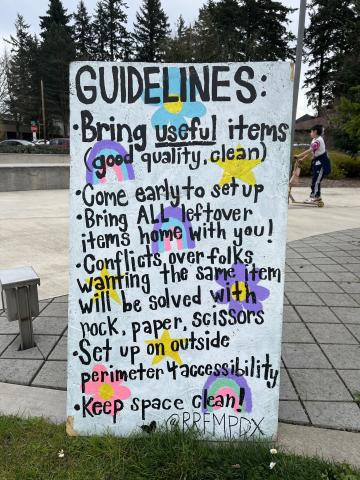 Guidelines for participating in the RRFM in Portland, Oregon. Photo by the Really Really Free Market. Guidelines for participating in the RRFM in Portland, Oregon. Photo by the Really Really Free Market.Joy in Community
These realizations of the gift economy—from Free Stores to free markets and BuyNothing groups—are more than a challenge to hyper-consumerism. They offer healing.
Smutney recalls the story of a woman who used goods from the Free Store to repair her relationship with her daughter. She would pick clothes and toys from the store and bring them to her daughter as gifts.
“It was a way for them to rebuild their relationship because she was providing, and she always felt guilty for not being able to give her daughter the things she wanted growing up, but was able to provide for her granddaughter,” says Smutney.
At the Portland RRFM, the organizers emphasize that the person-to-person connection is what’s so important about the market—the items are merely a vector for sharing community joy.
“As long as the community allows it and wants it, [we’ll keep doing it],” the organizers say. “When you have a lot of stuff at your house, the first thing that comes to mind is: I’ll take it to Goodwill. And you just drop it off. But people get a lot more satisfaction from actually seeing the person that’s going to enjoy it.”
Finding joy in community sharing and caring doesn’t mean you have to start your own market or Free Store (although we’d love to hear if you do, see the box below for tips). Simple first steps can include joining your neighborhood’s local BuyNothing Facebook group or FreeCycle group. Whatever option fits you best, give the gift economy a try.
Bring the Gift Economy Home
Feeling inspired? Start your own Free Store or RRFM! The organizers of Portland’s version advise to “just start it; don’t overthink it. If people see what you’re doing, they’re going to help.”
- Find a location. Find a neutral location where everyone will feel comfortable, such as a community center, school yard, or public park. Make sure to confirm any guidelines for using such a space for your event, by checking with relevant officials.
- Attract volunteers. Smutney says that if you build a Free Store, people will come. Most of Smutney’s volunteers were originally skeptical of the idea until they saw it in action—and then they asked to start one themselves. Local groups that support a giving economy, such as religious congregations, or BuyNothing and FreeCycle groups, are great recruitment networks.
- Advertise in the community. Hang banners at major intersections and in community hangouts like libraries and fitness centers, and canvass in the surrounding neighborhood. Consider sharing materials in more than one language to help non-English speakers.
- Gather items to give. Ask folks to bring their own donations. Take advantage of the changing seasons when people are cleaning out their closets. Offer to pick up items or have one drop-off location to make it easy for people to donate. You might even accept drop-offs on the same day as the market.
- Attract attention. If your market is going to be outdoors, ask volunteers to set up activities and entertainment that may pique the interest of passersby. Music, dancing, juggling, activities for children—you’d be surprised at the talents that people in your community can showcase.
- Have a plan for leftover items. At venues where items can’t stay overnight, ask participants to take home items that are not given away by the end of the day. Sometimes, volunteers may offer to bring them home until the next market. Another option is to donate excess to a local thrift store.
|
|
Carpool for the Climate and Community |
Cathy Cowan Becker, Green America’s responsible finance campaign director, works with an organization in Ohio to stop fracking in state parks. The state-wide Ohio Oil and Gas Land Management Commission that will decide the matter recently held a public meeting in Columbus seeking input from citizens. But in order to provide your perspective as an Ohioan, you had to be there in person.
“For most people, that meant a two-to-three-hour drive,” Becker says. She knew the tactic would impact turnout to voice opposition.
“I set up a carpool page on groupcarpool.com where drivers could post spots in their cars and people could join a car from their area. We got three cars full and a good turnout. The committee tabled the decision, so we get to do it again next month.”
But even aside from carpooling for political activism, ridesharing offers a win-win-win proposition for people, the planet, and your pocketbook. Many cars can seat several passengers, and yet of the 1.1 billion personal car trips each day in the US, nearly half are driven with only one of those seats occupied, according to the US Department of Transportation.
Every empty seat in the hundreds of millions of cars on the road represents a missed opportunity to save money, reduce traffic and pollution, and build community through a shared ride. While the idea of carpooling isn’t new, several resources make it easier than ever to publicize open spots in your car and to safely seek out promising carpool partners.
The Perks of Carpooling
There are several reasons to carpool—a 2018 study cited “cost of gasoline” and “less expensive than driving alone” as the most pressing motivations, but other reasons included “more convenient parking,” “finding good company to ride with,” and “a variety of pick-up and drop-off times.”
Sharing rides also means fewer cars on the road, which has a major environmental benefit. According to the US Environmental Protection Agency, transportation makes up nearly a third of the country’s greenhouse gas (GHG) emissions and a whopping 81% of all transportation is made up of light-duty vehicles and medium- and heavy-duty trucks. For trips where walking, biking, or public transportation aren’t an option, ridesharing is a powerful way to cut down on car miles driven. In many cities, carpooling also allows drivers to use high-occupancy vehicle (HOV) lanes, which may have lower traffic.
Amid the US loneliness epidemic, as detailed in the 2023 US Surgeon General Advisory “Our Epidemic of Loneliness and Isolation,” carpooling also provides a lifeline: social connection.
Scholar of “social capital” Robert Putnam, the author of Bowling Alone, has documented that across the population, every ten minutes of additional commuting time is correlated with a ten percent lower level of social connectedness. In a world where isolation poses serious health risks (29% higher risk of premature death, 32% higher risk of stroke), carpooling could literally be lifesaving.
Remember that while ride-sharing services like Uber or Lyft may be useful, they are not the same as carpooling. Paying a ride-share service does not remove a car from the road, does not foster the same community connection as developing a cooperative arrangement with other travelers, and does not save money like carpooling.
Share Rides to Work, School, and Worship
If you don’t have a friend or co-worker ready and willing to carpool with you, online tools can make finding carpool partners easy and safe.
The first step is to locate fellow carpoolers, so tap your community. Put out the word in-person at school events, church, or the office breakroom. In the internet age, check out your school or work’s website, or see if they have a Facebook or Nextdoor group, and inquire there.
“Incentive programs help encourage pooling,” says Adam Cohen and Susan Shaheen, members of UC Berkeley’s Transportation Sustainability Research Center. “There can be direct cash incentives, free parking, and more, offered or funded by employers and public agencies.”
Companies like RideShare and CarpoolWorld make it even easier, by offering ride-sharing services to
employers, so don’t hesitate to advocate for an incentive program at your workplace.
Share Rides to Events
Next time you’re planning a car trip to a large gathering such as a conference, concert, sports game, festival, or celebration, look for an opportunity to share rides there and back.
SpaceShare.com develops customized ridesharing applications for large festivals, conferences, and
community events.
AlterNetWays provides software to help coordinate transportation, such as a customized ride-sharing application for an event website for $50.
“Think about football games,” muses AlterNetWays’ CEO Mark Evanoff, noting that universities could help organize ridesharing to both home and away games. “Somewhere on the university’s website there will be a link to buy tickets to the game. Universities could add just one more link that says, ‘click here to carpool to this game.’”
For private events like weddings or family reunions, there are a variety of free technologies that can help participants find a ride. Try setting up a spreadsheet online through Google Sheets and create a public URL for the document that you can share with guests by e-mail.
Share Rides in Town
Many local ridesharing resources serve particular metropolitan areas. Many lively local websites, sometimes established by the municipal transportation authority, help citizens share rides.
For example, at Central Texas’ Commute Solutions, neighbors collaborate locally to set up carpools for one-time and recurring car trips.
AlterNetWays also works directly with local transportation authorities to provide a customized application that allows residents to coordinate ridesharing through the city or county’s transportation website.
Across the country, city officials may already offer carpool services you didn’t know about—try searching online for: “[city name] transportation department carpool.” For example, in the Bay Area of California, the San Francisco Municipal Transportation Agency (SFMTA) supports carpooling in various ways, providing dedicated drop-off/pick-up zones downtown, parking permits, discounted rates, and more.
Erica Kato, chief spokesperson of SFMTA, stressed the importance of a well-maintained ridesharing service in order to achieve the benefits of carpooling like saving money and reducing emissions: “As folks get used to having car share available and get rid of a personal car (or forego purchase of a new one), having that car share service get less reliable is a bad thing—we don’t want to drive people back to buying their own cars.”
If possible, you can also reduce your environmental impact by walking, scootering, biking to stores, parks, and other recreational areas in your neighborhood. According to a 2021 study in “Transportation Research Part D: Transport and Environment,” people can reduce their transportation footprint by 67% by choosing a bike over a car for one trip a day.
Share Rides Out of Town
Heading out of town for the weekend? A number of national ridesharing websites help carpoolers find each other for trips between cities. CarpoolWorld offers inter-city rides, as do apps like Hitch or Ridesharing.
Cohen and Shaheen believe carpooling can increase thanks to technology: “Digital matching platforms and rating systems can help enhance trust between carpooling partners and match carpoolers with similar preferences (such as carpoolers with similar interests and/or music preferences, etc.).”
Safety is another ride-sharing concern, and it is always important to practice caution when matching with someone you don’t know to share rides. This can mean making sure someone you trust knows your ride-share details, and you agree on clear guidelines and rules with other participants, including any health concerns, such as agreeing to mask while in a confined space, or keeping a clean car. Let’s Go Smart, a Springfield, MO program encouraging climate-friendly transportation, provides a useful carpool FAQ addressing safety and other concerns.
With all the benefits and increased ease of ridesharing, Evanoff envisions a day soon when cooperatively sharing car rides will become a routine part of planning how to get from point A to B.
|
|
Cook One Meal, Eat for a Week with Cooking Cooperatives |
Few things bring people together like food. Steaming casseroles, warm noodles, smoked
veggies—and while we all wish we could eat great food every night, the reality is that leftovers can be monotonous, and cooking can be exhausting.
Cooking cooperatives can take the stress out of cooking several nights a week and can bring exciting flavors to the table, often for much lower prices than cooking alone. With today’s hectic schedules and evolving lifestyles, one of the many shapes and sizes of cooking co-ops may fit your unique needs.
Cooperative Cooking for Young Adults
The Southern Scholarship Foundation in Florida has been practicing cooperative living for over 60 years. A nonprofit housing community for college students made up of 26 houses across six universities, all residents are high-achieving students of underserved backgrounds. Every Monday through Thursday, two or three students will cook in bulk and the house will sit down together to have dinner.
One of the joys of cooperative cooking is the chance to try new flavors from different cultures. Julian Romero, a student at the University of Florida in Gainesville and house manager of Williams-Pilot Scholarship House, says that in a single week alone his house has eaten Korean ground beef, chicken casserole, and vegan walnut and lentil Bolognese.
Ja’Chelle Johnson, a student at Florida A&M University in Tallahassee and house manager at LaVerne Weddle Pilot Scholarship House, says that “what I like about house dinners is the sense of unity, having dinner together with other people and hearing about their days, it feels like a real family. I enjoy learning about the different cultures of people I live with.”
 The students of the Southern Scholarship Foundation at the University of Florida share their home cultures, build community, and save money by cooking cooperatively. You can adapt their strategies for your own life, save on your food budget, and meet new friends or deepen existing relationships. The students of the Southern Scholarship Foundation at the University of Florida share their home cultures, build community, and save money by cooking cooperatively. You can adapt their strategies for your own life, save on your food budget, and meet new friends or deepen existing relationships.
(Photos by the Southern Scholarship Foundation)Cooking Co-ops for Community
Cooking cooperatives do not have to involve living together—neighbors, friends, and families can work together in unique ways to share good food without the same roof over their heads.
For example, in Birmingham, Alabama, a cooking cooperative fed three entire families for ten years— until the families’ kids were grown. Ruthann Betz-Essinger and her friends Leigh Fran and Caroline would each cook a single large meal per week to feed all three families, and package the results into thirds. One share of each big meal would stay home, with the other two portions delivered to to the other families. In other words, through the power of cooperation, each family would cook only once each week, but would receive three fully prepared dinners.
Each Sunday, the group would share the packages amongst each other. Betz-Essinger says the group would provide each other with directions on how to reheat and prepare the meals, and that her family enjoyed the variety of dinners each week’s exchange would provide.
The cooking co-op was most helpful on busy weeknights—instead of having to prepare a meal from scratch after a long day, or resort to quick take-out, Betz-Essinger would simply open her refrigerator to find a meal already assembled. After reheating, her family would enjoy a delicious, healthy, homemade dinner.
“We loved the co-op as it gave us a huge variety of food, tastes, and flavors,” says Betz-Essinger. “I loved the surprise of what was in the bag as well as trying something that I would never have made for myself.”
The cooking co-op phased out as the families began to shrink. All the children who enjoyed their families’ shared meals are now in their mid-20s, married and living in different places across the country. Ruthann, Leigh Fran, and Caroline remain friends, however, and in reflecting on her co-op experiences for this article, Ruthann says she was inspired to give a new version of a cooking co-op a try.
“I think I will call Leigh Fran and Caroline to see if we should start up the co-op again since we are all empty nesters,” says Betz-Essinger. “It would be easier this time as we would be cooking just for six!”
How To Form Your Own Cooking Co-op
The joys of community, good food, and increased quality of life is a commonality that all shapes of sizes of cooking co-ops share. Try it yourself with friends and families—you might just find it’s worth continuing for months or years to come.
- Pick people who make it very easy to get the food to them, either through a common drop-off/pick up point, or by forming a co-op with neighbors or coworkers. Set up delivery times that fit with everyone’s schedule.
- Find people whose families are similar sizes, because it makes portioning easier.
- Find people with similar food tastes and practices, or people who are open to trying new things.
- Be sensitive to different cultures, tastes, allergies, and alternative food options to make planning, cooking, and eating enjoyable and inclusive for everyone involved.
- Establish clear guidelines for what the group expects each member to make when it’s their turn. A planning calendar can help to ensure a variety of foods.
- Package foods in containers that can be both frozen, reheated, and then reused, such as Pyrex baking dishes. Secondhand and thrift stores can be an inexpensive way to acquire additional containers.
If you like to eat well, save time and money, and build community in the process, consider forming a cooking co-op.
|
|
Lowering the Carbon Cost of Your Diet |
Do you want to increase the vegetarian component of your diet, whether for budget reasons, health reasons, or to protect the climate?
Maybe you are one of 7 in 10 Americans already doing your best to trim your personal greenhouse gas emissions—driving an electric car, putting up solar panels, or composting at home. None of us can do everything, but one option for helping out the climate at home is to eat fewer animal products, especially those from animals raised in confined animal feeding operations (CAFOs). In the U.S. alone, there are 21,000 CAFOs, and 90% of animals destined for human consumption are raised in these factories. In terms of greenhouse gas emissions, freshwater resources, pesticide use, and airborne emissions, CAFOs are notably detrimental to our environment. Read on to see how limiting animal products can help lower your carbon footprint.
Greenhouse Gas Emissions
One of the most widely-publicized environmental liabilities of animal agriculture is the greenhouse gas emissions that come from intensively farming animals. At nearly every process along the way, an assortment of dangerous gasses are emitted. It’s often a compounded problem because land is cleared and deforested to make room for animal farming, decreasing carbon dioxide absorption; and that land is then actively used for activities that release greenhouse gasses.
Certain animals, such as cows and sheep, belch methane, and the manure of all animal species decomposes and releases both methane and CO2. Transport and slaughter require additional fossil fuels. The three largest contributing sectors are beef, lamb, and dairy (specifically cheese), according to Our World Data and the Environmental Working Group. In contrast, life cycle assessments of most plant-based products have been found to have significantly lower carbon footprints.
Freshwater and Waste
While human bodies require on average a ½ gallon of water/day, fresh water given to sustain animals used for agriculture amounts to 20% of all global freshwater. Beef cattle require an average of 12 gallons of fresh water a day; cows utilized for milk production require 30-50 gallons (the size of an average bathtub); and pigs and sheep require between 3-7 gallons/day depending on gestation status and temperature. In addition to the animals’ water requirements, the operations themselves are incredibly water intensive because water is used to flush away manure from floors, to wash both live and slaughtered animals, to water the crops used to feed animals as compared to crops we directly eat, and during processing (such as chickens that are scalded in hot water before feathers are plucked).
What about output? Dairy cows excrete ~100 lbs of manure a day, beef cattle excrete up to 60-75 lbs, and pigs excrete ~11 lbs. For comparison, humans excrete about ¼ lb. While human waste water is required to be treated in water treatment plants, livestock waste does not have this same requirement, and may contain bacteria, heavy metals, medications, antibiotics, and hormones that enter our groundwater supply and waterways.
Pesticide Use
When people think of pesticides, they often think of fruits and vegetables. But meat and milk can contain high amounts of pesticides because these substances bioaccumulate in animal tissue. Glyphosate concentrations are allowed to be more than 100X higher on crops used to feed animals as compared to crops we directly eat. For example, upper limits on carrots for human consumption are 5 ppm, while upper limits on forage, fodder, and hay for livestock are 300 ppm. The World Health Organization reports that “More than 90% of human exposure to dioxins is through the food supply, mainly meat and dairy products, fish and shellfish.” Many of the pesticides used in the U.S. on feed crops (such as atrazine and paraquat) have been banned by other countries. In addition to documented human health effects of pesticides, widespread pesticide application threatens biodiversity and endangers the health of ecosystems.
Airborne Emissions
While most other emitting industries are regulated, industrial animal agriculture has exploited a loophole for nearly two decades. In 2005, under the Bush administration, the “Air Consent Agreement” was enacted. CAFOs agreed to have their emissions monitored by paying a fee in exchange for the EPA releasing them from any federal or state liability for past and future emissions violations until the study was completed. 90% of animal feeding operations signed up and encouraged other producers to sign up. Animal industries that fall under this study include pigs, broiler chickens, egg laying operations, and dairies. Emissions include methane, ammonia, VOCs, hydrogen sulfide, and particulates. Per the EPA itself, “reporting of air emissions from animal waste at farms is not required under EPCRA [Emergency Planning and Community Right-to-Know Act].” Eighteen years later, the study has yet to be completed and the EPA has failed to produce any report that outlines actions the industries need to take under the Clean Air Act.
Tips and Resources
Knowing all this, what can individuals do to reduce their meat and dairy consumption? Try the following:
- Check out the charts published by the Center for Sustainable Systems at the University of Michigan that rank foods in terms of their greenhouse gas emissions and choose foods that are more planet friendly.
- Choose plant foods when you can: the vast majority are significantly less water intensive than animal-based foods.
- Try out different non-dairy milks; charts published by Our World in Data show some environmental footprints of dairy and a selection of non-dairy milks.
- Start a Climate Victory Garden at home.
- Consider taking part in Meatless Mondays or other challenges to reduce the animal products in your diet, such as Veganuary.
- Sprout beans at home to obtain a great source of protein, fiber, and minerals.
- Grow microgreens! These take up minimal space, grow quickly, and can be higher in micronutrients than their larger counterparts.
However you choose to boost the plant-based content of your diet, you can feel confident your meatless choices have a positive impact on the planet, and you might just save some money too.
|
|
Ways to Eat Organic Food on a Budget |
It can be hard to eat organic food on a budget. But we have some tips on how to prioritize the foods least contaminated by pesticides, increase your access to healthy, organic food on a budget, and even build community along the way.
The good reasons to do so go beyond protecting your health and the health of your family. Prioritizing organic food also means protecting farmworkers, farming communities, and the environment (including pollinators and other beneficial insects) from exposure to harmful pesticides.
So, whether you’re going organic for reasons of personal health, or social and environmental protection (or all three!), we have some tips on how to increase your access to healthy, organic foods, and even build community along the way.
Prioritizing Your Organic Choices
The Environmental Working Group’s (EWG) Shopper’s Guide to Pesticides in Produce is a treasure trove of information for organic shopping. One gem is their “Dirty Dozen” list—fruits and vegetables most likely to retain pesticide residue even on grocery-store shelves.
“Numerous peer-reviewed scientific studies have shown that consumption of produce high in pesticide residues … increases the risk of certain negative health impacts,” explains the EWG. “The potential health problems connected to pesticides include brain and nervous system toxicity, cancer and hormone disruption.”
A major area of concern for EWG is children’s health. EWG explains that even low levels of pesticide exposure can negatively affect childhood development. While the Environmental Protection Agency (EPA) has taken steps over time to control pesticide usage, the EWG says that current regulations still fall short.
Sarah Graddy, EWG’s senior communications advisor for agriculture and climate warns about “persistent messaging from industry lobby groups” claiming that certain pesticides and agricultural practices are safe by pointing to government approval. “Our primary message, beyond eat more fruits and vegetables, is that legal does not always mean safe.”
Dr. Alexis Temkin, EWG’s senior toxicologist, adds that “when you see people switch to an organic diet, the levels of those pesticides that you can measure in people drop really, really quickly.”
To help you with your organic choices, the EWG also publishes the “Clean Fifteen”, a list of fruits and vegetables that are safer to buy non-organic because they retain lower levels of pesticide residue. Some of these items can be expensive, so to be truly budget-conscious, you may wish to limit purchases to within their growing season, or eliminate purchases overall of fruits and vegetables that don’t grow in your bio-region. This has the added benefit of reducing consumption of items that have traveled the farthest to arrive at your local store—a climate win and budget win all at once.
More Tips and Strategies
When it comes to shopping organic on a budget, here are further strategies that can help you with your grocery list:
- Vegetarian and vegan diets are generally the most affordable, studies have found. Cutting meat out of your kitchen can greatly reduce your bill, so switching to a plant-based diet can do wonders for both the environment and your wallet. The benefits of this strategy can be felt even eating meatless a couple days a week.
- Frozen organic foods are also a good option that can even have higher nutritional value, as they are harvested later in their life cycle when nutrition is at its peak, and they don’t lose nutritional value in transportation.
- Starting a garden can save money, cut pesticides, and reduce carbon emissions compared to store-bought vegetables. Turning your backyard, patio, or balcony into a regenerative Climate Victory Garden provides the opportunity to grow the most local organic produce possible while simultaneously giving back to the environment.
- Community Supported Agriculture (CSA) groups can help you access fresh and local organic produce. These community groups partner with local farms to provide members with a regular supply of produce, often paid for at the start of the growing season by an up-front membership fee that helps farmers plant without borrowing money. In turn, members receive a bountiful supply of local foods, saving money in the long run over conventional grocery costs. To increase accessibility, many CSAs offer sliding scale pricing, installment plans, or other pricing structures that extend through the growing season.
The USDA Local Food Directories can help you find nearby CSA programs, farmers’ markets, and other local food resources. Their search tool can filter your search for options that match your budget, like CSAs that welcome volunteer work as payment, or those that accept nutrition assistance programs. Farmers’ markets often take SNAP or EBT benefits, and can offer prices cheaper than the grocery store. - Recipients of SNAP or EBT benefits can save even more. Now available in 25 states, the Double Up Food Bucks Program doubles your benefits when they are spent on fresh fruit or vegetables. Anyone receiving SNAP or EBT benefits is automatically eligible.
With knowledge on your side, you can determine your own priorities to guide your organic shopping strategies, focus your organic purchasing on the right items for you, and still work to keep costs down. Whether you can utilize one or all of the resources mentioned here, every step taken towards a more sustainable future supporting organic agriculture is a win.
|
|
7 Ways to Save Money While Going Green |
Being more sustainable on a budget doesn’t just mean cutting down on costs – you can actually save money going green. To help you become more environmentally friendly while you save money, we’ve compiled this list of strategies to get you started.
One Less Car
Transportation produces the largest share of U.S. greenhouse gas emissions at 29% of our total. If we all drove 10% less than we do now, we would see a reduction of about 110 million metric tons of carbon dioxide emissions, or the equivalent of powering nearly 14 million homes for one year.
Ditching your car entirely is a huge step towards reducing carbon emissions, as is reducing a two-car household to one car only or making your second car an electric vehicle (something the IRA can help with, and that will save money in the long-term). Simply replacing as many car-trips as possible with walking, biking, or public transportation is a good option as well.
“My favorite is to run errands on foot or on my bicycle. I save money on gas and get some exercise at the same time. I also avoid the hassles of being stuck in traffic,” says Todd Larsen, Green America’s Executive Co-director for Consumer and Corporate Engagement. “And it’s better for the planet.”
Love Your Local Library
What’s not to love about public libraries? Libraries reuse resources in countless different ways, providing the public with accessible information and entertainment while contributing to carbon footprint reduction. Many libraries are now expanding beyond books, circulating a wide range of materials, such as craft kits, baking supplies, yard games, and more for their patrons.
“I get a lot of my books from Little Green Libraries or public libraries. The books are free, and I give them back after I’ve read them for others to enjoy,” says Larsen.
Grow Your Own
Gardening is a fun and cost-effective way to go green (literally!) and save money. If you have access to space for your own garden, winter is a great time to begin designing your plot for next season. If you don’t have your own space, consider other ways of planning ahead this winter to grow your own food in the spring—by seeking out local community gardens or working to start a new one with your city, house of worship, or local school.
The National Gardening Association has estimated that with a $70 per year investment you can grow up to $600 of fresh vegetables—a $530 savings! If you find yourself with more produce than you need, you can also consider trading your excess with others (another way to save money), donating to your local food bank, or preserving your excess by canning or freezing to keep saving money all winter long. Thrift stores are always chock full of mason jars, which are the perfect canning materials.
Green While You Clean
Looking at standard cleaning products reveals several opportunities for sustainable swaps: replacing paper towels with rags, making your own solutions like all-purpose cleaner and laundry detergent, and swapping single-use spray bottles with reusable glass alternatives are just a few steps that transform household upkeep into environmental support. Even personal hygiene products become a chance to make a difference.
“My favorite green-on-a-budget tip is bar shampoo and conditioner! It’s so much more bang for your buck, involves no plastic, and lasts for months,” says Anya Crittenton, Green America's Senior Writer & Senior Green Business Network Marketing Specialist. “Plus, there’s so many options for scents and hair types. I’m particularly obsessed with my purple bar conditioner to help keep my blonde from becoming too brassy—just as good, if not better, than a bottle!”
Reuse, Reuse, Reuse
Incorporating a philosophy of reuse into your lifestyle not only contributes hugely to waste reduction and climate health but will also take some pressure off your wallet. Plus, there are so many ways to implement this concept!
Consider participating in community exchange groups (for everything from clothing to tools, appliances, or other household items); ditching single-use items for reusable alternatives; and frequenting resale stores and warehouses, yard sales, garage sales, and flea markets.
“I look for clothes, furniture and garden tools first at resale stores—it’s surprising how often you can find good quality things this way,” says Mary Swanson, Senior Programs Specialist at Green America’s Clean Electronic Production Network.
What Really Matters? Buy Less.
When we put out our trash, it goes to landfills or industrial waste incinerators. Whether buried or burned, our trash generates methane and nitrous oxide, two greenhouse gases more harmful than carbon dioxide. Household consumption as a whole contributes to up to 60% of global greenhouse gas emissions, according to the U.S. Environmental Protection Agency. Making more intentional choices about our purchases not only helps alleviate this massive impact on the environment, but also directly reduces the amount of money we’re spending on a wide range of material goods.
“I think the best eco-label on a product would read: ‘Do you really need this?’ I try to avoid impulse purchases by meal planning and shopping from a list at the grocery store,” says Swanson.
Low- and No-Cost Gifts
We recommend applying these cost-saving ideas to your holiday giving, and perhaps agreeing with friends and family to spend less money, while still making the season meaningful. Reused items, such as vintage vinyl records or clothing, can make excellent gifts, as can passing along a treasured heirloom. Friends and family will appreciate your time and talents as much as a material object, so consider writing a heartfelt letter as a gift, or providing an experience—maybe a home-cooked meal, prepared with preserved veggies from the garden.
Tapping into techniques and resources like these can open the door for your own budget-friendly social and environmental impact.
Updated January 2026.
|
|
Going Green on a Budget |
We hope this issue of the Green American brings a smile of recognition to all of our readers who grew up with budget-conscious elders.
“Turn off the light when you leave the room.”
“Don’t waste food; someone else could eat that.”
“In my day we walked; you don’t need a car.”
Going green on a budget isn’t a new concept. In fact, in many ways, the goals of “living green,” and “sticking to a budget,” are the same: to live within our means, recognizing that resources are limited, and that waste comes with a cost. The same lessons about responsible consumption apply whether we are considering the resources of an individual, a family, a community, or the human family stewarding the resources of the planet that we share.
Adopting green-living choices may quite naturally align with the budget-conscious choices many are already making, especially those suffering from economic hardship or the recent high levels of inflation. However, living green is not just a luxury for the privileged few. This issue dives into budget-friendly strategies for everyone to pursue sustainable options for the purchasing categories where households often devote most of their spending, such as food, transportation, and clothing, offering specific suggestions in each category. Shifting purchases within these categories can have the greatest impact—on your budget, and for people and planet.
At the same time, many of the concepts behind the suggestions are universal—applicable across categories, and, as noted above, draw upon the wisdom that thoughtful, future-focused elders have passed on to younger generations for years, such as:
The value of sharing: While our society often prioritizes ownership, sharing our resources can also mean sharing our costs, and ultimately saving both. Are there household items that you don’t use often? Consider sharing with neighbors, friends, and family. Find more ways to swap and share resources with your community with Free Stores and Really Really Free Markets.
The value of cooperation: While our society often prioritizes rugged individualism, communities collaborating together can develop incredible cooperative resilience that supports both a sustainable and budget-conscious lifestyle. Consider collaborating with others on meal-planning and transportation.
The need to take a long view: Finally, while our society often prioritizes instant gratification, evaluating our actions within a longer-term perspective can help us identify the choices that are more sustainable—and over time, more budget-conscious. For example, while a green-energy upgrade at home might require up-front costs, your investments will pay for themselves in reduced energy bills for years (and you might qualify for a tax credit). While a fast-fashion outfit might be the cheapest short-term option, well-made vintage, or new responsibly produced clothing can last years longer and not need to be replaced. And while organic food can sometimes cost a bit more than conventional, the long-term benefits to your health and the health of workers and the environment will save on medical and remedial costs in the future.
Our green-on-a-budget recommendations begin with eight initial suggestions to go green and save money. We hope the stories of other Green Americans making budget-conscious and sustainable choices will inspire new steps for everyone interested in building a resilient future.
|
|
Green America Celebrates Transgender Awareness Week |
November 13 was the first day of Transgender Awareness Week, a 7-day stretch dedicated to highlighting the vast range of issues faced by members of the transgender and gender non-conforming community through education and advocacy, which culminates in the observance of the Transgender Day of Remembrance (TDoR) on November 20.
The first TDoR was held as a vigil in 1999 in honor of the recent deaths Rita Hester and Chanelle Pickett, two Black transgender women from Boston who were victims of anti-transgender violence and subsequent transphobic media coverage. Now, TDoR is a yearly memorialization of victims of anti-transgender violence – both in memory of lost members of the transgender and gender non-conforming community this year as well as the long and tragic history of fatal transphobia.
Transgender people live with a much higher likelihood than cisgender people of experiencing violent crime. The 2023 Trans Murder Monitoring Report shows that the number of reported murders of transgender and gender non-conforming people this year is just shy of 2021’s deadliest year of anti-transgender violence on record, with transgender women and femmes, especially Black women, disproportionately affected.
With the transgender community facing unprecedented rates of anti-transgender laws, violence, and relentless public transphobia, this year’s Transgender Awareness Week holds even more weight than ever before when it comes to the crucial need for recognition and allyship. With an overwhelming amount of mainstream media coverage and conversation about transgender and gender non-conforming people riddled with misinformation and bigotry, this week is a call to take the time to truly educate yourself on the truths of transgender experience and discrimination.
Listening to and amplifying transgender voices on personal experience and critical needs for advocacy to ensure the safety and livelihoods of all members of the community is a crucial first step with an importance difficult to overstate. As we approach TDoR while fighting through years of record levels of anti-transgender violence and a future that often feels overwhelmingly bleak, hear the call of Transgender Awareness Week to dedicate yourself to allyship and supporting the transgender and gender non-conforming community.
Holiday background and social justice
History/background of transweek
TDOR origin
Trans Murder Monitoring Report 2023
GLAAD TDOR
This is what Trans Solidarity Really Means
GLSEN Pronoun Guide National Center for Transgender Equality – State Action Center
HRC Fatal Violence List 2023
If You Care About Reproductive Justice, You Should Care About Transgender Rights (from 2015)
Trans Violence and Deadnaming in Media
Economy
The Financial Penalty for Being Transgender in America
Queer & Trans Liberation Means Economic Justice For All!
The economic consequences of anti-trans legislation
Environnent
Yes, trans rights are an environmental issue, too
Queering the environmental movement
In person events
Trans Awareness Week: Gender Affirming Closet (Old Dominion)
Virtual events
Live Out Loud! Transgender Day of Remembrance Virtual Panel
Books
This Body I Wore By : Diana Goetsch
Redefining Realness: My Path to Womanhood, Identity, Love & So Much More By: Janet Mock
Beyond Magenta: Transgender Teens Speak Out By: Susan Kuklin
How to They/Them By: Stuart Getty
|
|
Going Green on a Budget |
Find tips for greening your meals, clothing, transportation, and more, all without breaking the bank.
|
|
Hill + House |
Hill + House is your one-stop-shop for eco-friendly and sustainable products. We are a team of passionate individuals committed to creating a better, greener world for ourselves and future generations. Our journey started with a simple idea - to make sustainable living accessible and affordable for everyone. We believe that small changes can have a big impact, and that's why we have curated a range of eco-friendly products that make it easy to live a sustainable lifestyle.
From reusable water bottles to laundry detergent sheets, we offer a wide range of sustainable alternatives that are kinder to the environment. Our products are carefully selected based on their quality, sustainability and impact on the environment. We are committed to reducing our environmental footprint, and that's why we use only 50-100% recycled and biodegradable materials for our packaging. We’re also committed to supporting a variety of nonprofits, through our 1% for the Planet membership, that help with environmental conservation and preservation.
|
|
Tell B&G: Go Regenerative |
As a major food manufacturer, B&G Foods – the owner of iconic brands like Green Giant, Cream of Wheat, and Spice Islands – has the power to drive adoption of regenerative agriculture – a holistic approach that rebuilds soil health, sequesters carbon, increases yields sustainably, reduces pollution, and mitigates climate change.
|
|
Toxic Pesticides: B&G Foods the Target of Major Campaign Urging Shift to Agriculture Techniques That Protect Environment, Workers |
Owner of Popular Brands Like Green Giant, Skinnygirl and Ortega Under Pressure for Use of Pesticides that Harm Farmworkers and Pollinators, Lack of Regenerative Agriculture Practices.
WASHINGTON, DC – November 14, 2023 – Green America launched a new advocacy campaign against B&G Foods to urge the company to limit pesticide use and adopt environmentally responsible agriculture practices. The New Jersey-based holding company, which owns dozens of popular brands including Green Giant, Skinnygirl, Ortega, Fleischmann's, Cream of Wheat, Spice Islands and Crisco, received an “F” grade in the recent “Pesticides in the Pantry” scorecard released by the nonprofit As You Sow that graded the pesticide practices of major food companies.
On October 11, Green America sent B&G CEO Kenneth Keller Jr. a letter on behalf of its members, including over 250,000 consumers and 2,000 businesses. The letter requested a meeting about reducing the use of pesticides in B&G’s supply chain and adopting regenerative agriculture practices. B&G has yet to respond.
Emma Kriss, food campaigns manager at Green America, said: “We are urging B&G to become a ‘green’ agricultural giant by phasing out harmful pesticides, adopting regenerative agriculture, and implementing policies to protect workers and communities from pesticide exposure.”
Kendra Klein, deputy director of science at Friends of the Earth, said: "Amid rising concern about an insect apocalypse decimating the small but mighty pollinators responsible for one in three bites of food we eat, food companies like B&G Foods must take immediate action to address the pervasive use of toxic pesticides in their supply chains.”
The campaign petition urges B&G to:
- Adopt a plan to transition all supply chains to ecological regenerative agriculture by 2035 through techniques like no-till farming, cover-cropping, and crop rotation.
- End use of highly hazardous pesticides, phase out all harmful pesticides, and adopt Integrated Pest Management for all brands.
- Implement policies to protect farmers, farmworkers, communities, and pollinators from pesticide exposures.
In anticipation of the Green America campaign and As You Sow scorecard, B&G posted a hasty statement on pesticides. But the statement is vague. B&G must create a meaningful plan and timeline for addressing pesticides and regenerative agriculture.
Based on publicly available information, B&G currently does not have a pesticide reduction strategy or any public disclosures regarding pesticide policies or practices. There is also no information regarding the adoption of regenerative agricultural practices, which include techniques like no-till farming, cover-cropping, and crop rotation to improve soil health, capture carbon, retain nutrients, hold moisture, and reduce erosion.
B&G should adopt a rigorous integrated pest management (IPM) program to reduce and phase out all synthetic pesticide use. IPM utilizes natural predators and parasites, biological controls, and improved sanitation to control pests. This approach minimizes environmental impact and reduces pesticide residues in food and water.
The campaign also urges B&G to implement health and safety policies that exceed EPA regulations to protect farmworkers and communities from pesticide-related illnesses. Mandatory protective equipment, proper education on the pesticides in use and their risks (in native languages as appropriate), enforced re-entry intervals, pesticide application buffers from homes and schools, and regular biomonitoring of farmworkers' blood can better safeguard workers and families from avoidable harm.
Transitioning to regenerative agriculture and reducing pesticide use is critical for the future of food production. Unlike many large agricultural companies, B&G is failing to act on harmful pesticides that endanger consumers, farmers and farmworkers, agricultural communities, and pollinators. As a leader in the food industry, the actions B&G Foods take can catalyze much-needed change.
MEDIA CONTACT: Max Karlin for Green America, (703) 276-3255, or mkarlin@hastingsgroupmedia.com.
ABOUT GREEN AMERICA
Green America is the nation’s leading green economy organization. Founded in 1982, Green America provides the economic strategies, organizing power and practical tools for businesses and individuals to solve today’s social and environmental problems. http://www.GreenAmerica.org
|
|
Guide to Socially Responsible Investing and Better Banking 2024 |
|
|
Letter to B&G - October 2023 |
|
|
Give to People and Planet with the Fair Trade Gift Guide |
The holidays are upon us and with them the flurry to find the perfect gift for loved ones. This year, consider giving to not just people, but the planet, too, by shopping our Fair Trade Gift Guide.
Fair trade is a system of exchange that honors producers, communities, consumers, and the environment. It is a model for the global economy rooted in people-to-people connections, justice, and sustainability.
The fair trade movement has grown in demand over the decades – the most obvious sign being the development of multiple fair trade organizations and certifications, which promise that producers receive and give their workers a living wage, supply chains are ethical and sustainable, and labor laws are followed.
Every item recommended in this article comes from our thousands of certified Green Business Network members (and specifically our fair trade members), which meet or exceed Green America’s standards for social and environmental responsibility.
For the Homebodies
The 100% Organic Hemp Bed Sheet Collection from Delilah Home features hemp fibers, known for softness, breathability, and temperature-regulating properties, as well as being one of the more sustainable crops.
Make a statement at home with the Jellyfish Cocoa Lamp from daiseye. The lamp is made from fossilized cocoa leaves and wrought iron and is sure to get all your guests talking.
Add a splash of color to your home with the Funky Mushroom Trio chime set from Mira Fair Trade, made of reused metal.
Liven up a boring refrigerator with the Beaded Rhino Magnet from Wireworx, handmade from glass beads in South Africa and Zimbabwe.
Handcrafted in an artisans' cooperative in Ecuador, this pair of Fair Trade Ecuadorean Tagua Chess Pawn Figurines from Cadeaux du Monde is a wholly unique gift.
For Those Who Love Fashion
The Raja Rainbow Hoops from WorldFinds are a beautiful gift, with an even more beautiful story. This fair trade business works with women artisans around the world—including women in India, who use fabric scraps from traditional Kantha quilts to create pieces like these earrings.
All the art lovers in your life will be wowed by the jewelry of Dunitz & Company. These Degas Ballerina Earrings feature the unmistakable work of Edgar Degas created with wood board made from recycled eucalyptus.
Gift a loved one with a gold-dipped rose crown the from Belart and help them become the fantasy character of their dreams.
A perfect gift for the activist in your life, the Mantra Bracelets from Mayan Hands feature various inspiring words and are made of 100% cotton.
For the Globe-Trotters
WorldFinds’ Kutch Mosaic Crossbody bag is the perfect accessory for those on the go, small enough to not be cumbersome, while still eye-catching and ideal for all the important things you need to keep handy.
Travel organized with the Wayfarer Traveler Jewelry Roll from Tenfold Fair Trade Collection. The piece is made from handwoven organic cotton by artisans in Cambodia, screen-printed by hand using eco-friendly dyes, and accessories from vegan leather, including a loop on the back to hang the organizer.
For longer trips your friend is taking, gift them the Batik Patchwork Weekender Bag from Fair Trade Winds. Batik is an Indonesian technique of wax-resist dyeing applied to the whole cloth and this bag is made of 100% cotton with upcycled flour sack lining inside.
For the Little Ones
The Travel Tic Tac Toe Game from daiseye is a great stocking stuffer for kids of all ages! The drawstring bag is made of cotton with a kantha stitch tic tac toe board for use with the Neem wood X and O chips found inside.
This gift is double the fun for kiddos! The Hand Felted Tooth Fairy Pillow from Just Creations is both a lovely doll for kids and its small pocket for lost teeth is the perfect way to welcome the tooth fairy.
Encourage the artistic pursuits of anyone with Tenfold’s Pine Crayon Bundles, made from pine brances and sold in bundles of 10.
Books are a staple gift for a reason—especially when they boast such a fascinating story! Reach and Teach offers several genres for all ages. This book, The Pearl Hunter by Miya T. Beck, for middle grade readers, follows a young pearl diver who goes to the ends of the earth to rescue her twin sister, stolen by a ghost whale, in a fantasy world inspired by pre-Shogun era Japan.
Give the stylish gift of A Day at the Beach Kids' Patchwork Pants made of 100% cotton in Nepal from Soul Flower Boho & Organic Clothing.
For the Foodies
Never skimp on the spices with this South African tomato pepper, featuring sun-dried tomato, black peppercorns, garlic, onion, red bell pepper, olives, and basil, sold by Just Creations. This spice comes from Burlap & Barrel, which sources spices directly from farmer cooperatives and small farms.
Up pizza night with the fun and handy Bike Pizza Cutter from Fair Trade Winds.
Try out new meals with Reach and Teach’s Cook Real Hawai’i cookbook by Sheldon Simeon, boasting uncomplicated, flavor-forward recipes.
In an ever-stressful world, give yourself and loved ones some grace and compassion with a warm cup of cinnamon tea from Traditional Medicinals.
Or maybe your giftee is more of a coffee person. There’s no better coffee than Velasquez Family Coffee, featuring quality coffee from Honduras, like the Maximo's French Roast Coffee (dark).
|
|
All the Sustainable Creative Accessories You Need for Your Hobbies |
November has arrived and that means one thing—no, no, not Thanksgiving or fall decorations—it's National Novel Writing Month (NaNoWriMo)! Or school finals are coming up. Or you’re getting ready to start painting or cross-stitching holiday gifts. No matter the project, there’s a chill in the air, and it’s time to bundle up and invest in sustainable creative accessories and products to pursue your hobbies.
Every item recommended in this article comes from our thousands of certified Green Business Network members, which meet or exceed Green America’s standards for social and environmental responsibility.
Notebooks, Pens, and Beyond
The first thing any good creative needs is a collection of reliable writing tools, especially if you’re old-school and prefer longhand for notes, outlines, even full stories! Or if you’re an artist, you can use these products to sketch whatever’s in your imagination.
We’Moon has all the mystical products to get the creative juices flowing and stay on track with your writing goals.
The company’s moon calendars and planners can help you figure out the best writing timeline based on moon phases and stick to your deadlines.
 The We'Moon tarot deck. The We'Moon tarot deck.You can also check out the We’Moon tarot deck, with art from women around the world, to consult the major and minor arcana for ideas.
We’Moon also has an annual literary and art journal with submissions open from March through July once you’re finished with that short story or painting.
For all your paper needs, Green Field Paper Company is a one-stop shop.
Theis sustainable business offers everything from seed paper and greeting cards to hemp folders and labels.
EcoPlum offers all sorts of unique, sustainable office supplies that will make your writing journey easier.
Their wireless earbuds and wood mousepads will aid those who prefer to write or draw on a computer, while their vast collection of notebooks and pens, made from recycled materials, are great for those ideas you have on the go.
 A laser-engraved wood mousepad from EcoPlum. A laser-engraved wood mousepad from EcoPlum.Make Sure You’re Comfortable
Perhaps you’re a desk worker, or you like to curl up in a cozy armchair while imagining far-off places. Either way, it’s important to be comfortable when you’re in the creative space. There’s nothing worse than not being able to get in the groove because you’re hungry or cold or your upstairs neighbor won’t stop playing the drums.
If the air is crisp and the sky is grey, don’t worry about being cold with Mira Fair Trade’s handmade quilts and throws.
Organic and Healthy offers organic cotton blankets in a variety of weaves for whatever texture you prefer, whether it’s a waffle blanket or one also made with chenille.
If you’re someone who likes to create to music, or needs to drown out the world, then don’t miss out on EcoPlum’s bamboo Bluetooth speakers.
For all the extra comforts, check out sustainable online retailer What’s Good for cute, printed socks (with the profits going to various causes!) and delicious chocolate bars.
 A quilt featuring llamas and cacti from Mira Fair Trade. A quilt featuring llamas and cacti from Mira Fair Trade.
Set the Scene
Notes of orange, cinnamon, and clove fill the room and transport you to the magical land you’re creating, all thanks to Sea Witch Botanicals’ Quoth the Raven candle from What’s Good.
 Quoth the Raven candle. Quoth the Raven candle.
What’s Good boasts a unique collection of candles, incense, and essential oils to make sure the ambience is exactly what you need. You can also set an intention for your project with a crystal intention candle.
For other scents and options, look through a variety of candles made of sustainable waxes at Sunbeam Candles and Honey Candles.
It’s also important to make sure your own scene is conducive to and clear for creative thoughts.
Dolphin Blue has tons of office supplies to organize everything from pens to notes and all the miscellaneous desk clutter that helps the space feel like you.
Now, go forth and create your masterpiece—for people and the planet.
|
|
GSRIBB 2023 |
|
|
Green America Celebrates Native American Heritage Month |
The start of November also signifies the beginning of Native American Heritage Month, a dedicated time to recognize, honor, and commemorate the culture, history, and impact of Indigenous people and communities across the Nation. This year’s theme is Celebrating Tribal Sovereignty and Identity.
Initiated federally in 1990, Native American Heritage Month highlights an open opportunity for Native American communities to celebrate shared traditions and arts while remembering their culture’s ever-significant history. For non-Indigenous observers, this commemorative month should act as a stark reminder of the massive and urgent line of work to be done to begin to reconcile the long and painful tragedies inflicted by colonialism and persistent controlling Western narratives.
Native American Heritage Month also encompasses the National Day of Mourning for Native Americans, recognized on the fourth Thursday of November in opposition to the common Western celebration of Thanksgiving. The Thanksgiving holiday, which to most non-Indigenous people has been portrayed as a festive meal celebrating discovery and community, truly serves as a twisted recognition of mass colonialism spurring a dark future of genocide, oppression, and discrimination for Indigenous people on their own lands.
Another important aspect of Native American Heritage Month is in recognizing the immeasurable contributions Indigenous communities have made to the Nation. One area of resounding impact is in environmental justice and sustainability efforts, including fierce protection of critical nature reserves and refuges, clean water movements, wildlife and biodiversity protection, and countless other modes of support for critical actions to protect nature and fight climate change. Connection to nature and land is deeply engrained in Indigenous cultures and informs the importance of campaigns focused on returning land to the people who were connected with it long before any colonizers arrived.
The Landback Movement represents a necessary push to return Indigenous lands to Indigenous communities. Centuries of colonialism and harmful government intervention has led to the removal of Indigenous people from any decision-making or governance of their land and even from the land itself, opening the door for deregulations and other lasting detrimental choices by powerful Westerners on land that they never had a right to reside over in the first place. The Landback Movement yearns for a return to communal Indigenous land structures and the reversal of colonialist-imposed concepts like private land ownership. From cultural celebrations to movements like this one, Native American Heritage Month centers around an important reminder of the beauty and resilience of Indigenous communities – closely connected to this year’s focus on Tribal identity.
This Native American Heritage Month, honor the Native American and Indigenous communities in as many was as you can. Just a few ways to get involved include listening to and amplifying Indigenous voices and narratives, actively contributing to breaking down the dishonest and harmful narratives perpetuated by Western society at large, supporting causes like the Landback Movement, researching what Indigenous land you reside within and crafting a land acknowledgment, and donating to Native-led nonprofits and organizations.
Holiday Background & Social Justice:
Background information about the month
4 Reasons to Rethink Your November
Native Land Digital (Mapping Territories + Other Resources)
A Guide to Indigenous Land Acknowledgement
5 Places to Learn About Indigenous People in Pa
Native American Heritage - Lenape
Indigenous Tribes of Washington DC
Places in the US with Native American Names: By State
Beyond November, Indigenous Communities Honor Culture and Heritage Year-Round
The Indigenous Foundation: Resources
Native American Rights Fund: Voting Rights
The History of Thanksgiving for a Native American Perspective
The True Dark History of Thanksgiving
A Guide to Indigenous Land Acknowledgement
Economy:
National Congress of American Indians: Economic Development and Commerce
Native Americans are getting left behind in the remote work economy
A People’s Orientation to a Regenerative Economy
Environment:
On Native American Heritage Month, Decolonizing Environmentalism
Indigenous Environmental Network
In Person Events:
Walk for Justice (DC)
In person children's event (DC)
Virtual Events:
Virtual Teen Comics Chat – Native American Comics
Webinar, Nov 1
Guide to Indigenous mapping
The Colonial Urge to Commodify the Climate Crisis: Uplifting Real Solutions
Books:
There There by Tommy Orange
Firekeeper's Daughter By Angeline Boulley
Notable Native People by Adrienne Keene
Returning Home: Diné Creative Works from the Intermountain Indian School
Spirit Matters: White Clay, Red Exits, Distant Others By Gordon Henry
Fresh Banana Leaves: Healing Indigenous Landscapes Through Indigenous Science by Jessica Herdnandez
We Are the Middle of Forever: Indigenous Voices from Turtle Island on the Changing Earth by Dahr Jamail and Stan Rushworth
|
|
Eco-friendly Home Improvement at a Discount |
A number of IRA incentives are geared towards helping people with modest incomes to make sure that everyone benefits from going green.
If you were thinking of updating your home—from A/C to hot water heater to stove—now is the time to take advantage of tax credits that will save you money as you help to save the planet.
Over a year after the passing of the Inflation Reduction Act (IRA) in August 2022, the United States government has reported strong results, creating over 170,000 jobs by its first birthday and seeing over $110 billion dollars invested in clean energy manufacturing. Improvements like these show positive signs for the future, as well as significant savings in costs with the tax credits created by this law. However, while it’s relatively clear to see the benefits provided to businesses involved in IRA provisions, the IRA can also be a boon to folks looking to green their lives.
Your Home Incentives Start with an Audit
The government recommends beginning with a professional home energy audit to ensure that energy-efficient upgrades are not sabotaged by external factors in your home—a process that, if eligible, will earn you a 30% tax credit up to $150 once you submit IRS Form 5695 alongside your taxes. The Residential Energy Services Network is one directory of certified professional energy auditors in your area and is backed by the Office of Renewable Energy. Once it’s time to start the process of greening your home, there are many steps that can be taken that are eligible for tax credits provided by the IRA.
Electrical Equipment
Investing in electrical panel or circuit upgrades—or new electrical equipment—can earn you a tax credit of 30% of the consumer cost up to $600.
Installing a fuel cell can earn you a tax credit of 30% of the consumer cost, maxing out at $500 per half kilowatt (kW) of power capacity.
Temperature Control
Installing energy-efficient air conditioning systems can earn you a tax credit of 30% of the cost up to $600.
Installing an energy-efficient air-source or geothermal heat pump can earn you a tax credit of 30% of the cost up to $2000/year. (Learn more about heat pumps at https://www.greenamerica.org/your-green-life/invest-energy-efficient-home.)
Upgrading your insulation and air sealing can earn you a tax credit of 30% of the cost up to $1,200.
Water Systems
Installing energy-efficient hot-water boilers can earn you a tax credit of 30% of the cost up to $600/year.
Installing energy-efficient heat-pump water heaters can earn you a tax credit of 30% of the cost up to $2,000/year.
Installing solar water heaters can earn you a tax credit of 30% of the cost.*
Other Eligible Upgrades
Upgrading to energy-efficient windows can earn you a tax credit of 30% of the consumer cost up to $600.
Installing energy efficient skylights can earn you a tax credit of 30% of the consumer cost up to $600.
Installing rooftop solar panels can earn you a tax credit of 30% of the consumer cost.*
Federal Assistance Programs
The Weatherization Assistance Program (WAP) can aid in reducing energy costs and implementing energy-efficient improvements for low-income households.
The Low-Income Home Energy Assistance Program (LIHEAP) can assist qualifying low-income households with their home heating and cooling bills.
Take advantage of these opportunities to green your home while taking some pressure off your wallet.
*Government websites are not listing maximum limits for rebates on these upgrades at time of writing.
Transportation Incentives
IRA-provided tax credits extend even beyond the home. If you are considering purchasing a clean vehicle, you may be eligible for a tax credit for your purchase. Learn more about clean vehicles and deciding if they could be right for you on p. 37 and 38.
There are many specific requirements for eligibility for tax credits on clean vehicle purchases. The four main requirements for qualifying are a battery capacity of at least 7 kilowatt hours, a gross vehicle weight rating of less than 14,000 pounds, a final assembly completed in North America, and to be made by a qualified manufacturer.
The vehicle must be purchased for personal use, primarily in the U.S. There are modified adjusted gross income caps—$300,000 for married couples filing jointly, $225,000 for heads of households, and $150,000 for all other filers.
For more information on eligibility requirements and available vehicles, visit https://www.fueleconomy.gov/.
Purchasing a Vehicle Now
Purchasing a new electric or fuel-cell vehicle can earn a tax credit of up to $7,500.
Purchasing a used electric or fuel-cell vehicle can earn a tax credit of up to $4,000.
Vehicles Purchased Before 2023
Even vehicles bought between 2010-2022 may be eligible for these tax credits. All-electric and plug-in hybrids bought new can earn a tax credit of up to $7,500—but this varies depending on battery capacity.
|
|
Social Investing at Every Age |
If you ask multiple financial advisors for generalized advice on money matters, they’ll likely tell you that every person’s finances are different and ever-changing based on goals and plans. If they’re advisors who specialize in socially responsible investing (SRI), they’ll also agree that no matter how much money you have, you can use your money to support sustainable business practices and local economies.
That said, Green America pinned a few of them down on general financial and SRI advice for every decade of our lives, based on where the average person is at each stage. Use it as a rough guide to maximizing the power of your investments as you go through life.
In Your 20s
People in their 20s tend to have:
- Varying amounts of debt, including student loans.
- An entry-level salary in their field.
- Fewer expenses (may not have kids, etc).
- Beginner-level knowledge and comfort level with investments.
Start saving early: People in their 20s may feel that the need to save for retirement is less urgent, since it’s 40-plus years away. However, Steve Dixon, principal and investment manager at Birchwood Financial Partners says it’s critical for young people to start saving.
“My parents, the Baby Boom generation, didn’t need to figure this stuff out like younger generations will need to. Pensions were more prevalent and Social Security was viewed as more secure,” Dixon says. “Nowadays, few can count on a pension and changes to Social Security seem inevitable. It’s much more critical that young people save for retirement. The nice part is that there are lots of ways to do it.”
Save as much as you can: Elizabeth Warren, Massachusetts senator and bankruptcy expert, coined the “50/30/20” rule of budgeting, which suggests you should keep your necessary costs to 50% of your after-tax income, spend up to 30% on “wants,” and sock 20% into savings. When you’re just starting out in the working world, 50/30/20 might be more of a goal than a reality, but make a point to save as much as you can until you can reach 20%.
Make saving routine: Steve Dixon says your financial plan in your 20s should emphasize making saving for retirement part of your routine.
“It’s like exercising or eating right; if you build it into a routine, it’s so much easier than if you put it off,” he says. “Don’t wait until you have money to put away, because invariably, we never feel like we have enough money to put away.”
Young women need to save even more. Not only do women make less money than men over a lifetime, but they live five to six years longer—meaning they will need more savings for their retirement.
Get involved in your workplace retirement account: The easiest place to start saving is at work: If your employer offers a retirement savings account and will match a portion of your savings, take advantage of that—it’s free money! Make sure to save at least the amount that earns you the maximum employer match. If your employer does not offer a retirement account, you can open your own IRA or Roth IRA instead.
Invest intentionally: Julie Gorte, senior vice president for sustainable investing at Impax Asset Management, advises investors to align their investments with their values, such as support for women’s and LGBTQ+ rights. “When it comes to investors with an interest in gender lens investing, we tend to see them want to invest in companies with greater diversity in leadership or ownership and in companies creating products or services that positively impact women and girls,” she says.
Considering SRI
Break up with your megabank: The easiest thing to do to use your money for good is to switch banks. Break up with your megabank, if you belong to one, and choose a community investing bank or credit union. The federal government provides certification for community development financial institutions. Check out Green America’s Get a Better Bank database to find a community development bank or credit union near you.
Community investing banks and credit unions are known for treating customers better and generally charging lower fees than megabanks. Most allow the same convenience of online banking that a megabank would have.
Where does the socially responsible part come in? Community investing banks and credit unions have a mission to use their money to lift up low- and middle-income communities. For example, Wells Fargo lends its money to fossil-fuel projects, while many community investing banks make a point of avoiding fossil fuels, instead lending money to foster local businesses, support people trying to buy homes, and more. Community investing banks and credit unions are federally insured, which means they’re just as safe as a megabank or your local bank.
Get SRI into your workplace retirement account: Ask your employer if socially responsible funds are included in your workplace retirement account. If they aren’t, ask your employer to consider adding them.
In Your 30s
People in their 30s tend to have:
- Less debt.
- A higher salary than in their 20s.
- Growing expenses, from buying a home, growing a family, etc.
- Some retirement savings.
Set aside an emergency fund: The investment advice site Betterment.com recommends making sure you have an emergency fund by your early 30s. Most experts recommend setting aside at least six months’ worth of your salary in a savings account, in case of illness or job loss, for example.
Don’t cash out retirement accounts: People with even a small amount of retirement savings shouldn’t cash it out early, an article from Money Magazine warns. When you cash out a 401(k), the government takes out extra taxes, so a $5,000 balance could turn into $3,500 cash. If you leave your retirement accounts alone, you keep the money growing.
Reconsider your savings: As you age, make a point to divert as much as you can into retirement and other savings. Increase your contribution to your workplace retirement account, which you can have your employer automatically pull from your paycheck. And have your bank or credit union automatically divert money from your checking account into savings every paycheck, as well.
Consider mutual funds: If you didn’t in your 20s, start investing some of your savings in a mix of mutual funds across asset classes in your 30s. At a younger age, you can be more tolerant to risk since you have time to absorb any losses, but by your 30s you’ll need to start earning the returns needed to retire later in life. As a general rule of thumb, the higher the risk, the more potential for greater returns.
Considering SRI
SRI mutual funds: Generally, socially responsible mutual funds do as well or outperform the general market, making them a great option for green-minded people in their 30s who want to get started investing outside of a retirement account.
Look for socially responsible mutual funds, which offer automatic diversification, can help minimize risk, and most types are actively managed.
A socially responsible financial advisor: Your life is likely to go through some big changes in your 30s. You may get married and/or start a family, and you may buy your first home. Consequently, your finances will go through some big changes as well. A financial advisor can help you navigate these changes. Look for a socially responsible financial advisor, who can offer general financial advice and help you invest your money in line with your values.
Community investing: Your 30s may be a good time to maximize the social aspect of your portfolio and move some of your money into community investments that go beyond banking. These investments help finance community-building projects in the US or elsewhere in the world. They may help people build houses, install renewable energy, start small businesses, or otherwise help lift up local communities.
Calvert Impact {GBN}, for example, offers Community Investment Notes, which put your money into a pool of community development projects across the US and around the world—from loans for women-owned small businesses in Tanzania powered by solar to loans for affordable housing in Baltimore.
“Community investing is an important part of every portfolio and can play a key role in diversification,” says Cathy Cowan Becker, Green America’s responsible finance campaign director.
In Your 40s
People in their 40s tend to have:
- The highest wages of their careers.
- Long-term loans from big purchases.
- Established retirement savings.
- A need to continue saving for big purchases/ children’s needs, like college.
Max out your retirement savings: Advisors at Bankrate.com recommend making the maximum annual contribution possible to your retirement savings in your 40s, if you aren’t already.
For example, for the 2023 tax year, the maximum annual contribution to a 401(k) was $22,500.
Consider individual stock investments: If you haven’t already decided to invest in individual stock, your 40s could be a good time to do so. Buying individual stock has more risk than investing in mutual funds, but the rewards can be greater if the company does well.
Considering SRI
Screen your stock investments: Research companies before buying stock in them to ensure they’re socially and environmentally responsible. Purge any companies from your portfolio that you find are poor corporate citizens. A socially responsible financial advisor can screen your holdings for you.
“It is critical we start to be more intentional with our investing – because all investing makes an impact,” says Julie Gorte of Impax. “We see many women and the next generation already doing this. They recognize the need to be intentional with their investments and where their capital is going and who they are investing it with.”
Become an active shareholder: If you hold stock, you’ll receive a shareholder proxy ballot every spring. Vote your proxy ballot in favor of social and environmental shareholder resolutions. Mutual fund managers receive and vote the proxy ballots for their stock holdings, and they must disclose those votes on the fund website. If you disagree with how one of your mutual funds voted on a particular ballot, call the investor relations department and let them know.
In Your 50s
People in their 50s tend to have:
- Peak savings and investments.
- A short “time horizon” until retirement.
- A continued need to help children with college, plus assist aging parents with health and other issues.
Consider lessening your investment risk: As you start to think about retirement in the next decade or so, it may be time to shift your investments to be more conservative. Bill Holliday of AIO Financial uses the term “time horizon” to talk about how much time people can keep their money in an investment before they need it back.
“We don’t want to be forced to sell out of a volatile market when markets are down. If you have a short time horizon or don’t tolerate much risk, you want to have a good amount in fixed, stable investments,” Holliday says.
Consider your personal time horizon until retirement and check with a financial advisor to see if lessening investment risk is right for your portfolio.
Consider increasing your retirement contributions: In 2023, the 401(k) contribution limit for employees went up to $30,000 per year for people over 50. If you weren’t able to invest as much when you were younger, now is a good time to catch up.
Considering SRI
Find lower-risk socially responsible investments: Just because your investments may be getting less risky doesn’t mean you have to compromise on your values. No matter what your risk tolerance and time horizon, you or a financial planner will still be able to find socially responsible alternatives that fit with your needs.
Government bonds and certificates of deposit (CDs), for example, offer fixed returns and less risk for investors. Money market funds, or pools of CDs, bonds, and certain other investments offer automatic diversification and reduced risk.
SRI At Retirement (65+)
At 65, you might be setting the date for your retirement, or be retired, and you’re starting to withdraw from your savings and investment accounts. (Be sure to read up on the requirements for starting such withdrawals, to avoid fines or penalties.)
Considering SRI
Although you may want to reduce your investment in stocks, consider that you may well live 20 to 30 more years and you’ll need to continue increasing your assets to meet your needs. Socially responsible funds are a good option as they tend to be less volatile and reduce risk.
Steve Dixon suggests reconsidering community investment notes, which generally have a lower level of risk, when you retire.
“If I know I’m going to need that money within 18 to 24 months, if I’m being prudent, I shouldn’t be taking a lot of risk,” he says. “I want it in something secure.”
Community investments can deliver social impact while simultaneously being available for the near term. Many community investments allow you to choose an investment term of anywhere from one to 15 years.
Green America and the certified Green Business Network members mentioned in this article, which meet or exceed Green America’s standards for social and environmental responsibility, are here to help.
Updated 2023.
|
|
New App Makes Rocking Your Proxy Votes Easy |
If you own shares of stock in any publicly traded company, you have a voice in how that company is run.
Each year, hundreds of shareholder resolutions are filed on a wide range of environmental, social, and governance issues at companies across all sectors of our economy. Examples include asking companies to set goals to reduce greenhouse gas emissions, report on gender and racial pay disparities, disclose political influence spending, and more.
Any shareholder can vote on a company’s shareholder resolutions—but the process can be cumbersome and confusing, especially if you own shares in a lot of different companies.
Now there’s an app for that.
As You Vote launches
As You Sow, the nation’s leading nonprofit shareholder advocacy organization, has introduced As You Vote, a program to help individual and institutional investors vote on shareholder resolutions for companies in which they own stock. Individual shareholders can cast proxy ballots through an app platform called iconik.
“Every individual shareholder can now express their voice in shareholder democracy and vote for justice and sustainability on every item of every ballot,” says As You Sow’s CEO Andrew Behar. “Most individual shareholders stay on the sidelines and don’t vote because they are overwhelmed by complicated ballots. …Now anyone can take the field and impact corporate proposals on climate change, racial justice, political spending, and other critical issues.”
Shareholder ballots—called proxy ballots because they are voted remotely by proxy rather than in person at the company’s annual meeting—are emailed or postal mailed to shareholders. Anyone who owns stock in multiple companies can quickly be overwhelmed with proxy voting messages. Proxy ballots can be confusing, and it can take time to research the details of every resolution.
As You Vote streamlines the process by setting up proxy votes in the app on a wide range of shareholder resolutions according to guidelines developed by As You Sow and Proxy Impact, a proxy voting consulting service that promotes responsible business practices. The app is informed by scorecards and ratings on topics such as racial justice, workplace equity, clean corporations, and overpaid CEOs.
When you sign up for As You Vote, it links to your email to send a copy of your shareholder ballots to the app. You retain full voting control and can change recommended votes if you like, or you can vote the slate set up in the app. You can also upgrade to the paid version of the app ($5 per month) to set up your own customized voting profile.
Individual investors can have a big impact
Individual investors hold 25% of all public equities, more than the total ownership of BlackRock, Vanguard, and State Street (three of the biggest institutional investing firms) combined. But until now, it was easier for large asset managers to vote large numbers of proxies, giving their priorities an advantage over individual shareholders in shareholder resolution votes.
As You Vote helps correct this imbalance by boosting the votes of a larger, more democratic, and more diverse group of shareholders for social justice and a stable climate–individual shareholders with values like yours.
“This new technology is fully democratizing the public markets, and there’s no going back,” says Behar. “A new generation of investors is demanding to be heard and we are handing them the megaphone.”
As You Vote also allows institutional investors such as asset managers, endowments, and foundations to vote their values on proxy ballots through the Broadridge ProxyEdge platform.
Visit the ikonik app for more information on As You Vote individual investor platform. Third Act, a responsible finance group, also has a different version of this app.
Download the app today to be ready for the 2024 proxy season!
|
|
Shareholder Resolution Highlights |
Shareholder action or shareholder activism, describes the efforts investors use to influence corporate behavior. Today, shareholders are more concerned than ever about how companies are being held accountable on issues such as climate change, reproductive health, political influence and human rights.
These environmental, social and governance (ESG) concerns, if not addressed properly, can create problems that harm people and the planet and that detract from shareholder value.
Investors can first share their concerns by speaking with management, but if that doesn’t work, they will often introduce shareholder resolutions, or written requests to company management, that direct investors in the company (not through a mutual fund) receive and may vote upon.
Resolutions in 2023
According to the 2023 Proxy Preview, at least 542 shareholder resolutions were filed in 2023 on environmental, social and sustainable governance issues. This is on track to match or exceed 2022’s unprecedented total of 627 resolutions.
“The big thing that has changed is there is an enormous explosion of filings since 2021,” says Heidi Welsh, executive direction of the Sustainable Investments Institute (Si2), a company that conducts impartial research and publishes reports on organized efforts to influence corporate behavior on social and environmental issues, including the 2023 Proxy Preview. “Far more resolutions are going to vote than in prior years. Right now, people feel a sense of urgency. They are concerned that nothing is going to happen given the current divide in Congress.”
Climate and Emissions
Of the 542 resolutions that have been filed, 122 relate to climate change and 72 are related to greenhouse gas emissions.
“Companies state that they are in alignment with the Paris Agreement, but what they say and do isn’t consistent,” says Tracey Rembert, shareholder engagement specialist at Interfaith Center on Corporate Responsibility (ICCR).
“Resolution-filers are looking for clear reporting on how the companies will be in compliance with the emission restrictions. If a company is in the news or elsewhere and inconsistencies pop up, their employees are not happy,” Rembert says. “They want companies to be who they say they are. This includes LGBTQ+ support, gun safety, and any other concerns in the current policy arena.”
If a company is in the news or elsewhere and inconsistencies pop up, their employees are not happy. They want companies to be who they say they are. —Tracey Rembert,
Interfaith Center on Corporate Responsibility
Reproductive Rights
Another significant increase in proposals in 2023 relates to reproductive health care in response to the June 2022 US Supreme Court decision that prompted restrictions nationwide.
“The Dobbs v. Jackson Women’s Health Supreme Court decision, which overturned Roe v. Wade last June, has exposed companies to a whole new world of complication and risk,” says Shelley Alpern, director of corporate engagement at Rhia Ventures, a venture capital fund investing in women’s reproductive and maternal health innovations.
Several proposals ask companies such as Alphabet, American Express, CVS Health, Laboratory Corp. of America and Paypal, how they will handle law enforcement queries about private health information. Some proposals request an increase in digital privacy policies, others relate to insurance coverage for reproductive health care and maternal health benefits.
Other Major Investor Concerns: Human Rights, Diversity, Lobbying
Since 2021, proposals have focused on racial justice in the US, taking inspiration from the Black Lives Matter movement. Resolutions ask for transparency in how racism affects company proceedings and request a more comprehensive assessment with how race and civil rights intersect with employment practices.
In 2021, 50 resolutions were filed related to transparency of diversity in the workplace, but these numbers are trending down, with 38 filed in 2023, partially because some companies have complied with the requests.
Another large increase in resolutions relates to political influence. Over 90 resolutions ask companies to be more accountable about their efforts to influence the political arena related to lobbying and election spending. Others relate to mismatches between corporate policies and the beneficiaries of their corporate donations and lobbying.
Aside from the large increase in ESG resolutions in the last couple of years, Wall Street is facing pressure from right-wing policymakers who are pushing laws to stop investors from considering ESG criteria during their decision making. If these continue to gain traction, it could hurt progress.
Despite the increase in anti-ESG policies, Welsh isn’t concerned. “The anti-ESG proposals get a lot of attention, but it’s a small part of the bigger picture. We need to put it in perspective.”
What You Can Do
- If you own stock directly: All shareholders who have held at least one share of company stock for two months or more may vote. This can be done either in person at the company’s annual meeting or via a proxy ballot that is mailed or e-mailed to investors before the annual meeting. Green America has identified dozens of resolutions related to the green economy. You can either search by company or by issue of concern.
- If you own mutual funds: Read online or call your mutual fund managers to better understand how your mutual funds vote on shareholder resolutions. You can contact the mutual fund company directly to say how you want it to vote. The more people who voice their views to mutual fund managers about supporting ESG resolutions, the better the chance of making change.
- Other options: Write a letter to management in support of shareholder campaigns (anyone can do this). If you are an investor, attend an annual shareholder meeting and present your views. If you can’t attend in person, loan your shares and have someone attend for you. This can be arranged ahead of time by writing a letter and sending a copy of proof of ownership and identification.
Finally, if you aren’t comfortable having a company or certain industry sector in your portfolio, sell the shares. Divesting is another investing tool that can be powerful in making change.
Green America and the certified Green Business Network members mentioned in this article, which meet or exceed Green America’s standards for social and environmental responsibility, are here to help.
|
|
Megabanks have committed $6.9 trillion to fossil fuels since 2016 – with almost half to new oil, gas, and coal |
Now is the time to break up with your megabank. Find a community development bank or credit union on our Get a Better Bank map.
What if you found out the money in your bank account was being used to fuel fires and floods, leading to contaminated water from fracking or coal mining, or air pollution where you live? If you bank with one of the large Wall Street megabanks, that’s likely the case, according to the annual Banking on Climate Chaos report.
This year’s report – the 15th annual version – shows why it’s imperative to get a better bank or credit union if your account is at one of the megabanks highlighted in the report as a major lender or underwriter of fossil fuels. This includes switching from a credit card issued by one of these banks to a new card.
Here’s how it works: When you put your money into a bank account, it doesn’t just sit there. The bank uses the money to make loans. Community banks and credit unions make loans for community needs such as small businesses. The biggest banks make loans to large customers – including disproportionately the fossil fuel industry.
According to this year’s Banking on Climate Chaos report, the world’s 60 largest banks have plowed a total of $6.9 trillion into fossil fuel companies and projects – almost half of which has gone to fossil fuel expansion, despite warnings from scientists that the world can hold global warming to 1.5°C only with no new coal, oil, or gas projects.
In 2023 alone, these banks committed $705 billion to the fossil fuel industry, of which $347 billion went to companies actively expanding their coal, oil, and gas operations.
Among the dirtiest American banks are:
| Bank Rank | Bank Name | 2023 financing to fossil fuel industry (in billions) | Total financing since Paris Agreement (in billions) | | 1 | JPMorgan Chase | $ 40.875 | $ 430.926 | | 2 | Citibank | $ 30.268 | $ 396.331 | | 3 | Bank of America | $ 33.682 | $ 333.159 | | 5 | Wells Fargo | $ 30.378 | $ 296.247 | | 14 | Goldman Sachs | $ 18.818 | $ 184.927 | | 15 | Morgan Stanley | $ 19.104 | $ 183.547 | | 25 | PNC Financial Services | $ 12.149 | $ 108.312 | | 27 | Truist Financial | $ 14.232 | $ 105.352 | | 28 | US Bancorp | $ 12.779 | $ 97.274 | | | Total for US megabanks | $212.29 | $2,038.80 |
Sector-based data, frontline stories
A key feature of the 2024 Banking on Climate Chaos is its League Tables listing the lending and underwriting of the 60 largest banks not just for the entire fossil fuel industry, but also for selected sectors with high environmental, social, and climate impacts.
These sectors include:
| Fossil fuel sector | Total financing by Top 60 banks (2016-2023) | Number of fossil fuel companies financed | | Fossil fuel expansion | $3.344 trillion | 873 | | Gas-fired power | $1.328 trillion | 252 | | Methane gas import and export | $ 913.156 billion | 129 | | Coal-fired power | $ 700.008 billion | 456 | | Fracked oil and gas | $ 653.243 billion | 237 | | Thermal coal mining (used for heating) | $ 407.675 billion | 211 | | Tar sands oil | $ 99.187 billion | 37 | | Ultra deepwater oil and gas | $ 91.301 billion | 65 | | Arctic oil and gas | $ 46.646 billion | 44 | | Metallurgical coal mining (used in making steel) | $ 31.973 billion | 48 | | Amazon oil and gas | $ 11.148 billion | 24 |
The report also contains numerous stories from people on the frontlines of the climate crisis worldwide, such as the Mountain Valley Pipeline, heavily funded by Bank of America, JPMorgan Chase, Wells Fargo, PNC, and BNP Paribas.
This pipeline is slated to run from West Virginia to Virginia with a proposed extension into North Carolina. Grassroots groups such as Protect Our Water, Heritage, Rights (POWHR) and 7 Directions of Service have been fighting it for years – yet its approval was legislated by an amendment to the debt ceiling bill signed by President Biden in 2023 despite over 400 water quality violations so far during the pipeline’s construction. Learn more
Of special note are stories from the frontlines of methane import and export in Southeast Asia, where 29 gigawatts of methane gas power plants have entered operation since 2016 with 139 GW more in the pipeline – resulting in a surge of methane import terminals being built. These projects are funded heavily by two Japanese banks that have climbed the rankings of dirty banks: Mitsubishi UFJ, now at No. 4, Mizuho Financial, now at No. 6. Both banks are also funding LNG export terminals on the U.S. Gulf Coast. Learn more
Even worse, instead of taking steps to clean up their lending, megabanks are backing away from their already weak climate commitments. For example:
- Bank of America and US Bank quietly changed language prohibiting funding of extreme oil and gas projects to a much fuzzier “due diligence” framework.
- JPMorgan Chase – the world’s top funder of fossil fuels -- is now calculating its financed emissions through an “energy mix” target that includes renewable energy – diluting the impact of its fossil fuel financing and making it harder to trace.
- The largest four U.S. banks – JPMorgan Chase, Bank of America, Citi, and Wells Fargo – have all left the Equator Principles, developed 20 years ago to set minimum standards on risks to environment and local communities in countries where they finance oil, gas, coal, and mining projects. Green America was part of the original coalition that pressured these banks to adopt the Equator Principles.
New information, new methodology
This year’s Banking on Climate Chaos report has significantly expanded its data to include information about hundreds of oil, gas, and coal companies compiled in Urgewald’s Global Oil and Gas Exit List and Global Coal Exit List. The data is cross-checked against listings in both Bloomberg LP and the London Stock Exchange Group.
The new methodology also allowed report authors to count bank contributions to fossil fuel companies even if they were not the lead bank lending to or underwriting a project.
The result is a treasure trove of information that allows users to drill down to detailed listings of which banks are funding virtually any oil, gas, or coal operation and by how much each year since 2016. If you know of a fossil fuel operation, you can use the listings at the bottom of the Banking on Climate Chaos website to find out who is bankrolling it.
For example, where I live in Ohio the state legislature recently mandated fracking in our state parks and wildlife areas. By searching the Banking on Climate Chaos data, I was able to find out which banks fund the companies that want to frack these public lands – and, no surprise, the top 9 American banks are prominent on these lists.
Through the Banking on Climate Chaos data, we found that Southwestern Energy has received over $24.6 billion from the largest banks since 2016, Antero Resources over $11.4 billion, Gulfport Energy over $8.3 billion, Ascent Resources over $7.6 billion, Hilcorp Energy over $6.9 billion, EOG over $6 billion, and Encino Acquisition Partners over $3.6 billion. Each of these companies has bid on leases to frack public land in Ohio.
What can you do?
The Banking on Climate Chaos report lifts the hood on funding for fossil fuel companies and projects worldwide. Reading it is eye-opening – but can also be overwhelming. This system is so huge and so entrenched – what can one person do to counteract it?
The answer is simple: Just say no by moving your bank and credit card away from any of the megabanks disproportionately funding fossil fuels and to a mission-driven bank or credit union that builds your own community.
Getting a better bank
- Start by identifying a better bank or credit union. You can use Green America’s Get a Better Bank -- which maps over 6000 locations of 600 community development banks and credit unions nationwide -- or another tool such as Mighty Deposits, Bank.Green, Bank for Good or Better Banking Options.
- Open an account at your new financial institution, then slowly transition your auto deposits and auto payments to your new account. For detailed guidance, check out our 10 Steps to Break Up With Your Megabank and our FAQs.
- Close your old account and let them know why – here's our Sample Break-up Letter to Send to Your Megabank.
For more information, check out our Better Banking webinar.
Taking charge of your credit card
Credit cards are issued by banks or credit unions. The card issuer may not be the same as its brand name. The issuer is who you send your payment to each month. You can usually find the issuer name on the back of the card, sometimes in small print.
If your credit card is issued by one of the megabanks that disproportionately funds fossil fuels, we encourage you to switch to a different card. Even if your card does not have an annual fee and you pay it off in full each month, transaction fees paid by the merchant for each purchase you make go to the bank that issued the card.
If you have switched to a better bank or credit union, your new financial institution may offer a credit card. Be sure to ask who the card issuer is – hundreds of small banks and credit unions issue credit cards through Elan Financial, which is owned by U.S. Bank, a major funder of fossil fuels.
If your better bank or credit union issues its own card, you can use it knowing you are not supporting the fossil fuel industry. But if your new financial institution does not issue its own card, or uses a card issued by a fossil bank, you’ll need to look elsewhere.
Two credit card issuers that are not major investors in the fossil fuel industry are First National Bank of Omaha (FNBO) and TCM Bank, a subsidiary of the Independent Community Bankers of America, which issues the Green America credit card. You can find Green America’s list of Socially and Environmentally Responsible Credit Cards here.
As with better banking, if you switch to a new credit card, be sure to let your old card issuing bank know why.
For more information, check out our Take Charge of Your Card webinar.
Editor's Note: This article was revised on July 26, 2024 to update for the 2024 Banking on Climate Chaos Report
|
|
Vote with Your Dollars for a Better World |
Green America and the certified Green Business Network members mentioned in this article, which meet or exceed Green America’s standards for social and environmental responsibility, are here to help.
If you want to
- Get problematic industries like tobacco, fossil fuels, weapons, and others out of your portfolio.
- Invest in forward-thinking companies on the cutting edge of green technologies, like renewable energy, water purification, and responsible waste management.
Try Screening
What is it?
- Screening is making the choice to include or exclude investments in your portfolio based on social and environmental criteria.
- Avoidance screens mean that investments that violate your social and environmental criteria are kept out of your portfolio.
- Affirmative screens seek out investments that support business practices that work to advance a more just and sustainable world.
Scale
As of December 2022, U.S. investors have put $8.4 trillion into vehicles managed with sustainable investing strategies. This represents 1 in 8 dollars of total U.S. assets under professional management, according to the Forum for Sustainable and Responsible Investing, or US SIF.
Get Started
Do research and screen your own investments or hire a socially responsible financial advisor to help you.
“The very act of buying a portfolio that’s more consistent with goals of universal human dignity and ecological sustainability changes the conversation. It expands the mission of companies. 120-plus global stock exchanges have joined the Sustainable Stock Exchanges Initiative, which means that over 60,000 companies now attempt to track their impact on people and the planet. Those things never would have happened had just Wall Street been their shareholders.” —Amy Domini,
Domini Social Investments
If you want to
- Use your investor power to pressure irresponsible corporations to clean up their acts.
Try Shareholder Activism
What is it?
- Shareholder activism/advocacy describes the actions many investors take to press corporations to improve their environmental, social, and governance (ESG) practices—using their status as part-owners of companies as leverage.
- Shareholders, generally in coalition, may start out by dialoguing behind the scenes with corporate management to ask for change.
- If dialogues don’t work, shareholders may introduce a shareholder resolution, which is a formal request to corporate management to change company policies or procedures. All shareholders may vote on shareholder resolutions through a proxy ballot mailed or emailed to them, or in person at a company’s annual meeting.
Scale
Investors controlling $3 trillion in assets filed or co-filed shareholder resolutions on ESG issues at publicly traded companies from 2020 through 2022, according to the 2022 Report on Sustainable, Responsible and Impact Investing Trends produced by US SIF. Investors have filed over 542 environmental, social, and governance resolutions the 2023 shareholder season, according to Proxy Preview, a comprehensive database published by As You Sow, Sustainable Investments Institute, and Proxy Impact.
Get Started
If you own stock, look for a shareholder ballot to arrive in the mail in the spring, and vote in favor of social and environmental proposals. Every year, Green America rounds up the key issues on shareholder resolutions for your knowledge.
“Through dialogue, shareholder proposals, and other channels of communication, investors serve as an important catalyst for strengthening ESG policies, practices, and performance, as well as improving corporate social and environmental impacts.” —Jonas Kron,
Trillium Asset Management
If you want to
- Put your money to work by helping to give people the resources they need to succeed.
- Move your money away from predatory megabanks that heavily fund fossil fuels, and toward institutions that are doing good, especially in communities that have been economically marginalized and underserved due to discriminatory policies and practices.
Try Community Investing
What is it?
- The simplest method is to open accounts in a community development bank/credit union.
- Community-investing vehicles maximize the social impact of your investments, providing capital to people in the US and abroad who are under-served by conventional banks.
- Other options include CDs and money-market accounts in a community-investing bank or credit union, community-investing loan funds and venture capital, and mutual funds with community investments in their portfolios.
Scale
Thanks in part to Green America and US SIF’s publicity campaigns, the community investing field has grown from $5 billion in 1999 to $458 billion currently, according to the US SIF 2022 Trends Report. This sector has experienced rapid growth especially in recent years, growing over 1000% in the last 12 years (from $41.7 billion in 2010).
Get Started
Find a community investing bank, credit union, or loan fund in Green America’s Get a Better Bank Database.
“Mission-driven financial institutions like HOPE offer a tremendous return on investment. Over the course of nearly three decades, HOPE has generated $3.7 billion in financing that has improved conditions for more than 2.6 million people across the Deep South. When historically under-resourced people have the right tools, families and communities thrive, and the entire nation benefits.” —Bill Bynum,
Hope Credit Union
If you want to
- Send a message to an entire industry that it’s not sustainable.
Try Divestment
What is it?
- Divestment means pulling all of your money out of a particular investment or industry.
- The goal is to send a market signal to a company, industry, or government that its actions are not sustainable or acceptable, and their investors and customers want them to change course.
Scale
As of April 2023, 1,560 institutions representing over $40.51 trillion in assets have made a fossil-fuel divestment commitment, according to the Stand.Earth Global Fossil Fuel Divestment Commitments Database.
These include faith-based organizations, educational institutions, philanthropic foundations, pension funds, governments, for-profit corporations, and more.
Investors have divested $4.8 billion from private prisons as of 2019, according to Freedom to Thrive.
Get Started
Join the Fossil Fuel Divest/Invest campaign and pull your money out of the top 200 fossil fuel companies. A good financial planner can help. You can also check As You Sow’s Invest Your Values to find out if your mutual funds or ETFs are invested in a problematic industry, and to find top-scoring funds.
“Divestment is a powerful strategy, used after other strategies have not achieved the change needed. By pulling assets out of a country, industry, or company, investors declare that entity a pariah, and acutely raise the stakes for the continuation of the unacceptable conduct or policy. Divestment shines a spotlight on an issue that can no longer be ignored, intensifying the pressure for change.” —Fran Teplitz,
Green America executive co-director 2000-2023
|
|
5 Ways Community Development Lenders Can Increase Racial Equity |
With roots in the civil rights, anti-poverty, and other progressive movements, the mission of Community Development Financial Institutions (CDFIs) is to create more equitable access to financial products and services, particularly for low-income neighborhoods and communities of color which have faced discriminatory financial policies. CDFIs operate within a financial system steeped in a history of racial discrimination and they work to correct injustices.
Racial inequities in lending are well documented. For example, entrepreneurs of color are more likely to be denied loans—Black borrowers are turned down 38% of the time, followed by their Latino (33%), Asian (24%), and white (20%) counterparts, according to the 2022 Small Business Credit Survey. Even when entrepreneurs of color are approved for loans, they usually don’t get the full amount they sought. That has led many Black entrepreneurs not to apply for loans at all.
To help CDFIs address these patterns of injustice, the Nonprofit Finance Fund (NFF) and Capital Impact Partners studied how CDFIs in six states work with nonprofits and center communities of color in their lending and investments. The result is the Catalyzing Finance for Racial Equity Report, which explores five building blocks to advance racial equity in CDFI lending.
“Advancing racial equity requires that we listen to communities of color and constantly interrogate and improve our practices and policies,” said Aisha Benson, CEO of NFF. “By sharing our experiences of what’s working and what isn’t, among peer CDFIs, we can speed progress toward shared equity goals.”
The five building blocks and recommendations to enact them include:
Show a commitment to racial equity and communities of color by attending business events, ribbon-cuttings, local fairs, networking events, and the like. Build relationships with other organizations that have earned trust with potential borrowers. Be accountable to your own racial equity goals as well as to outside stakeholders. Building trust is not easy or fast but is foundational to everything else.
Know who your target clients are and have honest dialogue with them to learn what they want and need. Deliver targeted, community centric services in a respectful way that makes continued dialogue possible. Be transparent in explaining processes, provide timely decisions, and if you have to say no to a borrower, provide other resources and referrals so the person can learn how to qualify for a loan.
Design technical assistance offerings such as business planning, marketing, or skills training based on knowledge of the communities being served. Provide in-house assistance and develop partnerships with other local providers. Don’t rely on general best practices or programs that worked elsewhere. Talk with your clients to build an understanding of what they need.
Take a “total return” approach to investing, that considers not just interest on a loan, but how clients can leverage loans for additional funding to increase social and economic impact. Constantly assess loan structures to fit client and community needs. Be flexible in loan structure and terms. Offer payment options beyond simple interest rates, such as revenue-based financing, project-based return, or other non-traditional structures. Dismantle non-race-informed lending policies to deliver more capital to communities of color.
Too often, interest rates for CDFI loans are higher than for loans from a commercial bank. This conflicts with the CDFI mission of serving communities that have been discriminated against and economically marginalized. One way CDFIs can proactively seek to lower interest rates is by applying for grants to support special loan products or test innovative programs that may be riskier. A willingness to pursue cheaper capital demonstrates a commitment to racial equity and to communities that have been underserved and
underestimated.
Learn more about the Catalyzing Finance for Racial Equity Report.
|
|
10 Steps to Break Up With Your Megabank |
Not all banks are created equal. Whichever bank you use, your money will be there when you want it. But while it’s in your account, the bank can use your money how it wants, which could be aligned with your values, or not.
You can put your money to good use simply by doing your banking with a community development bank or credit union to meet all your regular banking needs, including accounts for checking, savings, certificates of deposit, loans and more.
Why are megabanks bad news?
- They may invest your money in industries you don’t support, like fossil fuel projects, military development, or abusive sweatshops.
- They lent billions in predatory sub-prime mortgages that their borrowers couldn’t repay, which led to the housing market crash in 2008.
- Their main objective is to make their Wall Street CEO and shareholders wealthier, too often ignoring harm to people and the planet.
- They don’t treat people right. Megabanks have been ordered to repay billions of dollars wrongfully taken from consumers.
- They are bankrolling the climate crisis, as shown in Banking on Climate Chaos Report.
- When choosing to have a checking or savings account at a community development bank or credit union, you are investing in a financial institution that supports communities, the environment, and your values.
Benefits can include:
- Creating good-paying local jobs.
- Supporting clean energy, fair labor, and food security in food deserts.
- Providing financial services to low-income people and investments in small business, affordable housing, and education.
- Investing in your local economy.
- More accountability to individual customer-members.
10 steps to move your money from a megabank
1.
Find a new community development bank or credit union through Green America’s Get a Better Bank. As you research your new financial institution, be sure to ask about fees, services, and the details about the banking products you need. Make sure to ask that the institution you select is FDIC- (for banks) or NCUA- (for credit unions) insured—which means the government will guarantee your deposits up to a certain amount, in the case of a bank failure.
2.
Open your new account with a small deposit while keeping your megabank account open. Order the products you need such as checks, debit cards, and deposit slips.
3.
Make a list of your direct deposits, like your paycheck, and automatic withdrawals, like your phone bill, that you want to transfer from your megabank to your new bank.
4.
Move your automatic deposits to your new account. If you have direct deposit for your paycheck, ask your employer to transfer your paychecks to your new account, for which you will need your account number and routing number—which are on the bottom of personal checks or online when you log into your account, or you can call to ask. Social Security payments or other forms of income you receive automatically into your account will need the same information. Ask for the date on which the first payment to your new account will take place.
5.
Move your automatic withdrawals to your new account (you will again need to provide the routing and account numbers). When you know that sufficient funds will be in your new account, transfer your automatic payments so they are now deducted from your new account. Ask for the date on which the payments from your new account will begin. It’s wise to leave a small amount of cash in your megabank checking account for at least a month after you think you have shifted your deposits and withdrawals to your new bank or credit union to guard against any unforeseen circumstances like checks that hadn’t yet been cashed or payments you forgot about.
6.
If you only have online banking through your megabank, download bank statements and save them in a safe place or print them. Save them for your records and keep canceled checks you may later need.
7.
Transfer the final funds from your megabank account to your new account—once you have all your automatic deposits and payments transferred and any last checks have cleared your old account. Electronic transfer of these final funds to your new account is usually the fastest and safest method to use.
8.
Close your megabank account. Once the last remaining funds in your old account have transferred to your new account, follow the bank’s procedures for closing accounts. Obtain written confirmation that your account is closed.
9.
Inform your bank why you broke up. Let them know you chose a bank that does not invest in fossil fuel projects or engage in predatory lending practices.
10.
Encourage your workplace, congregation, or alma mater to use a community development bank or credit union if they do not already do so. Also, if you are on the board of any nonprofits or live in a condo or housing co-op, encourage these organizations to switch too.
For colleges and universities, and other endowed institutions, turn to the Intentional Endowments Network for information on using their investments and accounts to help communities and not hurt the planet.

Bonus Steps!
Tell all your friends and family about your great new banking relationship and why you made the choice to switch.
Take action to put the rest of your money to work creating a greener planet by reading the rest of this Guide to Socially Responsible Investing and Better Banking.
|
|
Teen Vogue |
|
|
Sustainable Companies Building Community and a Greener Future |
Green America and the certified Green Business Network members mentioned in this article, which meet or exceed Green America’s standards for social and environmental responsibility, are here to help.
Sustainable companies that promote green practices can support you and your community to work together to promote positive environmental movements. This is especially important in industries that are major sources of climate change. We looked at two of these industries—construction and agriculture—to find leaders who ensure that truly green solutions and community-building are at the forefront of their organization’s efforts.
Out of the Landfill, Into the Community
In Edmonston, Maryland, Community Forklift is dedicated to sustainable practices that support the local community. The nonprofit gives old appliances and building materials a chance at a new life away from the landfill. By accepting donations from contractors, suppliers, homeowners, and businesses, Community Forklift fills its reuse warehouse with supplies available to the community at low costs or for free for limited-resource households.
Community Forklift not only provides a range of unique items and useful resources, but it also runs the Home Essentials Program (HELP), which allows individuals and households to apply for free-of-cost necessities, like repair supplies or air conditioning units in the summer. Community Forklift has distributed $483,000+ worth of materials to families in need since 2011.
“Thank you so very, very much! I got air, I got air! Thank you for everything,” one HELP program recipient reacted to her free air conditioning unit. Another recipient was able to replace a range that had a nonfunctional oven and only two working burners with a gently used stove, and yet another repaired their water-damaged floor with newly provided flooring.
The nonprofit connects with many facets of the local community to accommodate a wide variety of needs. Even Community Forklift’s executive director, Trey Davis, was a Community Forklift customer long before beginning his position.
“I have been a customer here since at least 2007 or 2008. I’ve been a huge fan of the place for fun and funky items and discount materials for my own projects, so when I saw the job listing, I immediately applied,” says Davis. Davis is excited about the wide range of community members with varying interests that Community Forklift connects with.
These connections extend beyond individuals, with contributions to nonprofits, schools, and community groups. The impact of Community Forklift can be seen looking around the community: furniture in apartments dedicated to arriving refugees, toilets for repair practice in women-empowering workshops, tools and décor at a local community garden.
Davis recognizes the significance of not just practicing sustainability but doing so while putting resources back into the community in a meaningful way.
“600 million tons of construction debris is going into landfills every year in this country, and yet there’s a lot of life left in a lot of those materials and people can use it,” says Davis. “So, we view it as extremely important to connect the supplies to the people that need them.”
Other leaders like Davis dedicated to building a greener future also recognize the importance of connection.
Individuals across a wide range of fields have committed themselves to identifying effective and creative ways to engage with community and bolster their sustainability efforts. While Community Forklift provides physical resources, other organizations focus on the distribution of resources in a different way: sharing knowledge.
Sustainability, Hot Off the Presses
The Organic and Non-GMO Report, a magazine and e-newsletter, approaches community-focused sustainability by sharing news, education, and resources with its readers while supporting the growth of the organic and non-GMO markets.
GMOs—genetically modified organisms—are mostly plants, some animals, whose DNA has been modified to create something that doesn’t occur naturally. Non-GMO foods have grown in demand with the growth of the movement advocating for non-engineered agriculture with less pesticides to support soil health and biodiversity. Founder and editor Ken Roseboro is passionate about increasing the public awareness of what foods they are consuming and how they come to be.
“We’re trying to raise awareness of the importance of these foods and agricultural practices because it will make a huge difference in the world,” says Roseboro.
The Organic and Non-GMO Report provides a wide range of information relevant to the industry’s leading ideas and developments, though Roseboro’s favorite part of the job is highlighting companies that make a positive impact. Stories of farmers committing to organic, non-GMO, and regenerative agriculture in support of the environment and their local community provide a bright light to readers worried about the future of agriculture.
 Ken Roseboro of the Organic and Non-GMO Report. Ken Roseboro of the Organic and Non-GMO Report.The magazine has also uncovered problematic practices in the industry, like a company practicing organic fraud. Two articles were published in The Organic and Non-GMO Report in 2007 reporting on Nevada Soy duped by grain broker Jericho Solutions (owned by Randy Constant), which sent them supposedly organic soybeans. The beans tested positive for GMOs. Then, 14 years later, The New Yorker’s article “The Great Organic-Food Fraud” cited Roseboro’s magazine as the first alarm bells raised about the scheme that led to “more than a hundred and forty-two million dollars in sales of fake organic grain between 2010 and 2017.” The USDA’s new Strengthening Organic Enforcement rules announced in March 2023 focus on preventing a repeat of this type of event by refining the standards of certifications, record-keeping, oversight, and more.
With his journalistic coverage and connections, Roseboro helps accelerate the work that he reports on by making introductions.
“Ken serves as the nexus for almost all of the knowledge within the evolving agriculture space,” says Jessica Hulse Dillon, director of Green America’s Soil & Climate Alliance. “Ken connects those of us working towards true regenerative transition to accelerate our collective and individual work.”
Sustainable Businesses and How to Find Them
Large corporations that pollute the planet and greenwash are frequently in the news. We hear less about the social entrepreneurs all over the country in many industries who are solving problems and helping people and the planet.
However, community-focused, sustainable organizations are found all over the country. Organizations dedicated to finding true green can provide support and resources for all of us.
Green America’s Green Pages can help uncover these genuinely green businesses. From food to clothing to banking, the Green Pages list companies and organizations that are leading the way to true green solutions. Get inspiration from green businesses at Green Pages that are committed to uplifting their communities towards a more sustainable future.
|
|
Debunking 5 Anti-ESG Myths |
Environmental, social, and corporate governance (ESG) is an approach to investing that is becoming more common and increasingly attacked by right-wing foes. With dominating headlines, it’s important to understand ESG investing myths and why they’re dangerous.
ESG criteria considers three issues before investing in a company:
- Environmental: A company’s greenhouse gas emissions; its use (or not) of renewable energy, etc.
- Social: How employees are treated; benefits packages; engagement in diversity, equity, and inclusion practices, etc.
- Governance: Construction and management of a company’s personnel, from diversity within the board of directors to a fair pay scale; protection from corruption; etc.
To stay informed amidst the onslaught of misinformation about ESG and other socially responsible investing practices, we’re debunking some myths:
MYTH: ESG investing is a passing fad and a political football.
The first myth about ESG investing is that this type of investing is a temporary strategy, or something newly created by the left to push a political agenda.
As former Vice President Mike Pence opined for the Wall Street Journal, it is not “consumer demand” that is driving this “new trend of woke capitalism,” but rather “large and powerful Wall Street financiers promoting left-wing … goals.”
TRUTH: It’s tried, true, and here to stay.
In fact, responsible investing has been around for centuries and isn’t going away.
Quakers and Methodists in the 1700s launched early ethical investing strategies, avoiding investments that went against their religious and moral views, such as the slave trade and gambling.
Since then, ESG investing has only increased—not due to a left-wing agenda, but because of learned strategies to avoid risks from company lapses. According to a 2022 Capital Group study, “ESG adoption is now widespread, with … ESG users jumping to 89%, up from 84% in 2021.” A 2022 Bloomberg Intelligence report further reported global ESG assets surpassed $35 trillion in 2020 and could soar past $50 trillion by 2025.
MYTH: ESG investing is only about the climate crisis.
ESG and climate headlines go hand in hand, leading many to believe ESG is strictly about the environment.
Some Republican politicians also perpetuate this myth through their attack on the climate crisis, falsely equivocating the two in political soundbites and muddying the public’s understanding of both.
TRUTH: ESG investing spans industries.
As Brandon Wester, director of investment research at Longwave Financial{GBN}, points out: “The other two major considerations are in the name.”
“The social and governance factors reveal costs the company will bear directly if it misbehaves,” Wester says. “When a company gets sued for misleading consumers or an executive gets litigated for bad behavior, it hurts the bottom line.”
The public is more directly affected by environmental considerations, which is why it’s a better news story, but every factor of ESG is important. Also, anti-ESG strategies are designed to protect and largely funded by fossil fuel interests.
MYTH: ESG investing sacrifices portfolio performance.
This is a favorite talking point among critics—that ESG portfolios don’t provide returns or positive performance.
In 2023, Rep. Andy Barr (R-KY), described ESG investing as “a cancer and a fraud within our capital markets, steering retail investors, sometimes unwittingly, into lower-performing, less diversified and higher-fee funds,” to CNBC—yikes.
TRUTH: Numbers don’t lie—ESG investing is a success for portfolios.
Wester suggests looking up stock indexes: “You will see right away that [poor performance with an ESG portfolio] is not true.”
He points to the ACWI index, which tracks the world’s investible public equity securities and shows the ESG index performing better than the main index over the past 10 years.
A 2021 NYU study confirms this, finding that 59% of ESG investments between 2015 and 2020 performed similar or better to conventional investments.
Acknowledging Barr’s point about fees, Wester says if a portfolio is managed in a “fundamentally sound way,” including limiting fees, “there is no argument to make towards it underperforming.”
In fact, not participating in ESG investing has a more negative impact.
Gary Retelny, CEO of Institutional Shareholder Services group of companies (ISS), warns ignoring ESG factors that “can drive long-term financial impact … could result in imprudent risk-taking to the detriment of the retirement savers and other investors our clients serve.”
The costs could go far beyond the individual, too. In Kansas, a bill to prohibit state contracts and retirement investments with companies that use ESG criteria would cost $1.1 billion in divestment costs and $3.6 billion in lowered returns over the next 10 years. Several other states are contending with this possibility as bankers and others push back against anti-ESG legislation.
MYTH: Participating in ESG investing means eliminating entire sectors and screening only “sin” stocks.
This myth was truer decades ago, when religious institutions followed the Quakers and Methodists’ strategy and refused to invest in bad actor sectors (or “sin” stocks) like gambling, tobacco, and more.
Screening is the process of using filters to determine which companies are eligible or ineligible for a portfolio based on the investor’s preferences, values, or ethics. Negative screening excludes bad actors, while positive screening chooses only qualifying companies.
TRUTH: ESG includes different sectors.
Investing has changed over the years and just as the environment is not the only concern of ESG, financial institutions don’t screen only “sin” stocks anymore.
Now, says Wester, ESG index funds “will tend to hold similar weights in each industry as the market benchmark, but will aim to invest more in the top actor.”
Investors are taking a less exclusionary route with ESG investing these days and screening based on values and ESG criteria.
MYTH: ESG information isn’t reliable or accurate.
As a (falsely labeled) “newer” investment strategy, critics of ESG question its reliability or accuracy.
The ESG Working Group, an association of eight House Republicans, cited in a 2023 report their “significant doubts about the credibility and efficacy of the ESG movement.”
TRUTH: As with any investing, new information is always being learned, but ESG is solid.
Many ESG investing analytics are available now, allowing investors to more accurately see how ESG portfolios are performing and assess ESG factors.
Wester recommends resources like Morningstar’s “sustainalytics” and YourStake.org to find data on mutual funds. YourStake relies only on information from third-party watchdogs, nonprofits, and government regulator documents.
The US lags behind the EU and other countries in ESG disclosures, but there is still “more than enough information to make informed investment decisions around ESG factors.”
|
|
Do You Need An Electric Car? |
Sleek, efficient, and quiet; in a growing energy crisis, electric cars are quickly becoming the it alternative to fossil fuel vehicles. Almost half of Americans said they would consider an electric car as their next vehicle, according to a poll by the Energy Policy Institute at the University of Chicago and the Associated Press. Before asking what you can afford or what brand to get, ask yourself what it means to buy an
electric car.
According to 2021 data from the EPA (Environmental Protection Agency), light-duty vehicles (cars and small trucks), account for a whopping 16.8% of US greenhouse gas emissions. Though corporations and governments are responsible for a majority of emissions reductions, our transportation choices will reduce our collective emissions.
The Real Question: Do I Need a Car?
A study by the University of Maryland for the Bureau of Transportation Statistics found that in 2021, 52% of all trips were fewer than five miles and only 2% were over 50 miles. That means most folks live in places where needs like work, groceries, school, and/or family are nearby. If that’s you, there are great options for transportation even better than an electric car:
Bicycles and E-bikes: For trips under five miles, consider tuning up your trusty bike or trying out an electric bike, which gives you a boost while you pedal, making longer, hillier, or heavier rides easier. If Americans replaced 50% of their short-distance car trips with e-bikes, it would save 273K metric tons of CO2 every day, which is the equivalent of 4.5 million tree seedlings growing for 10 years, according to data compiled by Bike Adviser. Many major cities have bike-sharing programs now—with e-bike rentals making it possible to try them inexpensively.
Car-sharing: The world of car-sharing is broad but can encompass “un-docked” cars you pick up on the street (like Turo, Getaround, and Free2Move) or designated locations (ZipCar). Sharing a car makes its use more energy- and cost-efficient. Neighborhood groups are popping up to share individually owned cars among a set group of people, which could work in close-knit communities. A 2023 study from Lund University in Sweden found that people who share instead of own their car can cut their transportation footprint by 40%.
Public transit: Public transit is super effective at moving the masses with much less fuel per person than a car. Not only that but it also reduces roadway congestion and is 10 times safer than getting somewhere by car, according to analysis of Department of Transportation statistics.
If you’re planning to buy an electric car to replace an older second car, we challenge you: try living with just one car, plus a bike, e-bike, public transit, and/or car-sharing options for your shorter-distance needs. If your household does need two cars, make the second electric. Not every option is accessible to everyone—we all do our own cost-benefit analyses.
Benefits to Switching to an EV
- Electric cars account for less than half of the lifecycle greenhouse gas emissions (GHGs) than do gas-powered cars, even accounting for electricity used while charging.
- EVs cost less to charge on average than filling gas-powered cars and trucks.
- Electric vehicles have much lower maintenance costs and frequency than most gas-powered cars.
- During a power outage, the energy from an EV can power the average home for up to three days.
- Increasing the number of electric cars on the road isn’t the last step the government needs to take to support clean transportation. Government support needs to come with regulations for auto manufacturing, increasing workers' protections, and sourcing responsibly. To make electric cars truly clean cars, they need to be made with consideration for workers and the climate.
Concerns for EV-Adoption
1.
Manufacturing electric cars includes the mining of precious metals, colloquially “dirty metals,” where the laborers are often members of low-income and marginalized communities being paid low wages and working hazardous conditions. This isn’t just a problem for EVs; mining required for materials and fuels needed for gas-powered vehicles is also not done in a socially or environmentally responsible way. But the EV industry has the opportunity to be truly green by urgently addressing labor and environmental abuses in its supply chain.
Solution: Lead the Charge, a coalition of environmental, civic, and Indigenous rights groups working to change the sustainability and fossil fuel auto supply chain, evaluates the world’s top automakers on their efforts to eliminate emissions, environmental harms, and human rights violations in their supply chains. Until recently, automakers were untouched by the wave of green initiatives. As the EV market grows, producing green cars means re-imagining the auto industry with an emphasis on human rights and increasing material efficiency.
2.
Larger EVs with larger batteries and greater range are heavy. The heavier the vehicle, the greater the local air pollution.
Solution: Only purchase an EV that is as large as you need and has the range you really need.
3.
Range anxiety—worrying the car won’t drive to the next station—is a common fear. This is often an overstated barrier since most people drive fewer than 35 miles per day according to the United States Department of Transportation.
Solution: The Joint Office of Energy and Transportation maintains a map of over 80,000 charging stations across the country. While charging stations are branded, major automakers are transitioning to manufacture universal charging stations.
Additional solution: If yours is a two-car household without being able to reduce to one-car in the near future, make your second car electric. Your first car can be used for longer trips, and the EV for the trips around town.
While electric cars aren’t the only alternative to gas-powered cars, the US relies heavily on car-based infrastructure. A green world is already en route. When it comes down to it, the electric car is the better alternative to gas-powered vehicles.
Advocating for Better Transportation
Advocate: Call or write to local leaders expressing your interest in electric bus fleets and electric light rail, which are the most efficient and accessible uses of electric vehicles.
Ask: During election or re-election campaigns, ask those running for public offices (such as governor, mayors, state senators) what their priorities are for public transportation and safe cycling infrastructure. When they’re elected, keep it on their radar!
Answer: When local leaders or public transit systems ask for community feedback, make sure to fill out their surveys, show up to town halls, and share invitations for those around to community groups. A loud, organized community is more likely to get what it wants—better public transit!
So, You’re Buying An EV
Whether a first-time buyer or not, trading in your old car for a different model is nerve-wracking. Some of the best things to remember when buying your electric vehicle is:
- Research what financial incentives are available to you. Does The Inflation Reduction Act apply to the car you’d like to buy?
- Know your range. Although many drivers are not clocking 35 miles per day, people use their cars for work, school, sports, groceries, and nights out. Ask the dealer what kind of factors will affect the car’s range.
- Understand the warranty and maintenance. New EVs require less maintenance than gas-powered vehicles and federal regulations require EV automakers to cover their cars for eight years or 100,000 miles. Get the specifics on your chosen brand and car.
- Check out the stats. Look up your preferred brand on Lead the Charge. If you’re disappointed by what you see on its climate and labor record, write a letter, email, or social media post tagging the company and sharing the stats. Tell it that a green supply chain is important to you.
|
|
Is there plastic in my closet? |
When someone asks, “what are you wearing?”
would you respond with “plastic”?
Probably not.
But there is plastic in many of the clothes we wear.
One way we express ourselves is through clothing—our style can say who we are, what we like, and sometimes, how we like to spend our time. Florals are fun; athleisure is comfortable and workout-ready; boots help us blaze new trails.
Researchers at Northwestern University coined the term “enclothed cognition” in 2012 to describe how the clothes we wear affect our mental health. But what we wear may also be affecting our physical health and the health of the planet at large.
Tiny Threads of Plastic
Nylon, polyester, and acrylic are the most common synthetic fibers in clothing. Synthetic fibers are made from petrochemicals—a product of fossil fuels. In 2020, 62% of fibers produced were synthetic, according to a 2022 report from Textile Exchange. Mixed materials, such as 50% cotton and 50% polyester, cannot be recycled, giving them just one life.
However, the sustainability problem with synthetic fibers—alongside relying on the petrochemical industry—is that synthetic fibers break down into smaller and smaller pieces with wear, washing, and age. The tiny pieces that break off in the wash cycle or from friction during use are called microplastics (defined as smaller than five millimeters, which is roughly the size of a sesame seed).
At such a small size, microplastics have made their way into humans and animals by way of oceans, groundwater, and food. Microplastics are estimated to be in 94.4% of oysters around the world, according to a 2022 study by the University of Adelaide. A 2021 research study published in Environmental International was the first to find microplastics in the placentas of pregnant women.
The health consequences of microplastics are relatively unknown. A 2021 peer-reviewed research study found that microplastics can latch onto the outer membranes of red blood cells and may limit their ability to transport oxygen. It is unknown if microplastics have carcinogenic properties.
Additionally, synthetic fibers aren’t great for upcycling projects. Less than 1% of the global fiber market was from recycled textiles in 2021. Most recycled fibers come from bottles, according to a 2022 report from Textile Exchange.
Plastic’s Toxic Secret: Forever Chemicals
Microplastics aren’t the only pollutant from synthetic clothing. Rain jackets, stain-resistant shirts, hiking pants, sports bras, and more have been found to contain PFAS, a class of chemicals applied to make clothing water- and/or oil-resistant. A 2022 report by Toxic-Free Future found that nearly three-quarters of clothing labeled water- and stain-resistant tested positive for PFAS. A major way that PFAS makes its way into the water supply is when laundry water goes down the drain.
PFAS sticks around in our bodies and the environment so well, that it has gained the nickname “forever chemicals.” After decades of use, PFAS has contaminated drinking water worldwide and is in the blood of nearly all Americans, according to the Center for Disease Control and Prevention.
PFAS is linked to several adverse health effects including thyroid dysfunction and cancer, according to the National Academies of Sciences, Engineering, and Medicine. PFAS can end up on our skin from contact with clothes, but it’s tricky to determine if it can end up in the bloodstream through skin-to-clothing contact. The surest way to absorb PFAS is through drinking water.
While reverse osmosis filtration systems can remove PFAS from drinking water, not everyone knows about or can afford those systems for their homes. Green America has urged the EPA to set regulations on six PFAS chemicals in drinking water. Regulation of PFAS is our best bet at reducing harmful chemicals in our drinking water, as well as keeping PFAS-laden clothes out of the washing machine as much as possible.
No More Plastic! Healthy and Green Clothing
When it comes to shopping for a sustainable wardrobe, the best options are the ones already in your closet. Purchasing more clothes, especially those that contain synthetic threads and PFAS, encourages companies to produce more of those items. But cleaning out your closet of toxic clothing is important, too.
4 Tips to Build a Healthier Closet
Get a Microplastics Catcher. Firstly, wash your clothes only when necessary. Washing too often releases unwanted microplastics, eats up energy and water, and shortens the lifespan of garments. But when it is time to wash, several different products can be useful to reduce microfiber pollution from your washing machine.
First, Cora Ball, which can be bought from Green Eco Dream{GBN} for $48, and is effective at reducing 31% of microfibers; the Guppyfriend washing bag reduces 54% of microfibers and is sold for around $35 from multiple online retailers. These percentage reductions were reported by a 2020 study by scientists at the University of Plymouth in England.
If you're willing to spend more, you can attach a microfiber filter to your washing machine. Options like the PlanetCare filter are attached to the washing machine system and can filter up to 90% of microfibers, according to their website. France is the first country in the world to require microfiber filters on all new washing machines, starting in 2025.
Shop Secondhand. A huge part of reducing demand for synthetic clothing is not buying it new. But there are some items, such as rain jackets, that are harder to replace. In this case, acquiring an item secondhand is a great alternative. Whether that means you buy it from a thrift shop, pick it up in a clothing swap, or acquire it as a hand-me-down, secondhand is the second-best option after using what you have.
Buy Sustainable Fabrics. Organic clothing is the healthiest and greenest option out there. Free of synthetic materials and PFAS, organic clothes are made using organically grown fibers such as cotton or hemp. These fibers are spun into t-shirts, denim, hats, underwear, and more. Clothes with the Global Organic Textile Standard (GOTS) are free from toxic chemical coatings in addition to being made from organic fibers (other organic labels do not cover coatings). When you do buy new, choose from small businesses with short and traceable supply chains, like those on GreenPages.org. We’ve made it easy for you to choose green with our article “Sustainable Fabrics, Ranked,” at greenamerica.org/fabric-rankings.
Take Action for Safe Clothing. Green America and our allies have made significant progress on safer and healthier clothing thanks to support from people like you. Green America successfully got kids’ clothes retailer, Carter’s, to remove toxic chemicals from their clothes because readers like you signed our petitions.
We can make sure that messages make it to bad actors by writing them letters. Use some of the facts in this article to support your message!
|
|
What is Drop Ship Fashion? |
Having a sense of style is free, but unfortunately, the environmental and social costs of the fashion industry are high. There are always new players arriving in the $1.5 trillion industry, with compelling ads on social media and slick branding making us want the trends, now. Where fast fashion adds hundreds of styles a month, drop-shipping means infinite styles are being sold on social media and made in unsafe working conditions.
Amazon, Shein, along with hundreds of other sellers popping up have green claims, beautiful imagery, and low prices, too. Here’s how to be a greenwashing sleuth to find out if the shop you’re looking at is truly green or just greenwashed to hide climate and labor abuses.
What Is Drop-Ship Fashion?
Of the new companies popping up in fashion, many are drop-shipping companies, which are online storefronts that sell directly from factory to customer. Anyone can set up these storefronts and logistics online, without ever having to set up factories or even visit them. It is concerning because there might not be anyone in a drop-ship fashion company who truly understands where items are coming from, how they’re made, by whom, and under what conditions.
How to Spot Greenwashing
Companies may claim products are recycled, biodegradable, made of eco-friendly materials, produced in small batches, sold direct to consumers without a go-between—what does it all mean?
Start by looking for a sustainability page on a company’s website that has commitments, not vague statements. It’s easy to get lost in the sea of certifications. While these certifications are a great start in holding companies accountable, ostensibly, third parties are coming in to inspect practices. Jean Tong, Green America’s labor justice campaigns director, says labor abuses and greenwashing have still been found under various clothing and textile certifications—and no certification covers all environmental and social concerns. How the company reacts when they find abuses or errors speaks volumes about the company—but the public does not always find out.
Before You Shop, Read This
When it comes down to it, Tong says she still looks to “reduce, reuse, recycle” as her north star.
“It’s easy to remember and is still the greenest way to think about fashion, in a world where it’s extremely hard to verify claims made by companies about their supply chains,” Tong says.
How can you apply the three Rs?
Reduce: There’s a reason this one comes first—because it’s the best option—reduce your own demand for new items. You don’t necessarily have to reduce the items in your closet. Reducing how many new purchases you make per month and per year is the best bet for greening your closet (or truly, any part of your life.)
Reuse: This can be more fun than you think—there are all sorts of fashion resources across the internet for showing multiple ways to style a piece and tips on mending your favorites. Mending can be very empowering to do yourself, or, if you’re not confident in your skills, support local jobs by bringing your items to an alterations shop.
Plus, with reusing comes swapping styles with friends: try inviting a few friends over to swap clothes they would otherwise donate to the thrift store. Neighborhood free groups on Facebook and Nextdoor can also be good places to post a category of clothes (say, women’s tops in size large) for round robins of swapping throughout your neighborhood or around town.
Recycle: Clothing donated to thrift shops does not always make it into another person’s closet. Goodwill, for example, moves donations from regular stores to outlets and then auctions, then to recycling centers, which is a common process for donated clothing. Unfortunately, most thrift stores don’t track what happens to all their items or won’t release that information to the public. In the last year that the EPA has reported data, 2018, 17 million tons of clothing were generated, and 14.5 million tons were sent to the landfill or incinerated, with only 2.5 million tons being recycled. Recycling or up-cycling at home, by using old clothing for patches, cutting up for rags or yarn, crafting with them—all counts as reuse!
|
|
The Billion-Dollar Furniture Waste Problem |
Mid-century modern, bohemian, colorful, or minimalist—furniture companies cater to our tastes by selling a gluttonous amount of furniture every year. The e-commerce furniture market was worth more than $27 billion in 2021—and a report from Next Move Strategy Consulting projects that it will surpass $40 billion by 2030.
But many of those purchases won’t last five years—and these pieces that are inexpensive, trendy, and low-quality are creating a furniture waste problem. Like its clothing equivalent of fast fashion, e-commerce and big box store furniture is an environmental nightmare.
Fast, Cheap, Toxic
Many wood-style furniture pieces are made with particle board (sawdust and wood chips glued together). Particle board cannot be sanded and refinished as it ages, and the mixed materials make it impossible to recycle.
Laminates, particle board, and medium-density fiberboard may release formaldehyde fumes, which are present in synthetic glues, adhesives, and paints, according to the Agency for Toxic Substances and Disease Registry. Formaldehyde can cause skin, eye, throat, and lung irritation in small amounts, and with prolonged exposure it is carcinogenic. Workers are most at risk from formaldehyde, which is currently not banned from household furnishings.
Some companies offer impressive-sounding sustainability commitments. IKEA aims to be “climate positive” by 2030, buying back furniture for recycling, and making plastic products from corn, beet, and sugarcane. While these are steps in the right direction, how can companies that sell mostly flimsy furniture, from IKEA to Wayfair and Amazon to Target, be truly sustainable? (It’s not just furniture—fashion faces the same criticisms.)
Once furniture breaks and can’t be repaired or recycled, it will end up in the landfill. The furniture that once polluted indoor air will also contaminate the environment with plastics and toxic chemicals. When it’s replaced, the cycle starts again.
What can we do about the furniture waste problem?
Buy Secondhand
Top tip: Find used furniture on community-based online marketplaces, flea markets, consignment shops, and thrift stores. Even if you buy secondhand fast furniture, extending its life is a better fate than directly to the landfill. Some companies are even turning reuse into a business.
Find Materials That Last
Solid wood can last decades. Consider supporting your local woodworkers and custom furniture makers to invest in quality furniture. While it is costly, these pieces become 100-year-old heirlooms. Ask your woodworker if the wood is sustainably harvested—look for the Forest Stewardship Council certification to ensure that your piece is sustainable from harvest to home.
Repair, Refinish, Reupholster
High-quality furniture can be repaired. A solid wood chair leg can be repaired by a woodworker when it breaks, and wood dressers can be sanded and refinished for a different look.
Is the print too dated? Take it to a reupholstery shop or re-cover it yourself. The cost of reupholstering a set of dining table chairs is more cost-effective in the long run than going through several different fast furniture sets.
Keep It Out of the Landfill
When it’s time to move, you can sell furniture or donate it to those in need. Refugees need furniture when they resettle—consider donating to your local International Rescue Committee office. Similarly, find your local United Way office, houseless coalition, or relief group, and ask if they’re accepting donations.
|
|
4 Sustainable Foods to Green Your Cooking |
Sustainable foods are a great way to make an impact in your daily life—in your own way. Finding your true green is all about the intentional choices you make in your unique sustainability journey. What you bring into the kitchen is no exception—in fact, it is a powerful way to lower your household’s carbon footprint.
“Carbon emissions” might make you think of vehicles or fossil fuels, but the problem doesn’t end there. A 2021 study from the European Commission and the UN Food and Agriculture Programme shows that 34% of human-made greenhouse gas emissions worldwide are caused by food systems, from production all the way to packaging and food waste at home.
Fortunately, low-emission foods aren’t hidden away; there may be options already in your kitchen to reduce your carbon footprint without giving up your favorite dishes. We compared emissions levels of various ingredients using data from a 2018 study from Oxford and LCA Research Group —the largest food impact analysis to date and ethical consumer guide HEALabel. Because these numbers have been converted from kilograms to pounds, some data points have been rounded.
Instead of Ground Beef, Try Pecans
Beef has the highest carbon footprint of any food item, contributing greatly to greenhouse gas emissions in the agricultural industry, with 2.2 pounds (lbs) of beef generating 218 lbs of emissions. Pecans sit at the other end of the spectrum, with a ratio of 2.2 lbs of pecans for 3.5 lbs of emissions, enabling a possible reduction in emissions that is almost unbelievable.
Try it in Tacos: With pecans substituting for beef, nothing can get in the way of your Taco Tuesday plans. By soaking the nuts and grinding them in a food processor, you can give pecans a comparable texture to beef—and they already have high-protein. With spices and sauces, pecans become a canvas for exciting flavor combinations. If pecans aren’t available to you, walnuts are another great option with just 1.7 lbs of emissions per 2.2 lbs.
Instead of Rice, Try Lentils
Rice production results in about 10 lbs of emissions per 2.2 lbs of rice. Rice production is so abundant that it contributes to 1.5% of total greenhouse gas emissions. Rice cultivation often involves crop clearing, the practice of either burning or flooding of fields that result in significant carbon and methane emissions. In comparison, lentils only produce 2 lbs of emissions per 2.2 lbs, plus they promote soil health and contain high fiber and protein.
Use a Lentil Base: Replace the rice in nearly any dish with all or part lentils to reduce your carbon footprint with a meal. Lentils lend themselves well to meal-prepping and pair well with other low-emissions ingredients like root vegetables.
Instead of Bacon, Try Eggplant
“Bacon makes everything better,” except when it’s racking up 27 lbs of emissions per 2.2 lbs of pork. Eggplant, however, generates a surprisingly low 1.1 lbs of emissions per 2.2 lbs and provides a healthy dose of fiber and antioxidants, too.
Plant-based Bacon: Eggplant bacon is a unique and versatile way to swap out your breakfast sides or afternoon BLT. Use soy sauce, Worcestershire sauce, and a dash of liquid smoke before crisping eggplant in the oven, air fryer, or pan. Homemade eggplant bacon is also a great chance to choose whole ingredients over processed alternatives like prepackaged plant-based bacon.
Instead of Cheese Sauce, Try Nutritional Yeast
Cheese is notoriously one of the hardest food items to eliminate from day-to-day cooking—even for those who strive to be fully plant-based. Cheddar cheese comes with a whopping 46 lbs of emissions per 2.2 lbs of the good stuff. Fortunately, a delightfully cheesy sauce doesn’t have to stay in the past. With 7 lbs of emissions per 2.2 lbs, nutritional yeast, a deactivated yeast in a flaky format, is a great low-emissions swap that provides both vitamins and protein and serves as a base to create all kinds of cheese substitutes. Because nutritional yeast is a complete protein high in vitamins and minerals, it is also a great choice for vegans who want to ensure they are getting their essential nutrients. Plant-based cheese can be found in grocery stores, too, which have significantly lower emissions than the production of dairy-based cheese.
Make it Saucy: With coconut milk, flavorings like onion and garlic powder, and turmeric for color, nutritional yeast can create a delicious, plant-based cheese sauce perfect for queso, mac and cheese, and countless other dishes.
Making occasional swaps in the kitchen is a way to incorporate lower-emissions choices while also creating an opportunity to engage in creative, whole cooking. By swapping high-emission foods for various low-emission options at home, you can use personal action to support a brighter future.
|
|
ABCs of Sustainable Schools |
Growing up, kids spend a lot of time at school—learning, honing talents, and extracurricular activities—so why not add environmental advocacy and literacy? There are many ways to make sustainable schools a reality and encourage students, parents, teachers, and administrators alike to consider sustainability in all they do.
A is for Assign Yourself Green Topics
Students picking topics is a great chance to research and share a subject they’re personally interested in, like climate change, environmental justice, or renewable energy.
For a book report, check out a story with coming-of-age and environmental themes like We Are Water Protectors, a picture book by Carole Lindstrom, illustrated by Michaela Goade, about a young Indigenous girl fighting to save her people’s water. Or for tweens and teens, try The Marrow Thieves by Cherie Dimaline, which is set in a world ravaged by climate change, where only North America’s Indigenous peoples still possess the ability to dream.
Check out your local school or public library, or an independent bookstore like Biblio to find these books and more.
B is for Bring Green School Supplies
When stocking up on school supplies, consider greener options.
In need of a new lunch bag? Try Eco-Bag’s organic cotton lunch bag, which can be custom-printed with a favorite art piece or quote.
For taking notes, GreenLine Paper Company has everything from recycled pens to recycled and tree-free composition books. Or try Green Field Paper Company’s hemp journals and sketchbooks. Students will enjoy writing down assignments in We’Moon’s annual astrology-themed planner. When in doubt, repurpose paper lying around the house.
If art is a favorite class, stock up on supplies from Natural Earth Paint.
C is for Campaign for a Greener School
There are more ways to go green at school outside of the classroom.
Depending on the campus and location, students can ask their teachers about starting a school garden and registering it with Green America’s Climate Victory Gardens. If the school already has a garden to register, email cvgs@greenamerica.org.
Students can also inquire about things like a gardening club, a recycling program, and more. At a time when schools are increasingly becoming contentious landscapes of cultural disputes, shared interests and bonding could be a boon for students, teachers, and parents alike.
At Eleanor Roosevelt High School, a Maryland-certified green school, Green America’s membership marketing manager Rob Hanson’s son Nate worked with Climate Parents of Prince George’s County to advocate for solar panels on the school building.
Depending on the school, there may be a student body council. If that’s the case, students can run for a council position on a sustainability platform and hear from fellow classmates.
Parents can get involved, too (beyond footing the bill for supplies). Encourage and engage kids about greening their school, no matter the age.
Dana Christianson, Green America’s director of membership, marketing, and operations, thinks of her son’s pre-school: “Since Eustace was 2 years old, nature has been his playground—literally. I love that the school [Forest Preschool, run by Baltimore City Recreation & Parks] harvests directly from Leakin Park to grow the children’s curiosity and creativity. Eustace has brought home paintings inked with pokeberry, collages from old magazines, and 3-D creations of sticks, seeds, and fashioned with wooden beads.”
School is a powerful and transformative place, home to learning of all shapes and sizes. Be a part of your school’s legacy to become a more ethical, sustainable, and thriving institution.
Green America and the certified Green Business Network members mentioned in this article, which meet or exceed Green America’s standards for social and environmental responsibility, are here to help.
|
|
Community Building Tip: Go to the Library |
Libraries have always been a place to explore the magic of books, but that’s far from all they do. Around the country, libraries are responding to community-building needs, offering more items and services than just books or a hush—proving what’s good for the Earth is good for people and vice versa.
Get inspired by libraries whose offerings truly green their communities and get ideas on how to bring inclusive items and programming to your local library.
Thinking Outside the Books
“A library is the ultimate recycling organization,” says Diana Friend, communications and marketing director at the Topeka and Shawnee County Public Library (TSCPL) in Kansas. “We have 400,000 items you can borrow, bring back, and share.”
Among those items are some you might not have expected to see at the library of your youth—people can check out luggage for a trip, kits for craft projects, or a health box with a blood pressure machine and scale. TSCPL points patrons to community collaborators for items like tools and seeds, which means that the library and its partners are each able to focus on what they do best.
Another library pushing the envelope with its offerings is Grafton Public Library in central Massachusetts. In the stacks, you’ll find recommended reads, but you might also come across a Barbie cake pan, ukelele, or bocce set.
 A community member shops at the TSCPL Monday Farmers Market in August 2023. A community member shops at the TSCPL Monday Farmers Market in August 2023.“Library of Things items allow you to try things that you might not be exposed to otherwise. You can’t know what you like if you don’t know it’s out there. Libraries, in all their offerings, help expose people to new hobbies, interests, and ideas,” says Heidi Fowler, reference librarian. “It’s silly to have to spend the money and then store a pan you’ll use once.”
Grafton’s Library director, Beth Schrieber, says the idea for the Library of Things came from a visit to another library where staff saw a community puzzle swap table and a system that lent out everything that would be needed to experience all the media that the library circulated—like if it lent video games, it also checked out corresponding consoles.
“If you check out a book for your three-year-old and you read it every night as a bedtime story, and they cry when they have to return the book, maybe that’s when you decide you need to own it,” Schrieber says. “But you don’t have to own everything. And that’s the beauty of public libraries—we circulate, and you can borrow whatever you want. The library of things collection just kept growing based on things that might get donated.”
Other items community members share through the library are a home energy assessment kit, a pricey telescope provided in part by an astronomy club, and yard games, for that barbecue.
By stocking items that otherwise might gather dust in a closet, libraries are building interdependent and less wasteful communities. And sustainable services aren’t just limited to things to take home, but experiences, skills, and events.
Thinking Outside the Building
Just as the library is not limited to just books, it’s not limited to what’s inside the building either. Creative services span from TSCPL’s bookmobiles and book bike, which helps the library reach underserved locations, to places to buy and even grow fresh food.
Each Monday in May through September in the TSCPL parking lot, crowds gather at the library’s farmers market. Stalls sell fresh fruits and veggies, along with breads, pickles, and other homemade foods. The farmers market started in 2009 in collaboration with Capital City Wellness and it became even more relevant when the neighborhood’s only grocery store closed in 2016.
“We saw the immediate response of people,” Friend explains. “[The library market] became their only access to fresh vegetables. It’s like in a lot of communities when grocery stores close, and they open up a dollar store—you can get groceries there, but you can’t get fresh.”
In Grafton, produce was grown on-site in connection with demand for a seed library. In seed libraries, patrons check out seeds, plant them, and return some seeds from the crop the following year. Raised beds built in place of the library’s lawn became a popular feature, with Scout troops and volunteers helping staff maintain a sensory garden, pollinator area, and heirloom variety vegetables. During its peak (the program was paused due to the construction of a library expansion), the fruits and vegetables were donated to the food bank and offered in bowls at the front desk for library staff and patrons.
Taking Your Library Past the Pages
“Libraries have never just been about books—we’re in the content business. The Library of Alexandria [in ancient Egypt] circulated scrolls, then it was books. Now we have video games—also valid forms of literature, entertainment, and media,” Schreiber says, herself having published a book called Game On!: Gaming at the Library (under her given name, Beth Gallaway). “But that’s not all people want to check out.”
So, what do you do if you want your library to carry more than the media it does—when you’re looking for a thermal leak detector, shovel and seeds, kayak, or crafting kits? Schreiber mentioned all of these were available at different libraries she’s researched or visited.
First, she recommends talking to your librarian about a swap table, such as for seeds, puzzles, or cake pans—something that the library doesn’t have to take responsibility for and can show if the community has a lot of interest in adding the collection. A further step can be bringing research—articles about a library of things, food security programs, citizenship resources, whatever you want to see—to the staff and board of the library. Every library has a budget; even advocating for $500 to be diverted from one type of content to something new like musical instruments, board games, or gardening tools, can create a shift in culture and a boost in community spirit.
“Start small,” Schrieber recommends. “Talk to the staff first—they might say, ‘That’s cool, let’s try it.’”
|
|
Community Gardens Rejuvenate Concrete Jungles |
“People often ask me what one thing I would recommend to restore the relationship between land and people. My answer is almost always, ‘Plant a garden…its power goes far beyond the gate.’”
Community gardens are public spaces for community events, activism, and learning. Like-minded people across the country have transformed neglected public and private spaces into gardens for a sense of belonging and health and encourage others to do the same.
Putting Community in Community Garden
Neighborhoods around the country are discovering the power of Wall Kimmerer’s advice—that when a garden blooms, so does its community. In northwest Washington, DC, the Glover Park Community Garden is tucked away between tall apartment buildings and a wooded park.
Walking beneath the archway, crunchy woodchips and light chatter greet every visitor. Plots are filled with gardeners lamenting hungry rabbits, discussing their days, and harvesting.
Tired of supermarket vegetables, Kaitlyn Hay first joined the garden to avoid eating industrial farm chemicals. A year of gardening changed her reasons for staying.
“It’s the people that come to the garden, it has that value to build community,” Hay says. “The communal knowledge that’s shared is awesome.”
Four miles east resides Columbia Heights Green, a community garden supported by a close-knit neighborhood.
Formerly used as an unofficial dump, the area is now an open-plan community garden that often hosts cookouts, educational seminars, and busy Saturday workdays.
Manager of collections, education, and access at Smithsonian Gardens in Washington, DC, Cindy Brown, says community gardens help reshape neighborhoods facing environmental injustice and economic recession.
“What you get out of that garden, like food, may not be as important as the strength that you build within that community to help each other out,” Brown says.
The University of California, Davis, published a survey in 2022 about the effect of gardening during the pandemic. Respondents wrote that what began as a solitary endeavor quickly became a shared hobby between neighbors, a safe space to socialize and engage with the community.
Yet community gardens are increasingly threatened by developers. Brown believes they only stay because of initiative taken by community members.
Athletics giant Under Armour (UA) owns several green spaces in its hometown of Baltimore, Maryland. In the neighborhood of Locust Point, UA donated land to the neighborhood, creating the Locust Point Community Garden. Though the garden is now a neighborhood hub, as UA prepares to move its headquarters to Port Convington, Baltimore, it is selling the land the garden is on.
Green America’s executive co-director for consumer & corporate engagement Todd Larsen and food campaigns manager Emma Kriss, in a collective effort with community members, sought to raise the garden’s profile by writing an op-ed in the Baltimore Sun. The op-ed urged UA to protect the important community asset.
“Community gardens like Under Armour’s provide safe spaces for neighbors—in this case nearly 100 households, including Under Armour’s own employees—to take charge of their health by growing nutritious vegetables and fruits that are more accessible to community members,” Larsen and Kriss wrote.
Larsen and Kriss end with a reminder for UA. As one of Baltimore’s largest local businesses, it has the opportunity to sustain those ties by preserving the garden either by continuing the lease or donating the space to the Baltimore Greenspace, a land trust.
Physical and Emotional Benefits
Steve Coleman is a gardener and executive director of Washington Parks and People, a nonprofit that manages the Columbia Heights Green and other community harvest spaces in DC. Coleman believes communities like the Green provide deep mental and emotional benefits.
“The places we put our money and our time are mostly indoor places,” Coleman says. “We’ve increasingly forgotten about the outdoors. We talk about it, but we spend less and less time outside.”
The Environmental Protection Agency (EPA) confirms that Americans, on average, spend 90% of their time indoors.
Yet, many urban environments force people to spend time indoors. Replacing greenery with concrete and asphalt to build cities creates urban heat islands, increasing daytime temperatures from one to seven degrees hotter than rural areas, and keeps it warmer at night too, according to the Climate Science Special Report.
The EPA says urban heat islands contribute to higher rates of heat-related deaths and illnesses, and that the addition of urban forestry and vegetation can lower temperatures by two to nine degrees.
Coleman believes the covid-19 quarantine left people desperate for connection—with others and the outdoors.
“Nature affects us on a very profound level,” Coleman says. “During the pandemic, suddenly, people rediscovered how much they needed, wanted, and valued being outside together with nature and each other.”
In 2020, Reuters reported that home gardening blossomed during the global lockdown. The article reveals that US seed company W. Atlee Burpee & Co sold more seeds in March 2020 than any time in its 144 years of existence. The same survey from UC Davis says gardening played a positive role in anxiety relief during the pandemic.
Under Coleman’s direction, the Green remained open during the pandemic, becoming a class and recreational space for students.
When gardeners care for the land, the earth reciprocates—with food, but also the unique opportunity to know yourself, the land, and neighbors.
Getting Your Hands Dirty
Community gardens aren’t accessible to everyone; a first step for many urban dwellers is to cultivate plants indoors or on porches. Brooke Bennett, Green America campaigns associate, thought gardening at home was going to be easy and instead found it to be a new level of learning to trust herself.
“I felt very confident in my work until I took a trip out of town and came back to almost all of my plants dead,” Bennett says. “It is a learning process, and I can start over anytime I want to.”
At some point, all gardeners were beginners intimidated by the prospect of plant survival. Luckily, gardening is an area where mistakes are common and expected.
“I’ve killed more plants than anyone around,” Smithsonian’s Brown says. “Except for the people that have gardened longer than I have.”
There are hundreds of reliable resources for beginner and seasoned gardeners. Green America’s Climate Victory Garden campaign reveals dozens of international community gardens to join; the American Horticulture Society gives regional-specific gardening advice; and other local guides at public libraries and each state’s land grant university reference Indigenous land knowledge.
Breathing in bird songs and soil, educating and providing nourishment, the community garden serves a key role for many as a roundtable for community gathering.
“When we come together in a collaborative such as this, the pooled wisdom is vastly greater than any one person,” Coleman says. “There’s a real power in that.”
Ready to Get Gardening?
Green America’s Climate Victory Gardens program has tons of resources, whether you’ve never bought seeds, or whether you’ve ripped up your whole lawn to start growing food.
|
|
Big Oil's History of Greenwashing |
1977
Exxon researchers determined that the burning of fossil fuels emits greenhouse gases. These human-caused emissions would warm the planet and have grave consequences. James Black wrote an internal briefing paper called “The Greenhouse Effect.”
1990
The first Intergovernmental Panel on Climate Change (IPCC) Assessment Report illustrated the worldwide consequences of climate change and the importance of international cooperation in addressing it.
2001
ExxonMobil asked President George W. Bush to fire Robert Watson, climate scientist, as chair of the IPCC. Under Watson, the IPCC released several reports linking human activity to climate change.
2004
British Petroleum (BP) launched its “carbon footprint calculator” so individuals could assess how their daily lives are responsible for climate change. This was a public relations campaign to promote the narrative that climate change is caused by peoples’ choices, not BP.
2015
InsideClimate News released the first exposé on ExxonMobil’s knowledge, denial, and misdirection of climate change risks.
2023
A state court in Oregon filed a lawsuit against Exxon, Chevron, and other fossil fuel companies for a 2021 heatwave that took hundreds of lives in the region, stating that the heatwave was a “direct and foreseeable consequence” of the burning of fossil fuels.
Fossil fuel companies have worked for decades to downplay the effects of burning fossil fuels on people and the planet so that they may turn a profit. They have run years-long disinformation campaigns to improve the public image of fossil fuels and their brands. But no matter what image they may paint for themselves, one (peer-reviewed, scientific) fact has remained the same: fossil fuels must stay in the ground to avert the climate crisis.
Fossil Fuel Companies Are in the Greenwashing Business
In the 1980s, Chevron televised a series of commercials and print ads showing Chevron employees protecting wild animals like foxes, bears, butterflies, and more. This ad campaign, titled “People Do,” sought to convince the public of Chevron’s good conservation deeds—and it was quite effective, winning awards and becoming a case study at Harvard Business school.
But for environmentalists, the People Do campaign represents a perfect case of greenwashing. Not only did Chevron invest more in the ads than the conservation projects, but they were misleading—including that several conservation projects were requirements by law, not initiatives of Chevron.
In the early 2000s, British Petroleum (BP) popularized the term “carbon footprint,” as part of another ad campaign. In 2004, BP released its carbon footprint calculator and provided “solutions” such as going on a low-carbon diet—essentially putting the onus of solving climate change on buyers instead of BP taking responsibility for its product. Additionally, BP funded anti-climate change messaging and opposed climate legislation. The company’s failures were laid bare six years later when the Deepwater Horizon oil spill (also referred to as the BP oil spill) poured an estimated 210 million gallons of oil into the Gulf of Mexico.
People Power
Luckily, people took notice. In the 1990s, Green America and many allies launched campaigns to address climate issues, such as promoting solar energy and opposing new coal-fired power plants. In 2008, 350.org was founded to build a 100% renewable energy future. In 2017, Sunrise Movement exploded on the scene with the Green New Deal. And in 2018, Greta Thunberg inspired youth around the world to demand climate action from politicians.
These collective voices shed light on the disinformation campaigns that Big Oil has tried to hide behind all these years. Legal battles have begun as well—the city and county of Honolulu sued Sunoco LP, ExxonMobil, and others in 2020 for flooding damage to beaches, roads, and public drinking water. The first youth climate lawsuit was won in Montana in 2023, with the court agreeing that by failing to address climate change, state leaders are in violation of the state constitution. More than two dozen other cities and states are suing, too.
Steps to Take Against Big Oil
Call Out Greenwashing
Big Oil has decades of greenwashing practice. Exxon’s latest hypocrisy is claiming that it will be climate neutral in its operations—but it’s the oil burning causing climate change, not just the drilling. Call out the hypocrisy when you see it, whether in conversation with friends, a post tagging the company on Instagram, X, or Facebook, or writing a letter to a local newspaper or news site. When big oil companies are exposed as greenwashers, their ads lose luster.
Switch Your Bank
Fossil fuel companies are in pursuit of profit and much of that is possible thanks to loans and financing from big banks. JPMorgan Chase has funneled more than $160 billion into fossil fuels since 2020, according to Fossil Banks No Thanks. However, banks run on the interest made on deposits and loans. Breaking up with your megabank—such as Citi, Wells Fargo, and Bank of America—and putting your dollars in a credit union or community development financial institution (cdfi) is a divestment from rampant fossil fuel financing.
Get the full picture of which banks are financing fossil fuels and take action with local groups that are pushing big banks to divest, such as school and community groups.
Vote
Fossil fuel companies cannot vote, but they donate millions to politicians and lobby against environmental protections. While most folks do not have the wherewithal to sue Big Oil, we do have the power to vote. Together, our voices can change the status quo. Whether we vote in elections for candidates with a climate change platform, or speak up at city hall, or volunteer to get the vote out—democracy is our tool to develop legislative change.
Find Your Best Next Step
Whether you choose to go vegan, bike or take public transit instead of a car, or grow your own Climate Victory Garden, taking steps to create change on small and large scales will make you feel good and grow your climate community. Consider these steps:
|
|
Five Sustainability Buzzwords and What They Really Mean |
From product labels to marketing tactics, there are many commonly used sustainability buzzwords that can quickly become hard to decipher.
When determining where to spend your money, it can be easy to get lost in the cloud of common sustainability-related terms. Using claims that sound good but are tough to verify is a common marketing tactic to create a sustainable appearance, a.k.a., greenwashing. Vague claims are often accompanied by idyllic images, such as a pristine lake or fresh flowers, which lull people into a sense of eco-friendliness, even if the pictures have nothing to do with how a laundry detergent or snack is made.
The Federal Trade Commission (FTC) plays a very limited role in cracking down on greenwashing, so savvy consumers can become more familiar with popular buzzwords to see past the haze. Knowledge is one more tool in your kit for distinguishing true green from greenwashing.
Biodegradable or Compostable
Biodegradable materials can naturally decompose with help from bacteria and small organisms. Biodegradability is great but can also cause problems: Chemically treated items like wood and paper products can become toxic in the process of being broken down.
Instead of buying items that are just labeled as biodegradable, look for Biodegradable Products Institute (BPI) certifications—this is a verified third-party mark of true biodegradability.
Compostable items break down over time into soil or fertilizer—but this isn’t true all the time. Without the necessary conditions, even if something is theoretically compostable it can still take hundreds of years to decompose in other environments like landfills or oceans. Many items marked as compostable are only compostable in industrial composting facilities (like “compostable” bioplastics), not in home compost bins (which can handle things like eggshells and coffee grounds).
If you have access to industrial composting, such as through your city’s pickup system, make sure you’re only putting items in there that are truly compostable. If you don’t have a composting service, swap items like supposedly “compostable” paper plates with versions that can be washed and reused, instead.
Carbon-Neutral
Carbon neutrality does not mean emissions-free, but rather that a company is reducing its emissions until it gets to the point where its emissions output is equal to its emissions reductions. Until it reaches that goal, it may be buying carbon offsets to make up the difference.
While carbon offsets are better than ignoring the problem, they don’t always result in forward momentum in battling the climate crisis—they simply claim to cancel out damage that’s already happening or done. Greenwashing in carbon offsets can complicate things further—for example, many carbon offset projects are based on planting trees that may or may not ever be planted.
While a plan for carbon neutrality is still more than many companies are doing, net-zero emissions is the next step further, which accounts for all greenhouse gas emissions from a company, not just carbon. Even fewer companies are taking on carbon negativity, which means decreasing emissions and offsetting more than what they produce.
While we wait for carbon negativity to become the standard, carbon-neutral and net-zero commitments should be investigated and celebrated if found to be genuine. Start by looking on a company’s website for programs with immediate effects, such as renewable energy and community projects, and verification of carbon offsets.
Reading reports from credible, non-partisan news sources can also help. The University of Massachusetts Amherst’s Top 100 Polluter indexes can provide more context for how company emissions rank, as well as acquainting yourself with carbon emission scopes—a classification system to label a company’s greenhouse gas emissions.
Eco-Friendly or Sustainable
Eco-friendly and sustainable may seem broad—because they are. At their core, both mean something that is good for the planet and not environmentally harmful. However, since neither term is regulated, they can lead to gray areas or straight-up greenwashing. The key to getting to the bottom of eco-friendly or sustainable claims is determining what exactly makes the product eco-friendly. Instead of taking the words at face value, investigate the packaging, website, or social media to look for sustainability pages and victories. A company practicing true green will gladly define the reasoning behind its use of the term.
Luckily, there are many certifications that are trustworthy when looking for products that are truly eco-friendly and sustainable. Green America’s Green Business Network certification covers businesses across 30+ industries. Other labels to look for that have third-party verification are Green Business Network, USDA Organic, Leaping Bunny, B-Corp, Environmental Working Group, Green Guard, GOTS, and Fair Trade Certified. Each industry, such as food or textiles, has its own certifications, so do your research as you buy and look into labels you see.
Ethical
Finding a product labeled as “ethical” sounds great, but the term actually doesn’t tell you much at all. Claiming that a product is ethical is a very convenient way for companies to avoid detailing their practices and backing up their green appearance. Reading the word ethical is an instant signal to pull out the magnifying glass and investigate the company further.
Finding a fair trade certification on the product’s label or website is a great sign. Fair Trade America and Fair for Life are trustworthy certifications representing that the company has been assessed as devoting time and resources to their economic, social, and environmental impacts in various ways that come together to create an ethically produced product. From respecting and empowering workers to climate action and transparency, Fair Trade companies represent a company certified in ethical behavior.
Fairtrade certifications aren’t the only way to think about or verify ethical behavior. A company that works in good faith with employee unions and doesn’t fight unionization, and has sustainability and worker rights reports on its website are also good tells that the company is interested in fair treatment of people.
When traversing the jungle of sustainability speak, knowing the meaning behind buzzwords can help you confidently choose products. While it may take a little investigation, identifying greenwashing and moving towards your own true green is possible. Before long, you’ll find that your true green detective skills are unstoppable.
Green America and the certified Green Business Network members mentioned in this article, which meet or exceed Green America’s standards for social and environmental responsibility, are here to help.
|
|
Bank regulators step up |
Two new actions set rules for community investing, guidance for climate risk
On October 24, 2023, a trio of federal agencies issued two actions aimed at pushing the nation’s banks – especially the largest banks – to invest in underserved communities and factor climate risk into their decisions.
Although the agencies did not incorporate everything environmental groups asked for, these actions are positive steps that will help provide a much-needed course correction for financial institutions that, so far, have been driving headlong into the twin crises of climate disaster and extreme inequality.
First, the agencies issued a final rule updating the 1978 Community Reinvestment Act (CRA), a landmark law designed to address systemic inequities in access to credit though redlining, or underinvestment in low-income neighborhoods and communities of color.
The new rule encourages banks to expand access to credit, investment, and banking services in low- to moderate-income communities, supports Minority Depository Institutions and Community Development Financial Institutions, extends reporting requirements to cover online banking, and expands eligible projects to include disaster preparedness and weather resiliency.
The agencies also issued final guidance urging banks with more than $100 billion in assets to incorporate measures of climate risk into their business planning.
The Principles for Climate-Related Finance Risk Management include both physical risks, such as the harm to people and property from climate-related disasters, and transition risk, such as shifts in policy, consumer preferences, or new technologies in the shift to a lower-carbon economy.
“We should not wait for a disaster to strike before we act,” said Michael Hsu, acting comptroller of the currency. “Prudence demands we act as risks emerge.”
The two actions were approved at the October 24, 2023, meeting of the board of directors for the Federal Deposit Insurance Corporation (FDIC) and joined by the Office of the Comptroller of the Currence and the board of governors for the Federal Reserve.
Reaction
Climate finance advocates generally see the two actions as encouraging banks to invest in climate-resiliency projects in underserved areas as well as incorporate climate risk into their own business decisions.
“The climate crisis presents risks not only to individual financial institutions, but it poses a systemic risk to the entire financial system that demands action now. With these new principles, federal banking regulators are finally laying the groundwork for a regulatory system which protects our economy from growing climate financial risks,” said Adele Shraiman, senior campaign strategist for fossil-free finance at the Sierra Club.
But advocates said the agencies did not go far enough in addressing climate-related investments and risks. Neither the CRA rule nor the climate risk principles discourage banks from investing in high-carbon industries that are driving the climate crisis.
"Regulators missed a key opportunity to mitigate climate risk and discourage financing for the polluting industries devastating the climate and our country’s most vulnerable communities,” Shraiman said.
Climate risk
The twin agency actions can be seen as two sides of the same coin. On one side of the coin, the new climate financial risk principles finally recognize climate change as a threat to financial stability.
“Physical and transition risks associated with climate change could affect households, communities, businesses, and governments – damaging property, impeding business activity, affecting income, and altering the value of assets and liabilities,” the guidance says. “These risks may be propagated throughout the economy and financial system.”
Large banks in particular have neglected to factor climate risk into their investment decisions. Since the 2015 Paris Agreement, the world’s 60 largest banks have poured $5.5 trillion into the fossil fuel industry, according to the Banking on Climate Chaos report.
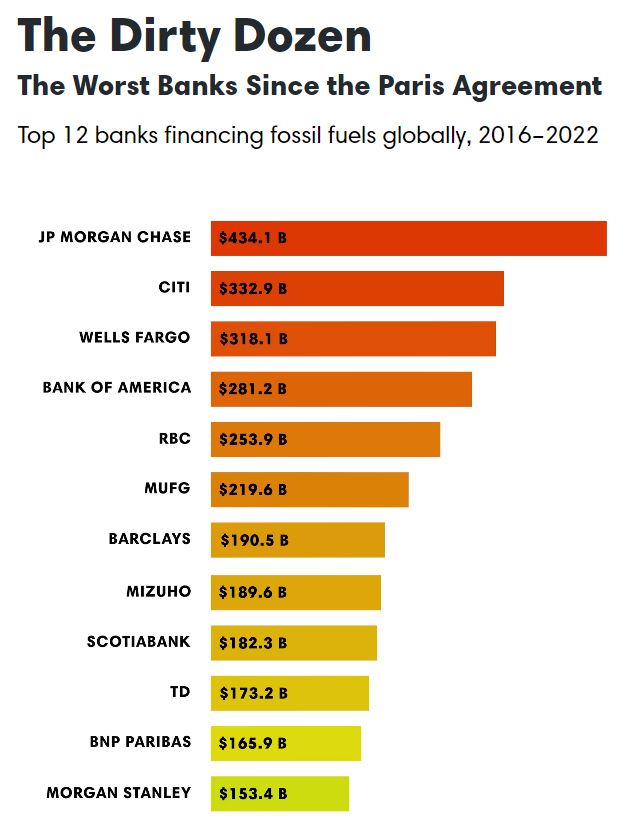 Banking on Climate Chaos Report 2023 Banking on Climate Chaos Report 2023About one-fourth of that amount -- $1.36 trillion – was from the world’s four largest banks – JPMorgan Chase, Citi, Wells Fargo, and Bank of America – all based in the United States.
Such large investments in fossil fuels include substantial physical and transition risk. According to the National Oceanic and Atmospheric Administration (NOAA), since 1980 the United States has experienced 372 extreme weather events with damages exceeding $1 billion each. So far in 2023 we have seen 24 climate disasters with damages exceeding $1 billion and deaths of 373 people.
Meanwhile, 90% of known fossil fuel reserves must never be dug up and burned if we want to limit global warming to 1.5°C, according to the Unburnable Carbon report by Carbon Tracker. This means over $1 trillion of oil and gas assets risk becoming stranded in a transition to a lower carbon economy.
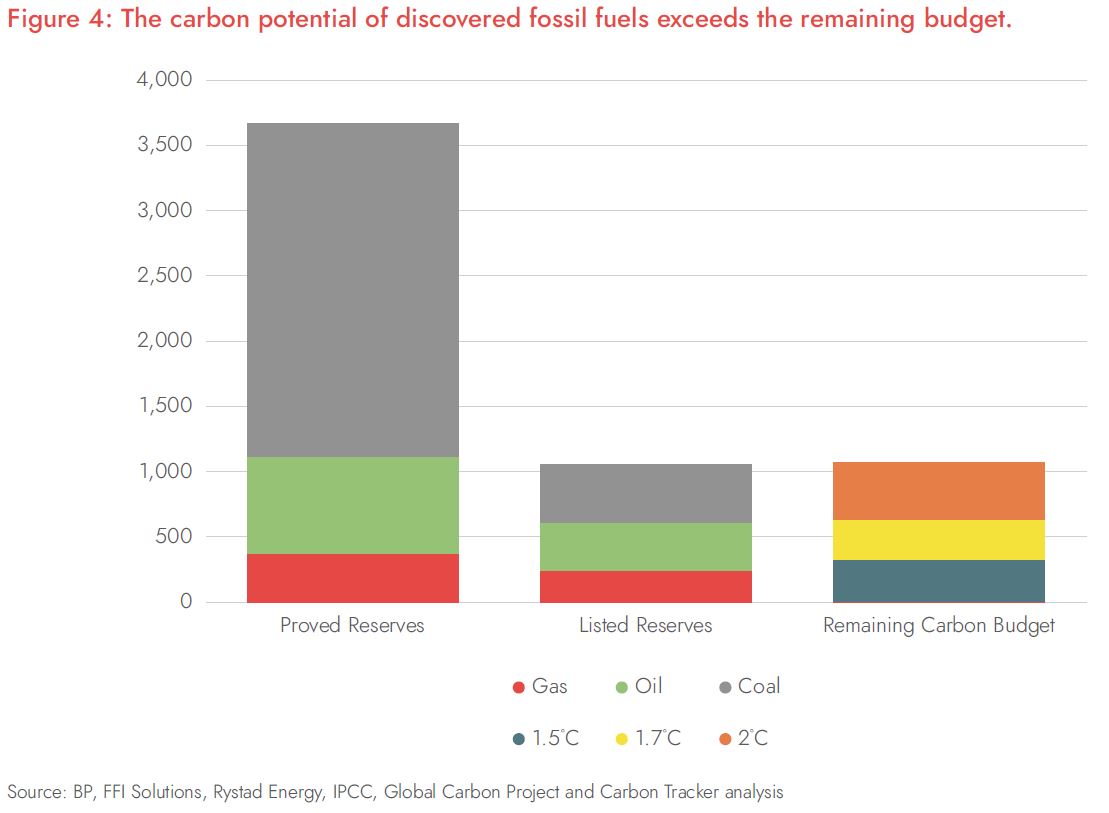 Unburnable Carbon: Ten Years On report by Carbon Tracker Unburnable Carbon: Ten Years On report by Carbon Tracker“Weaknesses in how a financial institution identifies, measures, monitors, and controls the physical and transition risks associated with a changing climate could adversely affect a financial institution’s safety and soundness,” the guidelines say. “The adverse effects of climate change could also include a potentially disproportionate impact on the financially vulnerable, including low-and-moderate income (LMI) and other underserved consumers and communities.”
To address this, the agencies issued a series of principles encouraging boards of directors for large banks to hold management accountable for climate risk, and encouraging management to develop processes to identify, measure, monitor, and control climate-related financial risks.
The guidelines encourage large banks to incorporate climate risk analysis into policies, procedures, and business strategy with both near and long-term planning through the use of scenario analysis. Public statements about climate-related commitments should align with internal strategies.
Community investment
On the other side of the coin, the new rule updating the Community Investment Act addresses climate risk by expanding eligible projects to include disaster preparedness and weather resiliency.
The almost 1500-page rule broadly interprets this to include projects such as:
- construction of flood control systems in a flood prone underserved urban or rural community
- retrofitting multifamily affordable housing to withstand future disasters
- promoting green space in urban areas to mitigate extreme heat
- upgrades to affordable housing such as efficient heating and air-cooling systems or more energy-efficient appliances
- community solar projects, microgrid and battery projects that could help ensure access to power to an affordable housing project in the event of severe storms
- financing community centers to serve as cooling or warming centers in low- or moderate-income areas that are more vulnerable to extreme temperatures
- assistance to small farms to adapt to drought challenges.
The new rule also addresses the rise in internet and mobile banking by requiring large banks to include geographic areas where they make significant numbers of mortgage and small business loans, whether they have a physical branch there or not, as subject to review under the Community Reinvestment Act.
The rule also allows banks to get CRA credit for any community development activities conducted with Minority Depository Institutions, Community Development Financial Institutions, Women’s Depository Institutions, and Low-Income Credit Unions.
What these actions are not
The CRA rule incentivizes banks to invest in climate resilience in communities long under-resourced through systemic inequality, and the agency guidelines encourage and incentivize banks to incorporate climate-related risk management into the everyday business practices.
But neither the guidelines nor the rule prohibit banks from investing in high carbon industries such as oil and gas – nor do they explicitly use race as a metric in community-based climate resilience.
“The principles neither prohibit nor discourage financial institutions from providing banking services to customers of any specific class or type, as permitted by law or regulation,” the climate risk guidelines say. “The decision regarding whether to make a loan or to open, close, or maintain an account rests with the financial institution.”
“The FDIC’s role with respect to climate change is centered on the financial risks that climate change may pose to the banking system and individual institutions, and the extent to which those risks impact the FDIC’s core mission and responsibilities,” said Chairman Martin Gruenberg. “The FDIC is not responsible for climate policy and does not tell banks which customers to serve.”
Although these actions do not explicitly tell big banks to stop underwriting fossil fuel projects and shift instead to community investment, they are a nudge in that direction. If these two actions motivate large banks to take a new path to a more sustainable and equitable world, they will have done their job.
|
|
Your Green Life |
Live green. Sustainable lifestyle tips and tricks for you and your family.
|
|
Editor |
**********************************************************************************
Green America is an equal opportunity employer. All qualified applicants will receive consideration for employment without discrimination regarding: actual or perceived race, color, religion, national origin, sex (including pregnancy, childbirth, related medical conditions, breastfeeding, or reproductive health disorders), age (18 years of age or older), marital status (including domestic partnership and parenthood), personal appearance, sexual orientation, gender identity or expression, family responsibilities, genetic information, disability, matriculation, political affiliation, citizenship status, credit information or any other characteristic protected by federal, state or local laws. Harassment on the basis of a protected characteristic is included as a form of discrimination and is strictly prohibited.
|
|
Social Media Specialist |
**********************************************************************************
Green America is an equal opportunity employer. All qualified applicants will receive consideration for employment without discrimination regarding: actual or perceived race, color, religion, national origin, sex (including pregnancy, childbirth, related medical conditions, breastfeeding, or reproductive health disorders), age (18 years of age or older), marital status (including domestic partnership and parenthood), personal appearance, sexual orientation, gender identity or expression, family responsibilities, genetic information, disability, matriculation, political affiliation, citizenship status, credit information or any other characteristic protected by federal, state or local laws. Harassment on the basis of a protected characteristic is included as a form of discrimination and is strictly prohibited.
|
|
SCI Research Fellow |
**********************************************************************************
Green America is an equal opportunity employer. All qualified applicants will receive consideration for employment without discrimination regarding: actual or perceived race, color, religion, national origin, sex (including pregnancy, childbirth, related medical conditions, breastfeeding, or reproductive health disorders), age (18 years of age or older), marital status (including domestic partnership and parenthood), personal appearance, sexual orientation, gender identity or expression, family responsibilities, genetic information, disability, matriculation, political affiliation, citizenship status, credit information or any other characteristic protected by federal, state or local laws. Harassment on the basis of a protected characteristic is included as a form of discrimination and is strictly prohibited.
|