|
Regenerating Traditions in Growing |
Industrial agriculture has changed our relationship with the land—instead of picking a tomato by hand, many Americans pick it out of a lineup on the grocery shelf. But cultivating the land is a fundamental practice of humanity, stretching back millennia. Many traditional gardening methods from around the world maintained a natural balance between the soil, the climate, and community food needs, in their own unique ways. The modern regenerative gardening/agriculture movement is informed by these ancient and ongoing traditions—and it’s helping people understand that we are part of maintaining the balance of the natural world as stewards of the land.
Shepherds of the Land
In Ortonville, Michigan, Tamarack Camps is helping Jewish children connect with their roots and the joys of tending the land. Farber Farm is an educational program at Tamarack Camps, where campers may grow and harvest peppers, kale, beans, broccoli, zucchini, and much more—the produce is served in the cafeteria, so the campers can experience the food from seed to table.
Alex Rosenberg, the Farber Farm manager, explains that while cultivating the land is not something typically associated with Judaism today, it is a foundational part of the religion.
“Our ancestors were shepherds of the land. All our holidays are woven into an agricultural calendar,” she says. “Just being on the farm and getting your hands in the soil is the absolute most Jewish thing you can do.”
 Camper harvesting red clover for herbal teas at Farber Farm. Photo by Tamarack Camps. Camper harvesting red clover for herbal teas at Farber Farm. Photo by Tamarack Camps.One of the oldest Jewish traditions, shmita, is about nurturing natural balance—every seven years, cultivated land is to be left alone to rewild. As many ancient Jews were animal shepherds, this process protects the land from overgrazing. The belief is that, if the land is allowed to rest, then the following years will be bountiful. It’s a reflection of the seven-day week with one day of rest.
During the most recent shmita, which occurred from September 2021 to September 2022, Rosenberg hoped to inspire the campers to think bigger than just their summer camp experience.
“How do we bring [shmita] forward into soil conservation practices that we can be doing year after year after year, rather than taking just a sabbatical?” Rosenberg asked. “How do we extend that and still be able to work within an agricultural framework where we are producing enough food in efficient ways to feed our communities?”
It’s food for thought that the regenerative movement is already working on. Shmita, interpreted for modern day farming, is rotational grazing—where animals are kept together to graze a short time and then moved to new fields, leaving the field where they grazed and fertilized to rest, for the diverse grass species to grow to support soil health, and sequester carbon.
For Farber Farm, the idea of shmita is a tool to teach campers about stewarding the land. The land requires rest and restoration much like humans do. It’s part of a curriculum that includes regenerative growing practices using methods like no till, cover crops, and composting to improve soil health. The lesson is that, with patience, nurturing the well-being of the land means caring for ourselves.
It’s also a lesson central to the Zuni tribe of the American southwest.
Bounty in Scarcity
Indigenous communities across the Americas have rich agricultural histories with holistic ecosystem management, many of which have informed the modern understanding of regenerative growing practices.
Venturing into the dry and hot environment of New Mexico, the Zuni tribe has practiced waffle gardening (heko:we in the Zuni language) in the desert for centuries. From above, the ground looks like a waffle, with little depressions in the soil to hold water for plants. A waffle garden can be sustained with limited water resources, making it extremely efficient in arid environments. This mindfulness towards limited resources is central to regenerative growing practices, which is conscious of waste.
Culturally, food sovereignty (the belief that people have the right to determine what and how they grow and eat) is woven into the Zuni way of life. As expert desert farmers, the Zuni people would grow food like maize, squash, and beans, historically. But in 1908, the Zuni River—what sustained gardens in the Zuni pueblo (village)—was dammed to form the Black Rock Reservoir. Since then, grocery stores proliferated, and gardening became scarce.
 Kenzi Bowekaty working on waffle garden repairs in Zuni, New Mexico. Kenzi Bowekaty working on waffle garden repairs in Zuni, New Mexico.Kenzi Bowekaty is the food sovereignty leader at Zuni Youth Enrichment Project (ZYEP) in Zuni, New Mexico, a nonprofit dedicated to connecting Zuni children and families with their traditions. Bowekaty says that during the pandemic, waffle gardens began to reappear.
“ZYEP decided to give out garden kits because we couldn’t continue our regular programming the way we would have,” says Bowekaty. “I feel like it’s really growing back again, because of people wanting their own food.”
Just as the waffle-shaped depressions in the ground are home for the plants, homes in the Zuni pueblo are parsed out in a grid. That reflection is just one of many for the Zuni and the plants they nurture.
“We really believe that the plants resemble us as people in the stages of life,” Bowekaty adds. A planted seed is like an embryo in a mother’s womb, that eventually emerges in the sun. When harvest time comes, and the heavy corn stalks slump over, which Bowekaty relates to how a person would hunch as they aged.
Like how taking care of each other in a family builds a strong unit, taking care of our plant family results in food we can eat. When it comes to regenerative growing practices, the belief that humans are akin to plants keeps us mindful of how to treat and maintain the land.
Take Action
|
|
Green Across Cultures |
The Earth is a place of incredible resources: powerful winds, rich soils, strong currents, and resilient life. When it comes to fighting climate change or investing in a greener future, our most crucial asset may be each other. For every harmful policy or practice, there’s a green strategy or innovation to make our society better and heal our planet. This issue celebrates those solutions that abound from across cultures and around the world. This issue chooses hope.
For a more just and sustainable world, we have looked around the globe for innovation and inspiration, to expand the conversation, and learn from our neighbors near and far. We hope you will find inspiration from creative thinkers and activists across the continents and know that we are in this together. We will find our way into a green future, together.
South Korean Music Brings Fans Together for Climate
Devotees of Korean pop music are excited about making change in the world. Supporters of the mega-group BTS raised over $1 million for Black Lives Matter in June 2020, matching BTS’ own donation. K-pop enthusiasts globally have come together for numerous social justice and political causes, and climate change is no exception.
KPop4Planet is a group of supporters seeking to raise awareness about the climate crisis, with its biggest campaign, No K-Pop on a Dead Planet, speaking directly to music labels. They’re demanding green album purchase options, low-emissions concerts, songs about the climate crisis, and artists themselves encouraging climate action. The campaign has collected over 10,000 signatures so far and hosted an in-person action about sustainable album releases, including CDs, in front of music company headquarters, according to Dayeon Lee, a Korean university student and leader of the campaign. In August 2022, JYP Entertainment became the first K-pop music production company to release an ESG report, thanks to supporter pressure.
“It’s not only that fans are showing interest in social issues. They’re concerned about political movements in the name of K-pop fans, such as raising money for Black Lives Matter and the Save Papua forest campaign [an important land to Indigenous people of Indonesia], which are all fan-driven campaigns,” Lee says.
She also points to Blackpink, a K-pop group with 23 million monthly listeners on Spotify, being appointed goodwill ambassadors for the COP26 summit in 2021 as “an example of how idols have encouraged K-pop fans to become engaged in taking climate action.” —Eleanor Greene
Taking Inspiration:
- Mobilize in your community, whether it is in person or online. Could your knitting group put pressure on yarn companies to source sustainable fibers? Could your book club talk to book publishers about recycled paper? Be specific about what you’re asking for and create a campaign, whether it’s social media, email, or letter-writing.
- Find green actions to bring together your community, like Kpop4planet’s “Fandom 4 Forests” which maps fan-led tree-planting projects globally. Share your actions on social media to gain momentum. Check Your Green Life for other ideas—from creating community gardens to free food pantries!
Protecting Land Is Protecting Culture in Puerto Rico
In 2017, Hurricane Maria devastated human and natural communities in Puerto Rico, including sand dunes, which are important natural barriers to weather and for archaeological sites, where important cultural artifacts have been found and continue to be threatened.
In the DUNAS project (Descendants United for Nature, Adaptation, and Sustainability), local communities in Puerto Rico have been using their knowledge of the environment to help bring back ecosystems and heritage sites.
With Para la Naturaleza, a Puerto Rican environmental organization, the project is incorporating citizen science and engaging community members on climate change and conservation techniques, like staying on trails. Isabel Rivera-Collazo, assistant professor at the University of California San Diego’s Scripps Institute of Oceanography, says protecting cultural identities by preserving Indigenous languages, passing information down, and recording the knowledge, are important steps in protecting local ecosystems.
“The idea of the project is to recover cultural heritage and use that link to the land to stimulate climate action and to support restoration of damaged ecosystems,” she says.
The project also included creating 3D images of pottery and artifacts found in archaeological sites in the dunes, which can be viewed online and printed with a 3D printer. Museums can more easily create exhibits this way and the actual artifact gets to remain with its original community. DUNAS printed these artifacts and gave them to elders in the community whose ancestors may have created the original pieces. —Aja Hannah
Clean Cars, Even in the Oil Country of Norway
Norway’s biggest industry is petroleum exports, but it’s also the country that has the highest percent of electric vehicles in use in the world (23%). The country even has a 2025 target for 100% of vehicle sales being electric. One way it does that is through tax savings—instead of offering rebates, Norway taxes electric cars at 4% (or 12.5% if the car is over $95,000 USD), compared to a 25% tax for non-electric vehicles. Along with monthly savings, electric vehicles end up being cheaper than gasoline-powered for many consumers.
“Tax incentives work. And once people drive an electric vehicle, most of them like it,” says Auke Hoekstra, founder of ZEnMo Simulations and senior advisor of smart mobility at Eindhoven University of Technology in the Netherlands, another country with very strong electric vehicle policy and usage.
“Norway is the biggest supplier of fossil fuels in Europe, but in-house, it’s almost 100% clean energy,” says Hoekstra, noting the country is not part of the European Union and relies on petroleum as a national source of income. Experts call the country’s reliance on oil as it strives to become a climate leader a paradox, and many activists and climate experts are striving to align policy with ambitions to lead on climate.
Besides creating tax incentives, Hoekstra says governments must provide good infrastructure, like charging stations that are easy to find and connect with most vehicle types. Governments can also make data available to citizens that help them make choices clearly—he looks to the US’ fueleconomy.gov, which helps car-buyers to compare vehicles side-by-side with prices and fuel economy, including all cars, not just EVs. —Eleanor Greene
Taking Inspiration:
- Show policymakers what’s working. In Norway and the Netherlands, significantly lower taxes are put on electric vehicles, then those rates are slowly raised again as uptake becomes more common and the prices of the vehicles themselves come down. US lawmakers have recently passed tax credits for electric vehicles, but cities and states also need to take note and take action to create infrastructure to support the transportation transition, like accessible charging stations, says Hoekstra.
- Cities like Oslo and Amsterdam have great cycling and public transit infrastructure. Advocating for infrastructure for cycling, walking, and clean public transit will benefit urban and ex-urban communities and people of all income levels.
Australia Is Fighting Fire with Fire
Fighting fire with fire sounds counter-intuitive, but for the Aboriginal and Torres Strait Islander Peoples of Australia, it’s a way of caring for and protecting the land. For over 60,000 years, cultural burnings have been practiced by First Peoples as an essential part of life, livelihood and wellbeing.
These intentional and controlled burnings help wildlife thrive—key in Australia, where 30 species have gone extinct since European colonization, more than anywhere else in the world—by providing various vegetation patches in different stages of regrowth, which increase the variety of habitats. According to The Nature Conservancy, they also reduce greenhouse gas emissions by eliminating dry brush that can worsen wildfires later in the season.
“Following the principle of ‘Right Fire, Right Time,’ fire is applied to specific places at times of the year to heal Country. This is an obligation and an active and empowering way of responding to climate change,” Rodney Carter, CEO of Dja Dja Wurrung Group says. As part of the Dja Dja Wurrung Country Plan through 2034, Dja Dja Wurrung people would be contracted and compensated to practice cultural burning.
“It puts First Peoples’ knowledge at the forefront, creates economic opportunities for First Peoples, and builds community resilience.” —Anya Crittenton
Taking Inspiration:
- Learn from and respect the practices of Indigenous peoples across the world and the long histories stewarding their lands.
- Research where you live and volunteer where help is needed, like a fire unit or wildlife protection group. These exist across the world, including in the US where Indigenous peoples also practice cultural burning.
In Switzerland, Residents Rule Recycling
In the last 50 years, the volume of Swiss household trash has doubled, with the average person producing roughly 1,550 pounds of waste per year, according to the Organisation for Economic Co-operation and Development. This is just 150 pounds less than the average American, according to the 2019 Verisk Maplecroft report, and yet in Switzerland, where recycling is mandatory, half of that waste will be recycled, according to the Swiss Broadcasting Corporation (SBC), compared to less than a third of American waste.
Swiss recycling depends on the everyday citizen. In Switzerland, there is an elaborate yet clear sorting system, separating paper from cardboard, PET bottles from plastic, even green, blue, and purple glass from brown and clear. Drop-off sites are detailed online, and door-to-door collection is available for the majority of recyclable materials in certified, color-coded garbage bags. Recycling etiquette is enforced through fines and “garbage detectives”—municipal workers who check garbage bags for rule violations.
“Like Santa Claus, they check who was naughty and who was good, at least on their home turf,” says Dardan Shehu, a writer for Study in Switzerland, who explains how foreigners and visitors may be scolded, lectured, or reported by neighbors when discarding waste in “un-Swiss” fashion.
Swiss consumers recycled 94% of their cans and glass bottles in 2018, according to the SBC. In the US, aluminum cans were recycled at a rate of 50%, with glass bottles resting just under 40%, according to 2018 EPA data.
Whether this success rate is due to higher social and community expectations, more intense accountability systems, a diversity of resources, or all of the above, American recycling has room to grow by comparison. —Olivia Liang
Taking Inspiration:
- Know the rules. Wash any liquids or food residue from recyclables and double check whether they can be added to your curb-side recycling or require special drop-offs. Read up on your local facilities (by searching “local recycling rules”) to stay informed about what is recyclable in your area.
- Speak up. Whether it’s in your schools, neighborhoods, or workplaces, not everyone might recycle properly and not everywhere may offer the option. If you feel comfortable, speak up to educate those around you or vie for clearer instructions or better recycling infrastructure.
Argentina Toasts the Planet with Eco-Wines
A glass of malbec, a taste of chardonnay—they all taste better when they’re made ethically. Wineries straddle numerous industries, from agriculture to cuisine and tourism to communications. The vastness of viticulture leaves plenty of room for waste and mistakes.
However, in Argentina, the world’s seventh largest producer of wine, sustainability in the vintner’s world has been a priority for many years.
In 2010, the Bodegas de Argentina, the business chamber for wineries in the country, established its Sustainability Commission, aimed at providing wineries and the larger Argentine wine industry with education, tools, and resources that encourage successful sustainability, resulting in certification. This helped set the benchmark for the world, with Argentina leading the way. In its second year, the Commission co-created the Sustainability Self Assessment Protocol, which outlines goals for wineries and tools to achieve them.
Many wineries in Argentina have already received certification from the Sustainability Commission with successes spanning all areas of business.
For Bodega Argento, a winery in Mendoza, now a global leader in organic winemaking, agricultural progress is vital.
“Soil health is reviewed and assessed annually,” Bodega Argento sustainability leader Andrés Valero says. “We utilize agronomic management and throughout the crop cycle, cover crops are maintained which, in addition to having a role in promoting surface and underground biodiversity, helps keep the soil alive and protects it from erosion.” —Anya Crittenton
Taking Inspiration:
- Transform agricultural practices to be regenerative-focused, both on the macro and micro levels with Green America’s Soil and Climate Alliance and Climate Victory Gardens.
- Vote with your dollar. When presented with numerous options, like wine at grocery stores, put your money behind an option that’s sustainably and ethically made.
Ghana Is Fashion Forward
Toxic chemicals, water contamination, miles upon miles of waste—the fashion industry is rife with sustainability and labor problems. In Ghana, people in the fashion industry and those concerned about climate change are dedicated to revolutionizing fashion. This is especially crucial as US exports of used clothing to Africa decimated several African countries’ apparel sectors.
Over a year ago, the World Sustainability Organization (WSO) partnered with Ghanaian media personality, entrepreneur, philanthropist, and model Natalie Fort, to increase sustainability awareness and offer certifications across the country. Fort runs a firm, Fort Group, which is dedicated to improving the lives of Ghanaians from healthcare to financial aid. Since 2019, she has been the Patron of the Ghana Philanthropy Forum, a nonprofit dedicated to strengthening CSOs, NGOs, community foundations, and other third sector networks in Ghana.
This partnership directly impacts Ghana through two areas of focus within the fashion industry: production of clothing and treatment of models.
WSO offers the Friend of the Earth Sustainable Fashion certification, which looks at prolonging the life cycle of materials, reducing the amount of waste, and reducing harm to the environment. In order to receive the certification, Friend of the Earth standards for Sustainable Agriculture, Sustainable Farming, and Sustainable Textile Processing must be met. Some of these standards include keeping an inventory of vulnerable wildlife and flora, reducing greenhouse gas emissions, and more.
“Africa and Ghana’s fashion brands represent an important potential added value for clothing’s export, as well as work opportunities for local communities,” WSO founder and director Paolo Bray says. “WSO’s task is to highlight those sustainable African clothing brands and help them enter new markets, which are always more demanding for environmentally friendly products.” —Anya Crittenton
Japan Is Making Sustainable Development Goals Fun
In 2015, the UN adopted the 2030 Agenda for Sustainable Development, aimed at enacting a plan for people, planet, and prosperity. As part of this plan, the UN created the Sustainable Development Goals (SDGs), 17 goals for each country to achieve, addressing things like poverty, hunger, clean energy, and more.
Every country in the UN is pursuing the 17 SDGs in their own way. In Japan, it’s become a nationwide trend, with SDGs playgrounds appearing, as well as SDGs trips offered by travel agencies and an SDGs Center at the popular amusement park, KidZania.
For one Japanese company, Imacocollabo, the SDGs presented an idea: a brand-new multiplayer, in-person, card-based game, the 2030 SDGs Game. Takeo Inamura of Imacocollabo explains the inception of the game on its website (2030sdgsgame.com): “The SDGs are ambitious and can seem overwhelming … While dramatic in their potential impact on the world, approaching them can be daunting.”
The 2030 SDGs Game is meant to give people practical and accessible ideas for helping create a sustainable world.
After gameplay, players engage in a facilitated dialogue, called kizuki, a uniquely Japanese term indicating a transformation to awareness.
“Participants share and examine their discoveries and observations, personal and collective, about assumptions, cultural lenses and biases, and how these influence the world that was created,” Aya Matsuyama, also of Imacocollabo, says.
The game is taking off globally and Inamura and his team have created an English version. On the game’s website, you can read past case studies of facilitated events, find worldwide online events, and even become a facilitator or host yourself. —Anya Crittenton
Taking Inspiration:
- Play to your strengths. Look at your own interests, hobbies, and skills—what can translate to sustainable efforts? Create art to get a message into the world or make and donate food.
- Create your own local gaming event, like a nature scavenger hunt or competition to identify native species.
|
|
How Attacks on Responsible Investing Could Hurt Climate Progress |
Attacks on a socially responsible investing strategy called ESG (that considers environmental, social, and governance criteria) are being used—like accusations of widespread voter fraud or teaching critical race theory—as a wedge to divide and mislead Americans and halt social and environmental progress.
Lawmakers in 10 states, including Florida and Texas, have recently passed policies that prohibit considering ESG when making investing decisions with state money, and seven more states have introduced similar bans or have pending bans, according to tracking by Morgan Lewis law firm. The laws prohibit state investors or the banks they use from considering ESG criteria, even when it is the smartest financial decision. The supposed point of these rules is to protect industries that are important to state economies, but so far that has only included fossil fuels and firearms—and the way the rules are written, even financial experts and banks don’t understand them.
“Republican lawmakers are using this attack on what they call ‘woke capitalism’ as part of their anti-climate, pro-gun strategy,” says Fran Teplitz, Green America’s executive co-director for business, investing and policy. “With Republicans in control of the House again after the midterms, they will likely use committee hearings to further attack ESG.”
Anti-ESG policies are already having a chilling effect on companies, by walking back climate commitments in order to keep doing business with these states.
“Whether it’s a moral argument, financial argument, or risk-hedge argument, it’s a very dangerous position, to say ‘we’re going to double down on fossil fuels,’” says Stephanie Cohn Rupp, CEO of Veris Wealth Partners.
What is ESG?
ESG means taking into consideration environmental, social, and governance decisions of a company, alongside traditional financial analysis, when deciding whether to invest in it.
ESG commitments are booming from banks and big businesses, which are using ESG data like climate risk (environmental), labor issues (social), and board effectiveness (governance) to see both how resilient and profitable their portfolios will be in the future.
ESG is already deeply embedded in investing practices, with global sustainable investing surpassing $35 trillion by 2020 and projected to reach $50 trillion by 2025, according to Bloomberg Intelligence.
Attacks on ESG & Their Impacts
Two 2021 Texas Senate bills prohibit local jurisdictions from working with banks that had adopted ESG policies “against” the oil and gas or firearms industries. After implementing the policies, Texas jurisdictions stopped working with JPMorgan Chase, Goldman Sachs, Citigroup, Bank of America, and Fidelity for their municipal bonds ostensibly because of their ESG commitments.
Making that switch meant having to renegotiate terms of many bonds with different banks, which cost taxpayers up to an estimated $532 million in the first eight months of the policy, according to a 2022 study.
Ironically, those megabanks are not boycotting the fossil fuel industry—in fact, JPMorgan Chase, Citigroup, and Bank of America are in the global top four banks funding fossil fuels, according to the Rainforest Action Network’s Banking on Climate Chaos Report. Those three banks have provided $899 billion combined in fossil fuel lending since 2016.
It’s a very dangerous position, to say ‘We’re going to double down on fossil fuels.’ — Stephanie Cohn Rupp, Veris Wealth Partners
Larry Fink, the CEO of BlackRock, the world’s largest investing firm, had issued a letter saying the company would “confront the global threat of climate change more forcefully.” But another executive at the company also issued a letter saying it would “continue to invest in and support fossil fuel companies, including Texas fossil fuel companies.” Companies going back on their climate statements is the exact chilling effect that politicians who introduce these laws are aiming for.
Florida Governor Ron DeSantis passed a resolution that prohibits the managers for the state’s $186 billion pension fund from considering ESG factors and requires managers to “only consider maximizing returns.” This fails to account for the ability of ESG criteria to contribute to maximizing returns, proving these attacks are being used as a culture war strategy rather than as investment strategy.
Why ESG Will Continue to Grow
Dan Garrett, the assistant professor of finance at the University of Pennsylvania who co-authored the study about Texas bonds, explained that most investment companies and investors are trying to get oil and gas off their balance sheets in the next 20 years, as the industry is declining and most agree it will continue to do so. Though oil and gas companies are currently seeing record profits partially because of the war in Ukraine, as renewable energy increases, the sector’s revenues will decline, and face stranded assets—creating long-term risk. But in Texas, Garrett says, the industry directly generates 10.6% of the state GDP.
“So, [policymakers’] incentive is ‘we would like to stop this capital from flowing out of our state,’” says Garrett. “Did this sort of policy slow that capital moving out of oil and gas? Maybe not.”
DeSantis’ position is that, “we are protecting Floridians from woke capital.” Most finance experts disagree with DeSantis and would say that considering ESG and maximizing returns are not in conflict.
In fact, a New York University report examining over 1,000 studies between 2015-2020 showed that sustainability initiatives at corporations drive better financial performance due to improved risk management and innovation.
What Green America Is Doing and What You Can Do
For decades, Green America has been working to help people align their investments with their values. Green America is now working to maintain momentum for ESG and combat misinformation from the radical right among investors, institutional investors, financial advisors, and funds. An immediate focus is on public messaging especially through social media—check out and share our posts at facebook.com/green-america. There are also steps investors and concerned citizens can take to protect ESG investing. Folks who have their pensions in state retirement programs can be especially effective advocates.
“Pensioners are the ideal spokespeople, as investors, because they worked hard and want their money to be there to sustain them in their retirement,” says Rachel Kahn-Troster, executive vice president at ICCR {GBN}. “They want the people managing their money to ensure the money is there and be assured that our planet and society are there in the future.”
Kahn-Troster adds that concerned citizens should call their local and state representatives, no matter what color their state swings. Investors can speak with their investment managers to express that using ESG as a lens to navigate investments and mitigate risks is important to them. Investing that considers ESG criteria alongside financial analysis is a prudent investment approach to build wealth. ESG investing is financially competitive, helps improve companies, and generates better outcomes for workers, communities, and the environment.
While the attacks on ESG are dangerous, fortunately there is widespread recognition among investment professionals and many regulators that ESG is legitimate and generates positive outcomes for all stakeholders. By doing a better job of identifying investment risk and opportunity, sustainable investing is expected to continue to grow.
Former vice president Al Gore and David Blood, co-founder of Generation Investment Management, co-authored a Wall Street Journal op-ed in November, strongly defending ESG: “The investment community is adapting for the next chapter of capitalism, in which sustainable investing is mainstream. This is the only way the planet, its people, and their investments can thrive.”
|
|
5 Green Long-Term Goals for the New Year |
Your ambitions for the new year might be big or small, but lifestyle changes of any kind take some work to practice and perfect. Indeed, 80% of all New Year’s resolutions are abandoned by the end of January. That’s why, instead of New Year’s resolutions, we’ve come up with five green goals to strive for in the new year that you can try, tweak, and restart as the year unfolds.
Buy and Read Banned Books
Many of the books we now value as literary classics were once challenged or banned: Harper Lee’s To Kill a Mockingbird, Alice Walker’s The Color Purple, John Steinbeck’s Of Mice and Men. These books, and many more, were once removed from reading lists and classrooms throughout U.S. history for their “anti-white” sentiments or inclusion of homosexuality, profanity, or blasphemy.
The fight against censorship continues today, as books that celebrate diversity are at risk in public schools and libraries. To join the national conversation about inclusivity, solidarity, and education, read these books that are currently under attack:
- The Hate U Give by Angie Thomas (2017)—This young adult novel about 16-year-old Starr Carter who balances her poor neighborhood with elite suburban prep school has been banned and challenged because it was thought to promote an anti-police message and social agenda.
- Lawn Boy by Jonathan Evison (2018)—This semi-autobiographical novel tells the coming-of-age story of Mexican American Mike Muñoz and has been banned and challenged because of LGBTQ+ content.
- Persepolis: The Story of a Childhood by Marjane Satrapi (2000)—This graphic memoir depicts Satrapi’s childhood and early adult years in Iran and Austria during and after the Islamic Revolution, and was challenged for graphic language and images.
Take action to defend everyone’s First Amendment right to read by reporting any censorship to The American Library Association and continuing this conversation at school boards, PTA meetings, and public hearings.
Spring Clean with Reuse in Mind
Sometimes “less is more,” but cleaning for cleaning’s sake is not as great or green as it sounds, especially when items end up in landfills. So, before you spring clean, consider these questions:
Think of the next five years: Before you pitch any furniture or tchotchkes, consider when they might come in handy. Will you have a family member going off to college in need of a desk? You don’t want that Dutch oven, but your Julia Child-obsessed niece or nephew might!
Is this salvageable? Sew a stitch, patch a rip, repaint that old bookcase. Before you discard clothes or furniture, brainstorm how your items can be re-imagined for a second (or third!) life.
Throw away or give away? When parting with items, consider where they will be most useful. Call consignment and secondhand stores, or even houses of worship and local nonprofits, to learn where your items will be most beneficial. You can also post pictures on local online marketplaces to ensure your items will be used and loved, or list on your local BuyNothing group or Freecycle.
Spend Time Outdoors by Growing a Garden
If you want to spend more time in nature this year, grow your green thumb and start (or expand) your garden to help combat carbon emissions. Join the Climate Victory Garden community to add your garden to our map, get tips from tens of thousands of climate gardeners, and learn about gardening to fight climate change.
Start Small: Whether you live in a one-window apartment or have a low-success rate with plants, your home garden can start as small as you want. Re-grow scallions in a mason jar or pot herbs to garnish every meal and cocktail.
Think Big: When expanding your garden, the most important thing to consider is what you actually enjoy seeing and eating! Plant bee- and butterfly-friendly flowers or grow peppers to spice up your life.
Cook with International Flavors
Experimenting with flavor combinations from around the world is a fantastic way to travel the globe and learn about other cultures while supporting local, ethnic grocery stores.
Expand your palate and refine your cooking skills with these international cookbooks:
- Mabu Mabu: An Australian Kitchen Cookbook by Nornie Bero
- Mi Cocina: Recipes and Rapture from My Kitchen in Mexico by Rick Martínez
- The Woks of Life: Recipes to Know and Love from a Chinese American Family by Bill, Judy, Sarah & Kaitlin Leung
- Korean American: Food That Tastes Like Home by Eric Kim
- Gullah Geechee Home Cooking: Recipes from the Matriarch of Edisto Island by Emily Meggett. The Gullah Geechee people are descendants of enslaved West and Central Africans who labored on coastal plantations in the American south. This geographic isolation allowed for Indigenous African traditions to survive, including food, art, spirituality, and language.
- Rice is Life by Lotus Foods founders Caryl Levine and Ken Lee. This new cookbook shares rice recipes from around the world that feature “the world’s most important staple food.”
Get Finances in Order and Make Your Money Green
Initiating financial change can always feel like a challenge, but Green America has resources to help get you started.
Examine your shopping habits. When buying soap, candles, clothing, or coffee, explore Green America's certified businesses to shop from sustainable businesses and vote with your dollars.
Break up with your megabank. Join thousands of others who have switched to a community development bank or credit union to keep your money in your community and fund projects you can be proud of.
Consider a new credit card. Many credit cards are tied to major banks and support fossil-fuel investment. Switch to a green credit card (including Green America’s!) that supports social and environmental justice.
Here’s to your New Year's green goals: For you, the planet and all people. You’ve got this!
Updated Dec 2025
|
|
Green Across Cultures |
Inspiring green solutions from communities around the world.
|
|
Tell the EPA to Ban Organophosphates |
The EPA has a legal and moral obligation to protect farmworkers, children and communities. We are going to do everything in our power to hold them accountable. Join us in continuing the fight by telling the EPA to ban organophosphates.
|
|
Higher Cocoa Prices Crucial to Easing Farm Poverty, Report Says |
Higher prices, rather than bigger crops, are crucial to help lift cocoa farmers out of poverty as inflation spirals, according to a report from non-governmental organizations.
Pressure has been mounting to tackle child labor on cocoa farms and ensure growers earn a living income. That’s spurred cocoa companies to launch sustainability programs aimed at boosting production in West Africa, where the bulk of the world’s output is...
|
|
Cocoa sustainability efforts will fail without living wage for farmers - report |
Environmental and social problems in global cocoa supply chains are likely to continue unless companies pay farmers substantially more for their beans, according to a major report on cocoa sustainability published on Wednesday.
The Cocoa Barometer, produced by the VOICE Network group of civil society organisations, found farmers in many cocoa-producing countries remain poverty stricken and unable to reduce levels of child labour and deforestation.
|
|
WOODEN ELEMENT |
Wooden Element is a small Illinois based artisan company with a passion for fashion, creativity, and preserving nature. Our small family business is run by a husband-and-wife duo (Natalie & David Akerele), working closely with talent in our local community. We also collaborate with a few artisans.
We handcraft wooden jewelry & accessories for ladies and gentlemen. We believe in social impact and a portion of our sales support Easter Seals, Best Buddies International (IL Chapter), and Sudan Interior Mission (SIM) - Egbe Revitalization Project West Africa. We also support Aletheia School (Peoria, IL).
We also believe in sustainable fashion. In terms of environmental responsibility, we use Eco-friendly resins, ethically sourced and/or recycled natural wood, repurposed wood, and biodegradable materials whenever possible.
We are proud to offer FSC (Forest Stewardship Council) certified sourced wood. We specialize in making Recycled Plastic and Biodegradable Cellulose Acetate sunglass frames. We also offer FDA and CE Certified Sunglasses.
Our earrings feature a hypoallergenic Copper Alloy, and are Lead Free, Nickel Free, and Cadmium Free. We also hand make PETA Approved Vegan cork jewelry & accessories. We utilize shipping/packing materials made from recycled paper. Wooden Element started in Wicker Park, Chicago, and eventually migrated to Central IL. We are now based in Peoria, IL. We aim to reinterpret classical fashion accessories and give them a modern wooden edge.
|
|
Department of Labor Upholds ESG Criteria & Proxy Voting in 401(k) Retirement Plans |
Green America, our members, and allies all secured a victory for investors nationwide.
Green America actively opposed Trump-era rulings that undercut the ability of retirement plans to include investment options that consider environmental, social, and corporate governance (ESG) criteria and that made it difficult for retirement plan fiduciaries to vote on ESG-related shareholder resolutions.
On November 22, 2022, the Department of Labor (DOL) reversed these rulings with a final rule, Prudence and Loyalty in Selecting Plan Investments and Exercising Shareholder Rights, that allows ESG criteria to be applied in employer-sponsored retirement investments and in the voting of shareholder ballots. In particular, the ability to consider climate impacts is a top concern of many investors and can now remain a consideration in 401(k) investments as the climate crisis escalates.
Green America supports the new rule. Decades of investment experience globally has shown that including environmental, social, and corporate governance criteria in the investment process provides competitive returns, which the Trump administration and right-wing pundits now claim. To the contrary, taking ESG factors into account means investors have a greater understanding of risk and opportunity and can invest more wisely to maximize their returns. The Department of Labor recognizes the value of investor choice and the benefits of ESG criteria as it works to protect the retirement assets of millions of American workers and their families. Globally, $35 trillion is invested using an ESG framework.
In addition, the ability of retirement plan fiduciaries to vote shareholder resolutions on issues such as climate, labor protections, human rights, corporate political contributions, and more plays a key role in improving corporate conduct. Green America and our allies urged the DOL to remove regulatory barriers to voting which the DOL has done.
Green America recognizes the importance of the new DOL rule and believes that ultimately all investing should be socially and environmentally responsible.
|
|
Is your favorite ‘green’ product as eco-friendly as it claims to be? |
Going green is good for business. Consumers are often willing to pay more for eco-friendly products than other comparable products on the market, according to market research.
But not all environmental claims are created equally. “Greenwashing” is a form of misinformation often used to entice an aspiring green consumer. Companies promising to be sustainable, biodegradable, or environmentally conscious sometimes fail to meet the promises they make to consumers.
|
|
Charity Navigator Logo |
|
|
Is It Greenwashing? Or Is It A Sustainable Business? |
All natural, Eco-friendly, Earth-safe…
What do all these words have in common?
They don’t mean anything! These marketing buzzwords are meant to grab your attention, but none prove the sustainability of the product or the company.
People are more interested in sustainable products than ever—65% of consumers believe brands have as much responsibility as governments to create positive environmental change, according to Havas Group Worldwide—and some companies are looking to make a pretty penny off those good intentions.
Greenwashing is a marketing tactic designed to make customers believe that a company has made an eco-friendly product or is an eco-friendly company, when that's not really the case, or the company has just done the bare minimum. It often involves making false or misleading claims, or even using green-colored packaging or similarly nature-inspired marketing to fool customers into buying the product and/or paying more for it.
The rule of three T’s can help you sniff out greenwashing:
Trustworthy Certifications
Certifications are the easiest and quickest way to determine if a company is sustainable. To earn certification, a company’s operations and supply chains are vetted by an external party.
Companies that have earned certification will put the label on their products and website, making it simple for shoppers. Green America’s Green Business Seal, the Non-GMO Project, EWG Verified, USDA Organic, Leaping Bunny, Climate Neutral Certified are all examples of trustworthy certifications. To be a conscious buyer, getting to know these certifications will make it easier to spot a green business in the wild. EcoLabelIndex.com can help you determine which labels are fake and which are legitimate.
For Green America staff, certifications are the number one way to check for sustainability:
“When I'm researching a company, seeing a trusted third-party certification is key.” —Anya Crittenton, editorial and Green Business Network communication associate.
“I look for logos on packages like Non GMO, Fair Trade Certified, and Rain Forest Alliance. For example, I saw the term “grown respectfully” on Nestle coffee packaging—but it had no further qualifiers and I have no way of knowing what it means. The Target store brand coffee I buy has the fair trade logo on the side of the package and since the mark is there I can look up those standards.” —Molly Bouffard-Briglia, senior operations and special projects manager, Center for Sustainability Solutions.
Transparency
While a third-party verification is a great way to tell if a company is sustainable, small businesses cannot always afford the steep cost of certification.*
That doesn’t mean the business is greenwashing, however. If a company is truly sustainable, it won’t have anything to hide. It is much easier to contact the owner of a small business than a large corporation, so take advantage of this to ask them questions! Ask about its sourcing, production, ingredients, and more. Inquiring lets the company know that this is what its buyers care about. Small businesses tend to adapt quickly, making them more likely to listen to buyer concerns.
Sometimes, this information is listed on the company website. Associations such as US SIF and Fair Trade Federation can help verify these claims.
Timeliness
Many companies are setting green goals, such as “eliminating all paper by 2024” or “going carbon-neutral by 2030.” But a goal is meaningless without a plan. How the company is going to achieve its sustainability goals is as important as what the goal is. Additionally, the plan should be appropriate for the size of the company.
If you think a company can do better, write a letter or tag the company on a social media post. Companies are at the whim of their consumer base; an effective letter can help sway them in the right direction. Learn how to write an effective letter at greenamerica.org/companyletter and visit our website to join thousands of conscious consumers like you demanding better of Walmart, Amazon, and more on climate, labor, and racial justice.
Determining if a business is sustanable requires a little bit of research, but as an informed buyer, you have the power to choose companies that support your values. Vote with your dollars for a cause that you care about, such as sustainability, racial justice, and climate action.
*Green America’s Green Business certification is designed for small and mid-sized companies with certifications tailored for nearly 40 different industries. The Network is home to 2,000 socially responsible eco-enterprises. Find certified green businesses at GreenPages.org and view the certification standards at GreenBusinessNetwork.org.
|
|
Wanted: Socially Responsible Credit Card |
Perhaps you’ve already taken steps to ensure your finances are green by switching to a community development bank, but check your wallet—do you own a socially responsible credit card?
Is your bank funding the fossil fuel industry? How can you best protect your credit score? Is there a credit card better matched to your values and needs out there? These are all questions to consider when developing your credit card literacy, and Green America is here to help.
Bankrolling the Climate Crisis
The world’s 60 largest banks have financed fossil fuels with USD $4.6 trillion since the 2015 Paris Agreement. That means your credit cards might have ties to financial institutions that are actively fueling the fire of climate injustice. Vote with your dollars by learning about the real-world impact of your credit card company, and consider a socially and environmentally responsible credit card instead. Credit cards are a high-profit product for banks, so when a lot of people switch from a mega-bank, it hurts their bottom lines.
- Amalgamated Bank offers several credit cards and is powered by 100% renewable energy with a fossil fuel-free policy, while also supporting immigrants, affordable housing, and worker rights.
- Green America Visa from TCM Bank means your transactions support our work to advance clean energy and regenerative agriculture and promote fair labor practices and green business.
Protect Yourself with Credit Card Literacy
According to the Consumer Financial Protection Bureau’s (CFPB) 2021 Card Report, fewer than half of all credit card agreements are simply written enough to be clearly understood by a high school graduate, creating ripe opportunities for abuse of their customers. But Consumer Action, a financial nonprofit fighting for strong consumer rights, puts it best: “When you know the rules you hold all the cards.”
With that goal in mind, here’s a guide to the basic concepts to know when evaluating a credit card:
Fees
“Credit cards are often marketed to consumers on rewards offers and other promotions that can obscure the real cost of the card in interest and fees,” says Wei Zhang, credit cards program manager at the CFPB.
From late payment to foreign transaction fees, it’s critical to evaluate your habits as a consumer. If you tend to carry a balance, for example, transfer to a lower rate card with a 0% balance transfer fee. Also, beware of cash advance and over-the-limit fees—they get pricey when invoked.
Interest Rates
If you pay your credit card balance in full and on time each month, interest rates won’t apply to you because they are the interest added to the amount held in your account—and the main way credit card issuers make money. Before the Credit CARD (Credit Card Accountability, Responsibility, and Disclosure) Act passed in 2009, issuers could raise a cardholder’s interest rate if their bills were paid even hours late. Now your payment is considered on time if it arrives before 5pm on the due date, and card issuers maintain your annual percentage rate (APR) for the first year, provided it is not a “teaser rate” and you did not pay your balance more than 60 days late.
Credit Lines
Keep your credit lines open, even when rarely used.
“A third of your credit score is based on how much available credit you have and how much of it you use,” says Ruth Susswein, Consumer Action’s deputy director of consumer protection. “The longer you have a card open and the less of the credit line you use, the more attractive you are to other lenders.”
Avoid simultaneously applying for multiple cards, as requesting too much credit at once may appear desperate. And to avoid damaging your credit score, make sure to stop using your card and pay off your balance in full before canceling.
Complaints
The CFPB's public complaint database is a great resource when evaluating a current or future bank or credit card company.
Search your bank or issuer to see what complaints consumers have shared and reported, though keep in mind that the CFPB only has authority over banks and credit unions with assets over $10 billion.
Being a credit card user can be daunting, but with the tools and resources to hold your bank—big or small—accountable, you have the ability realign your money with your values. To learn more about credit card use and abuse, consider these resources: CFPB, Consumer Action, Financial Health Network, and the Banking on Climate Chaos Report.
J.P Morgan Chase, Citi, Wells Fargo, and Bank of America have accounted for a quarter of all fossil fuel financing over the last six years, according to the 2022 Banking on Climate Chaos report. But their abuse doesn’t end there. Just as we encourage you to submit your complaints to the CFPB complaint database to keep credit lenders in line, see how the Big 5 Mega-Banks failed in their treatment of both people and planet in the last year.
|
|
Climate-Friendly Foods for Kids |
As they grow, children take their cues from adults. Parents and guardians exercise particular power in shaping perceptions about food.
“Kids are a vulnerable population,” shares Dr. Vanita Rahman, a physician, nutritionist, and clinic director with the Physicians Committee for Responsible Medicine. “They eat what adults offer them and…don’t have much control” over what lands on their plates.
It’s important to give youth the resources they need to grow and build a healthy relationship with food—which can help green the planet, too. Use the following tips as a starting point.
Serve more plant-based meals and snacks.
According to The Physicians Committee for Responsible Medicine, ditching meat and dairy for “low-fat, plant-based” food is safe and beneficial for people of all ages—kids included. In fact, nourishing plant-based eats can lessen children’s “risk for heart disease, cancer, obesity, diabetes, and other conditions.”
Plus, forgoing animal products can reduce your family’s climate impact. Discuss how eating more plants minimizes deforestation, wildlife loss, and greenhouse-gas emissions. University of Oxford research from 2018 indicates Americans could cut food-related emissions up to 73% with plant-based diets, depending on where you live. A study by Animal Charity Evaluators estimates each vegan saves an annual total of 105 vertebrates.
Find plant-based options in person at natural-food stores like Martindale's Natural Market, or shop online at Northwest Wild Foods.
Plate new flavors and incorporate choice.
No one can enjoy foods they’ve never tried. “There are very few tastes…we just take to,” says Rahman. “Most of them are acquired.” Early Childhood Education Professor Jennifer Paris recommends inviting kids to experiment by offering a range of tasty, nourishing options.
Pushing unfamiliar foods, though, can be tricky. Rahman proposes remixing well-loved recipes by subtly folding in new flavors. Her example? Black beans. A skeptic might warm to them once they’re added to a classic meal, like tacos.
Cultivate a fascination with freshness.
Kids are curious, and gardening offers an excellent space for wonder to take root. The Harvard Graduate School of Education highlights the “emotional connections to food” youth can foster in this setting: “They feel proud of and connected to [their food]—which is key to trying new dishes with an open mind.” Try starting a family garden or, if that’s not feasible, potting some seedlings.
Licensed dietitian and integrative nutrition provider Debra Garzon suggests visiting farmers markets regularly, if you can. The experience gives “kids the chance to pick up produce, exploring its texture and fresh aroma,” and stubborn eaters may even enjoy meeting growers and snagging samples.
Emphasize collaboration and creativity in the kitchen.
Bring out the whisks and oven mitts: It’s time to get cooking as a family! Research from the University of Central Florida supports a positive correlation between engaging kids in the kitchen and “increased consumption of fruits and vegetables,” contributing to healthier diets. Cooking with kids can also strengthen their self-assurance and build skill for future use.
Playing with imaginative plating is another way to keep children engaged. Dress up plain celery sticks as “ants on a log” with nut butter and raisins. Or put a healthy twist on an indulgent favorite. Rahman recommends pizza—maybe replacing pepperoni with cherry tomatoes or broccoli. For an extra layer of fun, “ask the kids, ‘What do you want to decorate it with? Let’s make it into a rainbow.’”
Start Composting.
According to the National Resources Defense Council, landfills are the third-biggest contributor of people-produced methane in the US. When organic-food scraps hit landfills, much of that waste decomposes anaerobically, generating greenhouse gases. But your family can help disrupt this harmful cycle. Share which foods—like produce peels—are compostable, start a system at home, and prep kids for lifelong impact.
Learn about labels.
Teach older kids how to read ingredients labels. For example, point out “good fats”—monounsaturated and polyunsaturated. Keep your eyes peeled for non-ecofriendly hidden ingredients like palm oil, whose industry infamously propels (illegal) deforestation.
Look into plant-based products, too. 2020 research out of the University of Paris homes in on ultra-processed foods (UPFs), including dairy substitutes and plant-based meats. “Not all vegetarian diets are necessarily healthy,” the conclusion reads, as “the consumption of UPFs [can] decrease both nutritional quality and healthiness of the diet.” To reap the health benefits of vegan eating, plate more natural foods than manmade ones.
Model green living.
A 2015 study from La Trobe University in Australia underscores the role parents’ behavior can have on kids’ eating habits and body-image development. In particular, children are more likely to consume nourishing foods when guardians themselves eat them. Positive reinforcement also has sway; recognizing when kids make healthy picks may encourage them to repeat the action.
Children lead with compassion and wonder. And when it comes to picking foods that benefit their bodies and the planet, Rahman thinks many kids are interested.
“They’re very conscious of the climate, they know plant food can help [curb] climate change, and kids just genuinely love animals,” Rahman says. She credits their curiosity. “If we can introduce [healthy and cruelty-free food] to them, they're likely to try it.”
Eating healthy, climate-friendly food with kids is an achievable feat, and the next generation’s open-mindedness can—and will—help green the world.
|
|
Talking to Kids About Difficult Topics? Start With These 5 Steps |
On any given day, a child will have innumerable questions about anything and everything, from global events to soccer practice. Kids are smart—they know when something’s going on.
Learning is a crucial part of growing up, but it can also be hard, especially with densely complex topics that are hard and emotionally taxing to teach, like climate change or racial justice.
Speaking separately to Dr. Ross Thompson, a distinguished professor of psychology at UC Davis, and Emily Neer, a PhD candidate in UCLA’s Developmental Psychology program, the experts offered insights and tips for parents and other adults broaching this territory.
Meet Them Where They Are
Both Thompson and Neer have the same answer when asked about “appropriate ages” and that is: “Meet the child where they are.”
A more honest conversation with a teenager, which aids in developing processing skills, would not be “developmentally appropriate” for a younger child, says Thompson.
“Follow your child's lead and engage with them in whatever they are engaged in,” Neer says. “Do they like being outside? Go for a hike and talk about what you see.”
All Feelings Are Valid
No matter the child’s age, their feelings are valid and must be acknowledged.
This can be hard, warns Neer, because as parents it is “easy to dominate the conversation, especially if the topic is complex” or bringing up negative emotions. That’s why letting the child lead the conversation is key, as it prioritizes their feelings and questions.
To do this, Neer suggests asking the child questions or encouraging them to share related memories and feelings as a way of directing the conversation.
“The last thing a parent wants to do is inflict an awareness on the child of that age that the world is changing in bad ways,” Thompson says. “The general guideline is to be reassuring, but honest and realistic, so you don’t leave a child without a means of coping with their own thoughts and questions.”
Encourage Media Literacy
We get information from everywhere – the internet, school or work, social media, friends, and family members, media. It’s important to make sure the information we’re taking in and sharing is accurate, especially with more upsetting topics.
“When children read or see information, they assume it must be true,” says Thompson.
That’s why it’s crucial as an adult to help children develop discernment and media literacy in order to independently engage with a story’s accuracy, credibility, or bias.
Neer recommends researching answers together, as a way of modeling to children that it’s okay not to have every answer and how to ask the right questions. In fact, Dr. Candice Mills found in her study “Why Do Dogs Pant?” about parental explanations that “the more frequently parents referred to looking things up, the more likely they were to acknowledge the limits of their own knowledge… and the less likely they were to provide inaccurate information.” Mills concluded this helps with children’s long-term learning.
If a child comes to you with misinformation, go back to the reassuring guideline. Criticizing or expressing shock at the child’s information may result in feelings of embarrassment and humiliation.
Together, try these three tips from the News Literacy Project:
- Research the source—and the sources quoted in the piece you’re looking at to make sure they’re credible
- Ask yourselves: What is the slant of the article and what is it trying to accomplish? Is it meant simply to inform, or to persuade?
- Do a web search to see if other credible sources are reporting the same thing.
You May Need Help, Too
They say it takes a village for a reason.
Many topics related to current events are not only upsetting to children, but adults as well, and can darkly affect anyone’s mental health. It is important in holding space for these conversations that the adult is taking care of themselves first. As the saying goes, “You can’t pour from an empty cup.”
Both Thompson and Neer support adults seeking individual therapy or medication for themselves, if need be, as well as other stress relievers like exercise, fresh air, meditation, and more.
In addition, make sure you have an open line of communication with the other adults in a child’s life like their teachers, relatives, and caregivers, as different people may be more comfortable being the person to tackle different topics. For neurodivergent children and children with disabilities, it is especially important to rely on your pediatrician for help.
Address the Child’s Needs
Finally, before you venture forth into helping a child learn and understand big ideas, you need to make sure their needs are met.
Thompson sheds light on a tool for this purpose: the reflective function. Practicing your reflective function means becoming “aware of yourself at the same time that you’re aware of what’s going on with the child,” he explains.
If a child is upset, what is motivating those negative emotions and what do they need to combat them? How does the child’s distress make you feel, and is this affecting your response to them? Understanding a child’s feelings and needs as well as the adult’s own feelings in the moment helps adults calibrate their responses to the child more thoughtfully. They can respond with greater insight into the child’s feelings as well as their own, and often be more helpful.
If it’s information or answers, practicing media literacy together will help. Or maybe more tangible action and hands-on learning can quell nerves, so go out and compost together or clean up a beach. Or a break and a snack.
Ultimately, talking to kids about complex ideas is easiest when you’re on the same team. By researching together, listening, and validating a kid’s vast emotional range, they will be better equipped to process ideas that are potentially frightening or complicated.
|
|
A Guide to Eco-Friendly Diapering |
When it comes to taking care of your little one’s bum, we understand that clean might be a higher priority than “green,” but at Green America, we field many questions about the best ways to make diapering more eco-friendly. From recommended products to cleaning hacks—whether you opt for cloth or disposable—here is an all-in-one green guide for your diaper routine.
Cloth or Disposable? Dealer's Choice
To cloth diaper or not to cloth diaper—that is the question for many environmentalists, especially when newborns can go through almost 3,000 diaper changes in their first year.
The Great Diaper Debate has long made claims about which diapers are best for planet and people. Financially, cloth diapers aren’t money-saving miracles; they require higher upfront investment that will only save money after the first year, but could be compounded if re-used for another child. As for the environmental impact, from manufacturing to disposal, there appears to be a negligible difference between cloth and disposable diapers—and pros and cons to both.
Disposable diapers have that magical “be gone!” quality that everyone—from 12-year-old babysitters to sleep deprived parents—can appreciate, but the gift of their one-time use is also materially wasteful as they’re carted away to landfills. Organic cotton cloth diapers, on the other hand, can be cleaned and re-used to cut down on material waste, but in the process demand higher water and electricity use at home, plus extra care.
Therefore, it all comes down to personal preference, but remember, “It doesn’t have to be an all or nothing thing,” says Dana Christianson, director of membership marketing and operations and one of the many green parents here at Green America. “People feel like, ‘I have to do this or not do this.’ No! You can make it up as you go.”
Cloth diapers with disposable liners, disposable diapers just for nighttime, travel, or daycare—no matter what you choose or how you might mix and match, the choice is yours.
Diapering Eco-Tips
When it comes to living green, what works for one parent might not work for another. That’s why, regardless of diaper type, there are always ways to make your routine more eco-friendly.
Look at the ingredients: When buying any baby products, a general rule of thumb is to look at the components—the more pronounceable they are, the better. Manufacturers are not required to publicly disclose their diaper “ingredients”—an option that big brands like Pampers and Huggies take advantage of—so trust in brands that prioritize transparency. Naty by Nature Babycare and Honest {GBN} diapers are good places to start with their fully disclosed plant-based materials.
Think natural: From foods to mattress pads, choosing organic will ensure fewer pesticides for planet and baby. Artificial fragrances are high in toxicity, and Environmental Working Group warns that “fragrance” should simply be read as “hidden chemicals.” According to the Children’s Environmental Health Network, many synthetic chemicals in fragrances are petroleum-based and include carcinogens and phthalates, which are endocrine disruptors, so choose products that are fragrance free or use essential oils.
Proper care: “The biggest misconception we combat is that cloth diapers are hard to care for,” says Kathleen Merrill, director of operations for Thirsties, Inc., a USA-made cloth diaper company. “Once you get your wash routine down, it’s really a slight addition to your normal laundry.”
Care for cotton diapers is easiest with newborns, when soiled diapers can be placed directly into the wash. However, when babies start eating solid foods at six months, the solid waste will add just a few additional steps to your regular laundry. To cut down on your environmental impact, line drying, and investing in high-efficiency appliances.
Proper disposal: While products like Diaper Genies might be helpful, sealing dirty diapers in multiple layers of plastic supports fossil fuel use and slows decomposition, so try to limit your trash bags. Biodegradable diapers are a great way to mitigate waste, but remember that throwing compostable diapers in the regular trash defeats their purpose. Not all community composting programs are equipped to properly process diapers, but search online for diaper composting programs near you. Also, avoid flushable wipes as they do not break down in sewage systems. Try reusable cotton wipes for cleaning up #1 messes.
Look for ways to save energy: If you use diaper warmers, noise machines, or other products that require electricity, unplug them when not in use.
From products to habits, there are many ways to make your diapering routine more eco-friendly, so choose what works for you and your little one.
Have You Heard of the Diaper Tax?
One in three US families experience diaper need, and as of August 2022, 29 states charge sales tax on diapers, ranging from 1.5% in Virginia to 7% in Indiana, Mississippi, and Tennessee. But with additional city and county taxes, diapers can be taxed as high as 11%, as they are in Oklahoma.
“We know that sales taxes are regressive and disproportionately harm low-wage families,” says Joanne Samuel Goldblum, CEO and Founder of the National Diaper Bank Network (NDBN). “In order to thrive, families need a sufficient supply of diapers to keep children healthy and to enable parents to go to work and school.”
According to the NDBN, the average child requires around 50 diaper changes per week, and families that cannot sufficiently afford diapers face related challenges, like not being accepted to daycares and facing potential health risks, like hepatitis A, viral meningitis, and bacterial diarrhea.
“Sales taxes on these material basic necessities, whether disposable or cloth diapers, makes it harder on families to purchase the essential items they require,” says Goldblum. Reducing or eliminating state diaper taxes will make these basic necessities more affordable and help families avoid unnecessary challenges.
How can I make diaper access more equitable?
Reach out to your local legislature to lower or eliminate your state diaper tax, and advocate for diaper vouchers and distribution within your own community.
Donate money to organizations like Baby2Baby that support families living in poverty by providing diapers, clothing, and other essentials.
Donate supplies to diaper banks, locations for which can be found through NDBN.
Volunteer your time and host a diaper drive to not only help families in need but educate those in your community about the impact of the diaper tax.
|
|
Is a Green Burial Right for You? |
Your life is about sustainability, but what about the end of life? Funerals have shockingly high environmental impacts—one burial is equal to driving over 2,400 miles, according to a 2017 study in France. Choices made for the end of one’s lifecan also be a beautiful celebration, especially when part of your legacy is care for the Earth. Many alternatives to traditional burials exist to honor your life and the planet, too.
Traditional Burials and Cremation
Traditional burials may include a casket, embalming, a burial plot, a burial vault, a headstone, and expensive funeral home costs. Cemeteries require a lot of water to maintain green grass, and with its many impervious surfaces, harmful herbicides wash away and contaminate waterways.
In addition, the embalming process is highly toxic and invasive. Embalmers, who use formaldehyde and other chemicals, must wear respirators and full body coverings during this process. Over time, embalming fluid leaks into the ground where it can contaminate drinking water—it is estimated that 827,060 gallons of formaldehyde, benzene, and methanol are buried in the US each year.
In 2015, the US cremation rate surpassed the casket burial rate. And while cremation doesn’t take up as much space in a cemetery as a casket, it’s not exactly environmentally friendly, either. Crematories emit air pollution in the form of particulate matter, sulfur dioxide, carbon monoxide, and mercury—cremations were responsible for 5.5% of mercury emissions in the US in 2017, according to the EPA. Crematories run on fossil fuels and often operate in frontline communities, already burdened with pollution.
How you choose your resting place is completely personal. A natural burial or another low impact alternative may be more suited for you.
What is a Natural Burial?
Natural burials have become more popular in response to the environmental concerns of traditional burials. A natural burial doesn’t use nearly the same amount of resources as a traditional burial: it omits the concrete vault and substitutes a hardwood or metal casket for a shroud and pine casket; the grave is dug by hand instead of machinery; and avoids all embalming fluids. This means the body can return to the Earth naturally within a few years. Depending on where the natural burial takes place, flowers and trees can be planted on the burial site.
Natural burials usually take place in green cemeteries or in protected lands as a conservation burial. Green cemeteries avoid artificial pesticides and practice environmentally responsible land management. Some cemeteries have designated areas for green burials—Green Burial Council cites over 150 green cemeteries across the country and has information on their website for people interested in learning more. Ask the potential funeral home you’d like to perform your service if they offer natural burials.
Trees for a Change is a gifting service that plants a tree in a national forest recovering from wildfire or pine beetle destruction. Trees for a Change offers memorial trees for family members that have passed away and includes a map so that the family and future generations may one day visit the tree. While the service does not replace a plan for remains, it is a truly green alternative or addition to a headstone as a memorial.
Water Cremation
Water cremation (or aquamation or alkaline hydrolysis) is a gentle alternative to flame cremation. It uses 90% less energy and there are no emissions or smoke during cremation, said Emily Nelson, CEO and founder of Be a Tree Cremation in a 2021 interview with Rocky Mountain PBS.
Water cremation uses a solution of water and alkaline chemicals to reduce a body to liquid and bone. The liquid is nutrient-dense and can be used as fertilizer—Be a Tree Cremation partners with Half Moon Farm in Lakewood, Colorado, to grow flowers and non-edible plants with this water. The bones are then dried and turned into cremated “ashes.” Aquamation is legal in 20 states as of 2021, and not all states are equipped with facilities.
Cremation Association of North America works to clarify the process and misconceptions around water cremation.
Human Composting
Much like composting you might do with veggie scraps, one of the newer burial services relies on microbes, oxygen, and plant matter to help the body decompose, converting remains to soil in 30 days. The soil is then returned to the family or can enrich conservation lands and forests.
According to Recompose, a human composition funeral service in Washington, each person that uses its service instead of cremation or traditional burial saves one metric ton of CO2 from entering the atmosphere. So far, only Washington, Vermont, Oregon, and Colorado have legalized this funeral service.
The blog Talk Death is another good resource to learn about human composting.
Planning for the end of life is an emotional and personal process. If a green burial option is right for you, it can be a special way to continue your legacy of caring for the Earth when it comes time to return to it.
|
|
The Truth About Vegan Leather |
Take a time machine back to the Paleolithic Period, and you might spot early humans sporting animal hides—the precursor to modern leather. Tanned skins remain popular 400,000 years later, but now they’re mass produced. In 2020 alone, the nonprofit Textile Exchange estimates the international-leather industry produced 12.5 million tons of product—and claimed 1.4 billion animal lives in the process.
This toll, mixed with numerous environmental issues, spawned replacement products. But how can shoppers tell if these “vegan” substitutes are truly more sustainable?
Activist and author Emma Håkansson is the founding director of Collective Fashion Justice (CFJ), an Australian nonprofit advocating for fashion justice. Håkansson calls large scale investment in vegan leather “an enormous win.” Still, there are miles to go before most alternatives satisfy what they call “total ethics:” “Does [the product prioritize] the life and wellbeing of all animals; humans and non-humans; as well as the planet, before profit?”
Learn how to identify the best products for people and the planet.
Myth: Animal skins are a waste-saving byproduct of the beef/cattle industry.
Animal agriculture and the leather industry may be locked in an iron-tight embrace, but they are distinct entities with separate profit goals.
The nonprofit Slow Factory inverts the “byproduct myth” by referring to Brazilian cowhides as a “co-product” of beef. The profits from leather encourage even more industrial agriculture of cows for meat and leather, which wreaks havoc on the Amazon. (Slow Factory’s website visualizes the impact.) Leather, then, isn’t an innocently claimed resource, but rather it accelerates environmental abuse and poses harm to life.
Damage can continue during the tanning process, too. For example, the film The Toxic Price of Leather spotlights Kanpur, India—a leather-making hotspot largely servicing Western nations. There, local tanning factories plague communities with toxic, untreated water and serious ailments, producer Sean Gallagher told The Guardian.
Myth: “Pleather” is a suitable substitute for genuine leather.
Hop back into the time machine and tear toward the 1960s, when pleather was born. The material still has its perks, like generally cheaper prices and animal-free sourcing. But pleather isn’t all rosy, predominantly considering it’s, well, plastic.
For every plus of pleather, there seems to be a downside. According to the Global Fashion Agenda, a nonprofit centered on sustainability in fashion, synthetic-leather production releases less than half the greenhouse gas genuine leather does. But the hazardous chemicals used to create pleather can adversely impact laborers—as well as the people sporting the products.
And while CFJ shares that recycled materials can be used to generate polyurethane (PU) pleather, synthetic leather is extremely slow to break down—lagging far behind genuine leather. When it does biodegrade, Harper’s Bazaar reports, hazardous chemicals leak into the ecosystem.
So, if genuine leather and pleather both pose problems, what’s the solution? Luckily, some products skirt the ethical issues of real leather and the toxicity of plastic.
Fact: Leather's brightest future is bio-based and plastic-free.
“The most important leather alternative innovations coming out are those working to become more circular—easily recyclable and biodegradable,” says Håkansson. Experimentation is booming, with brands forging products with the help of natural materials spanning from fungi and fruit to bamboo and bark.
Although these options are not purely fossil-fuel based, many still rely upon a percentage of plastic to bind bio-sourced materials, stunting their overall decomposability. Only a handful of brands—makers of fully bio-based vegan leathers—bypass plastic completely, leading the way toward decomposition potential.
Unfortunately, some companies tout how green they are while burying the exact contents of their products, especially manufacturers of hybrid vegan leathers. “It is important to question how much of the main, advertised ingredient a material really contains,” write Dr. Ashley Holding and Paula Lorenz, cofounders of the media source The Circular Laboratory. If this proves difficult to decipher, go with another material.
Fact: There’s cause for hope.
Is imagining a future without genuine or fossil-fuel-derived leather realistic? Håkansson chooses to think so. She points to a quote featured in the industry magazine Fashion United.
“Selling leather products, although highly profitable, will soon be as outdated as smoking on TV,” said the founder of Ganni, a brand set to ditch leather by 2023. They recently partnered with Vegea, whose hybrid material leverages scrapped grape skins.
The path to sustainable leather is convoluted, and large-scale impact will require increased access. Of course, there’s always the opportunity to skip (p)leather and pick other materials, like linen and organic cotton. But, if leather remains a preferred textile, Håkansson has advice for you:
“The best thing we can all do is buy far less and ask questions before we do. Do we really need and love that item? Will we care for it for years to come?”
When it comes to vegan leather, a bit of consideration goes a long way.
|
|
Sustainable Fabrics, Ranked |
Green doesn’t have to be your favorite color for you wear it well! Figuring out whether fabric is sustainable and socially responsible is a much harder task than identifying the color, unfortunately.
Here’s Green America's ranking of the most popular fabrics, with expert advice from Kari Morales of OrganicCottonPlus.com, a company that sells eco-friendly textiles, yarns, and notions, and Barkha Malik of Barkha’s Custom Sourcing, a consultancy firm that specializes in sourcing and producing sustainable fabrics and finished goods in apparel, gifts, and furnishings industries.
If you happen to be an aspiring fashion business owner, check out The Fashion Connection's resource library for more information.
Natural Fibers
Best of the best: Organic cotton and linen
While both organic and conventional cotton take a lot of water to grow, organically grown cotton requires no chemical fertilizers and pesticides, says Malik. Wearing certified organic cotton is a great step toward sustainability. Malik stresses that making sure those organic cotton pieces are GOTS and Fairtrade certified mean that you’re supporting both planet and people. See more about certifications at greenamerica.org/ethical-fashion.
Linen, which is made from the flax fiber, the same plant that makes the seeds you might add to smoothies, is another greenest pick. Linen takes a lot less water to grow than cotton, even non-organic linen. Linen is naturally pest-resistant and will also eventually biodegrade, which is a good thing! In the meantime, it will get softer with wear.
Other natural fibers:
Bamboo is another plant-based fiber, but worth having some wariness around, says Malik, because when it’s made into bamboo rayon, it is a chemical-intensive and wasteful process. But if you find the course woven material that is more like linen, bamboo can be a good choice.
“The natural fibers are all good—they are breathable, absorbent, and comfortable to wear. They are recyclable, and also biodegradable when no longer usable,” says Morales. “Hemp and flax [linen] are naturally pest resistant. Wool is both warm and cool, wicks moisture, and can absorb a lot of moisture without losing its insulating properties.”
Malik does not recommend wool or silk as they are not vegan, but recognizes others do. Silk is problematic because it involves killing thousands of silkworm cocoons—according to PETA, these animals can feel pain, making new silk production an unethical business. Wool production does not kill sheep, but that doesn’t mean all wool is sustainable and cruelty-free. Look for sustainability text on the company’s website if you are buying new wool.
Leather comes from nature, of course, but both it and its counterpart pleather (plastic leather) have a dark side.
On conventional cotton: Neither expert recommends conventional cotton, which means cotton that has not been produced with organic guidelines. Cotton is extremely water-intensive and chemical-intensive when grown non-organic.
Semi-Synthetics
Yes, there is a gray area between natural fibers that come from plants and animals, and synthetic fibers that are made by chemicals.
Rayon, modal, viscose, lyocell, are technically made from tree pulp, but undergo very chemical-intensive manufacturing process to become the silky smooth, soft fabrics we know.
Both the tree source and chemical processing can change these fibers from not-so-green to somewhat green. The Forest Stewardship Council does certify tree sources for sustainable management, just as you may see the FSC tree on a greeting card or pack of printer paper, though it is not the norm.
Both Morales and Malik say if you are going with a semi-synthetic, the fiber called TENCEL and other products made by the company Lenzing are preferable because Lenzing uses a zero-waste circular process for chemicals so it does not result in the same level of chemical waste as conventional rayon.
Synthetic Fibers
Synthetic fibers polyester, nylon, spandex, acrylic, Lyrcra, and elastane (also known as Spandex) are all commonly used because they are cheap to produce and quicker than growing crops.
The fact is, these materials are not good for the earth as they are made using chemical heavy processes, are petroleum-based so come from fossil fuels, and are not biodegradable, so will remain on Earth forever. Avoid buying synthetic materials when you can; though they are popular for sports clothing, consider buying natural versions, like performance wool and silk garments (preferably thrifted), which have the same wicking properties, as Morales says. Though they will be a larger upfront cost, look for those long-lasting pieces in thrift stores in your area or online.
Of blended fabrics, Morales says textiles that have synthetic fibers mixed with natural (like jeans that are 2% elastane, or a sweater that’s a 50/50 blend of acrylic and wool) are very unlikely be able to be recycled or biodegrade, unlike items that are not blended and totally plant- or animal-derived.
You may have seen companies touting new innovations where polyester is made from plastic water bottles and other plastic items are recycled into textiles and made into clothes. That trend has good intentions and companies may think they are doing the green thing by sourcing those fabrics, says Malik, but making fabrics out of plastics doesn’t address that those garments will still shed microplastics every time they are washed.
|
|
Shopping for Ethical Eggs |
It happens every week: past the produce and beyond the breads, the towering wall of egg cartons brings you to a crossroads. Purchasing ethical eggs has turned into a multiple-choice test: organic or non-GMO, pasture-raised, free range, cage free, or the mysteriously on sale and unlabeled. And they come in different colors, too? In deciding which eggs are good, better, and best, we end up creating a shopping cart traffic jam. Now, Green America has the answers with an egg-buying guide to help you decode the labels. At the end of the day, the greenest egg-sellers take both environment and animal welfare into consideration.
The Significance of Egg Color
While egg shell color tells us little else but the breed of hen, what lies within each egg can tell us even more. A cloudier egg white means a fresher egg, while an orange yolk is evidence of a carotenoid-rich diet, a nutrient found in grasses, flowers, and small insects, which indicates a pasture-grazing diet versus factory farm grain.
Stamps of Approval: Which Food Labels to Trust
While persuasive packaging might promise “natural” and “humane” products from happy and healthy chickens, the right certifications do the work for you by confirming what is legitimate versus greenwashing. The best certifications honestly fulfill their own claims and ensure responsible environmental and animal welfare practices.
The next time you shop, keep an eye out for these labels:
Environmental Welfare
Ken Roseboro, editor and publisher of The Organic & Non-GMO Report, explains the importance of buying organic when shopping for eggs: “I first look for the organic seal, which ensures the products I buy are produced in such a way to eliminate pesticides and other harmful substances, support soil health to sequester carbon and mitigate climate change, while supporting organic farmers who work hard to produce better quality foods.”
USDA Organic: Products contain only organically produced ingredients (without any genetic engineering) that are grown, handled, and processed without pesticides or other synthetic chemicals and fertilizers.
Non-GMO Project Verified: Chicken feed does not contain any genetically engineered ingredients above a set threshold. Remember, while not all non-GMO products are organic, all organic products are GMO-free.
Animal Welfare
Of course, we can’t forget the stars behind our egg-buying adventure—chickens! That’s why certifications endorsing animal welfare are crucial.
“The organic certification doesn’t address chicken welfare, and I only eat a few types of animal products, so I try to find eggs that also carry the Certified Humane seal,” Eleanor Greene, Green American editor-in-chief says. “I’m willing to spend more to have peace of mind about those two things.”
Certified Humane: Egg-laying hens have access to fresh water and diets that maintain health and well-being. Cages are prohibited and environmental factors including light, litter, space, and equipment all have strict regulations.
Certified Animal Welfare Approved by AGW: Animals have continuous access to pasture, are not put on feedlots, and cage confinement, hormones, and preventative or growth-promoting antibiotics are prohibited.
Shopping for ethical eggs can feel like a puzzle, but with the right clues, you can make informed and responsible purchases. As a bonus, look for cardboard packaging and eggs from local farms when you can. Now get crackin’!
|
|
Untraditional Bonds, Unconditional Care |
A forest is a family. Surveying the soil, you’ll uncover an impressive network of roots. These subterranean connectors kiss at the tips, passing nutrients and strengthening the whole forest in the process.
Humans are not dissimilar. Communities grow lush through distributed care. And when relationships get disrupted at the roots, people branch out—forging new, fortifying bonds.
A “found family” is an affirming group, consisting of individuals who aren’t genetically related but whose ideals, identities, and/or interests overlap. Activists, elders, and queer people are among many who may find homes in such shared spaces.
We spoke with three organizations to learn how found families cultivate solidarity.
TreePeople: Soothing Nature’s Scars
TreePeople harnesses the collective power of volunteers and staff “to grow a greener, shadier and more water-secure” Southern California. Over four decades, TreePeople has mobilized more than 3 million people to plant and nurture trees, and advance environmental advocacy.
Finding your place and the people you call family can be challenging, says Alyssa Walker, mountain forestry manager at TreePeople, explains—even in a huge city like Los Angeles. But once volunteers gather on common ground, relationships take root. She’s seen people swap phone numbers, inquire about loved ones, and even initiate eco-focused group chats. Each bond sprouts from a “shared concern” about the Earth’s wellbeing.
“It's not often that you find a group with such specific interests working toward a common goal; a group that's as enthusiastic as I am that a Mule Fat [shrub] we planted sprouted tiny leaves or an Arizona Bark Scorpion just crawled on my shovel,” volunteer Danette Rivera, shares. “Of course we become cherished friends because anyone excited about those things belongs together.”
Folding school-aged youth, especially from underserved communities, into TreePeople programming is a priority. In addition to planning events across the city to boost accessibility, the organization coordinates buses for volunteers from East LA.
“Overall, we try to foster an environment of acceptance and welcoming,” Walker says. She stresses the importance of safe spaces, respectful language, and practicing “mindfulness of everything around [them]”—including nonhuman beings. Mother Nature is, of course, a key member of the family.
TreePeople offers room for all SoCal residents to learn about and practice environmental renewal. They will “keep that door open to whomever wants to” contribute.
Elders Climate Action: An Intergenerational Embrace
Elders Climate Action (ECA) stretches the common definition of found family, especially as time and space are concerned.
Made up of thousands of involved elders spanning the nation, their community assumes a loose, broad shape. Members vary by chapter, background, and involvement, but they're unified by technology and a core emotion: love.
ECA member Todd Weber speaks to the elders’ “shared, deep concern” that they helped build “a world that is not in [younger or future people’s] best interests.” Some members are long-time activists, while others are newer advocates. Still, they’re all eager to offset their impact—to sway climate policy and construct “a just and sustainable future” for all life.
Members aren’t planning out their own lives 50 years on “because it won't matter—not for us,” Weber says. “We don't want to play golf [in retirement].” Instead, they’re focused on kids to come.
Ariana Genna, program and grant coordinator, references ECA’s work to make the movement intergenerational. As a college student, she led a discussion series called, “All Generations in Solidarity.” The organization’s aim, she says, is to “create a community of support and mentorship” that transcends age.
Beyond helping others connect, Genna fosters her own bonds with ECA elders. “I feel as though I have adopted dozens of extra-grandparents,” she says. “It is rare to find this sense of community.”
Weber resists the notion that “age [is] a period at the end of our life sentence.” A person’s impact can ripple beyond their time on Earth.
“We have to get all of the elders that have energy and opportunity to stand up,” he says. All are welcome.
Rebels of the Moon: Strong Communities Start with Self Love
When discovered early on, found families can be formative. At Rebels of the Moon, youth camps exist for the express purpose of fostering “radical self-love through connections to nature, body, and community.”
Key to being a “Rebel” is breaking apart “oppressive conditioning,” by challenging what society tells us to believe and feel. To do this work, Rebels use vulnerability, exposing their roots to accept community nourishment. Anyone can be a Rebel, but founder and director Katrina Alden especially encourages LGBTQ youth, people of all body types and abilities, and those most often not accepted and left behind to attend the camp.
Alden explains how this begins on day one: “We go into the big life events that made us who we are.”
Campers share difficult and joyful parts of life in a judgment-free space, where, as Alden enthuses, they proudly proclaim their pronouns and get to know one another authentically. A key lesson in learning self-love, and ultimately putting more care into the world at large, is accepting that others see and love you for exactly who you are.
“These are kids who…their vulnerability is unmatched,” Alden praises. This bravery from young people using their activist voices and eagerness to do the work, they explain, “becomes a web of inspiration” and “create[s] bonds that last a long time.” Alden says that after camps end, they hear from parents that campers remain in touch.
Alden wants Rebels to have a ripple effect: “Community is like concentric circles: inside is youth and we hold space and provide for them. Then the circles keep growing, and everyone has support behind them and somebody they can reach out to.”
Choose Your Family, Then Take Care of It
Like all the different types of forests on our planet, your family can look as vast and diverse as you want. Is it your nuclear family? The lifelong friends you made in the first year of college? Or perhaps it’s your drag family when you finally became Madame Sue Blime.
Growth abounds in ecosystems that provide safety, education, aid, and love. Like any meaningful relationship, maintaining and supporting your found family requires nurture and time spent together intentionally. Whichever family becomes home, you’ll find the forest becomes more beautiful and supportive when you care for it and its history and quality of life.
|
|
Your Checklist for House-Hunting in Climate Change |
We don’t have to tell you—choosing a home is all about location. But what’s important to some might be less important to others, like a good school system or an area that’s not stifling hot in the summer. Maybe you want to be near family or are moving across the country for work. Whichever location you choose, climate change is already a concern. The question is not if it will be affected by more severe weather and storms, but when and how.
Marc Richmond is a green builder by education and currently works as a green Realtor with Texas Green Realty in his hometown of Austin, Texas. He says all too often, agents and sellers don’t know or don’t want to disclose important information that prospective homebuyers should know. This is particularly true in his region, which is prone to extreme heat and flooding, and had an electrical-grid crisis in 2021. Another green Realtor, Mark Wheeler of Roots Realty in Portland, Oregon, sees a different side of things, as the weather is mild but the area receives significant numbers of climate refugees from Gulf Coast hurricanes and West Coast fires every year.
If you haven’t found your dream home yet or are hoping to purchase your first home, here’s your four-step checklist with tips from these green experts who focus on pairing their clients with homes and making sure they’re as safe as they can be when climate disaster strikes.
Find a Green Agent
Because real estate agents are often found by word of mouth, many of Richmond’s clients don’t even know about his green expertise, he says. But there are big benefits of working with someone with a green background, many of which you can find on GreenPages.org or Green.Realtor. There, you will be able to find professionals who not only know the industry, but understand energy efficiency and climate risks. He says, even if you find an agent through a referral, don’t forget to interview them for the job and make sure your goals align.
Use Public Data
Use public data to know the threats to and benefits of your community. It’s easy to forget or ignore bad weather if it’s not right in front of you, which is why Richmond likes to show homes in the rain even more than on sunny days—because severe flooding is a big issue in Austin. He says when you’re looking at a house, you can call your insurance company for historic claims from the last seven years (ask for the CLUE report). That way, you may be able to find if the property is already under threat from fire, flood, an insufficient electrical grid, or other climate-related issues. You can also find out floodplain information on RiskFactor.com (FEMA has outdated data that could give a different picture), or get a quote on flood insurance from your insurance broker. It’s also practical to look up drought conditions from the last decade, which while less acute than flooding, can lead to more fires and other problematic conditions.
“I talk people out of houses way more than I talk them into houses. Because I say, ‘Look, this is going to happen here. There’s been flooding here,” Richmond says. “This is part of the resilience of housing and finding a house that’s going to be durable, going to work, and going to make sense for people, because it’s the biggest investment in their lives.”
The conditions inside the house also count. No tap water is perfect, but the Environmental Working Group uses more stringent standards than the EPA on its database. It is a good place to start to figure out if your new home might be best off with an installed water filtration system. Wheeler says he recommends living somewhere with high-quality water.
It’s also a good idea to test for asbestos, radon, and lead, especially in older homes. Redfin is another resource that talks through the basics of several different climate risks and the markets most impacted by those risks. Redfin collaborates with ClimateCheck.com on this data.
Thinking Long-Term
The average American moves more than 11 times in their lives, which means folks might not be thinking of their current purchase as a “forever home,” says Richmond. But that doesn’t mean you shouldn’t think into the future.
“Will this house be able to sell in 10 years?” Richmond says. Even if you might not be interested in living somewhere long term, it is a protection on your investment to think about how big storms, floods, and extreme temperatures might impact the home.
Talk to Experts
Lots of experts are out there to help you make the best decision and green your home once you buy, it if that’s what you choose to do. A Home Energy Rating System Rater (HERS Rater) is an expert accredited to inspect the energy efficiency of the home, to verify sellers’ claims or to see what chances you might have to make efficiency upgrades. You might want to bring in a green builder if you want to talk about the structure and the cost of upgrades like heat pumps, insulation, furnace, or efficient windows.
Make your home efficient. Once you’ve bought a house in a location that makes sense for you in terms of risks, benefits, and affordability, there’s still time to make it the green home you want.
“Sustainability is always a pragmatic choice,” Wheeler says. “Sealing and insulating your home's building envelope gives you the most bang for your buck.” He also recommends knowing the threats your community faces, like earthquakes and wildfires in Portland, and being prepared with two weeks of supplies in case of complete supply-chain disruption.
Keeping the climate crisis in mind while house hunting may mean extra work up front, but in the long run, a resilient home will be more economical, safe, and comfortable for your family.
|
|
Your Green Life |
Green living tips for you and your family.
|
|
Meet the Soil Superheroes |
|
|
Climate Victory Garden Campaign Giveaway Official Rules |
Climate Victory Garden Campaign Giveaway 2022
Official Rules
NO PURCHASE OR PAYMENT OF ANY KIND NECESSARY TO ENTER OR WIN. A PURCHASE WILL NOT INCREASE YOUR CHANCES OF WINNING. THIS SWEEPSTAKES IS INTENDED FOR PLAY IN THE UNITED STATES ONLY AND WILL BE GOVERNED BY U.S. LAW. DO NOT ENTER IF YOU ARE NOT ELIGIBLE (AS DESCRIBED BELOW) AND LOCATED IN ONE OF THESE COUNTRIES AT THE TIME OF ENTRY.
1. Eligibility: Climate Victory Garden Campaign Giveaway 2022 (the “Sweepstakes”) is only open to: legal residents of the fifty (50) United States and the District of Columbia, who are at least eighteen (18) years of age or older at the time of entry, and who have not previously added a garden to Green America’s Climate Victory Garden. Employees, contractors, directors, officers, and agents of Green America (“Sponsor”), and its affiliates, subsidiaries, and related entities and members of the immediate family (spouse, parent, child, sibling and their respective spouses, regardless of where the reside) and household of each such employee (whether or not related) are not eligible to enter or win.
This Sweepstakes is subject to all applicable federal, state, and local laws and regulations and is void where prohibited. Participation constitutes entrant’s full and unconditional agreement to these Official Rules and Sponsor’s decisions, which are final and binding in all matters related to the Sweepstakes. Winning a prize is contingent upon fulfilling all requirements set forth herein.
2. Sponsor: Green America, 1612 K Street NW, Suite 1000, Washington DC 20006
3. Sweepstakes Entry Period: The Sweepstakes begins on November 30, 2022 at 12:00pm EST and ends on December 7, 2022 EST at 11:59pm (the “Sweepstakes Entry Period”). All entries must be received before the Sweepstakes Entry Period end time/date to be valid.
4. How to Enter: During the Sweepstakes Entry Period, enter the Sweepstakes by:
(i) Create a comment on Green America’s Post about the giveaway tagging three of your friends and then click on the Post’s hyperlink which will direct you to Sponsor’s Climate Victory Gardens website; and
(ii) click on “Add Your Garden” and provide all required details about you and your garden and click “Send” to submit your garden, and then take a screen shot or photo of the confirmation page and send the photo to the Sponsor via a direct message to receive one (1) entry into the Sweepstakes.
All entry steps must be completed during the Sweepstakes Entry Period to be valid. All added gardens must be real and actual gardens and must be owned by the entrant unless the entrant has prior permission from the garden owner to submit/add such garden. If it is determined that an entrant made up a garden or that such garden has already been added, such entrant will be disqualified, all as determined in Sponsor’s sole discretion. Entrant must perform ALL entry steps including without limitation, including all garden details as required, and comply with any applicable restrictions or requirements set forth herein to be valid. Entrants must agree to these Official Rules to receive an entry into the Sweepstakes. Limit: One (1) entry per person into the Sweepstakes during the Sweepstakes Entry Period, regardless of how many gardens are added and which social media platform is used to enter the Sweepstakes. You must have a personal relationship with any person that you tag in the Sweepstakes Post.
You must have an Instagram or Facebook account to enter this Sweepstakes. If you do not have an Instagram or Facebook account, you can create one for free by visiting Instagram.com or Facebook.com. By creating an account, you agree to such social media platform’s terms and conditions and guidelines. Your Instagram or Facebook account must be set to public in order for Sponsor to connect with potential winners; if your account is not public, you will not receive entry into the Sweepstakes.
Individuals who do not follow all of the instructions, provide the required information, and/or abide by these Official Rules or other instructions of Sponsor may be disqualified. Other entry methods than those outlined above are void and will not receive entry.
Automated entries are prohibited and any such use will cause disqualification. Entrants may not enter with multiple email addresses/Instagram or Facebook accounts nor may entrants use any other device or artifice to enter multiple times or as multiple entrants. If it is discovered that you have entered or attempted to enter the Sweepstakes multiple times using multiple identities, Instagram accounts, Facebook accounts, or email addresses, or that you submitted or attempted to submit more than the entry limit provided, all of your entries will be declared null and void, and any prize you might have been entitled to will not be awarded. Presence of an garden on the Sponsor’s website is not a confirmation, representation, or warranty by the Sponsor or any of its representatives that the entry is compliant with these Official Rules. Sponsor’s decisions with respect to whether an entry complies with these Official Rules are final and binding and may be made by Sponsor at any time.
5. Grand Prize Drawing: On December 8, 2022, Sponsor will randomly select one (1) winner from among all eligible entries received during the Sweepstakes Entry Period. Odds of winning a prize depend on the number of eligible entries received.
Potential prize winner must have a public Instagram/Facebook profile and will be notified on December 8, 2022 via a direct message at the Instagram account or Facebook account used to enter the Sweepstakes. Potential winner must respond to such message within 3 business days of it being sent and must provide a valid email address in their response. Sponsor will then email the potential winner with prize instructions, which email potential winner must respond to in three business days. Potential winners must meet all eligibility requirements, including timely replying to the notification and response email and execution and return of all releases and documents (if any) required by Sponsor, within the timeline allotted. Winning a prize is contingent upon fulfilling all requirements set forth in these Official Rules. Limit one prize per person/Instagram/Facebook account.
Potential winners will be disqualified, the prize will be forfeited and an alternate potential winner may be selected if (all as determined by Sponsor in its sole discretion): (i) any prize notification is returned as undeliverable; (ii) a potential winner declines his or her prize or any portion thereof; (iii) a potential winner is found not to be eligible or fails to comply with any of the Official Rules; (iv) a potential winner does not respond to direct message notification or the email within the timeframe provided; and/or (v) a winner cannot be verified or is otherwise unable or unwilling to accept and claim the prize as stated. Sponsor is not responsible for any change or issue with any email address, mailing address, Instagram or Facebook account, and/or telephone number of entrants. The decisions of Sponsor in all matters regarding this Sponsor are final and binding.
Winner may be required to complete, sign and return an Affidavit of Eligibility/Liability Release, and, where lawful, a Publicity Release, within the timeframe set forth in the document or prize may be forfeited. Prizes won by an eligible entrant who is a minor in his/her state or province of residence will be awarded to minor’s parent or legal guardian, who must sign and return all required documents.
6. Prize (1): One winner will receive a $250 gift card to [insert as I know we were finalizing this], which may be used toward gardening supplies of winner’s choice. Approximate retail value (“ARV”) of prize: $250 USD. Prize is non-transferable and no cash equivalent or substitution of prize is offered, except at the sole discretion of the Sponsor. If prize, or any portion thereof, cannot be awarded for any reason, Sponsor reserves the right to substitute prize with another prize of equal or greater value. Prize winner will be solely responsible for all federal, state, provincial and/or local taxes, and for any other fees or costs associated with the prizes they receive, regardless of whether it, in whole or in part, is used. Gift cards are subject to the terms, conditions, and restrictions as set forth by issuer. Any total amount exceeding the gift card amount shall be winner’s sole responsibility.
7. Release: As a condition of entering, entrants (or their parent or legal guardian if an eligible minor) agree (and agree to confirm in writing): (a) to release Sponsor, its affiliates, subsidiaries, retailers, and agents, and each of their officers, directors, employees and agents, Meta, and Instagram LLC (“Promotion Parties”), from any and all liability, loss or damage incurred with respect to the awarding, receipt, possession, and/or use or misuse of any prize; (b) under no circumstances will any entrant be permitted to obtain awards for, and entrant hereby knowingly and expressly waives all rights to claim, punitive, incidental, consequential, or any other damages, other than for actual out-of-pocket expenses and/or any rights to have damages multiplied or otherwise increased; (c) all causes of action arising out of or connected with this Sweepstakes, or any prize awarded, shall be resolved individually, without resort to any form of class action; and (d) any and all claims, judgments, and awards shall be limited to actual out-of-pocket costs incurred (if any), excluding attorneys’ fees and court costs.
8. Publicity: Except where prohibited by law, winner grants (and agrees to confirm this grant in writing, if requested) permission for Sponsor and those acting under its authority to use his/her name, photograph, and/or likeness, for advertising and/or publicity purposes in any and all media now known or hereinafter invented without territorial or time limitations and without compensation.
9. General Conditions: Sponsor is not responsible for lost, late, misdirected, undelivered, incorrect, or inaccurate entry information whether caused by Internet users or by any of the equipment or programming associated with or utilized in the Sweepstakes or by any technical or human error which may occur in the processing of the entries. Sponsor reserves the right to cancel, suspend and/or modify the Sweepstakes, or any part of it, if any fraud, bugs, virus, technical failures, or any other factor beyond Sponsor’s reasonable control impairs the integrity or proper functioning of the Sweepstakes, as determined by Sponsor in its sole discretion. In the event of cancellation, Sponsor will randomly award the prizes from among all eligible, non-suspect entries received prior to cancellation. Sponsor is not responsible for computer system, phone line, hardware, software or program malfunctions, or other errors, failures or delays in computer transmissions, the website, or network connections that are human or technical in nature. Sponsor reserves the right, in its sole discretion, to disqualify any individual it finds to be tampering with the entry process, the website, or the operation of the Sweepstakes or to be acting in violation of the Official Rules of this or any other promotion or in an unsportsmanlike or disruptive manner. Any attempt by any person to deliberately undermine the legitimate operation of the Sweepstakes may be a violation of criminal and civil law, and, should such an attempt be made, Sponsor reserves the right to seek damages from any such person to the fullest extent permitted by law. Sponsor’s failure to enforce any term of these Official Rules shall not constitute a waiver of that provision.
10. Governing Law & Jurisdiction: Except where prohibited by law, entrants agree that: (i) any and all disputes, claims and causes of action arising out of or connected with the Sweepstakes or any prize awarded will be resolved individually, without resort to any form of class action and exclusively by the appropriate court located in Washington, District of Columbia; (ii) any and all claims, judgments, and awards to entrants will be limited to actual out of pocket costs incurred, including costs associated with participating in this Sweepstakes, but in no event attorneys’ fees; and (iii) under no circumstances will entrant be permitted to obtain awards for, and entrant hereby waives all rights to claim, punitive, incidental and consequential damages, and any other damages other than for actual out of pocket expense and any and all rights to have damages multiplies or otherwise increased. All issues and questions concerning the construction, validity, interpretation and enforceability of these Official Rules or entrants’ and/or Promotion Parties’ rights and obligations in connection with the Sweepstakes are governed by and construed in accordance with the laws of the State of Washington, District of Columbia, without giving effect to any choice of law or conflict of law rules.
B. In the event of any conflict with any Sweepstakes details contained in these Official Rules and Sweepstakes details contained in Sweepstakes materials (including, but not limited to social media advertising and other promotion media), the details of the Sweepstakes as set forth in these Official Rules shall prevail.
12. Entrant's Personal Information: Please see the privacy policy located at https://www.greenamerica.org/privacy-and-policy for details of Sponsor's policy regarding the use of personal information collected in connection with this Sweepstakes. If you are selected as a winner, your information may also be included in a publicly-available winner’s list.
13. Winner’s List: For a list of winners, please send a self-addressed stamped envelope to: 1612 K Street NW, Suite 1000, Washington, DC 20006. Please specify “CVG Winners List.” Requests must be received by January 8, 2023.
This Sweepstakes is no way endorsed or sponsored by Instagram or Facebook (or by Meta Platforms, Inc.). All questions should be directed to the Sponsor and not to Instagram or Meta.
|
|
Special Issue |
|
|
Read Our Latest Issue |
|
|
Green America FYE 2022 Audit |
|
|
Head Case LLC |
Coming soon.
|
|
Shameless Shein |
Since the pandemic, online retail sales have increased significantly. Fast, cheap, and trendy fashion has progressively become more popular too.
One online retailer has caught a lot of consumers' attention: Shein. A simple search on TikTok shows that the hashtag “#shein” has 10.4 billion views. But what attracts consumers to Shein? The prices. Shein sells items like $5 dresses and $10 coats and is one of the cheapest online retailers. Yet, despite the low price of trendy styles, comes at a price: Shein is accused of harming the environment, exploiting workers, and poisoning its consumers with toxic chemicals.
What is Fast Fashion?
Fast fashion is a relatively new concept in the industry that causes harm to the planet and exploits workers. Fast fashion delivers the newest trends and styles to consumers as quickly as possible. The fashion industry is the 2nd largest polluting industry in the world and fast fashion is making the problem worse.
Shein is one of the fastest growing fast fashion companies and is producing 700-1000 new products daily. Shein pushes out designs much faster than any other retailer and the company's business model is raising red flags around its impact on workers, consumers, and the environment.
"While fast fashion places like H&M and Zara introduce new pieces by tracking trends and going through a 3-week process to come out with new designs, Shein is able to use real-time data to cut this process to 5–7 days."
Is Shein Selling Toxic Chemicals and Labor Abuses?
Shein’s products have been tested for toxic chemicals and metals and found to contain phthalates, PFAS, and lead - all of which can harm human health and the environment.
There is no evidence that Shein is taking any action to protect consumers or workers from toxic substances. Shein received the lowest rating on Green America's Toxic Textiles scorecard for the company’s failure to adopt a (Restricted Substances List (RSL) to protect consumers, a Manufacturer’s Restricted Substances List (MRSL) to protect workers, or a commitment to eliminate any class of toxic chemicals.
Recently, Health Canada recalled a children's jacket sold by Shein that contains nearly 20 times the amount of allowable lead in children's products. Researcher Miriam Diamond (an environmental chemist) describes the jacket as “evil.” Miriam Diamond was right; the jacket is very evil. Not just evil to the consumers but to the workers. Imagine the workers for Shein who are exposed to higher levels of chemicals and other harmful substances than the average customer and what that long-term exposure is doing to their health.
Lead exposure over time can negatively impact your body and overall health. Exposure to high levels of lead can cause:
- Anemia
- Weakness
- Brain damage
- Abdominal pain
- Forgetfulness
- Nausea
"I know it looks cute, but this is actually evil. The levels of lead in this trench coat are 20 times higher than the allowable limit for kids' jewelry. The allowable limit was put in place to safeguard kids' health," she told the crew on location in her laboratory in September." - MD
The jacket is not the only case of Shein selling dangerous products. A woman’s story recently went viral after purchasing nail products from Shein and having to go to the emergency room. Sara Holcomb, a comedian in Chicago, Illinois alleges that the product caused numbness that spread from her hand to her elbow. Her most recent video described how doctors told her she had chemical poisoning, and she notes that “Shein needs to be held accountable.” She is correct.
Shein is also accused of putting its workers at risk and creating horrible labor conditions. A recent undercover report by the U.K.’s Channel 4 found workers were working 18-hour days for very low pay, with only one day off per month, and were penalized 2/3 of their daily pay if they made a mistake on one item.
Shein's global head of ESG, Adam Whinston, recently spoke at a sustainability summit touting the company’s business model as “transformative”. However, the company seems to do little to address the concerns of high levels of toxic chemicals found in its products that affect workers and consumers alike, nor addressing poor labor conditions overall.
What You Can Do
Skip toxic fast fashion, and instead check out:
Green America recommends that consumers avoid Shein’s products and purchase used clothing to save money, resources, and our health instead of fast fashion.
And tell people you know – friends and family – about the harm caused by fast fashion companies like Shein and encourage them to seek out green alternatives as well.
|
|
Banza Announces Participation in New Regenerative Farming Verification Program To Help Transform Soil Health Through Chickpeas |
The Soil Carbon Initiative allows Banza to scale acres of chickpeas through regenerative management to mitigate climate change and soil erosion
NEW YORK, Oct. 27, 2022 /PRNewswire/ -- Banza, the maker of chickpea-based comfort foods, today announced its participation in the Soil Carbon Initiative (SCI), a new program from the nonprofit Green America. Dedicated to the regenerative agriculture transition, SCI incentivizes farmers to improve soil health, biodiversity, climate resiliency, and farm economics. SCI and Banza will work together to quantify the impact chickpeas can have on soil health.
Soil is the foundation of 95% of our food system. Climate change and intensive agriculture have put soil health at risk. Chickpeas, and more generally legumes, play a unique role in restoring soil health. They are one of the only crops able to capture nitrogen from the air and convert it to a usable form in the soil. To be a part of the solution, Banza is committed to transitioning chickpea acres to regenerative practices.
"Our mission is to inspire people to eat more chickpeas and other beans. Beans are nutrient-dense foods that play a key role in restoring soil health, yet 80% of the U.S population isn't eating the USDA recommended amount," said Brian Rudolph, CEO and co-founder of Banza. "We are eager to understand how planting more chickpeas can influence soil health. Our partnership with SCI is an important first step."
"Green America is thrilled to welcome Banza to the Soil Carbon Initiative, the country's first third-party, independently verified, regenerative agriculture program open to any farmer, in any production system," said Alisa Gravitz, CEO of Green America. "We recognize Banza for its commitment to help rebuild soil health, restore the climate and contribute to farm and rural community prosperity. Banza's strategy for using chickpeas, in rotation with other crops, to unlock soil health and improve nutrition for families across the country is truly game-changing."
Banza is dedicated to educating consumers on the positive impact chickpeas can have on their health and the planet in the long-term. To learn more about the initiative, visit soilclimateinitiative.org.
About Banza
Banza makes comfort foods out of chickpeas, including pasta, pizza, rice, and mac & cheese. Since 2014, Banza has been on a mission to inspire people to eat more chickpeas and other beans because of their positive impact on human and environmental health. Today, Banza's chickpea products are available in nearly 21,000 stores nationwide, and it is the fastest-growing pasta brand in the country. For more information about Banza, please visit www.eatbanza.com.
About Soil Carbon Initiative/Green America
Designed with input from over 150 food system stakeholders – from farmers to global food companies to soil and climate scientists – the Soil Carbon Initiative (SCI) is a commitment and verification program for soil and climate health. SCI was created with broad supply chain support in order to be scientifically rigorous yet practical and accessible for all farms and businesses. In March 2022, SCI launched its Go-To-Market Pilots, which are currently underway with a cohort of farmers and companies. SCI is an initiative of Green America, a DC-based nonprofit founded in 1982 with the mission to harness economic power to create a socially just and environmentally sustainable society.
SOURCE Banza
|
|
Is your Halloween chocolate playing a dirty trick on people & planet? – and what you can do about it! |
At Halloween, we want our costumes to be scary, not our chocolate. But underneath the wrappers of many chocolate bars is cocoa coming from pods doused in pesticides. That is bad for us and even worse for the people who grow cocoa.
Large chocolate companies do not want you to know what goes into making cocoa. That is why Green America has been providing consumers with an annual Chocolate Scorecard for almost 10 years. It is an effective tool for civil society organizations to hold chocolate companies accountable for their supply chain management and sustainability goals. And it gives consumers an ethical guide when navigating an opaque shopping experience. We want to help all those chocoholics out there to choose ethical chocolate more easily!
For the first time this year, the chocolate scorecard included a new category: Agrichemical Management.
There are many reasons why.
Agrichemicals in Chocolate
Ghana and Côte d’Ivoire, where over two-thirds of the world’s cocoa come from, have seen a steady rise in pesticide use, as have other cocoa-producing countries like Indonesia. This trend is not surprising, since low- and middle-income countries (LMIC) with weak regulations are often treated as a lucrative market for unscrupulous exporters of highly hazardous pesticides (HHPs). At this rate, agrichemicals in chocolate are common, and spreading fast.
Banned or unapproved pesticides are regularly exported from high-income to LMIC, in particular Africa and Central America. The United States, the second largest exporter of pesticides, legally permits U.S. companies to export pesticides that are not even approved or registered-for-use in the U.S. under the 1947 statue, the Federal Insecticide, Fungicide and Rodenticide Act (FIFRA).
In Ghana and Côte d’Ivoire where tens and thousands of small-scale cocoa farming households continue to make around $1 per day per person (well below the poverty line of $2.15 USD), many farmers are incentivized to use pesticides without proper information or personal protective equipment (PPE). Impoverished farmers are often desperate for higher yields and pesticides create that in the short term, since cocoa is highly vulnerable to pests and diseases when cultivated as a monocrop.
Effects of Pesticides on Women and Children
To make matters worse, poverty and the lack of access to public education have driven many farming households to rely on child labor. A 2020 report found that over 1.5 million children engage in cocoa production in West Africa. According to the same study, children have been exposed to agrichemicals at an increasing trend from 5% in 2008 to 24% in 2019. Children handle hazardous pesticides and other agrichemicals when they engage in spraying, transporting, storing, mixing, and cleaning machines used for dispensing pesticides. Children and pregnant women are particularly susceptible to harm from pesticide exposure. Those who handle pesticides, as well as those in the surrounding community, can suffer from acute poisoning to serious chronic health issues. In fact, many chemicals used on cocoa farms around the world are not even allowed for use in the United States or EU countries because they pose alarming and well-documented health risks. In addition, pesticides often pollute soil and water, further harming human health. Many farmers rely on streams or wells for washing and drinking water that have been contaminated. Few have access to piped-in and treated water.
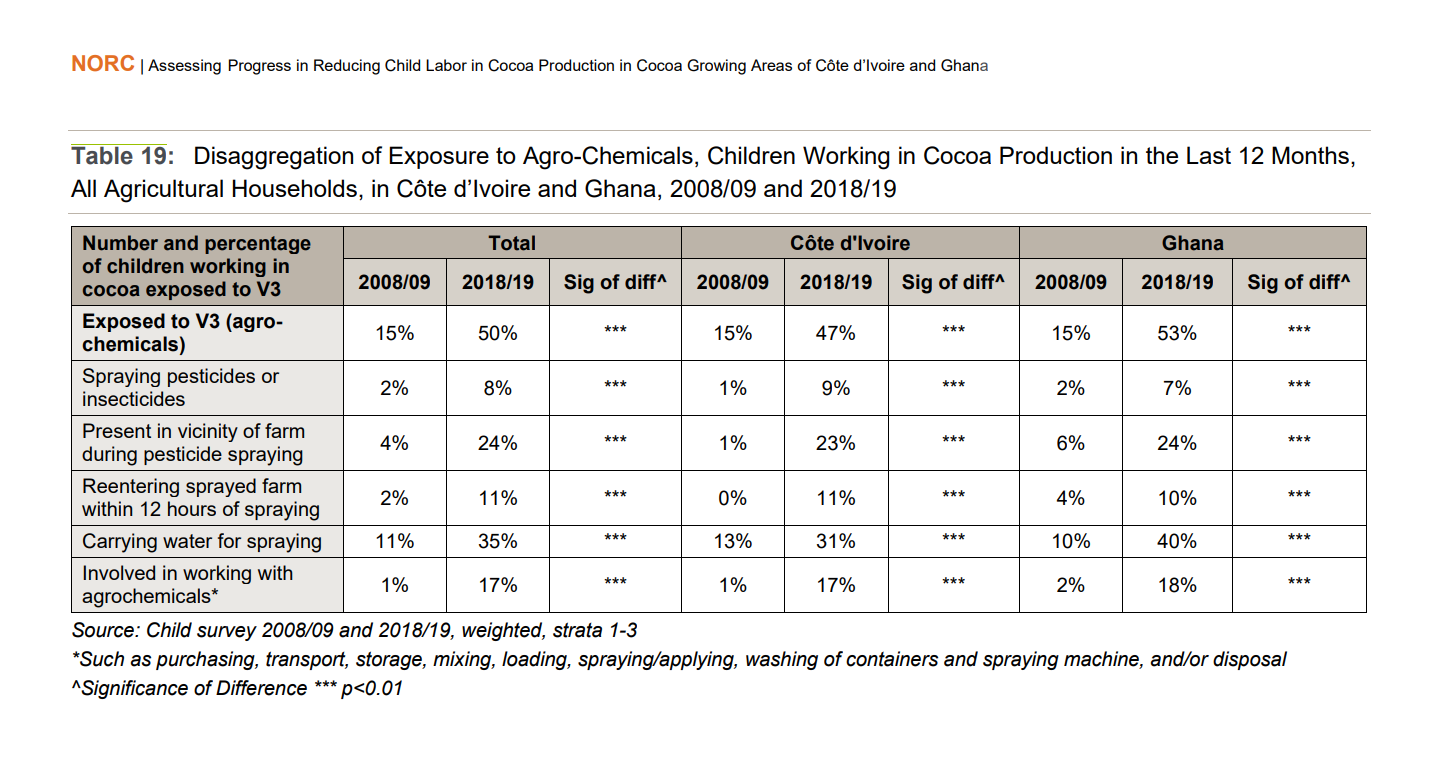 Dangers of Pesticides to Our Planet
The vicious cycle of pesticide use is not costless to consumers thousands of miles away. The global trend of agrichemical use in cocoa is contributing to:
- Pollinator collapse and risk of extinction
- Catastrophic biodiversity collapse
- Toxic pollution of soil and water
- Microplastics that persist in the environment and in our bodies, according to a recent report exposing deliberate use of microplastics in synthetic pesticides and fertilizers
Standing Up Against Toxic Pesticides in Chocolate
Green America and its allies are calling on the chocolate industry to address the use of toxic pesticides in cocoa production. Industry needs to get serious about the problem, and foot the bill for a much needed and urgent reform. Chocolate is projected to be a 180 billion USD industry by 2025, thriving despite the COVID-19 pandemic. We cannot ask impoverished cocoa farmers, many of whom experienced a decrease in their income during the pandemic, to shoulder the burden of transitioning from hazardous pesticides to sustainable and soil-nourishing practices.
Recently, the German NGO INKOTA, and the VOICE Network, a global network of NGOs and trade unions working on sustainability in cocoa, co-hosted a webinar “Harmful Impacts, Little Action: Pesticides in Cocoa Production in West Africa” calling on a transition to safer pesticide alternatives.
The groups behind the Chocolate Scorecard, including Green America, began asking major chocolate companies two years ago to transition away from highly hazardous pesticides, and to ensure the transition was farmer centric. This year the companies were ranked publicly for the first time.
Here are some of the questions companies were asked and graded on:
- Does the company have lists of active substances that it monitors, prohibits, or restricts throughout its supply chain?
- In the last two years, have any active substances been added to or deleted from the company’s monitored, prohibited, or restricted list?
- How does the company support farmers to reduce chemical use?
- How does the company support farmers in adopting non-chemical alternatives to pesticides?
- What percentage of your volume is certified organic?
- How is the company ensuring that children and pregnant women are not exposed to pesticides?
The scorecard found that many companies, including Mondelez and Lindt, need to do significant work to address pesticides. At the bottom of the pack, General Mills and Starbucks refused to share anything about what they are doing to address environmental and social harms of their cocoa, including pesticides.
Check out the chocolate scorecard to see how the companies rank.
Etelle Higonnet, leading activist in cocoa industry reforms, shared: “It is absolutely possible to do better cocoa – that is pesticide-free, that uses biochar and compost instead of fertilizers that are chemical, and that is good for forest, good for wildlife, good for human health.”
Let us all commit to better cocoa.
What You Can Do to Fight Pesticides in Your Chocolate
As consumers we can drive change in the industry. Consumer pressure has gotten some of the largest chocolate companies to take action.
Take action today by:
- Take Action: Tell the EPA to ban dangerous organophosphates
- Acting on social media: Send a message to major chocolate companies that they need to address farmer poverty, child labor and pesticide in their cocoa.
- Buying from the heart: Purchase chocolates from companies that are leaders in protecting farmers, communities, and the environment. To eliminate pesticide from cocoa, the best you can buy is organic chocolate. Second best is to purchase chocolates that are certified by FairTrade or Rainforest Alliance.
- Telling your friends: Message your friends and family on Halloween, share this blog with them, and let them know about how they can help treat – not trick – both people and planet!
|
|
Women Farmworkers Shouldn’t Be Forced to Risk Their Health |
Farm work is one of the most dangerous jobs in the US, in part due to pesticide exposure, and women’s share of the farming workforce is increasing. According to the USDA, in 2009 women made up 18.6% of farmworkers but in 2018, women accounted for 25.5% of the workforce. Ongoing concerns about farmworkers' exposure to pesticides have been documented in the September 2022 Report “Exposed and At Risk”.
The United States uses the second largest amount of pesticides out of all countries in the world; as of 2018, the US used over 400,000 tons of pesticides per year.
Farmworkers are exposed to higher amounts of pesticides than consumers, which in turn could lead to more negative health consequences – particularly for women farmworkers. Farmworkers can be exposed through handling pesticides, directly spraying the pesticides, coming in contact with pesticides residue while on the job, through pesticide drift, and pesticide residue can stay on clothing which can be carried into the home, risking the health of families as well.
What does pesticide exposure look like?
- In the short term, those exposed can experience: stinging eyes, rashes, blisters, blindness, nausea, dizziness, diarrhea and even death.
- Over the long term, chronic effects can include: cancer, birth defects, reproductive harm, neurological and developmental toxicity, and endocrine disruption.
Pesticide impacts on women:
In the list above, you will notice that a few of those long-term effects impact reproductive health, which is one of the key reasons pesticide exposure can cause additional harm to women.
A study examining pesticide related illnesses and injuries in farmworkers from 1998 – 2007 found that women farmworkers were twice as likely to experience an illness or injury related to pesticide exposure than men. With women’s share of the farm work force growing, it is even more pressing that we greatly reduce the amount of pesticides used in agriculture and eliminate the use of all highly hazardous pesticides.
According to the Association of Farmworker Opportunity Programs (AFOP), exposure to pesticides while pregnant can be particularly harmful; it could lead to miscarriages, premature births, and birth defects. Pesticide exposure can be even riskier in the first few weeks of pregnancy, potentially before a woman knows she is pregnant. AFOP recommends all women that are pregnant or trying to become pregnant take additional precautions and try to avoid pesticide exposure.
Pesticides add to the toxic chemical exposure all women face
An added risk to chemical exposure is how we interact with the world and what products we each come into contact with. Women tend to be exposed to more chemicals than men. Women still often carry out more of the household cleaning than men, resulting in women being exposed to more harsh cleaning chemicals.
Additionally, women tend to use more personal care products than men. The Environmental Working Group estimates women are exposed to 168 different chemical per day through personal care products; while men, on average, are exposed to 85 per day – this number does not factor in pesticide exposure or exposure to cleaning products. It is likely that the various toxic chemicals interact with each other to produce greater impacts, so when women are exposed to toxic chemicals in personal care products and then through work exposures, the risks are compounded.
Additionally, Women’s Voices for the Earth notes that some chemicals accumulate in fat, and women tend to have a higher body percentage of fat than men, which in some cases, leads to women having much higher levels of certain chemicals in their body. And, some chemicals build up in our bodies over time, so increased exposure in both the amount of a chemical and number of chemicals poses a unique threat to women.
Women should have equal access to all occupations and with that equal access, women should not face an additional burden of being exposed to harmful pesticides or other chemicals while working.
While pesticide exposure creates health risks for women, that is not to say that pesticide exposure is not harmful to men – in an ideal world, no one would be at risk of being exposed to chemicals that harm our health.
Regardless of your occupation, everyone has a right to a healthy and safe workplace. And employers must adapt their practices in order to respect that right. In the case of agriculture, there are alternative growing methods that use less or no pesticides, such as regenerative agriculture or organic farming.
|
|
How Small Businesses Can Have a Big Impact in the Climate Fight |
When we think about the companies responsible for carbon emissions, we tend to focus on the Chevrons and ExxonMobils of the world. But virtually every company has a carbon footprint. And each can help solve our global problem.
“Small actions on a local level add up,” says Fran Teplitz, executive co-director of business, investing, and policy at the Washington, D.C.-based Green Business Network. “We’re big advocates of doing what you can, based on who you are and where you are.” This domino effect has the potential to build positive momentum across business sectors.
|
|
El Cuadro de Mando 2022 del Chocolate |
|
|
2022 Chocolate Scorecard |
|
|
The Pesticide Problem |
|
|
Pesticides: A Big Problem for Pregnancy and Children |
Pregnancy comes with precautions such as no heavy lifting, light exercise, getting plenty of rest, and avoiding air travel closer to one’s due date. There is another concern to add to the list: pesticides.
According to the Association of Farmworker Opportunity Programs , being in contact with pesticides is harmful, especially during pregnancy. Pesticides not only affect the parent, but the unborn child as well. Pesticide exposure during pregnancy may lead to miscarriages, preterm births, low birth weight, birth defects, and learning problems in children. Researchers have also found that these impacts can cause long-lasting effects in children.
Pesticide exposure is hard to study. It’s difficult to point to a single source, especially if the exposure is at low doses over the course of years. Recently, a group of scientists has made progress in understanding the impacts of pesticide exposure. The Center for the Health Assessment of Mothers and Children of Salinas (CHAMACOS) study is the longest-running longitudinal birth cohort study of pesticides and other environmental exposures among children in a farmworker community. 500 children have been examined since birth for 19 years. The health assessment is still ongoing and closely follows each child’s neurodevelopment and risk-taking behaviors, while the children are entering into their late teens and early adulthood.
Findings of the study thus far include risks from the following pesticides:
- Organophosphates: “shorter duration of pregnancy, poorer neonatal reflexes, lower IQ and poorer cognitive functioning in children, increased risk of attention problems in children”
- DDT: poorer mental development in two-year-old children
- PCBs: Altered maternal and neonatal thyroid levels
People Most Affected by Pesticides
An important element is that the study largely followed low-income Latinx mothers and farmworkers' families. This is important to note because the communities that are mainly affected by pesticides are low-income Latinx families.
Further complicating risks to pregnant farmworkers is the loss of reproductive rights in much of the US. Considering all the risks pregnancy entails and the high mortality rate of Black and brown mothers in the US, the Supreme Court’s decision to overturn Roe v. Wade was an unprecedented reversal of the rights of people who can get pregnant and will harm people who are already marginalized in this country. This will cause a disadvantage to Black and Brown people, LGBTQIA+ people, Indigenous people, people living in poverty, immigrants, non-Christians, and people with disabilities. Since most farmworkers in the US are Latino/a without access to funds to pursue reproductive care out of state, we will likely see a rise in risky pregnancies, compounded by pesticide exposures, in farmworkers.
Increased Autism Risk in Children Exposed to Pesticides
Exposure to pesticides during pregnancy may also raise a child’s risk for developing autism. A study published in the BMJ by Von Ehrenstein eVon Ehrenstein et al. found it is possible that pregnant mothers living in areas with heavy pesticide spraying (including glyphosate (the main ingredient in RoundUp), chlorpyrifos, diazonon, malathion, avermectin, and permethrin) set them apart from those with little to no exposure. Babies exposed in their first year of life appear to be at higher risk of developing autism with accompanying intellectual disabilities. These findings should lead policymakers to create changes in pesticide regulations to better protect children.
Moms Fighting Back
Moms living in areas with heavy pesticides are leading the way to impactful change, starting in California. The Guardian interviewed Fidelia Morales, a mother of five, who lives near citrus groves where chlorpyrifos use is common. She said pesticide exposure has hurt her family, especially her 11-year-old son. This exposure has not just affected the Morales family—many Central Valley residents traveled to the state capital and testified about the fear of the long-term impacts on their families.
These actions got policymakers’ attention. In May 2019, Governor Gavin Newsom and CalEPA announced that they had listened to residents and that a ban was “needed to prevent the significant harm this pesticide causes children, farmworkers, and vulnerable communities”. The state phased our chlorpyrifos over the next two years. Community leaders and mothers noted this is “only the beginning- and they are just getting started.” And state action in California, Hawaii, and New York built momentum for the US EPA to issue a ban on the use of chlorpyrifos in food products in 2022.
The ban on chlorpyrifos in food crops is an important step forward, but many toxic pesticides remain in use throughout the United States.
Green America supports the Precautionary Principle. Pesticides should not be allowed unless they are proven to be safe. Instead of the status quo, pesticides are allowed until they are proven unsafe. Green America urges states and the Federal Government to follow the precautionary principle.
What’s Next?
Public awareness and mobilization. Increasing public awareness and activism on pesticides will lead policymakers to change policies about pest control and start looking for alternatives that are safe for human and environmental health.
Here are 3 ways to help the cause:
- Tell the EPA to ban dangerous organophosphates
- Buy more organic foods as your budget allows and when available
- Ask farmers about regenerative agriculture with these helpful questions
- Ask federal legislators to support the Protect America's Children from Toxic Pesticides Act (PACTPA) and the Children’s Act for Responsible Employment (CARES) to protect child agricultural workers in the US overall.
|
|
Communications & Outreach Contractor, Clean Electronics Production Network |
The Clean Electronics Production Network (CEPN) is seeking a communications / outreach contractor to support our work over the next few years. This is a part time (average of approximately 4 to 6 hours per week) ongoing opportunity.
CEPN is a multi-stakeholder, cross-industry collaboration that launched in 2015. The goal of the network is to move the electronics industry towards zero exposure to toxic chemicals in the manufacturing process. CEPN is an innovation network within Green America’s Center for Sustainability Solutions.
In August 2021, CEPN launched Toward Zero Exposure - a commitment program with leading electronics companies to protect workers from chemical hazards in the electronics supply chain. We are seeking to build awareness of this program and expand participation.
Areas of Support:
- Outreach: Work with CEPN staff to grow the Toward Zero Exposure program participation by:
- Supporting new participant outreach and recruitment
- Identifying and supporting opportunities and events for outreach
- Developing communication materials / collateral to explain and demonstrate the value of the program
- Communications: Take responsibility for writing and editing:
- CEPN’s quarterly newsletter, announcements, and other communications materials
- Toward Zero Exposure annual report
- Digital Engagement: Enhance the Toward Zero Exposure program's and CEPN’s online presence, and manage LinkedIn
Preferred Qualifications & Experience:
- Excellent writing skills. A writing style that is compelling and clear. Ability to explain complex ideas in an easy-to-read style.
- Excellent oral communication skills. Ability to talk confidently, honestly and strategically with a wide variety of global stakeholders including senior executives from electronics companies.
- Experience, or demonstrated interest in, the mission and scope of CEPN.
- Ability to learn quickly, synthesize a large amount of information and present it clearly, meet deadlines and to work calmly under pressure.
- Ability to work independently as well as within a team environment.
- Take responsibility for strategy, as well as moving a project from concept to completion.
If interested, please send a statement of qualifications including hourly rate and 3 to 5 relevant work samples to pbrody-heine@greenamerica.org and gleib@greenamerica.org.
_______
Green America is an equal opportunity employer. All qualified applicants will receive consideration for employment without discrimination regarding: actual or perceived race, color, religion, national origin, sex (including pregnancy, childbirth, related medical conditions, breastfeeding, or reproductive health disorders), age (18 years of age or older), marital status (including domestic partnership and parenthood), personal appearance, sexual orientation, gender identity or expression, family responsibilities, genetic information, disability, matriculation, political affiliation, citizenship status, credit information or any other characteristic protected by federal, state or local laws. Harassment on the basis of a protected characteristic is included as a form of discrimination and is strictly prohibited.
|
|
Groups: Agriculture, Soil Health Missing from Agenda of White House Conference on Hunger, Nutrition, And Health |

Join a coalition of farmers, food companies, and businesses in support of a regenerative approach to healthier food for all Americans
WASHINGTON, DC – SEPTEMBER 27, 2022 – Green America’s Soil & Climate Alliance, the Plant Based Foods Association, and the Plant Based Foods Institute along with a diverse coalition of farmers, food companies, and businesses, applaud the Biden-Harris Administration for hosting the first White House Conference on Hunger, Nutrition, and Health in more than 50 years. Consistent, equitable, and culturally appropriate access to healthy and affordable food is a cornerstone of our joint work across the food system and agriculture supply chain, and the inextricable link between soil health and human health cannot be ignored.
This link has not been listed as a priority for discussion as we begin charting a meaningful path forward. Soil health has a profound influence on the nutrients that make it into our diet and onto our dinner plate. So we call on the White House Conference on Hunger, Nutrition, and Health to address the link between soil health and nutrition as a key part of the solution for healthier food for all Americans.
"Our mission is to inspire people to eat more chickpeas and other beans. Beans are nutrient-dense foods that play a key role in restoring soil health, yet 80% of the U.S isn’t eating enough of them,” said Brian Rudolph, CEO and co-founder, Banza. “Planting more crops like chickpeas will yield only positive outcomes for people and the planet.”
As a coalition and a country, we must actively support the transition to an agricultural system that is diversified, regenerative, resilient, and adaptive. These agricultural practices have multiple benefits, including climate drawdown and resiliency benefits, soil conservation, water quality and conservation, biodiversity, domestic food security and economic prosperity for farmers and rural communities.
"Providing high-quality, nutrient-dense plant-based foods for consumers is a top priority for Lupii," said Isabelle Steichen, co-founder and CEO of Lupii. "We know that the health of the ingredients we use starts at a soil level and being able to work on a domestic level with American farmers who prioritize regenerative farming practices allows us to deliver healthy plant-based foods that align with our values and the values of consumers."
New research1 shows regenerative agriculture practices are proven to provide more nutrient dense food improving human health outcomes. The National Strategy must include support for regenerative agriculture practices and outcomes as part of its solutions to the challenges being addressed. Farmers are the backbone of our food system in the US, and they are working to regenerate soil and grow healthy food through regenerative practices like cover cropping, reduced tillage and inputs, and integrating livestock where appropriate.
In parallel with the White House effort, we commit to:
- Leveling up on regenerative practices within our farms and companies to deliver healthier food to consumers at a price they can afford.
- Working across the food system to enable food brands and companies the ability to improve their domestic sourcing through and encourage regenerative practices that promote biodiversity, nutrient dense food, and healthy soil.
- Building diversity into the supply chain with the structure necessary for BIPOC and underserved populations to engage with large-scale purchases of raw ingredients.
- Collaborating with the broader food space to ensure that the way food is being grown in the US contributes to the goals outlined by the White House.
About the Soil & Climate Alliance
The Soil & Climate Alliance is a supply chain working group housed under Green America, the nation’s leading green economy organization. The mission of the Soil & Climate Alliance is to advance a resilient, equitable, and inclusive agriculture system that regenerates soil health, sequesters carbon, and revitalizes farm and rural economics, while improving water quality, biodiversity, food security, and nutrition. Our members are farmers, seed breeders, ingredient suppliers, traders, transporters, processors, retailers, brands and CPGs, investors, researchers, and farmer support organizations. Our Soil Carbon Initiative provides farmers and food companies with an outcomes-based, independent third-party verification program.
About the Plant Based Foods Association
The Plant Based Foods Association (PBFA) is the only trade association in the U.S. representing over 320 of the nation’s leading plant-based food companies. PBFA’s mission is to champion, strengthen, and elevate our members and the plant-based food industry. PBFA empowers the industry by advocating for government policies that allow fair competition while expanding market opportunities for retail, distribution, and foodservice to support the continued growth of the plant-based foods industry.
About the Plant Based Foods Institute
The Plant Based Foods Institute (PBFI), PBFA’s sister non-profit organization, is focused on driving plant-based food system transition through policy and business strategies. Driving this transition requires a holistic approach that recognizes the complexity of the challenges we face, builds bridges across sectors, and ensures businesses can thrive—and it requires solutions that work for a diverse coalition of food system participants. That’s why PBFI incubates, implements, and evaluates strategies that empower the broadscale change we need, through the power of plant-based.
This comment is supported by:
MEDIA CONTACT: Max Karlin for Green America, (703) 276-3255, or mkarlin@hastingsgroup.com.
1 Montgomery DR, Biklé A, Archuleta R, Brown P, Jordan J. 2022. Soil health and nutrient density: preliminary comparison of regenerative and conventional farming. PeerJ 10:e12848 https://doi.org/10.7717/peerj.12848
|
|
Starbucks Offers More Plant-Based Milks |
After pressure from Green America and allies to address the environmental impacts of its dairy, Starbucks has taken two important steps forward.
Starbucks has announced its Journey to Sustainable Dairy. The company is working with The Nature Conservancy to find ways to reduce the climate and water impacts of its dairy, while benefiting farmers. This is a new program, so it will take some time before its impacts can be evaluated.
Starbucks previously announced that they will be offering more plant-based milks, including almond, coconut, soy, and oat milks, as alternatives to conventional dairy products.
An environmental audit found that dairy was the main source of emissions in the company's supply chain, which prompted this change and the company's goal to reduce carbon emissions by half by 2030.
As one of the world's largest dairy purchasers on earth, the steps towards more sustainable cow's milk dairy and plant-based alternatives are a win for the climate, with plant-based milks having lower emissions than dairy products, as well as a boon for animal welfare. It remains to be seen how well Starbucks dairy commitment will support struggling small US dairy farms.
Starbucks made these announcements after years of Green America highlighting the company's industrial milk habit and its negative impacts on the planet, and campaigning for their switch to organic milk. Over 150,000 consumers took action with us in our "What the Starbucks" campaign asking the company to address it's enormous climate footprint from dairy milk.
|
|
Climate Emergency Petition Signatures - Green America - 090822 |
|
|
CVS, Apple, Target, and Ben & Jerry’s Top “Skip The Slip” Scorecard Grading Sustainable Receipt Practices |
Room for Improvement: Green America Gives “D” Grades to McDonald's, 7-Eleven, Burger King, Claire's, Rite Aid, Safeway, Family Store, Panda Express and Wendy's.
WASHINGTON, D.C. – SEPTEMBER 7, 2022 – Green America released a new update to its Skip the Slip report on the impacts of paper receipts on forests and climate change, as well as how the chemicals used on receipt paper affect consumer and employee health. The report also features a scorecard that grades 33 major U.S. companies on their progress to address the waste and health risks associated with paper receipts.
A major finding of the report is the progress CVS is making to address the impacts of its receipts. In 2017, Green America began urging CVS to address its wasteful, phenol-coated (BPA or BPS) paper receipts. The campaign led to a dialogue between Green America and CVS on alternatives. As a first step, the company implemented BPS-free paper in all 10,000 stores and increased promotion of its digital receipt option to ExtraCare Card members, and 7.3 million customers have signed up. In 2019, an estimated 58 million receipts were sent digitally, saving 48 million yards of receipt paper - more than enough paper to circle the globe. In 2020, total paper savings rose to 90 million yards – enough to circle the globe twice.
In April 2022, CVS added a new receipt prompt at cash registers so all customers could choose a printed receipt, digital receipt or no receipt. As of July, the receipt prompt saved over 87 million yards of receipt paper. CVS also reports phasing out print circulars in 2/3 of its markets, resulting in a 70% reduction of paper use, and shortened the length of its receipts.
The Skip the Slip scorecard graded companies on their current progress, including whether they offer digital receipts or receipt paper free of BPA and BPS.
“Since launching the Skip the Slip Campaign, the negative effects those little paper receipts have on customers, employees, communities, and the environment is now recognized by businesses big and small,”said Green America’s Climate Campaigns Director Dan Howells. “It is great that CVS, the largest drugstore chain in the US, has taken note and is substantially reducing the amount of paper receipts issued and ended the practice of issuing receipts coated in toxic chemicals.”
"Receipts may be small but their effect on our health and the environment is significant and solutions are readily available," said Joshua Martin, Director of the Environmental Paper Network-North America. "Retailers who are sustainability and public health leaders simply must eliminate the toxic coatings from their receipts that make them harmful to public health and unrecyclable, and avoid the wasteful and unnecessary use of forest resources by offering and encouraging digital and no-receipt options."
The updated Skip the Slip report details how consumption of thermal paper for receipts increased in the United States and worldwide prior to COVID-19, but decreased in 2020 due to the pandemic. Now that the pandemic’s impact on in-person shopping has lessened, consumption of receipt paper is increasing and projected to continue increasing.
Every year in the United States, receipt use consumes 3.6 million trees and over 10 billion gallons of water.Production and disposal of receipt paper generates unnecessary waste and emits the carbon equivalent of over 471,000 cars on the road. Receipts also pose health risks to people who are regularly in contact with them.
An estimated 93% of paper receipts are coated with Bisphenol-A (BPA) or Bisphenol-S (BPS), endocrine-disruptors which serve as color-developers to make the text appear on receipts. The chemical coating is absorbed through the skin and is linked to fetal development issues, reproductive impairment, type 2 diabetes, thyroid conditions, and other health concerns.
In 2021, Green America surveyed Americans on receipt preferences and found that 86% of respondents want retailers to offer digital receipts. Nearly half had already signed up for digital receipts and cited that they prefer digital receipts because of the environment and ease of receipt storage. On average, respondents stated they throw away or lose 49% of the paper receipts they receive, even ones they intended to keep.
ABOUT GREEN AMERICA
Green America is the nation’s leading green economy organization. Founded in 1982, Green America provides the economic strategies, organizing power and practical tools for businesses, investors, and consumers to solve today’s social and environmental problems. http://www.GreenAmerica.org
MEDIA CONTACT: Max Karlin for Green America, (703) 276-3255, or mkarlin@hastingsgroup.com.
|
|
Carter's to Remove Toxic Chemicals from Baby Clothes and Source Sustainable Fabrics |
Carter’s, the largest U.S. retailer of baby clothes, is taking important steps to limit toxic chemicals in its supply chain and use sustainable fabrics - thanks to pressure from Green America and its members!
Because of our Toxic Textiles campaign and thousands of consumers speaking up, Carter’s is adopting a Manufacturing Restricted Substances List (MRSL) to protect workers and communities in its supply chain. When the MRSL is put into place, it will provide a list of chemical substances banned from intentional use in the processing of textile materials that go into Carter’s clothing. This will protect workers who make Carter’s clothing, local communities where textiles are made, and the kids who wear Carter’s clothing.
In 2020, Carter's released a Restricted Substances List (RSL), disclosing information about energy usage and waste reduction, and providing greater transparency about efforts to protect human rights within its supply chain.
Carter's announced 100% of its cotton and polyester will be sustainable by 2030, including using organic cotton and recycled polyester.
|
|
Green America's 2022 Retailer Receipt Scorecard |
|
|
A Bank for a Diverse, Local Community |
What made rev abby mohaupt switch to a better bank that reflects her faith and values?
The rev mohaupt (who uses all lowercase for her name because that’s how her grandmother spelled it) shares with Green America’s Fran Teplitz, executive co-director, what motivated her and how rewarding making the switch was.
rev. mohaupt is the director of education and training at GreenFaith, and former co-moderator of Fossil Free PCUSA, a grassroots movement to get the Presbyterian Church (USA) to divest from fossil fuels. She’s also a PhD candidate at Drew University in Religion, Culture, and Ecology. rev abby recently moved back to Chicago after living in California, New Jersey, and Texas. Her last move created the perfect opening for switching to a bank whose mission she supports.
Fran: Why did you decide to switch banks now? What was most important for you?
abby: I was moving to a new city and when I closed all of my accounts in Texas, I knew that when I opened a new account in Chicago, I wanted to use a bank that was more in line with my values. A few years ago, I switched from Chase to Amalgamated for my larger/recurring expenses, but I needed a more local bank for some tasks. As I looked for banks, it was important to me that I work with a bank that focused on people and diversity, and one that was small enough that it wasn’t one of the major investors in fossil fuels.
I ultimately chose a bank that was historically created to support Korean immigrants, and now continues to support specifically multi-ethnic communities. Because so much of my financial life (and professional and personal life) is about divestment from fossil fuels, I was surprised that this was the best fit for me (I assumed that I would choose based on fossil fuels alone).
But there was also something lovely about this choice for at least two reasons:.
- Our liberation from injustices are intertwined – immigration justice is climate justice.
- When I was in seminary, much of my education was enhanced by Korean students who taught me to be a better person of faith…. and my life is better because of immigrants every day. I’m charmed by that connection.
Fran: Those are powerful connections to your new bank. What was most important for you to find in a new bank?
abby: I wanted to be able to go to my bank in person and to have the location be one that was easy to get to. While there are closer banks to our apartment, those were all big banks that support fossil fuels. The bank I ended up opening an account with – Hanmi – is right on the route home from my daughter’s daycare, so I pass it nearly every day.
Fran: So the solution you needed was right in your neighborhood! What resources were helpful?
abby: I used Green America’s bank resource to look up banks in my neighborhood that had similar values. I didn’t have to close any accounts (because I’d done that previously), so I simply had to compare the map on the site to where I regularly go.
Fran: Tell us about your new bank! Anything surprising?
abby: I love our new bank. I opened the account one afternoon after picking my daughter up from daycare. She sat pretty quietly throughout most of the interaction, but she also captured the heart of the banker who helped us through the process. A couple weeks later, I was going through the drive thru, and that same banker helped me. He asked how my daughter was doing– which was so surprising after several weeks!
Fran: What’s your message to others needing to switch to a bank or credit union that reflects their values?
abby: Before you begin this process, it can feel like a mountain of work – just start with one account and move one account at a time. There’s no “pure” money – so do the best you can, using the resources available to you so that you bring your money in line with what you believe in.
...just start with one account and move one account at a time.
Fran: What is your next step for greening your financial life?
abby: The next step for us is moving the last of our investments in line with our commitment to be invested with our values. It’s a step that I’ve let linger for a couple of years, and I’m ready to make that call. Then I think we’ll start integrating our transportation commitments with our finances! Now that we live in Chicago, we have lots of green options for travel, and each of those options are more cost-effective than owning a car on our own.
|
|
Honoring Ancestral Land Through Regenerative Agriculture: How One Palestinian Business Protects the Sacred Olive Tree |
For Nasser Abufarha (above, left), endeavoring to make Canaan Palestine [GBN] a green business was always about more than the sustainability practices he believed in. It is, first and foremost, a way to honor his ancestral land and the thousands of years of history it held, including the olive trees, standing strong and representing a sacred way of life.
The company, which sells local and natural Palestinian staples like olive oil and almond products, is what Nasser describes as the “marketing arm.”
It all began, however, as Nasser explains, “to help save the community, save the relationship with the land, save the trees, save the crop.”
The foundational systems of Canaan Palestine, including fair wages and regenerative agriculture, are natural outcomes of the roots of Nasser’s goals. Like the widespread roots of the olive tree, these systems could not exist without the richness of Palestinian soil and the Indigenous peoples who came before, teaching reverence for the land.
Nasser offers an illuminating perspective on what being a green business means, beyond numbers and science.
Honoring the Land
The land of Canaan was one of the earliest inhabited by humans, with Indigenous peoples forming societies as early as the Neolithic period. Many different societies appeared across this land, with olive trees as important fixtures in all these societies since the beginning.
If the olive trees knew the hands that planted them, their oil would become tears. Mahmoud Darwish, Palestinian poet
Some olive trees in Palestine are over 5,000 years old, Nasser explains in earnest. Trees that, for more than a millennium, have sustained, fed, and nurtured life through resilience and strength.
“This is something to protect,” says Nasser. “These ecosystems are something to learn from, to teach us about sustainability, and to make sure they remain for future generations.”
It was this realization that began taking Canaan Palestine into a new direction, beyond its commitment to tried and true methods like fair trade and wages.
What Is Regenerative Agriculture?
Abufarha wanted to forge new paths and began looking at ways to make Canaan Palestine sustainable at the root—literally.
Regenerative agriculture has become a core tenant of the business, leading the business to work with farmers not only to avoid exploitative practices born from political occupation, but with adopting more sustainable farming techniques. This style of farming adopts a holistic approach that considers all living things within an ecosystem and the health of the land, rather than the industrialized way of farming in the Western world, which leads to excessive soil erosion and the destruction of biodiversity.
 A beautiful, massive olive tree in Palestine. A beautiful, massive olive tree in Palestine.One way Nasser is encouraging regenerative agriculture among the farmers and villages Canaan Palestine works with is through intercropping. Decades ago, in the 70s and 80s, Nasser explains, Palestinian farmers also worked with grapes. The traditional way of farming was harvesting olive trees with other vegetation and crops.
“The diversity of plants amongst the olive trees makes a more stable regenerative environment,” Fatin Zahra, Business Market Manager of Canaan Palestine, explains. “Grapes in particular function well amongst the olives and are alive and green during the summer months when most of the grasses have dried out. This creates more shade and cools the area down, which helps with water retention. Additionally, their roots provide nutrients to the soil which the olive trees can benefit from.”
However, without a market for them, the farmers uprooted these crops.
“We’re bringing this back—almost every month, there is a crop,” Nasser says proudly. Canaan Palestine is broadening this work to include more crops again farmers means to make a livable wage and have work year-round, rather than during one season. “We are encouraging farmers to go back to agroforestry. We are giving farmers multiple seedlings to integrate back into their farms: almonds, grapes, figs, carobs, walnuts, and more based on what best suits their plots.”
Another technique the company is adopting and teaching to farmers is minimum tillage. Nasser says that farmers, from the 70s on, were taught to till the soil twice or three times, but that is no longer the most sustainable way to care for the land and its crops.
Putting Palestinian Farmers First
"For the last 60 years, farmers have been given instructions by formal agricultural extensions to move away from their traditional practices to adopt new ‘modern’ methods of agriculture,” Nasser says. “Canaan is fostering gaining back sound traditions that sustained these olive trees for thousands of years.”
 Local Palestinian farmers who work with Canaan Palestine. Local Palestinian farmers who work with Canaan Palestine.
He continues: “We encourage them not to plow as much. But to them, plowing is weed control. We have to teach them new habits and new ways of seeing things. It’s less about the farms being clean of vegetation and more about farms being clean from pollution.”
It takes time, practice, demonstration, and small steps.
As Fatin details, Canaan Palestine is committed to supporting these farmers and setting them up for success.
“We've done weekly workshops with farmers, led by the employees of Canaan and the Palestine Fair Trade Association,” she says. “They visit each village and educate the farmers on regenerative agriculture and the many benefits it can have on their lands and health of their soil.”
As Nasser says, the nature of regenerative agriculture is “tailored to the farm,” meaning it’s not a one-size-fits-all system. It is, however, the only path forward.
“For Palestine to have a future, for people to hold onto their lands, we have to apply these practices,” Fatin concludes.
Read more about Canaan Palestine.
|
|
Food Huggers |
Food Huggers designs make it easy to adopt sustainable practices at home. We offer customers solutions that make sustainable habits easy and fun to do without giving up convenience or style.
Our company mission is to help customers reduce different types of waste at home. Food Huggers designs keep your food fresh at home replacing single use plastics with high quality reusable alternatives.
There is more FOOD in US Landfills than anything else. Reducing food waste is one of the top things we can do as individuals to reduce the output of methane gas. By making it easy and fun to keep your food fresh we help customers reduce food waste at home which reduces the methane gas output of our landfills.
The average American family of four throws away $1600 a year in wasted food. Reducing this financial waste helps to improve the economics of our households as well as our communities.
|
|
Decarbon |
Be empowered to act on climate change! Decarbon is a simple app to help you lower your carbon footprint AND take broader community action. It's like Apple's Health app for carbon tracking.
Key things to know about Decarbon:
- You set a carbon budget and reduce the impact over time by completing climate actions
- Climate action "collabs" are hosted a different leader in the climate movement each month
- 100% transparent - Open source carbon footprint database
- 100% free (no ads or paywalls)
How Decarbon works:
- Link your bank (or use our estimator)
- Automatically track purchases
- Join collabs to take action and reduce emissions
- Offset unavoidable emissions with carbon credits
Contact us at hi@decarbonapp.com
Give a damn about climate change!
I started Decarbon because I'm... scared. The climate emergency feels more and more desperate, and for years I've struggled to understand both what my contribution to the problem is and what I can actually do about it.
Hopefully Decarbon will serve as a simple tool to help demystify those things for us. If understanding the climate impact of a purchase was just as easy as knowing it's price, if tracking everything was super easy, and if we all reduced our impact to within a sustainable amount, maybe we can start to turn this ship around. (I know that oil companies and governments bear the biggest responsibility, but that doesn't mean we should do nothing!)
Lastly, we're committed to keeping Decarbon completely free for everyone - no paywalls, ads, or selling your data.
Peace and love,
Kyle
Why does Decarbon track CO2e?
Carbon dioxide equivalents (CO2e) is a standardized way to compare the total greenhouse gases embodied in our purchases. For example, even though burning gasoline when we drive our cars includes methane and nitrous oxide gases in addition to carbon dioxide, we can use CO2e as a total metric for it’s impact. Decarbon tracks CO2e to keep things simple and to help you easily compare the impact of your purchases apples-to-apples.
How does Decarbon calculate the CO2e impact of my purchases?
Tap the info icon on your purchase to see the exact calculation Decarbon made! The CO2e impact for your purchases is a simple multiplication of the purchase amount, the CO2e emissions factor (CO2e per $) of the purchase category, and any modifiers that you can apply to the purchase to make it more accurate.
What should my annual CO2e budget be?
It should be as low as humanly possible! The initial goal on Decarbon is 7 metric tons of CO2e per year, so you can start with that and then lower it as you begin to understand your impact. Ultimately, we need to limit climate change to 1.5 degrees Celsius, so your goal should be as low as possible to support that.
How does Decarbon connect to my bank?
Decarbon uses Plaid, a trusted third-party tool, to connect to your bank and get transaction information from your checking and credit card accounts. Plaid is used by Venmo, American Express, Coinbase, and others to manage their user’s bank connections.
What bank data does Decarbon have access to?
Once you connect a bank, Decarbon will have view-only access to the transactions of your associated checking and credit card accounts. Decarbon never has access to your bank login credentials, account numbers, or routing numbers. Decarbon can’t make any transactions on your accounts.
Will Decarbon work outside the USA?
You can use Decarbon anywhere, but the experience is currently optimized for individuals living in the United States.
|