|
Ghana Cocoa |
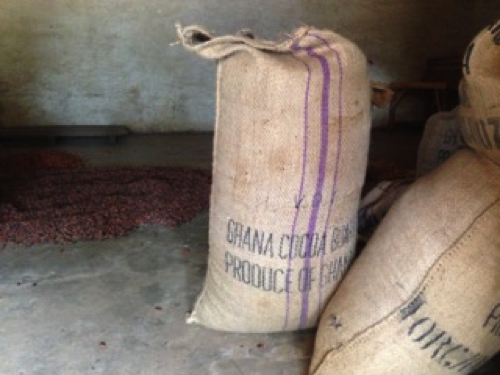
Organic certified cocoa from Ghana.
Five years ago, if you wanted to buy an organic chocolate bar, you would have had a hard time finding one with cocoa from anywhere in West Africa. Despite the fact that the region is the largest producer of cocoa in the world, providing raw cocoa to companies like Hershey, Mars and Cadbury, it simply did not have organic certified cocoa farms. In Ghana, for example, which supplies roughly 30% of the world’s cocoa, the government long reserved the right to apply pesticides on all cocoa farms in the country to prevent plant diseases they feared could threaten the entire harvest. And, while fair trade production—which limits the use of certain chemicals—launched in Ghana in 1995, organic was still an impossibility for almost two decades.
Recently, however, things have started to change, and several industrious Ghanaian farmers are producing some of the first organic certified cocoa in in the country. Late last year I had the chance to visit Ghana for a series of meetings focused on boosting farmer incomes—an issue we’ve advocated for at Green America for years. At the meetings I was able to meet dozens of cocoa farmers from throughout West Africa. Many of these men and women had produced cocoa their whole lives, and came from long lines of cocoa farmers—so they were experts.

Farmer Francis Otu explaining cocoa production.
Francis Otu is one of the farmers I met. Francis has been cocoa farming for a long time, but started using organic methods in 2006. He is a member of Cocoa Organic Farmers Association (COFA). Located in the Brong Densuso area of Ghana’s Eastern Region, COFA is the first organization producing organic cocoa in Ghana. COFA has four communities (clusters of farms) owned by over 600 different members. Even though Francis started using organic insect repellents in 2006, such as neem, it was not until more recently the government blocked off COFA’s communities from regular pesticide treatments. Combined, members of COFA own 1250 acres of land, which equates to roughly 950 football fields that are no longer being treated with chemicals.

Cocoa pods up close.
Cocoa farming, organic or not, is intense work. Unlike large-scale farms here in the United States that sprawl for acres and rely on machines, cocoa farms are typically are very small, just 3 to 5 acres, and must be harvested by hand. At first glance, the farms don’t seem like farms at all, but forests. On the farm I visited during my visit, the cocoa trees were well spread out; their branches created a cool and quiet canopy for all of us standing below, and the ground was covered in dead leaves. These leaves, which I initially imagined had fallen randomly, were actually part of the farmers’ pest-prevention measures, staving off weeds from growing in the ground.
Francis is passionate about organic farming and using no synthetic chemicals. When I asked why, he stated, “because it is healthier for me, as the farmer, for my land, and for the consumers in Europe who buy my cocoa.” After the three year transition period required to obtain organic certification, he can also make more money. “It’s very difficult to make a living as a cocoa farmer, but as an organic farmer it’s a little better. I make a premium of 20 cedi per bag I sell.” (roughly $5).
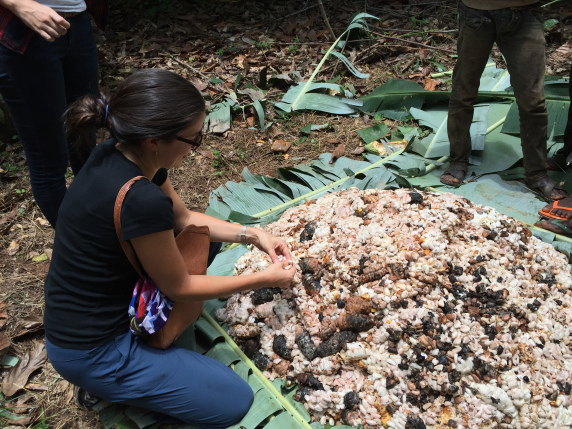
Inspecting fermenting cocoa beans.
Cocoa pricing is always a little confusing. In Ghana, COCOBOD, the government’s central cocoa marketing branch, sets the price of cocoa each year. For this growing season, the price was increased to 420 GH¢ per 64kg bag, or $105. Francis and his peers then earn $110 per bag. From conversations I had with several of the farmers attending the conference, it seems 1 acre of land can yield about 4 bags per year, which for most farming families would equate to only $1680 annually. The Cocoa Barometer found that most cocoa farmers in Ghana and their children live on just $0.86 per day, well below the global poverty line of $1.25/day. Child labor, a symptom of extreme poverty, has been a known problem in West African cocoa fields for more than a decade. In a 2015 survey, Tulane University, commissioned by the US Department of Labor, found that more than 2 million children in Ghana and Cote D’Ivoire work in hazardous conditions growing cocoa, such as burning fields, applying agrochemicals, carrying heavy loads, and not attending school.
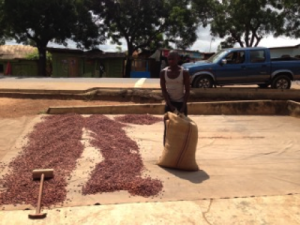
After the cocoa pods are picked, and the beans inside fermented, they are laid out to dry in the sun.
While organic certified cocoa does command a higher price than conventional, if there is no buyer interested in organic, the cocoa will be sold as conventional. Francis explained that though he started using organic methods nearly a decade ago, earning certification and finding buyers took many years. Right now, COFA sells its cocoa to a Swiss chocolate manufacturer, but still has no US buyers. When I asked what would help Francis and his peers most he said, “more direct relationships with buyers so that we can make long-term investments in our farms and maintain quality.”
Globally, organic cocoa production is still a minute portion of all cocoa sold. The ICCO estimates that just 15,000 tons of more than 300 million tons is grown under organic conditions, or .05%. And less than 30% of this cocoa comes from West Africa, according to the FAO. However, the emergence of organic cocoa in Ghana could not come at a better a time. Consumer demand for organic products is growing at a strong pace, cocoa included. According to Euromonitor International, global organic chocolate sales were estimated to have nearly doubled from $171 million in 2002 to $304 million in 2005.
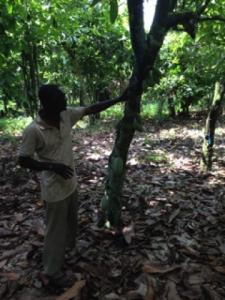
Francis pointing out one of his cocoa trees.
The purpose for my visit to Ghana was to learn from farmers what challenges they face and what it would take to make cocoa farming a long-term, profitable livelihood for farmers. Cocoa farmers throughout West Africa live in extreme poverty—malnutrition, remote homes, no access to schools, and no regular income–despite the world’s voracious consumption of chocolate. At the meetings, Francis declared to all of us that “just like a cocoa tree needs nutrients like water and sunlight to survive, so too do cocoa farmers. If cocoa farmers can not earn a decent income for their work, there will be no chocolate.” For our part as consumers, we have a delicious job to do—buy and eat more organic and fair trade certified cocoa, to support all the men and women who pick each and every pod.
Check out our Chocolate Scorecard to find organic and fair trade chocolates, and to find out which companies are lagging behind.
Photos by Emilie Schoots and Elizabeth O’Connell. |
|
Your Rights as an American Worker |
Student guest workers protest outside a Times Square McDonalds back in March, accusing the company of refusing to pay its workers overtime and wage theft.
Despite the promise of certain legal rights to safe, healthy, and fair work conditions, sweatshops and slavery still exist here in the United States. As exposed in last month’s issue of The Green American, “Fair Labor at Home,” in fleeing from terrible working conditions in their native countries, many immigrants are flung from the frying pan into the fire. Seeing their precarious financial or legal situation, certain unscrupulous employers will sometimes lure desperate immigrants into their employment with promises of a better life, only to subject them to the very conditions many were trying to escape in the first place.
While in very sad cases employers use economic coercion, threats of deportation, or physical force to exploit their workers, part of the battle is knowing your rights as a worker. After all, how can you know when your rights are being violated and thus be incited to action, if you weren’t aware you had rights in the first place?
So whether you’re just touching down on American soil for the first time or have never left it, it’s important to get acquainted with your legal rights. That’s why we here at Green America have compiled a short list of some of your most fundamental rights as a worker.
A quick caveat: The information provided in this post does not constitute legal advice. It is merely a list of certain legal rights and certain resources that can describe your rights more in full. It is my hope that this post will serve as a simpler alternative to the labyrinth of links and pages that is the Department of Labor’s website.
Minimum Wage
There’s a federal minimum wage ($7.25/hour) and your state’s minimum wage (varies) — employees are entitled to the higher of the two. However, there are certain industries (agriculture, industries where tipping is prevalent, etc.) and positions (internships mostly) where it is legal for employers to pay their employees less than minimum wage. Some of these exceptions will be covered below.
Overtime for Hourly Workers
According to Federal labor law, when an employee works over 40 hours in a single week, s/he is owed a minimum of 1.5 times regular pay for every additional hour worked over 40. The week “need not coincide with the calendar week, but may begin on any day and at any hour of the day.” Federal law does not permit averaging of hours over two or more weeks.
Employees are not automatically entitled to overtime pay for work on Saturdays, Sundays, holidays, or regular days of rest. Overtime is about the hours worked in a given week, so as long as the 40 hours plus is worked within a seven day window, the exact days worked doesn’t matter – be it Veterans’ Day, Christmas, or the day of your mother’s funeral.
Keep in mind that many professions are exempt from receiving overtime so make sure to check if you qualify before you go busting any doors down.
Overtime for Salaried Workers
If you make less than $23,600 ($455/week) you automatically qualify for overtime — even if you work in an industry that does not typically allot overtime rates. If your employer cuts your pay when you miss part of the work day, you’re not exempt. However, if neither of the aforementioned criteria applies to you, you may still merit overtime (unless of course you work in an exempt field).
Meal Breaks
There are no federal mandates requiring that employers allot their employees meal breaks during the workday, only state laws. However, not every state has bothered to enact regulations. Only 20 states — California, Colorado, Connecticut, Delaware, Illinois, Kentucky, Maine, Massachusetts, Minnesota, Nebraska, Nevada, New Hampshire, New York, North Dakota, Oregon, Rhode Island, Tennessee, Vermont, Washington, and West Virginia — require that employers to provide some sort of break for meals. Click here for a rundown of your state’s regulations if you’re lucky enough to work in an aforementioned state.
Miscellaneous Breaks
The outlook is even bleaker when it comes to breaks before and after lunch. A paltry nine states — California, Colorado, Illinois, Kentucky, Minnesota, Nevada, Oregon, Vermont, and Washington – require that employers give their workers’ intermittent “rest” periods throughout the workday.
Sick Leave
According to the Family and Medical Leave Act (FMLA), in order to merit sick leave you must (1) have worked for your employer for at least 1,250 hours over the last 12 months; and (2) work at a location where there are at least 50 employees employed by your employer within 75 miles.
Those who do qualify are allowed up to 12 weeks of unpaid, job-protected leave for the birth or adoption of a child or for the serious illness of the employee or their spouse, child or parent.
But if the FMLA doesn’t apply to you, don’t give up hope! Many local governments have enacted their own regulations regarding sick leave.
Minimum Wages for Tipped Employees
Some states allow an employer to pay their employee less than minimum wage when the remaining portion can be made up in tips. For example, in North Carolina an employer can pay a waiter, bartender, or hotel maid as little as $2.13/hr as long as they make more than $20 in tips a month. For a full list of wages by state, check out the DOL’s website.
Filing a Complaint
Think one of your rights has been violated? For wage violation employees may find out how to file a complaint by contacting the local Wage and Hour Division office or by calling the program’s toll-free help line at 1-866-4USWAGE (1-866-487-9243). “In addition, an employee may file a private suit, generally for the previous two years of back pay (three years in the case of a willful violation) and an equal amount as liquidated damages, plus attorney’s fees and court costs.”
For safely or environmental violations, workers or their representatives may file a complaint or request that an Occupational Safety and Health Administration (OSHA) inspect their workplace if they believe there is a serious hazard or that their employer is not following OSHA standards via fax, email, or telephone.
Protection for Whistle Blowers
The OSHA will withhold the identity of the whistle blower if requested by the worker. Thanks to the Occupational Safety and Health Act of 1970, it is illegal for an employer to fire, demote, transfer, deny a raise, or discriminate in any way against a worker for filing a complaint or using other OSHA rights. Remedies can include job reinstatement and payment of back wages.
Still have questions? Interested in something I didn’t cover? The Department of Labor’s website offers a more comprehensive account of workers’ rights. The AFL-CIO is also a great resource |
|
Apple Responds to Campaign for Employee Safety |
Yesterday in partnership with Students and Scholars Against Corporate Misbehaviour and the activism arm of the Nation, Green America and China Labor Watch launched a petition to improve worker health and safety for Apple employees in the factories that make Apple products.
Apple was quick to respond to our campaign, in a statement shared with Computer World, however, their statement falls far short of meeting the demands of the campaign.
First, we are calling for the elimination of the most dangerous chemicals used to make Apple products. Two dangerous chemicals known to be used by Apple include benzene and n-hexane, but there are more. Thousands of chemicals can be involved in making one electronic device, many of which are newly developed and not sufficiently tested. Apple does not disclose the list of chemicals used at its supplier factories. Transparency will be the first step in eliminating the most dangerous chemicals, removing them is next.
Apple pointed out it has led the industry in removing other dangerous chemicals from its products, but its statement did not include benzene or n-hexane. Nor did it indicate that Apple had removed toxic chemicals from the processes of making the parts–simply the final products themselves.
In cases where workers are still exposed to dangerous chemicals, workers must be provided with proper training and protective gear. In China, the legal minimum requirement for health and safety training is 24 hours. Apple’s new EHS training program provides no evidence that trainings will be enforced for workers at supplier factories, only that management will be trained. Additionally, China Labor Watch has issued reports revealing that at one of Apple’s main assembly factories, safety trainings were sometimes only 10 minutes long.
Secondly, we are calling on Apple to ensure that all workers who have been injured are receiving appropriate care. At present, Apple has no mechanism to track worker health and safety at its supplier factories, and therefore has no idea of the pervasiveness of occupational illnesses. Tracking will be the first step, but to be a leader, Apple should ensure that any worker who has become ill making iPhones is receiving proper diagnosis, can access appropriate care, and can afford the care he or she needs. The current process for Apple employees to receive occupational diagnosis and access treatment is bureaucratic, time-consuming, and the care is not sufficient. Apple needs to step in to expedite this process. For workers that have already become ill, sometimes gravely, time is of the essence.
It’s true that Apple has led in its industry, which is why Apple can and should be the first tech company to take this next step for workers.
Additional reforms Apple should take to protect the workers making its products include:
- Disclose the chemicals used in products and to make products at supplier and assembly factories, and a mitigation plan for all chemicals considered to be dangerous
- Disclose incidences of worker injuries and illness
- Require all supplier and assembly factories to conduct pre-hire and post-resignation health exams, while at the same time ensuring that workers are not tested for pregnancy or discriminated against for other diseases like hepatitis B or HIV.
- Disclose all manager safety trainings (including the training content), audit results, inspection results, and steps it took to resolve problems. (Including locations of inspections.)
- Disclose inspection/audit findings to the public
Until this information is public, it’s difficult for consumers to trust what Apple says it is doing. Greater transparency is the first step towards worker safety, and it must be followed by action.
People interested in joining us to push Apple to protect workers and move towards true sustainable manufacturing should sign our petition to the Apple’s CEO, Tim Cook
|
|
Who Pays the Price? The Human Cost of Electronics |
This short documentary, Who Pays the Price? The Human Cost of Electronics, reveals the worker health and safety abuses and hazards of the electronics industry in China, profiling workers poisoned by chemicals and their struggle for compensation. The film is made by filmmakers Heather White & Lynn Zhang.
Thousands of young people in China enter export factories to make the West's favorite electronic gadgets, only to find they have contracted occupational diseases or worse, leukemia, by the age of 25.
|
|
Leaving Your Megabank for a Greener Option? FAQs |
Are you thinking about breaking up with your mega-bank? By switching to a smaller, community bank or credit union, you are choosing to support the green economy by placing your money in the hands of ethical institutions. Joining a green bank is one of the biggest ways you can vote with your dollars, but it is also a major decision. Here are answers to some of the most frequently asked questions we receive when people shift to greener financing, with thanks to This! Is What We Did for answers to some questions.
Are accounts at smaller banks and credit unions safe?
Yes, your accounts at community investing banks and credit unions are insured up to $250,000 per depositor at any bank with FDIC insurance and any credit union with NCUA insurance.
Will switching to a new bank affect my credit rating?
In general, opening or closing bank accounts will not affect your credit rating because these institutions do not usually inquire into your credit history. You may want to verify this with the bank or credit union before opening a new account. Your credit score is based on a number of factors and it is very important to ensure that bills are paid on time, in full. If you are seeking a loan, ask what information will be used to determine your eligibility.
Do community development banks and credit unions pay a competitive rate of return?
Yes. Community development banks and credit unions pay a rate of return on savings accounts and certificates of deposit comparable with that of other banks and credit unions. They also provide better customer service and have lower fees.
What if a megabank holds my mortgage?
You may be able to refinance your mortgage with a community development bank or credit union. If a green bank or credit union is offering a lower interest rate than you are currently paying, this may make a lot of sense.
How do I avoid ATM fees when I bank with a small bank without many branches?
Many credit unions have reciprocal relationships where they will not charge each other’s customers ATM fees. You can also take out a week's worth of cash at your bank and supplement those withdrawals with cash back on debit card transactions from stores. Many pharmacies and grocery stores will let you receive $35-100 (or more) in cash back for free with each purchase.
I have an elite personal banking option with a climate-bad bank. Will I have more influence with that bank if I remain a customer than if I end my banking with it?
This is a personal judgement call. However, Green America and other coalition partners have been engaging with US megabanks for many years and have yet to see any meaningful change. At this point, we think the better strategy is to for people who care about sustainability and equity to end their relationship with a bank that is still plowing billions of dollars into oil, gas and coal. If you have a preferred relationship with a climate-bad bank, it would be helpful for you to seek a meeting with a bank branch manager to let them know why you are ending your relationship and encourage them to share that with their supervisors.
It feels like too much hassle to change to a new bank. I have too many auto-payments and auto-deposits.
Green America has created a lot of resources to help! While it can feel overwhelming to sift through the details, moving our money from climate-bad banks is both doable and is one of the most effective things we can do to fight climate change.
I’m getting frustrated trying to find a truly green bank or credit union. I’ve done all this research into new institutions, only to find that they’re all somehow tied to fossil fuels. What do I do?
It is frustrating to do so much work to identify a green bank or credit union, only to find your prospective new account may be connected to the fossil fuel industry. For example, many green banks and credit unions offer credit cards issued by Elan Financial, which is owed by US Bank, one of the megabanks with considerable investments in oil, gas, and coal. The fossil fuel industry is powerful, and it’s going to take a large, coordinated effort to break that power. That's why we believe it's important to focus our efforts on pressuring the largest US funders of climate chaos. If even one of these bigger banks changes their act, there will be ripple effects throughout the entire global financial sector. And substantial progress in this area IS happening! HSBC, the largest bank in Europe by total assets and the 13th largest funder of fossil fuels worldwide, recently committed to not funding any new oil and gas projects. The pressure is starting to mount on these massive institutions, thanks to the persistent and coordinated efforts of folks like you!
For additional information regarding banking with community development banks and credit unions, turn to our Community Investing Guide.
Green financing is our way to an ethical, green economy, and it starts with you! Break up with your megabank and switch to a green bank today.
Need more help? This! Is What We Did offers Move Your Money Office Hours. Trained peer facilitators have daily 30-minute sessions that you can sign up for to ask questions and get personalized assistance in switching to a new bank or credit card. Sign up for a time here.
|
|
Child Labor in Cocoa: What You Need to Know |
NGOs and news outlets in the West first shined a light on the issue of child labor and extreme poverty among cocoa farming communities in West Africa in the early 2000s. Since then, major chocolate companies, and the chocolate buying public, have become aware of these ongoing problems.
Yet despite this awareness, and many promises by the chocolate industry to address the problem of child labor, a report released in July 2015 commissioned by the United Stated Department of Labor showed that hazardous child labor in Ghana and Côte d’Ivoire is a growing problem. The report found over 2.1 million children across both countries to be conducting hazardous tasks to harvest cocoa. A 2016 exposé in Fortune magazine brought renewed attention to the sustainability efforts of the biggest chocolate industry players.
Companies Are Increasingly Using Certifications
Starting in 2009, several companies began to make commitments to ethically certify their cocoa, as a means to trace their supply chain and deliver farmers a slightly higher price per ton—an important step to addressing one of child labor’s root causes: poverty.
Cocoa certification in West Africa, through Fair Trade International, Fair Trade USA, Utz Certified, or Rainforest Alliance, has led to some improvements for the farmers involved, but certified cocoa still only represents a fraction of the 3.5 million tons of cocoa sold worldwide. Additionally, in terms of impact, not all certifications deliver the same benefits to farmers. Only the Fair Trade certifications guarantee a minimum price to farmers, as well as a guaranteed premium payment of $200 USD per ton, and even that alone is not enough to lift farmers and their families out of poverty.
Moving Beyond Certification
In addition to certification, some chocolate manufacturers have launched their own programs to attempt to prevent child labor in their supply chains. Simultaneously, these chocolate companies are looking to avoid the looming cocoa shortage, as some analysts predict cocoa demand could outgrow supply by 2020. To ensure the future supply of cocoa, most companies have launched sustainability and productivity projects; however very few address child labor specifically. While productivity trainings to increase farmers’ yields seem like a logical argument to increase farmer incomes, this approach often does not take into account additional labor needed to harvest the extra crop—whether that’s in the form of hired day laborers, or children or women working without pay.
In order to tackle the persistent problem of child labor in the cocoa sector it must be addressed head-on, through community-based child labor monitoring and remediation systems. This means that any program touted to be fighting child labor must not only be educating farmers about the problems of child labor, but also regularly looking for child labor. That’s the monitoring part. When child labor is identified there must be clear and swift procedures to ensure the child is removed from harm and appropriate authorities are notified. That’s remediation. Offending farmers must establish a plan and timeline to correct this behavior. If the problem is not corrected a responsible company should choose to cease working with this farmer. Fair Trade International certification includes a child labor monitoring and remediation program. And Nestle, in partnership with the International Cocoa Initiative (ICI), is rolling out a community-based child labor and remediation program, with a goal of covering all its farmers by the end of 2016.
Learn More:
Our 2017 Chocolate Scorecard grades chocolate companies on their products by assessing their certifications and, when applicable, their progress on commitments to becoming 100% sustainable. Although Fair Trade certifications alone are not enough to eradicate child labor in the field, they are still helpful tools for consumers to make ethical purchases. This scorecard can help you choose consciously as you purchase your next chocolate treat, and more importantly, can help you raise your voice to the world’s largest chocolate brands, to let them know you expect your favorite chocolates to be made without child labor.
Take Action:
Although not one of the top chocolate companies globally, Godiva is found in many American malls and convenience stores. Unlike their larger competitors, however, Godiva has not made any significant commitments to address child labor in their supply chain. Sign our petition to Godiva calling on the company to stop lagging behind its competitors in preventing child labor in its cocoa.
Looking for Better Chocolate Options?
While the major chocolate companies still have work to do to address child labor in their supply chains, many smaller brands already offer fair trade chocolate options—which means they have long-term, direct relationships with their farmers and guarantee a minimum price. Check out these brands.
|
|
Social Investing |
Want a hot finance tip? Save more money. A lot more. When you save, and then invest your savings, you are creating the future.
The more you invest in affordable housing, education, community, health care, and environmental protection, the more our shared future will manifest these values.
And the more you channel your investments away from pollution, guns, tobacco, and sweatshop labor, the healthier and more equitable our world will be.
Divest from Climate Change
Learn how to pull your money out of fossil fuel companies and invest in a clean energy future.
Further Discover ...
Mutual Fund Performance Chart
Check out the latest in Socially Responsible Mutual Funds that are members of our Green Business Network and US SIF - The Forum for Sustainable and Responsible Investment (the association for socially responsible investment professionals and institutions). Socially responsible funds use multiple strategies to promote corporate responsibility, including social and environmental screening, shareholder action, and voting their proxies.
|
|
Senate Votes to Close Slavery Loophole |
For decades, American companies have legally been allowed to import goods made with child or slave labor —mainly due to a loophole in federal regulations. A bill being sent to President Obama’s desk may finally close that loophole for good.
The Tariff Act of 1930 bars imports into the US that are made with slave, indentured, or convict labor. However, it contains a loophole allowing companies to import goods—like cocoa made by child slaves in Côte d’Ivoire or shrimp caught by enslaved fishermen aboard Thai ships— without penalty, provided those goods aren’t available in the US in sufficient quantities to meet demand.
Senators Ron Wyden (D-OR) and Sherrod Brown (D-OH) authored an amendment to the Trade Facilitation and Trade Enforcement Act of 2015 that would finally close this slave-labor loophole. The US Senate voted 75-20 to pass the bill, including the Wyden-Brown amendment.
A similar bill passed the House last year, and President Obama plans to sign the bill into law next week.
“My friend Senator Brown … and I believe that in 2016 and beyond, Congress cannot allow for the perpetrators of slave or child labor to have any place in the American economy,” Sen. Wyden said in a Senate floor speech just before the bill’s passage. “So the old system that leaves the door open to child or slave labor if it’s used to make a product that isn’t made here in the US—that system absolutely must end, and it will.”
Liz Jardim, Green America’s campaigns director, says that fair-labor organizations have long been working to close this “criminal” gap in import regulations. Green America and our allies submitted official comments to the US Department of Labor (DOL) asking for the closure of this loophole and for the DOL to begin requiring companies to prove that products they import were not made with forced labor.
“The Senate voting to close this loophole is very welcome news,” she says. “We are hopeful that once the President signs this bill into law, the impacts it will have on removing forced labor from global supply chains could lead to major improvements for enslaved workers all over the world.”
US retailers still need to hear from us: Sign Green America’s petitions demanding that Costco stop buying shrimp caught by slaves on Thai boats and that Godiva stop buying cocoa grown using child labor.
For the latest news from our Fair Labor campaign, sign up for Green America’s e-mail newsletter. |
|
Concerned with not having paper receipts? |
As our Skip the Slip campaign reports, in the US, over 3 million trees and 9 billion gallons of water are used each year for paper receipts, producing over 4 billion pounds of greenhouse gas emissions and 302 million pounds of solid waste (from paper production and disposal). The majority of thermal paper receipts are coated with BPA or BPS, posing health risks to workers and customers.
Our Skip the Slip campaign urges businesses to improve receipt practices as one way to cut unnecessary waste. Changes can be made using a variety of solutions as we recognize that every company, from family-owned, local food trucks to large corporations with thousands of stores, will have different needs for receipts based on available technology and customer preference. Our two campaign goals are to see paper receipts become an opt-in process rather than opt-out, and for better paper to be used for those customers wanting a paper slip.
Digital receipts are a part of this solution, and we want to address the valid questions surrounding them:
Proof of purchase
Sometimes a customer is asked to show proof of purchase while leaving the store. Green Americans have raised concerns that if the receipt is digital, a shopper would need to produce the evidence on their phone or the employee will need to check the system to confirm purchase. This may sound cumbersome and would suggest anything but a modern, efficient way to make a purchase.
We urge companies to first consider why certain individuals are being asked to prove legitimacy of their purchases, and not permit staff to profile customers based on racist stereotypes and prejudices, which are too often cause for suspicion of customers. Beyond this, we advise companies that require proof of purchase for all customers leaving the store to incorporate a system for this in transitioning to digital receipts, such as applying a sticker to items to signal purchase.
Negative impacts of digital
This is an issue we have written about and taken on through several campaigns at Green America. It is necessary to highlight the impacts of digital, both the environmental costs of powering data centers and producing electronic items, as well as the social costs of unsafe working conditions for those who make digital products and the disposal of used electronics in developing countries.
However, we believe in a two-part solution. 1) Individuals should strive to reduce consumption of energy, generally, and 2) companies should choose to power their networks and data centers on clean, renewable energy.
Estimates show the carbon footprint of an average email (as how you would receive a digital receipt) is 4 grams of CO2, and an average year of emails totals 300 pounds of CO2 per person. This takes into account the power for data centers and the energy the computer itself uses to send, filter, and read emails. A mature tree can absorb 21,772 grams of CO2 per year. This would suggest one tree can accommodate the emissions of over 70 individuals emailing every year. All this to say, while reducing energy consumption is essential, we must demand companies that use huge amounts of energy to commit to using renewable sources and keep natural forests intact by curbing products which necessitate their removal.
Security concerns or IRS requirements
Another worry is of digital receipts causing trouble with the IRS if your taxes are audited. However, electronic receipts have been allowed to serve as documentary evidence since 1997. As long as it has the vendor name, address, transaction date, and amounts, you’re all set.
While people should choose the filing system that works best for them, there are notable potential issues with relying solely on paper receipts. They can be misplaced, lost in a fire or flood, affected by mold, or even become ripped and faded, rendering them useless.
Many people already scan paper receipts to have digital copies to avoid these situations, however it’s key for the digital copy to be clear and legible. This is an area where digital receipts excel above the other options. In the case of an IRS audit, a digital folder of receipts you can easily print is faster and more secure than sorting through hundreds of paper receipts gathered in a box.
Lack of access to computers and smartphones
Based on a Pew survey, 13 percent of Americans do not have access to or choose not to use the internet. Digital receipts might not be the best answer for these individuals, however this leads us to a key component of the Skip the Slip campaign: make paper receipts an opt-in process.
At present, paper receipts are something you receive automatically and you usually have to ask to opt out (ideally, before it prints, to reduce waste). Green America wants to see paper receipts as an opt-in, so the default will be no receipt, but customers who wish to have one can request a copy to be printed on safer, recyclable paper and given to them at the end of the transaction.
For the sake of employee and customer health, companies must end their use of thermal receipt paper coated in BPA or BPS, which are endocrine-disrupting substances and are absorbed when we touch receipts. We want better paper options for customers who need or choose a hard copy of a receipt. As part of our campaign, we urge companies to use phenol-free paper alternatives along with offering digital receipts for customers who prefer paperless options.
|
|
Sample Break Up Letter to Send to Your Mega-Bank |
The following letter can be used as a model to explain to your megabank why you have broken-off your relationship with them. After you have closed your account, be sure to send a letter to your megabank informing it why you have left. The letter can be sent to the CEO. Contact information for the CEOs and addresses of the largest banks in the nation can be found below.
Edit to reflect your experience.
Dear (Name of your mega-bank or its CEO):
After (number) years as an account holder, I have closed my checking account / savings account / credit card with (name of bank).
Taking this step has been on my mind for some time. The economic crash of 2008, and the shameful role of the largest banks in driving that collapse, as well as ongoing predatory practices have prompted me to take action.
The continued bankrolling of fossil fuel project driving the climate crisis has strengthened my resolve to switch to a better bank. The nine largest US banks have financed fossil fuels by over $2 trillion since the Paris Agreement. These banks have done nothing to stop the money pipeline to extinction.
I want you to know that I am no longer going to be part of financial institutions that profit at the expense of the majority through unfair fees and especially at the expense of economically marginalized communities and individuals through predatory practices.
I am no longer going to be part of financial institutions that don’t know me and don’t care about my specific needs and questions. I am no longer going to be part of financial institutions that pay their top executives exorbitant salaries – and bonuses – while their clients face foreclosure and economic hardship that could largely have been prevented.
I am no longer going to be part of financial institutions that invest in fossil fuels or fossil fuel infrastructure while the need to be move to renewable energy becomes increasingly dire each day. I am no longer going to be part of financial institutions that are not lending to the small businesses that are the engines of jobs and innovation for our economy.
It is with a sense of pride in what our country and financial system can do, that I am now meeting my household’s banking needs with a Community Development Financial Institution. I now have a smaller community development bank /credit union that works to know me and my circumstances.
My new financial institution is dedicated to the economic uplift of struggling communities, not to extracting profit from those in need. My new bank / credit union is helping me play the constructive role I want to play in making economic well-being a reality for more Americans. I can now tell my family / friends / children about the good that my deposits are doing. I only wish that this had always been the case.
In closing, there are steps that (name of bank) could take to improve its impact on people and the planet, especially your role in financing the fossil fuel industry. I urge you to join other banks, investment firms, and corporations in:
* Inventorying and disclosing your Scope 1, 2, and 3 greenhouse gas emissions immediately.
* Committing to cut your financed carbon emissions in half by 2030 and to zero by 2050, in line with climate science, and creating concrete step-by-step plans and programs to meet these goals.
* Creating fossil-fuel-free banking products to meet consumer demand.
Thank you for considering these important and timely actions.
Sincerely yours,
(Your Name and Contact information)
|
Following is contact information for the four largest depository banks in the US. You can use this information to send a letter to the CEO explaining why you broke up with the bank.
| Citigroup
399 Park Ave.
New York, NY 10043
Phone: 800-285-3000 | Bank of America
100 N. Tryon St.
Charlotte, NC 28255
Phone: 800-299-2265
Fax: 704-403-0968 | JPMorgan Chase
270 Park Ave.
New York, NY 10017
Phone: 212-270-6000
Fax: 212-270-1648 | Wells Fargo & Co.
420 Montgomery St.
San Francisco, CA 94163
Phone: 866-878-5865 | | |
|
|
Human Welfare Labels |
Back to the Food Labels Guide
FairTrade International/FairTrade America
- Certified by third-party inspector FLOCERT, which regularly audits participants.
- This certification ensures a fair price is paid to smallholder farmers and a Fair Trade premium is paid, which goes towards the development of the local community.
- Crops are raised sustainably without GMOs, pesticide use is reduced though standards are not as strict as organic.
- FairTrade International only certifies cooperatives.
- FairTrade certified products are mostly food items (coffee, tea, chocolate, bananas, rice etc.).
- Has stringent regulations for the ingredient contents within a FairTrade product, if an ingredient is available under the FairTrade standard it cannot be substituted for a conventional variety.
Fair Trade USA
- Certified by SCS Global Services (SCS) a third-party independent verifier which enforces standards and compliance criteria developed by Fair Trade USA.
- Ensures products (most commonly coffee, chocolate, bananas, tea, and sugar) are produced free of forced labor or poor working conditions.
- Establishes a minimum price for goods, so smallholder farmers do not fall prey to market fluctuations.
- Allows for the certification of large farms or plantations as well as corporate owned farms and/or plantations.
- Allows for the use of non-Fair Trade ingredients within a product despite the existence of a Fair Trade version.
Fair for Life
- Certified by the Institute of Marketecology (IMO), an independent third-party certification, which specializes in international inspections of environmental and social standards.
- This product certification is based on a non-product-specific standard. Food and non-food products alike from raw materials to the finished product can be certified. Fair for Life also certifies entire companies.
- Ensures fair and positive practices between producers and the companies that purchase from them.
Sustainably Grown Certified
- Certified by SCS Global Services, a third-party organization that provides environmental and sustainability verification, certification, auditing, testing, and standards development.
- This certification addresses a broad range of environmental, social, and economic sustainability issues pertaining to crop production. (Note: this standard does not address animal husbandry or welfare).
- Specific environmental protection issues addressed include production system parameters, soil and water resources, air quality, climate change, ecosystem protection, energy efficiency, and waste management.
- Social responsibility requirements cover work agreements, wages and benefits, working hours, child labor, non-discrimination and freedom of association, human resource management, health and safety, and community relations.
- Economic sustainability issues addressed include business accounting and reporting, continuity and resilience, community economic engagement, and product quality and safety.
How we rated the labels
1. First, we considered whether the label evaluates a practice that could lead to measurable benefits. For example, organic labels are certifying practices that prohibit the use of synthetic chemicals and therefore seek to reduce impacts on the environment and human health. This leads to measurable benefits. By contrast, “farm fresh” is meaningless since it does not define practices that create any measurable benefits.
2. We then looked at whether the label represents a legal or regulatory standard that is clearly defined. For example, the USDA organic standards are clearly defined by the USDA, and those standards are publicly available. By contrast, the words “naturally raised” are not regulated, and are meaningless.
3. We then considered whether the standards set forth by the label are subjected to third-party certification or audit. The use of an outside certifier and/or auditor helps to prevent greenwashing that can easily occur with self-regulated labeling.
Labels that received the highest marks from Green America (4 to 5 stars) are those that scored the highest on the criteria above.
|
|
Certificates of Deposit |
Clean Energy CDs have a positive impact on our environment and economy by helping other Credit Union members afford to use clean energy.
This CD includes investment in renewable energy projects and businesses as well as energy efficient affordable homes.
Green America assumes no legal or financial responsibility for the practices, products, or services of any businesses listed. Please read all materials carefully prior to investing.
Back to Financial Products & Services
|
|
Retirement Investment Options |
Social(k) offers over 500 Environmental, Social and Governance (ESG) screened funds and ETFs (exchange traded funds) alongside thousands of traditional investment options to retirement plans for individuals or organizations.
Here is a sample list of fossil-free funds, either by policy or practice:
They work in association with many of the advisory firms across the country.
If you are interested, contact your financial advisor or Socialk.com. More info at www.socialk.com and www.facebook.com/Socialkretirementplans.
Green America assumes no legal or financial responsibility for the practices, products, or services of any businesses listed. Please read all materials carefully prior to investing.
Back to Financial Products & Services
|
|
Campaign FAQs |
Here are some answers to common questions about this campaign.
There are two main parts of a wireless network that use energy whenever your mobile device is connected: the transceivers that receive and transmit information over the wireless network; and the data centers that store that information. The global network of mobile phone users is vast - it’s set to reach 4.8 billion in 2017, so the energy requirements are huge and quickly growing. The energy required to charge your device is small compared to what it takes your service provider to run the network. Any time you connect to a wireless network, you may think you’re only using electricity that charged your device, but the information you access is stored physically on servers, which requires energy; as do the devices that transmit your signal. These run on a mix of power sources, including coal, natural gas, nuclear; and renewable energy like solar and wind.
Data centers are central locations of computing and networking equipment, and they have existed as long as we've had computers. Over the years, data processing demands have grown exponentially and now we have many inter-connected servers running 24/7. These "server farms" are necessary to keep networks running, and telecommunications companies rely on them for customer satisfaction and revenue. Not only does it take massive amounts of energy to keep the servers running, but their environmental conditions must be kept steady, to prevent machines from overheating. Energy efficiency is judged by power usage effectiveness (PUE), and research has shown that half the energy goes into computing and the other half for other tasks or goes to waste. In 2012, McKinsey & Company found that the average data center was only using 6-12% of its power to do computation work, with the rest wasted in idling. It has been reported that some data centers waste 90% of the power used due to incessant running at maximum capacity. The industry (including Verizon and AT&T) has increased efficiency, which has stopped energy usage from skyrocketing, but US data centers were still using 70 billion KW in 2014 (the last year for which we have data). For more information on data centers: https://www.acs.org/content/acs/en/pressroom/presspacs/2013/acs-presspac-january-23-2013/toward-reducing-the-greenhouse-gas-emissions-of-the-internet-and-telecommunications.html http://www.tiaonline.org/policy/energy-environmentWe are focusing on these companies due to the significant impact the telecommunications industry has on our global greenhouse gas emissions, and the public statements AT&T and Verizon have released about the urgency of climate change. Despite their public statements, in 2016, a mere 1.26% of AT&T's energy comes from renewable sources, and that is largely from natural gas. Thanks to the Hang Up On Fossil Fuels campaign and the tens of thousands of consumers who have voiced their concerns, in 2018 AT&T signed contracts to purchase 520 MW of power from two wind farms in Oklahoma and Texas. This takes AT&T's use of renewable energy from less than 2% to 20%. Verizon is still using less than 2% renewable energy, has issues no targets for reducing total emissions, and lacks transparency regarding its energy usage. AT&T and Verizon both rely heavily on " energy intensity" as the key metric of progress for their energy use. This is measured by the amount of energy required per unit, or capita, and the lowering of energy intensity can occur through improving equipment or processes. Essentially, both companies are using less energy per unit of data, so while the demands of their customers for data has grown dramatically, overall energy usage by both companies has grown more slowly, which is a good thing. The problem with solely using this metric to demonstrate increasing sustainability is that it provides very little to no information on the impacts of energy being used overall by a company for its power. In the case of these telecommunications giants, they are reducing growth of their electricity use, but energy use is still growing, and almost all of the millions of megawatts they use is coming from fossil fuels. 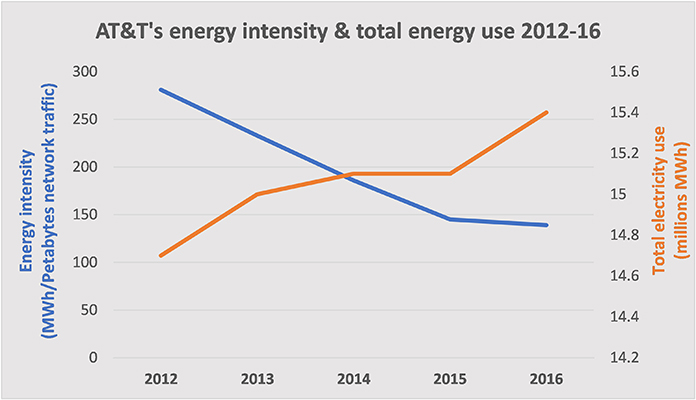 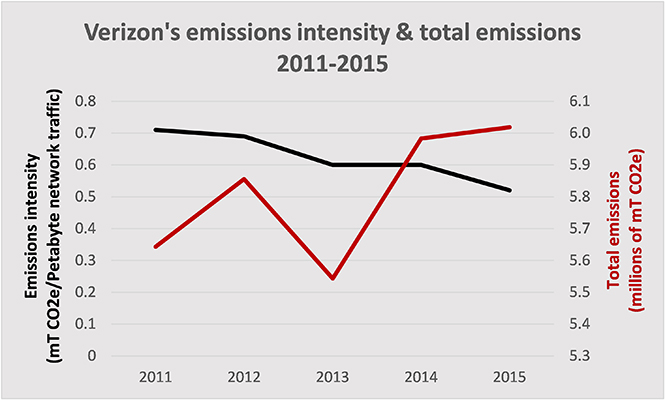 We are urging AT&T and Verizon to reduce their emissions, increase their use of clean energy and reduce their dependence on fossil fuels to power their network. Specifically, we ask that they:
- Publicly set greenhouse gas emissions reduction goals with a timeline to get there.
- Make a commitment to increase the amount of renewable energy powering their networks, with a goal of 100% clean energy by 2025, largely coming from solar and wind sources.
In January 2018, T-Mobile announced a commitment to 100% renewable energy by 2021, demonstrating that a rapid transition to renewable energy in the telecom industry is entirely possible.
Clean energy options are increasing ever year, in large part to satisfy the demands set by major corporations. There are 75,000 megawatts of wind power installed in the US, making up 5.4% of the power grid, with the projection to double by 2020, and reach 20% by 2030. Last year, a record of 14,000 megawatts of new solar were installed and 2018 will bring total US solar installations up to two million units. If major companies like Apple can achieve 100% renewable energy across all data centers, we know that AT&T and Verizon can do the same. T-Mobile, a direct competitor to AT&T and Verizon has made a commitment to purchase 100% of its electricity from renewable energy by 2021.
Some tech companies like Google and Apple committed to running on 100% renewables several years ago and are happy to flaunt their progress to the public. AT&T and Verizon are each other’s number one competitors in the US, and up until 2018 have shown a similar lack of commitment to renewables. In February 2018, AT&T took an important step forward by agreeing to purchase 520 MW of power from two wind farms in Oklahoma and Texas. Prior to T-mobile's announcement of 100% renewable energy by 2021, Sprint had been the leader in renewables. The company was awarded by Carbon Disclosure Project in 2015 for performance leadership. It has set goals to reduce GHG emissions by 20%, reduce electricity use by 20%, reduce GHG intensity by 75%. 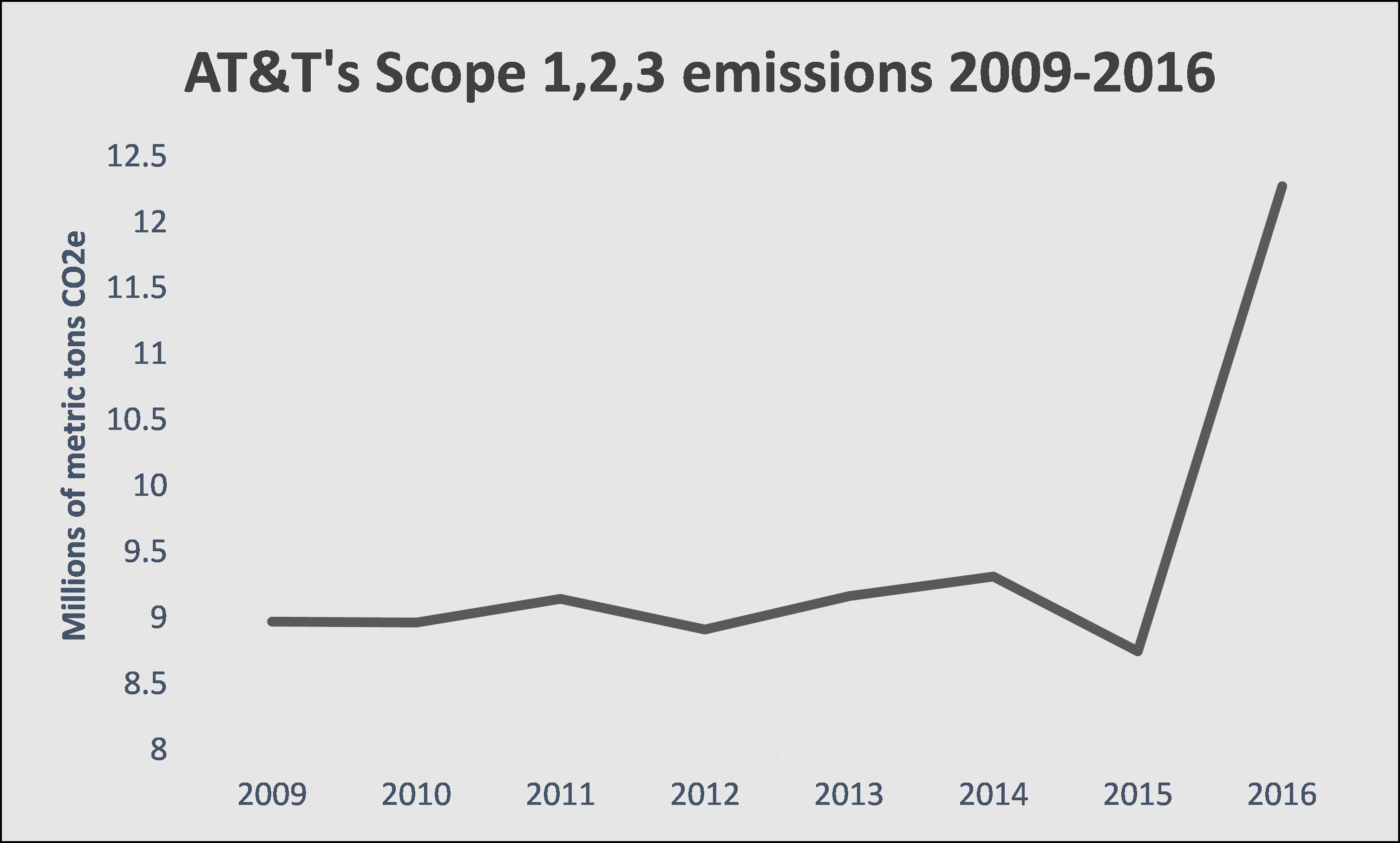 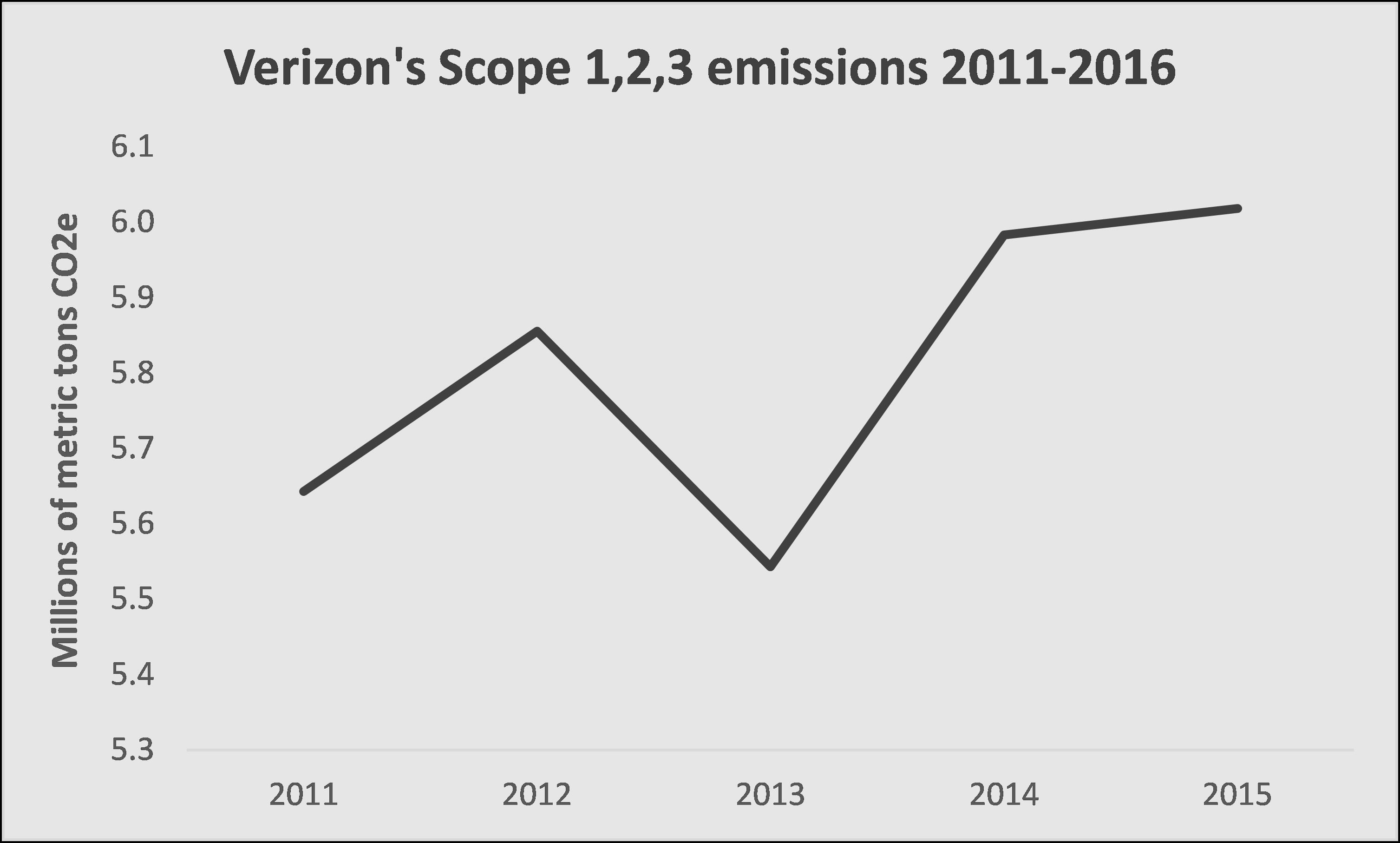 Thank you for wanting to take action on this important issue! Please call the CEOs’ offices at the numbers below. You can use the script below. We'd love to hear how your interaction goes, if you would like to provide a de-brief of your conversation to our campaign director, Beth Porter, at BPorter@greenamerica.org. AT&T: Contact CEO Randall Stephenson’s office at (210) 821-4105 Verizon: Contact CEO Lowell McAdam’s office at (212) 395-1000 “As a customer of [AT&T or Verizon] I expect your company to do its part to reduce climate emissions. I want to see your company adopt a goal of 100% renewable energy, from wind and solar, by 2025. Several large tech companies are already at 100% renewable power. Your company needs to be a leader in telecommunications. I appreciate that you have reduced energy intensity of your operations. Now, please move to 100% renewable power. Thank you.” The “Hang Up On Fossil Fuels” campaign is led by Green America, a not-for-profit membership organization founded in 1982. Green America’s mission is to harness economic power—the strength of consumers, investors, businesses, and the marketplace—to create a socially just and environmentally sustainable society.
|
|
TRUE TALE: How Robert Haley is going zero-waste at home, while working to make his zero-waste by 2020. |
When Robert Haley was a kid growing up in the ’60s, he collected Coke bottles for a nickel or dime.
Today, Haley is the Zero Waste Manager for the San Francisco Department of the Environment and he recycles a lot more than just bottles and cans. After working for both the nonprofit and for-profit sectors, Haley realized the government sector was where he could effect the most change.
“I work in this field because it feels good,” he says. “It’s part of my being, the way I want to live.”
In his job, Haley has helped develop a comprehensive recycling program for San Francisco with goals of 75 percent landfill diversion by 2010 and zero waste by 2020.
“It’s an ideal,” he says. “We may not ever get to 100 percent zero waste, but we’d like to get as close as possible.”
And while colored bins and progressive legislation push San Francisco residents to improve their waste management practices, Haley’s own recycling habits have become “almost an obsession,” he said.
“In my office, I don’t have a trash can,” notes Haley, who says he hasn’t thrown away so much as a staple in 13 years. He has a ten-pound ball of staples on his desk “the size of a grapefruit.” Haley and his partner Rachel recycle and compost about 99 percent of the waste that comes into their house.
The zero-waste lifestyle all begins with what he buys.
“I only like to food shop. Occasionally I have to buy clothes, but I really think about whether I need something, if it has toxics in it, and how it is packaged,” he says.
Haley resoles his shoes when they wear out and has become accustomed to telling people he doesn’t need a paper bag or napkin when they offer him one. At the cleaners, Haley takes off the bag from his clothes and hands it back right there.
“If I accumulate extra hangers, I take them back,” Haley says. “I don’t take any waste home.”
Amidst rising concerns about climate change, Haley says he sees the momentum picking up, but worries about whether there’s sufficient political will to catalyze change. Even so, he remains idealistic.
“You should try to do some good while you’re here, leave the world a little better,” he says. “I’m going to do whatever I can do.”
|
|
Concerns about Industrial Dairy Operations |
The dairy industry isn’t what it once was: bucolic imagery of red barns and a few cows roaming the grass-covered hills. The industry has become a thing of the past; more concerned with profit and efficiency than the cows themselves. Dairy production is located in only a few states with 86 percent of the milk supply produced on only 26 percent of the farms. While Dean Foods controls 40 percent of all fluid milk sales in the US, some of the largest producers of dairy worldwide are companies such as Nestlé and Kraft, known for their questionable ethics and concerning environmental practices. Due to consolidation, the majority of dairy cows are raised in large concentrated animal feeding operations (CAFOs) linked to issues of animal welfare and public and environmental health.
Animal Welfare
The modern cow’s diet is a direct result of the consolidation of the dairy industry and the CAFO lifestyle. When you drink a glass of milk there is a good chance that unbeknownst to you, you are consuming a product heavily reliant on genetically modified organisms (GMOs). Soy and corn are not only the top crops grown in the US, but they are also majorly genetically engineered (GE) with 90 percent of corn, 93 percent of soy, and 90 percent of cottonseed being GMO. These crops are turned into many hidden additives that result in 70% of processed foods containing GMOs, and are widely used in the dairy industry as feed. With such large numbers in a herd and no access to grazing, dairy cows consume a diet of mostly GE corn and soy. Currently over 35 percent of GE corn becomes animal feed. GE crops require numerous inputs such as herbicides, insecticides, and fertilizers, not to mention large quantities of water, making dairy feed an extremely resource-intensive crop. Cows were not intended to live on a diet of corn and soy; these feeding practices cause numerous severe health issues and digestive problems.
Organic milk is one step in the right direction, though it is not the end all be all. Organic ensures that dairy cows are not given any hormones or antibiotics, but does not ensure the quality of their living conditions and the diversity of their diets. An organic cow is not necessarily grass-fed and vice versa. The USDA definition of grass-fed is very limited and only refers to the type of feed given to cattle and has nothing to do with living conditions and antibiotic usage. Organic doesn’t always mean local or small producer either; many of the environmental issues associated with dairy are a result of consolidation and organic doesn’t remedy this problem. As described above, corporate dairy consolidation is a trend likely to continue.
When it comes to dairy cows there is one key thing to remember: in order for a cow to produce milk it must first produce a calf (usually through artificial insemination). Every year farm operators impregnate dairy cows so they can spend the year continually lactating and then start the cycle again. Throughout the process of impregnation and lactation, cows live in extremely crowded and unnatural conditions, such as standing on concrete floors surrounded by their own urine and feces, without access to pasture. Once industrial dairy cows have completed their 4-5 prime years of production they are culled from the herd and sold off as hamburger meat (despite the fact that a healthy cow can produce milk for 15-20 years). In industrialized dairy production, calves are seen more as a byproduct of milk production rather than as actual living beings. Immediately after birth they are taken from their mothers; and bull calves are either killed, sent to veal-producing facilities, or raised for hamburger. Therefore, the conventional dairy industry directly supports the production and consumption of conventional meat.
Public and Environmental Health
Factory farms pose a number of risks to both people and the environment. As a response to crowded and unsanitary living conditions, cows are often given daily doses of antibiotics via feed or injection to prevent the spread of disease and spur growth. The overuse of antibiotics for non-therapeutic purposes has resulted in the prevalence of a number of antibiotic-resistant (AR) bacteria. These “superbugs” can transfer from animals to humans through contact with animals, contact with infected meat, and the consumption of crops that have been fertilized with manure from feedlots. AR bacteria pose such a great risk due to their ability to horizontally transfer genes to other bacteria that factory farms serve as breeding grounds for life-threatening AR genes to enter the world. According to the Center for Disease Control’s (CDC) 2013 Threat Report on Antimicrobial Resistance, of the 2 million people who contact AR diseases each year, 23,000 of them result in death. A number of these infections and deaths could be prevented if animal agriculture did not use 80 percent of our antibiotics supply to compensate for poor living conditions.
In order to maintain and even increase the already high levels of milk production, dairy cows often receive hormones. The most common hormone is recombinant bovine growth hormone (rBGH), a genetically engineered synthetic hormone developed by Monsanto. This hormone results in increased cases of infections among the cows leading to a greater need for antibiotics. The EU and Canada prohibit the use of rBGH due to major human health concerns including a connection to various forms of cancer and its likely impacts on reproductive health. Savvy companies such as Chipotle have already transitioned to sourcing hormone-free dairy products, and it’s time that other companies follow suit.
Along with animal health risks from factory farms, this type of concentrated agriculture results in a number of unmeasured environmental externalities. A large number of cattle contained in one area, without access to pasture, creates vast amounts of consolidated animal waste and methane emissions. A report published by the CDC voices concerns over the environmental and health impacts of CAFOs (farms with 500 or more cows). Animals produce 3-20 times more waste that humans every year. Cattle manure and gases result in high levels of greenhouse gases, a drastic impact to ambient air quality and is a major contributor to climate change. Not only is dairy production extremely water intensive with producers using up to 150 gallons of water per cow per day, the waste can leach into ground and surface water polluting numerous ecosystems and water sources. Such environmental hazards pose a constant and direct risk to communities within a close vicinity to a facility. One region cannot contain the harmful impacts; therefore, ecosystems and communities far and wide are at risk.
Steps Toward Change
It is easy to lose sight of what milk really is and what it takes to produce it. By opening up the discussion on the impacts of the dairy industry, we are creating a space for conversation and change. Many dairies are incorporating organics and grass-fed principles and it is time they become the norm rather than the exception. How do we do this? Companies such as Dean Foods and Starbucks have massive purchasing power and require such large quantities of a product that they have the ability to create a tidal wave of change and drastically improve our food system. We need to hold them accountable. In 2014, Chobani announced three organic yogurt flavors coming soon, along with a commitment to work with farmers on transition strategies toward a GMO-free and organic milk supply and to explore what 21st century sustainable dairy operations can entail. When consumers band together by encouraging companies to set higher standards and make more ethical decisions in their supply chains, things begin to change.
|
|
What You Need to Know about Gene-Editing |
For the last few years, Green America has been working to educate consumers of the long-term implications and harm posed by genetic engineering (GE). Together we have made great strides in pushing companies to shift away from genetically modified organisms (GMOs) and towards organics.
But the biotechnology industry is at it again, this time with gene-edited crops. Gene-editing is an offshoot of genetic engineering, using more recently developed technology, such as CRISPR. This technology allows scientists to target specific traits and either remove or rearrange them.
Here's why this is concerning, and why it is definitely not the answer to fixing our conventional agriculture system.
Twenty years ago GE technology was promoted as the golden ticket that would increase yields, decrease pesticide usage, and all together promote a more sustainable and profitable system of agriculture. So far it has failed to live up to these promises. Gene-editing is being promoted in the same way.
Whether or not you believe the science of genetic engineering itself has merit, the system of agriculture that it promotes is extremely unsustainable and continues to be one of the largest contributors to climate change. With genetic engineering we have seen the mass propagation of monocropping and the overuse of pesticides and synthetic fertilizers. The mass use of gene-editing technology will further our dependence on these toxic chemicals. So far gene-editing companies are focused first on developing herbicide-resistant varieties, with some attention to drought. This is a similar development trajectory taken by those behind GE crops, and after 20 years we have yet to see any improvements in drought tolerance, water-use efficiency, or energy-use efficiency. Additionally, the crops engineered for herbicide-resistance resulted in the unfortunate and unintended creation of herbicide-resistant superbugs and superweeds.
Waiting to act to lessen the impacts of agriculture on climate change is not an option. In order to mitigate conventional agriculture’s negative impacts we need to be moving away from the idea of magical fixes. There are a number of changes that can be made right away that will make a huge difference, such as crop rotation, using composted material (manure and food waste), and cover cropping. All of these are a much better solution than waiting to see how gene-editing technology plays out over the next ten years.
There is still a great deal that scientists still do not understand when it comes to genomes and how they interact with one another, which raises serious concerns for the unintended consequences of gene-editing. So far the federal government has failed to see any sort of distinction between this technology and conventional breeding techniques and at this point has decided to allow it to go unregulated.
This technology is not limited to the editing of plant DNA. Gene-editing has huge ethical and moral implications as scientists around the world are working to see how this technique can be used on animals and humans. Scientists in China recently bred gene-edited monkeys and have made the first alterations to human embryos. Consumers and many scientists are calling for a ban on this technology until further research can be done and the ethical implications are weighed.
In reality, gene-editing is genetic engineering 2.0. If left unchecked it will sneak its way onto every grocery store shelf. In this area, a more precautionary approach is a must.
Gene-editing using CRISPR technology is already on the horizon for wheat, one of the world’s most important food crops. Sign the petition to stop the development of GE wheat, including by methods derived from gene-editing.
|
|
Add Socially Responsible Investing to Your Workplace's Retirement Plan |
Back to the Vote With Your Dollar Toolkit
A recent report by the Morgan Stanley Institute for Sustainable Investing found that 84% of individual investors – including 99% of GenZ and 97% of Millennials – are interested in sustainable investing. Yet many people have few to no climate-safe options in their retirement plan, which represents most people’s largest investment.
Our new free guide from Green America and Social(k) shows both employers and employees how to add more socially responsible fund options to their workplace retirement plan.
Plan for a Better Future explains:
- Why socially responsible retirement plans are a key part of the green economy.
- Why employers should offer responsible funds in their retirement benefits.
- Where both employers and employees can learn more about socially responsible investing.
DOWNLOAD THE GUIDE
The section for employers, written by Social(k), walks company leaders through how to start a retirement plan if they don’t already have one, how to add responsible options to an existing plan, and typical fee structures for both. Starting a responsible 401K plan is easier than ever and provides an employee benefit of lasting value.
10 Steps to a Responsible Retirement Plan
The section for employees, written by Green America, goes over how to bring socially responsible investment options to your company in 10 steps.
- Educate yourself about socially responsible investing.
- Identify co-workers who share your interest.
- Form a group to discuss your goals, needs, and questions.
- Evaluate the options in your employer’s current retirement plan.
- Schedule an introductory meeting with your HR person. Raise the issue, assess receptivity, and answer questions.
- Find data on responsible investing and identify potential fund options and plan advisors.
- Share what you’ve learned with your HR person and find out your employer’s decision-making process.
- Invite experts and advisors on socially responsible investing to speak to your employer as needed.
- If your employer is receptive, work with them on next steps to add responsible options to your retirement plan.
- If your employer is not immediately receptive, don’t give up. Continue to educate employees and find out when to bring it up again.
The Plan for a Better Future guide includes a sample employee questionnaire, a fact sheet on socially and environmentally responsible investing, and lots of resources for where to learn more.
DOWNLOAD THE GUIDE
By pursuing socially responsible investments:
- Employees can align their financial goals with their social and environmental priorities.
- Employers can align their benefits package with the values of their company/organization and their employees – and strengthen employee morale and retention by offering a more robust benefits package.
Download your FREE copy of Plan for a Better Future: How to Add Socially & Environmentally Responsible Investment Options to an Employer’s Retirement Plan.
Your investments make a difference for people and the planet! Socially responsible investing is key to a greener economy and cleaner finances.
Back to the Vote With Your Dollar Toolkit
|
|
Tell Carter's to End Toxic Textiles |
Carter’s is the nation’s largest baby and children clothing company and boasts that it sells 10 items of clothing for every kid born in the U.S. But, while Carter’s is a leader in sales, it is a laggard in disclosing which chemicals are in its clothing. That’s a big concern, because the textile industry uses thousands of chemicals, and many of them are toxic.
We're asking Carter's to adopt a strong, public chemical management policy that will protect workers and consumers, starting by disclosing what chemicals are being used in its supply chain. We also want Carter's to develop plans to restrict/replace the most toxic chemicals with safer alternatives, and we want Carter's to publicly report on its timeline and progress. Join us by calling on Carter’s via social media or phone!
The Problem with Carter's
In the apparel industry, there isn't widespread transparency on what chemicals are being used - nor their effects on human health and the environment. Workers work with these chemicals - and are not always provided with adequate safety protection, exposing them to increased risks of diseases. Over 8,000 chemicals are used to turn raw materials into textiles. Currently:
- Approximately 20% of industrial water pollution comes from textile manufacturing.
- Textile dyeing is the second largest polluter of water globally.
- The fashion industry alone emits 10% of global carbon emissions, more than all international flights and maritime shipping.
- 43 million tons of chemicals are used in textile production every year.
Meanwhile, rivers - that communities rely on - in manufacturing countries are heavily polluted, becoming so toxic that they cannot sustain wildlife. And once clothes hit our stores, residual chemicals can affect consumer health too. Odor-wicking, anti-wrinkle, flame resistant - our clothes are treated with chemicals to make them this way.
The Solution
Better and transparent chemical management policies! Workers should not be risking their lives to make our clothes. Environments and communities should not be polluted to satisfy our shopping needs. And clean clothes should be readily accessible to all consumers, not just those who can afford to pay a premium on clothing. That's why Green America is calling on major American apparel companies to clean up their act and remove Toxic Textiles from their supply chain.
Take Action
We're calling on companies, starting with Carter's, to adopt strong chemical management policies, starting by disclosing what chemicals they're using to make our clothes - and their plans for restricting and replacing the most toxic chemicals. To start, Carter's needs to adopt a strong public Manufacturer's Restricted Substances List (MRSL) to protect workers and communities and a Restricted Substances List (RSL) to protect consumers. And once that happens, we'll keep pushing them to continue adopting policies that protect workers, the environment, and consumers.
Send Carter’s the message that we need to know what toxic chemicals we are being exposed to on Twitter and Facebook:
Paste the below message in your Facebook status or on Twitter:
@Carters, you need to be transparent about toxic chemicals – share an RSL & MRSL with customers now! As a customer I want to #lovecarters, but you need to ditch #toxictextiles with @GreenAmerica today: https://www.greenamerica.org/2019-toxic-textiles-scorecard
Or contact Carter’s on Facebook Messenger.
Call the Customer Line
Call: 888-782-9548
*Once the menu is presented to you, press 4 to contact corporate customer affairs.
"Hello, my name is _______ and I'm a Carter’s customer. I am very concerned about the chemicals that Carter’s is exposing my child [or grandchildren, niece/nephew, or just children] and workers to. The toxic chemicals may have lasting, negative effects on not just children, but workers and their communities, and I deserve to know what is being used.
I am joining Green America in asking Carter’s to be transparent and disclose its restricted substances list and its manufacturing restricted substances list, if there is one. Carter's customers deserve to know what toxic chemicals may be in their children's clothes and what Carter's is doing to eliminate those toxins. Thank you and have a great day."
|
|
Toxic Textiles Report |
Sustainability: it’s not a word usually associated with the fashion industry, yet one that consumers are increasingly seeing more when we go shopping. But is sustainability just the next “trend” in fashion - or something that companies are actually moving towards?
Currently:
- Approximately 20% of industrial water pollution comes from textile manufacturing.
- Textile dyeing is the second largest polluter of water globally.
- The fashion industry alone emits 10% of global carbon emissions, more than all international flights and maritime shipping.
- 43 million tons of chemicals are used in textile production every year.
Green America's new report explores a variety of environmental and social challenges in the fashion industry in this report and looked at 14 major American apparel companies frequently found in shopping malls to see what, if anything, they are doing to address these issues in their supply chains. We reached out to companies with detailed surveys, read corporate social responsibility (CSR) reports when available, and reviewed corporate websites. Our partner, Fashion FWD, also contributed to this report.
Some of our key findings include:
• Large commitments without concrete plans, metrics, or timelines: Companies often say that they have a policy addressing an environmental or labor issue without going into detail about what they are doing to measure their progress or achieve their goal.
• Transparency is improving but mostly still lacking: four companies (Target, VF (which owns The North Face and Jansport), Nike, and Gap) identify chemicals used in their supply chains through a Manufacturing Restricted Substances List (MRSL), and an Restricted Substances List (RSL), while three companies (Ascena Retail, The Children’s Place, Urban Outfitters) rely on an RSL as their chemical management policy. An MRSL restricts chemicals used in the manufacturing process, while an RSL restricts what chemicals can be found in the final consumer product. Meanwhile, six companies (Target, VF, Nike, Gap, Ascena, Abercrombie & Fitch) list factories that they source from.
• Token sustainability initiatives and brands: Companies are increasingly incorporating sustainability efforts into their policies, but often will use one policy that addresses an issue in some detail or produce a line of clothes made a little more sustainably to demonstrate their commitment to sustainability when in reality, they are not addressing most issues in their supply chains.
• Leaders and laggards overall: While none of the major brands are true leaders in the field, Green America identified the following companies as having better environmental and labor practices – Target, VF, Nike -- and several companies that were clearly laggards – Carter’s, J.Crew, Forever 21.
Overall, we found that companies are starting to move in the right direction, but much more has to be done to fully address the scope of the environmental and social challenges in textile supply chains.
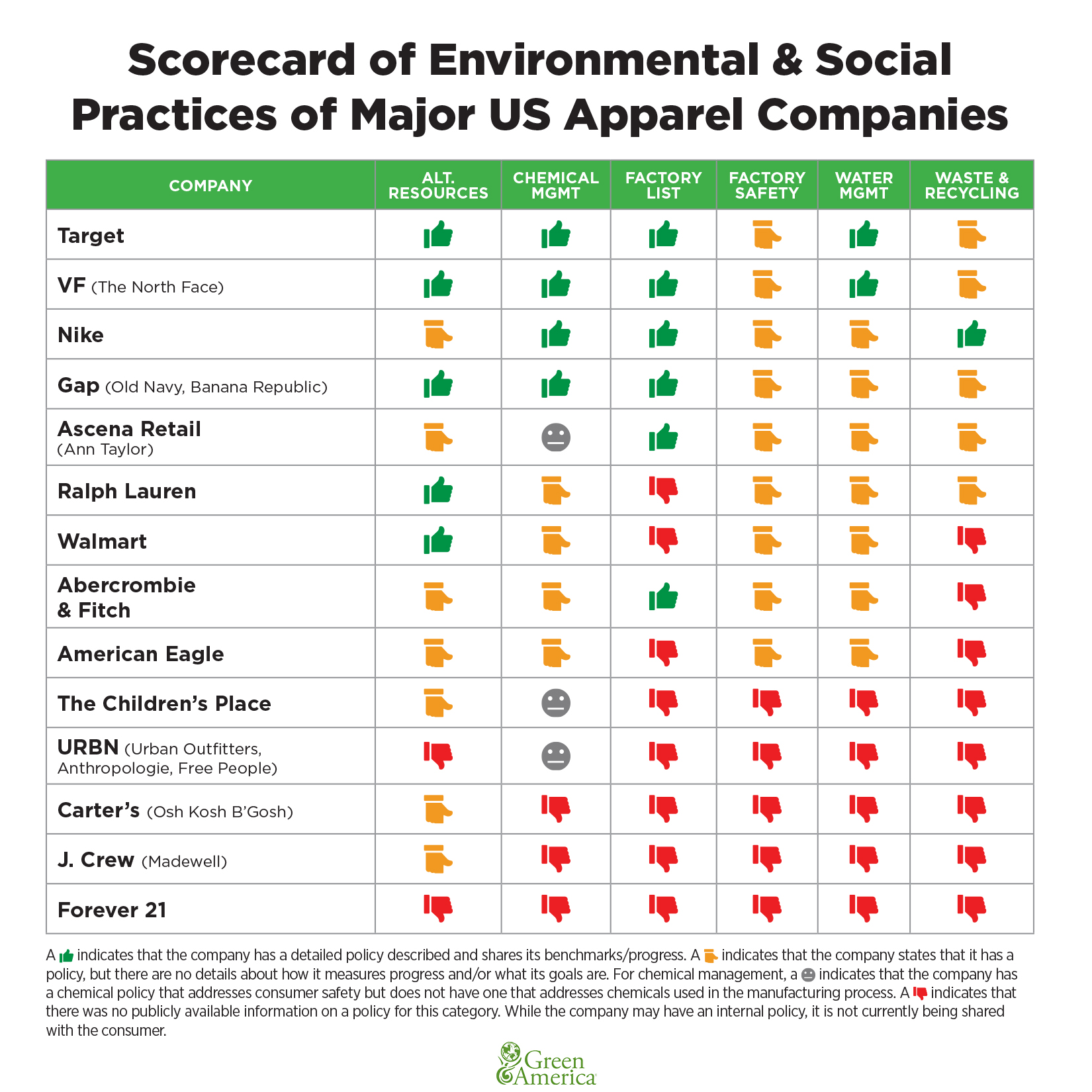
Read more about the scorecard here.
Consumer interest in reducing waste and consumption has led to increase in in-store recycling programs and the rise of the secondhand market. While the solutions are not always perfect, they are steps in the right direction.
When consumers want something, the markets listen – and we must continue to demand more of companies.
Read the full report Toxic Textiles. |
|
Supporting Local Business and Youth with Better Banking |
When you invest your money in community banks, you create enormous positive impacts in your community.
When you deposit money to a bank, it does not simply sit there. It goes to work in investments or loans that help the bank make money. Most banks don’t tell their customers what companies they invest in—it could be fossil fuels, agribusiness, anything.
New Resource Bank, which opened its doors in California’s Bay Area in 2006, provides loans primarily to socially responsible individuals and companies.
“We were founded with a very different triple-bottom-line mission to not only value profit, but [also] the environment and society. No one of those three is more important than any other,” says Stephanie Meade, the bank’s director of marketing and culture.
Initially, to get business off the ground—and to weather the 2008 financial crisis—it also granted loans to real estate-companies, small businesses, and individuals who didn’t necessarily share the bank’s mission.
However, as more and more socially responsible companies popped up and looked to responsible banks for funding, New Resource Bank hit its stride and began growing by 15 to 20 percent per year. The small bank that once had 14 employees and $40 million in assets is now celebrating its 10th anniversary, with 48 employees and over $300 million in assets. It just opened a loan office in Boulder, Colorado. (In 2018, New Resource Bank was acquired by Amalgamated Bank, which has committed to maintaining the bank's commitments to social and environmental responsibility.)
Today, 89 percent of its loans support sustainable businesses, nonprofits, green real estate, clean energy, and organic and natural products. Before receiving a loan, companies applying must fill out an impact assessment, including their mission and values.
“We believe that companies that are socially and environmentally responsible are better companies, are stronger companies, and hopefully will be more profitable and less risky companies,” says Meade.
One of the many success stories that New Resource Bank has supported through loans and advising since 2014 is Old Skool Café, a nonprofit jazz-themed supper club started by a former juvenile corrections officer. The restaurant trains and employs at-risk youth ages 16-22 in its San Francisco location. The young people learn to run events, the kitchen, dinner service, and musical performances.
The café’s founder, Teresa Goines, came up with the idea after the gang-prevention group she ran lost its funding. She funded Old Skool herself for six years but cashed out her retirement, savings, and inheritance to do so. With financial assistance from
an ongoing community grant, she could afford to rent a space for the restaurant from a church. But when the space went up for sale, she only had funding for about half of the $550,000 purchase price. A friend referred Goines to New Resource Bank, and she was able to secure a real-estate loan for the rest of the money.
“We love what [Old Skool does],” says Skyler Webster, the New Resource banker who works with the café. “They’re right here in the community, and they’re giving at-risk youth a real path.”
But New Resource isn’t just trying to “preach to the choir,” as Meade puts it. The bank will work with companies all over the spectrum of social and environmental commitment, so all can grow into green champions. The bank offers free events, online resources, and networking opportunities for clients to improve as sustainable businesses. Every year, borrowers retake the assessment to gauge their progress.
Individual account-holders have to be in California. New Resource will work with companies from around the country who need loans, or individuals across the US who are looking to open an impact CD, in which the money you invest is loaned out to high-impact nonprofits, organic- and natural-product companies, and clean-energy companies while you earn interest.
Wherever you live, Meade thinks it’s important to find a bank that shares your values. “I just encourage people to make sure their values line up in all aspects of their lives, not just in certain ones, like buying organic food,” says Meade. “Where you bank actually reflects your values in a lot stronger of a way than you’d think it would, because finance and banking is the foundation of our economy. Banks determine what businesses get funding to grow and thrive.”
|
|
What You Can Do to End Sweatshops |
Through the purchases you make, and those you choose to avoid, you have the power to create an economy where child labor and sweatshops cease to exist. And your voice, together with the voices of others, can help encourage companies here and abroad to ensure that all workers are paid fairly and treated with respect.
By taking one or more of the steps outlined below, you can make a real difference to end sweatshops.
1. Demand sweatshop-free products where you shop
Ask companies you do business with to ensure that no sweatshop or forced child labor is used in the manufacturing of the products they sell. The next time you go shopping for clothes, shoes, or household items, take a minute to fill out a customer comment card and ask the company to work with their suppliers to make sure that workers are paid a living wage and treated fairly. Or visit the company's web site and send a message online.
Check out the apparel category in our Sweat-Free Guide.
2. Buy union-made, local, and secondhand
For clothing and household items, check out your local secondhand or consignment stores. When buying new clothing, look for the union label on the clothing you buy, or make your purchases from the socially responsible businesses listed in on GreenPages.org.
3. Buy Fair Trade
Fair Trade is an economic system that ensures healthy working conditions, self-determination, and fair wages for workers. When you purchase Fair Trade products, you help ensure a sustainable livelihood for farmers and workers. Look for coffee, tea, chocolate/cocoa, bananas, mangoes, pineapples and other fresh fruit bearing the Fair Trade Certified™ label. If your supermarket or local health food store doesn't stock fair trade products, ask them to do so and explain why. At restaurants, suggest the addition of Fair Trade Certified™ coffee and tea to the menu. Also Fair Trade Certified sugar is now available as well.
You can also buy crafts, clothing, jewelry, and other household and gift items from companies that belong to the Fair Trade Federation (FTF).
FTF members are also members of Green America's Green Business Network™ and are listed on GreenPages.org.
Learn more about fair trade.
4. Ask questions
If you are unsure about whether or not a company is working to transform the factories that make their products into places where people are paid a living wage and treated fairly, then ask.
Use our "Consumer Checklist" below to help you write a letter or send an email to a company asking about their sourcing practices. If the company does not have good answers for these questions, it is not doing enough to stop sweatshops.
- Does your store know how the workers who made this product were treated?
- Do you have a list of all the factories around the world that make your products? Does it include the wages and working conditions in each factory? Can you provide me with a copy of it?
- Does your store guarantee that the workers who made this product were paid a living wage, enough to support their families?
- Does your store have a code of conduct that protects human rights and forbids child labor and unsafe conditions in all the factories that make the products you sell? How do you enforce these rules? Are your factories monitored by independent, third-party sources?
- Are you providing development programs in the communities where your workers live? Are you working with others in your industry to apply meaningful labels so consumers can know that exploited labor was not used to make your product?
5. Mobilize at your workplace, school, or in your community
Encourage local businesses to source sweatshop-free products. Work with your coworkers to ensure that the company t-shirts are sweat-free. Work with members of your faith community to develop a sweatshop-free purchasing policy. If you are a student or affiliated with a university, demand that your institution buy items such as uniforms, sporting equipment, and other goods from companies that monitor conditions along the supply chain and guard against employee abuse at all stages of production.
Get a free copy of Green America's Guide to Ending Sweatshops to help you with your efforts. Bulk pricing is available. Call (800) 584-7336 or email info@greenamerica.org to order.
6. Use shareholder clout to end sweatshops
If you own stock in individual companies, check the proxy ballots that you get in the mail and be sure to vote in support of any shareholder resolutions that require the company to improve its labor policies.
Also, if you put money into mutual funds, your investments can still work to improve the way companies treat their employees. Some mutual funds refuse to invest in companies that demonstrate indifference to workers' welfare, while others engage in the practice of shareholder action to get companies in which they invest to improve their labor practices. Over the past few years, mutual funds such as Calvert and Domini Social Investments have been working to get companies such as Dillard's and Wal-Mart to adopt policies designed to ensure that their products aren't being made under sweatshop conditions.
To find a mutual fund that screens out companies with bad labor practices or engages in shareholder advocacy, consult the financial planning section of Green America's Green Pages.org. You can also order a copy of Green America's Guide to Shareholder Action for a small fee. Call 1-800-58-GREEN.
Learn more about shareholder action.
7. Educate Others
Let the people around you know what they can do to put an end to sweatshops. Send an email to your friends letting them know about this online resource.
One way to spread the word is by giving your friends and family gift memberships to Green America. They'll receive a free copy of the GreenPages.org with their membership to help put them on the road to sweatshop-free purchasing.
Learn how you can find sweatshop-free and fair trade products.
|
|
Key Shareholder Resolutions to Vote in 2025 |
Fewer ESG resolutions in 2025
The 2025 shareholder resolution season was scaled back from previous years. Shareholders filed 355 environmental, social, and governance proposals as of February 21, 2025 – 34% less than the 536 such proposals in 2024.
Why was the number of shareholder resolutions down this year?
- Shareholders who filed resolutions in previous years decided not to file this year until they could assess the direction of the new Securities and Exchange Commission (SEC).
- The change in presidential administration has dramatically shifted policy at the SEC, which is excluding many more proposals now than in previous years.
- More companies engaged in dialogue with shareholders to avoid the need to vote on resolutions that could draw attention given the current political attacks on DEI and climate.
Still, there were many important shareholder resolutions to vote on in 2025, including:
- 85 proposals that address climate change
- 77 proposals on corporate political influence
- 52 proposals on environmental management
- 37 proposals on human rights
- 36 proposals on diversity at work
If you own company stock directly (not in a mutual fund), we urge you to vote your values on the company's resolutions.
Below you will find a list of 2025 shareholder resolutions as of February 21, grouped by company name and by issue.
Read your proxy ballots carefully and cast your votes to reflect your values. Here are quick tips on how to read a proxy ballot.
By Company
Issues Structure
Resolutions By Issue
New this year is a list of anti-ESG resolutions that attack corporate progress on diversity, human rights and other important social issues. The number of anti-ESG resolutions continues to climb, this year accounting for 14.7% of all proposals.
Please note that each company's proxy ballot may not exactly match the shareholder resolutions we list here. This list is based on Proxy Preview, which is published in March. Often companies challenge shareholder resolutions at the SEC, or a resolution may be withdrawn by its sponsor. If that occurs after Proxy Preview goes to print, you may not see that resolution listed on the company's proxy ballot.
Definitions
Here are definitions of key abbreviations and terms you’ll see in our short descriptions of the shareholder resolutions:
- Net-zero GHG emissions = “net zero means cutting greenhouse gas [GHG] emissions to as close to zero as possible, with any remaining emissions re-absorbed from the atmosphere, by oceans and forests for instance” – United Nations
- Scope 3 = “….emissions a company is responsible for outside of its own walls—from the goods it purchases to the disposal of the products it sells? In fact, the majority of total corporate emissions come from Scope 3 sources,…” Greenhouse Gas Protocol
As a share owner, you are a part owner of the company, and voting your proxy is an important responsibility.
Learn about your shareholder rights! Shareholder Proposals: An Essential Investor Right, by the Shareholder Rights Group, Interfaith Center on Corporate Responsibility and US SIF, catalogues the role of shareholder resolutions in creating a powerful platform for challenging and improving corporate policies, practices, performance and impacts, and in surfacing investor perspectives on material issues.
Thank you for voting your values! Post this “I'm voting” badge on social media and let people know you're proud to raise your voice on important issues as a shareholder. Click to share to Facebook or Twitter.

Green America is not an investment adviser nor do we provide financial planning, legal, or tax advice. Nothing in our communications or materials shall constitute or be construed as an offering of financial instruments or as investment advice or investment recommendations.
|
|
10 Cons of Nuclear Energy |
There is a new glow for nuclear energy. With the growing energy needs of artificial intelligence, major tech companies like Microsoft, Google, and Amazon are looking to nuclear energy – including everything from re-opening Three 3-mile island to building smaller nuclear plants around the country – to provide low-carbon energy. But nuclear fission power is not a climate solution. It may produce lower-carbon energy, but this energy still comes with a great deal of risk.
Solar power, wind power, geothermal power, and aggressive energy efficiency are climate solutions that are safer, cheaper, faster, more secure, and less wasteful than nuclear energy. Our country needs a massive influx of investment in these solutions if we are to avoid the worst consequences of climate change, enjoy energy security, jump-start our economy, create jobs, and work to lead the world in development of clean energy.
Here are 10 reasons why nuclear energy is a bad idea:
1. Nuclear waste:
The waste generated by nuclear reactors remains radioactive for hundreds of thousands of years and needs to be kept contained for one million years. Currently, there are no long-term storage solutions for radioactive waste, and most is stored in temporary, above-ground facilities. These facilities are running out of storage space, so the nuclear industry is turning to other types of storage that are more costly and potentially less safe.
2. Nuclear proliferation:
There is great concern that the development of nuclear energy programs increases the likelihood of proliferation of nuclear weapons. As nuclear fuel and technologies become globally available, the risk of these technologies falling into the wrong hands is increasingly present. To avoid weapons proliferation, it is important that countries with high levels of corruption and instability be discouraged from creating nuclear programs, and the US should be a leader in nonproliferation by not pushing for more nuclear power at home.
3. National security
Nuclear power plants are a potential target for terrorist operations. An attack could cause major explosions, putting population centers at risk, as well as ejecting dangerous radioactive material into the atmosphere and surrounding region. Nuclear research facilities, uranium enrichment plants, and uranium mines are also potentially at risk for attacks that could cause widespread contamination with radioactive material.
4. Accidents
In addition to the risks posed by terrorist attacks, human error and natural disasters can lead to dangerous and costly accidents. The 1986 Chernobyl disaster in Ukraine led to the deaths of 30 employees in the initial explosion and caused a variety of negative health effects on thousands of people across Russia and Eastern Europe. A massive tsunami bypassed the safety mechanisms of power plants in Fukushima Japan in 2011, causing three nuclear meltdowns, resulting in the release of radioactive materials into the surrounding area. In both disasters, hundreds of thousands were relocated, millions of dollars spent, and the radiation-related deaths are being evaluated to this day. Cancer rates among populations living in proximity to Chernobyl, especially among children, rose significantly in the years after the accidents.
5. Impacts on Local Communities and Ecosystems
Nuclear power plants, which use enormous amounts of water as a coolant, increase the temperatures of local water bodies, which can harm local ecosystems and kill aquatic wildlife. Also, with climate change creating increasing water shortages, nuclear power plants are at risk of temporary shut downs since without water they can’t be cooled. In addition to the significant risk of cancer associated with fallout from nuclear disasters, studies also show increased risk for those who reside near a nuclear power plant, especially for childhood cancers such as leukemia. Workers in the nuclear industry are also exposed to higher-than-normal levels of radiation, and as a result are at a higher risk of death from cancer.
6. Energy production
The 440 nuclear power plants currently in existence provide about 9% of the world’s energy. Studies show that in order to meet current and future energy needs, the nuclear sector would have to scale up to around 14,500 plants. Uranium, the fuel for nuclear reactors, is energy-intensive to mine, and deposits discovered in the future are likely to be harder to get to. As a result, much of the net energy created would be offset by the energy input required to build and decommission plants and to mine and process uranium ore.
7. Not enough sites
Scaling up to 14,500 nuclear plants isn’t possible simply due to the limitation of feasible sites. Nuclear plants need to be located near a source of water for cooling, and there aren’t enough locations in the world that are safe from droughts, flooding, hurricanes, earthquakes, or other potential disasters that could trigger a nuclear accident. The increase in extreme weather events predicted by climate models only compounds this risk.
8. Cost
Unlike renewables, which are now the cheapest energy sources, nuclear costs are on the rise, and many plants are being shut down or in danger of being shut down for economic reasons. Initial capital costs, fuel, and maintenance costs are much higher for nuclear plants than wind and solar, and nuclear projects tend to suffer cost overruns and construction delays. For example, the recently constructed Vogtle nuclear plants in Georgia came online 7 years late and $17 billion over budget. The price of renewable energy has fallen significantly over the past decade, and it is projected to continue to fall.
9. Competition with renewables
Investment in nuclear plants, security, mining infrastructure, etc. draws funding away from investment in cleaner sources such as wind, solar, and geothermal. Financing for renewable energy is relatively scarce, as compared to fossil fuels, and threatened by political headwinds, and increasing nuclear capacity will only add to the competition for funding.
10. Energy dependence of poor countries
Going down the nuclear route would mean that poor countries, that don't have the financial resources to invest in and develop nuclear power, would become reliant on rich, technologically advanced nations. Alternatively, poor nations without experience in the building and maintaining of nuclear plants may decide to build them anyway. Countries with a history of nuclear power use have learned the importance of regulation, oversight, and investment in safety when it comes to nuclear. Dr. Peter Bradford of Vermont Law, a former member of the US Nuclear Regulatory Commission, writes, "A world more reliant on nuclear power would involve many plants in countries that have little experience with nuclear energy, no regulatory background in the field and some questionable records on quality control, safety and corruption." The U.S. should lead by example and encourage poor countries to invest in safe renewable energy technology.
Conclusion
Nuclear energy is not the answer to the climate crisis. Energy efficiency, solar and wind power are the real climate solutions.
Ready to take action? Demand corporations rapidly scale up the use of renewable energy that advances energy justice in the US and abroad.
|
|
Nuclear Power is Not a Climate Solution |
This piece first appeared on August 22, 2020 in the publication New Labor Forum.
The climate crisis is the greatest challenge facing the world today. The Intergovernmental Panel on Climate Change (IPCC) has warned us that to keep global warming to 1.5 degrees Celsius, we need to reduce emissions by 45 percent from 2010 levels by 2030 and reach net zero emissions by 2050. Proponents of nuclear power as a climate solution, including Gary S. Was and Todd R. Allen, authors of “The importance of nuclear energy in our future energy mix,” highlight the fact that nuclear reactors do not emit greenhouse gasses during operation while providing baseload generation. Nuclear, wind, and solar power all have significant and comparably lower lifecycle greenhouse gas (GHG) emissions than coal and natural gas plants.[i] However, the proponents of nuclear power, such as Was and Allen, and billionaire Bill Gates, are overlooking the significant risks inherent in the technology and the fact that scaling up nuclear power would take too long and is too costly to be an effective climate solution.
Instead, we need to scale up renewable energy technologies like wind and solar to increase zero-carbon generation, while accelerating energy efficiency and storage technologies nationwide. Together, these solutions will provide consistent power and address baseload capacity traditionally provided by coal and nuclear plants.
Nuclear Power is Inherently Risky
Was and Allen argue that nuclear power is safe, and even good for your health. However, the significant risks inherent in nuclear power are well-documented, understood by the general public who are justifiably wary of the technology, and can be avoided by shifting power generation rapidly to renewable energy instead.
The Intergovernmental Panel on Climate Change (IPCC) summarizes the risks of nuclear power well: ‘‘Barriers to and risks associated with an increasing use of nuclear energy include operational risks and the associated safety concerns, uranium mining risks, financial and regulatory risks, unresolved waste management issues, nuclear weapons proliferation concerns, and adverse public opinion.’’[ii] Collectively these risks make nuclear power a non-starter for addressing climate change.
Nuclear power plants rely on radioactive uranium for fuel. Uranium mining is inherently risky and produces radon emissions and soil and water pollution. Uranium mining frequently occurs in areas where Indigenous peoples live and in sensitive ecological areas. The largest release of radioactive materials in U.S. history occurred in the Church Rock mines in New Mexico in 1979. Over 1,100 tons of solid radioactive mill waste and 93 millions of gallons of radioactive tailings contaminated 80 miles of riverbed of the Puerco River, deeply impacting the Navajo Nation.[iii] Despite this history, the Trump Administration is currently working to expand the mining of uranium, potentially putting the Grand Canyon and American Indian tribes at great risk.
Nuclear power plants pose potentially catastrophic risks during operation. The accidents and catastrophes at Three Mile Island, Chernobyl, and Fukushima highlight the inherent risks of nuclear power, and scientists have estimated the likelihood of another Fukushima-like event to be 50 percent within 60-150 years, with smaller accidents occurring every year.[iv] In The U.S., the current fleet of reactors is aging, and the Nuclear Regulatory Commission (NRC) is often extending the licenses of plants for an additional 20 years, even though an extensive report by the Associated Press of NRC records found that the agency colludes with industry to weaken regulations and ignore significant risks from cracked concrete, leaking valves, and corrosion at aging plants.[v]
Spent nuclear fuel poses a long-term risk as well. Some of this waste can remain radioactive for tens of thousands of years, posing risks to future generations, including risks of weaponization and proliferation. The common consensus is that nuclear waste is most safely stored in deep geological burials, but no country has yet done this for civilian reactor waste. In the United States, the proposed Yucca Mountain repository has been actively opposed by residents and legislators from Nevada and delayed for years, and the Trump Administration is now opposed to it, resulting in ongoing riskier temporary storage in 35 states nationwide.
As a result of these risks, nuclear power faces significant opposition from the U.S. public, while renewable energy is widely supported, which makes the path forward for renewables much easier. Opinion polls demonstrate that 51 percent of the public opposes nuclear power, with 21 percent strongly opposing it,[vi] compared to 92 percent support for solar and 85 percent for wind.[vii]
Nuclear Power is Too Expensive and Too Slow to Scale
Was and Allen argue that nuclear power is the most reliable and cost-effective source of baseload generation. They are ignoring the major delays and cost overruns of nuclear power plant construction in the United States and abroad that make it clear that scaling up nuclear power to address the climate crisis is simply not cost effective or timely.
In the mid-2000s, as United States utilities planned to construct new nuclear power plants, construction costs were already soaring to $5,500 to $8,500/Kw or $6-$9 billion per unit.[viii]
The actual cost of construction is even higher. Two nuclear plants were pursued in South Carolina and two in Georgia, each utilizing the Westinghouse AP1000 design. The South Carolina plants were abandoned due to construction delays and cost overruns, and are the subject of a U.S. Securities and Exchange Commission lawsuit alleging investors were defrauded after $9 billion was spent.[ix] The Georgia plants are still under construction, but five years behind schedule, and experiencing significant cost overruns. Originally budgeted at $14 billion, they are now projected to cost over $28 billion.[x]
Delays and cost overruns are not limited to plants in the U.S. alone. Several nuclear reactors are years behind schedule in Europe as well, including the Hinckey Point-C plant in the UK, a plant in Flamanville France that is eight years behind schedule, and the Olkiluoto lll plant in Finland, which is 11 years behind schedule.[xi] Extensive delays have resulted in significant cost overruns throughout the history of nuclear plants worldwide, on average nearly 20 percent.[xii] Significantly, the construction of nuclear power plants today costs 60 percent more than earlier generations of reactors,[xiii] at a time when the cost of wind and solar technologies are rapidly declining.
Proponents of nuclear power state that advanced reactors, including new, smaller modular reactors, will solve the cost issues, since they can be built in factories and do not require the same active safety systems as current reactors. But modular reactors are not ready for construction, their safety systems are not foolproof, and they will need substantial government subsidies.
The Secretary of Energy Advisory Board concluded in 2016, “there is no shortcut to reestablish a vigorous U.S. nuclear power initiative that could be a major source of carbon-free generation”, and found that new technologies could take 25 years and nearly $12 billion to develop.”[xiv] Notably, the commission was looking at “the capability to deploy new nuclear power plants at scale, at the rate of 3 to 5 gigawatts electric (GWe) per year, in the time period 2030–2050.” That extended time frame means nuclear power will not be able to scale up rapidly enough to help us avoid the worst impacts of climate change.
Efficiency and Renewables are the Way Forward
Pursuing new current-generation nuclear plants or advanced nuclear energy technology is a dead-end, and more importantly, would take resources away from scaling up the proven technologies of solar, wind, storage, and energy efficiency that are already paving the way to zero-emitting energy generation. As we scale renewables up, we can retire coal, natural gas, and nuclear plants.
As the IPCC states, in its special report on climate: “The political, economic, social and technical feasibility of solar energy, wind energy and electricity storage technologies has improved dramatically over the past few years, while that of nuclear energy and carbon dioxide capture and storage (CCS) in the electricity sector have not shown similar improvements.”[xv]
The IPCC is understating the case for renewables. Moving to 100 percent renewable energy worldwide is entirely possible. Researchers at Stanford University mapped a transition to 80 percent renewables (wind, hydro, geothermal, and solar) by 2030 and 100 percent by 2050 for 139 countries worldwide. The transition is technically and economically feasible, would meet the goal of keeping global warming to 1.5 degrees Celsius, would require no new hydropower, and would create 24 million net new jobs worldwide. It would also require a maximum of only .22 percent of new land across the countries, with significant solar going on rooftops and onshore wind integrating with other land uses.[xvi]
In the United States, as the cost of wind and solar energy plummeted, electricity from renewable energy doubled between 2008 and 2019, with 90 percent of new renewable capacity coming from wind and solar. [xvii] Renewable energy now provides nearly 20 percent of U.S. energy generation,[xviii] generated more power than coal in April 2020,[xix] and is rapidly increasing to 76 percent of new energy generation in the U.S. as utilities choose renewables solely based on cost.[xx]
To ensure wind and solar can provide consistent power and meet baseload generation as fossil fuels and nuclear plants phase down, energy storage technologies and installations are proliferating. Two new projects demonstrate the potential. Southern California Edison will bring 770 MW of battery storage facilities online in California in 2021, and a 409 MW storage facility will go online in 2021 in Florida as well.[xxi] A typical coal-fired power plant generates 600 MW, so these storage facilities are game changers.
And, to reduce the need for baseload power, the United States could gain considerably from increases in energy efficiency. A McKinsey and Company report found that fully deploying residential, commercial, and industrial energy efficiency measures in the United States could cut energy use by 23 percent nationwide and save $1 trillion.[xxii]
Renewable energy and energy efficiency are also major job creators. As of 2019, nearly 350,000 Americans were employed in solar energy, nearly 115,000 in wind, and 84,000 in storage, compared to 61,000 in nuclear. There are already nearly 2.4 million jobs in energy efficiency as well. Notably, until the novel coronavirus outbreak, wind, solar, storage, and energy efficiency jobs were increasing, while nuclear experienced job losses.[xxiii]
We don’t have time to lose. With the novel caronavirus wreaking havoc on the broader economy, and at least 35 million jobs lost, including tens of thousands of clean energy jobs, now is the time for the federal government to fully invest in a Green New Deal, and keep truly clean energy growing. Doing so would create several million green jobs, including in the growing renewable energy, storage, and energy efficiency sectors. It would also put the U.S. on a pathway to 80 percent renewables by 2030 and 100 percent by 2050, helping ensure our country is doing its part to keep global warming to 1.5 degrees Celsius or less
Please also see Green America's 10 Reasons to Oppose Nuclear Power.
[ii] Intergovernmental Panel on Climate Change (IPCC), T. Bruckner et al. “Energy Systems” in Climate Change 2014: Mitigation of Climate Change. Contribution of Working Group III to the Fifth Assessment Report of the Intergovernmental Panel on Climate Change (2014); O. Edenhofer et al., eds., Cambridge University Press, 70, 517.
[iii] Marley Shebala, “Poison in the earth: 1979 Church Rock spill a symbol for uranium dangers,” Navajo Times, July 23, 2009.
[iv] Spencer Wheatley et al. “Reassessing the safety of nuclear power.” Energy Research & Social Science Vol. 15 (May 2016): 99.
[v] Jeff Donn, “US Nuke Regulators Weaken Safety Rules,” Associated Press, June 20, 2011.
[vi] “US public opinion evenly split on nuclear,” World Nuclear News, April 1, 2019.
[vii] John Weaver, “92% of Americans want moAR solar power, greater than any other action Pew Research says,” PV Magazine, November 26, 2019.
[viii] David Schlissel and Bruce Biewald, “Nuclear Power Plant Construction Costs,” Synapse Energy Economics, July 2008: 2.
[ix] Andrew Brown, “Dominion close to settling case with securities regulators over SC nuclear project,” The Post and Courier, May 8, 2020.
[xi] Peter Reina, “New Delays Hit Europe's Nuclear Power Projects” Energy News-Record, September 27, 2019.
[xiii] J. Portugal-Pereiraab, P. Ferreirac, J.Cunhac, A. Szkloa, R.Schaeffera, M.Araújoc “Better late than never, but never late is better: Risk assessment of nuclear power construction projects,” Energy Policy 120, (September 2018): 158-166.
[xiv] U.S. Department of Energy, Secretary of Energy Advisory Board Report of the Task Force on the Future of Nuclear Power, (Washington D.C. September 22, 2016): 1.
[xv] Intergovernmental Panel on Climate Change (IPCC), H. de Coninck et al.: “Strengthening and Implementing the Global Response” in Global Warming of 1.5°C. An IPCC Special (2018Chapter 4, 315.
[xvi] Mark Z. Jacobson et al. “100% Clean and Renewable Wind, Water, and Sunlight All-Sector Energy Roadmaps for 139 Countries of the World.” Joule 1 (2017): 108–121.
[xvii] Cara Marcy, “U.S. renewable electricity generation has doubled since 2008,” Today in Energy, U.S. Energy Information Administration (blog), March 19, 2019.
[xix] Jason Murdock, America’s Renewable Energy Sources Have Produced More Electricity Than Coal Every Day for 40 Days Straight,” Newsweek, May 5, 2020.
[xx] Silvio Marcacci, “Renewable Energy Prices Hit Record Lows: How Can Utilities Benefit From Unstoppable Solar And Wind?,” Forbes, Jan 21, 2020.
[xxii] Jon Creyts, Hannah Choi Granade, and Kenneth J. Ostrowski, “US energy savings: Opportunities and challenges,” McKinsey & Company Website, January 1, 2010. .
[xxiii] National Association of State Energy Officials and Energy Futures Initiative, 2020 U.S. Energy &
Employment Report: 56,60,75,121,124.
|
|
Antibiotics in the Dairy Industry: What You Need to Know |
Long gone are the small-scale family farms that provide dairy to local cheese producers and families. This is the era of industrialized agriculture and concentrated animal feeding operations (CAFOs). One of the many dirty secrets of the dairy industry is the use of antibiotics. CAFO operators use antibiotics to make up for the concentrated confinement of animals, unsanitary living conditions, and the use of hormones.
Using antibiotics for non-therapeutic purposes, any use of antibiotics in food animals without disease or documented disease exposure, has led to the development of antibiotic resistant (AR) bacteria, which have infiltrated our food system and pose a major risk to human health. According to the Center for Disease Control (CDC) 22 percent of AR infections originate from foodborne pathogens. This was never an unexpected outcome, in fact in his 1952 Nobel Peace Prize acceptance speech Alexander Flemming warned of the creation of superbugs from the misuse of antibiotics, a warning we ignored. The big question is what happens when even our strongest antibiotics no longer win out against the toughest bacteria?
Antibiotic Use in the Dairy Industry
Following the “get big or get out” mantra from policy leaders, the agricultural industry adopted heavy use of antibiotics. The most common non-therapeutic uses of antibiotics are for prevention of disease and growth promotion. Of the 29 million pounds of antibiotics used each year 80 percent goes to livestock. Entire herds or flocks are continually given low doses of antibiotics in their feed or water to prevent disease and promote growth, two things that would happen naturally if animals had more natural living conditions and access to pasture.
CAFOs (or factory farms) are large-scale animal housing operations that raise a large number of animals, most commonly cattle, chickens, and pigs. These facilities focus on efficiency, measured by how quickly the operator can raise an animal and send it to market for slaughter. As a result, animals live in extremely crowded conditions with little to no access to the outdoors. These conditions increase animal stress and poor hygiene, which increase pathogen development and decrease growth. With so many animals concentrated in one area there is a vast amount of manure creating the perfect home for the proliferation of bacteria. A 2014 study published in the Proceedings of the National Academy of Sciences highlights the connection between non-therapeutic antibiotic use in animals and an increase in bacteria populations. These situations increase the potential for infections such as environmental mastitis, an udder infection in dairy cows that is caused from environmental conditions rather than a traditional bacterial infection.
The Dangers of Antibiotic Resistance
The threat of AR to human health starts at the farm and follows the food chain all the way to your dinner plate. Farms serve are as hotspots for AR; in fact anyone who lives near CAFOs or fields fertilized with animal manure is at a greater risk to superbug infections. These fields can pose a risk because bacteria from the manure can be transported from its original source to fruit and vegetable production. Once these products go to market the bacteria can follow them; and if they are not properly cleaned, can transfer to humans. According to the CDC AR causes infections that are more difficult to treat resulting in prolonged and costlier treatments, an increase in healthcare costs of $20 billion a year, and an overall expense to the economy of $50 billion. In 2019, the CDC found that 2.8 million Americans contracted antibiotic-resistant infections and more than 35,000 people were killed by these infections. Clearly, this is a real and imminent threat.
One of the greatest risks of AR genes is that they have a number of ways to enter the environment. AR bacteria can spread to rodents and flies and can be carried from one place to another across borders and seas (think black plague). The bacteria themselves possess the capability to horizontally transfer genes allowing one form to share its new supper genes with all of its friends and family. Since AR bacteria have reached such prevalence in our food system even animals raised without antibiotics or organically may still be carriers of AR bacteria. The CDC, along with many medical organizations, including the American Medical Association, oppose non-therapeutic uses and are calling for changes in farming practices to save antibiotics for humans.
Antibiotics in Dairy
The current dairy industry is one that promotes industrialization and consolidation over the health and wellness of the herd. In an effort to achieve higher levels of so called efficiency, dairy producers predominately use CAFOs and the hormone rBGH to increase milk production. rBGH or recombinant bovine growth hormone is a genetically engineered synthetic hormone created by Monsanto to increase milk production levels. Studies have found that rBGH usage results in increased cases of mastitis infections, which ultimately requires higher levels of antibiotics.
The Food Safety Inspection Service (FSIS) of the USDA is responsible for inspecting meat for contamination with residual antibiotics, pesticides, and heavy metals. “Residue” makes its way into the food supply when producers bring animals to slaughterhouses while they have contaminants still in their system. When dairy cows are culled from the herd due to incurable infections they are processed into ground beef. Often, cows are processed before the proper withdrawal period, therefore the antibiotics are still in their systems when they are converted into meat for human consumption; antibiotics are then passed on to humans. While the cows are being treated with higher levels antibiotics for an infection, their milk is supposed to be pulled from human consumption but is often fed to calves. These calves will likely be processed into veal likely with residue of antibiotics from being fed tainted milk.
By purchasing dairy consumers also support the meat industry. In 2009, of the 33.3 million cattle used to produce beef 2.9 million were dairy cows. In 2008, plants processing dairy cows and veal were responsible for 90 percent of the residue violations. This begs to ask the question of who is really looking out for our milk and why antibiotics are not more heavily monitored. FSIS, EPA and FDA jointly monitor residue violations through the national residue program. The USDA’s Office of Inspector General released a report stating that the national residue program “is not accomplishing its mission of monitoring the food supply for harmful residues.”
The CDC suggests that the use of antibiotics for growth promotion should be phased out. Doing so would follow the trend of many European nations. Since implementing the ban they have seen a steady decline in the number of cases of AR.
Take Action
It is time for consumers to call on the dairy industry to change their way! Join us in urging Dean Foods and Starbucks to make an organic milk commitment. By doing so, these companies will help transition the current CAFO dairy system to one that does not rely on concentrated confinement and antibiotics. The future of antibiotics in the US depends on it.
|
|
Climate Victory Gardening 101 |
Whether you’re a beginning gardener or seasoned expert, this Climate Victory Gardening toolkit is for you. The toolkit begins with a bit of history and context. It also revisits the basic science of how your garden sequesters carbon to fight climate change. Knowledge is power, but practical advice is important too.
In this toolkit, you’ll find 10 practices with tangible actions that you can implement in your own garden, today. You’ll also find a timeline with suggested steps to take before, during, and after the growing season. Ways to connect with other gardeners and resources for deeper dives into many topics also come at the end of this toolkit. You can find more information at our website. Or, feel free to contact us with questions at ClimateVictoryGarden@GreenAmerica.org.
You can also download the PDF here.
Toolkit Contents
Rooted in History Food as a Solution How It Works Carbon-Capturing Practices
Growing a Climate Victory Garden Health Benefits Joining the Movement Resources
The History of Victory Gardens

During the victory garden movement of World Wars I and II, Americans planted gardens to feed and support both their local communities and troops overseas. These efforts were wildly successful. By 1944, nearly 20 million victory gardens produced 8 million tons of food—around 40 percent of the fresh fruits and vegetables consumed in the U.S. at the time. This incredible show of grassroots organizing and community efforts are the inspiration for today’s Climate Victory Garden movement.
The time has come when citizens can again use their gardens as a force for good—this time to fight climate change. Garden movements empower and inspire action at the individual and community level. These grassroots efforts chip away at much larger issues that otherwise may seem overwhelming and out of reach. And, if millions of people plant Climate Victory Gardens, it will have a significant impact on climate change. Both then and now, change is possible through the food system.
Food as a Solution
Our global food system is a major player in climate change. It contributes up to 29% of greenhouse gas emissions. It doesn’t have to be like this.
Food grown using regenerative methods can be part of the climate change solution, rather than a major contributor to the problem. In fact, research from the Rodale Institute shows that regenerative methods—widely adopted—could sequester more than 100% of current carbon dioxide emissions.

Climate change is already having devastating effects around the world. The most recent Intergovernmental Panel on Climate Change report makes clear that we only have 12 years to meaningfully address climate change. We need action at all levels, from the largest institutions down to the community and individual level. Green America’s Center for Sustainability Solutions is working with the supply chains of food companies—large and small—down to the farm level to institute regenerative practices over the next decade. Climate Victory Gardens give individuals and communities the opportunity to fight climate change on the ground and in their backyards, in the very soil beneath their feet—today.
Throughout the U.S. we have 40 million acres of lawns. Lawns are water hogs, they leach chemicals into freshwater sources, and they sequester very little carbon. Imagine if just half of these lawns were converted to Climate Victory Gardens. We’d sequester massive amounts of carbon and grow healthy food for millions of Americans.
How? It’s all about soil health.
How Climate Victory Gardens Work
Plants use the sunlight’s energy to turn carbon dioxide into the sugars it needs to grow. This may sound familiar—it’s a process called photosynthesis. All crops grow this way, and all crops pull carbon out of the air. Some of this carbon is used to form the basic building blocks of growing plants and their roots. Some is released underground through roots to feed the abundant soil communities — earthworms, bacteria, fungi, and millions of other species. In turn, these organisms build healthy soil and provide nutrients for the crops.
Carbon is important and necessary for growing healthy food. But if all agriculture pulls carbon from the air, why do we need Climate Victory Gardening?
It’s important that sequestered carbon stays underground, where it contributes to soil health rather than reentering the atmosphere as a greenhouse gas. Conventional farming and gardening practices often lead to soil depletion and low soil carbon levels, while Climate Victory Gardening uses methods that minimize soil disturbance and improve the soil’s ability to hold carbon.
The healthier the soil, the better it is at keeping carbon underground (and growing food!).
10 Carbon-Capturing Practices
Whether you’re an experienced horticulturalist or novice gardener, these simple practices can be integrated into any plot. Here’s what you can do to transform your garden into a Climate Victory Garden. While we understand that not all of these practices can be implemented everywhere by everyone, we encourage you to do your best and commit to incorporating as many into your garden as possible. And, over time, we hope that you will be able to adopt them all.
Click on either image below to view our handy 10 Carbon-Capturing Practices Infographic.

Growing a Climate Victory Garden
Everyone’s gardens are going to look different, so it’s hard to give specific steps on how to either start or convert an existing plot into a Climate Victory Garden. But, we hope the steps below will help you get started. Think of this as a very loose timeline, with actions to take during three different times: before, during, and after your main growing season.
PRE-SEASON: PLANNING

Many gardeners think they can skip this, but it’s one of the most important and involved steps in the process, especially when you’re considering carbon capture.
- Choose your site. Consider zoning laws, HOA restrictions, exposure to the elements, sun and shade, and previous uses in that area. It’s especially good if you can see your garden from the kitchen window so you’re reminded to harvest and care for your garden often. If you don’t have space at your home, consider community or school gardens, city allotments, or join a neighbor in their efforts!
- Test your soil. This is a good way to figure out what may be lacking in your soil. Soil tests also identify possible toxins that you don’t want in your food. If you’re interested in comparing soil carbon levels year-to-year, you can test for that too.
- Build garden beds. Consider beds narrow enough to reach the middle, so you’re not stepping on and compacting your healthy soil. Transfer soil from paths to beds to build them up and delineate clear walking areas. Where possible, use permeable materials if you want a “paved” walking area. Don’t go too big on your first garden, they can be more work than expected (try 10 square feet if you’re a first-time gardener).
- Build your soil. Remember that this takes time and should be done throughout the year, but it’s easiest to apply compost, manure, and natural amendments before planting for easier integration into the soil and less disturbance of your plants. You’ll know what amendments to add based on your soil test. And, you can always be working on your compost.
- Choose your seeds/plants. You may choose your favorite vegetables, produce with a high price tag in the grocery store, easy beginner veggies, or coordinate with your neighbors. Consider native plants and those best adapted for your area. Learn your planting zone and choose seeds that thrive in your zone. Explore companion plants and those that add nutrients to your soil. You can find seedlings at your local nursery, but quality may be an issue, so grow from organic seeds when you can.
- Sketch a plan. Physically measure the outline of your garden/beds and sketch on a piece of paper (it doesn’t have to be pretty, consider using the ratio of 1 square inch on the paper to 1 square foot in the garden). Read your seed packets closely to determine plant spacing needs and draw this onto your sketch. Space is one of your plants’ most important resources; use your sketch as a map during planting and keep it to ensure you’re rotating plants next year.
DURING THE SEASON: PLANTING AND MAINTAINING
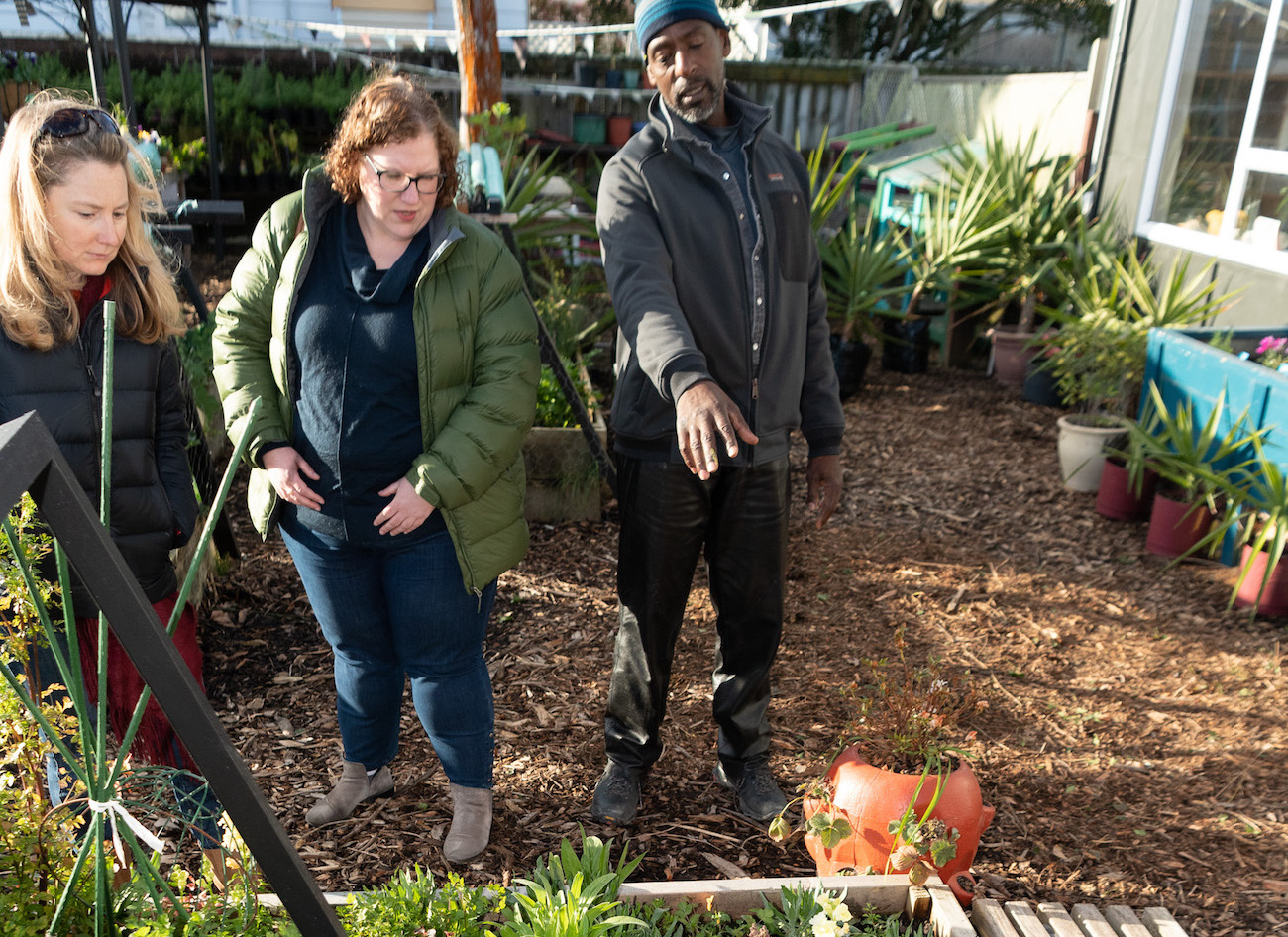
The Gangsta Gardener, Ron Finley, August 17-20 2018 photo: US Embassy
This is what comes to mind when many think of gardening. Successful planting depends on careful planning, so don’t start this until you’ve closely considered the steps above.
-
Know your frost dates. Most seed packets have information about when to plant seeds, often written as “# of weeks before/after last frost.” In some parts of the country, this will mean starting some seeds indoors.
- Plant your seeds. Depending on where you live, you may want to invest in some indoor growing lights, a spray bottle for watering, and seedling trays to get a head start on spring. Plant more than you think you’ll need, as you should expect some losses during this fragile phase. Share any extras you have in seed/seedling swaps. Transplant your seedlings or plant your seeds outside according to seed packet information or planting calendars. Remember to disturb the soil as little as possible to ensure it retains carbon.
- Maintain. This is the daily work of weeding, watering, monitoring for pests, composting, and harvesting. Remember to only remove weeds that may harm plant growth; the others add biodiversity and coverage for your soils. Revisit the Climate Victory Gardening practices on pages 5 and 6 and integrate into your daily practices. Team up with neighbors to share and help out. Experiment to find what works for you and your garden.
- Observe. Continue adding to the plan/map you made at the start of the season. This observing can be done in the form of journaling, photographs, sketches, notes on your calendar, and there are even phone apps for this. Many find it useful to have a physical notebook for taking notes in the garden. Look for plants thriving or failing, pests, moisture levels, sunlight, etc. Dates are important too.
POST-SEASON: PREPARATION
After the excitement of summer harvesting is over, it’s time to prepare your garden for the winter and future growing seasons.
- Save for the future. If you’ve allowed plants to go to seed or fruit to stay on the plant, consider saving these seeds. You can preserve excess harvest by freezing, drying, or canning. Or, share with friends.
- Update your sketch. Things change over the course of the season, so be sure to update your garden sketch to have the most accurate representation for starting the process again next year.
- Cover soils. The easiest thing here is to leave plant residues, that is, the spent plants from the growing season. You can also add mulch, straw, leaves, or grow cover crops if your weather allows for it. It’s a good idea to add compost before snow falls. Continue to maintain your compost during the off-season, so you’ll have plenty to start with next year.
- Prepare for spring. You have all winter to research new varieties, and many gardeners find great joy in perusing seed catalogs as research. Review your sketches, notes, and journals to determine what plants and/or methods didn’t work, and plan accordingly for next year. Create long-term goals for your soil and reevaluate goals for the season passed. Consider what carbon-sequestering methods you used and how to improve upon these.
Health Benefits
In addition to providing nutritious foods, beautiful landscapes, and carbon sequestration, gardening offers a variety of health benefits. There is so much to gain from gardening, whether you are just starting your very own garden or you have been doing it for years; there may be more to gain than you realized. There is increasing evidence that gardening provides substantial health benefits.
- Stimulates hands-on learning
- Tunes motor skills
- Raises social-responsibility awareness
- Supports stress release
- Engages the creative process
- Helps keep the brain young l Boosts immunity
- Provides social opportunities
- Builds a sense of community
- Reduces food insecurity
- Connects people to nature
- Promotes exercise
- Improves mental health
- Increases exposure to Vitamin D
- Decreases risk of dementia
Engaging children in gardening promotes learning, supports development of new skills, strengthens social interactions, encourages environmental appreciation, and improves focus—all while encouraging them to eat healthier. Whether the garden is located in the backyard, at school, at church, or in pots on an apartment balcony, kids who are engaged in the process develop a sense of confidence and ownership that connects them to their food.
Joining The Movement
Climate Victory Gardening is a movement that’s happening in your community, across the country, and even online. Enrich your experience by getting involved on each level.
Your Community
- Commit to carbon-sequestering practices in your own garden.
- Talk to your local garden groups or community garden about sequestering carbon and building healthy soils.
- Consider starting a garden in a public/open access space so more people can experience and enjoy its benefits.
- Explore partnerships with institutions (schools, hospitals, workplaces, etc.).
- Gardens at these institutions can have a positive impact on peoples’ psychology, while also sequestering carbon and preventing water run-off.
National
Join others around the U.S. (and world!) in your commitment to carbon-sequestration by registering your garden online. Search our map to find your fellow gardeners all across the country, or even in your own neighborhood.
Online
Partake in discussions on the Climate Victory Garden facebook group, where gardeners share best practices, ask questions, and brag about their gardens
Resources
We hope you’ll be able to get your Climate Victory Garden started with this toolkit. But, there are many more resources that can help you take your understanding and adoption of carbon-sequestering techniques to the next level.
|
|
What Practices Make My Garden a Climate Victory Garden? |
Your garden has the power to be part of the climate solution as a Climate Victory Garden.
As an environmentally-conscious gardener, you can adopt gardening practices that protect the soil—this is where we’re storing carbon—while minimizing climate impacts beyond the boundaries of your garden. For example, when you skip store-bought synthetic chemicals, you’re protecting the life in your soil and its ability to capture carbon, as well as avoiding the emissions associated with the production and transportation of these products.
The good news is that if you're new to gardening, these Climate Victory Gardening practices are easy to adopt. If you're already a seasoned gardener, chances are you’re probably already doing some of these practices. All gardens are going to look different, and these Climate Victory Gardening practices are intended to inform the hundreds or even thousands of decisions you make in your garden each season. Whether you’re a beginner or seasoned gardener, there’s something for everyone.

5 Beginner Gardening Practices
Grow food
- Here's how: plant your favorite foods, share with your neighbors
- Why it's important: reduces food miles, decreases grocery bills, encourages seasonal eating, establishes a close relationship with food
Cover soils
- Here's how: apply mulch, leave plant residues, plant cover crops, strategically allow weeds
- Why it's important: decreases water use, curbs erosion, and protects local water sources
Compost
- Here's how: compost kitchen and yard wastes, apply compost as fertilizer, share with your neighbors
- Why it's important: repurposes waste, reduces methane (a greenhouse gas) from landfills, and increases quality of soil and nutrient density of foods
Ditch the chemicals
- Here's how: fertilize with compost, plant companion crops, use integrated pest management
- Why it's important: decreases pollution from production to run off, reduces input costs, ensures your safety
Encourage biodiversity
- Here's how: grow many different plants, feed soil life with compost, plant pollinator habitats
- Why it's important: ensures healthy soils and nutritious foods, balances ecosystems, and keeps pests in check
Your beginner gardening questions are answered here.
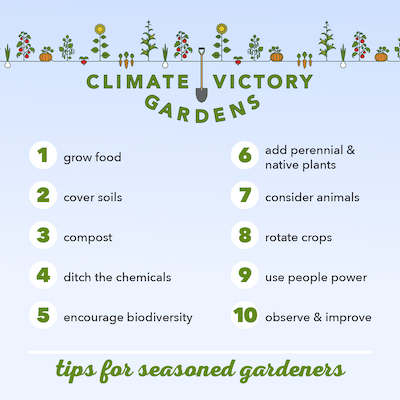
5 More Gardening Practices
Add perennials & native plants
- Here's how: reduce disturbance of soil, plant trees, choose perennial grasses, shrubs, and herbs
- Why it's important: allows for multiple harvests from a single planting, protects garden from the elements, promotes diversity, and controls weeds
Consider animals
- Here's how: allow chickens, goats, and other small animals to forage for insects or eliminate weeds
- Why it's important: decreases pests and increases fertilization naturally
Rotate crops
- Here's how: choose different crops and new locations each season, consider nitrogen fixing plants
- Why it's important: ensures balanced soil nutrients and keeps pests to a minimum, reducing chemical input use
Use people power
- Here's how: hand-pull weeds, rake instead of using blowers, choose push mowers over gas powered, and bike to your garden or market
- Why it's important: reduces dependency on fuel, decreases emissions and costs
Observe and Improve
- Here's how: test soil for nutrients, monitor moisture, and remove pests and diseased plants quickly
- Why it's important: determines how water, inputs, and other management can be applied most efficiently
Your seasoned gardening questions are answered here.
Have questions about how to do any of these? Check out our resource pages for more info. These gardening practices also have tangible climate benefits. Your garden can support the environment, so consider adding yours to the Climate Victory Garden map!
|
|
A (More) Sustainable Guide to Refreshing Your Look |
For some people, summer is ending much too soon; for others, they can’t wait for the start of fall … and the new school season.
Whether you’re in the market for a fresh new look – or just need some clothes that fit your family’s needs! – we put together a guide to a more sustainable way to do your back-to-school shopping:
Attend or organize a clothing swap
Clothing swaps are a great way to bring communities and friends together, and have clothes cycle through a community. It is a fun and low-cost way to find new clothes, catch up with old friends and meet some new people.
Shop secondhand
Thrifting, on-line markets, and consignment are all en vogue. When you shop secondhand, not only are you potentially saving money on new (to you!) clothes, secondhand clothes help keep clothes out of landfills longer and are a good way to avoid contact with residual chemicals that can be found on new clothing.
Thrift stores are still great options to shop secondhand, especially on a budget. Used stores like Plato’s Closet and Buffalo Exchange not only offer in-trend, lightly used clothing at great prices, they will also purchase your clothing as well. Meanwhile, websites like ThredUp and The Real Real are also changing perceptions of how to shop secondhand – ThredUp buys and sells trendy clothes, while The Real Real is a luxury consignment shop.
Shop at a green business
Sometimes, you just don’t have time to comb through the secondhand market to find what you need. Sometimes, there are things you would just prefer to buy new. We get it! If you can, try to shop at a green business.
Green America’s Green Business Network is a great place to start. By supporting green businesses, you are voting with your dollar for practices that are more sustainable, and showing conventional businesses that consumers care about how their clothes were made. Sustainability certifications can also be a helpful guide to learn more about how your clothes were made.
Research the big-name brands if you think you’ll shop with them
Green alternatives can sometimes come at a premium price point. If you find yourself shopping at a conventional store, try to do some research to see what – if any – sustainability plans they have.
Our scorecard is a helpful primer on what major companies are doing, and what issues you should be asking your favorite companies not on the scorecard. Some conventional companies also have token sustainable lines of clothing, such as jeans made in a fair trade factory, shirts made with organic cotton, or another token “sustainability” initiative.
It’s important to remember that no amount of sustainability plans can negate the environmental and social aspects that come with producing large amount of clothing. Unfortunately, we cannot shop our way into sustainability just yet; however, we do still need to wear clothing on a daily basis, so we can, at least, adjust our habits to become more mindful of how our actions impact people and the planet.
|
|
Toxic Textiles FAQs |
Frequently asked questions about chemicals in clothing.
The fashion industry is a highly polluting industry. Experts estimate that over 8,000 chemicals are used by the textile industry, and there isn’t enough transparency about what chemicals are being used by specific companies or in specific garments.
According to the World Health Organization (WHO), 20% of industrial water pollution comes from the textile manufacturing industry. Wastewater containing the chemicals and dyes used in manufacturing textiles end up in local water sources; in some manufacturing countries, local water sources are so polluted by chemicals that they can no longer sustain wildlife. In some places, locals can tell what is the ‘It’ color of the year based on what color the local river source is.
Meanwhile, workers are exposed to toxic chemicals while bleaching, dyeing, and applying finishing treatments to textiles that will become clothes.
Chemicals in clothing not only affect workers, communities, and environments in manufacturing countries, residual chemicals can also affect consumer health as well.
The Toxic Textiles campaign is putting the spotlight on major American apparel companies to get them to come clean about what chemicals they’re using and how they plan on cleaning up their supply chain. We believe that clean clothes should be available to all consumers – not just consumers who can afford to buy clothing at a premium price point.
Safer alternatives and better wastewater management technology are already available – but companies and factories have little incentive to use them when they can hide the toxins lurking in their clothes. Meanwhile, there are industry initiatives that are already helping companies adopt chemical management policies. We need more companies to take part in these initiatives.
Thousands of chemicals and dyes are used to turn raw materials into our clothes. There currently isn’t enough transparency or understanding of all of the different chemicals and chemical formulations that are being used, nor their impacts on human and environmental health. Regulation like Registration, Evaluation, Authorization and Restriction of Chemicals (REACH) in the European Union is designed to help identify more of the chemicals and chemical formulations that are being used by the industry. We need similar disclosure here in the US, but since our national government is failing to protect workers and the public, we need to demand transparency directly from companies.
A Manufacturing Restricted Substances List (MRSL) is a list of chemicals/chemical formulations that are restricted or banned in the manufacturing process. Through an MRSL, a company/supplier may address dangerous chemicals that are used in the process to make the clothes but do not show up in the final product. MRSL can help to protect workers and the local communities near factories.
Companies are turning to nonprofits to help them craft and implement MRSLs. Zero Detox of Hazardous Chemicals (ZDHC) is an organization that works to help companies implement MRSLs and wastewater management policies.
A Restricted Substances List (RSL) is a list of chemicals that are restricted or banned from final consumer products. An RSL is an important component for consumer safety. Industry initiatives like Afirm Group and the American Apparel and Footwear Association provide members with RSLs they can utilize. RSLs focus on consumer safety and do not address chemicals used in the manufacturing process.
Azo dyes are one of the most commonly used dyes, comprising of 60-70% of dyes in use. Azo dyes can release a compound that is a known carcinogen. The most toxic compounds have been banned in the EU.
Brominated and chlorinated flame retardants are used to help fireproof clothing and can be found in children’s clothing. Flame retardants can cause thyroid disruption, memory and learning problems, delayed mental and physical development, lower IQ, advanced puberty and reduced fertility.
Formaldehyde is used to keep clothes wrinkle-free and shrink-free and is a known respiratory irritant and carcinogen.
Heavy metals are found in dyes and leather tanning, and can cause nervous system damage, kidney damage, and/or be carcinogenic, depending on the heavy metal.
Perflourinated chemicals are used to make clothing waterproof and stainproof. PFCs can affect liver health and disrupt hormonal functions.
The EU’s primary legislation for regulating chemical use is REACH, which requires companies to disclose what chemicals they are manufacturing or importing and demonstrate how risks of use can be managed.
In the US, the primary legislation for chemical management is the Toxic Substances Control Act (TSCA). The Toxic Substances Control Act (TSCA) is an American law that was meant to regulate chemical usage. However, tens of thousands of chemicals were grandfathered into the program as “acceptable” without prior testing or understanding of their health effects. There are almost 85,000 chemicals that are currently approved for use – and only nine are banned, as the mechanism to restrict/ban chemicals is cumbersome. Recent efforts to reform the bill – including an update to the bill passed in 2016 – have recently been undermined by the EPA.
In California, Proposition 65 requires the state to maintain an updated list of chemicals that are known to cause cancer or reproductive toxicity. Companies must provide Californian consumers if they may be at risk of being exposed to one of these chemicals. The current list has over 900 chemicals on it.
From a consumer safety standpoint, shopping secondhand can help reduce the risk of being exposed to some of the residual chemicals that may have wound up on your clothing.
|
|
Natural Gas Pipeline and Infrastructure Explosions Nationwide |
Natural Gas pipelines explode with alarming frequency in the US, killing and injuring people, and causing millions of dollars in damage. Interstate pipelines are permitted by the Federal Energy Regulatory Commission (FERC), which has approved all but one pipeline over the past 30 years, and routinely rejects legitimate concerns raised by impacted communities.
In just 2015 to 2017, there were 12 deaths and 10 injuries reported from natural gas pipelines in the US. Pipeline explosions also cause millions of dollars in damage and evacuations. This list does not include the many injuries, deaths, and extensive property damage reported from natural gas explosions reported at homes, apartment buildings, businesses, from local natural gas infrastructure.
From June 2015 to June 2017, the following incidents have been documented
February 17, 2017: A natural gas pipeline operated by Kinder Morgan in Refugio Texas exploded creating a massive fire. The explosion shook homes 60 miles away.
February 10, 2017: A natural gas pipeline operated by Phillips 66 Pipeline in St. Charles Parish, LA exploded, injuring 3 workers.
February 1, 2017: A DCP pipeline in Panola County TX exploded and created a crater in an airport runway, shutting down the airport for a month. (Editor's Note 1/13/20: Two stories no longer available online)
January 17, 2017: A natural gas pipeline operated by DCP Midstream exploded in Spearman, TX, which led to multiple fire crews being called to the scene.
August 20, 2016: 10 people in New Mexico were killed when they were camping near an underground natural gas pipeline operated by El Paso Energy that suddenly exploded.
April 18, 2016: 2 workers were killed when they struck a pipeline at the Southcross Gas Processing Plant in Bonnie View, TX.
April 29, 2016: A 30-inch pipeline in Salem Township, operated by Spectra, exploded, severely injured a worker, and caused the evacuation of local businesses and homes.
January 9, 2016: A 30-inch pipeline operated by Atmos Energy in Robertson County, TX exploded and forced the evacuation of several families.
August 26, 2015: Two workers were injured when a Boardwalk/Gulf South Pipeline Co underwater pipeline off the coast of Louisiana ruptured and exploded.
June 27, 2015: Four workers were injured when a pipeline exploded at a gas booster station in White Deer Texas.
June 17, 2015: A pipeline operated by Energy Transfer Partners ruptured in Cuero, TX and caused a massive blaze and the evacuation of 7 families. 165,732 pounds of volatile organic compounds may have burned.
The incidents documented above represent a continuation of and ongoing trend of repeated natural gas pipeline disasters in the US
From 2010 to 2016 -- Gas companies reported 35 explosions and 32 ignitions at their transmission pipelines, according to federal records. The explosion killed 17 people and injured 86. A September 2010 explosion in San Bruno, Calif., killed eight and injured 51 people.
Dangers From Liquified Gas
In addition to pipeline explosions, there are risks from compressor stations and liquefied natural gas export facilities, including a 2014 explosion at a rural Washington State LNG storage facility that injured several workers and resulted in evacuations. The explosion called into question the safety of LNG storage facilities located near population centers nationally.
|
|
FAQs about the Sweatshop Problem |
Q. What are sweatshops and how bad is the problem?
A. The US Department of Labor defines a sweatshop as any factory that violates two or more labor laws, such as those pertaining to wages and benefits, working hours, and child labor. Anti-sweatshop advocates go further to say that beyond following the letter of the law (which can be very weak in many countries that attract sweatshops), a factory must pay a living wage in safe working conditions, enforce reasonable work hours, provide for sick leave and maternity leave, and allow workers to organize to avoid being labeled a sweatshop.
Because no single definition exists (and because sweatshop owners don't want their factories to be revealed), it’s difficult to assess the worldwide scope of the problem. Compounding this difficulty is the “race to the bottom,” which means that companies don’t always let their sweatshop factories stay in one place, if they can shift their manufacturing to ever-cheaper and less-regulated locations. For example, the number of sweatshops in Mexico soared in the 1990s after NAFTA enticed companies to close their US operations and move south. As global manufacturing costs continued to shift, many companies then moved their operations from Mexico to even more attractive Asian countries. And more recently still, after the US-Jordan Free Trade agreement went into effect in 2000, the number of sweatshops in that country exploded as well. Between 2000 and 2005, apparel exports from Jordan to the US soared 2000 percent, often due to the round-the-clock labor of guest workers from poor Asian countries who were following the jobs as they moved.
Q: But if companies have to cut costs to stay competitive, aren’t sweatshops inevitable?
A: No. Low prices are only one of many factors consumers take into account when they shop, and most consumers don’t intentionally purchase goods made in sweatshops.
Reporting for Dollars and Sense magazine in 2006, sweatshop expert John Miller, a professor of economics at Wheaton College, explained how paying decent wages to workers at the beginning of the supply chain has little effect on a company’s competitiveness. “In Mexico’s apparel industry, economists from the Political Economy Research Institute found that doubling the pay of non-supervisory workers would add just $1.80 to the cost of a $100 men’s sports jacket,” explained Miller. “And a recent survey by the National Bureau of Economic Research Found that US consumers would be willing to pay $115 for the same jacket if they knew it had not been made under sweatshop conditions.”
Living wages and reasonable working hours would not threaten companies’ overall profitability. No one should have to work 17-hour days just so Americans can save a few dollars on clothes.
Q: Doesn’t low-wage sweatshop employment help alleviate poverty? Aren’t sweatshops a necessary step on the road to economic development?
A: No. Sweatshop workers are trapped in a cycle of exploitation that rarely improves their economic situation.
“In many cases, countries’ minimum wages are insufficient to climb out of poverty,” says Todd Larsen, Green America’s Executive Co-Director for Consumer & Corporate Engagement. “What’s more, sweatshop watchdog groups continually find factories that pay illegal wages, lower even than the minimum.”
Consider the example cited in a 2003 National Labor Committee report on a Honduran worker sewing clothing for Wal-Mart at a rate of 43 cents an hour. After spending money on daily meals and transportation to work, the average worker is left with around 80 cents per day for rent, bills, child care, school costs, medicines, emergencies, and other expenses.
If sweatshops were a necessary step toward economic development, they would not exist in the world’s most developed economies; however, sweatshops continue to be uncovered even in the United States. The US Department of Labor regularly uncovers sweatshop abuse in American factories, which are often contracted to make fast fashion clothing for American brands.
Q: Isn’t it time-consuming and expensive for corporations to track their goods’ origins?
A: No, most corporations already track their goods to the subcontractor or factory level in order to monitor the quality of their products.
“In competitive industries like the apparel industry, all companies have quality control,” says Nikki Bas, executive director of Partnership for Working Families. “If companies are able to send representatives to inspect the quality of a garment, they can inspect the quality of their factories as well.”
Q: Do some companies track their goods to keep sweatshop labor out of their supply chains, and mark their products with a special label?
A: Unfortunately, no overarching “sweatshop-free” label exists, though a union label is a good indicator that at a minimum workers are free to organize and have a voice. In addition, since the mid-1990s, a number of “social auditing” organizations have emerged, and companies may now coordinate with one to inspect their factories for sweatshop abuses, to greater or lesser degrees of success.
These organizations operate under a number of different structures. For example, Verité, operates as a nonprofit organization, inspecting factories on behalf of their client companies, which pay Verité a fee to perform audits and help facilitate follow-up correction programs for violations. (Verité does not make its findings public because conditions can change so quickly in faraway factories.)
Another example, Worldwide Responsible Apparel Production (WRAP), operates as a 501(c)6 corporation, and makes its list of inspected and certified factories available on its website, searchable by country, as a resource for companies in search of factories. Established by the American Apparel and Footwear Association, WRAP has come under fire from anti-sweatshop organizations as having weak codes of conduct and operating too closely with the apparel industry.
Similarly, the Fair Labor Association, which contracts with specific companies to perform inspections, has fallen out of favor with many activists over concerns about poor enforcement and corporate influence.
Whichever monitoring organization a company might use (and there are many more), the bottom-line concern among anti-sweatshop activists lies in the lack of transparency to the consumer of the findings, as well as the inability of inspectors to stay aware of factory conditions at all times. Instances of factories improving their conditions specifically for inspections are well-documented, and critics further charge that monitoring organizations lengthen the supply chain, relieving companies of their responsibility to vouch personally for the conditions of their factories.
Q. If something is made in the USA does that automatically mean it is sweatshop-free?
A: Unfortunately, just because something is Made In The USA doesn't mean it isn't made in a sweatshop. In general, countries with strong labor laws (not just the US, but several European countries, Cambodia, and others) may produce fewer sweatshop abuses than countries with weaker or non-existent laws, but no one country is automatically sweatshop-free.
For instance, the Department of Labor conducted random inspections on 77 garment factories in southern California in November 2016, and discovered that 85% of the inspected factories were violating federal labor laws. Major retailers including Forever 21, Ross, and T.J. Maxx, contracted these factories to create bargain-price clothing, at the expense of the industry's primarily immigrant workforce.
Grievous sweatshop abuses have not only been uncovered in U.S. factories, but also in factories located in U.S. territories. These factories may also use the "Made in the USA" label, despite being exempt from certain U.S. labor laws.
For example, for many years garment workers in Saipan, in the Commonwealth of the Northern Marianas Islands (CNMI) have been exploited under the islands’ exemption to US labor laws. Efforts to bring CNMI under US law have long been stymied by lobbyists and lawmakers sympathetic with exploitative garment businessess, though as this guide was going to press, the US Senate voted to finally extend federal labor and immigration laws to CNMI.
Q. How do I learn more?
There may be common items or foods you did not know were made with working conditions that endanger people and the planet. Here are eight things made with sweatshop labor. Green America is working to end sweatshop labor. Join us! Here are steps you can take to end sweatshop labor.
|
|
US Companies Exploiting Workers |
When you hear the word “sweatshop,” what comes to mind?
Most likely shadowy factories in faraway places like China or Bangladesh, where exploited workers are packed into small spaces with their machinery, breathing in dust-filled air and working 14- to 18-hour days for poverty-level wages. Anyone who has ever read about sweatshops knows that abusive working conditions are the norm in such places.
But they’re “over there,” not here in America, right? With our better labor and environmental laws, surely sweatshop conditions don’t occur on US soil?
It’s a popular myth that even the most knowledgeable Green Americans may believe. In fact, after Green America’s online editor Andrew Korfhage posted a link to a story on the Rana Plaza factory collapse in Bangladesh back in April, one commenter urged people to buy “Made in the USA” to avoid purchasing from companies that do business with sweatshops.
If only it were that easy. Unfortunately, exploiting workers—horrific, inhuman abuse—does occur in the US, and it’s more prevalent than you think.
“Fair Labor at Home,” the July/August issue of the Green American covers in-depth how workers in US restaurants, farm fields, domestic labor situations, and workplaces tied to national corporations like Walmart, McDonald’s, and Wendy’s are regularly subjected to sweaetshop-style working conditions. Because they may still be learning English or may be unfamiliar with US labor laws, recent immigrants, both documented and undocumented, are among the most exploited workers in the country, enduring wage theft, dangerous working conditions, discrimination, and even physical assaults.
In 2012, student guest workers from Latina America and Asia on J-1 cultural visas won a settlement against McDonald’s, which agreed to pay them $213,000 in stolen wages and $141,000 for health and safety violations the students endured in the workplace.
Warehouse Workers for Justice (WWJ), a coalition of workers at US warehouses in Walmart’s supply chain, has, to date, recovered over $700,000 in stolen wages through lawsuits against Walmart-contracted warehouse companies, with more suits pending. The majority of the workers are people of color, says WWJ’s Leah Fried, with up to half of them being immigrants.
And farmworkers picking tomatoes for Wendy’s say the company isn’t doing enough to protect workers from abuse and assault, and it hasn’t raised its wages of 50 cents per 32-pound bucket of tomatoes for 30 years. Almost all of the top fast food chains in the country have signed onto the Fair Food Program—an agreement spearheaded by the Coalition of Immokalee Workers in which they agree to pay a penny per pound premium to tomato pickers and implement real protections for workers. Wendy’s, however, is the lone holdout, and has faced campus protests in 2019 over their refusal to join the Program, which would guarantee that laborers are paid at least the local minimum wage.
The “Fair Labor at Home” Green American has more details on each of these cases. But imagine our editors’ surprise (not really) when, as we sent the issue to the printer, news broke that 7-11 was being investigated for luring more than 50 Pakistani immigrants into the country to work for 14 7-11 stores in New York and Virginia. Upon their arrival, the workers had to put in 100-hour workweeks (That’s right—at least 14-hour workdays.). In addition, they were forced to live in employer-owned boarding houses and had “rent” money deducted from their paychecks. In fact, the money that was left over was so miniscule that the New York Times referred to the scheme as a “modern-day plantation system.” The federal government is also investigating allegations that the 7-11 employers stole additional, “substantial” money from the workers’ paychecks.
The 7-11 franchise owners also stand accused of committing identity theft to give the workers false identifications and conceal their trafficking scheme. The 7-11 corporation did little to monitor the situation, even though its records showed that stores in two different states had several workers with the same name and Social Security number on their employee rolls.
7-11 stores in at least seven other states are under federal investigation for similar trafficking and labor violations.
As we noted in the Green American, “The immigrant rights movement is not about handouts, but about ensuring that every US immigrant’s situation is handled fairly and with compassion—and that exploitation of this vulnerable worker population comes to an end.”
As we work together to promote Fair Trade and stop worker exploitation around the world, join with us at Green America to also call for the rights of workers inside our borders. |
|
Community Investing Guide |
How you save and invest your money has as much an effect on the world as how you spend your money. If you’re tired of seeing your banking and investment dollars support projects you don’t believe in (like fossil-fuels or weapons manufacturing) or practices you can’t endorse (like deceptive lending or huge bonuses to their CEOs), then make this the year you break up with your mega-bank and start investing in communities.
Green America’s Community Investing Guide provides an introduction to community development financial institutions, or CDFIs – banks, credit unions, and other financial groups with a mission to direct your banking and investing dollars into projects that improve people’s lives.
Download the PDF
Whether you need a bank for depositing a weekly paycheck, or an investment opportunity for a larger sum – or anything in between – our Community Investing Guide gives you the resources you need. With the global economic crisis focusing even more public scrutiny on the greed and mismanagement of the corporate mega-banks, it’s clear: community investing is more important now than ever before.
|
|
Domestic Work is Real Work |
Did you know there is a whole sector of American workers who do not have the right to organize, to overtime pay, or legal protection from workplace discrimination and harassment?
Domestic workers, such as those providing care for children and the elderly, are actually exempt from a large number of the employment rights many Americans take for granted. Excluded from the Fair Labor Standards Act (FLSA) of 1938, this sector was left out of many of the legal protections.
This means that many domestic workers
- Do not have a right to minimum wage
- Do not have a right to unpaid maternity leave
- Do not have a right to weekends or time off
- Do not have a right to overtime pay
- Often face sexual or emotional harassment
The potential for exploitation faced by domestic workers is made even more dire by the  fact that many of these workers are recent immigrants without the English language skills and supportive social networks to fight back against abuse. fact that many of these workers are recent immigrants without the English language skills and supportive social networks to fight back against abuse.
Fortunately, activists have already successfully passed a bill in New York, making it the first state to recognize domestic workers as real workers under state law and granting the sector many of the protections that other workers enjoy.
Now they’re taking the fight to California, Illinois, and Massachusetts — here’s how you can get involved.
California
Go to the National Domestic Workers
Alliance’s California Bill of Rights campaign page to:
- Take part in their letter -writing campaign
- Take part in their phone-in campaign
- Make a donation to Mujeres Unidas y Activas
- Promote this bill through your social media handles
Illinois
Are you an Illinois resident? Click here to tell your representative to support the Illinois Domestic Workers’ Bill of Rights (note that while the website notes an April date, the bill is still in the works and you do have time to make your voice heard) . Also — go to the NDWA’s campaign page or Arise Chicago to stay in the loop about developments on Domestic Worker Rights in that state.
Massachusetts
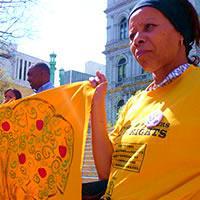
You can support the Massachusetts campaign in a number of ways.
Go to NDWA’s campaign page to
- Sign a pledge card
- View photos
- Learn more about the campaign
You can also stay in the loop by liking the Massachusetts Coalition for Domestic Workers’ Facebook page.
Fair Labor in the USA
In the Fair Labor at Home issue of the Green American, we highlighted the sweatshop conditions, wage theft and slave labor that occur right here in the USA. Providing legal protection for domestic workers is a key part of creating fair labor in America.
We’ve been blogging about labor issues in the USA — check out our other posts, may of them written by our editorial fellows, Krisna Bharvani and Sierra Schellenberg:
|
|
What Fair Trade Means to Us |
Members make Green America’s fair trade programs possible. That’s why we’re sharing an incredible opportunity to make a difference while shopping. In celebration of Fair Trade Month, INDIGENOUS organic + fair trade fashion is offering 20% off to Green Americans, while donating 25% of each purchase to our fair trade programs on purchases made through November 15.
To INDIGENOUS, fair trade means much more than fair wages in the local context. It’s about providing good work to some of the poorest communities in the world, and transforming lives through opportunity. It’s the right to work in safe, clean conditions. And at its core, fair trade is about treating workers not as another commodity, but as humans worthy of respect.

INDIGENOUS makes stylish organic + fair trade clothing in Peru, location of the world’s longest history of textile design. In many Peruvian cultures, textiles were valued above all other treasures. It’s no surprise that imaginative and complex textile work is still found throughout the region, from small markets to high-end boutiques.
Traveling through South America in 1993, INDIGENOUS co-founder Scott Leonard was struck by two things: the amazing textiles that surrounded him, and the extreme poverty of the region. From this trip was born INDIGENOUS, one of the first eco-friendly and fair trade clothing companies.

The fast-fashion industry is notorious for environmental and human rights abuses. The quick turnover of the fashion cycle, combined with the race to profit, have led to an industry that hides its shame behind glitz and glamour. Sweatshops, child labor, rivers polluted with toxic dyes, and unsafe working conditions cannot and should not be ignored.
You deserve
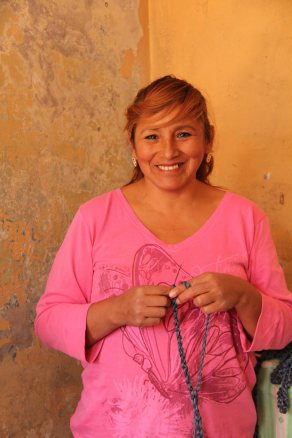
to wear clothing that suits your morals as well as your style. That’s why INDIGENOUS, a long-time Green America member, has been doing things differently for over twenty years. Using fair trade principles as a guide for better business, INDIGENOUS invests in its artisans by providing skills training, access to grants and no-interest loans, fair wages, and safe working conditions—artisans like Ana (pictured left), a single mother who lives with her two children and her visually impaired father in a community for blind people and their families. Ana provides work for the people in her community, allowing them to help support their families. Fair wages and no-interest loans have helped her buy new knitting machines to take on more intricate work.
The INDIGENOUS line is made from 100 percent natural and organic fibers, including organic cotton, eco-friendly Tencel™, and free-range alpaca. Each piece is dyed with safe, low-impact dyes, or kept PURE with no dyes at all. Best of all, each piece is carefully created by artisans earning a fair wage.
By wearing clothing that honors both people and planet, you support a movement away from fast fashion, and toward a more sustainable and equitable future. During Fair Trade Month, celebrate with both Green America and INDIGENOUS. Through November 15, when you use your special Green America Member code at purchase, you will save 20%, and INDIGENOUS will donate 25% to our fair trade Initiatives on your behalf. These contributions will benefit Green America’s campaigns to end sweatshop labor. So what are you waiting for? Do some good. Get shopping!
INDIGENOUS makes natural-fiber clothing using the softest organic cotton and sustainably raised alpaca. Each piece is dyed with safe, eco-friendly dyes, or created PURE, with no dyes at all. Shop gorgeous sweaters, boiled alpaca wool coats, chic ponchos, and more. |
|
Apple Profits Soars, Workers Suffer |
Apple made headlines last week when it announced record-setting profits from its most recent business quarter (Oct-Dec 2014, Apple’s fiscal Q1).
$74.6 billion revenue
$18 billion in pure profit
$142 billion net cash reserves
74.5 million iPhones sold
Apple fiscal Q1 numbers, as reported by BBC
These figures blew past many analysts’ predictions and Apple’s previous records for the same quarter last year.
On the micro level, there are also some important numbers to pay attention to:
Number of workers in “final assembly” plants: 500,000
Hours worked per week: 72 – 105
Hours are higher during peak production seasons. The following calculations are based on 84 hour work weeks. (12 hour days, 7 days per week).
Monthly base wage: $244 (1530 yuan)
Overall monthly wage (including overtime): $582 (3650 yuan)
Hourly wage: $1.62 per hour (10.13 yuan/hour)
Labor cost per iPhone assembled: $0.27
Recommended living wage: $725 (4537 yuan)
Calculated by Asia Floor Wage for a 48 hour work week.
Recommended Hourly Wage: $3.77 (23.6 yuan)
Recommended labor cost per iPhone assembled: $0.63
Cost difference for assembly labor per iPhone: $0.36
Exchange rate used: $1 = 6.26 yuan
Explanation of Calculations:
Young workers assembling iPhones. Credit: SACOM
According to Apple, 1.5 million people work in their supply chain, a third of which work in “final assembly” mega-factories. This means that during the same three months Apple set these financial records, 1 million Apple workers made the parts for these phones and 500,000 put them together.
Workers at one assembly factory make base wages of 1530 yuan ($244) per month (This is the minimum wage in Suzhou, China). With lots overtime, workers can increase these earnings to roughly 3650 yuan ($582) per month, according to a 2014 investigation by Students and Scholars Against Corporate Misbehaviour (SACOM). This was at Pegatron, one of Apple’s main suppliers in China, which handles the final assembly of Apple’s iPhones. Other final assembly plants include Foxconn and Quanta.[1]
The living wage in China, as calculated by the Asia Floor Wage in 2013, is approximately 4537 yuan ($725 USD, PPP). This is based on working 48 hours per week at a rate of about $3.77 per hour.
However, workers in Apple’s supplier factories, do not work 48 hours per week, especially during peak production times. SACOM’s investigation found that some workers at Pegatron worked for 10 weeks without a rest day and often for 12-15 hours a day, sometimes up to 17-18 hours a day. This means that during peak production time, workers at Pegatron were working between 84 and 105 hours per week. This is more than double a typical workweek around the world.
Taking a conservative estimate of (12 hours/day, 30 days per month) workers earn approximately 10.13 yuan/hour, or roughly $1.62 per hour. This is less than half the recommended living wage of about 3.77 per hour.
According to a 2008 study published by MIT’s Sloan school of Business, which looked at the value chain of iPods, the assembly time required for one device was 10 minutes, or six iPods per hour. Which means, if comparable, the cost of labor per iPhone assembled is roughly 27 cents.[2]
Apple’s profit margin, or the money in pure profit it makes on every iPhone sold, is 39.9%, according to BBC. The industry average for consumer electronics is below 10%, according to Standard & Poor’s. The iPhone 6 costs between $199 and $749 at Apple’s online store, which means that depending on which phone you buy and the amount of storage you elect, Apple could be pocketing somewhere between $79 and $299 in profit. Apple’s margins are high for any sector, let alone a sector that requires the work of millions of human beings to make a product. The per piece labor of just $0.27 (for assembly) helps explain how Apple is able to achieve these remarkable margins.
Labor is one of the highest costs that any business will incur in any sector. One of the reasons, and usually the primary reason, a business may choose to manufacture in one particular country is the relative “cheapness” of labor costs there—meaning low wages. But at what point does the pursuit of lower wages move from a “savvy business scheme” to full-on exploitation?
In China, where Apple’s iPhones are made, wages are relatively low. So low in fact that workers must rely on overtime pay to get by. Electronics brands argue that workers like to work overtime so they can save for their future, but if workers base wages were raised to provide a living wage to begin with, would they elect to work such exhausting hours?
In these mega-electronics factories, there are typically 2 shifts, day and night. Workers either work 12 hours during the day, or 12 hours straight through the night. This often does not include time that workers may need to dress/undress, pass through security, or attend pre- or post-shift meetings. With either shift, little time is left over for recreation, personal development, or even rest.
Exhausted from long shift, many workers fall asleep on the job. Credit: BBC Panorama
In fact, in a recent BBC expose of Pegatron, one of the most apparent problems was the amount of workers falling asleep on the job, some while operating or working near dangerous equipment.
A recent letter written by nine non-profit and workers organizations called on brands to address the poverty wages in the manufacturing sector by paying “living wages, according to a credible benchmark, throughout their operations and supply chains… and structur[ing] their business relationships with suppliers, both in terms of price and volume, in such a way that living wages can feasibly be paid.” For electronics in China, this would mean paying the living wage for 48 hours of work–not poverty wages that rely on excessive overtime to get even close to this figure.
$1.62 per hour, or less, is just too little to compensate someone who works six+ days a week, for 12+ hours a day, in exhausting and often dangerous conditions. As documented by Green America and allies, toxins are prevalent in Apple supplier factories (many of which are suppliers for Apple’s competitors as well), and workers are developing cancer and other devastating diseases as a result. Apple announced in 2014 that it would ban two harmful chemicals in its final assembly plants to protect workers, however, there are hundreds of hazardous chemicals used in electronics manufacturing, particularly at parts and semiconductor manufacturers.

36 cents, the amount it would cost Apple per iPhone to pay final assembly workers a living wage
The trade-off workers in these factories must make for these meager wages is one that arguably no worker in the United States would willingly accept.
So when does the pursuit of lower wages move from a “savvy business scheme” to full-on exploitation? In the case of Apple, who made $18 billion in profit last quarter and who could spend just 36 cents more per iPhone to ensure living wages, it’s painfully clear it has crossed this line. And what better company to fix this error than the most profitable company in the history of the world?
[1] In 2012, the New York Times did a thorough job analyzing workers hourly wages at Foxconn, another final assembly factory.
[2] This estimation is imperfect. It does not include the cost of labor further down the supply chain, at parts manufacturing plants. (Though the MIT study estimates these workers earn even less than assembly workers, due to greater competition among parts manufacturers). It also bases the assembly time required on iPods, not iPhones. Finally, it relies on exchanging yuan to US dollars, a rate that is not constant. ($1=6.26 yuan was the exchange rate at the time of writing.) |
|
Regenerative Agriculture & Farming to Reverse Climate Change |
Regenerative agriculture* harnesses the relationships between plants and soil microbes to pull excess carbon dioxide out of the atmosphere and store it in plants and soils where it is a useful nutrient for farmers.
You may have noticed that we’ve been talking about regenerative agriculture a lot lately, especially its amazing potential to reverse climate change and bring numerous benefits to farmers, consumers, and local environments.
Today, we’re focusing on the how of regenerative agriculture—we’ll dive more into the specific practices that farmers and gardeners alike can use to not only reduce greenhouse gas emissions, but also draw down excess carbon while bringing about many other ecosystem benefits at the farm and landscape level. Many of these practices have been around for ages; they’re proven to improve resiliency to ever increasing weather extremes and enhance long-term farmland values, which makes them good for the farmer and good for the planet.
Here are the practices explained below (click each method for more information):
Composting
Compost is made up of rich organic material, the end result of decomposed kitchen scraps, manures, and yard wastes. When added to agricultural fields or mixed with garden soils, compost supplies a variety of nutrients, providing food for soil microbes, and creating healthier soils and crops.
The benefits for farmers and fields range from reduced costly off-farm inputs to greater resistance to pests and plant diseases to increased moisture retention. This is a win for climate change too, resulting in soils with living ecosystems of micro-organisms that capture and store excess carbon, taking it out of the atmosphere and sequestering it where it can be used to enhance a farm’s productivity. This reduces the need for adding harmful, energy-intensive petrochemical pesticides and fertilizers. Diverting organic wastes from landfills also results in fewer methane emissions, helping reduce another more potent greenhouse gas.
Many agricultural practices are site-specific, but composting is one fundamental element of organic and regenerative agriculture that can be adopted by anyone growing and/or eating food.
Zero to Low Tillage and Mulching
Conventional and organic farms that use invasive tillage methods to prepare fields release significant amounts of stored carbon into the atmosphere, damaging soil structure.
New studies show that certain types of low to zero tillage—especially single pass no-till—provide significant carbon storage potential while reducing the amount of carbon released into the atmosphere. In this practice, crop residues and cover crops are rolled flat and left to keep soil surfaces covered year-round, where they effectively become mulch that feeds healthy soil micro-organisms and speeds up the process of storing more carbon in the soil. Crops are then planted into the mulch, keeping weeds to a minimum. These practices also increase rainfall infiltration to help prevent storm flooding and limit soil erosion, while enhancing soil moisture retention—adding protection for the farmer against drought. Reduced tillage and mulching increase the soils’ ability to sequester carbon and reduces greenhouse gas emissions coming from the soil, farm vehicles, and the factories that produce synthetic fertilizers and pesticides.
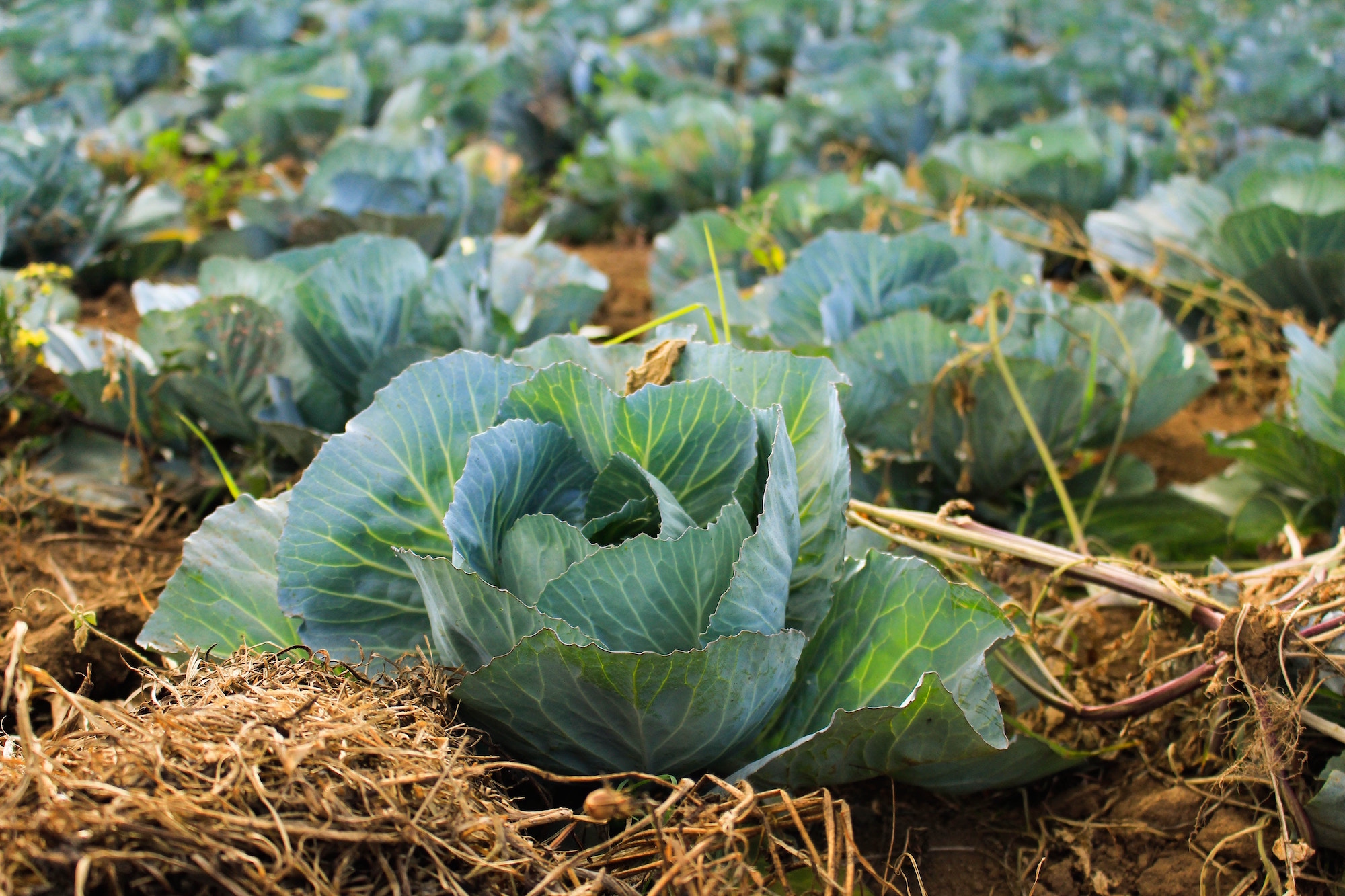
Cover Cropping and Crop Rotation
Farmers can enhance their carbon storage potential further by adding mixed species of cover crops and diversifying cropping rotations—both build soil health, store more carbon, and help keep soils covered and their micro-biome (communities of microbes) nurtured year-round.
In modern-day industrial agriculture, lands are often planted with a single crop and/or tilled and left bare (fallow) for long periods of time (aka monocropping). Cover cropping—the growing of beneficial plants during these times of rest or in combination with the primary crop—significantly reduces soil erosion and agricultural runoff after rainstorms or irrigation. Cover crops include wheat, barley, peas, clovers, and many others (often grown in mixes), and can also be used in consumer products like beers and cereals. While many farmers recognize these benefits, current crop insurance policies limit farmers’ use of cover crops.
Rotating crops rather than planting the same monocrop year after year is another practice that encourages restoration of healthy soil ecosystems. This method rebuilds farm systems that provide more nutrient-dense crops for our own healthy diets. Crop rotation also helps farmers reduce the need for petrochemical-based pesticides because their whole farming system provides more natural resistance to pests—this is critical for the health of our communities, as chemical drift and contaminated surface and ground water is a major health threat.
Regenerative agriculture incorporates the wisdom of including both diverse cover crops and crop rotations. It helps farmers choose cover crops that use nature to supply their crops with organic nitrogen and rebuild many other key aspects of soil health at the same.
Perennial Plants and Diverse Crops
Diversity above ground encourages diversity in the soil. Perennials—plants that provide harvests for multiple growing seasons—range from berries to tree crops and can be integrated into any size farm or garden. Because perennial plants don’t need to be planted each year, soil disturbance is minimized and soil organisms thrive. The plants themselves take carbon out of the atmosphere and store it in their trunks and stems, as well as in their deep root systems.
Perennials often have extensive root systems, with the added benefit of storing carbon deeper in the soil where it is more stable. Diverse crops in general support healthy, carbon-sequestering soils because they encourage diverse soil communities and distribute carbon at varying depths underground. They also are better able to resist extremes in weather like droughts and floods, and have the ability to defend themselves from pests. Perennials function best when planted using regenerative organic approaches that include adding pollinator habitat and intercropping with nitrogen-fixing support species.
Managed Grazing
There are many types of grazing systems that rotate livestock to maximize animal and soil health. Adaptive multi-paddock grazing (AMP) is a system where the animals are managed in ways that mimic the constantly moving, vast herds of wild herbivores to draw down and store carbon. Under this method, soil microbial communities are diverse and healthy enough even to mitigate the methane produced by the livestock in real time, contrary to what has previously been understood about these systems.
AMP grazing and other methods of intensely managed grazing decrease the need for conventionally grown, annual feed crops that emit carbon and other greenhouse gases, because the animals are eating directly from the land in ways that restore ecosystem function and health. The high-quality feed also reduces methane emissions from livestock, as it is easier for them to digest, also decreasing the need for antibiotics. It lessens the need for energy-intensive petroleum-based chemical fertilizers and herbicides, because the animals are enriching the land naturally as they forage and leave manure and urine behind. Their impact on the land restores a healthy soil micro-biome, increases the density of plants that cover the land surface, and—when incorporating perennial and native forages or trees—are able to store even more carbon deep underground, increasing its long-term stability.
All agriculture sequesters carbon from the air through photosynthesis, but it is a combination of the above practices that ensure more carbon is stored than released, and that the drawn down carbon stays underground where it is beneficial. There are many valuable tools and practices in regenerative agriculture that can help us win the fight to reverse climate change. These tools, combined with organic production methods, also bring many benefits to farmers, while providing healthier landscapes and more nutritious foods to consumers.
Regenerative organic agriculture is a win-win-win opportunity, but consumers must speak up with their dollars to scale it up fast. Without strong signals from consumers, not enough farmers will switch to these practices in the timeframe needed to reverse current climate trends that threaten food security and the future of our planet.
*This is an exciting time in the worlds of sustainable agriculture and climate change mitigation, when these two fields have the opportunity to collaborate and reinforce one another. This partnership is in its early stages, and terminology is constantly evolving. Regenerative agriculture is a new term that is still being defined and debated. Green America is proud to be a part of this discussion and stands behind agriculture that builds healthy farmlands, supports farmers and farmworkers, protects local environments, benefits consumers, and contributes to the fight against climate change—regardless of the term used to describe it. The organization recognizes that implementation of these agriculture methods will always be site specific and depend on soil characters, crops grown, and local climates. Green America's long-term goal is agriculture production that is regenerative and meets the USDA organic standard, the best way to achieve this is through the Regenerative Organic Certification. Green America supports all farms reducing chemical inputs and enhancing soil preservation techniques to move closer to those twin goals.
SaveSave |
|
Natural Gas: Why Is It Dirty? |
Natural gas is marketed as a clean energy source, but the reality is very different than the marketing. Natural gas is a highly polluting fossil fuel.
The impacts of natural gas include:
Climate change
The burning of fossil fuels releases carbon dioxide into the atmosphere, increasing CO2 levels, trapping heat, and contributing to global climate change.
- While natural gas is a cleaner burning resource than coal and liquid petroleum, it still emits a large amount of carbon into the atmosphere in the form of both CO2 and methane.
- CO2 is released during combustion, the process used to generate electricity.
- Methane is leaked in large quantities during extraction and transport of natural gas. Methane is a greenhouse gas that is about is about 87 time more potent than CO2 over a 20 year period (1).
- Studies show that global methane emissions have spiked dramatically since 2002. This is mostly due to the boom in natural gas extraction in the U.S. Leaked methane cancels out any reduction in CO2 emissions brought about by replacing coal with natural gas (1,2).
Air pollution
Air pollution is another side-effect of fossil fuel use. Air pollution is generally more regional than the effects of carbon dioxide, and can have devastating impacts on local populations and ecosystems.
- When natural gas leaks at extraction sites, pollutants such as volatile organic compounds (VOCs) are emitted to the atmosphere. VOCs, like trimethylbenzenes, xylenes, and aliphatic hydrocarbons react to form ground-level ozone, also known as smog. Smog can cause a variety of respiratory and cardiovascular effects and is especially dangerous to the elderly, young children, and people with asthma (3,4).
- Diesel fumes from the operation of trucks and machinery and gas leaks on drill sites pose a hazard to workers and nearby residents. People who live near areas of high oil and gas activity have been found to be at greater risk for chronic illness and cancer (5).
Water pollution
Like air pollution, water pollution is another more localized effect of fossil fuel use. Water is usually polluted during the process of extraction or in the handling of waste products. Water pollution can also have devastating impacts on human health the the environment.
- Hydraulic fracturing, also known as fracking, is a process by which natural gas is extracted from wells. Fracking is a dangerous practice for a number of reasons:
- Depending on location and well-type, fracking can use between 1.5 and 15.8 million gallons of water per well (6).
- Wastewater from these wells is often disposed of by injecting it deep underground into what are called Class II injection wells. Evidence suggests that these wells can cause earthquakes in the surrounding area. This not only puts people and buildings at risk, but it also increases the potential for groundwater contamination with wastewater (7,8)
- Accidents or poorly built wells can lead to contamination of groundwater by additives in fracking fluid (9). These additives can contain dangerous chemicals such as benzene and lead, which are toxic to humans (9,10).
- Extraction companies are not required to disclose all the components of fracking fluid. Many components are considered “trade secrets” and are never reported to regulatory agencies (10).
- Naturally occurring radioactive materials often come to the surface where they can build up in wastewater pipes. This can lead to maintenance workers being exposed to higher than normal levels of radiation (11).
(1) "Overview of Greenhouse Gases." EPA. Environmental Protection Agency. Web. 23 Aug. 2016.
(2) Turner, A. J., D. J. Jacob, J. Benmergui, S. C. Wofsy, J. D. Maasakkers, A. Butz, O. Hasekamp, and S. C. Biraud. "A Large Increase in U.S. Methane Emissions over the past Decade Inferred from Satellite Data and Surface Observations." Geophysical Research Letters 43.5 (2016): 2218-224
(3) “Health Effects of Ozone Pollution.” EPA.gov. Environmental Protection Agency. Web. 23 Aug. 2016
(4) "Health Effects of Air Pollution". CalEPA.gov. California Environmental Protection Agency, Air Resources Board. Web. 23 Aug. 2016
(5) Mckenzie, Lisa M., Roxana Z. Witter, Lee S. Newman, and John L. Adgate. "Human health risk assessment of air emissions from development of unconventional natural gas resources." Science of the Total Environment. (2012)
(6) Haines, S.S. "Methodology for assessing quantities of water and proppant injection, and water production associated with development of continuous petroleum accumulations." USGS. U.S. Geological Survey (2015): 1117-18
(7) Ellsworth, W. L. "Injection-Induced Earthquakes." Science 341.6142 (2013): 1225942.
(8). "Minimizing and Managing Potential Impacts of Injection-Induced Seismicity from Class II Disposal Wells: Practical Approaches, EPA.gov. U.S. Environmental Protection Agency. (2015)
(9)"Assessment of the Potential Impacts of Hydraulic Fracturing for Oil and Gas on Drinking Water Resources" EPA.gov. U.S. Environmental Protection Agency (2015)
(10) "Chemicals Used in Hydraulic Fracturing." U.S. House of Representatives, Committee on Energy and Commerce (2011)
(11) "TENORM: Oil and Gas Production Wastes." EPA.gov. U.S. Environmental Protection Agency. Web. 23 Aug. 2016. |
|
Can't find a Better Bank Near You? |
If you are not finding a financial institution that meets your needs from our database, you can use the links below to search a larger field of small banks and credit unions. Remember, while any smaller bank will have far less negative impacts than a megabank, you may not approve of all of their lending practices (even if local).
Other links:
(Note: with credit unions you will need to ask if you meet their eligibility criteria) |
|
The Role of Receipts In Shopping While Black |
“There are very few African American men in this country who haven’t had the experience of being followed when they were shopping in a department store. That includes me.” It’s been seven years since President Barack Obama spoke these words, and sadly, they never stopped being relevant.
The killing of George Floyd, after the murders of several other Black Americans, amplified a national (and even international) conversation about systemic racism, and racial profiling in stores is part of that. Racial discrimination ruins people’s shopping experience as they are treated unfairly while shopping. Beyond that, it can result in customers feeling unwelcome or even unsafe in stores as discrimination can threaten their physical safety if a manager calls law enforcement.
Racial profiling should not be seen simply as inconvenient for people; it can cause long-lasting harms and even life-threatening events. Studies have shown that discrimination is uniquely painful for Black people, increasing the likelihood of depression and capability of suicide.
Skipping the Slip Can Put People of Color at Risk
When Green America started our Skip the Slip campaign where we encourage retailers to preference a no receipt or digital option for customers checking out, we initially did not take account of the fact that the move away from digital receipts, which is good for the environment and human health, could endanger the lives of Black and brown shoppers. But, when California was considering the Skip the Slip legislation that at first mandated digital receipts for most retailers, and as we talked to organizations in the state about the impacts of that mandate, we quickly realized that, due to racism, people of color could be at risk walking out of a store without a paper receipt. In fact, paper receipts are a necessity for customers who are asked for proof of purchase, and Black and Latinx shoppers are asked this at disproportionately higher rates.
According to a 2018 Gallup Poll based on 6,000 U.S. adults, 30% of Black respondents said they were treated less fairly than white customers when shopping.
Such experiences include everything from “slights, like being ignored in favor of a white patron, to serious attacks on dignity and liberty, like being detained and questioned after making a purchase or handcuffed on suspicion of shoplifting.”
Current System is Reinforcing Racial Profiling in Stores
Additionally, there are stores that have been rolling out facial recognition technology largely in non-white, low-income communities. The cameras alert security agents if the system matches customers' faces to ones that have been previously caught engaging in criminal activity. Although the system aims to prevent theft and protect customers and employees, the fact that it’s predominantly used in communities of color is concerning. The system reportedly “doesn’t pick up Black people well”, which can cause the system to misidentify people, ruining their shopping experience and might even lead to arrest of an innocent person, or physical harm.
In some cases, employees are told by management to follow people of color, which may indicate that the issue is reinforced by a greater systemic racism. According to the National Association for Shoplifting Prevention (NASP), there is no profile of a shoplifter and it should not be correlated with race, age, gender etc., therefore, stores should put neutral policies and practices in place that monitor behavior of customers to catch shoplifters, not engage in racial profiling.
Companies should also provide easily accessible channels for employees or customers who see or experience harassment to file complaints. Additionally, companies must have processes and enforce policies to ensure that these complaints will be taken seriously, as well as conducting random third-party audits to ensure individual store compliance.
The problems with bias generally flow from the top of the organization and it can even be unconscious, which make prescriptive bias trainings largely ineffective. Instead, organizations should encourage “normalized, nonthreatening conversation about bias”. Cultivating an environment where such discussions are normalized brings more awareness to the issue and is more likely to achieve the behavior change intended: “The most effective learning happens over time, with topics surfaced and revisited repeatedly. These habits then need to be supported by systems that reduce bias at the source.” Eradicating these kinds of discrimination is key to ensuring lasting social peace in our society and will give everyone the same privileges, including something as leaving the store with digital or no receipt, and not worrying about it.
Stores Need to Stop the Discrimination
Because of accusations of racial profiling, some stores that used to check customer receipts upon leaving are putting an end to this policy.
For instance, Lowe’s suspended its receipt checking practice nationwide after customers complained Lowe’s was only checking receipts in specific stores in “high-theft” and “inner-city” locations.
Green America advocates for solutions that benefit the well-being of people and the planet, and no one should be left out of accessing these solutions. All customers should have a right to proceed in a store without fear of harassment or racial profiling. This shift in store practices needs to exist to create an environment that allows all customers to shop safely. Until these issues are tackled, electronic receipts are not a viable option for many, exposing them to human health risks from paper receipts coated in toxic chemicals. Green America will urge retailers to adopt anti-discriminatory practices and advocate for a more equitable and inclusive society. Retailers can also do more to advance racial equity by taking the Fifteen Percent Pledge and dedicating 15% of their shelf space to Black-owned businesses.
To learn more about the fight against racial profiling and how retailers can implement the policies proposed, we urge you to explore the following resources:
|
|
What do People Think of Paper Receipts? |
Why Paper Receipts?
Our Skip the Slip campaign tackles the unnecessary environmental waste and toxins used in thermal paper receipts. Every year in the US, receipt use consumes over three million trees and nearly nine billion gallons of water. Receipt production creates nearly 300 million pounds of solid waste and emits the greenhouse gas equivalent to over 400,000 cars on the road each year. And the majority of thermal paper receipts are coated with BPA or BPS, exposing those who regularly touch receipts to these toxic chemicals.
Green America urges retailers to provide a digital receipt option and a phenol-free (meaning no BPA or BPS) paper receipt upon customer request. You can find out more details on our campaign here, along with our report that lays out the issue in detail.
We want to make sure that all customer preferences are met by receipt options, so we asked Americans what they prefer and want to see from receipts in the future. Here's what they told us.
Survey Results
1. What is your preferred receipt method?
When asked this question, 42 percent of respondents said they prefer paper, 34 percent prefer both paper and digital, 17 percent prefer digital, and 7 percent prefer no receipt at all. Broken down by age group, we see that preference for digital is highest among those aged 44 and younger, and the preference for no receipt is highest for those aged 16-24.
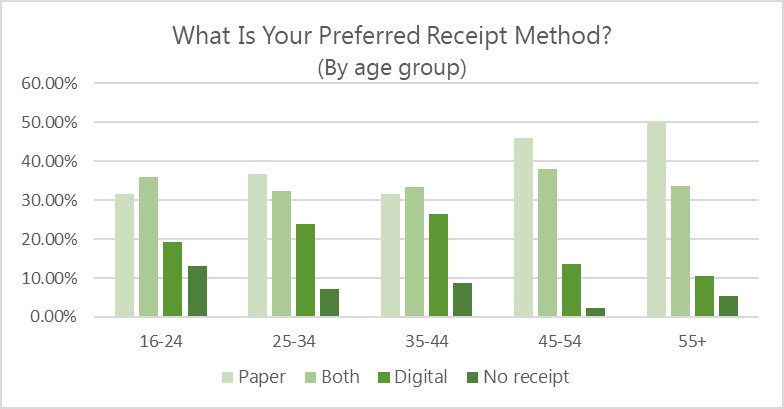
2. Why Do You Prefer Digital or Paper Receipts?
Of respondents who prefer digital, 70 percent say it's because they're better for the environment and easier to store.
As for respondents who prefer paper receipts, 64 percent say it's because they feel more secure with a physical copy, and 39 percent say they feel paper copies make it easier for them to monitor their spending.
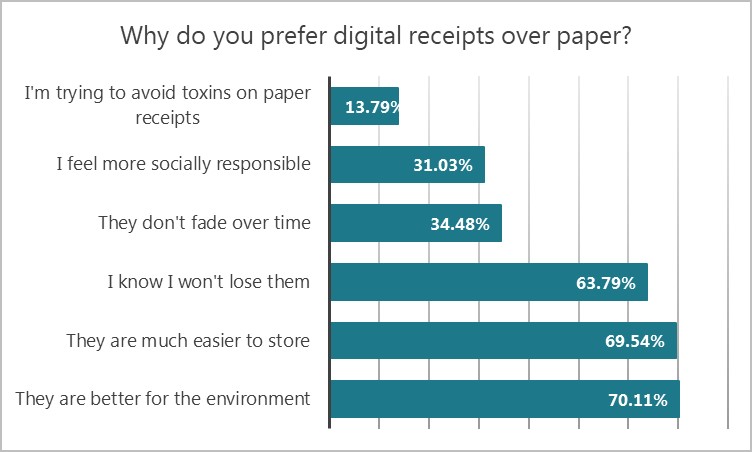
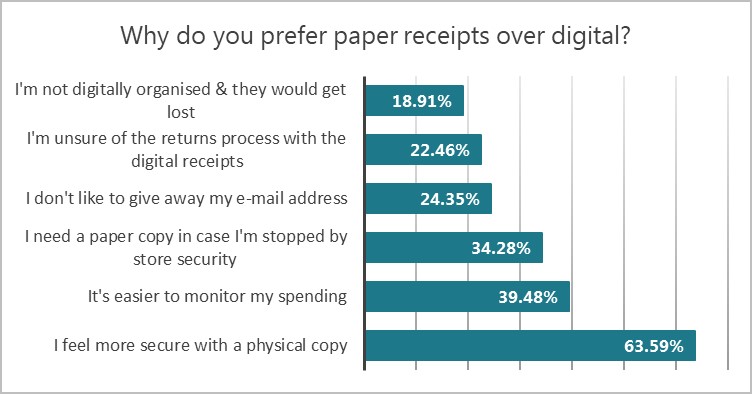
3. How often do you lose or throw away paper receipts?
Respondents who take paper receipts say they lose receipts that they intend to keep an average of 5 times a month.
Most respondents estimated that they throw away or lose over half of paper receipts that they receive, with 28 percent saying they throw away or lose nearly all paper receipts that they receive. Almost half of respondents said they "feel guilty" throwing away paper receipts.
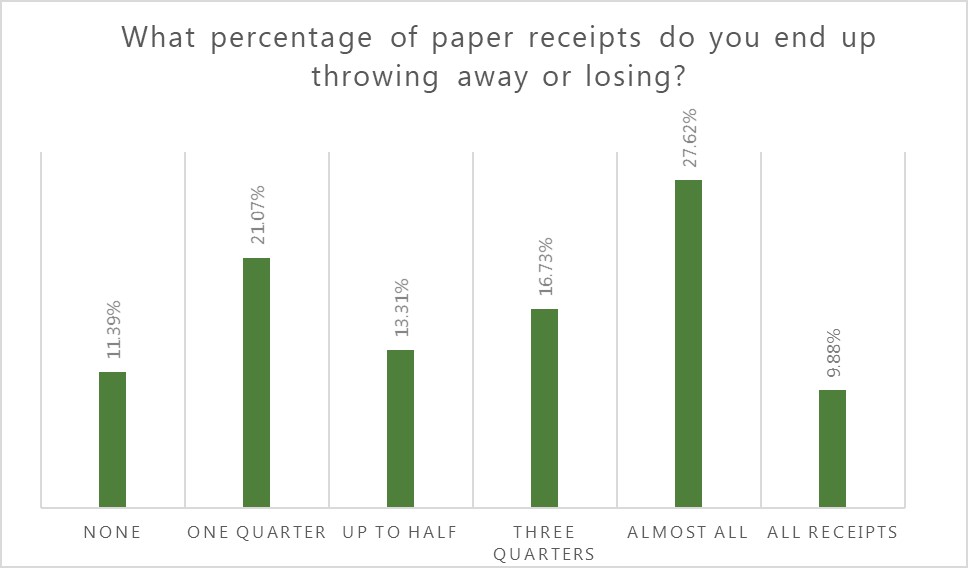
4. Would you like retailers to offer digital receipts as an option to customers?
Of all respondents, whether they prefer digital or paper, 89 percent would like retailers to offer digital receipts as an option, with the majority saying it should "definitely" be an option.
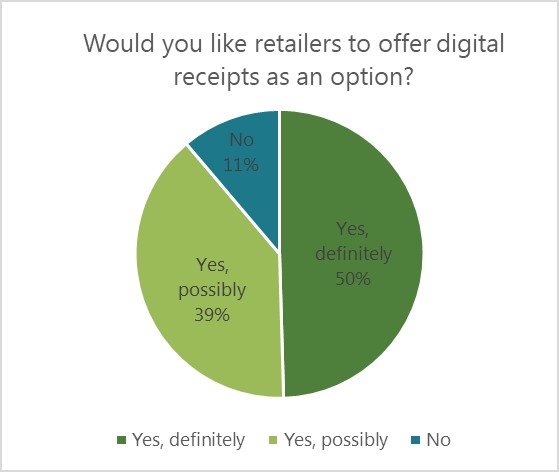
5. Additional Findings
Over a third of respondents often throw away paper receipts without thinking about it. Also, a third want to see companies do more to reduce the number of paper receipts. More than a quarter of respondents expressed being concerned that the US consumes 256,300 tons of thermal paper for receipts every year. And 20 percent of respondents don't know why we still use paper receipts.
So, What Did We Learn?
- The majority of Americans want to see digital receipt options at stores.
- One quarter of people prefer digital or no receipt options, the majority of this group aged 44 years or younger. Just less than half of respondents prefer paper receipts, with the majority in age groups 45 years and older.
- Customers report losing receipts they intended to keep 5 times a month.
- More than 37 percent of customers throw away or lose nearly all or all of the paper receipts they receive.
These findings are in line with the goals of Skip the Slip. We want retailers to offer: a digital option; phenol-free paper receipts by customer request; and an option for no receipt so that customers can have the choice. Forward-thinking retailers are already looking to offer paperless options, as preferred by many younger customers. By offering these options, stores can reduce paper waste and save money by not printing receipts people do not want.
This research was conducted by Censuswide, with 1,011 general respondents in the US in July of 2019. Censuswide abide by and employ members of the Market Research Society which is based on the ESOMAR principles. See full results summary here.
|
|
Your Green Life |
2020 has thrown everyone for a loop. But Green America has been steadfastly advocating for a just, inclusive, and green recovery from the pandemic economy. Our vision is the same as ever: We work for a world where all people have enough, where all communities are healthy and safe, and where the abundance of the Earth is preserved for all the generations to come.
Look to Your Green Life for ideas on how to make a difference from home, get inspired by dozens of eco-projects, find tips to stay connected, and build your green, resilient community. |
|
GA's 2020 Green Economy Victories |
Together with our members, we’re getting the largest companies on the planet to change the way they do business for the better—sourcing clean energy, engaging in agriculture that protects the soil and sequesters carbon, and ending practices that harm workers, communities, and consumers. This is the green economy.
Indeed, our successes come from our 200,000+ members sending tens of thousands of messages to corporate CEOs, the hundreds of news and social media stories we generate each year, the guidance we provide companies to adopt truly green practices, and all the information we provide to families to deepen their green journeys for people, planet, and economic justice.
At a time when covid-19 is exposing and increasing the inequalities in our country and world, Green America’s work to create a green economy is more important than ever. Here are just a few of our successes from the past year.

We’re getting the telecom giants AT&T, Verizon, and T-Mobile/Sprint to rapidly adopt renewable energy to power their massive networks. Thanks to our campaigns, T-Mobile/Sprint is nearing 100 percent renewable energy, Verizon is committed to 50 percent renewables, and AT&T is sourcing over 25 percent renewable energy. This is all up from the industry using near zero percent just three years ago.
We successfully pushed Amazon to commit to 100 percent renewable energy by 2030 and to finally disclose the company’s massive climate impacts and plans for addressing them.
Walmart announced it would be transitioning to low-impact refrigerants by 2040, but does not specify what refrigerants it will use or provide solutions to its current refrigerant leaks. Our Cool It! campaign will keep the pressure on Walmart to accelerate its timeline and provide a more detailed plan to end its HFC emissions.


We’re helping companies like food industry giant Danone North America make their brands regenerative and carbon positive—that is, removing more carbon from the atmosphere than it takes to grow, make, and transport the products. For example, Danone’s Horizon brand announced it will be “climate positive” by 2025. As the largest organic dairy brand in the world, this marks a key shift for the dairy industry.
We’ve reached millions of people with our Climate Victory Gardens campaign and there are now over 4,050 registered Climate Victory Gardens in the US. These gardens are drawing down 10,855 tons of carbon every year, which is the equivalent to eliminating emissions from nearly 90,000,000 miles driven. And, gardeners nationwide are growing healthy foods for their families.

We pressured JPMorgan Chase, the world’s largest funder of fossil fuels, to stop financing fossil fuels; the bank has agreed to end new financing of coal and arctic drilling, and to phase out existing financing for coal mining by 2024.
We’re working with leaders in the banking and investing community worldwide to promote climate safe lending—ending the financing of fossil fuels and rapidly scaling up renewable energy in the entire banking sector.

We pressured Carter’s, the largest baby and kid’s clothing retailer in the US, to restrict the toxic chemicals used in their clothes, protecting the most vulnerable consumers and the workers making these baby clothes.
We’re working with the largest tech companies—including Apple, Dell, and HP—to remove the most toxic chemicals from their supplier factories to protect millions of workers worldwide.
Join us and our work for a more just world by voting with your dollars and supporting small, sustainable business to help build the green economy and generate more green victories!
|
|
corporate turkeys 2020 |
|
|
Turkey's Don't Feed |
|
|
This Year’s Corporate Turkeys Are… |
Last year, Green America launched a new tradition for Thanksgiving: crowning CEOs leading the way in bad business practices as Corporate Turkeys of the year. This year’s winners distinguished themselves through their failures in corporate responsibility. They didn't treat workers well in the pandemic, take action on the climate crisis, and continued to pump toxic chemicals into the world.
And the Corporate Turkey winners are:

1. For failure to protect workers in the pandemic: Jeff Bezos, Amazon.
When the pandemic broke out, orders to Amazon increased, which put more pressure on workers and upped the hours worked in Amazon’s warehouses (where working conditions were already hazardous, pre-COVID-19). Warehouse workers repeatedly called on Amazon to protect them from COVID-19 and offer paid time off for workers who needed it. Amazon responded by firing several workers who raised concerns. As a result of Amazon’s inaction, over 19,000 Amazon workers have contracted COVID-19. Join Green America in pushing Amazon to protect its workers.
2. For continued efforts to market poisons: Werner Baumann, Bayer Monsanto.
Even though Bayer-Monsanto is likely to pay over $11 billion to settle lawsuits stemming from Roundup’s cancer-causing properties, the company continues to forge ahead with GMOs and the toxic pesticides that are tied to them, including a new GE corn that resists five toxic chemicals. At a time when more and more farmers are calling for regenerative agriculture, we need to end Bayer-Monsanto’s toxic reign. Find out more about GMOs and pesticides.
3. For driving the climate crisis: Doug McMillon, Walmart.
Walmart talks a good game on climate change, but the mega-retailer is refusing to act fast on its biggest source of emissions: refrigerants. The HFCs that cool Walmart’s fridges and freezers are a major source of the climate crisis, but unlike Target and Aldi, Walmart is moving too slowly to set a clear goal for climate-friendly refrigerants in all of its stores and facilities. Since Walmart is the nation’s biggest grocer, join Green America in urging Walmart to act fast on refrigerants.
While these three corporate CEOs are all Corporate Turkeys of the year, there are many more. Last year’s “awards” went to the CEOs of Amazon, Godiva, Walmart, and Carter’s for their negative impacts on people and the planet.
Check out all of Green America's actions and join us in pushing corporations to make progress on major social and environmental issues.
And, if you are not currently a member of Green America, please consider making a donation to support our campaigns calling on corporations to be more responsible. |
|
CVG Pin Key |
|
|
Breaking Down the Claims of a Plastics Greenwash Campaign |
As public outrage on the plastic pollution crisis has grown, businesses are now grappling with how to reduce their plastic footprint. Meanwhile, misleading claims and plastics greenwashing by manufacturers pose challenges to customers and businesses trying to make sustainable choices.
Plastics manufacturers and trade groups are working to improve the reputation of their products and have used the coronavirus pandemic to boost production. In some cases, misleading and false information is being pushed to present plastics in a better light.
The National Association for PET Container Resources (NAPCOR) has a new marketing campaign called Positively PET, positioning it as the plastic “everyone can feel good about.” PET is one of the most ubiquitous forms of plastic – people drink from it, eat from it, and even wear it.
What is PET?
PET (polyethylene terephthalate) is a plastic resin that’s frequently used to package food and beverages. It’s also used in carpet, apparel, and automobile parts. Its first use was as polyester textile fibers in the 1940s and by the 1970s, chemists developed a way to mold it into bottles.
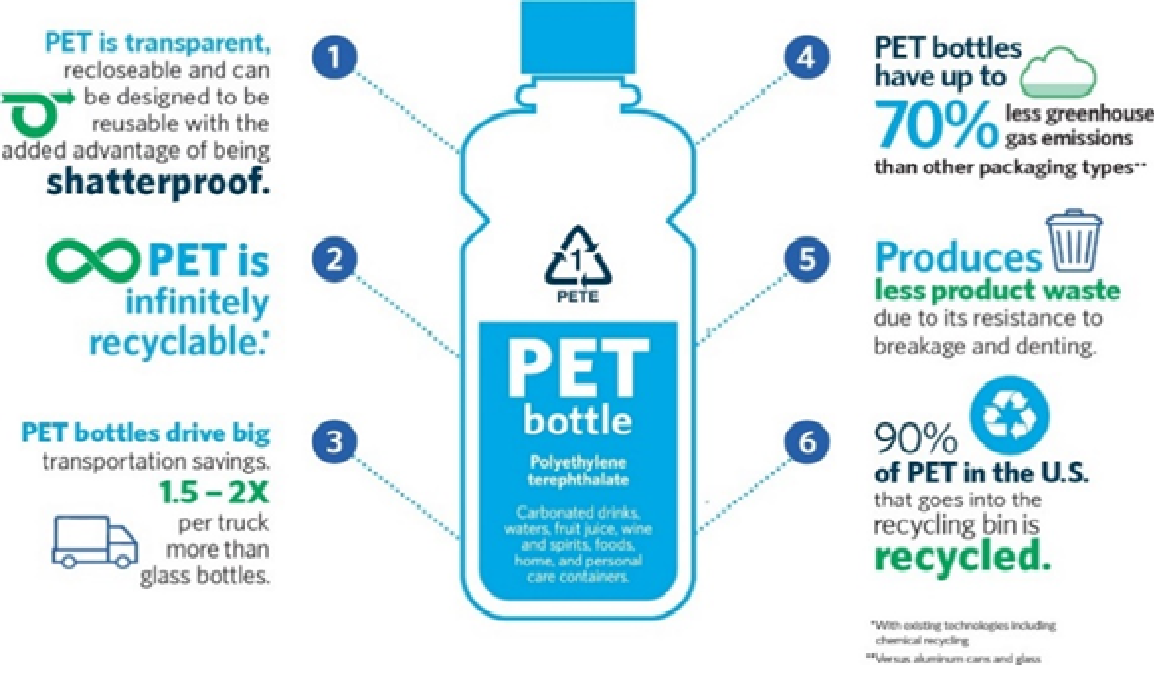 Figure 1 Infographic, PostivelyPET, NAPCOR Figure 1 Infographic, PostivelyPET, NAPCOR
You can identify PET by the small number 1 in the recycling symbol on a container – these numbers are just plastic resin identification numbers and do not mean that an item is recyclable. This confusing labeling causes contamination for recyclers, as recycling bins are filled with many plastics that can’t be recycled or have no end markets.
The industry is attempting to separate PET from other plastic types, with a narrative that it’s high-performing, environmentally friendly, and chemically safe. But how accurate are these claims?
“Infinitely Recyclable”
When materials are “infinitely recyclable,” they can be recycled time and again down to their raw state. Glass and metal fall under this category, but plastic can only be recycled once or twice and often requires new plastic modifiers to be added to strengthen the recycled plastic. Paper fibers also slightly weaken when recycled, but these fibers can be reused roughly seven times in a cascading process from products with longer fibers (magazines and copy paper) down to lower grade items that use shorter fibers (cardboard or tissue paper).
Claims of infinite recyclability for plastics hinges on the use of chemical recycling, which returns plastics to their basic molecular state. It’s estimated that even with the expansion of chemical recycling, only 20 percent of plastics could effectively go through this process because of contamination or limited recycling collection. But GAIA reports that chemical recycling is more energy-intensive, ineffective, and bad for the climate and communities. It releases air pollutants and most plastic waste is lost or burned in the process rather than becoming new usable plastic. Until strict regulations on toxic chemicals, emissions, residue management, and other concerns are passed, GAIA advises that mechanical recycling is a better option with a smaller carbon footprint.
Scaling up recycling capability is a necessary piece of addressing waste, but it alone will not be an effective solution to eradicating plastic pollution. Manufacturing with virgin plastic is cheaper than using recycled and the petroleum industry is increasing its reliance on plastic as a source of revenue. If nothing changes, new plastic production will surpass 400 million metric tons a year by 2040, releasing over 2 billion tons of greenhouse gases and leaking over 29 million tons into our environment.
Even if plastics recycling technology improves, if the economics are still preventing a decrease in virgin production, we will continue to see a flood of plastic waste.
“High Recycling Rate”
In an effective recycling system, we would use fewer new materials and reduce resource extraction. But new plastic production is expected to triple by 2050 and the overall recycling rate for plastics is a dismal 8 percent. The claim that PET is the most recycled plastic is accurate, but it’s misleading to suggest PET recycling rates are “high.” Each year, just 29 percent of PET bottles and jars are recycled in the United States.
For decades, the plastics industry has increasingly filled our waste streams with a range of items, insisting that recyclers deal with any mold of mix of plastic resins. The oil industry makes more than $400 billion a year making plastic, showing little incentive to boost recycling rates that would compete with new plastic production. Industry records prove that there has always been “serious doubt” that plastic recycling could ever be viable on an economic basis. Despite this knowledge, the industry has continued to mislead the public.
“Fewer Environmental Impacts”
Plastic is lightweight, durable, and flexible, which are incredible qualities for packaging but also why managing plastic is so difficult. The variety of plastic molds and resins is a challenge for recyclers to sort and sell. Small, light plastic items can be lost in the management process or be erroneously sorted and end up contaminating other recyclable materials at sorting facilities.
The plastics industry cites the lower transportation emissions from plastic, but life cycle models show that even if some materials slightly increase transportation impacts, the savings on the production and disposal phases compared to plastic still generate overall emission savings.
The industry claims PET causes fewer impacts than other forms of packaging, such as aluminum, but this claim doesn’t reference disposal. Recycling plastic poses technical and economic challenges, but aluminum can be recycled time and again without loss of quality and beverage cans have on average 73 percent recycled content.
We can’t compare materials without considering their market demand, current recycling infrastructure, and risks they pose when polluted into the environment. The industry says that aluminum cans polluted into waterways sink while plastics float near the surface, presumably making plastic easier to remove from the environment. The reality is that a dump truck worth of plastic enters our oceans every minute. An estimated 99 percent of this plastic ends up buried on the sea floor or suspended deep below the water’s surface, posing grave threats to wildlife. Some items break down over time only to become microplastics in the air we breathe and the food we eat.
This crisis is caused by a deluge of plastic items that manufacturers are churning out at increasing speed. The plastics industry has continued to push recycling as the solution while also blocking efforts to improve recycling and reduce waste at every turn.
Real Solutions for Plastics Greenwashing
Greenwashing industries have no place in a truly green economy. While plastic tries to fix its public image, its wave of pollution continues to surge. Many businesses want to shrink their plastic footprint but are uncertain of which solution fits their unique packaging needs. The good news is that packaging solutions exist that reduce greenhouse gas emissions and serve a more circular, responsible management of materials.
- Go package-free. Sustainable businesses know that naked products are easier on production costs and better for the planet – and conscious consumers are willing to spend more on brands that care about the environment. Many of Green America's certified Green Business Network members opt out of packaging or choose easy-to-recycle options like paper or cardboard. LUSH is a major retailer that sells many of their products without excess packaging.
- Explore reusables. Innovative companies have ideated reusable packaging into their business models. Fresh Bowl is a company that offers healthy foods via vending machines, packaged in reusable containers that can be returned for credit. Deposit schemes, take-back programs, and bulk options are viable alternatives, too.
- Right-size and redesign. Rethinking products at the development phase can also reduce plastic packaging waste, such as Seventh Generation's Zero Plastic Homecare line. Seventh Generation removed the need for plastic altogether by eliminating water from their cleaners, delivering powders that work just as efficiently as liquid formulas.
- Support the Break Free From Plastic Pollution Act. The legislation pulls from the success of state and local initiatives to reduce plastic, such as developing a 10-cent nationwide container deposit system, bans non-recyclables, and tackles petrochemical pollution. Your company can join Green America, as well as 470 other organizations, in voicing your support for the act.
- Design for circularity. For any plastic items that you cannot find alternatives for, use recycled content to avoid plastic designs with dyes, pigments, and additives. Look to recyclable inks and labels for marketing on your packaging.
|
|
Justice, Equity, Diversity, and Inclusion in Agriculture |
Green America works with many partners all along the supply chain from farmers to consumer products to create a safe, just, and sustainable food system. We know that some communities are often left out of important conversations and are striving to build an inclusive and diverse society where all people have an equal place at the table.
Here are some resources about this important work for equity, justice, diversity, and inclusion including great allied organizations that are spearheading change.
Without access to fresh food, health and wellbeing is bound to suffer. But to truly tackle food access, activists take on racist systems and language, too.
How urban gardening is regenerating L.A.’s soil—and community
Soul Fire Farm is a force to be reckoned with, tackling racism and injustice at all levels of the food system.
For Black American farmers, turning to the soil can mean confronting painful history. Some farmers are reclaiming that past as they use regenerative farming techniques to take on food insecurity and the climate crisis.
Imagine you’re new to a community. But it is plagued by poverty, conflict, and oppression. Parts of your neighborhood are covered in trash, and abandoned homes are a common sight.
Meet the South Florida Organization Combatting Food and Health Injustice.
Our path forward together on climate and race - November 9, 2020 Trump’s Department of Labor Fast-tracks Rule to Undermine Socially Responsible Investing
The warming climate is already affecting families from the oil fields of North Dakota to the rising waters of the Gulf Coast. But climate warriors are reclaiming spaces and fighting for our future.
From 1964 to 1992, the oil giant Texaco extracted billions of barrels of oil from the Amazonian rainforests of Ecuador.
Communities of color are disproportionately impacted by climate change and toxic pollution. These communities are also forging the path toward environmental and climate justice for all.
We have had many big breakthroughs recently. Major companies across all industries are changing -- proof of the power of consumer pressure. We are witnessing how our economic power is truly changing the world for good and towards a simpler, more sustainable way of living.
Green America believes we must work together to build a truly green economy that values all people and the planet.
Work of Our Allies
Kiss the Ground
Intertribal Agriculture Council
The Organic and Non-GMO Report
Mercaris
Freedmen Heirs Foundation
Soul Fire Farm
National Black Farmers Association
Rise and Root Farm
Ron Finley HQ
Agriculture Justice Project
Bread for the City
La Via Campesina
Video: Plantation Economics and Historical Discrimination in the USDA
Chris Newman on The Checkout Podcast
Identifying and Countering White Supremacy Culture in Food Systems - Duke University (PDF)
Agricultural Diversity Facts
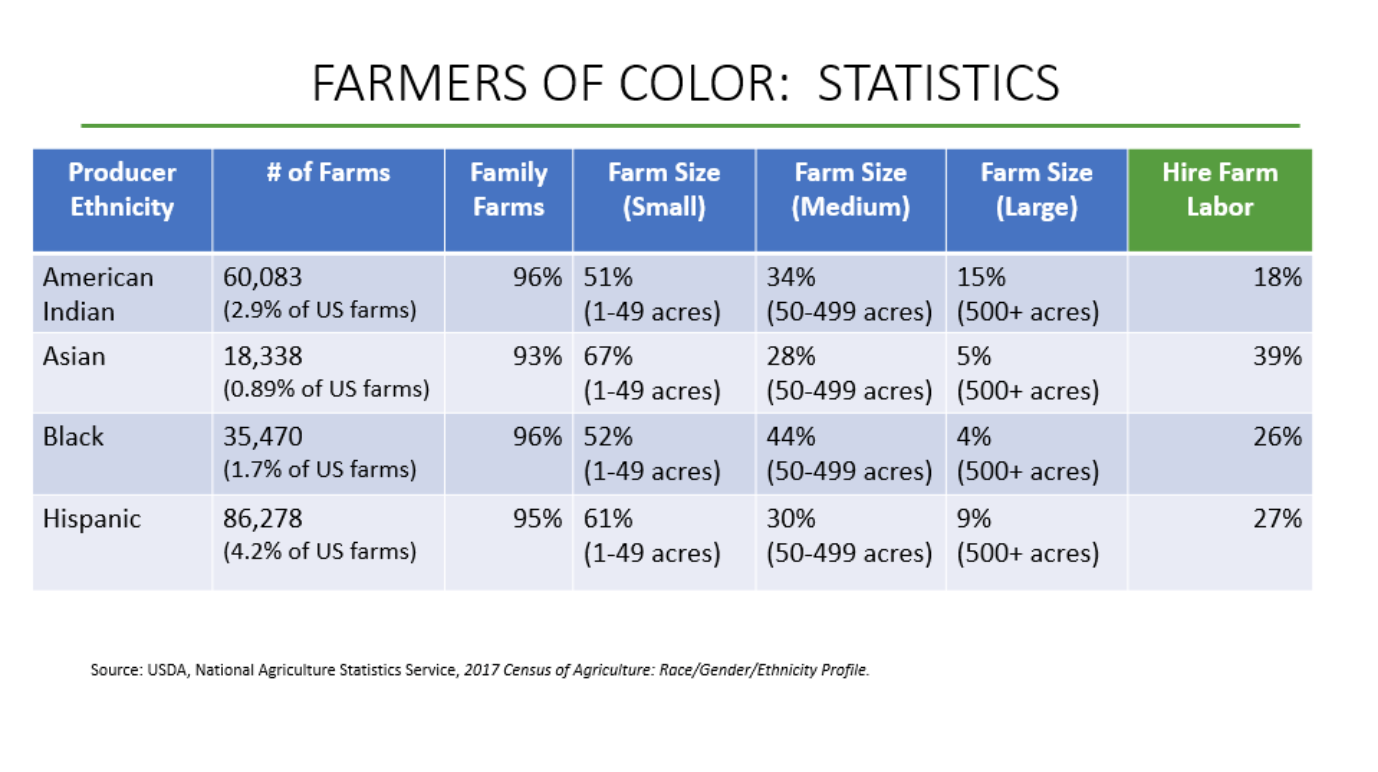
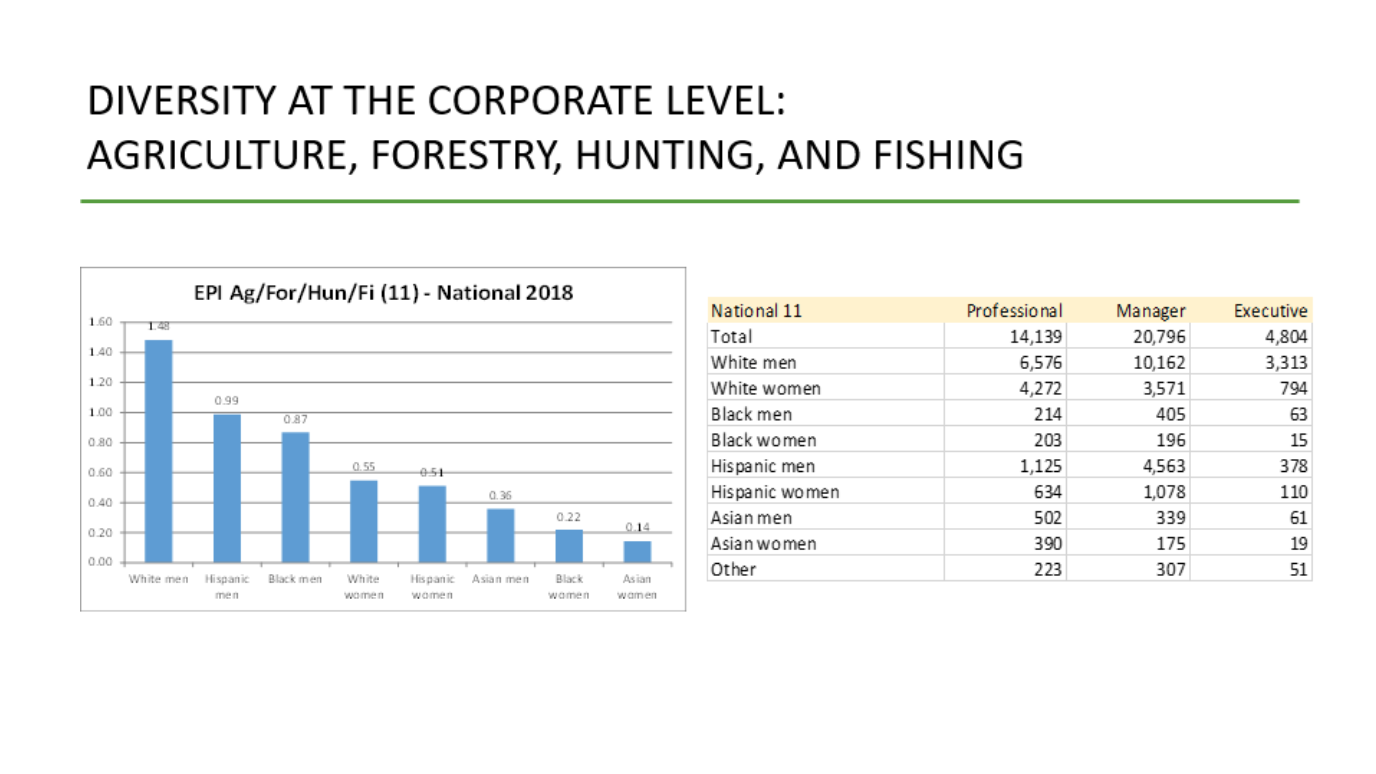
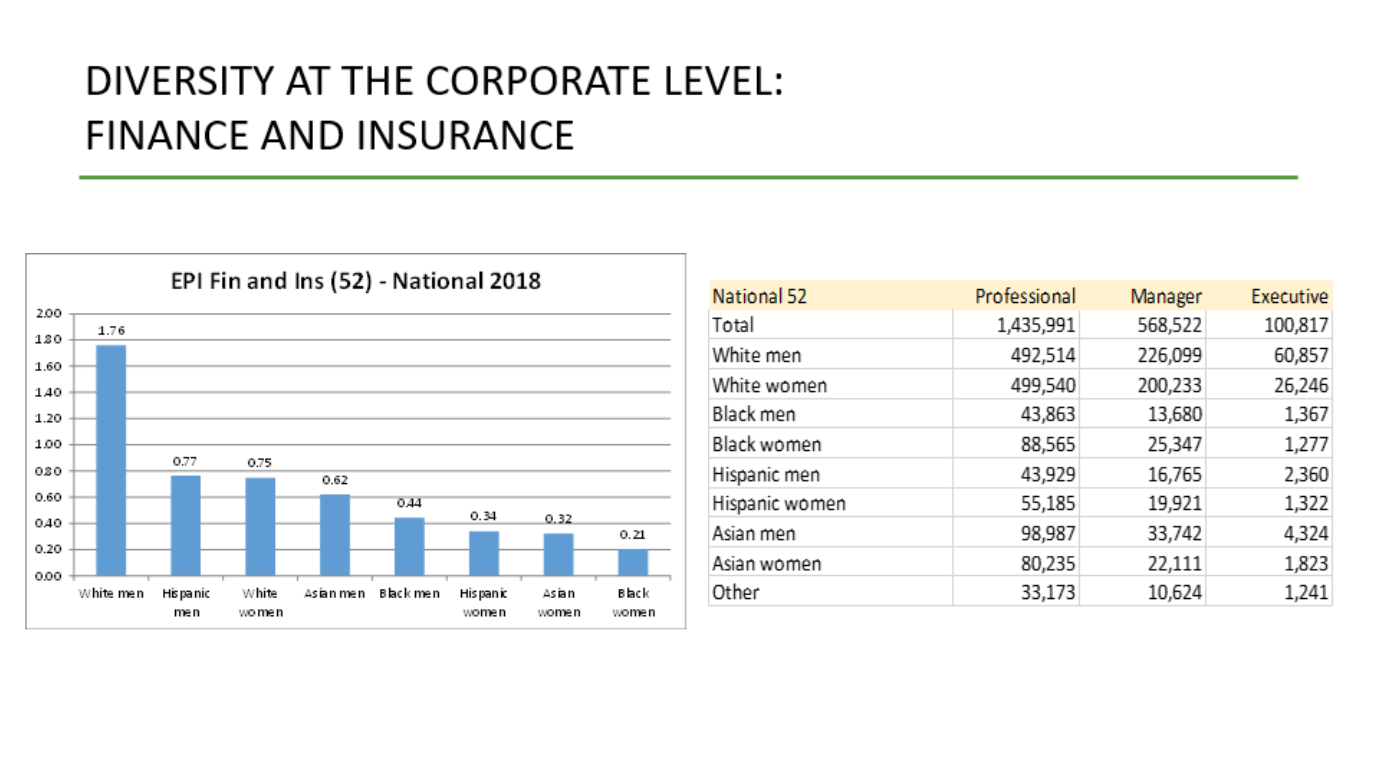
|