|
Garden kids, Inc |
Parents love our healthy fabrics and hand-made quality. Kids love our soft, comfy designs. Made-to-last of high-quality organic cotton—and kid-approved! Made in California. |
|
DHANA INC |
Dhana Inc. is an ethical circular fashion brand connecting our youth to people and planet through the medium of fashion. Dhana Inc.'s signature brand is the Dhana Wearin' the World Collection for babies, kids, and teens. Created by artists, inspired by nature, Dhana apparel reflects the lifestyle of the trendy, socially conscious, and environmentally savvy. Dhana celebrates ten years of commitment to social and environmental impact, is a Best For The World Honoree 2018, and original signatory of Global Fashion Agenda's 2020 Circular Fashion System Commitment. |
|
UKUSH Handmade |
Handmade totes, bags and scarves in bamboo, cotton & wool. Fair trade, repurposed. Original beaded jewelry and keychain/ornaments. Mayan co-ops. |
|
Terra Experience |
Beautiful handwoven textiles, art, accessories, gifts, jewelry, 18 doll clothes, from Guatemala and Latin America. Strives to support Fair Trade, Mayan artisans, their communities and environment. |
|
Goza Gear Screen Print & EMB |
Custom t-shirt, hoodie, and tote bag printer. Custom embroidered hats, fleece, sport shirts and more. Eco-Friendly apparel printed with phthalate free or water base inks. Oeko-Tex certified threads used for all embroidery. Contract services available (customer supplied goods). California's first certified green screen printer. ʺCaring about what you wear for over 20 yearsʺ. |
|
Ink Forest Eco-Friendly Screen Printing |
Ink Forest screen prints apparel using only water based inks. Also offers promotional items/
Ink Forest is a Certified Women Owned Business.
|
|
HandCandy Mittens |
Fun and functional hats, mittens, scarves, and other necessary accessories from recycled sweaters and other discarded clothing. |
|
TS Designs, Inc. |
ʺTS Designs is a custom t-shirt manufacturer and printer focused on creating domestic and sustainably made shirts for environmentally and socially conscious businesses and organizations.ʺ
TS Designs, founded in 1977, is a custom t-shirt manufacturer and printer focused on creating domestic and sustainably made shirts for environmentally and socially conscious businesses and organizations.
Always innovating they developed WhereYourClothing.com, which allows you to see every step along your t-shirt’s journey, beginning with the farmer who grows the cotton, including an image of the contact person, their phone number, email, and a physical address.
The supply chain of their flagship t-shirt brand, Cotton of the Carolinas is around 750 miles and completely made within North Carolina, USA.
TS Designs has innovated garment dyeing techniques encompassing reactive and natural dyes; promotes natural fibers such as cotton and hemp; has developed the eco-friendly screen print process REHANCE, which has a super-soft no print feel, and provides Direct to Garment printing with water-based inks.
It’s retail brand, Solid State Clothing offers small batches of premium-quality t-shirts and is a platform for experimenting with new materials like natural dyes and creative collaborations with regional artists and makers.
Under the leadership of CEO and President Eric Henry, TS Designs sets the bar for corporate responsibility by cultivating responsible clothing. Eric says, “We have set out to make the highest quality and most sustainable t-shirts in the marketplace.” |
|
STAY VOCAL |
Our ReUse T-shirts are the voice of a progressive, positive world.
ReUse Apparel. ʺBecause you can't recycle the planet. We rescue T-shirts and give them a second life with a new design.ʺ |
|
Ecologic Designs, Inc |
Outdoor and lifestyle gear that is ecologically and socially responsible and produced in Colorado from recycled vinyl, bike tubes, and sustainable fabrics. |
|
Ancient Circles/Opens Circle |
Celtic design products made in the US or imported under strict supervision (no child labor). Ancient designs in jewelry, tapestries, clothing, scarves, and costumes. |
|
Blue Canoe |
ʺVersatile, comfortable, organic cotton clothing from active and casual wear to lingerie. Our reputation is quality, stylish cuts, and harmonious colors.ʺ |
|
DECENT EXPOSURES, INC. |
100% cotton bras, underwear, and clothing for the comfort you deserve! Over 200 sizes and 20 colors, including organic cotton and latex-free elastic.
About Us
Hate your bra? Wish you didn’t have to wear one? In 1986, Decent Exposures® began manufacturing the Original Un-Bra, designed by women, for women, with your comfort in mind. Since then, we have successfully fit thousands of customers of all sizes, from 30AA to 60J, and every size in between. Over the years, we have expanded our product line to include front closure bras, nursing bras, swimwear, everyday and activewear clothing, as well as baby items and accessories, all made from the same high quality fabrics we use to make our bras and underwear.
Social responsibility is important to us. We use recycled materials for packaging whenever possible, limit our use of plastic, and pass on large fabric scraps to be re-purposed or recycled. We buy organic fabric whenever possible, all of which is made in the USA. In 2016 we were one of 10 finalists for Green America’s People and Planet Award for ethical apparel supply chains. All our products are made in our Seattle office, where most of our employees have been with us for over 10 years. They are paid well above minimum wage, with excellent benefits, and are truly valued for the excellent work they do. We have never bought or sold our mailing lists, as we know quality products and customer satisfaction are the best ways to generate business.
We proudly offer personalized services and customize our products so they fit you. With over 30 years of experience fitting women, both in person and long-distance, we’re confident we can help you find what you need for your unique shape. Need your straps longer or shorter? Armholes cut higher or lower? Latex-free elastic? We can adjust and modify our products to ensure a perfect fit, and we keep your information on file for future orders. Because we offer so many products in such a wide range of sizes, colors and fabrics, we make most items to order, so you get exactly what you want. We do have a small inventory of products available that can ship right away. Regular First Class shipping is included in our prices, so there are no surprises at checkout, with most orders shipping in about 3 weeks. For faster delivery, see our Shipping Options.
Whether you have been a customer for years or are just hearing about us for the first time, we look forward to helping you find the comfort you deserve! |
|
EcoPlanet-EcoChoices.com Natural Living Store |
|
|
Fair Indigo |
After years in the apparel industry, a small group of us left our jobs determined to make a difference and to change the industry we grew up in. To build clothing that's timeless, of impeccable quality, and sustainably made. Sustainable not only for the planet, but for the human beings involved in your clothing's journey from the cotton farms to your closet.
Instead of racing to the bottom, we're aspiring to the top. With premium-quality organic T-shirts and loungewear that looks good, feels good, and does good.
Yes, it's time to say good bye to cheap, disposable, fast fashion. For good. |
|
FaeriesDance.com |
Eco-Fashion and organic lingerie boutique offering a huge selection of sustainable clothing including hard-to-find organic items from evening gowns to organic cotton bras and underwear. FaeriesDance.com also has recycled and sustainable jewelry as well as fashions for men and children. More than 1200 eco-friendly, ethically produced items available. |
|
Elisabethan LLC |
Exceptional garments and goodies made from all the post-consumer, RECYCLED fabric we can get our eager little mitts on. Colorado-made since 1996. |
|
INDIGENOUS |
ʺINDIGENOUS is the premier brand in affordable eco-luxury fashion. Our Fair Trade and organic apparel is designed using only the most supple organic cotton, silk, wool, alpaca, and Tencel™. INDIGENOUS makes stylish, comfortable clothing that is healthy for you and good for the environment.ʺ |
|
Mata Traders |
Vintage-inspired and artisan-made. Clothing and jewelry designed in Chicago and handcrafted by Fair Trade women's cooperatives and artisan groups. |
|
Sympatico Clothing |
Eco-Friendly Hemp and Tencel Women's Clothing
Sympatico Clothing is crafted for women seeking simple elegance and comfort in their apparel. Made of eco-friendly hemp and Tencel (lyocell), our styles incorporate classic lines while celebrating the female form in all its diversity.
Women's Natural-Fiber Clothes Made in the USA
Designed and hand-crafted in the USA, each piece of Sympatico clothing is preshrunk and is easily machine washed and tumble or air dried. Our hemp and tencel are sustainably produced and combine for lovely drape and a soft hand. |
|
Texture Clothing |
Sustainably made women's clothing, using hemp & organic cotton. Made in the USA. Clothing with a Conscience. |
|
Synergy Organic Clothing |
Fashion forward clothing and yoga apparel for women to be worn with effortless style. |
|
Upland Road / Eco-Boutique |
Sustainable, ethically-made clothing, accessories, kitchen goods and gifts.
Hand-Selected Clothing, Accessories and Gifts for Women, Men and Kids. Supporting People and the Planet, Everything At UplandRoad.com Is Eco-Friendly And Ethically-Made. Visit Us Now! |
|
Asha Imports |
Fair Trade and environmentally friendly accessories from India and Bangladesh. Made by women refugees or those escaping poverty or sex trade. Offers popular sari throws, quilts, pillows, handbags, and other recycled plastic or jute bags. |
|
All About Climate Change |

Climate change is caused by emissions of carbon dioxide and other greenhouse gases that are released when fossil fuels are burned or forests are cleared. These gases rise into the atmosphere and can remain for decades or even centuries. As they build up, the gases create a "glass window" over the Earth, trapping in heat that would otherwise escape. As the Earth’s temperature rises, our climate begins to change, resulting in:
-
Decreasing snow cover and sea ice
-
Rising sea levels and increases in water temperature
-
Increasing precipitation over middle and high latitudes
-
Severe drought in lower latitudes, leading to food shortages and starvation
-
Faster spread of disease
-
Increasing frequency of extreme precipitation
Compromised living conditions, financial burdens, and social and cultural disruptions will be felt, particularly impacting people of color, low-income, and indigenous communities
The science is clear — climate change is occurring and human activity is the primary cause. The debate is not about whether or not climate change is real. The questions facing us now are: How devastating will its impact be on humans and the environment and what are we going to do about it?
|
|
Grounds for Change: Organic Coffee Empowering Women |
Grounds for Change, a Certified member of the Green Business Network since 2007, is making waves as an industry leader for its impressive environmental sustainability and social commitments. This article originally appeared as the Impact department titled “Organic Coffee Changing the Lives of Peruvian Women” in the Fall 2016 issue of B Magazine.
Grounds for Change co-founder Kelsey Marshall remembers the precise moment when he and his wife, Stacy, got the idea for their family company. It was 2003, when the fair-trade movement was still in its infancy, and the couple was harvesting coffee beans — an educational interlude during a work trip to Costa Rica. Stacy ran an environmental nonprofit focused on protecting leatherback sea turtles in the Central American nation, and Kelsey, an e-commerce executive, was accompanying her.
“The pickers were Nicaraguan. They had crossed the border with their entire families, and I can remember clearly how the parents worked in the fields while the kids rested in the shade, beneath some trees,” Marshall says.
The Marshalls talked with the pickers and farmers, and learned of their challenges, including the difficulties farmers faced when they wanted to switch to organic production. Organic coffee farmers typically have lower yields than conventional farmers do, and the certification process requires a three-year conversion period before farmers are qualified to earn the premium price organic coffee brings in the marketplace.
“We were looking for a business that we could start small and grow, that we could bootstrap,” Marshall says. “Getting that sense of the conditions that the pickers were experiencing was vital. It inspired us to create a business that would champion both fair-trade and organic certification in order to get more money back into the hands of farmers.”
Using their savings, the Marshalls quit their jobs and launched Grounds for Change in Poulsbo, a laid-back town on Puget Sound in Washington state. Grounds for Change has grown steadily into a company that stands out, even in the highly competitive field of fair-trade and organic coffee roasters. Grounds for Change is the first U.S. roaster to gain carbon-neutral certification from Carbonfund.org, a leading third-party, carbon-reduction certifying organization in the United States.
Grounds for Change earned the seal by shrinking its coffee’s environmental footprint to a minimum Grounds for Change supply chain . The fair-trade coffee company works with growers who hand-pick shade-grown beans and avoid using charcoal-based fertilizers. And Grounds for Change buys offsets to make up for the energy used by its end-consumer coffee drinkers when they heat their water.
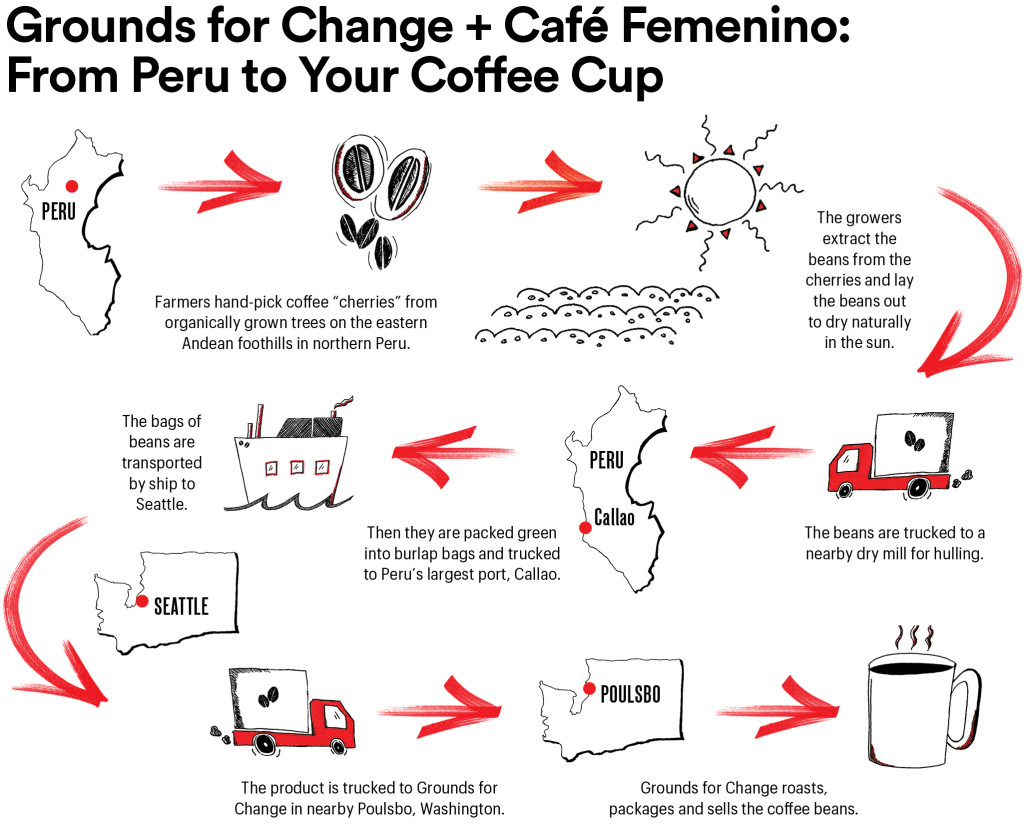
But the most interesting aspect of Grounds for Change’s push to make the coffee industry more equitable and sustainable may not be its environmental innovations. The company’s social commitments go above and beyond the formal requirements of its fair-trade certification and include its partnership with the groundbreaking program Café Femenino.
Founded in Peru in 2004, Café Femenino aims to support women within the often impoverished communities that grow coffee across the developing world, disrupting local power structures in ways that improve human rights and economic justice. Café Femenino is now one of the best-selling coffee brands of the Organic Products Trading Company (OPTCO), which is based in Vancouver, Washington, and wholesales the beans in North America to roasters such as Grounds for Change.
Amplifying Women’s Voices With Café Femenino Label
“It [Café Femenino] has revolutionized our lives,” says farmer Lili Leyva Alvites, 37. She adds that by choosing women-led organizations to grow its coffee, Café Femenino has empowered her and her female neighbors in La Florida, a small coffee-growing village in the lush eastern Andean foothills of northern Peru. By seeking out female farmers, the partnership has given those women freedom and power they have never experienced before. “The timidity has gone,” Alvites says of the role the women play in the local coffee-growers collective, and the community more generally. “Thanks to Café Femenino, we now have a say. We are on the council [of the collective]. Before, we were embarrassed to speak up.”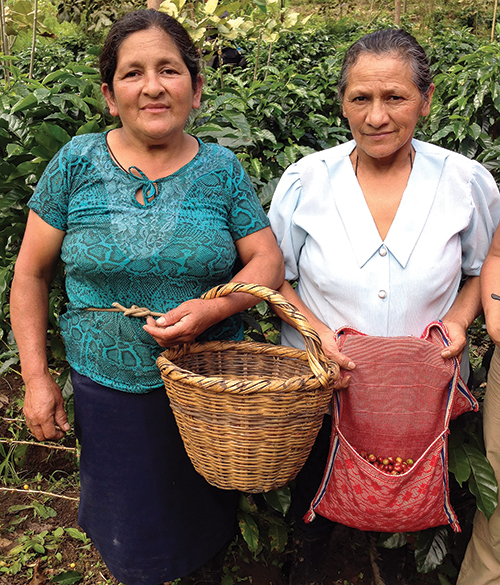
Grounds for Change and Cafe Femenino coffee growers pause to display their harvests on an organic coffee farm in the Andean foothills of Peru. Photo courtesy of Grounds for Change.
The idea behind Café Femenino is that the women, who tend to be responsible for children and the elderly in their communities, are more focused on using income in a responsible and sustainable way and in improving local resources. So far, the women who supply Café Femenino are proving its hypothesis.
“Now, we have more money for basic necessities, like food, education and medicine. Without Café Femenino, none of that would be possible; we were just scraping by,” says Alvites.
For Alvites, the necessities include earning enough cash — and with it the status to win her father’s approval — to finally finish high school, a rare achievement for a woman in this part of rural Peru. That accomplishment has allowed Alvites to take on a leadership role in her local coffee-growers collective, comprising 76 women and 96 men. The collective has been a supplier to Café Femenino since 2004.
Alvites has also been able to buy her own 5-acre plot of land and now harvests about 1 ton of her own coffee beans a year. Meanwhile, the villagers earn 50 percent more for their beans than previously, and women also take an active role, for the first time, in managing the collective.
“The biggest change happens when the women get involved in the decision-making process in a cooperative where traditionally only men have been in control,” says Connie Kolosvary, Café Femenino’s program director, who spends much of her time shuttling to various growers collectives. “Even if there is distrust initially from men, within a short time they see that by having the women take on this role, they are receiving more revenue, and they are not, in fact, running the business into the ground.”
In rural northern Peru, where roughly a quarter of the program’s women are based, this power shift addresses entrenched sexual inequality: A 2005 World Health Organization study found that 69 percent of women in rural areas near Cusco had experienced physical or sexual violence by a partner, and only half the women in the region had received at least one year of secondary education.
Café Femenino now supports 4,500 female producers from all over the world, including Bolivia, Mexico, the Dominican Republic and Rwanda.
How Grounds for Change Creates Values-Based Value
Café Femenino’s success is founded, in part, on its partnerships with U.S. roasters. These partners include Grounds for Change, which sells to retailers and customers directly, getting higher prices for its quality coffees thanks to its positive environmental and social impacts. Grounds for Change’s customers will pay more for fair-trade, organic coffee bthecwhen they know their dollars are improving farmers’ lives. Marshall takes a long-term approach to value creation by building loyal, sustainable relationships with both his customers and the growers.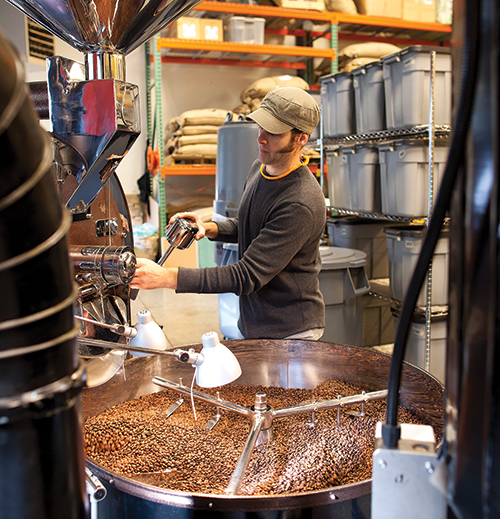
Grounds for Change employee Michael Williams roasts coffee beans in Poulsbo, Washington.
Photo courtesy Grounds for Change.
In addition to the Café Femenino label, Grounds for Change sells other Partnership Blends, including The Wildlife Land Trust blend and Save Our Wild Salmon blend.
Marshall won’t provide total revenue numbers, but says, “Our coffee is a good value, and comparable in price with other high-end specialty providers. We have just chosen to take a lower profit margin. There is lots of competition, but our long-term customers keep coming back to us because of the consistently high quality.”
Roasters of Café Femenino coffee must donate at least 2.5 cents per pound to the program’s nonprofit arm, the Café Femenino Foundation. Coffee growers in the program can apply for the Foundation’s grants, now averaging $4,500 each, to use for a range of community improvements — everything from workshops on the sustainable breeding of food animals (including guinea pigs, a traditional food staple in the Andes), to the installation of running potable water. “Grant requests are for a range of programs that improve the social status, nutrition, sanitation, education, and health of the women and their families,” says Café Femenino Foundation President Marilyn Dryke. The Foundation has given out an average of about $100,000 in grants per year, she says.
“The women will decide if their community will benefit from a library or even a better school,” Kolosvary says. Because it believes in the program, Grounds for Change donates an additional 10 cents per pound back to Café Femenino to support the grants.
The benefits of Café Femenino, and its commercial association with Grounds for Change, are even visible in the women’s physical demeanor, says Kolosvary. Over time, she notes, the timidity of some of the women vanishes. “When a program is first started, the women are often not even aware that they have rights. The change in awareness and self-esteem is something special to watch.”
This article originally appeared as the Impact department titled “Organic Coffee Changing the Lives of Peruvian Women” in the Fall 2016 issue of B Magazine.
|
|
6 Really Terrible Gift Ideas |
1. Items in "Stupid Plastic" Packaging
Tired of single-use “stupid plastic” packaging, sharp wire ties, and open-proof plastic containers that many products come swathed in? The Earth is too. Most plastic is made from polluting, resource-intensive petroleum, and tons of single use plastics are clogging oceans and harming wildlife.
Avoid gift items wrapped in excessive plastic and online retailers that package items in even more plastic.
Solution: If you’re buying anything new this holiday season, look for items in independent, local stores that aren’t over-packaged. When ordering via mail, ask sellers to avoid sending plastic when they ship your items.
2. Unnatural Candles
Candles are always a popular stocking stuffer but they could be making you sick. Conventional candles are made with paraffin wax—a petroleum by-product that releases carcinogenic soot when burned and can damage your electronics and ductwork. They’re often scented with synthetic oils that can cause lung irritation and other health problems and some candles may even have lead, a neurotoxicant, in their wicks.
Solution: Choose GMO-free soy or beeswax candles scented with 100 percent natural essential oils. Find green candlemakers at GreenPages.org.
3. Plastic Toys
Everything we said about plastic packaging holds true for plastic toys. Even worse, many of today’s “It” toys (like Barbie dolls) are made from PVC plastic—known as the “poison plastic” because it leaches toxic chemicals throughout its life cycle.
Solution: Avoid soft plastic toys like rubber ducks, which are often made with PVC. Consider non-plastic secondhand toys and new toys made from wood, cloth, and other natural materials from green retailers at GreenPages.org.
4. Problem Electronics
Every year, Greenpeace scores electronics manufacturers on their efforts to reduce company-wide greenhouse gas emissions, implement recycling take-back programs, eliminate toxic innards in their products, and minimize excessive packaging. Amazon, Acer, LG, Samsung and Sony were bottom dwellers in the 2017 Greenpeace Guide to Greener Electronics which evaluates energy use, resource consumption, and chemical elimination. A 2012 study by the Ecology Center deemed the iPhone 4S and 5, the Motorola Citrus, the LG Remarq, and the Samsung Captivate and Evergreen as the least toxic cell phones.
When it comes to worker rights, China Labor Watch released a 2011 report that detailed child and sweatshop labor in factories making products for Dell, IBM, Ericsson, Philips, Microsoft, Apple, HP, and Nokia. Two 2012 reports from the nonprofit revealed child workers and sweatshop labor abuses in factories making Apple and Samsung products.
Solution: Buy used electronics or refurbish current electronics whenever possible. Consider giving a gift certificate from your local electronics repair shop for a tune-up in lieu of a new electronic item. Be sure to recycle your old electronics with a responsible recycler. Find one at e-stewards.org, or take your old electronics to your local Best Buy (bestbuy.com/recycle/), which will recycle them for free via responsible recyclers like Electronic Recyclers International.
5. Conventional Chocolate
If you’ve been reading the Green American for awhile, you’re likely familiar with the fact that much of the cocoa that goes into the products of major US chocolate companies comes from West Africa, a region where child and slave labor is a huge problem.
Solution: Buy Fair Trade Certified™ chocolate. The Fair Trade system uses independent monitoring to ensure that your chocolate comes from cooperatives that pay their workers a living wage, ensure they work in healthy and safe conditions, use sustainable farming methods, and set aside a premium for community development. Look for the Fair Trade Certified logo on chocolate at your local stores, or order chocolate from the companies listed at GreenPages.org.
6. "International" Home Décor
The home décor items you see at stores like Pier 1 Imports may look tempting, but chances are the artisans who made them received very little for their beautiful work.
In fact, our allies at the International Labor Rights Forum named Pier 1 to its 2010 Sweatshop Hall of Shame for the poor treatment of workers in the Paul Yu factory in the Philippines, which makes Pier 1 items. The factory fired 200 workers in 2010 for attempting to form a workers’ association. In addition, five of six Paul Yu workers labor under a temporary contract, meaning they make less money and have fewer benefits and no collective bargaining rights compared to full-time workers. While temporary contracts are only supposed to last six months by law, many Paul Yu workers have been working as temps for several years.
Solution: Get beautiful, high-quality baskets, shawls, jewelry, furniture, and other home decor and personal items with an international flair from Fair Trade businesses. Find them in the “Fair Trade” and “Home Decor,” “Jewelry,” and “Clothing” categories at GreenPages.org.
|
|
Fabrics and Labels to Look For |
Fabrics and Labels to Look For

When you shop for new clothes, a number of factors can affect the social and environmental impacts of your purchases. For example, about 14.2 million workers worldwide are trapped in forced and exploitative working conditions, including those in clothing manufacture, according to a June 2012 report from the International Labour Organization (ILO).
Also, toxic pesticides can harm farm workers and the Earth; clothing dyes may contain heavy metals (look for low-impact dyes); and many companies apply toxic finishes to promote fire-, wrinkle-, and stain resistance. Clothing made from petroleum-based polyester has a high carbon footprint, and clothing made from rayon requires a toxic chemcial soup to turn wood pulp into fabric.
To find the greenest clothing when you shop, look for these fabrics and labels:
Look for These Eco-Friendly Fabrics
BAMBOO
This hardy plant grows quickly, generally with few chemical inputs. However, toxic chemicals may be used to turn the plant into fabric. The Federal Trade Commission mandates that companies using this process label their products “bamboo-based rayon” rather than just “bamboo.”
ORGANIC COTTON
More than 25 percent of the world’s pesticides are used in conventional cotton production. Organic cotton is grown without toxic, synthetic chemical inputs.
INDUSTRIAL HEMP
Hemp is rapidly renewable and requires little or no pesticides.
RECYCLED POLYESTER
This fiber is made from cast-off polyester fabric and soda bottles, resulting in a carbon footprint that is 75-percent lower than virgin polyester. Recycled polyester contains toxic antimony, but some companies are working on removing it from their fabrics.
SOY CASHMERE /SILK
This fabric is made from soy protein fiber left over after processing soybeans into food. The soy may be genetically engineered unless noted on the label.
TENCEL
Like rayon, Tencel is made from wood pulp. The difference is that it uses Forest Stewardship Council certified wood pulp and less-toxic chemicals in a closed-loop process.
WOOL
Wool is renewable, fire-resistant, and doesn’t need chemical inputs. Look for chlorine-free wool from humanely-treated animals.
Look for These Labels
   
BLUESIGN
Ensures that a piece of clothing is not exposed to harmful chemicals throughout the supply chain, from raw materials to finished product.CERTIFIED ORGANIC
Ensures that thec clothing's raw materialswere grown without chemical fertilizers and pesticides. Does not prevent toxic finishes.GOTS ORGANIC
The Global Organic Textile Standard (GOTS) requires clothing be 95 percent organic, with no toxic dyes or finishes. Supply chains must comply with GOTS' waste and labor standards as well.OEKO -TEX
This independent certification system limits the use of toxins in everything from raw materials to finished clothes.
 
  
SA8000
A designation from the non-governmental organization SAI, which is applied to factories and farms to show they meet standards for social responsibility and labor rights.UNION-MADE PRIVATE LABELS
These labels indicate that your clothes were made by workers who were allowed to organize and advocate for better wages and working conditions.FAIR TRADE
(Fair Trade Certified, FLO International, Fair Trade Federation, IMO Fair for Life)
These independent certification and membership systems ensure that workers who grow raw materials or who make clothing earn a living wage, labor under healthy conditions, and earn a premium for community development.
|
|
9 Ingredients to Watch Out For |
Because of the prevalence of soy and corn in processed foods, about 30,000 genetically modified food products sit on US grocery store shelves.
Here are the top 9 GM ingredients to watch for:
1. SOY
GM since: 1996
How widespread: 94 percent of the US soybean crop was genetically modified in 2011, according to the USDA.
What to watch for: Soybeans show up in many traditional (i.e. not organic) soy products, such as tofu, soy milk, soy sauce, miso, and tempeh, as well as any product containing the emulsifier lecithin (often derived from soybean oil), such as ice cream and candy.
2. COTTONSEED
GM since: 1996
How widespread: 90 percent of the US cotton crop was genetically modified in 2011, according to the USDA.
What to watch for: The cotton plant, genetically modified to be pest-resistant, produces not only fibers for fabric, but also cottonseed oil, available on US shelves as a standalone product, and also commonly used as an ingredient in margarine, in salad dressings, and as a frying oil for potato chips and other snacks.
3. CORN
GM since: 1996
How widespread: 88 percent of the US corn crop was genetically modified in 2011, according to the USDA.
What to watch for: GM corn can make its way into hundreds of products: breakfast cereals, corn-flour products (tortillas, chips, etc.), corn oil products (mayonnaise, shortening, etc.), and literally anything sweetened with high-fructose corn syrup, which covers sweetened fruit drinks, processed cookies and other snacks, yogurts, soups, condiments, and many other products.
4. CANOLA OIL
GM since: 1996
How widespread: 90 percent of the US canola crop was genetically modified in 2010, according to the New York Times
What to watch for: Any canola oil made in the USA. This popular cooking oil, originally derived from rapeseed oil by breeders in Canada (the name is a contraction for “Canadian oil, low acid”) comes from a genetically modified plant that is no longer simply cultivated, but grows wild across the Dakotas, Minnesota, and Canada.
5. U.S. PAPAYA
GM since: 1998
How widespread: 80 percent of the US papaya crop was genetically modified in 2010, according to the New York Times.
What to watch for: All papaya grown in the US. Hawaiian papaya was genetically engineered to withstand the ringspot virus in the late 1990s, with the GM version rapidly taking over the industry. In 2009, the USDA rescinded regulations prohibiting GM papaya on the US mainland; they have since been introduced to Florida plantations.
6. ALFALFA
GM since: In 2005, the USDA deregulated GM alfalfa, though cultivation was later halted in 2007, following lawsuits from the Center for Food Safety and others who demanded a full evaluation of the threats to conventional alfalfa plants, and the emergence of herbicide-resistant weeds. Following a new environmental impact study, the USDA in 2011 again deregulated GM alfalfa, which is grown primarily as feed for dairy and sometimes beef cattle.
How widespread: Data on the re-introduction of GM alfalfa in 2011 will be available from the USDA in July. At present, GM alfalfa is used primarily as hay for cattle. The Monsanto Technology Use Agreement for “Roundup Ready” GM alfalfa forbids its use for sprouts.
What to watch for: It’s difficult to tell from a meat or dairy product whether it is from cows fed GM alfalfa. Look for organic dairy products and organic or 100 percent grassfed meat. An even better option is to go vegetarian or vegan.
7. SUGAR BEETS
GM since: 2005
How widespread: 95 percent of the US sugar-beet crop was genetically modified in 2009, according to the USDA. Around half of the sugar produced in the US comes from sugar beets.
What to watch for: If a non-organic bag of sugar or a product containing conventional sugar as an ingredient does not specify “pure cane sugar,” the sugar is likely a combination of cane sugar and GM sugar beets.
8. MILK
GM since: 1994
How widespread: Recombinant bovine growth hormone (rBGH) is a GM synthetic hormone injected into dairy cows to boost milk production. 17 percent of US cows were injected with rBGH in 2007 (most recent figure). Milk from rBGH-treated cows contains elevated levels of Insulin Growth Factor-1, a hormone linked to increased risks for certain cancers.
What to watch for: No label is required for milk from rBGH-treated cows, though many brands of non-treated milk label their containers as such.
9. ASPARTAME
Genetically modified since: 1965
How widespread: Aspartame, an artificial sweetener, is derived from GM microorganisms. It is found in over 6,000 products, including diet sodas.
What to watch for: Avoid anything labeled as containing Nutrasweet, Equal, or aspartame.
|
|
7 Ways to Cheat on Your Mega-Bank |

So, you’ve been wanting to end your relationship with your mega-bank, but you can’t break up just yet. While you work toward making a clean break, we’ve got some suggestions for how you can “cheat” on your mega-bank: ways you can move money into banking products from community development financial institutions (CDFIs), even if you’re maintaining a primary bank account elsewhere.
1. Savings accounts -- No matter where you keep your primary checking account, you can open up a savings account with a community development bank or credit union anywhere in the country. Many CDFIs offer online banking services, so consider shopping around for a bank or credit union that matches your values best.
2. IRAs, Roth IRAs, Education Savings Accounts, and money-market accounts-- For your education, retirement, and other specialized long-term savings needs, these common types of savings accounts can be found at many, but not all, community development banks and credit unions. Be sure to roll over IRAs from your mega-bank to your new community development bank or credit union without taking money out to avoid any tax liabilities. Be aware that money market savings accounts often require a relatively high minimum balance, and offer relatively high rates of return, based on current interest rates.
3. Credit cards -- One of the easiest ways to cheat on your bank is to cut up your corporate mega-bank credit cards, and start using a card affiliated with a CDFI. Green America offers a Visa card through Beneficial State Bank.
4. Certificates of deposit -- Purchasing CDs through CDFIs can be a good way to save and invest your money, if the terms (minimum amount and duration until maturity) meet your needs. Some CDFIs offer CDs that are targeted to specific issue areas, such as helping businesses and individuals go solar and financing women-owned businesses and organizations.
5. Refinance your mortgage -- Depending on interest rates, this may or may not make sense for your financial situation. Your local CDFI can go over this possibility with you and work out a plan to make the switch, if it would be advantageous for you.
6. Assist others who want to move their money -- It’s not just individuals who can move their money into community development. If you have influence over how your workplace, faith community, or other organization does its banking, you can encourage these groups to break up with their mega-banks with these resources:
7. Find a new financial planner -- Socially responsible financial planners can help you find even more ways to move your money, from mutual funds to venture capital and beyond. If your current financial planner isn’t up to speed on how your banking and investing can do good in the world, find a new one in Green America’s National Green Pages™. The more steps you take toward “the big break-up” ahead of time, the easier it will be to finally pull the plug on your mega-bank relationship.
|
|
Managing Stress With Herbal Support |
Throughout history, people have searched for ways to relieve stress. Some methods are healthy, such as gathering with friends and family, meditation, or ritual. Other de-stressors can have negative consequences when used in excess—think cocktails, drugs, or midnight ice cream binges
While they don’t take the place of great social support, herbs are a wonderful, natural way to help the body and mind cope with stress. Whether your stress shows up as muscle tension, circling thoughts, digestive upset, or a racing heartbeat, there is a traditional herbal remedy to soothe the reaction.
Understanding Stress Reactions
The body has certain built-in mechanisms for recognizing and reacting to stressors. The sympathetic and parasympathetic
nervous systems are two sides of a coin: they work together, ideally, to keep you in balance.
The sympathetic nervous system ramps things up: gets your heart racing, narrows your vision, shuts down digestion releases sugar and adrenaline into the bloodstream—it’s a rush! And it empowers you to deal with danger, such as a sabre-tooth tiger. Our ancestors, when under attack, had to either fight the tiger or run away. The body is magnificently prepared to do one or the other: it’s known as the “fight or flight response.” A third option is to play dead. What’s your reaction of choice or habit?
The parasympathetic nervous system does the opposite, allowing your body to “rest and digest” or “feed and breed.” It calms things down, brings blood flow to the gut to fully digest our food, and allows us to revel in safety and joy.
Without any sympathetic nervous system action, we’d never get out of bed. A healthy stress reaction is a good thing! And, the body’s extreme stress reactions are meant to be short-term, or acute: Deal with the saber-tooth tiger, get over it, and get on with the good stuff. In modern life, many of us experience unhealthy stress reactions: long-term or chronic situations. For example, if you’re in an intensely pressured job situation for months or perhaps years, your stress reactions are no longer helpful. You cannot fight, or run away, or play dead. When the sympathetic stress reaction is chronic, it can lead to inflammation, weight gain, and depletion of the adrenal glands. That’s where herbs can help.
Matching Plants and People
People have been using plants for health for as long as there have been people and plants. Plants contain multiple complex chemicals, called constituents, that affect our bodies by connecting with specific receptors on cell membranes. Caffeine, for example, is a constituent found in coffee beans and tea leaves.
Our bodies’ interactions with plants are more complex than with synthesized drugs, due to the wide range of constituents in each plant. For example, chamomile calms the mind and supports digestion. When it comes to managing stress, not every herb is perfect for every person. Here are some starting guidelines:
 Are you a hot, fiery, “fighter” type? In that case, warming herbs may not be the best choice for you (i.e., cayenne pepper); choose something cooling and soothing instead. Are you a hot, fiery, “fighter” type? In that case, warming herbs may not be the best choice for you (i.e., cayenne pepper); choose something cooling and soothing instead.
Is flight your reaction?
 Are you always on the lookout for danger? You may do best with grounding, nourishing herbs. Are you always on the lookout for danger? You may do best with grounding, nourishing herbs.
 How about playing dead—do you tend toward inertia? In that case, you may react best to pick-me-up plants to get you moving. How about playing dead—do you tend toward inertia? In that case, you may react best to pick-me-up plants to get you moving.
Ten Herbs to Consider
To work with stress reactions, turn to herbs that can affect the nervous system, taking things down a notch to counteract acute (stage fright) or chronic (job stress) sympathetic activity. Herbs that do this are called nervines. Herbs that go a step further, helping the nervous system to really rewire the way it behaves over time, are called neurotrophorestoratives.
Here are ten herbal de-stressors to consider. Choose the ones that match your “type” (above) and need.
Chamomile (Matricaria recutita): This humble, apple-scented flower is traditionally taken as a tea after dinner because it’s a nervine, and because it supports digestion. Chamomile has been shown to be a powerful anti-inflammatory—reducing “inflamed” thoughts as well as inflammation in the body. Safety concerns: If you’ve got a ragweed allergy, you may have a negative reaction to chamomile or anything else in the Asteraceae family.
Lemon balm (Melissa officinalis) is called “the gladdening herb” for itsability to uplift and calm at the same time, both as a tea and through its lovely scent. Traditionally, it’s been used to decrease anxiety and ease sadness. Lately, it’s been researched for its ability to support cognition, especially in Alzheimers patients. Safety concerns: Avoid large doses if you have low thyroid function.
Lavender (Lavandula angustifolia; other species are interchangeable) is a well-known and -loved scent; in fact, it’s been clinically proven to relax, especially when sniffed off and on (rather than as a constant background scent). Lavender flowers are warming, and are used to reduce anxiety, especially the sort that keeps you from eating. Lavender is also used to combat sadness, whether centered in your thoughts or in your heart. A little bit goes a long way: use a wee dash in a mug of tea, or 2-5 droppers per day of tincture; or, simply smell the essential oil or the flowers. Safety concerns: Avoid if you have Irritable Bowel Syndrome.
Damiana (Turnera diffusa/ T. aphrodisiaca) is traditionally considered a men’s herb, and an aphrodisiac—the libidoenhancing effect is not physiological, but rather enhances mood. This makes it a fun addition to winter cordials—but don’t worry, it’s a gentle herb, not a crazy love potion. Damiana is a warming, uplifting neurotrophorestorative when used over time. Also, clinical trials have shown that it can lower blood sugar. Safety concerns: Use caution in pregnancy; and it may have a mild laxative effect.
Tilia (Tilia Americana/ T.cordata/ T. playtphollos/ T. tomentosa) is also called linden flower, lime flower, and basswood. The flowers can be made into a tasty tea or tincture. Tilia has been used to reduce anxiety and soothe restless sleep and insomnia. It also supports the circulatory system; a tilia tea can help if your anxiety results in heart palpitations. Safety concerns: Separate from iron supplements by 2-3 hours.
Passionflower (Passiflora incarnata) is named because of its amazing tropical-seeming flowers. It seems impossible that this plant is a North American East-Coast native, and even considered an invasive weed in some places. The flowers, leaves, and vine can be used for tea or tincture, and the species is important—other Passifloras produce better fruit, but Passiflora incarnata is the species used by herbalists. Used over time, passionflower can support sleep, help to reduce anxiety, and, as herbalist Michael Moore said, soothe “chatterbrains.” Safety concerns: None.
St. John’s wort (Hypericum perforatum) makes the sun shine a little brighter, and it has been extensively studied as a tool for lifting depression. It’s been found useful in mild to moderate depression, and traditionally was used to relieve anxiety and lift sadness. The flowering tops are, ideally, harvested at midsummer. It makes a nice tea, or you can purchase tablets containing concentrated extracts. Safety concerns: St. John’s wort will cause photosensitivity, meaning you’ll sunburn much more easily when taking it. Do not take St. John’s
wort if you are taking medications: it works with the liver to remove toxins— and drugs—more efficiently from the body; this includes birth control pills.
Bacopa (Bacopa monieri/ B. monniera; Herpestis monnieri) is an herb from India also called brahmi—but there are a few other herbs also known as brami, so using the name bacopa helps avoid mixups. Bacopa reduces anxiety and has an antioxidant effect in the body. It is cooling, and is especially suited to people whose memory is affected by stress. Bacopa is bitter, so it doesn’t make a great tea; it’s best taken as a powder. Safety concerns: Bacopa can cause gut irritation. Use caution if you’re taking anti-cholinergic medications or have a thyroid condition.
Skullcap (Scutellaria lateriflora) got its name because its flowers look like little hats. It’s a nervine and a neurotrophorestorative, and also helps the skeletal muscles to relax. Skullcap is moistening and great for anyone feeling something akin to stage fright. It’s bitter, so if you’re making tea, try mixing it with something more tasty. The tincture has a more gentle, nourishing effect. Safety concerns: Historically, skullcap was diluted with germander, which is toxic to the liver; this is no longer an issue.
Kava kava (Piper methysticum) hails from Polynesia, where it is traditionally used in social gatherings and rituals. Kava has been shown to reduce anxiety, relax skeletal muscles, and relieve some types of pain. Kava has a very distinctive taste, and it can numb your tongue. Many prefer tincture to the concentrated powder, which can be too strong. Safety concerns: Avoid with liver disease and heavy drinking.
Herbal Safety
Depending on how sensitive you are, and how well-matched you are with a particular plant, it may have immediate, noticeable effects. Some herbs are drop-dose, meaning you should take only a few drops at a time; others need to be taken in larger amounts. (None listed here are drop-dose.) Many herbs are tonic, meaning they take weeks to months to slowly help the body shift its patterns. This is a deeper level of healing, and it requires patience, persistence, and observation. Keeping a journal can help determine if your stress reactions are shifting.
For the most part, our bodies know how to utilize the benefits of herbs. That said, negative reactions can occur. The most common are nausea and/or dizziness. There is also the chance, as with anything you ingest, that you may have an allergic reaction to an herb. If you experience a negative reaction, stop taking the herb immediately and consult a doctor if you have problems breathing or break out in hives.
It’s also important to work with good-quality products. Figuring out which companies are reputable and which products worthwhile can be overwhelming. Use common sense, don’t believe any hype for magic pills, and read labels. And, consider consulting a trained herbalist, who has gone to school for years to figure this stuff out.
Lifestyle Shifts to Reduce Stress
Without self-observation and lifestyle shifts, herbs are only a band-aid. You need to meet the herbs halfway. Here are some action steps to do that:
• Self-observation is a great way to keep tabs on whether your stress levels have risen to an unhealthy place. Where does stress manifest in your body? For some, it’s headaches; for others, it’s tight shoulders, an upset stomach, or even sleeplessness or mood swings. When you catch the stress reactions early, you are in a brilliant position to make adjustments for a healthier lifestyle.
• Breathe: deeply, into the belly, focusing on the place(s) in your body where your stress manifests. This triggers the parasympathetic nervous system, and lets your body know it’s safe to relax.
• Exercise: joyfully, in a way that you love; it helps the body release built-up stress hormones.
• Touch: being touched releases oxytocin, a hormone that makes us feel happy. For real. Go get a massage.
• Sleep: the body has things to do that it can’t get done while you are awake. Get more sleep—even an extra ½ hour— for a greater sense of well-being.
• Meditate: meditation leads to calmer brain waves, and a greater ability to deal with stress. Start with two minutes a day—no pressure.
• Cultivate a spiritual practice or philosophy: Having a larger perspective or big picture, of any tradition or of your own making, eases the sense of chaos that can be triggered by the random events of life—thus reducing stress reactions.
—Tricia McCauley, MS
NutriciaConsulting.com
Organic Herbs
Choosing organic (or close-to-organic, “consciously wildcrafted” herbs) from responsible green companies helps you avoid toxic pesticide residues and support organic farming. Truly green companies also refuse to sell endangered herbs, such as true unicorn root. And they will offer Fair Trade versions of herbs sourced from overseas to protect workers. The following companies bear Green America’s Seal of Approval for their top-level green practices:
• Frontier Natural Products Co-op, 800/786-1388
• Herbalist & Alchemist, Inc., 800/611-8235
• Mountain Rose Herbs, 800/879-3337
• San Francisco Herb and Natural Food Company, 510/770-1215
• The Scarlet Sage Herb Co., 415/821-0997
• Taos Herb Co. Inc., 800/353-1991
Tea, Tincture, or Powder?
Choosing the form of your herbs is important. Some herbs are only effective when processed in a certain way, though most are more flexible. Choose a preparation that fits your lifestyle and budget.
Tea (technically an herbal infusion) is often easy to get hold of; common herbal teas can be found in the grocery store. Loose-leaf teas are easy to make in a French press. If you’re a gardener, it’s fun to grow your own herbs for tea. Many people enjoy the soothing ritual of a morning or evening cup of tea.
A tincture is an herb that’s been soaked in a mixture of alcohol and water. If you avoid alcohol, this is not the form for you. Tinctures are more expensive than teas, often prohibitively so. However, they are more portable, and if brewing tea every day stresses you out, a tincture may be much more convenient.
Powders are created by drying and grinding up an herb. They can be nice to mix into applesauce, yogurt, or nut butters. Capsules, of course, are available in most grocery stores and organic markets, and are convenient if you don’t mind swallowing pills. Always read labels so you know what you’re getting. |
|
TerraCycle Gives "Unrecyclables" a New Life |
Wondering how to responsibly dispose of cereal and chip bags, candy wrappers, make-up containers, and other single-use packaging items? Send them to TerraCycle!
Founded in 2001, TerraCycle offers national mail-in recycling programs for all kinds of hard-to-recycle plastic waste. The company helps "upcycle" some items like candy wrappers and juice pouches into stronger and longer-lasting incarnations, such as backpacks and kites. It also facilitates recycling of other hard-to-recycle plastics, such as chip bags and butter tubs, into bins, fencing, an more.
Individuals, schools, nonproffits, and community groups can visit Terracycle.com to sign up for one or more trash collection "brigades." Each brigade focuses on a different kind of waste. Send your collected items to TerraCycle when you reach the minimum amount (5 - 100 items), using the company's postage-paid mailers.
In most cases, Terracycle will donate two cents or two Terracycle points to the charity or school of your choice. Terracycle points can be exchanged for select charity-based gifts.
"Terracycle has always been about making recycling and resource conservation not a chore, but something we do because it's fun and interactive and community-based," says Albe Zakes, TerraCycle's marketing director.
|
|
Why Josh Barclay and Green America Say: "Efficiency First!" |
This article is an expanded Web version of a piece that first appeared in the print edition of the Green American.
High school science teacher and Green America member Joshua Barclay’s super energy-efficient home started off as a simple science experiment, trying to answer the question: Can solar panels power a home, even in cloudy Michigan?
But as he and his wife Mary Ledvina installed a solar array to power their home in Whitmore Lake, just outside of Detroit, they made that home as energy-efficient as possible. Barclay agrees with Green America’s longtime advice that before going solar, it’s vital to improve your home’s efficiency in every possible way so you’ll need fewer panels, saving money and resources.
“The energy efficiency piece, although renewables are flashy and exciting, is where you gotta start,” he says.
Barclay and his wife had already tried to cut down on electricity costs, for instance by setting the thermostat lower during the winter, when they received the original “Efficiency First!” issue of the Green American (then the Co-op America Quarterly) in 2008.
As recommended in that issue, Barclay scheduled a Home Performance with Energy Star energy audit. He and Ledvina also implemented all of the efficiency steps Green America had detailed, such trying not to heat or cool empty rooms, air-drying their dishes instead of applying the dishwasher’s “dry” setting, using power strips to turn off electronics and eliminate phantom load, keeping the refrigerator full, washing clothes with cold water, putting a blanket on their hot-water-heater, and plugging air leaks. They also implemented all the retrofits recommended by their energy auditor.
Barclay and Ledvina’s house is similar to the average American home in its size and the sorts of appliances it contains. Yet, while the average American home uses 30 kilowatt-hours of energy per day, theirs uses about ten.
Even so, their behavior and lifestyles have not changed radically, says the couple.
“I feel that a lot of things that we’ve done, I haven’t even noticed,” says Ledvina.
The solar array they installed produces 15 kilowatt-hours per day, on average (more in the summer and less in the winter). With the efficiency improvements, this figure is more than the house needs on average, showing that solar energy can power a home, even in Michigan.
Interestingly, the energy conservation steps Barclay and Ledvina took cut down on the amount of electricity their home gets from the grid more than the house’s solar array does.
“We saved more from energy efficiency than we ever saved from our solar array,” he says. “So really, the most ‘efficient’ thing is to target energy efficiency.”
TAKING EFFICIENCY TO SCHOOL
Crediting Green America with helping him make his home as efficient as possible, Barclay has also been teaching his students at West Bloomfield High School about the benefits of energy efficiency for over ten years. He started by collaborating with School District Facilities Operations Supervisor Bill Wold to have his students audit the school’s energy use.
“We didn’t do it just so we could save money,” Wold says. “The primary focus was teaching the kids about energy efficiency.”
When these audits began, appliances that measure power usage were not on the market yet, so Barclay made some of his own using ammeters and extension cords from his classroom. He and his students made a database looking at what parts of the school used the least and most amount of energy; they found that replacing light-bulbs, installing motion-sensor light switches, and turning off computers at night and over breaks could bring significant savings.
At the same time, Wold employed professional energy auditors who also found significant savings. With Barclay’s help, students presented these findings to the school board, noting how much money could be saved each month through efficiency improvements. They illustrated these savings by showing what the money could get the school district: astroturf for the field, coaches for all-female varsity teams — the list went on and on.
The school board took the energy auditors’ recommendations, and Barclay believes his students’ presentations tipped them over the edge. And so the West Bloomfield School District schools began retrofitting. They picked the “low-hanging fruit” first, Wold says, putting in new windows, roofing, and light bulbs, and they have continued scheduling retrofits to this day. The results are already having positive financial effects, with Wold and Barclay reporting savings of around $100,000 on last year’s heating and electricity bills at the high school.

As Joshua Barclay and Mary Ledvina installed a solar array to power their home, they also increased their home's efficiency.
GETTING THE COMMUNITY’S ATTENTION
Soon after the first retrofits, Barclay found grants through Michigan’s public service commission for a renewable energy project. To apply for the grant, schools had to show that they had already undertaken energy efficiency measures — just as West Bloomfield had.
West Bloomfield won one of the grants, but they charted their own course on how to use the grant money. For one, the grant specified erecting solar panels on an existing building.
“That didn’t fit our dream, because we wanted to attract people’s attention,” Barclay says. “We wanted to put it out there by itself. And we wanted it to move, because according to educational theory, the more action and motion you have in something, the more you attract people’s attention.”
Mel Barclay, Josh’s father — whom Josh credits for fueling his fervor for renewable energy — was thrilled by the idea of placing a solar array on one of the area’s busiest streets, where students, parents, and regular community members would be able to see renewable energy up close instead of through a television screen.
He offered to cover the matching funds required by the grant-making commission — enough to secure the grant, but not to fulfill Barclay and his students’ dream of a free-standing solar array whose panels followed the sun as it traveled across the sky.
“The grant was what got us interested in the project and that was really the jumping off point,” says Natalie Davenport, who was a student in the school’s environmental club EARTH (Environmentally Aware and Ready to Help) during the lead-up to the installation of the solar array . “Even with the grant, we had to raise a lot of money and jump through a lot of hoops.”
So Josh Barclay and EARTH sponsored initiated a series of fundraisers, selling collapsible, reusable shopping bags from Green America Green Business Network ™ member ChicoBags (Chicobags.com), holding organic bake sales, and getting local businesses to chip in.
“To be honest, when we first were talking about ‘Let’s get a solar tracking array,’ we knew it was going to be a long road,” says Kacie Mills, who was EARTH’s co-president during the lead-up to the installation of the solar array. She notes that Barclay’s confidence rubbed off on the group.
“He always had faith in the project, even from the beginning,” she says. “With him, you knew it was going to get done.”
The biggest fundraiser was the sale of inscriptions on the paving stones planned to rest in front of the solar array. Mills says that the club had a grid showing where each inscription would go, and she remembers her excitement each day as the grid filled up.
Before the grid was completely filled, the members of the student environmental club each chipped in some money to buy a paver, together. On it, they inscribed: “Proof that all big things start small.”
CONTINUING THE SCIENCE EXPERIMENT
The science experiments and educational exercises continue. Last year, Barclay and his students made two YouTube videos about energy efficiency: one showing how Barclay and Ledvina took the steps recommended by Green America’s “Efficiency First!” issue, and the other detailing their energy audit and the efficiency steps they made after it took place.
“We based much of the footage [from the first film] on the 2008 ‘Efficiency First!’ issue. We took all of Green America’s advice and captured each improvement item on film as we did them at my home,” says Barclay.
During the 2011-12 school year, Barclay’s students will measure whether the entire science classroom’s energy needs are covered by the school’s solar array, first by calculating classroom electricity consumption and then by tracking the array’s production. Meanwhile, the biggest sun-tracking solar array in the greater Detroit area remains a point of interest for passers-by, as does the big digital sign next to the array showing how much energy is being produced.
“While it's true that we are not powering the whole school with this array, it is a symbol of hope and change,” Davenport says. “Every day, there are thousands of people the drive by the array, and the subtle hint that a high school is doing this might plant the seed for them to do the same. The Environmental Revolution, just like every revolution in the past, is by the people and for the people.”
Despite the interest generated by the solar arrays at Barclay’s house and at West Bloomfield High, Barclay emphasizes the need to reduce energy consumption first.
“Lots of people are like, I’m going to go green, I want to go solar — but these non-flashy things like taking plugs out when you don’t need the appliances, that’s really the way to go green,” he says. “Once you’ve done those efficiency measures, then you can go solar.”
- Read more about Barclay and Ledvina’s efforts at DreamFarm.org.
- Take Green America’s recommended steps for energy efficiency from our 2008 “Efficiency First!” issue and our 2011 “Efficiency First!” update.
- View the “YouTube videos Barclay and his students made on “How to Green Your Home and Save Green for Your Wallet”
|
|
Community-Owned Solar Gardens |
Community-owned solar gardens make renewable energy accessible to all.
Glenn Sliva works as a consultant for some of the biggest oil and gas companies in the world, like Chevron, Exxon, and BP. As a reservoir engineer, he calculates the amount of oil and gas in the ground at a given site, so he’s intimately aware that fossil fuels are, as he calls them, “depleting assets.”
“I’m in the energy business, so I know what’s coming. Energy prices are going to skyrocket,” Sliva told Green America. That’s why he’s chosen to get in early on an innovative new program established last year near his home in western Colorado.
Sliva is one of 19 co-owners of the nation’s first community-owned “solar garden,” a 338-panel solar array installed in El Jebel, CO, in August of 2010 as the first project of the Clean Energy Collective (CEC), a for-profit company that helps facilitate these projects. Conceived as a way to reduce costs and make solar energy more accessible, the collective ownership structure allows participants to access some of the local- and statefunded clean-energy incentives single homeowners enjoy, and bulk-purchasing drives the cost down even more.
As ratepayers to Holy Cross Energy (the local electric utility), the solar coowners see credits on their utility bill for all of the solar power their individual panels have produced. The panels also assist Holy Cross in meeting its renewableenergy goals. Required by Colorado law to produce ten percent of its power from renewable sources by 2020 (and pursuing an even more ambitious internal goal of 20 percent by 2015), Holy Cross moves closer to these goals each time citizens working with the Clean Energy Collective establish a new solar garden.
“Collective purchasing also means optimal siting and angling of the solar array, rather than working around individual rooftop conditions, so each panel achieves maximum efficiency,” says Paul Spencer, CEC president.
Spencer explains that when electricity customers cooperate on a large common project, each step of the process—from purchase of the panels to installation to maintenance—becomes more efficient and much cheaper, thanks to economies of scale. That’s how the CEC can step in as the organizer, negotiating with local electric utilities, coordinating site selection and construction, and providing maintenance—all while still offering co-owners a pricing structure that’s more competitive than the average home-based system.
For example, says Spencer, a participant with very little up-front investment capital available can purchase into the collective with a single panel (at around a $500 cost), which would be an unthinkable option at the single-rooftop scale due to installations costs. At the higher end of the investment continuum, a participant who purchases enough panels to cover a home’s full energy needs also benefits from the collective structure, spending a good deal less money up-front than someone installing an individual system—and then seeing that smaller investment break even in about 10 to 13 years, versus up to 20 or 30 on many home-based systems.
So far, most participants have bought into the Collective somewhere between those extremes; many have purchased half of their power-usage as solar energy. Still, some, like Glenn Sliva, have bought in all the way. Sliva started by bringing his at-home energy use down as much as possible, and then invested about $10,000 of his savings in 15 panels to power his 3,000-square-foot home. Compared to what he could have spent on an at-home system, he considers it a bargain, especially when he thinks forward to how he’ll avoid future fossil-fuel costs.
The idea is catching on. In June, the Clean Energy Collective activated its second solar garden, a much larger array with 3,575 panels co-owned by about 250 people. Two more Colorado projects are under discussion at present, and Spencer says his group is working with potential partners in 26 states and five other countries to share the collective solar purchasing model elsewhere.
“Colorado is our proving ground,” says Spencer. “We wanted to create a vehicle to make clean energy accessible and affordable to the masses. I think we’re showing we can do it.”
Buying into a Solar Garden
While the solar garden model is fairly new, it’s starting to catch on, including in urban areas like Edmonds, WA. This fall, the Frances Anderson Center in downtown Edmonds will be the site of a 75 kw solar installation, with 750 solar panels adorning the roof of this city-owned community center. Carlo Voli, a native of Italy who has lived in Edmonds for ten years, is the proud owner of one of those panels. And the other 749? They belong to different community members who have come together as the Edmonds Community Solar Cooperative.
Voli, who has since become the president of the cooperative’s board of directors, bought the very first share in the cooperative. Each share, called a Sun Slice™, represents one panel that will be installed on the Frances Anderson Center; each SunSlice costs $1,000. Members of the cooperative will receive revenue generated from the project in proportion to the number of SunSlices they own.
“Joining a community solar cooperative is a more affordable way to participate in clean energy projects that reduce greenhouse gases and generate clean energy,” says Chris Herman of Sustainable Edmonds, a local group that started organizing the project in 2008. “You can purchase a solar panel or two, and then receive a share of the energy and incentives generated indirectly through a rebate to cooperative members.”
The project, which sold 100 percent of its initial offering of SunSlices this summer, lets people who may be renters, or have unsuitable roofs for solar, support and invest in clean energy in their community.
“In the Seattle area, 50 percent of residents are renters,” says Stanley Florek, CEO of Tangerine Power, a local company working with the Edmonds Community Solar Cooperative and others looking to do similar projects. “And 20-25 percent of homeowners have trees blocking the south-facing part of their roof, so we’re left with only a quarter of the population who could do solar in the first place. That’s where SunSlices come in—anyone in the community can purchase a piece of a solar installation, and they’ll be able to walk by and see their panel generating energy for the community.”
Florek notes that buying a SunSlice doesn’t give someone the right to run off with the solar panel on a whim—members of the cooperative agree to keep their panels on the installation spot for ten years. During that time, each cooperative member gets a yearly check of his/her portion of the revenues of the project—Florek estimates that members of the Edmonds cooperative will receive $100 a year per panel, meaning that they will earn back their investments in ten years. At the end of that period, the members of the cooperative will vote on whether to keep the solar array or sell it.
For Voli, the cooperative embodies the type of activity he wants to see in his city. “This is a project that brings together people in the community, helps us work together and share revenues as a cooperative, and generates clean energy!” he says. “And what’s just as exciting is that this is the first fully citizen-owned power generation project in the state, and one of the first in the entire country, creating a reference point for a lot more of these to happen in the future. I believe that what we’re doing here will be a model for solar energy generation and community action for people all over the country.”
|
|
Solar Power Leases: Avoid the Big Initial Costs |
Would you like to get a solar power system on your roof without having to pay a single cent up front? Leases are making it possible for people in several states to go solar with no money down.
The single biggest barrier to going solar has always been the high upfront costs of purchasing solar panels, says Solar City founder Lyndon Rive.
“So we created a service that allowed the homeowner to go solar and save money from day one with no investment on their side. We started the solar lease in 2008, and it has done fantastically,” Rive says.
What is a Solar Power Lease?
A solar lease allows you to have a solar power system installed on your home with no upfront investment. Instead, you basically rent the system, making monthly payments over a period of 10-20 years that tend to be about 15 percent lower than the average conventional utility bill, says Rive. Historically, utility rates have increased over five percent every year, but with a solar lease, you can lock in lower electricity rates for the term of your lease.
Companies that offer solar leases often don’t charge interest, but recoup costs by accepting the applicable federal, state, and local tax incentives. Most offer free maintenance and cleaning for the entire term of their customers’ leases. The panels themselves are under warranty for about 25 years for customers who lease or buy.
|
|
Investing to Empower Women |
Socially conscious investors have been making investments in companies that make equal rights for women a priority. A growing body of research confirms that doing so is
a smart financial decision.
Experts have found there is a relationship between women’s participation and the economic success of both companies and overall economies, which means that shareholders may enjoy better financial and social returns from companies that have more women in management.
But women are still underrepresented in the economic arena. A March article in The Atlantic, for example, points out that 23 of the world’s top companies have no women at all on their boards.
Also, the World Bank notes that “in low-income countries, women consistently trail men in formal labor force participation, access to credit, entrepreneurship rates, income levels, and inheritance and ownership rights.”
There are now a wide range of actions investors can take to boost women’s involvement in the global economy—while gaining from it financially.
Empower Women, Strengthen the Economy
“Eliminating gender inequality and empowering women are finally being recognized, on a global basis, for what they are—urgent moral and economic imperatives,” says Joe Keefe, president and CEO of Pax World Management. In Pax’s recent report, “Gender Equality as an Investment Concept,” Keefe is helping bring these findings to light.
“Numerous studies … have shown that companies that empower and advance women are likely to reap the benefits in terms of improved performance and profitability,” writes Keefe, citing several reports, including a 2008 paper entitled “A Business Case for Women” from the management consulting firm McKinsey & Co. The paper cites research suggesting that companies with several senior-level women tend to perform better financially.
The United Nations also notes that “among Fortune 500 companies, those in the top quartile when it comes to women’s representation on their boards outperform those in the lowest quartile by at least 53 percent on return on equity.”
Investments That Support Women
“Even though we know women improve business, the world does not behave that way. The financial sector is still dominated by men,” notes Leslie Christian, president and CEO of Portfolio 21 Investments. But investors don’t have to sit around waiting for this to shift—they can actually effect change.
The most obvious way to increase gender diversity in business is to invest in companies that are committed to diversity and to empowering women.
Donna Clifford, investment consultant at Rainbow Solutions Inc. in Medford, MA, notes investors can first look at a company’s board of directors and management team to see how many are women. Investors can also examine a company’s policies and procedures, such as on equal opportunity, maternity leave, advancement, and educational opportunities, says Clifford. Hiring a socially responsible financial advisor can be a big help here.
By investing in socially responsible mutual funds, investors can take a shortcut, as these funds screen for social criteria, often including diversity and equal opportunity. They may eliminate companies with poor diversity records, and seek out businesses with forward-thinking policies that promote opportunity for women. At least one specialty fund makes women’s empowerment its primary focus: Pax World’s Global Women’s Equality Fund.
Criteria behind the fund screens vary, as do definitions of how much diversity, and what kind, is enough. You can find out details about a mutual fund’s screens or other efforts to promote diversity in its prospectus or by discussing this with a financial advisor. (Click here for Green America’s picks of mutual funds that are active on women’s empowerment.)
Shareholder Action for Women
One powerful way stock-market investors can promote diversity is to vote their proxy ballots, which every publicly traded company sends out annually to each shareholder. The boards of directors are elected through these ballots.
In addition, many investors are taking a stand on diversity by filing shareholder resolutions. These non-binding requests to management also end up on a company’s annual proxy ballot—which is voted upon by shareholders, thus alerting them and the public to hot-button issues.
Large-scale shareholders—such as mutual funds, pension funds, foundations, faith-based groups, or other investor coalitions—can use their considerable economic power to wield a great deal of influence by entering into dialogue with corporate management or by filing resolutions.
Byrd Bonner, executive director of the United Methodist Church Foundation in Nashville, TN, has been involved in several shareholder campaigns on diversity. For example, he says, at Hertz Global Holdings, “we negotiated to include some language in their proxy statement disclosures that puts them on record as having a commitment to seeking women and people of color for board membership.”
An ongoing case of a resolution being repeatedly filed to keep pressure on a company involves Home Depot. Eight different parties, including Trillium Asset Management, filed a resolution with Home Depot in hopes of persuading the company to make public its data on diversity, which it is required to collect under federal law. Having to disclose diversity data, thus making the company accountable and marking its progress, is an incentive to break the glass ceiling. Susan Baker, portfolio manager at Trillium, adds that “diversity strengthens a company’s brand image, employee satisfaction, and customer loyalty, and can sustain shareholder value over the long term.”
A failure to ensure diversity in the workplace has financial consequences relevant to investors: Home Depot has paid out more than $100 million to settle discrimination lawsuits in the last 14 years, she notes. “That’s investor capital getting diverted to settle lawsuits.”
If you own stock, vote to support diversity-related shareholder resolutions that appear on your annual proxy ballot. Online services such as MoxyVote.com and ProxyDemocracy.com can help you keep track of and vote your proxies.
You’ll only get your proxy ballots for individual company stock you own—not for mutual funds. Fund managers cast proxy ballot votes for all mutual funds. Each fund is required by the SEC to disclose its proxy-voting guidelines and records, so call investor relations or visit its Web site to view this information.
Microlending for Women
Microcredit serves as another avenue toward women’s empowerment. The term generally refers to very small business loans, perhaps as small as $25, for lowincome people across the US and around the world otherwise unable to access capital. These programs frequently focus on women, who research shows register higher repayment rates. Studies also show that increasing women’s participation in the economy, as many microcredit programs aim to do, benefits society overall.
“Gender equality has a whole slew of positive ramifications on development, including increased poverty reduction,” says Malcolm Ehrenpreis, senior gender specialist at the World Bank.
Numerous studies show that when a mother is educated, her children gain better health and education prospects, which are the foundations for sound human development that in the longer run tend to lead to higher rates of economic growth, he notes. Research also shows that giving women access to credit or a salary leads to greater increases in the welfare of all household members, Ehrenpreis says.
Expect these topics to be fleshed out further in the World Bank’s much-anticipated “World Development Report 2012: Gender Equality and Development,” due out late this year.
Also, women tend to invest their business proceeds “in ways that would have a longer-lasting, more profound impact on the lives of their families and communities,” notes Women’s World Banking, a nonprofit microfinance organization. “The key economic priorities for poor women—to a far greater extent than for men—continue to be health care, the education of their children, and housing.”
Consult our free guide to community investing to find screened and approved community development organizations offering microfinance investments. You can invest as little as $10 through Web-based services such as Kiva.org.
Looking Ahead
Laura Berry, executive director of the Interfaith Center on Corporate Responsibility, says she sees these strategies beginning to bear fruit. “Even though the numbers haven’t changed as much as we’d like, I think we’re directionally correct,” she says. “Women have moved from tokenism to authentic leadership. Even when you look beyond the social investing audience, you can start to see women making a real difference.”
The strongest argument to keep moving in this direction is simply that involving women makes better business, Christian says: “Investing in women is a very smart business decision.” |
|
9 Ways to Support Sustainable Food |
Back to the Vote With Your Dollar Toolkit
All across the country, people are creating healthy, vibrant, local, and sustainable food systems. Help change the system in your area in the following ways:
1. Start your own garden (and raise your own chickens for eggs). For urban gardening advice, see our interview with "Garden Girl" Patti Moreno.
2. Make your own organic soil. See our how-to article on composting for more.
3. Eat local and organic. Join a CSA, buy from farmers' markets, and visit locally owned restaurants. Find them at LocalHarvest.org.
4. Close the loop. If you want to get organic waste for your farm or used vegetable oil to power your car, contact growingSOUL to see if you can form a relationship with a loal Chipotle Mexican Grill: 301/537-7422, growingsoul.org.
5. Join a local food club. Google "organic food delivery" or "local food club" to fin a service near you. Foothills Connect sells its software to any groups interested in replicating their Farmers Fresh Market Initiaitive to bolster local farmers, FarmersFreshMarket.org.
6. Eat less meat, more veggies. Reduce your personal climate emissions and care for animals. Consider becoming a vegetarian or vegan, if you aren't already.
7. Involve children. EarthWorks staff are happy to share the curricula they've developed for their Growing Healthy Kids program. Contact earthworks at cksdetroit dot org. (Use the subject line "Education Coordinator -- Curriculum.")
8. Volunteer with a sustainable farm or food justice organization. Find one at LocalHarvest.org.
9. Invest in good food. Community investing organizations offer vehicles that support the creation of small, local businesses -- including organic farms, grocers, and restaurants -- as well as healthy food systems. Find out more from our Community Investing Guide.
Back to the Vote With Your Dollar Toolkit
|
|
Lifting Up "Food Deserts" |
Highlighting the work of "Growing Power" in Chicago and Milwaukee
“Right now, there are 23.5 million Americans, including 6.5 million children, who live in what we call ‘food deserts,’” First Lady Michelle Obama stated in February,in support of her “Let’s Move” campaign against childhood obesity.
A food desert is a community where residents have difficulty getting access to fresh produce, much less organic produce. These areas lack the grocery stores many Americans take for granted and are instead dotted with fast food restaurants and convenience stores that offer mainly high-calorie processed foods. According to research by the Food Trust, a Philadelphia-based nonprofit, people who live in food deserts have a higher risk of obesity, type 2 diabetes, and heart disease.
Fortunately, many communities are finding ways to bring good food to these underserved areas. Growing Power, an urban farm and education center in Milwaukee, was one of the earliest. Run by former professional basketball player Will Allen, Growing Power sits next to a low-income housing development in a neighborhood that didn’t have a grocery store for miles. Today the farm churns out a dizzying amount of produce on two acres, showing all of Milwaukee that it’s possible to grow your own healthy, sustainable food in the city. There’s another Growing Power in Chicago, run by Allen’s daughter Erika.
At the Milwaukee Growing Power, 15,000 pots with over 150 varieties of vegetables—including organic herbs, salad greens, sunflowers, radishes, and mushrooms—grow intensively in 13 solar powered greenhouses and hoop houses. Goats, chickens, and turkeys thrive in clean pens. Fourteen beehives sit on the northern side of the farm. And two aquaponic hoop houses boast an ingenious system designed by Allen, where salad greens grow in and filter wastewater from farmed tilapia and perch runs.

Allen shows off a Growing Power greenhouse.
The organization sells its produce through its own farm stands, at localgrocery stores, and through its Farm-to-City Market Basket program, where people in neighborhoods without easy access to fresh food can order weekly organic produce deliveries. It also brings in young people from the community to learn where their food comes from and how to run an organic urban farm.
“We feed over 10,000 people from the main facility,” says Allen.
Smack in the center is the heart of the operation: the huge piles of compost, created by red wriggler worms from food waste from the farm and nearby businesses, and tended by volunteers.
“Today, if you drop me off anywhere in the world with a handful of worms, I can build you as big a food production system as you want,” Allen told Milwaukee Magazine earlier this year.
Many people have called on Growing Power to do just that. The organization trains over 1,000 farmers per year around the world in its intensive growing and composting methods.
And this past March, the city of Milwaukee launched a partnership with Growing Power to create 150 new green jobs for low-income African-American men. In 2009, black men made up 53 percent of Milwaukee’s jobless.
The organization recently hired the first 20 men, who began learning how to build hoop houses. They will soon start learning how to intensively grow food using Growing Power techniques.
“We have a powerful opportunity to provide dignified work, and to grow what I like to call ‘the good food revolution,’” says Allen. “Employment lowers crime and allows people to stabilize their own lives. Our new hires will feel part of a larger effort to improve the public health of our city.”
Allen’s work has garnered him many accolades, including a MacArthur Genius Grant and a spot on Time magazine’s “100 World’s Most Influential People” list in 2010. Michelle Obama asked him to stand next to her as she launched her Let’s Move campaign. And in May, he won one of four US Green Awards, judged by 19 leading green organizations, including Green America.
But he’ll readily admit that none of that matters as much to him as the opportunity to get his hands dirty on his family farm and at Growing Power.
As Allen wrote in his “Good Food Manifesto” that appears on GrowingPower.org: “I am a farmer. While I find that this has come to mean many other things to other people—that I have become also a trainer and teacher, and to some a sort of food philosopher—I do like nothing better than to get my hands into good rich soil and sow the seeds of hope.”
— Tracy Fernandez Rysavy |
|
Labor Activists Face Death Sentence |
Bangladeshi workers seek living wages and safe working conditions in the factories of Walmart suppliers

There are 3.4 million garment workers in Bangladesh employed at 4,200 factories, supplying clothing for Walmart and other major US retailers. Safety conditions in these factories are often so poor, about 100 workers per year die in factory fires because the doors are locked or blocked, says Bjorn Claeson, executive director of SweatFree Communities.
And they get little help from the government, or from the US companies they supply with goods. In fact, two Bangladeshi activists were arrested last year and are facing possible death sentences simply for calling for better wages and safer conditions for the country’s garment workers.
In the summer of 2010, representatives from the Bangladesh Center for Worker Solidarity (BCWS) and Bangladesh Garment and Industrial Workers Federation (BGIWF) were working with local factory employees to demand compliance with existing labor laws and a higher minimum wage—equivalent to about $2.50 per day.
As former factory workers themselves Kalpona Akter, BCWS secretary general, and Babul Akhter, BGIWF secretary general, well know the situation the majority of Bangladeshi factory employees face daily.
In one factory in Dhaka, for example, employees make clothing primarily for Walmart for “malnutrition wages” equivalent to a little more than $1 a day, says Aleya Akter, a senior machine operator at the factory (and no relation to Kalpona).

Labor activists Babul Akhter and Kalpona Akter with factory worker Aleya Akter (L to R). To send a letter to Walmart calling for the charges against Akter and Akhter to be dropped, visit Sweatfree.org/bcws.
They work under lock and key, ever fearful of the factory fires they hear about in other parts of the country, she says.
“We can make 80 pieces per hour, but the managers ask for 120 per hour. If we don’t make this quota, the managers slap us and yell at us, and we have to work long overtime hours,” says Aleya, who along with Kalpona and Babul spoke about the situation to US crowds during SweatFree Communities’ recent “Truth Tour.”
Walmart does inspect its factories, but Aleya notes when the inspectors arrive, the workers are coached to lie. “If we do not lie and tell them we have better working conditions and a living wage, we lose our jobs,” she says.
Instead of demanding that the factories improve, Bangladeshi law enforcement levied 11 criminal charges against Kalpona and Babul last summer, including an unsubstantiated charge for setting off explosives. When the two went into hiding, hoping to call on international allies for assistance, local officials “took our [nongovernmental organization] registration, froze our bank accounts, and shot at our offices. They threatened our families,” says Kalpona.
After 21 days in hiding, both were arrested and spent a month in jail. Kalpona spent 11 days in a small cell where she was interrogated for grueling stretches. At one point while Babul was in prison, four men stood on his hands and legs while another beat him.
Thanks to international activist pressure, Kalpona and Babul were released after a month in custody. But they still face all 11 charges. If found guilty, “we will be convicted for a life sentence or for the death penalty,” says Kalpona. Claeson at SweatFree Communities notes that since at least two of the factories behind the lawsuits are Walmart suppliers, the retail giant could easily make these unfair charges disappear.
“Walmart is the lynchpin here,” he says. “If it told the factory managers to stop the lawsuit or lose their Walmart contracts, they would stop it.”
Sadly, Walmart has done nothing of consequence, say Claeson and Kalpona. When Green America contacted Walmart, a spokesperson wouldn’t comment directly on the case, saying,“Walmart’s sourcing decisions reflect our values and demonstrate respect for workers throughout the supply chain.”
“We need to keep continuous pressure on Walmart,” responds Kalpona. “It is important that consumers tell Walmart that it needs to change its business model to take workers’ rights seriously,” says Todd Larsen, corporate responsibility director for Green America.
“People can also use their dollars to vote for a more responsible supply chain by purchasing from businesses that sell Fair Trade or union-made clothing. Green Pages.org is a great place to start.”
To send a letter to Walmart calling for the charges against Akter and Akhter to be dropped, visit Sweatfree.org/bcws.
|
|
9 Toxic Ingredients to Avoid in Personal Care Products |
Find product safety ratings at CosmeticDatabase.org.
Find research on individual ingredients at Toxipedia.org,
and always avoid these nine worst toxins.
![9Toxins[1][1].](/sites/default/files/inline-images/9Toxins%5B1%5D%5B1%5D.jpg)
Download an 8x10 poster of these nine toxins »
1. PARABENS: They’re in adult and baby shampoo and many other products, and they are estrogen mimickers that can lead to cancer.
2. FRAGRANCE: The FDA requires that food, drug, and body care companies list their ingredients on their products—but chemicals used to scent products can be clumped under the vague term “fragrance.” Found in everything from shampoo to deodorant, a single product’s secret fragrance mixture can contain potentially hundreds of toxic volatile organic compounds.
3. NANOPARTICLES: Found in lotions, moisturizers, make-up, and particularly sunscreen, these untested ingredients are so small, many scientists are very concerned about their potential health effects, as they can penetrate cell walls and are highly reactive. Products with nanoparticles aren’t often labeled as such, so check your conventional body care products at CosmeticDatabase.org orNanotechProject.org/inventories/consumer/.
4. FORMALDEHYDE: A common hardener in nail polish and an ingredient in bath products, this chemical is a known carcinogen. Nail polish also often contains the developmental toxicant TOLUENE.
5. PHTHALATES: These hormone disruptors have been linked to male genital abnormalities, liver and kidney lesions, and higher rates of childhood asthma and allergies. They’re often hidden in the fragrances of an array of products for men, women, and children, and listed as DIBUTYL PHTHALATE in nail polish.
6. PETROLEUM BY-PRODUCTS: Listed as mineral oil, petrolatum, liquid paraffin, toluene, or xylene, these chemicals are found in a dizzying number of products, including many shampoos and soaps. Of most concern is the fact that they are often contaminated by cancer-causing impurities like 1,4 DIOXANE, which is a probable carcinogen. Industry has done very little to prevent such contamination.
7. TRICLOSAN: A primary ingredient in anti-bacterial soaps and products, triclosan has been linked to hormone disruption and the emergence of bacteriaresistant “superbugs.”
8. LEAD: It’s a potent neurotoxicant, and it’s been found in several popular brands of lipstick and men’s hair coloring kits.
9. MERCURY: A neurotoxicant that can severely damage human health, mercury— often listed as “thimerosol”—is still used in some cosmetics like mascara. |
|
11 Ways to Protect Yourself |

Ninety-one percent of Americans and nearly 5 billion people worldwide use a cell phone. Increasingly, cell phones are becoming a vital part of our lives, functioning as our primary mode of personal and business communication as well as our calendars, cameras, MP3 players, and address books. It is hard to imagine a world where we didn’t have all these functionalities at our fingertips. But at what cost to our health?
Here’s what can you do to protect yourself from potential harm from radiofrequency radiation emitted by these devices:
1. Always use a hands-free headset or the speakerphone setting when talking on your cell phone. Some researchers say a wired headset, especially a “hollow tube” headset you can special-order—which will be labeled as such and uses hollow tubes rather than wires to conduct sound—is the best. But even a Bluetooth wireless headset will reduce your radio-frequency radiation exposure by several thousandfold.
2. Keep the phone off your body. Carry your phone in a purse or bag with the antenna (back of the phone) pointed away from you, not in your pocket or bra. When you’re talking on it (with a headset or on speakerphone) put it on a table in front of you. Just a few inches can substantially reduce your radiation exposure.
3. Text instead of talking. Holding your cell phone away from your head to send text messages exposes you to less radiation than talking on it without a headset.
4. Turn it off. Phones only emit radio-frequency radiation when they’re searching for or receiving a signal, so a phone that’s off or in “airplane mode” is safe.
5. Replace cordless phones with corded models. Cordless phones can emit as much radiation as cell phones, and the charging station constantly emits radiation.
6. Use a low-radiation cell phone. Unless you live in San Francisco, cell phone retailers aren’t required to display the specific absorbency rate (SAR), or the amount of radiation a phone causes your body to absorb. Search FCC.gov/cgb/sar to find out the SAR level of your model, or consult the Environmental Working Group’s online database: EWG.org/cellphones. But no matter how low the SAR of your phone is, it’s still important the phone away from your head and body whenever possible.
7. Keep your cell phone, cordless phone, and wireless modem away from your head. All three will expose you to radio-frequency radiation, so banish all three from the bedroom or, at least, keep them away from your head and body. If you must have wireless Internet, turn off your router when you’re not using it, especially at night—a power strip with a timer can help.
8. Keep your phone fully charged. When a cell phone’s signal strength is weak or blocked, it has to work harder—and consequently emits more radiation.
9. Be wary of devices that claim to block EMF exposure. A Google search yielded 236,000 results for “EMF protection,” most of which were sites selling “protective” devices ranging from pendants and crystals to microchips and herbal remedies. Most experts agree that many are based on quasi-science and there’s no evidence that they work. Some “EMF shields” for your phone can actually increase the amount of radiation that it emits, since they block the signal and the phone has to work harder.
10. Don’t give cell phones to young children as toys or pacifiers. If you occasionally let your small tot play Pac-Man on your cell phone, put it into “airplane mode” so it won’t search for a signal—which means it won’t emit radiation.
11. Take care with older children. Children are more susceptible to potential harm from radio-frequency radiation than adults. If you give your children a cell phone for safety reasons, also give them a headset and encourage them to text or use the speakerphone instead of putting the phone close to their heads.
—Victoria Kreha
|
|
Passive House, Aggressive Savings |
A certified Passive House will cut down the energy used to heat a home by a jaw-dropping 90 percent.
Jim Conlon lives and breathes energy efficiency—as president of Elysian Energy, he oversees hundreds of energy audits every year and provides energy-efficiency consulting to green builders in the greater DC area. What’s got him excited lately is the movement to bring super-efficient Passive Houses to the mainstream.
“One of my employees had read about Passive Houses and asked me to take a look. I immediately fell in love,” he says. So Conlon, who teaches classes on energy audits in his spare time at the Green Building Institute (GBI), set out to bring a Passive House course for home builders to GBI.
“It was very rigorous training, even for those of us who should already know about green building stuff. And it really blew our doors off,” he says.
So what are Passive Houses, and why is this green-building professional over the moon about them? Created in 1996 by two German scientists, Passive House certification is likely the most stringent standard for energy efficiency in the world. While green building certifications like LEED and Energy Star Homes are comparatively easy to achieve with a few modifications, building or retrofitting a Passive House requires the very best energy-efficiency technology available.

Courtesy: OurPassiveHouse.org.
A Passive House will cut down the energy used to heat a home by a jaw-dropping 90 percent, and will reduce the total energy use by at least 60-70 percent—all while providing excellent indoor-air quality.
“It starts out with the goal of a home that is really high-performance,” says Conlon. “If something is good, then let’s be great. If reducing drafts is good, eliminating them is better. If more insulation is better, then let’s insulate the heck out of these things.”
Joe and Rebecca (last name withheld) can attest to that. In 2008, the couple had finally saved up enough money to make their drafty 1960s home in Salt Lake City, UT, greener and more efficient. Then their architect suggested building a certified Passive House instead.
Like all Passive Houses, Joe and Rebecca’s new home is so well sealed that it doesn’t need an “active” standard furnace for heating, relying instead on super-efficient insulation, triple-paned windows, captured heat from appliances, and passive solar building techniques that maximize the sun’s heat—such as having many south-facing windows to capture the sun’s strongest rays.
Because they’re so airtight (Joe says it’s like “living in a very comfortable thermos”), Passive Houses also have a Heat Recovery Ventilation system, which exchanges the indoor air for fresh air from outside, while keeping the heat inside.
A system with added humidification is available for homes in dry climates, and those in hot climates may need a small supplemental air conditioner.
“The comfort surprised me the most,” says Joe of his Passive House. “It gets cold here in Utah, and in a traditional home, you always kind of know what it’s like outside in winter—the walls are cold, or you’ll walk past a drafty window. In this house, you can’t sense that. There have been times where we’ve walked outside and went, ‘Holy crap, it’s cold out here!’ And then we have to go back in and put on another layer.”
You don’t have to pursue Passive House certification to build one. Joe says he and Rebecca did so to help out their architect and because “being the first
in Utah held some allure.” You can also retrofit an existing house into a Passive
House, though the process is currently quite extensive. If you’re not willing to tear your walls down to the studs, a certified Passive House consultant can still give you advice on incorporating some Passive House elements.
Joe estimates that they spent 10-20 percent more than building a conventional home, but their average monthly energy bill has gone down from $120 to $20. According to the Passive House Institute US (PassiveHouse.us), when you factor in energy savings, constructing or retrofitting a Passive House can be less resource-intensive over its lifetime than living in an existing conventional home.
Today, over 15,000 Passive Houses and buildings have been certified in Europe. The standard has only recently made it to the US, but it’s quickly catching on.
Joe says he and Rebecca “absolutely love” their new home: “I can’t think of a single drawback.”
And Jim Conlon says his dream is to build his own Passive House. “I know how true and great they are in terms of big picture, and they’re healthy and comfortable—and super cheap, when you account for all utility bills you’d pay through its lifetime,” he says. “I joke that Passive House is my new religion.”
--Tracy Fernandez Rysavy
|
|
Energy Efficiency: The Magic Bullet |
To curb the climate crisis, increase national security, and avoid economic disaster as peak oil looms, it's time to accelerate energy efficiency.
Back in 1977, then-President Jimmy Carter gave a speech to the American public in which he laid out a brave, ahead-of-its time energy policy. He exhorted Americans to deeply conserve their use of gas and oil—to drive less, carpool, and retrofit their homes to be more efficient, while his administration worked to ramp up renewable energy sources and create a platform for sustainable energy consumption moving forward.
“We must not be selfish or timid if we hope to have a decent world for our children and grandchildren,” he said. “We simply must balance our demand for energy with our rapidly shrinking resources. By acting now, we can control our future instead of letting the future control us.”
The 1973 OPEC (Organization of Petroleum Exporting Countries) embargo against the United States was over, and the long lines and painful shortages at local gas stations had come to an end. But even though things looked better in the short term, Carter knew that the country had to look toward the future.
The world is running out of oil, he told the nation in 1977. In fact, the US had already achieved its domestic “peak oil” threshold and was on the downward end of its supply. Ever-increasing dependence on foreign oil left the US vulnerable to more oil embargoes and other threats to national security, he said. And he foreshadowed disasters such as the recent BP oil spill, noting that the thirst for more and more oil would result in large-scale environmental degradation.
We have the technology to avert all of those problems, Carter told the nation: renewable energy and energy efficiency.
Carter didn’t get everything right—he also called for increasing coal production to displace oil. But the majority of his energy strategy was visionary.
Sadly, before his plan could really take root, he lost his bid for re-election. Our nation never took action, and subsequent administrations reversed or failed to reinstate Carter’s energy policies. Of particular note is the Tax Reform Act of 1986, which killed Carter’s tax credits for development of new renewable technologies. Experts say this one reversal caused the US to fall from its status as a world leader in renewables in the ’70s and early ’80s to the bottom of the pack, where it has remained to this day.
![Carter550w[1][1]](/sites/default/files/inline-images/Carter550w%5B1%5D%5B1%5D.jpg)
President Jimmy Carter delivers his now-famous energy address at a joint session of Congress in April 1977. (Photo credit: Getty Images/Sahm Doherty)
Today, scientists warn that we’re approaching peak oil worldwide—a 2010 University of Oxford study warns that world demand for oil will outpace supply by 2015. Drilling and mining disasters like this year’s BP oil spill and the West Virginia coal mine collapse have become all-too-regular occurrences. National security experts still warn that our dependence on foreign oil has left us vulnerable to terrorist acts. And atmospheric carbon levels, an important indicator of global warming, reached 386 parts per million (ppm) as of last year and are steadily climbing. The Intergovernmental Panel on Climate Change says that once the world reaches the 450 ppm threshold—which it is on target to hit by 2050—we will likely have reached the point where climate change is irreversible.
What might have happened had the US embraced the green-energy future back in 1977? Would global warming now be a minor threat instead of a major one? Would we have gone through the tragedy of September 11th, and the subsequent wars in Iraq and Afghanistan? Would we live in a cleaner, safer world, with green technologies at the forefront?
It’s impossible to know for sure, but if the US had remained committed to efficiency and renewables after Carter left office, things might be very different today.
Energy Efficiency: Time to Do It Ourselves
While politicians are in gridlock on climate legislation, we cannot afford to have another 30 years go by without action. We don’t have to sit by and do nothing while debates rage on and the laws needed to have an impact fail to materialize. Like Dorothy in The Wizard of Oz, we’ve always had a large part of the solution within reach: energy efficiency.
Buildings, including homes, consume 70 percent of all electricity used in the US—and they also use up large amounts of fuel oil for heating and other uses, states the National Resources Defense Council in its 2010 report, Reducing the Need for US Drilling Through Energy Efficiency. If the US halved the energy use of just the buildings that use oil for heat, it would save as much oil as 170 BP Deepwater Horizon spills, states the report.
Advancing energy efficiency is the closest thing we have to a magic bullet to help combat the climate crisis, reduce our need for oil and coal, and make our planet healthier. We already have the technology to trim world energy use by 50-70 percent and phase out oil by 2050, says Rocky Mountain Institute scientist Amory Lovins. Now we just need the public will, something Carter lacked.
Get Started Today
Green America’s simple, doable proposition: Let’s each cut our energy use by 50 percent in the next five years—just ten percent per year. Sound ambitious? The city of Juneau, AK, nearly reached that threshold in just four weeks.
When an avalanche knocked out the hydroelectric power system that provided relatively cheap energy to Juneau in 2008, the city was ready. The electric utility switched over to a backup diesel system—which kept the lights on in the state’s capital, but also sent energy prices skyrocketing to five times their normal rate.
With the city in crisis, the US Department of Energy sent Berkeley Lab scientist Alan Meier, author of How to Save Energy in a Hurry, to Juneau to recommend how its citizens could ... save energy in a hurry.
Meier did a quick audit of several businesses and low-income housing units in the city. His recommendations turned out to be rather simple, including things like turning off appliances when not in use, turning down thermostats, installing compact fluorescent light bulbs, and conserving water. The city launched a public education campaign to get all of Juneau, including tourists, on board the conservation train.
Within a month, the entire city had cut its energy use by 40 percent, demonstrating how a community-wide commitment to simple changes of habit can make a big difference.
While 89 percent of Americans feel that making their home energy efficient is important, less than one-third believe their own homes are actually efficient, according to a nationwide poll conducted on behalf of the nonprofit RESNET. The energy savings are there for the taking—consider this your invitation to ramp up your efficiency efforts today.
As Jimmy Carter said in a 1979 speech, “We often think of conservation only in terms of sacrifice. In fact, it is the most painless and immediate way of rebuilding our nation’s strength.”
Find previous energy-saving articles from Green America's publications »
|
|
Community Investing Banks and the Economic Crisis |
Community investing banks don't promote the reckless practices that brought down the economy, and they use your dollars to provide much-needed services to underserved communities.
With big changes occurring at two of the country’s largest and best-known community investing banks, socially responsible investors may be wondering how the current financial crisis is affecting community development financial institutions. Is the money in accounts at these banks safe? Is opening new accounts in these accounts a sound financial move? And what will happen to the social and environmental missions of the community investing banks where changes have taken place?
Here’s what you need to know.
Big Changes for a Community Investing Pioneer
The Federal Deposit Insurance Corporation (FDIC) predicts that the number of banks that will fail this year will exceed 2009’s total of 140. Community investing banks are part of the broader banking world and are not immune to national economic developments and policies. Most are weathering the recession well, and their services to low-income communities are more essential than ever.
However, ShoreBank, America’s first and best-known community development bank, has faced some difficulty in recent months. After 37 years of serving low-income areas of Chicago, ShoreBank’s Midwest bank became the 15th Illinois-based bank to shut its doors (albeit temporarily) since the beginning of the year.
ShoreBank served some of the hardest hit areas in the country, including Detroit and Cleveland as well as the south side of Chicago. Unlike similar requests from many of its “too-big-to-fail” counterparts, ShoreBank’s request for Federal Troubled Asset Relief Program (TARP) funds was denied.
“The US government failed to realize that by letting smaller banks fail, they are harming Main Streets across the country. Community investing banks lend to small, local businesses, which are the backbone of their community,” says Fran Teplitz, Green America’s
director of social investing programs.
ShoreBank Rises Again
Fortunately, ShoreBank’s mission to lift up low- and moderate-income areas of Chicago, Cleveland, and Detroit will live on. This summer, Urban Partnership Bank, based in Chicago, stepped in and purchased ShoreBank’s assets. Urban Partnership Bank shares ShoreBank’s mission of providing loans and other financial services to underserved communities, so it will continue to advance ShoreBank’s work.
If you are a customer of ShoreBank, don’t worry—your accounts will be transferred over to Urban Partnership Bank without an interruption in your services. No customers have lost any deposits, even those with over $250,000 in their accounts. ShoreBank assures its customers that “all banking business continues as usual, and all relationship managers remain the same.”
The Urban Partnership Bank has also applied to become a certified community development financial institution (CDFI) through the US Treasury Department, further cementing its commitment to continue ShoreBank’s good work investing in communities that need it most. In addition, the new Urban Partnership Bank will be helmed by ShoreBank’s president and COO, William Farrow.
The ShoreBank Pacific Merger
Big changes are also afoot at ShoreBank Pacific, a Seattle-based subsidiary of ShoreBank and the bank with which Green America has a co-branded VISA card. ShoreBank Pacific plans to merge with OneCalifornia Bank, a CDFI focusing on lending to local businesses, nonprofits, and community organizations.
The merger still needs to be approved by federal regulators, which is likely to take two to four months. The ShoreBank Pacific name will also likely change, though the new name has not yet been determined. The new entity will have assets of approximately $300 million and will serve low- and middle-income areas all along the US West Coast.
“OneCalifornia Bank’s history of providing responsible, affordable financial services to low-wealth communities complements ShoreBank Pacific’s focus on financing environmentally sustainable businesses,” said Harry Haigood, chairman and CEO of OneCalifornia Bank. “We think this merger holds the promise of great synergy.”
Your Deposits are Safe
Don’t be afraid to put your money into a community development bank. Remember, all personal holdings in banks are insured up to $250,000 per financial institution by the FDIC, so you won’t lose any money up to that cap. That FDIC cap is effective until Dec. 31, 2013.
Opening up accounts at multiple community development banks will help your money go to different projects and safeguard you in case a bank does fail and you are waiting to get your money back from the FDIC; your funds won’t all be tied up in one place.
“Accounts in community investing banks are just as safe as those in mega-banks, and their mission is critical to fostering economic recovery in this financial crisis. They’re solving, rather than exacerbating the economic downturn,” reports Todd Larsen, Green America’s director of corporate responsibility programs.
Your Deposits are Critical
It is more important now than ever to invest in community development banks. CDFIs provide funding to communities where traditional financial institutions don’t usually dare to tread. Most large banks do not think it’s worth the time and paperwork to make loans for small businesses who will not be borrowing large amounts of money. Community investing banks often focus on small, local businesses as part of their mission.
“People with accounts in community development banks are strengthening communities, in their own backyard and across the United States,” says Sylvia Panek of the Social Investment Forum.
“These funds are playing a critical role today in America’s economic recovery, especially in areas hit hardest by the recent financial crisis, by drawing people back into the economic fabric of their community and promoting small business and job growth.”
It was the mega-banks that were behind the creation of weak and predatory subprime mortgage products that helped create the economic crisis. In contrast, community development banks and credit unions help lift everyday people up and ensure a healthy, fair economy going forward.
Given the choice between a federally insured mega-bank invested in weapons and coal-fired power plants, and a federally insured community development bank invested in day cares, organic farms, and sustainable forestry, it’s clear where your accounts can have the most powerful impact. For more information community investing, visit Green America’s CommunityInvest.org.
What Is a Community Investing Bank?
Community investing banks are a type of community development financial institution (CDFI), which work in areas that are underserved by traditional financial institutions. CDFIs are different from local “community banks” in that they have an express mission of funding community development initiatives. They grant loans for education, affordable housing, or business start-ups to deserving low- and moderate-income people whom traditional institutions might consider “unbankable,” and they provide financial training to help those loans succeed.
In 1994, Congress created the CDFI Fund within the Department of the Treasury. The CDFI Fund certifies CDFIs and, since its inception, has provided upwards of $1 billion in federal funding to these institutions. There are 885 CDFIs across the US.
For example, when Danny Schwartzman graduated from college, he wanted to open up a café in Minneapolis that served local, organic, and Fair Trade food and paid workers a living wage. He found few banks that were interesting in funding a start-up green restaurant with a young prospective owner—until he met with a representative from University Bank, a Sunrise Community Bank and a certified CDFI.
After working with Schwartzman, University Bank not only financed the café, it gave him loans to turn the upper floors of the building he purchased into affordable-housing apartments. He also bought and renovated the building behind his. Since opening its doors in 2009, the Common Roots Café has become a bustling 120-seat restaurant that purchases organic ingredients from over 30 local producers. This “risky” business venture also created more than 30 jobs, helping to make downtown Minneapolis healthier and greener. |
|
Is Organic or Local Food Better? |
Which is best for people and the planet?
And how do we make truly healthy food accessible to all?
You walk into the grocery store, wanting to buy some Granny Smith apples for a pie you’re planning to bake. You find there are two types—organic apples from across the country, or apples from a local farm that uses chemical pesticides and herbicides. Which do you choose?
It’s a conundrum we’ve all faced at one time or another, particularly since 2007, when a University of Alberta study announced that the climate-change benefits of organic food are almost negated when that food has traveled a long distance from farm to plate. In response, the “locavore” movement—or people dedicated to buying much of their food in season, from local farms—enjoyed a resurgence in popularity, casting doubts on the wisdom of always buying organic. And yet, even in today’s economy, US organic sales continue to grow, according to the Organic Trade Association. In 2009, as the economic crisis raged on, US organic food sales increased by 5.1 percent, totaling $24.8 billion. In contrast, total US food sales grew 1.6 percent.
Are organic shoppers making the right choices, when that food isn’t also sourced from a farm near their grocer? New research is providing more evidence to consider when choosing between organic and local, when you can’t have both.
The Case for Organic
Research that wasn’t available when the University of Alberta released its “food miles” study shows that organic farming actually sequesters more carbon in the soil than conventional chemical farming. And it uses no chemical inputs, which need to be trucked in from long distances and spread across fields using fossil-fuel-powered machinery.
The nonprofit Rodale Institute has been running a side-by-side comparison of organic and conventional farming systems for over 30 years. In 2008, Rodale reported that organically farmed soil sequesters nearly 30 percent more carbon than chemically farmed soil.
If all 3.5 billion acres of farmland on the planet were farmed organically, the soil would sequester nearly 40 percent of the world’s carbon dioxide (CO2) emissions, they said. And converting all 434 million acres of US farmland to organic would sequester nearly 1.6 billion tons of CO2 per year, the equivalent of taking 800,000 cars off the road annually.
Studies from the University of California–Davis and the UK Soil Association corroborate Rodale’s research, with both finding that organically farmed soil sequesters about 28 percent more CO2. In addition, farming chemicals must be transported by air, train, or truck from factory to farm, which may be a long distance—further adding to the climate impact of conventional farms.
“The bulk of food-system emissions don’t come from food miles,” writes Anna Lappé in her book Diet for a Hot Planet (Bloombury, 2010). “Indeed, reducing our carbon footprint means considering more than just this distance from food to plate.”
Farm Chemicals Poison our Bodies
The President’s Cancer Panel Report, released in May, shocked the country by stating that 41 percent of all Americans will get cancer at some point in their lives. And, the report was the first from such a panel to link environmental causes to cancer: “The Panel was particularly concerned to find that the true burden of environmentally induced cancer has been grossly underestimated,” the panelists wrote in a letter to President Obama.
Among the panel’s recommendations was one asking people to “[choose], to the extent possible, food grown without pesticides or chemical fertilizers.”
Several studies have found possible and probable links between various pesticides and cancer. One of the most recent, published last February in the journal Environmental Health Perspectives, found that farmers who sprayed one of six types of commonly used pesticides on their produce fields were twice as likely to contract the deadly skin cancer melanoma as those who did not. One of the six, Carbyl, is a major ingredient in the household pesticide Sevin.
In addition, parents and teachers across the country have long been scratching their heads over the rise in Attention Deficit Hyperactivity Disorder (ADHD). While many believe, with good cause, that doctors are simply overprescribing ADHD medication, a June 2010 study published in Pediatrics journal has found a potential link between chemical farming and the disorder.
Researchers from the University of Montreal found that children with above-average levels of organophosphate pesticides in their urine were twice as likely to be diagnosed with ADHD as those who did not. These pesticides are commonly used in chemical farming.
“An extensive body of evidence demonstrates that pesticides harm workers, damage the environment, and demonstrate toxicity to laboratory animals,” says Kari Hamerschlag, senior analyst at the nonprofit Environmental Working Group (EWG). “When you can’t find out anything about how a local food was grown, [our scientists] recommend choosing organic, which provides a guarantee that no pesticides or chemical fertilizers were used to grow it.”
Farm Chemicals Harm the Earth
The nation has been riveted to the catastrophic BP oil spill in the Gulf of Mexico. But the National Oceanic and Atmospheric Administration (NOAA) projected that even without accounting for the spill, 2010’s “dead zone” in the Gulf would be larger than ever before.
A “dead zone” is an area of oxygen-depleted water in the ocean, caused by out-of-control algae blooms, in which practically no aquatic life can survive. The Gulf of Mexico’s dead zone has averaged about 6,000 square-miles for the past five years, but this year, it’s projected to reach anywhere from 6,500 to 7,800 square miles.
Why? NOAA scientists point to the excess nitrogen and phosphorus run-off into the Mississippi River from fertilizers used on farms, as well as sewage and animal waste contamination, all of which contribute to algae blooms.
That’s just one example out of the many studies on how chemical farming pollutes ecosystems, making it clear that the planet can’t sustain chemical farming indefinitely.
Organic Could Feed the World
One of the main arguments against a worldwide shift to organics is the allegation that organic farms can’t possibly feed the world. However, a 2007 University of Michigan study looked at yield rates for different types of food grown both organically and non-organically. It found that “organic methods could produce enough food on a global per capita basis to sustain the current population, and potentially even a larger population, without increasing the agricultural land base.” Part of the reason is that the average agricultural yield around the world is much lower than that of state-of the-art organic farming.
Plus, notes The Omnivore’s Dilemma author Michael Pollan in the New York Times, “40 percent of the world’s grain output today is fed to animals; 11 percent of the world’s corn and soybean crop is fed to cars and trucks, in the form of biofuels. Provided the developed world can cut its consumption of grain-based animal protein and ethanol, there should be plenty of food for everyone.”
Organic Just May Be Healthier
A June 2009 study from the London School of Hygiene and Tropical Medicine gave the chemical industry a boost by citing that organic food is nutritionally no better than conventional food. However, the EWG and the Organic Center separately reviewed the study and concluded that the London scientists were wrong.
The London scientists downplayed their findings that organics came out significantly better in three of the 13 nutrient categories they studied: Organics contained more beneficial phosphorus and titratable acids. And conventional foods contained more nitrogen, which may be linked to cancer. The London study also failed to take into account the health effects of additives and pesticide residues in conventional produce.
And other studies, such as 2003 research from the University of California–Davis, have found that some types of organic produce have been found to contain “significantly more” cancer-fighting antioxidants than conventional produce.
Where Local Fits In
The local food movement isn’t just about food miles—it’s about the importance of asking questions about where your food comes from, and really connecting with your food and how it impacts your community. It’s a way to break free from corporate agriculture—and its chemicals and processed corn and soy end products—and support family farmers.
Green America has been a longtime advocate of local, independent businesses, and the reasons for that support hold true when it comes to local, independent farms: Buying local strengthens local communities.
Buying local is important, says Maria Rodale, author of Organic Manifesto (Rodale Books, 2010) and CEO of Rodale, Inc. But when it comes to food, buying organic has the edge—for now.
“Intellectual debate is hugely important, and the freedom to debate is what is great about America. But that freedom shouldn’t ever be at the expense of poisoning our children and the environment with farm chemicals,” says Rodale. “There comes a time when we all have to agree—or agree to agree on major points. There’s enough evidence to know that embracing organic is the right thing.”
Organic standards are strong enough, she says, that shoppers can trust the label when it comes to toxins.
It’s not perfect. The reality is that certified organic food can come from big agribusinesses, some of which have many of the problems of industrial agriculture—from the loss of biodiversity to raising animals on crowded fields. This may be organic, but it is not sustainable. To have a truly restorative and healthy food system, it must be organic and local.
However, because of the seriousness of the toxic chemical burden and climate footprint from conventional agriculture, Green America advises choosing organic when you can’t have it both ways.
“While organic standards are good, we must make them better,” says Rodale. “We must work together to create the best definition of what organic means, to include social justice and Fair Trade standards and humanely raised animals and more.”
When You Buy Food
Uniting behind organic doesn’t mean everyone should avoid non-organic food at farmers’ markets and community supported agriculture (CSA) arrangements. While a family farmer may not run a certified organic farm, s/he may come close. Many small-scale farmers work hard to minimize pesticide and fertilizer use, and some types of produce need very few chemicals to grow, even conventionally.
Ask questions, and write down the answers. Get the names of specific pesticides, look them up later on databases like Scorecard.org and Toxipedia.org, and decide for yourself if these substances are things you want to eat.
The Leopold Center for Sustainable Agriculture says that income from CSAs and farmers’ markets help family farmers grow and diversify. With your encouragement, they might just use that income to travel further down the path to organic.
For the climate, the environment, and our health, it’s vital that the fractured factions of the sustainable food movement unite behind the organic banner. Then, one day, when we buy local to foster community resilience, we’ll also inevitably be buying organic—and everyone will have truly healthy, affordable, delicious food, grown without poisons. |
|
How New Credit Card Rules Can Help You |
If you’ve ever carried a balance on a credit card, you may be well acquainted with how much the fees and penalties added to that balance can cost you. And you weren’t alone: In 2008, the “big 4” mega-banks—Citigroup, JP Morgan Chase, Bank of America, and Wells Fargo—charged their customers $15.1 billion in credit card penalties and overdraft fees, according to the Center for Responsible Lending. That money was equivalent to 80 percent of the $18.3 billion in bonuses the four banks paid to executives that year, despite needing huge infusions of taxpayer bailout money to stay afloat.
Those fees are big business for mega-bank card issuers, so they’re not interested in helping you avoid them, says Fran Teplitz, Green America’s director of social investing.
“The big banks that played a leading role in our country’s financial crisis continued to maneuver unscrupulously even after the government bailout,” she says. “Some attached predatory, hidden fees to financial products like credit cards, or jacked up interest rates unfairly to grow their bottom lines. They are profiteering and stripping wealth from families rather than strengthening the economy for the good of society as a whole.”
Last February, the US government enacted new rules for credit cards to protect consumers from predatory practices. The Credit Card Accountability, Responsibility, and Disclosure (CARD) Act created several important protections for credit card users—though it also opened the door for a different set of hidden fees and penalties.
Protections for Card Users If you use a credit card, the new rules under the CARD Act will benefit you in the following ways:
A warning on rate changes: Instead of suddenly increasing your interest rate, card companies must now send you a 45-day advance notice.
More useful billing statements: Making only the minimum payment on a high credit card balance is a surefire way to stay in debt, because it inflates the interest you’ll pay. Thanks to the new rules, credit card companies now have to tell you exactly how long it’ll take to pay off your balance if you just make the minimum payment. Your statement will also tell you how much you should pay each month to eliminate your balance in three years.
The US Federal Reserve gives this example: Say you owe $3,000 on a card with a 14.4 percent interest rate and a $90 minimum payment. Your monthly statement will tell you that if you make only the minimum payment, it’ll take you 11 years to pay off your balance, and you’ll pay $1,745 in interest. It’ll also tell you that if you pay $103 every month, it’ll only take you three years to pay off your balance, and you’ll pay $712 in interest—a savings of $1,033.
“This information is going to be so helpful to credit card users,” says Teplitz. “It’ll give people a realistic monthly picture of just how much money they can avoid giving away to mega-banks by paying off their balances quickly.”
A year of stable interest rates: Credit card companies cannot increase your interest rate for 12 months from when you open the card account. There are exceptions: If your credit card is tied to a variable index (which must be explained on your original card agreement) or if you are later than 60 days with a monthly payment, your interest rate may legally increase within that first year.
Banks may also still offer six-month introductory interest rates, and increase to the “normal” interest rate when the offer expires.
No retroactive rate increases: Interest rate hikes after that first year also will only apply to new charges. Balances you carried before an increase can only be charged interest at the old rate.
Highest comes first: If you pay more than the minimum, your credit card company must apply the extra to the portion of your balance that has the highest interest rate. Beware, though—the card company can still apply up to the minimum payment to the portion with the lowest interest.
Restrictions on over-the-limit fees: Before the new rules, credit card companies could allow you to charge over your limit, and then level a penalty charge against you for exceeding that limit. Those days are no more. Now, unless you actually tell the credit card issuer to allow charges over your limit, it must simply decline such charges. Other than a little embarrassment, you won’t suffer any further penalties.
Fee caps: Annual or application fees cannot equal more than 25 percent of the initial card limit.
Protection for young people: If you are under 21, you’ll now need proof that you can make payments, or an older cosigner, to get a card. Your cosigner will have to agree to any credit card limit increases, making it easier for parents and guardians to teach teens to use cards responsibly.
Standard payment scheduling: Card companies must now deliver your bill 21 days or more before the billing date. The billing date must be the same day every month (or the next business day after, if the company doesn’t process payments on your due date). And the cut-off time for payments can’t be earlier than 5 p.m.
No double-cycle billing: Double- cycle billing meant card companies considered not only the current balance on the credit card, but also the average daily balance from the previous billing period when calculating interest. Then, they’d often use the higher figure for interest calculations. The new rules make this practice illegal.
Extends gift cards: Gift credit cards cannot expire for at least five years under the new law. Card issuers cannot level “inactivity fees” unless the card has gone unused for over a year.
What to Watch For
Green America and other groups warn credit card users that credit card companies aren’t going to go gently into that less-predatory night. The Pew research firm predicts that the new rules will cost the credit card industry at least $10 billion annually (and save consumers that amount).
“Card users should be wary of new fees their credit card companies could charge them, as they try to recap this lost revenue,” says Teplitz.
Among things to watch for:
The new rules don’t cover corporate cards. Watch for interest rate hikes and more fees on corporate cards.
Interest rate hikes: There’s no cap on interest rates, so card companies could send yours skyrocketing.
New fees: Card companies will be adding more fees and increasing existing fees. Look at your statement for any new annual, processing, and activity fees.
Cutbacks on rewards: If you have a rewards card, be aware that those rewards could shrink.
Break Up with Mega-Banks
As credit card companies deal with the repercussions of the CARD Act, consumers should be wary. If you don’t like what you see, shop around for another card.
And pay off your balance every month to keep your hard-earned money from needlessly ending up in a mega-bank’s executive bonus pool.
Green America has long been urging people to break up with mega-banks. Now, even mainstream financial experts are getting on board with that advice. Money magazine’s Amanda Gengler told CBS’ Early Show in February, “Some of the nasty [credit card] practices that we’re hearing about are often from the largest banks. Consumers need to read the terms and then shop credit unions, regional banks, smaller banks, because they often can provide much friendlier credit cards.”
Get a card with a community investing bank, and you’ll get a friendlier card, along with the peace of mind that any interest or fees you pay help low-income people better their lives and communities. |
|
More Steps to Energy Efficiency |
Take these actions and save up to 56 percent of your energy use!
Replace Your Light Bulbs
Take the step: Replace the incandescent light bulbs in your house, even if they haven’t yet burned out, with compact fluorescent light bulbs (CFLs).
Why: You’ve been hearing about the wonders of CFLs for years now—they last ten times longer and use one-fourth as much energy as incandescent bulbs—but you might still have some old incandescent bulbs around your house. Incandescent bulbs are inefficient because they give off 90 percent of their energy in heat—while CFLs give off little heat. Don’t let the higher price of a CFL stop you—because CFLs use so little energy and last so much longer, a CFL bulb will save you $30 or more over its lifetime.
Please note that CFLs do contain a small amount of mercury. However, CFLs still result in fewer mercury emissions than incandescents. The average coal-fired plant spews about 13.6 mg of mercury to power an incandescent bulb, while it only emits 3.3 mg to power a CFL. Add that to the 5 mg of mercury the average CFL contains, and you still come out ahead. Be sure to dispose of CFLs properly: call your local solid waste authority for local options, take them to an Ikea store for recycling, or recycle them by mail with a Sylvania RecyclePak.
Light-emitting diode, or LED, lights are also becoming more widely available for uses around the home. A mercury-free LED light lasts about 50 times longer than an incandescent bulb. You can now find LED reading lamps and LED Christmas lights. A strand of LED Christmas lights uses 90 percent less energy than incandescents.
The big picture: If each home in America replaced one bulb with an Energy Star CFL, it would save enough energy to light 3 million homes for a year and prevent greenhouse gases equivalent to the emissions from 800,000 cars.
Resources: The Energy Star program’s page on CFLs includes information about clean-up and disposal of broken CFLs, as well as energy-saving calculators and purchasing tips.
Plug Your Air Leaks
Take the step: Plug the energy leaks in your home. Call your utility for a free energy audit, or call an energy auditor in your area—they will be able to find the air leaks in your home and assess how you can fix them. A local contractor can help you plug those energy holes, or you can seal leaks around windows and doors yourself with weatherstripping or caulk available at your local hardware store.
Why: Investing in energy-efficient heating and cooling systems will only take you so far if your home is leaking out the cool or warm air you’re putting in it. The EPA estimates that properly sealing and insulating the “shell” of your home—its outer walls, ceiling, windows, doors—is often the most cost-effective way to improve energy efficiency in your home. By properly sealing and insulating your home, you can save anywhere from 5 to 50 percent of your energy bill each year. Only 20 percent of homes built before 1980 are well-insulated, so if you own an older home, you should assess if you need more insulation.
The big picture: If one fourth of US households weatherstripped and caulked their doors and windows, it would save enough energy in heating and cooling costs to prevent 8 million tons of CO2 from being emitted.
Resources: The Energy Star program's Do-it-Yourself Guide to sealing and insulating your home includes step-by-step information on how to find and plug air leaks. Find nontoxic insulation made from recycled cotton; ask your local hardware store, or look in the "Building—Supplies/Kits" category of our National Green Pages™.
Reduce Your Water Use
Take the step: Reduce the water you’re using. Simple ways to save water include fixing any leaks around your house and replacing faucets and showerheads with low-flow alternatives.
Why: According to the EPA, American public water supply and treatment facilities consume enough electricity each year to power more than 5 million homes. So think of turning off your faucet when you don’t need it as you do turning out the lights when you leave a room. In fact, the energy used to transport and treat the water that runs out of your tap for five minutes would power a 60-watt light bulb for 14 hours. Additionally, water shortages are becoming a harsh reality for many communities—a recent government survey found that at least 36 states are anticipating water shortages by 2013.
The big picture: If just one out of every 100 American homes changes to water-efficient fixtures, we would avoid adding 80,000 tons of greenhouse gas to the atmosphere, says the EPA.
Resources: The EPA’s WaterSense program has information about installing low-flow water fixtures, low-water-use landscaping, and more.
Cut Waste Through Windows
Take the step: Plug window leaks: Make sure that the edges of your windows are properly sealed. Fill any gaps with caulk (find no-VOC caulk from AFM Safecoat) to stop air leaks.
Cover up in winter: By covering windows with heavy curtains or drapes, you can greatly cut down the heat loss. You can also purchase storm-window kits from your local hardware store. These kits come with plastic film and a special tape, and will cost you about $3–$8 per window. Reflective “low-e” films are also available, which reduce the amount of heat that escapes through windows while still letting light through.
Shade for Summer: While your AC is working to cool your home in the hot months, the sun shining through uncovered windows is heating up your home. Reduce solar heat gain by installing window coverings like drapes, blinds, or awnings. Awnings on the outside of your windows are about 50 percent more efficient than indoor drapes, because they stop the sun before it even hits the glass. Consider installing awnings on south-facing windows, where the sun comes in most intensely (you can retract them in the winter).
Why: Windows take up about 15 percent of wall space in the average home, and offer far less insulation than your walls. In the winter, up to 16 percent of heated air in your home can escape through your windows, and in the summer, solar glare coming in through windows heats up your home. Installing window coverings or using low-e film can stop heat gain and loss by up to 50 percent—and can save you up to ten percent of the energy you use for heating and cooling.
Resources: Gaiam has do-it-yourself window-insulating kits and more. Look in the National Green Pages™ for eco-friendly blinds and curtains, like insulated bamboo shades from Earthshade Natural Window Fashions.
Help Your Hot Water Heater
Take the step: Add an insulating cover to your hot water heater and the pipes. If you have an electric hot water heater, it’s an easy job to do yourself. If you have an oil or gas-powered heater, you may need a plumbing professional. (See p. 14 for information about when to replace your hot water heater with a new, more efficient model.) You can find a blanket for your hot water heater at most hardware stores.
Why: In a typical American household, about 13 percent of the energy used goes to heating water. Insulating your hot water heater can reduce heat losses by 25–45 percent, trimming as much as ten percent off your water-heating costs. The insulation will pay for itself in less than a year.
The big picture: If half of US households simply turned down their hot water heater by ten degrees, it would prevent 239 million tons of CO2 emissions.
Install Ceiling Fans
Take the step: Install ceiling fans in your most-used rooms. When shopping for a ceiling fan, look for the Energy Star label—Energy Star fans use 50 percent less energy.
Why: By helping the air in your home circulate, ceiling fans can help make your heating and cooling systems more efficient. In summer, using a ceiling fan can create a “wind chill effect” in your home, making it feel cooler than it really is, meaning you can either turn down your AC or turn it off altogether in mild weather. Using a ceiling fan in the summer can save you up to 40 percent on your cooling costs. But don’t let your fan gather dust in the winter—instead, switch the rotation direction so that the blades move clockwise—this helps circulate the warm air that is rising to the ceiling back down into the room and can save you ten percent on your heating bills.
Resources: DoItYourself.com has step-by-step instructions to help you install a ceiling fan in your home.
Get a Programmable Thermostat (or learn to use the one you have!)
Take the step: Check if you already own a programmable thermostat, and use it. If you don’t have one, get one at your local hardware store.
Why: Almost half of American households already have programmable thermostats, but only one quarter of their owners actually use them—a big mistake, because they can save you a lot on heating and cooling costs. A programmable thermostat allows you to automate when your heating or cooling systems come on and off—for example, it can be programmed to come on to warm the house shortly before you get up, and to automatically shut off during the hours when you are sleeping or away at work. It will pay for itself in energy savings within a year.
The big picture: If everyone who has a programmable thermostat started using it to make their heating and cooling more efficient, we would save 15 million tons of CO2 from being emitted.
|
|
31 Ways to Walk or Bicycle More |
Biking or walking isn’t as scary as it seems—in fact, 40 percent of trips taken in the US are fewer than two miles from home, according to the League of American Bicyclists, so integrating more biking and walking into a daily routine is often convenient and manageable.
When starting to bike or walk more, however, you don’t have to quit driving cold turkey, says David Mozer, director of the International Bicycle Fund (IBF). “It’s like any new activity—you build up to it, and you can sort of train for it,” says Mozer.
Kathy Holwadel, the 53-year-old president of Cincinnati’s pedestrian and bicycle advisory committee Bike/PAC, began biking in November 2006 at age 50, when she got nervous about rising gas prices. After three years of pedal practice and testing bike routes, she now bikes at least five days a week as her main form of transportation, and she has also completed two 500-mile bike rides across Ohio.
First Steps to Walk or Bicycle More
1. Before you try to commute by foot or bicycle, invite a friend or neighbor on a leisurely walk or bike ride to test how much you can handle.
2. Visit a local bike shop to make sure your bike is in working order (especially the brakes).
3. Mix walking or biking into your commute. To build endurance, drive to work, but stop short of your workplace (walkers, try a half-mile; bikers, try two miles). Then bike or walk the rest of the way, gradually increasing the distance each week.
Walking or Bicycling More, Once You're Comfortable
4. Practice biking or walking to the store, school, or work on a day when you aren’t rushed. It’ll help you figure out how much time to allot for travel.
5. If there are public transit stations nearby, try biking or walking to them.
6. Ask neighbors who work close to or in your office if they want to commute together using foot or pedal power.
7. For bicyclists, ask members of a local bike group if they’ll bike around town with you and show you the ropes. Some cities have programs like San Francisco’s Bike Buddy, which pairs experienced cyclists with novice cyclists to ride together around the city.
“When you bike commute, that’s often the best part of your day, as opposed to a commute being drudgery and the worst part of the day,” says Mozer. “Hopefully, things click well, and you’ll soon be enjoying yourself out there.”
RESOURCES: According to the Bureau of Transportation Statistics, 26 percent of people who aren’t biking don’t have access to a bike. Read our article about how to start a bike-share program ). Local bike shops often refurbish bicycles and sell them at a discount, and don’t forget garage sales and website like Freecycle, eBay, and Craigslist.
Facing Your Fears
“How can I possibly be safe in that traffic lane next to all these cars?” is the concern Green America member Lucy Gigli hears from many prospective bicyclists as part of her work with the group Bike Alameda. Walking near traffic worries pedestrians, too. But don’t be intimidated by the cars and trucks that seem to dominate the roadway—you have the right to walk or bike to your destination without hesitation, and there are plenty of ways to do so safely and confidently.
Be Visible to Drivers
8. Bicyclists can increase the likelihood that drivers will easily spot them by riding near the center of their lane, using hand signals when turning or changing lanes, attaching an LED safety light to their bike, and wearing a reflective vest at night. Pedestrians should also use LED safety lights and consider reflective vests so motorists can see them, especially at night.
Obey the Law
If you’ve ever had to slam on the brakes because a fellow motorist has swerved in front of you without using a turn signal, you know how unsafe rule-breakers can be on the road. Avoid jaywalking—motorists aren’t watching out for pedestrians to cross the road outside of crosswalks. If you’re biking, follow traffic signals, use hand signals when turning or switching lanes, and try not to weave between street- and sidewalk-riding.
Practice makes perfect: Plan a walking or biking route based on how comfortable you are alongside traffic.
9. Call your city hall, city transportation department, or department of parks and recreation to see if your city has a bike map, which highlights not only city streets, but bike lanes, bike paths, and sometimes one-way streets, steep hills, and public transit stations.
10. Bike paths allow you to travel with less traffic. Main streets are also good choices: For pedestrians, there will likely be more sidewalks and crosswalks. And for bicyclists, there will likely be more traffic signals— rather than blind intersections—and even bike lanes.
11. Solicit advice from a loc al bike group about your bike-travel plans, because they’ll likely have tips on the best and worst paths and streets to use.
12. Some local bike groups offer bike education classes, which can provide resources and direct contact with bicyclists who know how to navigate your city.
Car-Free Carrying
It’s hard to imagine carrying a watermelon or four bags of groceries home from the supermarket by hand, let alone while trying to ride a bike. But once you feel confident traveling without a car, consider investing in some helpful contraptions to make it easier to run errands and even commute with cargo. In comparison to the price of a car, along with its associated insurance and
maintenance costs, a bike and some helpful attachments have significant economic and environmental advantages.
13. When it comes to carrying groceries and office paperwork, pedestrians can use a shopping trolley, a rectangular-shaped carrier perched on two back wheels, or a wheeled backpack to easily carry heavy items. Green America executive director Alisa Gravitz doubled the distance she could walk when she invested in her own “bag on wheels.”
14. For bikes, racks that sit on a bike’s back wheel or trailers that attach behind the bike can carry small loads.
15. Bike attachments also work well for commutes. Panniers (bags that hook onto the back of a bike) and rear racks are ideal attachments to hold paperwork, purses, and briefcases. Over-the shoulder and messenger bags work as well. (Some bikers avoid backpacks, because they can add to sweat build-up.)
16. Bikes are also useful for carrying large items, if you get a cargo trailer. Don’t underestimate how much bike trailers can haul—Revolution Rickshawsm rents out cargo trailers in New York City that can carry hundreds of pounds. “We move a lot of big catering jobs, for around 100 people,” says Gregg Zukowski, the company’s owner. “We’ll move 500–600 lbs. or more between restaurants.”
17. To take small children on the road, invest in a special bike trailer with seats, or in child-size bike seats that attach to the back of your bicycle.
David Mozer participates in a carpool to get his kids to school, and not everyone can bike. So he compromises by driving the kids to the school, parking his car, and walking or biking to the rest of his destinations for the day.
“I cut my driving in half. I wasn’t pleased with driving, [but] I essentially only did one trip to the school,” says Mozer.
RESOURCES: Check out Xtracycle, Planet Bike, sporting goods stores, and online retailers to browse bike accessories. Reusablebags.com sells a foldable trolley for walkers.
Confronting the Elements
Snow, rain, steep hills, hot days. It just takes a little extra planning and practice to deal with the elements on foot or on bike.
18. Start practicing during warm, sunny weather, when the climate is welcoming to novice walkers and cyclists. As you become more acclimated to temperature cycles, it will be easier to ride in less ideal conditions.
19. A rain jacket, gloves, extra layers, and weather-proof bags can protect you and your belongings from the rain or cold.
20. Many buses sport bike racks these days, so you can bus your bike home if the weather changes for the worse.
Don’t feel obligated to always bike or walk—if the weather is dangerous, take the bus, call a taxi, or carpool instead. For instance, although Mozer says fresh snow is pretty easy to bike in, he warns that settled snow can be icy and dangerous. The same goes for 95-degree heat waves and other severe weather events.
Also, don’t let a little perspiration stop you from commuting sans your car—walking or biking can be a fun way to incorporate exercise into your daily routine.
21. To sweat less, adjust your route to include fewer hills, or allow more time so you won’t have to walk or pedal as fast.
22. If sweat is inevitable, pack a spare outfit in your pannier or shoulder bag, so you can change when you get to work. Some commuters even bring a week’s worth of clothes to the office every Monday.
23. See if your workplace has a shower, or if there is a fitness center nearby that will allow you to use its showers for a small fee. If you can’t shower, don’t sweat it—many bike commuters say that cooling down for ten minutes and washing your face before changing clothes is an adequate substitute. A spray bottle and a hand towel can get you ready for the work day.
Don't Let Hills Get You Down
24. Try powering up the ones on your shortest, safest route to see if you can handle them. Or, you can walk your bike uphill. “I live at the top of a one-mile steep hill,” says Holwadel. “I’m old, and I have weak lungs; if I can do it, anyone can.”
25. If you’d like some extra oomph to get up the steeper inclines, consider an electric assist for your bike, which can be especially helpful if you’re carrying cargo.
26. There are also ready-made electric bikes on the market to add some power to your pedaling. It can take anywhere from 30 minutes to eight hours for an electric bike to charge, depending on the model.
RESOURCES: Visit your local sporting goods store for outdoor gear and cycling apparel. Lightfoot Cycles sells different types of electric assists. To browse electric bikes, visit Optibike, Schwinn Bikes, or Electric Cyclery.
In Emergencies
You also might be sweating about the unforeseeable. When you have to bolt from the office to deal with a sick child at school or a family member in the hospital.
27. Stash the cash you save on gas in your pocket in case you have to call for a taxi. Some organizations, such as Ecology Action in Santa Cruz, CA, offer free emergency taxi rides to people who walk, bike, or take transit to work or school. Check to see if your city has a similar program.
28. Ask for permission to leave your bike in the workplace in the event of an emergency.
29. If you’re worried about your bike getting a flat or breaking down, sign up for the Better World Club’s 24-hour roadside assistance for bikes, as well as cars.
30. Get to know your local bike repair shop so you’re prepared when it comes time to make repairs.
31. Or, join a bike group or ask neighbors who cycle for help with bike maintenance. Many organizations, like BICAS in Tucson, AZ, empower bicyclists to learn bike repair for themselves, offering workshops and tools to assist them.
RESOURCES: To sign up for the Better World Club, contact 866-238-1137, www.betterworldclub.com. For a list of local bike groups in cities across the US, visit The League of American Bicyclists.
—Cathy Wilson
|
|
Stop Sweatshops and Child Labor |
In a globalized economy, it can be difficult for consumers to track the supply chain behind the shoes and other products they buy. Unfortunately, oppressive labor conditions and the problems of sweatshops and child labor still exist.
Child Labor at Puma
In June of 2008, for example, China Labor Watch reported on poor conditions at a factory producing high-end Puma shoes for American retailers. Thousands of workers at the Dongguan Surpassing Shoe Co. Ltd. were routinely forced to work overtime, laboring 12 hours a day on weekdays and sometimes overnight on Saturdays. They are routinely exposed to toxic chemicals without the use of any safety equipment; and workers live in cramped dormitories strewn with garbage, where more than 80 people share a single bathroom. These Puma workers are paid 64 cents an hour; and are frequently fined if they refuse to take on overtime shifts.
Take Action Against Child Labor
- Demand corporate responsibility. If a company can’t or won’t share specifics about how its products are made or where they come from, it is not doing enough to stop sweatshops and replace them with safe workplaces that pay a living wage.
- Vote with your dollar. Find responsible companies with transparent supply chains, and reward them with your business. Buy Fair Trade to ensure your purchases aren’t funding exploitative labor practices. And look for the union label when you shop; unions are key to protecting workers’ rights. Remember, you can buy used items, too.
|
|
How to Advance Green Energy |
Twenty-five years ago, power generated by wind turbines and solar panels was so futuristic that it was called “alternative” energy. But the day is coming soon when green energy won’t be alternative at all because we’ll be getting a major portion of our energy needs met renewably.
You can help lead the way by choosing green energy sources, especially as these options become increasingly cost-competitive with dirty energy sources. Our Solar Catalyst program’s research shows that solar power, in particular, could reach ten percent of total US electricity generation by 2025.
Go solar: Combine government incentives, future energy savings, net metering, and more to make solar an affordable solution today.
Tell your utility to go solar: Our Solar Catalyst program’s Utility Solar Assessment Report shows that solar will be cost-competitive in the short-term planning horizon of every utility in the US. Tell your power company to begin making large-scale solar deployment plans now. Give them the link to our study (a PDF) to get started.
Support renewable energy generation: Direct your energy dollars away from coal-fired power and toward renewables by purchasing “green power.” This may be an option through your utility (check the EPA’s map), or you can purchase Renewable Energy Certificates (RECs, or “green tags”) that support putting as much green energy onto the grid as your household is using. Explore green tag products that are certified by the Center for Resource Solutions.
Choose carbon offsets that build renewable energy projects: If you are looking to purchase carbon offsets for the emissions you generate after becoming extra-efficient, consider an offset that helps create more renewable energy projects, like those from NativeEnergy. Your purchases help make new green energy facilities financially viable that would have otherwise lacked the capital to go forward. Remember, offsets are not a substitute for reducing energy. They are best used as a transition to zero-energy use: reduce, offset, and repeat each year.
Invest in the clean-energy revolution: There are now more than a dozen mutual funds, index funds, and exchange-traded funds that give investors opportunities to put their money to work for “clean-tech” solutions while saving for a secure retirement. Turn to the socially responsible investment vehicles listed in our National Green Pages™ and our Guide to Socially Responsible Investing.
Our resources for greening your energy use:
• Get the guide to going solar, The Promise of the Solar Future (PDF).
|