The border lands between the North Woods of northeastern Wisconsin and the Upper Peninsula of Michigan historically haven't been a hotbed of environmental activism. The region, populated largely by farming and middle- or working-class families, trends staunchly conservative in states that toggle between red and blue from election to election. People kayak and fish in the summer, ski and snowmobile in the winter, and hunt deer and duck when the law permits them to do so. They don’t attend protests.
But then someone messed with their river.
If you travel from the North Woods to “the U.P.,” down gravel roads and through increasingly wild landscapes to the mouth of the Menominee River, what may strike you is the quiet. The forest here is dense and lush and seems like it could swallow the few slender roads that wind along the river’s banks at any moment. Of course, it’s not completely silent. You hear the babble of the river, the trilling of a hundred birds, and the snap of twigs as deer, opossums, and other wildlife creep through the trees to drink from the rushing water. But what you don’t hear much of is the noise of humanity. Cars, cell phones, chatter—the sounds of human comings and goings barely reach this far into the woods, if at all. To many local residents, it feels like a sacred place.
To the Menominee Tribe, it is sacred.
According to tribal history, this land is where the Menominee Nation’s creation story took place about 10,000 years ago. Their story states that the five main clans of the Tribe—Ancestral Bear, Eagle, Wolf, Moose, and Crane—were transformed at the mouth of the river into human form and became the first Menominee.
The river also feeds directly into Green Bay and Lake Michigan, so it contributes to the drinking-water supply of the more than 35 million people who get their water from the Great Lakes. 6.6 million people in Illinois alone rely on Lake Michigan for their water.
Now, Toronto-based Aquila Resources wants to put an open-pit sulfide mine 150 feet from the river, near the point of the Menominee Nation’s origins. Tribal members are deeply concerned about what that means for their ancestors who are buried on the site.
But the Back Forty mine isn’t just about saving the Menominee’s cultural heritage, stresses Guy Anahkwet Reiter, a community organizer with the Tribe. The Menominee and local residents also fear what the mine’s impacts will be to the water, the surrounding environment, and human health.
“The Great Lakes hold 20 percent of fresh water in the whole world,” Reiter says. “The Menominee River flows into Lake Michigan, where millions of people get their drinking water. Ninety percent of the breeding stock of Lake sturgeon only use the Menominee River. If project goes through, you can say goodbye to Lake Michigan’s lake sturgeon and to clean water. This isn’t just a Menominee problem. It belongs to all of us.”
Calling themselves Water Protectors—like North Dakota’s Standing Rock Sioux before them, who fought to keep the Dakota Access oil pipeline from crossing their sacred traditional lands and burial sites—the Menominee and numerous other members of the local community are mobilizing for a stand-off against Aquila.
More Toxic Than Your Average Mine
Andi Rich, a lifelong resident of the twin cities of Marinette, WI, and Menominee, MI, didn’t know a lot about sulfide mining when she first heard about plans for the Back Forty mine. But when she started researching, what she found turned her into an activist.
“I knew about places around here that have had mines, and it wasn’t the end of the world. But I started seeing some Facebook posts about contaminated water and how close the mine would be to the Menominee River. The proximity drew me in,” she says. “Then I realized it wasn’t a regular mine but a sulfide mine, and there are all these hazards that come in with that. So I started wondering, ‘What are we thinking? Why would anybody do this?”’
As Rich discovered, to create an open-pit sulfide mine, Aquila Resources would dig a hole 750-feet deep only 150 feet from the banks of the Menominee River. Which, again, flows directly into Lake Michigan. While mining itself isn’t a terribly clean proposition, sulfide mining is much dirtier than average because it often results in toxic acid mine drainage.
Aquila plans to extract gold, zinc, copper, and other metals from sulfide ore. Sulfide ore is basically sulfide-mineral rocks, which contain sulfur that’s chemically combined with enough of any of these metals to make them worth extracting. The company would dig its pit to remove the soil and rocks covering the sulfide ore. Then, it would mine the ore through a cycle of drilling and blasting to bring it out of the ground.
From there, Aquila plans to use cyanide to extract the metals from the sulfur on site. As the nonprofit SOS Blue Waters describes in a mining case study on its website, “... regular mining is like mining the chocolate chips out of a cookie, while sulfide mining is like mining the sugar out of a cookie.”
Here’s the thing with sulfide minerals: When they’re exposed to air or water, they create sulfuric acid, a highly corrosive substance that’s a component of drain cleaners and battery acid—and a suspected respiratory and musculo-skeletal toxicant. When you have an open pit sitting 150 feet from a vital waterway, the chances of it flooding and creating sulfuric acid, sending that and other substances into said waterway, don’t seem all that slim.
“There are no examples of metallic sulfide mines which have not polluted both surface and ground waters,” says Dr. Al Gedicks, who has been assisting the Menominee with protecting their traditional lands. “Metallic sulfide mines will pollute up to 27 billion gallons of fresh water per year.” Gedicks is professor emeritus of sociology at the University of Wisconsin-La Crosse and executive secretary of the nonprofit Wisconsin Resources Protection Council.
He points to a 2016 research paper by the Great Lakes Indian Fish & Wildlife Commission, which states, “Uncontrolled acid generation from AMD [acid mine drainage] results in an ecosystem with high levels of metals, dissolved solids, sulfates, and acidity. A mine draining acid water can devastate rivers, streams, and aquatic life for many years.”
Due the potential impacts of the mine, American Rivers named the Menominee River to its Most Endangered Rivers List in 2017.
Blue Sky, Orange Water
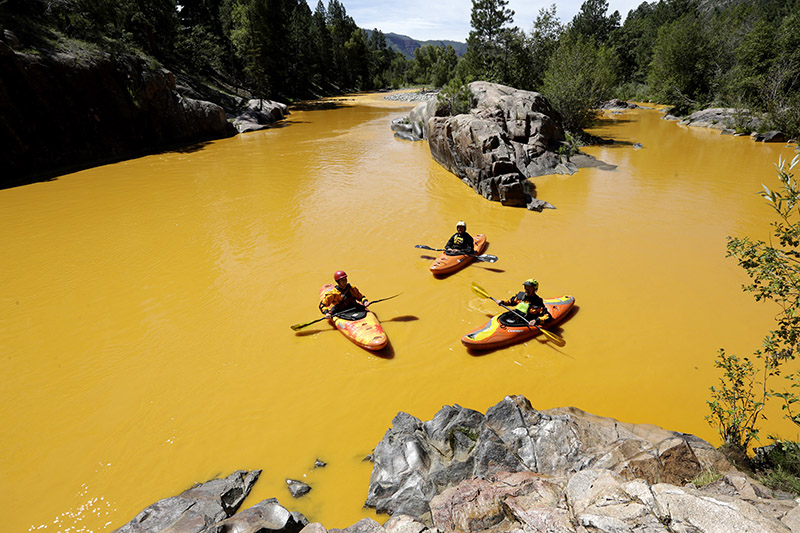
Caption: People kayak in Colorado’s Animas River, which turned orange after the disastrous 2015 Gold King sulfide mine spill released millions of gallons of toxic wastewater into it. Photo by Jerry McBride/The Durango Herald via AP
Plenty of examples exist confirming that sulfide mines can release pollutants for years after their closure. In fact, more than 40 percent of the streams in the western US are contaminated by acid mine drainage, according to the EPA. A disastrous 2015 spill from Colorado’s Gold King Mine, for example, released millions of gallons of acid mine drainage into Colorado’s Animas River, devastating nearby farmland and the Navajo Nation.
At the time of the spill, EPA contractors had been working to mitigate pollution from the mine, when they accidentally breached a containment dam inside it, sending cadmium, lead, arsenic, and other toxic elements into the river.
Here’s the kicker: The mine had been abandoned since 1923. While mining pollution controls have certainly improved since then, the Gold King disaster does show what's at stake if even those improved controls fail.
The Navajo Nation sued the EPA in August of 2016, demanding $160 million in compensation for damage to tribal lands, farms, cattle herds, and gardens. Senator John McCain (R-AZ) noted that the total economic impact on the Navajo from the spill could total $335 million. The EPA had accepted responsibility for the accident, but officials said it didn’t have to pay damages under “sovereign immunity” laws. The Navajo lawsuit is still pending.
Meanwhile, in Menominee, local activists fear what happened in Colorado and other sulfide mine sites could happen to them. They say Aquila is already trying to hide the potential environmental fallout from its plans for the Back Forty Mine, pointing to the fact that the company’s Michigan state permit applications state that the life of the mine [LOM] will be approximately seven years. But several Aquila press releases say that the mine will be operational for 16 years, meaning it will have more than twice the impact than what’s in the permit applications.
By minimizing LOM, the company can misrepresent the mine’s effects, says Gedicks. “Aquila is excluding half of all the potential impacts on water quality, air quality, and potential discharge of waste on site,” he says. “That deprives the public of the ability to understand what the impact of the mine would be. There’s effectively no transparency.”
While Aquila and the Michigan Department of Environmental Quality (DEQ) have made plenty of promises that the mine will adhere to “strict” environmental and water-quality regulations, the Menominee and other local activists have significant doubts. (Aquila did not respond to Green America requests for comment.)
The Power of Community
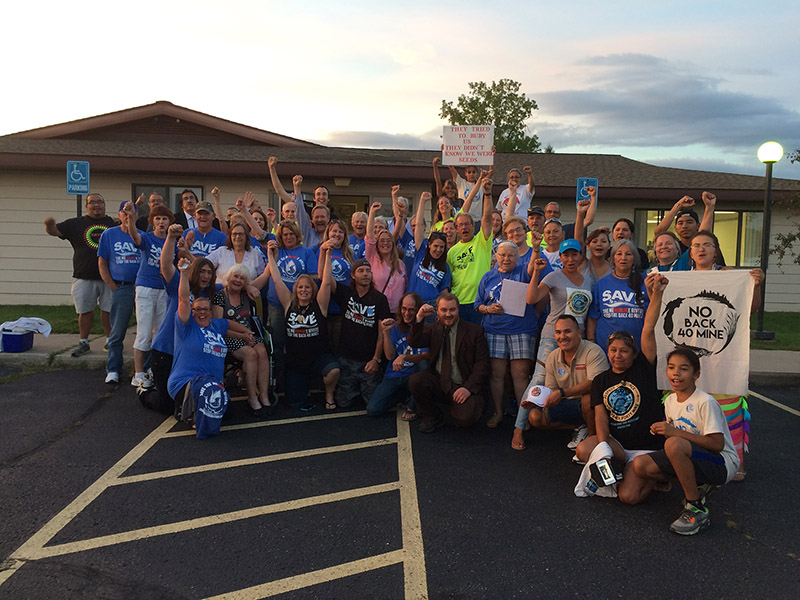
Caption: A coalition of Menominee Tribal members and residents of the towns near the Menominee River celebrate after the Menominee County Board passed a resolution opposing the Back Forty Mine in August. Photo via Andi Rich
Word of mouth travels quickly in North Woods communities. If you happen to move to the area, people will likely know your name, what kind of car you drive, and where you live before you even lay eyes on them for the first time. Those lines of small-town communication have been critical to spreading the word about the potential impacts of the mine. Community activist Andi Rich is the owner of Hammer Construction in Marinette, WI. At first, she says, she was concerned about the environmental impacts of the mine. But then she realized it might also affect her business.
“We do home improvement, which a lot of people use home equity loans to finance,” she says. “If this mine goes through, it’s a ticking time bomb on Marinette’s water supply. And if I was looking at buying a house in Marinette, and there’s a mine going in, I’m not going to buy a house anymore. Who’s going to want to move here? Home equity is going to disappear in the entire city.”
Not to mention the impacts on fishing families, fly-fishing guides, boat and kayak rental outlets, outdoor equipment stores, and other businesses that rely on North Woods tourism, she says.
So Rich went to a meeting of local citizens who were concerned about the mine. She found it “enthusiastic but not very organized,” so she started asking herself what she could do to help. She put in an order for some yard signs and brought about a dozen bearing the words “Save the Menominee River! Stop the Back Forty Mine!” to the next meeting. The signs vanished in a heartbeat, and Rich was bombarded with requests for more. So she ordered more.
And that’s how she became one of the people steering the citizen action group to Save the Menominee River. The group put up a public Facebook page and started organizing protests. Most take place in front of the Ogden Club, a bar and restaurant in Menominee, MI, owned by Aquila Resources’ communications manager Robin Quigley and former vice-president of exploration Tom Quigley. Aquila “rents” offices on the Ogden Club’s second floor.
The protests occur about twice a month. Group members also table local events, hand out fliers, speak at local schools, and turn out en masse in their “Save the River” shirts in local parades. They’ve urged a boycott of the Ogden Club and have pressed local city and county boards to adopt resolutions opposing the mine.
“Nobody I run into in daily life is for this mine,” says Rich.
It does indeed appear that Aquila has close to no social license for the mine. Community members say that business has dropped considerably at the Ogden Club because of the boycott. And when the Michigan DEQ held a public comment period on the mine permits, it generated over 2,000 comments against the mine, a full 98 percent of all comments. To date, four local towns and eight tribal governments have passed resolutions opposing the mine. In August, Menominee County, home to Aquila’s Upper Michigan offices, joined Green Bay’s Brown County and two others in passing similar resolutions. After their vote, the board had to wait several minutes for the cheering in the crowded room to quiet.
“Those Are Our Ancestors”
The Menominee Nation has worked closely with the Save the Menominee River group, providing the critical environmental justice voice to the mix.
When the Standing Rock Sioux put their bodies in front of the construction crews coming to place a stretch of the Dakota Access Pipeline on their traditional lands, their biggest concern was that the pipeline would desecrate the burial sites of their ancestors. The Menominee share a similar concern with one key difference: The Sioux strongly suspect their ancestors lay under DAPL’s path.
“We have actual physical proof,” says Reiter. “We have 22 ancestors that are literally right there on the mine site.”
Aquila claims that the mine will not disturb Menominee cultural resources—which it determined by conducting its own archaeological survey, rather than having an independent entity do so. The company did not consult with the Menominee Nation.
“They did a very limited archaeological survey where we weren’t included,” says Reiter. “They determined what was important, what was sacred, without us even being there. The quality of work they did was not up to the standards that we would do.”
His tone takes a sarcastic turn: “They were, of course, fortunate to be able to find the mounds that are eight feet tall in some areas, but they weren’t able to find others.”
Even so, Aquila’s survey did discover cultural sites within their project area, although not where the pit will be located, says Reiter. In fact, the University of Michigan had surveyed some of the archaeological sites and burial mounds on and near what is now the mine site back in the 1950s. It recently conducted testing of the bodies they excavated back then, and in February of this year, determined that they were indeed genetic ancestors of the Menominee. Those ancestors “came home” to the Menominee reservation in Keshena, WI, for reburial and tribal honors this summer.
In 48 states, it’s required by law—specifically, the National Historic Preservation Act—that companies get the free, prior, and informed Consent (FPIC) of Native Tribes before conducting development projects on their lands or archaeological sites. Unfortunately for the Menominee, Michigan is one of two states that are exempt from that law.
“The federal government has delegated the entire mine permitting authority to the Michigan government, and Michigan says they don’t have to consult with the Menominee Tribe,” says Gedicks. “If the mine had been located across the river in Wisconsin, [Aquila] never would have been able to get away with this nonsense.”
Aquila needed four permits from the Michigan DEQ to start digging the Back Forty pit. Despite the fact that the public is overwhelmingly opposed to the project, Aquila received the third permit in February. Now, the company is only a wetlands permit away from shovels hitting the ground. Reiter, Rich, and others know that time is running out, so they’re stepping up their efforts to stop the mine.
The Wisconsin Resources Protection Council and another local organization, Save the Wild UP, have sent letters to the Ontario Securities Commission, which is responsible for investment regulation in Canada, stating that the life-of-mine information Aquila sent to Michigan is fraudulent and a violation of securities regulations. The groups are also demanding that the DEQ deny the wetlands permit on the basis of this information.
If the DEQ approves the final permit, Reiter says that the Menominee are prepared to put their bodies between Aquila’s heavy machinery and the Menominee’s sacred traditional land.
“If it comes between standing machines and my ancestors, I’m going to do that, and gladly,” he says. “We, the Menominee, were given the responsibility to look after that river and land by the Creator thousands of years ago, and that supersedes any treaty or law. This Menominee River is a part of me; its essence is within my soul. There isn’t a Menominee Indian around who wouldn’t feel connected and unified standing next to the river while gazing on its sacred banks and water.”
Several community members will likely join them. But Rich hopes it won’t come to that: “[Support has] started growing rapidly in the last couple of months. More people are putting up signs. For the first time, I’m very hopeful we can stop this mine.”
UPDATE (2/19/2018): On January 22, 2018, the Menominee Nation filed a lawsuit in federal district court against the Army Corps of Engineers and the US EPA, claiming the agencies have failed to adequately review permits for the Back Forty mine.
The Menominee state in their lawsuit that the EPA and the Army Corps should have taken over the permitting process under Clean Water Act rules, rather than leaving oversight to the Michigan DEQ.
“The Menominee River and its wetlands are interstate federal waters, used in interstate commerce under the law. So under the law, this permit cannot be controlled by one state,” says Janette Brimmer, an Earthjustice lawyer who represents the tribe, in a statement. “The Clean Water Act is clear that the federal agencies must have the primary role and jurisdiction in this permitting process, and that they are legally obligated to comply with additional protections for the Menominee River under federal law.”
UPDATE (4/19/2018): On March 8th, the EPA and the Army Corps of Engineers sent a notice to the Michigan Department of Environmental Quality, stating that the agencies had questions about the wetlands permit for the Back Forty Mine. The letter cited several areas of concern over the mine's permit application, including that Aquila's application doesn't specify how the company plans to prevent the leaching of toxic compounds from the mine site, and how the company will protect the river during heavy rains.
The agencies gave the Michigan DEQ and Aquila 90 days from the date of the letter to adequately resolve the issues in the letter. If they cannot, permitting authority would transfer from the DEQ to the Army Corps.
Activists are hesitant to call the letter a victory, since even if the Army Corps takes over the permitting authority, it could still eventually grant the wetlands permit and pave the way for mine construction. However, they say that it does buy them more time to work to stop the mine.
Take Action
Aquila Resources is a publicly traded company on the Toronto Stock Exchange. The Wisconsin Resources Protection Council says that one of the most powerful things people can do is contact the companies funding mine to voice your opposition.
Sign Green America’s letter to the companies funding the Back Forty Mine—Orion Mine Finance, Hudbay Minerals, and Ruffer—telling them the mine has no community support and asking them to withdraw funding.
American Rivers is collecting signatures for a petition to the Michigan DEQ, asking it to deny Aquila’s last permit for the Back Forty Mine.
Keep informed about the Menominee Nation’s fight against the mine on their campaign website: NoBack40.org.
Support the Menominee Tribe’s GoFundMe campaign to crowdfund their legal opposition to the mine.
Header photo by Brian Benkowski. Read Benkowski’s article series, “Sacred Water: Environmental Justice in Indian Country,” at ehn.org/ehs/news/2016/tribal-series/sacred-water/.
|