
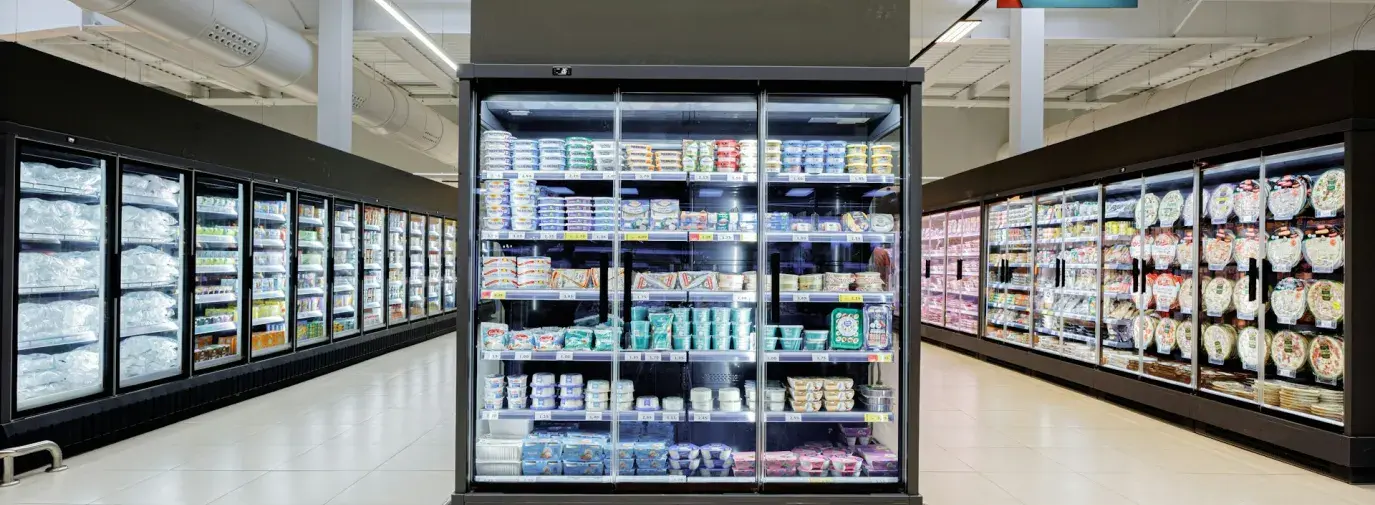
Green America investigates refrigerant leaks at major Sacramento supermarkets, revealing progress and ongoing climate pollution risks.
EXECUTIVE SUMMARY
Refrigerant leaks are major short-term drivers of climate change.
And as a major source of refrigerant leaks, supermarkets can’t afford to ignore how those leaks are their primary source of direct climate emissions.
Green America monitors refrigerant leaks from stores run by the country’s largest supermarket chains as part of our efforts to encourage these corporations to reduce their carbon footprints.
We recently revisited supermarkets in Sacramento, California, where we previously discovered refrigerant leaks that we reported to the corporate headquarters of supermarkets and to the California state regulator.
We found refrigerant leaks in 5 out of 11 stores in 2024, but in only 1 out of 11 stores in 2026.
In 2024, we found leaks at Albertsons/Safeway, Walmart, Kroger, and Save Mart stores.
In 2026, we only found a leak at 1 Walmart store. However, that one leak found in 2026 (20 ppm) was greater than any leak detected in 2024.
The reduction in leaks detected overall could have resulted from increased regulation of supermarkets, pressure from nonprofit organizations such as Green America, and/or supermarkets working to reduce expenses affiliated with refrigerant leaks.
Green America will continue to investigate leaks at grocery stores in locations around the country and provide reports on our findings.
INTRO
Refrigerants are essential to modern life, but the most common refrigerants are greenhouse gases called hydrofluorocarbons (HFCs), which intensify the climate crisis.
These harmful, human-made gases are leaking out of refrigeration systems and rapidly entering our atmosphere. As part of the crucial work of cutting CO2 emissions, we must also address dangerous, extremely potent HFCs.
Eliminating HFCs and adopting climate-friendly natural refrigerants like CO2, ammonia, or propane is a top solution to address the climate crisis that can prevent nearly half a degree of global warming. Natural refrigerants all have a very low global warming potential (GWP), meaning they contribute very little to climate change. Better cooling can help prevent 460 billion tons of greenhouse gas emissions in the coming years.
Supermarkets are major drivers of refrigerant pollutants. A typical supermarket consumes 4,000 pounds of refrigerants each year; a quarter of that amount regularly leaks out due to faulty systems.
Refrigerant leaks from US supermarkets emit 45 million metric tons of greenhouse gases every year—the equivalent of 9.5 million cars on the road.
To address this issue, Green America is calling on all supermarkets to commit to:
- Using only natural refrigerant (HFC-free systems) in all new locations;
- Releasing concrete timelines to phase out HFCs and transition to natural refrigerants in all stores and facilities by 2030;
- Not adopting HFO refrigerants being pushed as an alternative by chemical companies, which have a lower Global Warming Potential (GWP) than HFCs, but breakdown into PFAS chemicals when released to the environment;
- Rapidly repairing refrigerant leaks and publishing annual leak rates;
- And ensuring responsible refrigerant disposal to reduce emissions.
Preventing HFC refrigerants leaks in supermarkets is essential while we urge stores to adopt natural refrigerants as doing both helps protect our climate. But many supermarket chains continue to allow extensive refrigerant leaks.
FINDINGS
Green America staff visited 11 stores in Sacramento, California, in February 2026 and took three separate readings of potential refrigerant leaks at each store.
We visited the same 11 stores in July of 2024.
Overall, we found the rate of leaks decreased between 2024 and 2026 at the stores we visited, with most stores that had significant leaks in 2024 demonstrating no leaks in 2026.
| Total Number of Leaks Found | |||
| Company | Number of Individual Stores Visited | Number of Stores with Leaks in 2024 | Number of Stores with Leaks in 2026 |
| Albertsons/Safeway | 6 | 2 | 0 |
| Walmart | 2 | 1 | 1 |
| Kroger | 2 | 1 | 0 |
| Save Mart | 1 | 1 | 0 |
| Total | 11 | 5 | 1 |
| Largest Leak Found | ||
| Company | 2024 | 2026 |
| Albertsons/Safeway | 4 ppm | 0 ppm |
| Walmart | 12 ppm | 20 ppm |
| Kroger | 3 ppm | 0 ppm |
| Save Mart | 12 ppm | 0 ppm |
The Walmart store where we found a leak in 2026 is using R-407a refrigerant, an HFC refrigerant with a GWP of 2,107, while CO2 has a GWP of one. This means that every kilogram of R-407a refrigerant that leaks is equal to nearly two tons of leaked CO2.
INTERPRETATION
The number of leaks at the 11 stores decreased significantly between 2024 and 2026. We found a total of five leaks in 2024 and only found one leak at a single store in 2026, though that single leak is significant.
The decrease in leaks detected overall could be due to several factors:
1. Increased regulation by the federal government and State of California requiring improved refrigerant leak management may have pushed several major grocery chains to increase leak detection in their stores.
2. Advocacy by nonprofit organizations, including Green America, and consumers has put pressure on companies to increase their leak detection and better address refrigerant leaks. Several major grocery chains have documented that they are prioritizing refrigerant leak reductions in their corporate social responsibility (CSR) reports in recent years.
3. The average grocery store leaks 25% of its refrigerants each year, creating unnecessary expenses. Across the grocery sector, tightening refrigerant leaks can save the industry millions of dollars per year. Stores may be proactively addressing leaks to save money. A number of supermarket chains are instituting infrared leak detectors in stores to find and eliminate leaks more promptly.
4. Green America and allies reported leaks we found at stores in 2024 to their headquarters as well as to the California Air Resources Board (CARB), which regulates and investigates refrigerant leaks in the state. It is possible that these reports resulted in improved leak management at the specific stores we visited.
METHODOLOGY
We performed three separate tests of refrigerant leaks at each supermarket we investigated. The most recent testing was performed in February 2026. Prior testing was performed in July of 2024.
For a detected leak to be considered significant, it needed to exceed 2 ppm.
At the one supermarket where a leak was detected in 2026, three separate significant readings were obtained.
Different leak detectors were used in the 2024 and 2026 testing, but both have an accuracy of +/- 1 ppm.
In 2024, we employed the Bacharach PGM-IR Bagless Portable Refrigerant Monitor, which can detect over 60 different refrigerants, including various chlorofluorocarbons (CFCs), hydrochlorofluorocarbons (HCFCs), and HFCs. The machine compares the infrared (IR) signatures of the air sample to the preprogrammed signature for the selected refrigerant. The device has an accuracy of +/-1 ppm for most HFCs and +/-10 or +/-15% for HCFC-22
In 2026, we employed the Inficon D-TEK Stratus Refrigerant Leak Detector and Portable Monitor, which can detect all CFCs, HCFCs, HFCs, hydrofluoroolefins, blends and CO2. The Inficon D-TEK Stratus does not require the user to look for a specific refrigerant. Instead, the device references a library of IR signatures and outputs a ppm value if the intake matches any of the signatures in the reference library. The device has an accuracy of +/-1 ppm or 10% of its reading
REGULATION
Increased regulation of refrigerant leaks by the U.S. Environmental Protection Agency (EPA) and the State of California could play a role in reducing the number of leaks we detected in 2026. Supermarket chains may be anticipating the impacts of increased regulation and complying in advance.
The EPA’s HFC Management Rules came into effect on January 1, 2026, and require refrigerant management systems with a charge size of 15 pounds of refrigerants or greater to take proactive measures to address leaks and requires automatic leak detection on systems with a charge size of 1,500 pounds or greater. However, the current EPA has also proposed delays in the phase out of HFC refrigerants, which Green America opposes, since it will also delay replacing HFC refrigerants with natural refrigerants.
The CARB Refrigerant Management Program (RMP) has regulated refrigerant leaks since 2009 and “requires facilities with refrigeration systems containing more than 50 pounds of high-GWP refrigerant to conduct and report periodic leak inspections, promptly repair leaks; and keep service records on site.”
Failure to comply can result in significant penalties. CARB investigations of refrigerant leaks in supermarkets resulted in settlements of $1,014,125 with H-Mart and $1,592,500 with Save Mart respectively in 2024; over $5 million with Albertsons in 2021; and $60,000 with Walmart in 2021. These settlements may act as a deterrent. At the same time, with thousands of refrigerant systems statewide, increased resources for CARB enforcement of the RMP are likely needed to ensure greater compliance statewide.
In addition, California’s new Corporate GHG Disclosure Program will require any company with over $1 billion in revenue to report refrigerant leaks across all their locations. The penalty for missing or incorrect reporting can reach $500,000 annually.
NEXT STEPS
Green America will continue to investigate grocery store refrigerant leaks in California and other states to assess the leak rates of various supermarket chains and see if state regulation has had any impact.