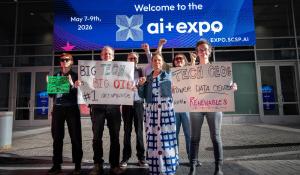

Meta claims to be building massive data centers across the country in a way that is sustainable and beneficial to communities.
The company spent over $6 million on ads trying to convince policymakers and the public that its data centers benefit communities, focused on a data center that it says is reviving Altoona, Iowa.
But the facts speak otherwise.
Meta’s All-Too-Real Impacts on the Ground
1. Meta’s Hyperion Data Center in Richland, Louisiana, is resulting in the fast-tracking of seven new gas power plants in addition to three gas plants that were already approved in 2025. This is despite extensive community pushbacks and a report from the Union of Concerned Scientists, documenting $90 billion in projected health and environmental damage from data center development in the state.
2. Meta’s data center in Newton County, Georgia, uses so much water that it’s causing local taps to run dry, and the county is estimated to run a water deficit by 2030.
3. Meta is proposing a 366 megawatt natural gas plant to run a data center in El Paso Texas despite local opposition.
And the reality in Altoona, Iowa, the town featured in Meta’s $6 million ad buy, is more complicated than the company lets on. Altoona is not the down-on-its-luck farm town the ad portrays, but a suburb of Des Moines. And a local opposition group, Warren County Citizen’s for Responsible Development, posted a lengthy takedown of Meta’s charm offensive with local leaders over water and energy use, and noise pollution.
The post concludes – “What’s being spun as “economic development” is actually a transfer of responsibility from corporations to citizens. What they built in Altoona should be a cautionary tale, not a blueprint.
Welcome to the Wild West of Data Infrastructure.”
Meta Needs to Change Course:
We are asking Meta to Build Smart, Build Clean
Data centers should go where they won’t harm communities. Many existing data centers create more noise, pollution, and congestion for underserved neighborhoods already dealing with unsafe and unhealthy conditions. Communities should be fully involved in the placement process to ensure everyone benefits from data center construction.
Put Efficiency First
Design AI programs to do more with less energy by taking advantage of the most efficient chips and processing.
Zero Fossil Fuels, No Nukes, Period
Every aspect of AI processing must run on clean energy—no coal, no gas, no nuclear. We don’t lack the right technology, and using renewable energy, with battery storage and Virtual Power Production (VPPs), can meet the needs for peak demand while lowering the cost of energy for your company and consumers.
Community Power
Listen to families living near proposed data centers and power sources and give them a say – some communities would agree to data centers and the revenues they can bring if those centers are designed to address noise and air pollution, utilize renewable energy, minimize water usage, and provide benefits to homeowners.
Transparency
Meta is building data centers without being fully transparent about issues like the electricity and water needed to run them. Your company has the opportunity to be a good neighbor and address the concerns of community members, starting with energy bills and water usage.
The investment Meta is making in developing data centers is in the billions. Meta needs to protect the communities it serves, and create benefit for the company, by ensuring it invests in powering AI with 100% renewable energy that creates community benefits.