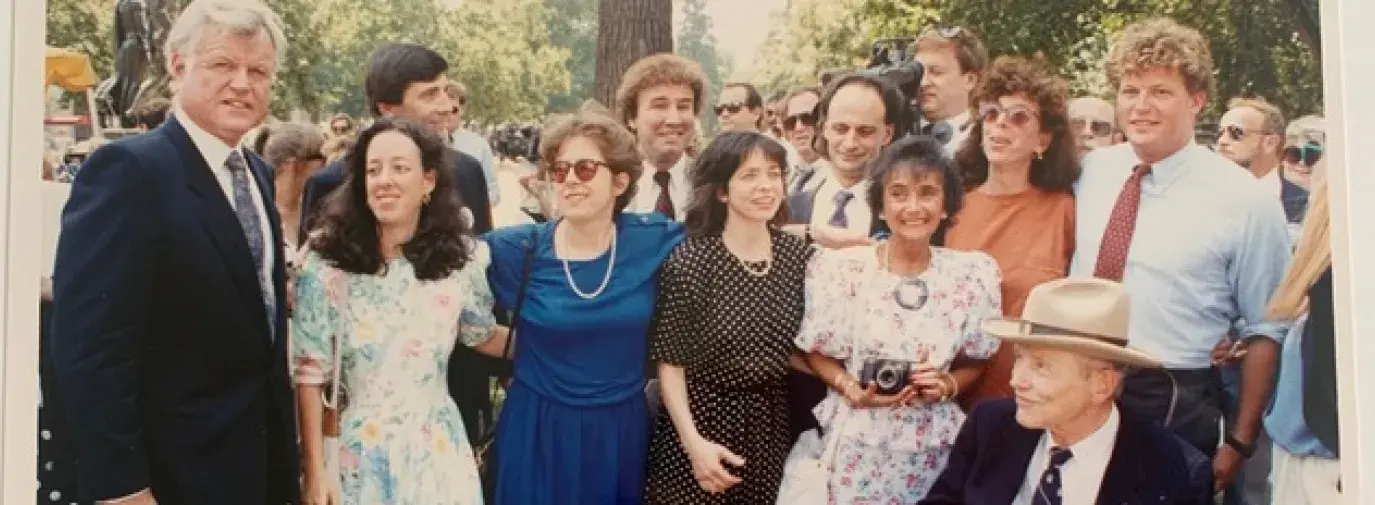
Karen Peltz Strauss has been a member of Green America since 2010. She has built a long career advocating for disability rights, particularly for the Deaf and hard of hearing community. She worked at Gallaudet University for over a decade, first providing services for low-income Deaf individuals before transitioning to national policy work on telecommunications access. She was appointed to the Federal Communications Commission during the Clinton administation, serving from 1999-2001, and then again during the Obama administration.
Strauss is the author of A New Civil Right: Telecommunications Equality for Deaf and Hard of Hearing Americans and continues to advocate for expanding closed captioning and audio description, collaborating closely with Deaf and Blind communities. Strauss spoke with Green America’s Executive Editor Michi Trota about how Green America’s work has impacted her life and the lives of her family, as well as her disability advocacy and concerns about the climate crisis and its impact on disabled communities.
This interview has been edited for length and clarity.
Michi Trota: You’ve said Green America is your “North Star on the environment and green living.” What have you found to be most valuable from those many years of membership?
Karen Peltz Strauss: The most valuable thing Green America has done for me has been to provide information and tips about ways I can live a greener, more sustainable life: the benefits of ESG investing, the value of starting a Climate Victory Garden (through your farming webinars), learning which chocolate manufacturers don’t rely on child labor, and the benefits of owning a Soda Stream, which, for our household has eliminated hundreds, if not thousands, of club soda bottles over the years.
On a more global level, I so appreciate Green America’s efforts and consumer campaigns to convince companies to engage in more sustainable practices, such as natural refrigerants in supermarkets, cleaner energy for businesses and data centers, reducing or eliminating the use of paper receipts or making these nontoxic, the removal of chemicals from children’s clothing, and the use of regenerative farming.
Trota: How has your understanding of what it means to “go green” evolved over the years? What are some of the most impactful “green” changes you’ve made in your everyday life?
Strauss: I marvel at all the changes I and my family have made over these many decades, several of which were introduced to us through Green America. Going green is now a central part of our daily lives.
We installed solar panels on our home, which supply all our electricity. We also purchased an electric stove and energy efficient appliances. We use water-saving showerheads and LED light bulbs.
When [our Toyota Prius] died a few months ago, we purchased a fully electric car and now charge it using the energy from our solar panels—an emission free vehicle! When in the city we generally take public transportation (or walk).
We switched to ESG investing and also use a credit union whose core mission is to help the community.
My diet is primarily plant-based, and we have three small [Climate Victory] gardens where we grow many types of vegetables, such as tomatoes, zucchini, peppers, and lettuce, and herbs. For the past three years we have composted all food scraps with our city and at the end of the year in return, the city gives us a 5-pound bag of compost, which we use in our gardens.
We minimize plastic use and recycle [and reuse] everything we can. Just before the pandemic, my husband and I cleared out a stack of old music CDs. But I couldn’t bear throwing away the plastic jewel cases that could not be recycled by our city. One day a post on our neighborhood listserv caught my eye: a local teacher was looking for these for her students’ art projects. It was very satisfying to see them go somewhere they’d be used and appreciated.
This past winter, D.C. went approximately four weeks without any trash pick-up because cold weather following a large snowstorm turned the alleys into mounds of ice, preventing garbage trucks from getting through. For us this didn’t matter. Because we recycle, compost, and reuse to such a great extent, we easily went the entire time with only a single trash bag.
Trota: You’ve built a career on disability advocacy, particularly focusing on working with the Deaf and hard of hearing communities. How have you seen climate change impact disabled communities?
Strauss: The ability to obtain emergency information, evacuate, and access transportation and emergency services can be significantly more challenging for people who are deaf, blind, or have mobility disabilities.
As the frequency of weather emergencies increases, so too does the importance of ensuring that disability communities have access to timely and accurate information through the same media sources that everyone else uses. This means that when a television station airs emergency broadcasts, it must provide closed captions so that people who are deaf and hard of hearing can read what the newscaster is saying. The station also needs to include audio description so that people who are blind can understand what is being shown on the screen.
It is particularly essential that these measures be taken in advance of extreme weather events so that people with disabilities can be informed how to effectively evacuate and take other precautions.
Much of my work has focused on partnering with nonprofit accessibility organizations and working at a federal agency to draft laws and regulations that ensure accessible communications for people with disabilities. These efforts have been successful in expanding access to 911, televised emergency programming, and mobile weather alerts. Yet significant gaps remain.
Currently, my colleagues and I are working to ensure that deaf individuals who rely on American Sign Language (ASL) can communicate directly with 911 call takers who are fluent in ASL. Today, most depend on video relay services, where sign language interpreters relay information back and forth between callers and emergency personnel. In highly stressful situations, this indirect communication can result in critical delays and errors. Direct video communication—already in use by the 988 Suicide and Crisis Lifeline—can provide a faster and more effective response for regional and local 911 centers with Internet capabilities.
On a related front, the World Institute on Disability is collaborating with organizations and local governments to strengthen emergency preparedness for people with disabilities through its Emergency, Disaster and Climate Resilience Services program.
Trota: You and your family share a passion for justice-oriented work, working in fields like criminal justice, complex energy law, and public defenders. What are some of the ways you bring “green living” into those pursuits?
Strauss: My husband and I both went to law school with a goal of finding legal careers that advance a more just and inclusive society. This is why the principles of Green America resonate so deeply with us. Just as equity and inclusion are foundational to Green America’s mission, so too are they central to the work we do.
My career has been devoted to ensuring the full inclusion of people with disabilities to ever-evolving communication technologies that are essential for independence and meaningful participation in employment, education, civic life, and recreation.
As an energy attorney, my husband works with cities, states, and consumer advocates to develop regulatory policies that promote reliable, affordable, and renewable energy sources, such as solar and wind. His work also includes ensuring that members of energy worker unions earn fair wages and have safe workplaces.
Trota: Having seen how Green America has evolved over the last quarter of a century, where do you hope the organization can go next?
Strauss: Continue doing the terrific job of helping people learn how to make their lives greener and urging companies to engage in more sustainable and equitable practices.
I hope that Green America takes new steps to include the voices of people with disabilities in its environmental initiatives. As Alisa Gravitz wrote in the Spring 2025 edition of Green America’s magazine, “[c]reating a truly sustainable future requires all voices at the table.”
Meier Galblum Haigh of Disability Culture Lab delivered a similar message when interviewed by GA in “Embracing a Diversity Perspective in DEI Work” in the same edition.
Trota: What is something that brings you joy in these difficult times?
Strauss: Spending time with my grandchildren always brings me joy. Playing games, sharing meals, reading together and cheering them on at sporting events and school performances is always a delight. I also find joy in the calm of a beach with my husband, especially at sunset. Last but not least, dancing makes me joyful!