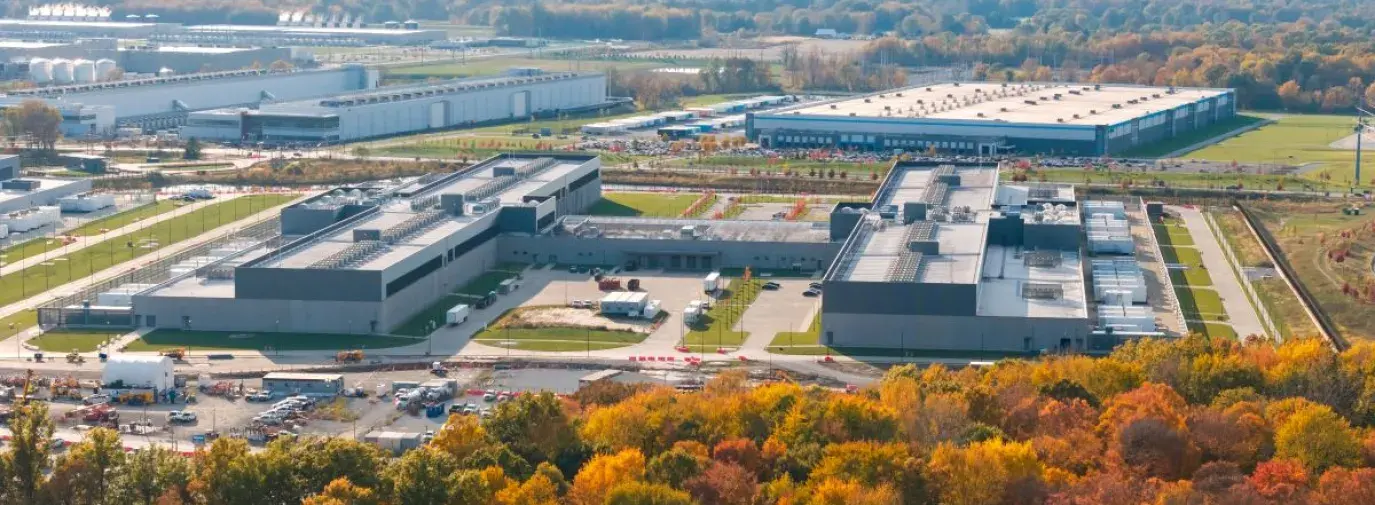
Despite the current U.S. economic downturn, there’s at least one sector that’s projecting significant growth in 2026: data center construction. According to a recent report by construction forecasting firm FMI Corp, data center construction is expected to rise by 23% in 2026, while more traditional areas such as office, warehouse, hotel, and apartment construction are slowing down. And as mega corporations like Amazon, Google, and Meta continue to increase their demands for hyperscaled processing facilities, they’re running roughshod over everyday communities, many of which are already struggling with access to reliable energy, clean water, and uncontaminated environments.
“Between the local air and water pollution to the effects of climate change being made worse by fossil fuels for data centers, there is much to lose for communities everywhere,” says Green America’s Climate Campaigns Director Dan Howells.
The boom in data center construction isn’t happening without help. Private investments and state tax incentives are fueling development while the current administration has asserted its desire to prioritize “facilitat[ing] the rapid and efficient buildout of this [data center] infrastructure by easing Federal regulatory burdens.”
Meanwhile, it’s the people who will have to live by those data centers who are paying outsized costs in diverted municipal resources and funds. It’s public tax dollars that are spent to build the roads and other infrastructure that privately-owned data centers need to operate, rather than facilities and improvements that benefit and are accessible to everyone. Additionally, the presence of data centers in a community can lead to rising electricity costs for the surrounding regions due to power demands—people have seen up to a 30-40% increase in their utility bills.
And when developers approach city and municipal officials, many people don’t find out there’s a data center coming to their neighborhood until after construction is well underway. Sadly, it’s not uncommon for companies to get non-disclosure agreements signed with local officials, cutting communities out of development discussions entirely.
“We have heard this happening again and again across the country,” says Howells. “This is leaving communities in the dark about the resources needed for data centers.”
The current model of data center construction benefits tech corporations at the expense of the communities forced to house them. But that approach rests on the assumption that communities aren’t capable of fighting back. In fact, Data Center Watch notes that community opposition over the last two years has resulted in the cancellation of $64 billion in data center development across the continental U.S.
As we’ve seen time and again, coordinated, collective action can be a powerful tool for communities to ensure their best interests aren’t overlooked in the corporate rush for profit and exploitation.
Data Centers Aren’t A New Problem, But They’re Now Much Worse
Over a decade ago, data centers already required immense amounts of energy to power cloud computing and storage needs. In response, Green America launched a campaign to demand that Amazon commit to powering its data centers on 100% renewable energy sources instead of driving up the demand for fossil fuels and other polluting sources contributing to greenhouse gases and climate change. Thanks to collective efforts from our members and partners, that campaign succeeded in pushing Amazon Web Services (AWS) to reach 100% renewable energy in 2023.
But now that tech companies are going all-in on their campaigns to normalize generative AI use by the general public, data center proliferation has gone into overdrive. There are nearly 4,000 existing data centers in the U.S., with another 3000 planned or in development. Developers and tech companies insist this rapid expansion isn’t just necessary for the country to remain technologically competitive, it’s also beneficial to communities. Public opposition to data centers are repeatedly met with claims of boosting the job market and increasing business opportunities and revenue. However, the reality is much less rosy.
“It is still very early in the build out of many of these data centers, but early analysis is showing very little job benefits,” says Howells. In the meantime, communities are finding themselves facing water shortages, spiking electric bills, growing heat islands, noise pollution, and air pollution from backup diesel generators.
For many, it’s now a question of “when” they’ll have to confront the possibility of data center construction in their hometown. And while the prospect of going up against tech giants may feel intimidating, it’s also an opportunity to strengthen connections with your neighbors and elected officials to ensure that any development plans work for your community’s benefit, not at your expense.
Community Bonds Can Provide Important Checks on Corporate Pressures
Data centers are issues of concern to communities nationwide, regardless of political leanings, because people are experiencing the impacts of their development in material ways. Economic experts have pointed to the importance of transparency, community protections, and broader planning for evolving utility requirements, especially with the possibility that communities may end up with not just one, but multiple hyperscaled data centers.
While tightened regulations and repealing generous tax incentives would certainly help, those changes take time to go into effect—assuming they’re able to pass. By contrast, community partnerships offer the chance for people to directly advocate for their concerns and needs with local officials, developers, and tech companies. Community-oriented approaches to development have become increasingly common in recent decades, particularly in response to growing public concerns about environmental and economic impacts that often leave communities bearing the brunt of unexpected and undisclosed costs.
Howells notes how concerns about data centers negatively impacting communities are reflected in both conservative- and progressive-leaning districts. Regardless of political leanings, more and more people are showing up en masse at local government meetings to demand accountability for themselves and their neighbors. In many communities, opposition to data centers presents an opportunity for expanded coalition-building and collective pressure on officials who need their constituents’ votes.
“When individuals build on that to work together, it makes it harder for policymakers and companies to ignore community input or opposition,” says Howells.
Prioritizing a community’s needs is what underpins Green America’s AI Data Center campaign, which rests on two main components: For communities that do not want data center, it provides an action plan to stop them from being built; for communities that are open to data centers, it offers a community partnership model to follow for making sure that the data centers are using only renewable energy and meeting community needs at no cost to taxpayers or increase in electricity costs.
That model was initially created in response to proposed data center facilities in Prince George County, Maryland. Now freely available as a guide for any community facing data center incursions, the model lays out how data center development doesn’t have to inherently mean choosing between economic growth, revenue generation, and jobs, or environmental protection, community health, and clean energy—corporations can, and should, choose to do both. For instance, improvements in battery storage technology and expansion of renewable energy sources mean that communities don’t have to be hit with pollution and higher energy bills if they choose to allow data centers to be built.
“If a community is open to a data center, they can work together to ensure data centers bring benefits like local jobs, protection from increased energy bills, tax income for the community, and more,” says Howells.
He also points out how these partnerships are a chance for companies to create real foundations for good will and community buy-in—if they actually choose to listen and act on what communities say make for good, long-term neighbors.
Considering the public’s growing opposition to expansive data center development, community partnership approaches should appeal to tech corporations, developers, and local government. At least 14 states are currently considering legislation to ban data center development and a recent Gallup poll noted that seven in 10 Americans oppose local construction of AI data centers.
If tech companies continue to insist that data centers be treated as essential to our national infrastructure and economy, they must prioritize the needs and perspectives of the communities they operate in.